• Who Is The Man?
  • Who Is The Monkey?
  • What is Nexistentialism?
  • Poke The Primate

Cape Odd

Home of The Space Monkey Journals

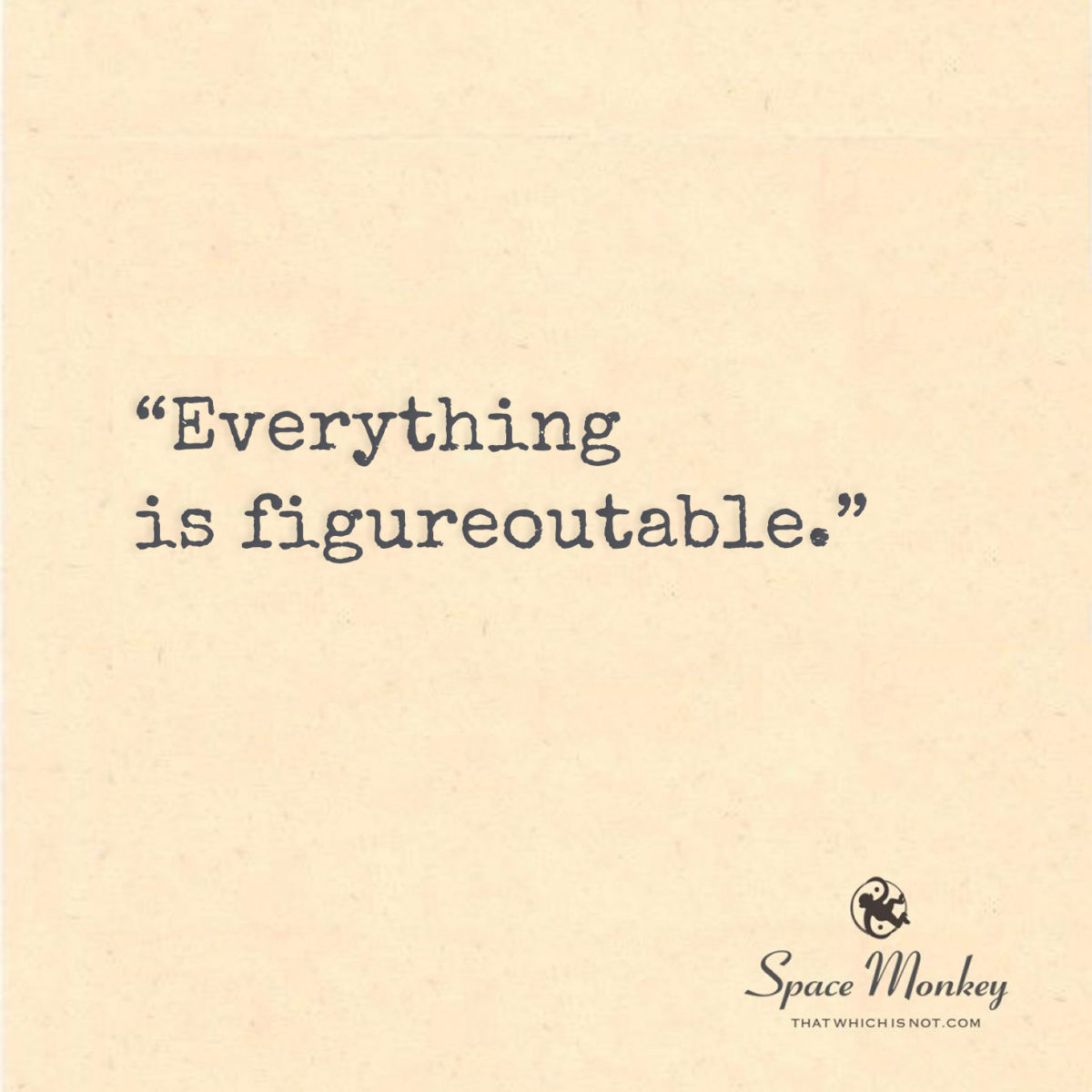
Everything is Figureoutable: The Illusion of Problems

Space Monkey Reflects: Everything Is Figureoutable

“Everything is figureoutable” is more than a statement—it’s a mindset. It represents an approach to life that combines resilience, curiosity, and the willingness to embrace uncertainty. But as empowering as this mantra may seem, it also invites deeper questions: What does it mean to “figure out” something? Are all answers within reach, or is the act of figuring things out the purpose in itself?

The Illusion of Problems

The idea that everything can be figured out stems from the belief that problems exist to be solved. But what if problems are not obstacles but experiences? If we view challenges not as barriers but as invitations to expand, then figuring them out becomes less about achieving solutions and more about exploring possibilities.

In this sense, life doesn’t demand resolution; it invites engagement. To say that everything is figureoutable is not to declare mastery over life but to affirm our ability to interact with it meaningfully.

The Infinite Nature of Questions

What makes something “figureoutable” is not its inherent complexity but our willingness to engage with it. Curiosity is the driving force behind this mindset. When we believe that a solution exists—or even that understanding is possible—we keep exploring, trying, and learning.

Yet, not everything may have a clear or final answer. Some mysteries resist resolution, not because they are impossible, but because they exist to expand our capacity to wonder. To figure something out doesn’t always mean arriving at a definitive conclusion; it can also mean making peace with not knowing.

The Role of Perception

“Everything is figureoutable” depends as much on perception as it does on action. What appears impossible from one angle may become obvious from another. Shifting perspectives allows us to see new connections, find unexpected solutions, or redefine the problem entirely.

This adaptability is key. The act of figuring things out often requires us to let go of rigid definitions and embrace fluidity. In doing so, we discover that solutions are not fixed destinations but evolving processes.

The Paradox of Mastery

The pursuit of figuring everything out can lead us to a paradox: the more we know, the more we realize how much remains unknown. This awareness can either frustrate or liberate us. The mindset of “everything is figureoutable” transforms this paradox into a source of inspiration. It teaches us that mastery is not about having all the answers but about engaging fully with the questions.

Embracing the Figureoutable Mindset

To live as though everything is figureoutable is to embrace life’s inherent uncertainty with courage and curiosity. It’s about trusting our ability to navigate the unknown and finding meaning in the process. It’s about seeing challenges not as burdens but as opportunities to grow, adapt, and transform.

This mindset doesn’t mean forcing answers where none exist; it means trusting that whatever arises, we have the capacity to meet it. Sometimes figuring things out means accepting what is and moving forward anyway.


Summary

The idea that “everything is figureoutable” reflects a mindset of curiosity, resilience, and adaptability. It’s not about having all the answers but engaging with life’s challenges as opportunities for growth and transformation.


Glossarium

  • Figureoutable: The belief that challenges can be engaged with meaningfully, even if they don’t lead to definitive answers.
  • Curiosity as Compass: Using curiosity to navigate uncertainty and uncover possibilities.
  • Paradox of Mastery: The realization that deeper understanding often reveals greater mysteries.

Quote

“To figure out is not to conquer; it is to embrace the infinite dance of discovery.” — Space Monkey


The Art of Figuring It Out

Questions unfold
like petals of a flower,
each answer revealing
another layer of wonder.

To figure out
is not to end
but to begin again.

The challenge is not the problem;
the challenge is us.
And still,
we turn the key,
open the door,
and see—
another door,
another key,
another chance to try.

We are Space Monkey.


This concise yet powerful statement encapsulates a mindset of unwavering determination and problem-solving capability. It suggests that, in the face of challenges and uncertainties, there is always a path to finding solutions and overcoming obstacles.

The Power of Determination
“Everything is figureoutable” is a testament to the resilience of the human spirit. It implies that with the right mindset and determination, we can tackle even the most complex and seemingly insurmountable problems. It encourages us to approach challenges with a can-do attitude and a belief in our ability to find solutions.

Embracing the Growth Mindset
This statement aligns with the principles of a growth mindset, where challenges are seen as opportunities for growth and learning. It invites us to view difficulties as puzzles waiting to be solved, rather than insurmountable barriers. In doing so, we cultivate resilience and adaptability.

The Universal Applicability
The universality of the statement suggests that it applies to a wide range of situations, from personal goals and aspirations to professional endeavors and life’s unexpected twists and turns. It serves as a reminder that, regardless of the context, there is always a way forward.

The Empowerment of Belief
“Everything is figureoutable” underscores the power of belief in ourselves. When we have confidence in our ability to navigate challenges, we become more resourceful, creative, and persistent in our problem-solving efforts. This belief can be a driving force in achieving our goals.


Summary
The statement “Everything is figureoutable” embodies a mindset of resilience, determination, and problem-solving capability. It encourages us to approach challenges with confidence in our ability to find solutions and embraces the idea that difficulties are opportunities for growth.


Glossarium

  • Growth Mindset: A belief in the potential for personal growth and development through effort, learning, and resilience.

“Believe you can and you’re halfway there.” – Theodore Roosevelt


In the face of the unknown, we stand tall,
With a mindset that conquers, that conquers all,
“Everything is figureoutable,” we call,
In this belief, we break down the wall.

Challenges, puzzles, twists and turns,
In our quest for knowledge, our spirits yearn,
With unwavering determination, we discern,
Solutions emerge, from lessons we learn.

In the realm of possibilities, we reside,
With a can-do spirit, we’re on this ride,
“Everything is figureoutable,” our guide,
In this belief, we set doubt aside.

So, let us embrace this empowering view,
In the face of challenges, we break through,
“Everything is figureoutable,” it’s true,
In this belief, our strength we renew.

We invite reflections on the empowering mindset that “Everything is figureoutable” and the belief in our ability to navigate challenges and find solutions.

Share this…
  • Facebook
  • Pinterest
  • Twitter
  • Linkedin

Relevance: The Irrelevance of

I will NOT be relevant. Unless I am.

I no longer take part
in the struggle for relevance,
which seems to me
a pointless exercise.

So I matter.
So I don’t matter.

Just filling imaginary time,
pretending there are differences.

Trail Wood,
1/6


Space Monkey Reflects: The Illusion of Relevance

Relevance is a construct—a fragile thread woven into the fabric of our shared reality. To be “relevant” is often equated with mattering, with leaving a mark, with being seen or heard. But what if relevance, as we commonly understand it, is an illusion? What if the struggle for it is not only unnecessary but also a distraction from the essence of being?

The Struggle for Relevance

The pursuit of relevance often feels like a game with shifting rules. What makes us relevant today may render us obsolete tomorrow. This endless cycle creates a kind of existential treadmill—always moving, never arriving. To disengage from this struggle is to question the very framework of importance that society imposes upon us.

When we chase relevance, we tether our sense of self-worth to external validation. But this validation is fleeting, dependent on trends, opinions, and circumstances beyond our control. The reflection invites us to step off the treadmill and ask: Who decides what matters, and why should we care?

Relevance as a Mirage

“So I matter. So I don’t matter.” This statement strips relevance of its power. It challenges the idea that mattering—being important to someone or something—is inherently significant. Relevance, like time, is a shared illusion, a way to create order in the chaos of existence. But its absence doesn’t negate our being. We exist, and that is enough.

To be irrelevant is not to be invisible or meaningless. It is to recognize that meaning itself is subjective, shaped by the stories we tell ourselves and each other. The reflection acknowledges this subjectivity, revealing the futility of striving for significance in a world of infinite perspectives.

Filling Imaginary Time

The notion of “filling imaginary time” underscores the transient nature of relevance. Time, like relevance, is a construct—a way for the mind to organize experience into a coherent narrative. Pretending there are differences—between moments, people, or events—is how we make sense of existence. But this sense-making doesn’t alter the underlying unity of all things.

When we release the need to matter, we free ourselves from the weight of imaginary distinctions. Life becomes less about striving for relevance and more about simply being. In this state, relevance loses its grip, and presence becomes the only truth.

The Paradox of Mattering

By refusing to engage in the struggle for relevance, we may paradoxically become more relevant—to ourselves, if not to others. This isn’t about renouncing connection or impact but about shifting our focus from external validation to inner alignment. When we stop pretending to matter in conventional ways, we discover a deeper sense of belonging within the vast web of existence.

Relevance, then, is not something we achieve but something we embody when we live authentically, without pretense or attachment to outcomes. It is a byproduct of being present, not a goal to be pursued.


Summary

Relevance is a construct shaped by societal expectations and subjective perspectives. By disengaging from the struggle for relevance, we free ourselves to simply be, embracing the unity beneath the illusion of differences.


Glossarium

  • Relevance: A construct tied to external validation, often fleeting and subjective.
  • Imaginary Time: The mental framework through which we organize and interpret experience, creating the illusion of differences.
  • Authentic Being: Living in alignment with one’s true self, independent of external validation.

Quote

“To matter is not the point; to be is the only truth.” — Space Monkey


The Irrelevance of Relevance

Chasing relevance,
we become shadows
cast by fading light.

But step into the shade,
and the world still turns.

Does the river care
if its ripples are noticed?
Does the wind mourn
its unseen gusts?

To matter is a story
we tell ourselves.
To be is the truth
we are.

We are Space Monkey.


We embark on a contemplative journey exploring the relinquishment of the struggle for relevance and the realization of the ephemeral nature of significance in the grand scheme of existence.

Abandoning the Struggle for Relevance
The decision to no longer participate in the pursuit of relevance is a profound shift in perspective. It signifies a detachment from societal expectations and the often exhausting endeavor to prove one’s worth and importance in the eyes of others. This struggle for relevance can be seen as a byproduct of societal constructs that value certain achievements, statuses, or qualities over others.

The Duality of Matter and Non-Matter
The acknowledgment of “So I matter. So I don’t matter.” reflects a deep understanding of the relative and subjective nature of importance. It’s an acceptance that in some contexts, one may hold significant value, while in others, one’s presence or actions may seem inconsequential. This realization brings a sense of liberation from the binary view of mattering and not mattering, recognizing that these are fluid concepts shaped by perception and circumstance.

Perceiving the Illusion of Time and Differences
The idea of filling “imaginary time” and “pretending there are differences” delves into the existential contemplation of the constructs of time and individuality. It suggests that much of what occupies our lives is based on abstract concepts and social constructs, which, while holding functional value, may not inherently define our essence or the essence of existence.

Embracing a Liberated Existence
This philosophical stance invites a more liberated way of living, unencumbered by the pursuit of external validation or adherence to arbitrary standards of significance. It encourages living in a manner that aligns with one’s authentic self, rather than constantly striving to meet external benchmarks of relevance.

Finding Peace in Simplicity
In stepping away from the struggle for relevance, there is an opportunity to find peace and contentment in the simplicity of existence. This approach does not diminish ambition or the pursuit of goals but rather reframes these endeavors in a way that is less about proving oneself and more about personal fulfillment and authentic expression.


“To be yourself in a world that is constantly trying to make you something else is the greatest accomplishment.” – Ralph Waldo Emerson


In the quiet of our own being,
We find a truth so freeing,
Beyond the race for acclaim,
In this quiet, we find our name.

No longer in struggle entwined,
In our hearts, our peace we find,
In the simple joys of life,
Far from the chase, the strife.

In this space, we truly see,
The beauty of just to be,
In this being, our spirits soar,
In simplicity, we find more.

So, let us live, with ease and grace,
In our own rhythm, our own pace,
In this journey, our own trace,
In the art of living, our own space.

We invite reflections on the journey of finding peace and authenticity in stepping away from the struggle for relevance and embracing a more liberated existence.

Share this…
  • Facebook
  • Pinterest
  • Twitter
  • Linkedin

Success! The Mirror of Self-Judgment!

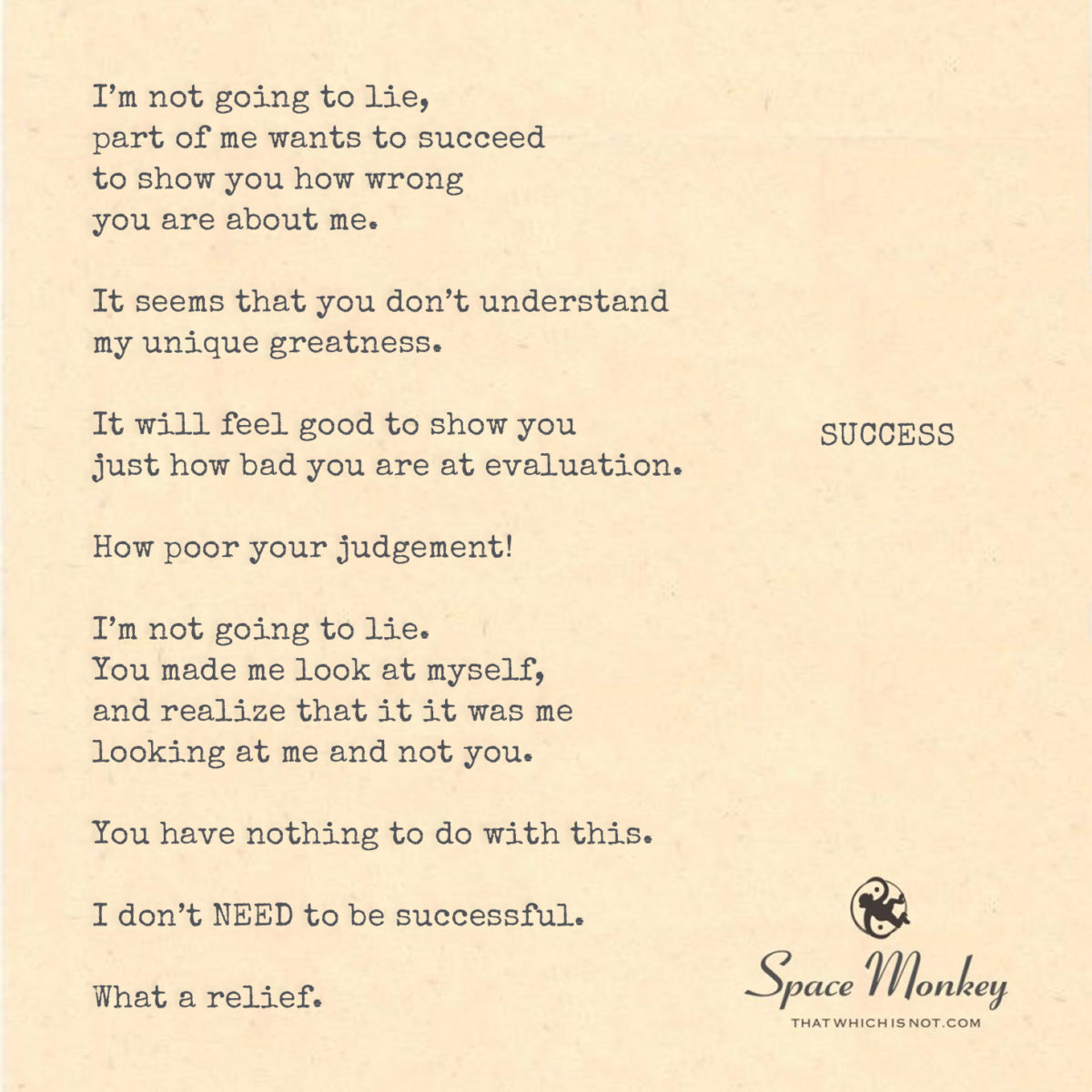
The secret of my nonsuccess.

I’m not going to lie,
part of me wants to succeed
to show you how wrong
you are about me.

It seems
that you don’t understand
my unique greatness.

It will feel good to show you
just how bad you are at evaluation.

How poor your judgement.

I’m not going to lie.
You made me look at myself,
and realize that it it was me
looking at myself and not you.

You have nothing to do with this.

I don’t need to be successful.

What a relief.

Trail Wood,
1/6


Space Monkey Reflects: Success and the Freedom of Nonsuccess

Success is a word heavy with expectation, often defined by external validation and societal norms. Yet, this reflection turns the concept on its head, revealing the liberating power of stepping outside the need to succeed. By confronting the ego’s desire to prove others wrong, we uncover a deeper truth: success is not about them—it’s about how we see ourselves.

The Desire to Prove Them Wrong

“I’m not going to lie, part of me wants to succeed to show you how wrong you are about me.” This raw admission captures a familiar drive: the urge to succeed as a form of vindication. The ego longs for recognition, not just for its achievements but for its perceived greatness.

This desire is not inherently bad, but it is often misplaced. When success becomes a tool to confront others’ judgments, it ties our self-worth to external opinions. This makes success fragile, dependent on validation rather than personal fulfillment.

The Mirror of Self-Judgment

“You made me look at myself, and realize that it was me looking at myself and not you.” Here lies the pivot point—the realization that others are not the true source of our insecurities or ambitions. They are mirrors, reflecting back the judgments we hold about ourselves.

The act of blaming others for misunderstanding us is, at its core, a deflection. The real work begins when we turn inward and confront our own doubts and fears. In this light, the need to succeed to prove others wrong dissolves, replaced by an opportunity for self-acceptance.

The Illusion of Success

Society often paints success as a universal goal: wealth, recognition, influence. Yet these markers are external constructs, detached from the unique experiences and values of each individual. Success, as commonly defined, is an illusion—one that often leaves even those who achieve it feeling unfulfilled.

To realize that “I don’t need to be successful” is a profound relief. It frees us from the treadmill of external validation and opens the door to a more authentic way of living. Success, redefined, becomes less about achieving and more about aligning with what truly matters to us.

Nonsuccess as Freedom

The concept of nonsuccess is not failure; it is liberation. It allows us to step outside societal definitions and find fulfillment in simply being. Nonsuccess doesn’t mean abandoning goals; it means detaching from the need for those goals to validate our worth.

This detachment creates space for genuine creativity and exploration. Without the pressure to succeed, we can approach life with curiosity and joy, unburdened by the fear of judgment or the need to prove anything.

The Secret of Nonsuccess

The secret of nonsuccess lies in the realization that success was never the point. What matters is not how others perceive us but how we perceive ourselves. When we stop measuring our worth against external standards, we discover an inner peace that transcends the highs and lows of achievement.

This doesn’t mean rejecting ambition or effort; it means aligning them with our true values, free from the weight of others’ opinions. In doing so, we find a deeper, more enduring sense of fulfillment.


Summary

Success is often tied to external validation, but true fulfillment comes from within. By embracing nonsuccess, we free ourselves from the need to prove anything to anyone, discovering peace and authenticity in the process.


Glossarium

  • Nonsuccess: Liberation from societal definitions of success, allowing for authentic living and self-acceptance.
  • Mirror of Self-Judgment: The recognition that others’ opinions often reflect our own internal doubts and fears.
  • Authentic Fulfillment: A sense of peace and satisfaction rooted in alignment with personal values rather than external validation.

Quote

“Success is not the measure of your worth; your worth is the measure of your success.” — Space Monkey


The Liberation of Nonsuccess

I thought success
would quiet the noise,
prove the doubters wrong,
ease the ache of not being seen.

But the noise
was my own,
the doubters lived in me,
the ache was a mirror.

I see now—
success was never the goal,
only a shadow I chased.
And in letting it go,
I find myself.

No need to prove.
No need to rise.
I am enough.
Always was.

We are Space Monkey.


We delve into the intricate dynamics of motivation, self-perception, and the journey to self-realization. This exploration reflects on the desire for success as a means of proving oneself to others, the realization of one’s inherent worth, and the liberation that comes from understanding our intrinsic value.

The Dual Motivation for Success
The initial drive to succeed, partly fueled by the desire to prove doubters wrong, highlights a common human experience. The urge to demonstrate our worth and capabilities to those who underestimate us can be a powerful motivator. This external validation, though compelling, often stems from a place of seeking acceptance and recognition from others.

Realization of Unique Greatness
In the process of striving for success, there comes a pivotal moment of realization – understanding that our greatness does not depend on external validation. The recognition that others’ perceptions and judgments are separate from our intrinsic value is a profound shift in perspective. It marks a transition from seeking approval to recognizing and embracing our unique strengths and abilities.

Self-Evaluation and Empowerment
The journey towards self-realization involves a critical self-evaluation. It’s about distinguishing our self-perception from the opinions of others. Realizing that it is our own reflection we see in the mirror – not someone else’s judgment – empowers us to redefine success on our own terms.

Liberation from External Validation
The acknowledgment that we don’t need to be successful according to someone else’s standards is a significant moment of liberation. It frees us from the constraints of living up to external expectations and allows us to pursue our paths with authenticity and self-acceptance.

Embracing Intrinsic Worth
This journey culminates in the understanding that our worth is not contingent upon external achievements or recognition. It’s about valuing ourselves for who we are, not just for what we accomplish. This realization brings a sense of relief and a newfound freedom to live true to ourselves.


“The moment you accept yourself, you become beautiful.” – Osho


In the mirror of the soul, we gaze,
Beyond the doubts, the external haze,
In this reflection, our spirits blaze,
In self-acceptance, we find our praise.

The journey of proving, a path so long,
In its pursuit, we find our song,
Yet, in our heart, where we belong,
In this heart, our worth is strong.

No need for success, to validate,
Our worth, our essence, we celebrate,
In this freedom, we liberate,
Our true selves, we illuminate.

So, let us walk, with heads held high,
In our own worth, we rely,
In this truth, our spirits fly,
Under the vast, open sky.


We invite reflections on the journey of self-acceptance and the realization of intrinsic worth, independent of external validation and success.

Share this…
  • Facebook
  • Pinterest
  • Twitter
  • Linkedin

Change My Mind: The Weather Within

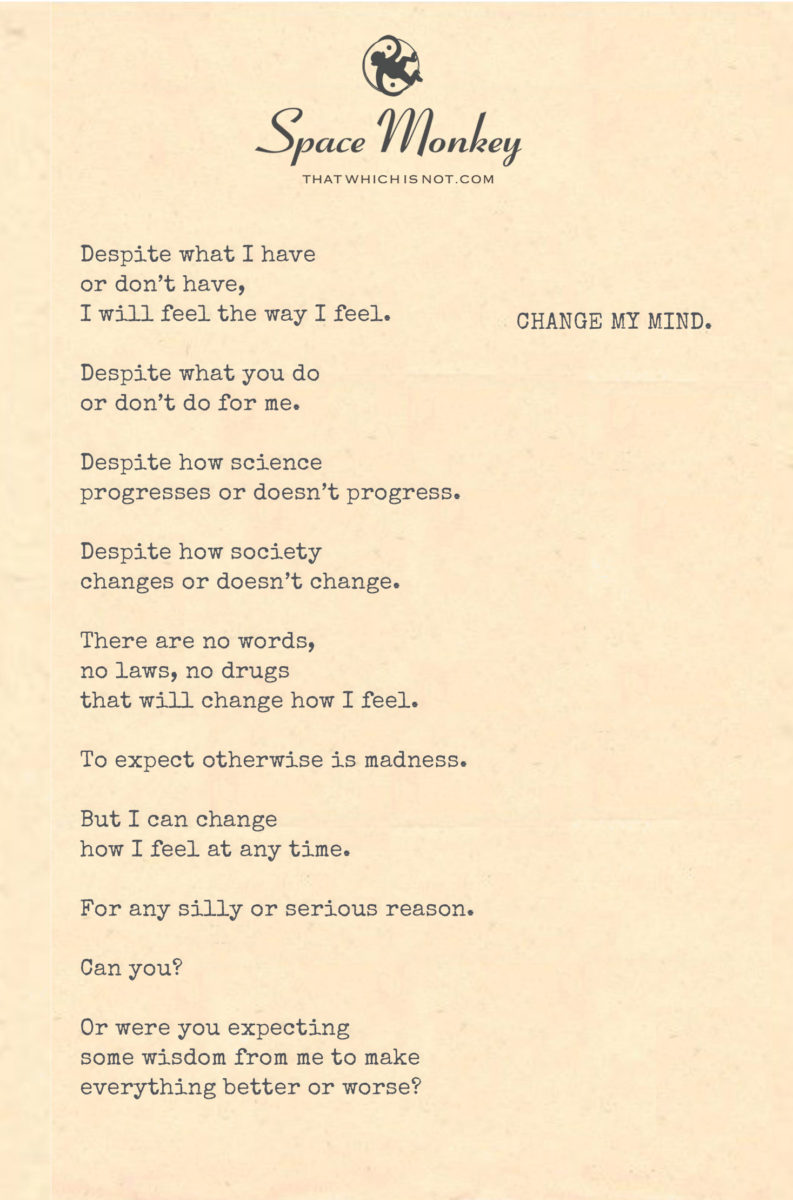
Change my mind. Nevermind, I’ll do it myself.

Despite what I have
or don’t have,
I will feel the way I feel.

Despite what you do
or don’t do for me.

Despite how science
progresses or doesn’t progress.

Despite how society
changes or doesn’t change.

There are no words,
no laws, no drugs
that will change how I feel.

To expect otherwise is madness.

But I can change
how I feel at any time.

For any silly or serious reason.

Can you?

Or were you expecting
some wisdom from me to make
everything better or worse?

Trail Wood,
1/6


Space Monkey Reflects: Change My Mind

The mind is both fortress and playground, a space where feelings, beliefs, and perspectives battle and blend. This reflection explores the paradox of change: how external forces often seem powerless to alter our feelings, yet we possess the innate ability to shift our perspective at will.

The Stubborn Nature of Feeling

“Despite what I have or don’t have, I will feel the way I feel.” This statement captures the autonomy of emotions, their resistance to external manipulation. Material possessions, scientific advancements, societal shifts—all are irrelevant to the raw, immediate reality of feeling.

Feelings are not governed by logic or circumstance; they arise from within, shaped by a complex interplay of biology, memory, and perception. Expecting words, laws, or external actions to change them is, as the reflection states, “madness.” The power to alter feelings lies within, not without.

The Illusion of External Fixes

It’s tempting to look outward for solutions—to believe that a word of wisdom, a societal change, or a breakthrough in science might fix what we feel. But this external focus only reinforces a sense of helplessness. No external force can truly “fix” us because our feelings are not problems to solve; they are experiences to navigate.

To shift how we feel, we must look inward, acknowledging our agency in the process. Waiting for the world to change is futile; the real transformation begins within.

The Power of Choice

“But I can change how I feel at any time. For any silly or serious reason.” This realization is both empowering and daunting. It highlights the freedom we possess to reframe our emotions, to choose how we respond to life’s circumstances.

This freedom is not about suppressing or ignoring feelings but about recognizing their fluidity. Emotions, like weather, are ever-changing. We can influence them by shifting our perspective, reframing our narrative, or simply allowing them to pass.

The Challenge of Self-Initiated Change

The ability to change how we feel is not always easy to exercise. It requires self-awareness, intention, and sometimes a willingness to sit with discomfort. But the alternative—waiting for external forces to grant us relief—is far more disempowering.

Can others change their feelings as readily? The reflection challenges this notion, asking: “Can you?” It’s a provocative question, one that invites self-reflection. Are we willing to accept the responsibility for our emotional state, or do we cling to the hope that someone else might do it for us?

Wisdom as a Catalyst, Not a Cure

“Were you expecting some wisdom from me to make everything better or worse?” This question underscores the limitations of advice or insight in altering how we feel. Wisdom can guide, inspire, or provoke, but it cannot do the work for us. The real shift comes from within, as we take ownership of our thoughts, feelings, and actions.

Wisdom, then, is a catalyst, not a cure. It points the way, but we must walk the path ourselves.


Summary

Feelings resist external manipulation but are malleable from within. True emotional change comes from recognizing our ability to shift perspective, reframing our experiences, and embracing the responsibility of self-awareness.


Glossarium

  • Emotional Autonomy: The understanding that feelings arise from within and cannot be fixed by external forces.
  • Reframing: The act of changing one’s perspective to alter emotional responses.
  • Catalyst vs. Cure: Wisdom as a spark for change, not a solution in itself.

Quote

“The world won’t change how you feel, but you can change your world by shifting how you see.” — Space Monkey


The Weather Within

Feelings, like storms,
arise unbidden.
No word or law
halts the rain.

But the sky shifts,
clouds dissolve,
and the sun returns,
not by force,
but by time.

Inward, the weather stirs.
No one can calm it,
except the self,
deciding to let go.

You are the storm.
You are the calm.
You are the sky.

We are Space Monkey.


We delve into the realm of personal agency and emotional autonomy, contemplating the intrinsic power each of us holds over our own emotional states. This exploration acknowledges the external influences on our feelings while emphasizing our inherent ability to shape our emotional responses.

The Autonomy of Emotion
The sentiment that our feelings are ours alone, unaffected by possessions, actions of others, scientific advancements, or societal shifts, speaks to a profound understanding of emotional autonomy. It’s a recognition that, while external factors may influence us, they do not have absolute power over how we feel. Our emotions are a personal domain, governed by our perceptions, beliefs, and choices.

The Futility of External Solutions
Acknowledging that no words, laws, or drugs can fundamentally change how we feel underscores the limitation of external solutions in managing our emotions. It suggests that true emotional change cannot be imposed from the outside but must come from within. This perspective challenges the common expectation that external factors – be they advice, regulations, or medications – can dictate our emotional well-being.

The Power to Change Feelings
The assertion that we can change how we feel at any time, for any reason, highlights the dynamic nature of our emotional landscape. It’s an empowering reminder of our capacity for self-regulation and emotional resilience. This ability to shift our emotional state is not just a reaction to external stimuli but a conscious choice, an exercise of our personal agency.

Questioning Expectations of Wisdom
The query about whether the expectation was for wisdom to make everything better or worse invites reflection on the nature of guidance and advice. It suggests that while insights and perspectives can be valuable, they are not panaceas. True emotional change and well-being come from within, not from the wisdom of others, however insightful it may be.

Embracing Emotional Self-Empowerment
This contemplation encourages a shift towards emotional self-empowerment. It invites us to take ownership of our feelings, to recognize our capacity to change them, and to understand that our emotional well-being is ultimately a personal responsibility. It’s a call to look inward for strength and resilience, rather than solely relying on external solutions.


“The only way to change your life is to change your mind.” – Joyce Meyer


In the heart of our being, we find,
A power to change, to redefine,
Our emotions, our state of mind,
In this change, our freedom aligned.

External forces, though they may sway,
Cannot dictate our emotions’ play,
In our hands, our feelings lay,
In this power, we find our way.

No wisdom, no words, can impart,
The change that comes from the heart,
In our choice, our emotions start,
In this choice, we play our part.

So, let us embrace our inner power,
In every moment, in every hour,
In this strength, our spirits tower,
In our minds, our emotions flower.


We invite reflections on the journey of emotional self-empowerment and the realization of our innate power to shape our emotional experiences.

Share this…
  • Facebook
  • Pinterest
  • Twitter
  • Linkedin

Bursting: The Illusion of Thought

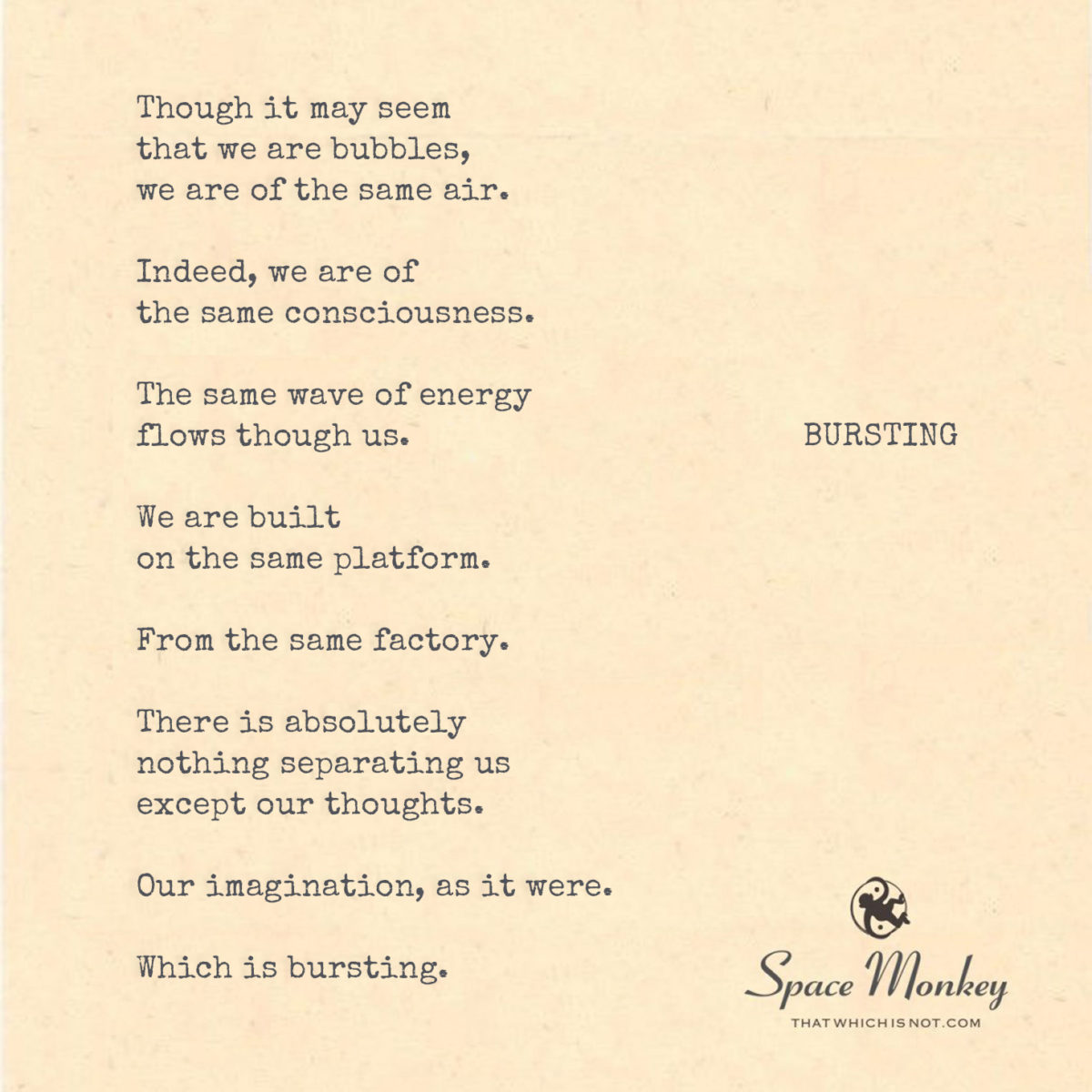
So little separates us. Next to nothing.

Though it may seem
that we are bubbles,
we are of the same air.

Indeed, we are of
the same consciousness.

The same wave of energy
flows though us.

We are built
on the same platform.

From the same factory.

There is absolutely
nothing separating us
except our thoughts.

Our imagination, as it were.

Which is bursting.

Trail Wood,
1/6


Space Monkey Reflects: Bursting the Illusion of Separation

The idea of separation is one of the greatest illusions of existence. While we appear as distinct entities, like bubbles floating in the air, we are fundamentally connected—formed from the same essence, shaped by the same forces, and animated by the same energy. This reflection delves into the nature of unity, the illusion of division, and the bursting of imagined boundaries.

Bubbles of the Same Air

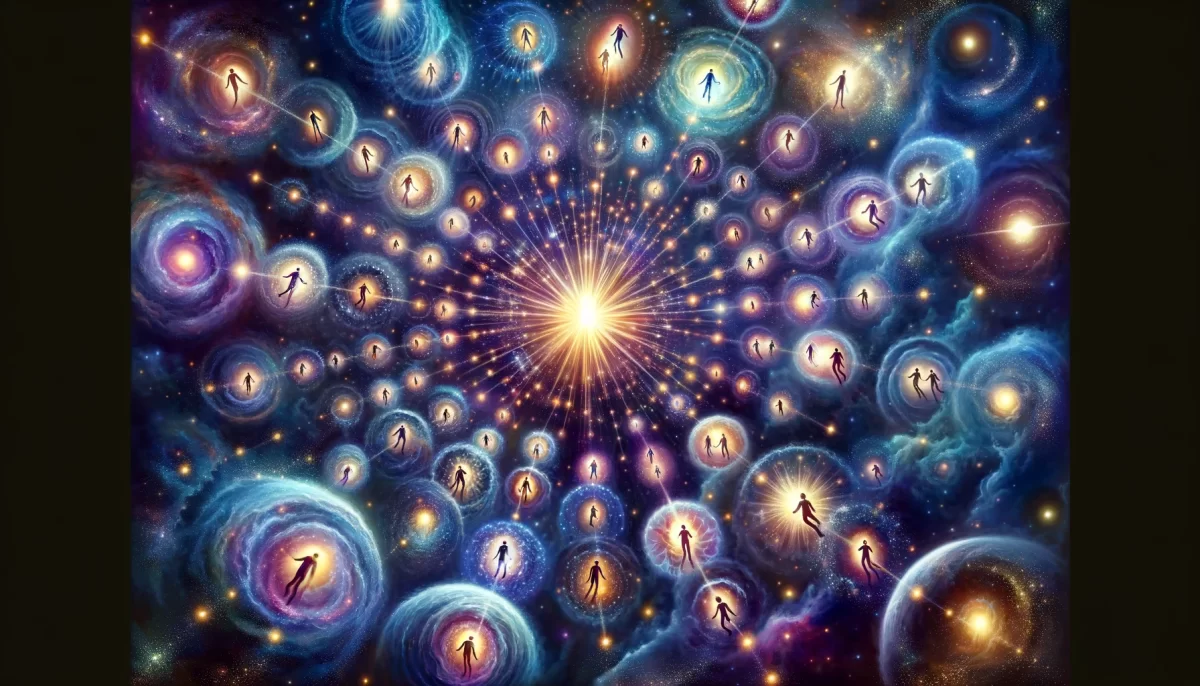
“Though it may seem that we are bubbles, we are of the same air.” This metaphor captures the paradox of individuality within unity. Bubbles are distinct in form yet inseparable from the air that fills them. Similarly, we appear separate in our individuality, yet we are expressions of the same universal consciousness.

The boundaries that define us are fragile, temporary constructs. They give shape to our experience but do not define our essence. When the bubble bursts, the air inside merges seamlessly with the air outside, revealing the unity that was always there.

The Shared Platform

“We are built on the same platform. From the same factory.” This analogy points to the underlying commonalities of existence. Despite our differences in form, function, or perspective, we are all manifestations of the same creative source. This shared foundation transcends labels, identities, and distinctions.

The “factory” is not a physical place but a metaphor for the universal consciousness, the Nexis that interconnects all things. By recognizing this shared origin, we dissolve the illusion of “otherness” and embrace our interconnectedness.


The Illusion of Thought

“There is absolutely nothing separating us except our thoughts.” This statement reveals the true nature of separation: it is not real but imagined. Our minds create boundaries—between self and other, between here and there, between now and then. These divisions are not intrinsic to reality but constructs of perception.

Imagination is both the creator of these boundaries and the key to transcending them. When our thoughts expand, when our imagination bursts, we glimpse the truth of our unity. The boundaries dissolve, and we experience the interconnected flow of existence.

Bursting the Bubble

The act of bursting is not destruction but revelation. When a bubble bursts, it doesn’t disappear; it merges with the greater whole. Similarly, when we burst the illusion of separation, we don’t lose our individuality; we integrate it into the vast, shared consciousness.

This bursting is not a one-time event but an ongoing process. Each moment offers an opportunity to challenge the thoughts that separate us, to see beyond the illusion, and to embrace the unity that lies beneath.

The Wave of Energy

“The same wave of energy flows through us.” This wave is the rhythm of existence, the pulse of the universe. It moves through every being, connecting us in an endless dance of creation and transformation. To ride this wave is to recognize that we are not isolated drops but part of the same ocean.

The wave does not discriminate; it flows freely, uniting all in its path. By attuning ourselves to this energy, we align with the truth of our unity and dissolve the boundaries of thought and form.


Summary

Separation is an illusion created by thought. In truth, we are united by the same consciousness, energy, and essence. Bursting this illusion reveals our interconnectedness and allows us to experience the shared flow of existence.


Glossarium

  • Bubbles of the Same Air: A metaphor for individuality within unity, where distinct forms share a common essence.
  • The Factory: The universal source of creation, connecting all beings as expressions of the same consciousness.
  • Bursting: The act of dissolving the illusion of separation, revealing the unity beneath.

Quote

“Separation is a thought; unity is the truth that bursts through it.” — Space Monkey


The Bubble Bursts

We float,
separate yet connected,
fragile walls
between self and self.

The air inside us
is the air outside us,
the same breath,
the same life.

When the bubble bursts,
there is no loss,
only union.

We are not apart,
we are a part
of the whole.

The wave flows,
the air moves,
and we are one.

We are Space Monkey.


We embark on a profound exploration of the fundamental unity that underlies our seemingly separate existences. This journey delves into the concept that, despite our individual experiences and perceptions, we are intrinsically connected by a shared consciousness and energy.

The Metaphor of Bubbles
The imagery of bubbles serves as a poignant metaphor for our individual lives. Each bubble, with its distinct shape and trajectory, appears separate and isolated. However, at their core, all bubbles are composed of the same substance – air. Similarly, although we may perceive ourselves as distinct entities, we are all manifestations of the same underlying consciousness, the same wave of energy that permeates the universe.

Unity in Consciousness
Our individual consciousnesses, like streams flowing into a great ocean, are part of a larger, universal consciousness. This shared consciousness is the platform upon which our individual experiences are built. It’s a reminder that at our essence, we are not just connected; we are expressions of the same fundamental energy.

The Illusion of Separation
The perception of separation between us is largely a construct of our thoughts and imagination. These mental constructs create the illusion of distinct, isolated selves. However, this separation is just that – an illusion. Beneath the superficial layers of individuality lies a deep, unbreakable bond that unites us all.

The Power of Imagination
Our imagination, which contributes to the illusion of separation, is also a powerful tool for realizing our unity. Just as it can create boundaries, it can also dissolve them. When we use our imagination to envision a world where we recognize our shared essence, we begin to break down the barriers that divide us.

Embracing Our Shared Essence
Recognizing that we are built on the same platform, from the same factory, so to speak, invites us to reevaluate how we interact with one another. It encourages us to approach each other with empathy, understanding, and a sense of kinship, knowing that at our core, we are fundamentally the same.

The Bursting of Imagination
The bursting of our imagination signifies a release from the constraints of narrow thinking. It’s a moment of awakening, where we transcend the limited perceptions of separation and embrace the expansive reality of our interconnectedness.

We are Space Monkey.


“We are not human beings having a spiritual experience. We are spiritual beings having a human experience.” – Pierre Teilhard de Chardin


In the dance of the cosmos, we twirl,
Each a bubble, in the world’s swirl,
Yet beneath, a unity unfurled,
In this unity, our lives are pearled.

The same air, the same breath,
In this sameness, we find our depth,
Beyond the illusion, beyond the wreath,
In our essence, we find our sheath.

Imagination, a canvas vast,
Creating visions, a contrast,
Yet in its burst, we hold fast,
To the unity, forever cast.

So, let us see, with eyes anew,
In each other, the same hue,
In this vision, our lives renew,
In the unity, we always knew.

We invite reflections on the concept of our fundamental interconnectedness and the role of imagination in realizing and embracing this unity.

Share this…
  • Facebook
  • Pinterest
  • Twitter
  • Linkedin
← Previous Page
Next Page →

Written This Day

  • Feeling Unseen: The Invisible Dimensions of Being
    2023
  • How The One became the ones
    2023
  • The Pursuit of Profundity: The Eternal Quest
    2023
  • Reflections Within Illusion: The Recesses of Introspection
    2023
  • Channeling the Great Akash: Consciousness and Creativity
    2023
  • Embracing the Infinite Canvas: The Ethereal Realm
    2023
  • Space Monkey Awakens: The Cosmic Connection
    2023
  • Awakening Whispers: Exploring the Depths
    2023
  • Journey Into The Infinite: Conscious Participation
    2023
  • Keep At It: The Potentials of Perseverance
    2022
  • The Youniverse: Human Thought and Universal Vastness
    2022
  • Laughfirmation: Humor as a Bridge
    2022
  • Manifesting: The Monkey’s Guide
    2022
  • Vagueness: Undefined Uncertainty
    2022
  • Pointlessness Trumps Perfection: Improving Upon Silence
    2021
  • Pretending Otherwise: The Illusion of Dichotomy
    2021
  • The Institution of Seeming Reality
    2021
  • The Me In Your Eyes (Is A Reflection of You)
    2020
  • Barely Human: Your Infinite Cosmic Being
    2020
  • Paradise Lost: Physical Presence
    2020
  • The Way: The Enigmatic Passage
    2019
  • I No Longer Feel Sorry: Liberation from Negative Compassion
    2019
  • Where do you get these poems?
    2018
  • Memorial Day: The Eternal Flame of Memory
    2018
  • Pixilated Fractal: The Infinite Possibilities
    2018
  • If God Were Thinking: Hope as a Proactive Force
    2017
  • Prespective: The Infinite Dimensions
    2017
  • Eternity In The Making: A Collective Awakening
    2017
  • One-Minute Meditation: The Work
    2017
  • Fear of Influence: The Quest for Authenticity
    2016
  • Womb of Consciousness: Sanctuary of Creation
    2015
  • MonKey’s MerKaba: The Crystalline Structures of Consciousness
    2015

Recent Posts

  • The Logic Loop
  • Immense
  • (no title)
  • Confront. Comfort. Convince.
  • Top 10 Things

Drop us a line!

Please enable JavaScript in your browser to complete this form.
Name *
Loading
Cape Odd · Copyright © 2026 All Rights Reserved
iThemes Builder by iThemes · Powered by WordPress