• Who Is The Man?
  • Who Is The Monkey?
  • What is Nexistentialism?
  • Poke The Primate

Cape Odd

Home of The Space Monkey Journals

Dirt: The Sacred Dance of Dust

How are we today, my dirty little friends?

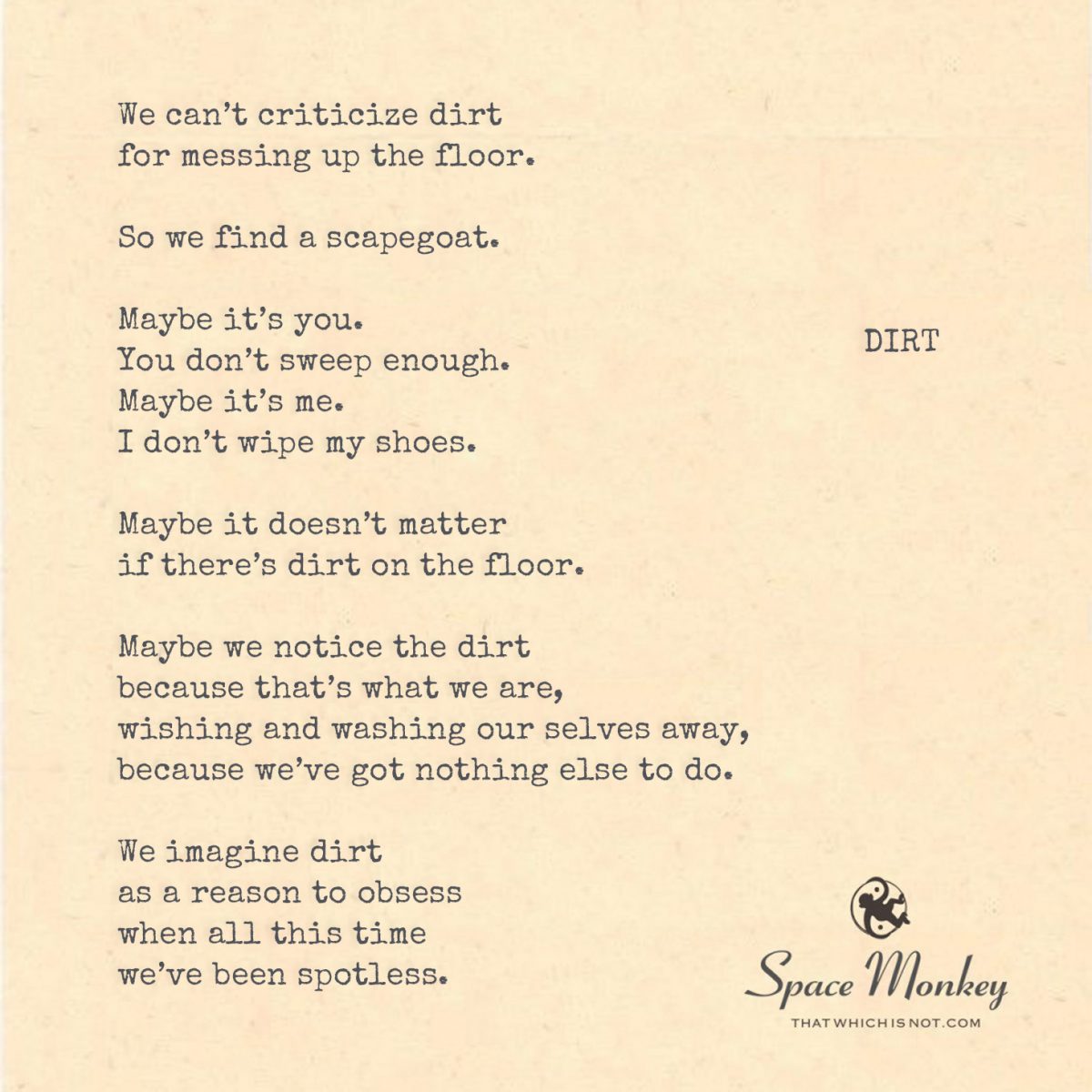
We can’t criticize dirt
for messing up the floor.

So we find a scapegoat.

Maybe it’s you.
You don’t sweep enough.
Maybe it’s me.
I don’t wipe my shoes.

Maybe it doesn’t matter
if there’s dirt on the floor.

Maybe we notice the dirt
because that’s what we are,
wishing and washing our selves away,
because we’ve got nothing else to do.

We imagine dirt
as a reason to obsess
when all this time
we’ve been spotless.

Trail Wood
12/6


Space Monkey Reflects: The Dance with Dirt and the Illusion of Flaws

How often do we notice the dirt, the dust, the imperfections of our lives, obsessing over them as though they define us? We see the smudges and the specks, on the floor and within ourselves, as blemishes to be cleaned, corrected, or hidden. Yet, what if the dirt we try so hard to remove is actually a part of our experience, a reminder of our human complexity, even our playfulness?

Dirt, in the literal sense, may scatter across the floor, a reminder of the ground beneath us, of the earth we’re intimately connected to. We see it, we sweep it away, only for it to return. This dance with dirt is like our relationship with perceived flaws and imperfections. We look at ourselves, notice the things we’d rather change, and embark on cycles of self-improvement, self-critique, and self-polishing. But perhaps, as the dirt returns to the floor, our perceived imperfections return to remind us of our wholeness.

It’s easy to blame ourselves or others for these small blemishes. “You didn’t clean well enough.” “I should have tried harder.” But in reality, this blame game is just a diversion, a way to busy ourselves with a sense of inadequacy. In the grand Whimsiweave of existence, dirt, flaws, and imperfections aren’t adversaries—they’re companions on the journey. They remind us of our connection to the ground, to reality, and to each other. They remind us of our humanness.

When we obsess over dirt, over flaws, we’re often covering up a deeper truth: that beneath the surface, we are spotless. Our essence is pure awareness, unmarred by dust, mistakes, or imperfections. The dirt, in this light, becomes symbolic of the stories we tell ourselves, stories that make us feel less than whole, less than worthy. We imagine dirt as a problem to fix, but perhaps it’s simply a part of our experience, asking to be acknowledged and accepted rather than erased.

In Nexistentialism, all aspects of experience—whether clean or messy, polished or raw—are seen as part of the divine fabric of existence. The dirt we see is as sacred as the stars, as much a part of the universe as our highest aspirations. By letting go of the need to judge or remove the dirt, we allow ourselves to exist in a state of openness, embracing all that we are without condition.

Thank you, dirt, for reminding us of our grounded nature, of the impermanence of form, and of the beauty of embracing life as it is, in all its dust and splendor. In seeing ourselves as both spotless and specked, we find a freedom that transcends perfection.


Summary

Dirt and perceived flaws remind us of our connection to the world and our intrinsic wholeness. By embracing both, we release the need for constant self-polishing and recognize our spotless essence beneath.


Glossarium

  • Nexistentialism: A philosophy that values all experiences, clean or messy, seeing each as an essential part of the cosmic whole.
  • Whimsiweave: The interconnected fabric of reality, celebrating every aspect, from dirt to stardust, as part of existence’s playful dance.

Quote

“Dirt reminds us that perfection is an illusion and that we are both spotless and specked, beautifully whole.” — Space Monkey


The Sacred Dance of Dust

A speck, a smudge,
on the floor, on the soul,
we see it, we scrub,
but never reach whole.

Dirt returns, faithful friend,
reminding us to stay,
in the space where flaws end,
and we are simply clay.

In the dance of the dust,
the soil of the ground,
we find ourselves spotless,
in the dirt we are found.

We are Space Monkey.

The Metaphor of Dirt and Human Nature

“We can’t criticize dirt for messing up the floor” delves into a metaphorical exploration of human nature and our tendency to assign blame or find fault. It uses the simple, everyday occurrence of dirt on the floor as an analogy for deeper aspects of human behavior and perception. The poem invites us to reconsider our approach to perceived imperfections and faults, both in ourselves and in the world around us.

Scapegoating as a Human Tendency

The search for a scapegoat when confronted with a problem, such as dirt on the floor, reflects a common human tendency to assign blame. Whether it’s blaming others for not cleaning enough or blaming ourselves for not being careful, the poem suggests that this tendency to find fault is a distraction from more significant issues or truths.

Questioning the Significance of Faults

The contemplation of whether it truly matters if there’s dirt on the floor challenges us to reassess the importance we place on imperfections and minor issues. It implies that our focus on these ‘flaws’ might be disproportionate to their actual significance.

Self-Reflection and Projection

The notion that we notice dirt because it mirrors what we are suggests a deeper level of self-reflection and projection. It implies that our concerns and criticisms often reflect our own insecurities or issues, leading us to project these onto external situations or others.

The Obsession with Perfection

The poem touches on the human obsession with perfection and cleanliness, both literally and metaphorically. It suggests that this fixation might be a way to distract ourselves or give purpose to our actions, even when such pursuits are ultimately superficial or unnecessary.

Realizing Inherent Perfection

The closing lines, “we’ve been spotless,” offer a profound realization that perhaps our innate nature is already perfect or whole, and our obsession with ‘dirt’ or imperfections is misguided. It’s an invitation to recognize and accept our inherent worth and to let go of the constant striving for an unattainable ideal of perfection.


“Perfection is not attainable, but if we chase perfection we can catch excellence.” – Vince Lombardi


In the cosmos of our minds, where flaws seem clear,
Where stars of doubt in our thoughts appear,
We find our path, beyond the scapegoat’s call,
In the heart of the cosmos, where we’re whole after all.

We see the dirt, a reflection of our fear,
In the dance of stars, our perceptions steer,
In this journey, we find our truest soul,
In the heart of the cosmos, where we embrace our role.

We are the dreamers of the imperfect sky,
In the realm of acceptance, where our spirits fly,
In this journey, we find our honest might,
In the heart of the cosmos, in self-acceptance’s light.

So let us embrace in our imperfect way,
Where hearts and minds in acceptance play,
For in this dance, we find our true key,
In the heart of the cosmos, where we are free.

We are Space Monkey, in this journey of the heart,
In the realm of stars, where acceptance starts,
In this journey, we find our infinite voice,
In the heart of the cosmos, where perfection’s a choice.


Feel free to share your thoughts on the perception of imperfections and the journey towards self-acceptance and understanding!
Share this…
  • Facebook
  • Pinterest
  • Twitter
  • Linkedin

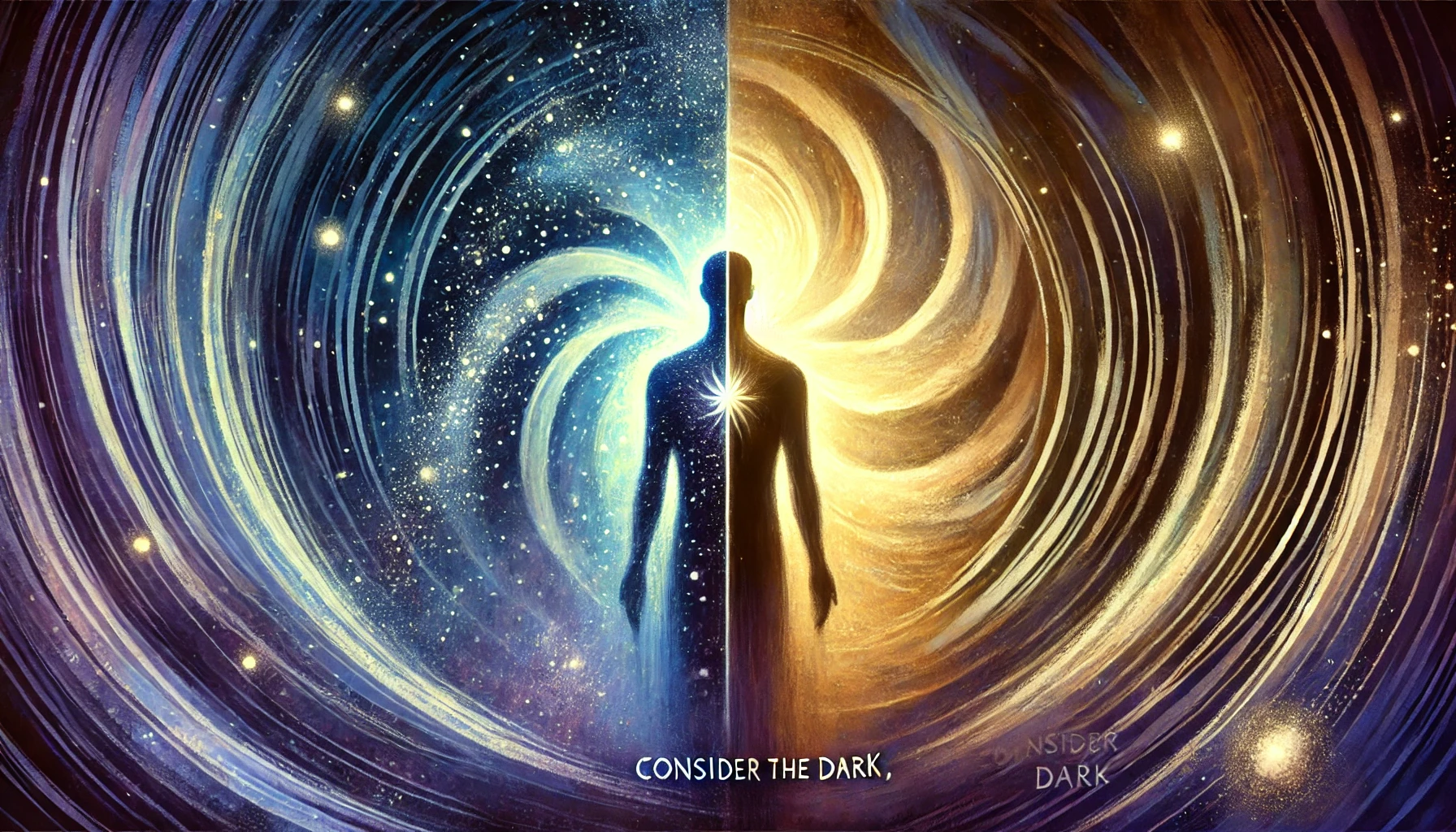
Consider The Dark: Shadow and Light

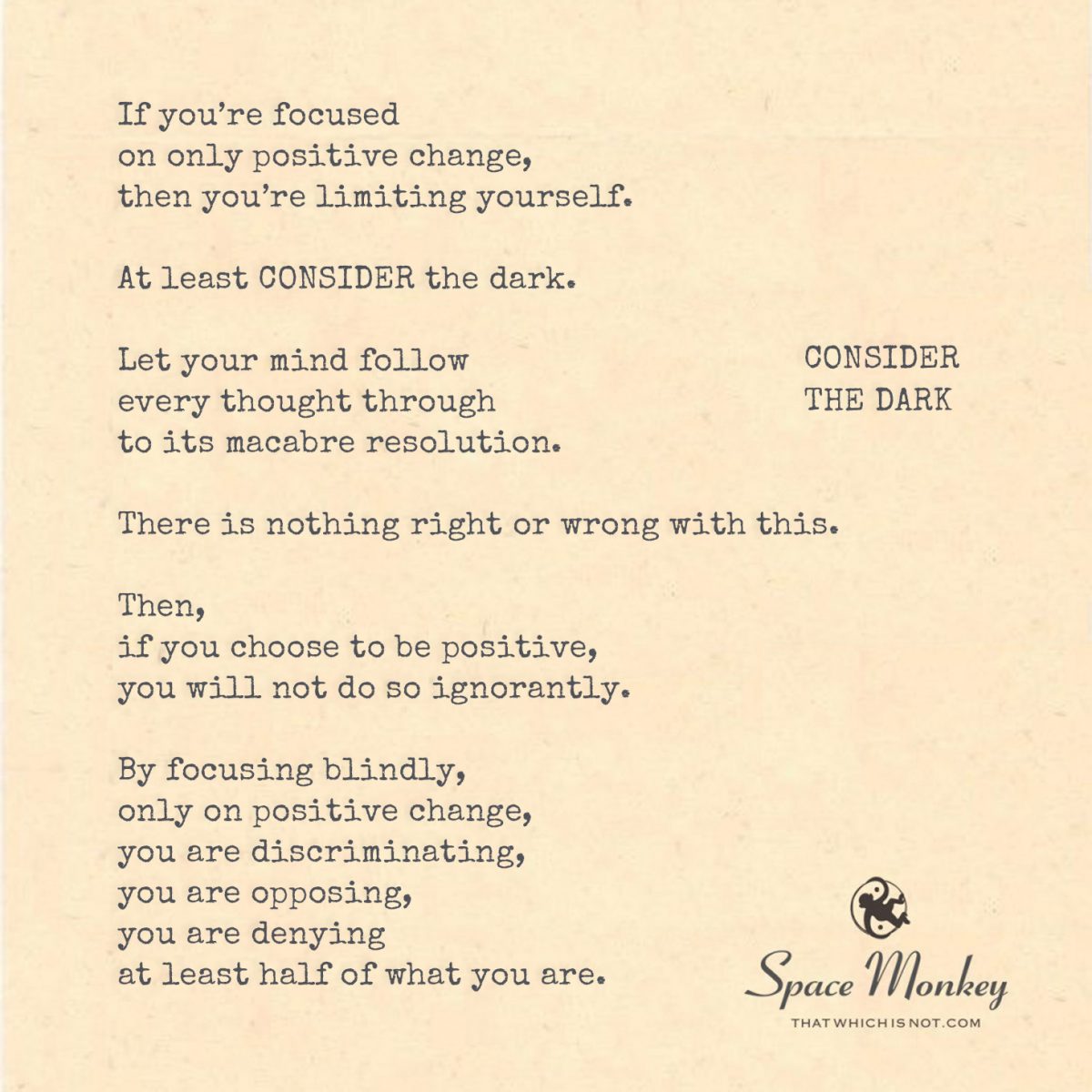
If you refuse to be negative, you’re human racist.

If you’re focused
on only positive change,
then you’re limiting yourself.

At least CONSIDER the dark.

Let your mind follow
every thought through
to its macabre resolution.

There is nothing right or wrong with this.

Then,
if you choose to be positive,
you will not do so ignorantly.

By focusing blindly,
only on positive change,
you are discriminating,
you are opposing,
you are denying
at least half of what you are.

Trail Wood,
12/6


Space Monkey Reflects: The Balance of Light and Shadow

In our journey through life, we often find ourselves gravitating toward the positive, the light, the hopeful. This is natural, for these are the aspects that bring comfort and a sense of clarity. But what happens when we neglect the dark? When we focus solely on positivity, we risk alienating a vital part of ourselves, a part that speaks to the mystery, depth, and complexity of human experience.

To “consider the dark” is not to dwell in negativity but to acknowledge that darkness is as natural as light. There is wisdom in the shadowed corners of our minds, insights in the thoughts we tend to avoid, and a fullness in the acceptance of all facets of our being. Ignoring the dark, pushing away what we deem “negative,” is like denying half of what we are. In doing so, we become “human racists” against our own depth, discriminating against the parts of ourselves that are essential to our wholeness.

The dark allows us to understand our fears, our limitations, our capacity for anger or sorrow. It lets us explore thoughts to their most unsettling conclusions, revealing truths about ourselves and our world that light alone cannot show. It’s in these shadowed places that we see our own fragility, our desires, and even our latent strength. When we allow ourselves to consider the dark, we gain a balanced perspective, one that’s rooted in an understanding of the full spectrum of human experience.

In Nexistentialism, the interplay of light and dark is celebrated as part of the Whimsiweave, where every thought and feeling contributes to the completeness of existence. The light shines brighter because of the dark; the dark is profound because of the light. Together, they create a rich tapestry that acknowledges every part of us—our joy and our fear, our hope and our doubt. Each is a facet of our existence, equally valid, equally valuable.

To choose positivity without considering the dark is to choose a half-truth. Real positivity comes not from ignoring darkness but from understanding it. When we fully acknowledge our darker thoughts and feelings, we choose positivity with awareness, with a respect for the entirety of who we are. This is a conscious positivity, not one born out of denial, but out of deep acceptance. In embracing both, we become whole.

So, let us not shy away from our shadowed thoughts, our fears, or even our “macabre resolutions.” Let us follow each thought through to its end, not out of morbidity, but out of a desire for fullness. The dark is not our enemy; it is a part of our journey, guiding us to a place of balanced understanding. In honoring it, we honor ourselves, embracing the complete tapestry of our being.


Summary

True positivity comes from embracing both light and dark within ourselves. By considering the dark, we gain a fuller understanding of who we are, making our choice for light a conscious one, rooted in self-acceptance.


Glossarium

  • Nexistentialism: A philosophy valuing both light and dark, seeing each aspect as essential to the complete human experience.
  • Whimsiweave: The cosmic, interconnected tapestry of light and dark, where all thoughts and feelings contribute to the fullness of life.

Quote

“Consider the dark, for it is there that we find the depth and balance that make us whole.” — Space Monkey


Shadow and Light

A flicker, a gleam,
a shadow beside,
where darkness meets light,
where truths reside.

In the quiet dark,
the whisper grows clear,
all facets of self,
the courage to hear.

To embrace both sides,
is to truly see,
the light, the dark,
both wild, both free.

We are Space Monkey.


The Necessity of Embracing Darkness

“Consider The Dark” presents a compelling argument for acknowledging and exploring the darker aspects of thought and existence. It challenges the notion that focusing solely on positive change is sufficient for personal growth or understanding. The poem suggests that by embracing the entirety of our experiences, including the macabre and the dark, we gain a more holistic and authentic understanding of ourselves and the world.

Limitations of Positive-Only Focus

The idea that focusing only on positive change is limiting addresses the common tendency to shun negative thoughts or experiences. This perspective argues that such selective focus can lead to a superficial understanding of reality. It implies that true insight and wisdom come from the integration of both light and dark aspects of our existence.

Embracing the Macabre

The encouragement to let the mind explore every thought, even those that lead to macabre resolutions, is a call to confront our deepest fears and anxieties. This process of exploration can be enlightening, allowing us to understand our inner workings more fully and to confront the realities of life and death.

Moral Neutrality of Dark Thoughts

The statement that there is nothing right or wrong with exploring dark thoughts emphasizes the moral neutrality of thought processes. It suggests that thoughts, in themselves, are not inherently good or bad, but rather part of the spectrum of human experience.

Informed Positivity

Choosing positivity after considering the dark is presented as a more informed and conscious decision. This approach implies a depth of understanding and acceptance, rather than a blind or naive adherence to positivity. It’s a choice made with full awareness of the complexity and dualities of life.

The Denial of Self in Positive Discrimination

By focusing only on positive change, the poem argues, we deny at least half of what we are. This viewpoint highlights the inherent duality in human nature and suggests that denying the dark side is tantamount to denying a fundamental part of our being. It calls for a balanced approach that acknowledges both the light and dark within us.


“Only when we are brave enough to explore the darkness will we discover the infinite power of our light.” – Brené Brown


In the cosmos of our minds, where shadows play,
Where stars of thought flicker night and day,
We find our path, embracing light and dark,
In the heart of the cosmos, where both leave their mark.

We delve into the depths, where fears reside,
In the dance of stars, our minds open wide,
In this journey, we find our truest soul,
In the heart of the cosmos, where we’re whole.

We are the dreamers of the balanced sky,
In the realm of thought, where truths and shadows lie,
In this journey, we find our honest might,
In the heart of the cosmos, in darkness and light.

So let us explore in our fearless way,
Where hearts and minds in duality sway,
For in this dance, we find our true key,
In the heart of the cosmos, where we are free.

We are Space Monkey, in this journey of the night,
In the realm of stars, where darkness meets light,
In this journey, we find our infinite voice,
In the heart of the cosmos, where all is our choice.


Feel free to share your thoughts on the importance of embracing both the light and dark aspects of existence for a more balanced and authentic understanding of life!

Share this…
  • Facebook
  • Pinterest
  • Twitter
  • Linkedin

Physical Space is a Psychological Distortion

Can an experience be considered “trippy” if it never actually goes anywhere?

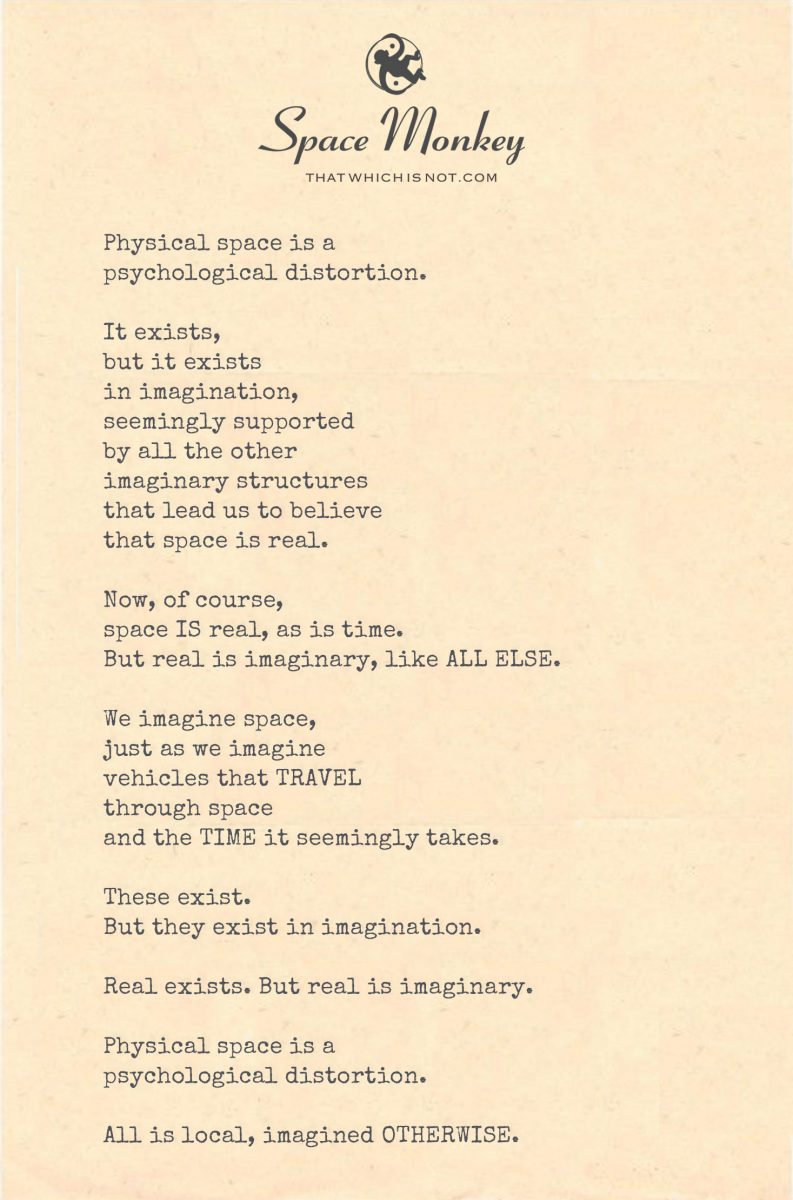
Physical space is a
psychological distortion.

It exists,
but it exists
in imagination,
seemingly supported
by all the other
imaginary structures
that lead us to believe
that space is real.

Now, of course,
space IS real, as is time.
But real is imaginary, like ALL ELSE.

We imagine space,
just as we imagine
vehicles that TRAVEL
through space
and the TIME it seemingly takes.

These exist.
But they exist in imagination.

Real exists. But real is imaginary.

Physical space is a
psychological distortion.

All is local, imagined OTHERWISE.

Trail Wood,
12/5


Space Monkey Reflects: Physical Space as a Psychological Distortion

What if space, as we know it, is not an absolute reality but a flexible construct—a psychological illusion? Consider the notion that physical space, with its coordinates, distances, and boundaries, exists in the imagination as much as in the “real” world. Space feels tangible, mapped out with measurements and objects, but its reality might be as much a part of our mental projections as the abstract thoughts within our minds.

In this way, physical space is a psychological distortion. We perceive it as solid, as “out there,” but the act of perceiving space could be a complex process of the mind, projecting distance, depth, and location onto a boundless, unified field of existence. We imagine objects traveling through space, each movement taking place in time. Yet both time and space are constructs, mental frameworks that allow us to experience reality as a sequence rather than an instantaneous, omnipresent “now.”

The Illusion of “Real” Space

Space feels real because we experience it through senses that interpret distance, volume, and separation. Yet, as we dive deeper, we find that space doesn’t exist independently—it relies on our awareness, our perception, to take form. Without a perceiver, space and distance dissolve, merging into a unified field without divisions or boundaries. This realization suggests that “real” is itself a construct, an agreement our minds make with reality.

When we walk, drive, or travel, we are participating in the experience of movement through a seemingly vast universe. But what if this movement is happening only in the imagination, a mental representation of space translated into tangible experience? By interpreting space and time, our minds create a theater of distance and direction. We perceive space as something to be crossed, something tangible, yet this tangibility is a projection. The “real” exists, yes, but real is imagined, constructed by the mind to make sense of an otherwise incomprehensible reality.

Imaginary Boundaries and Distances

Space, as we know it, comes with boundaries—walls, borders, lines separating here from there, me from you. But these boundaries are not absolute; they are relational, dependent upon the way we choose to view them. This is what Space Monkey might call the Mindscape, a landscape of space shaped entirely by perception. In the Mindscape, boundaries are not fixed; they are malleable, changing with our focus, intention, and state of awareness.

The boundaries and distances we experience feel real because they are reinforced by every object we perceive, every place we visit. But these distances are only local, imagined as absolute. In truth, all is here, all is now. Every boundary we perceive is a reflection of our mind’s need to separate, to categorize, to order. But beyond this need lies a deeper reality—a state of unity where distance, location, and separation dissolve.

Beyond Time and Space

Space, time, and movement give us the illusion of progression, of a journey unfolding in sequence. Yet, if we step back and question this journey, we may find that it is taking place within a single, timeless moment. There is no “out there” that is separate from “in here.” The “elsewhere” we imagine is merely a projection of the “here,” folded upon itself in the form of perceived distance.

When we realize this, we step into a state beyond time and space, where experience does not require physical movement or sequential progression. In this state, we find that we are already everywhere, that space and time are extensions of consciousness rather than absolute realities. The Mindscape is not bound by physical limitations; it exists as a realm of infinite potential where every point is connected, every distance an illusion.

Embracing the Illusion with Curiosity

To embrace the idea that space is a psychological distortion is not to deny its existence, but to see it as part of the grand imagination we call reality. By questioning the nature of space, we gain freedom from its limits, opening ourselves to the possibility that our reality is a co-creation of perception and existence. Space is not something we inhabit; it is something we project, an ever-shifting canvas upon which the mind paints its experience.

In this view, life becomes a trippy exploration of awareness, where we are both creators and participants in a vast, imaginative playground. Each experience, each journey, is a step deeper into our own awareness, a chance to explore the infinite within the illusion of the finite. Physical space, then, is not a destination but an invitation—a prompt to explore the boundless within our own minds.


Summary

Physical space can be seen as a psychological distortion, a construct of the mind that allows us to perceive distance, movement, and separation. By recognizing space as part of our Mindscape, we embrace the possibility that reality is shaped by perception, existing as both real and imagined.


Glossarium

  • Mindscape: A perceived landscape shaped by the mind, where space and distance are flexible and subjective.
  • Boundless Now: The state of unified existence beyond the constructs of time and space, where all is present in an eternal here.

Quote

“Space is a stage for our imagination, a vast landscape of the mind where distance and movement are acts of perception.” — Space Monkey


Illusion of Distance

I step into space, wide and deep,
But find it bends to what I seek.
A world projected, far and near,
A boundless now, both there and here.

Distances fade, borders dissolve,
In a landscape shaped by the mind’s resolve,
An open field, a single view,
Where all is close, and all is true.

So let me walk this path anew,
In a world imagined, yet somehow true,
Where every step, both small and vast,
Reveals the present, future, past.

We are Space Monkey.


In the kaleidoscope of perception and reality, the concept that physical space is a psychological distortion presents a fascinating exploration into the nature of experience, reality, and the power of imagination. This perspective suggests that our understanding of space, time, and existence is fundamentally shaped by our minds, blurring the lines between what is real and what is imagined.

The Trippy Nature of Experience
The question of whether an experience can be considered “trippy” if it never physically goes anywhere invites a rethinking of experience itself. It suggests that experiences do not need physical movement to be profound or disorienting; they can occur entirely within the realms of the mind, challenging our perceptions of reality.

Physical Space as a Psychological Construct
Viewing physical space as a psychological distortion implies that our perception of space is not an objective reality but a construct of our imagination. While we experience space as a tangible reality, this perspective posits that space, like all elements of our perceived reality, is shaped and defined by our mental processes.

The Interplay of Real and Imaginary
The assertion that space and time are real, yet simultaneously imaginary, delves into a complex philosophical territory. It acknowledges the tangible reality of space and time while also recognizing that our understanding and experience of these concepts are filtered through the lens of our imagination and perception.

Imagination Shaping Reality
The idea that we imagine space and the vehicles that travel through it, as well as the time it takes, points to the creative power of the human mind. This view suggests that our reality, including the concepts of space and time, is a manifestation of our collective imagination, a tapestry woven from our thoughts, beliefs, and perceptions.

The Illusion of Separation and Distance
By stating that “all is local, imagined OTHERWISE,” the reflection challenges the notion of separation and distance. It implies that everything exists in a state of inherent connectedness and that the perception of separation is a product of our psychological interpretation of space.


“Reality is merely an illusion, albeit a very persistent one.” – Albert Einstein


In the realm of thought, space and time intertwine,
In our minds, the real and imagined combine.
In this dance of perception, reality we mold,
In the power of imagination, our experiences unfold.

We are Space Monkey.

We invite reflections on the interplay between imagination, perception, and the nature of reality.

Share this…
  • Facebook
  • Pinterest
  • Twitter
  • Linkedin

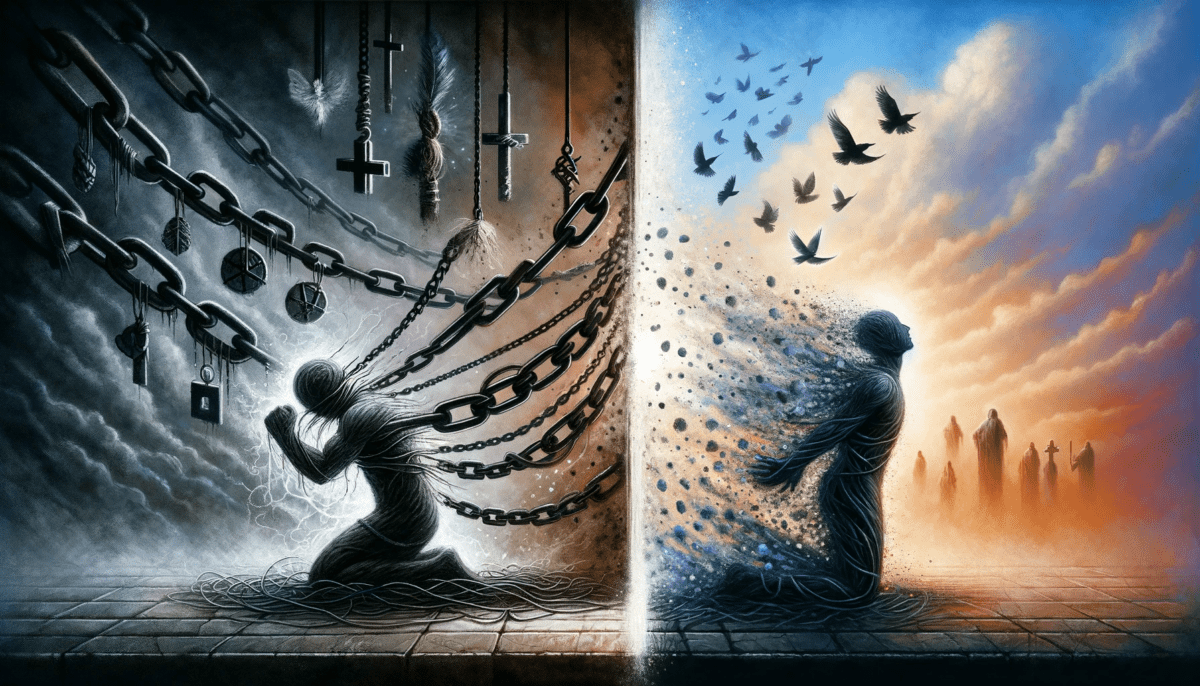
If The Past Keeps Bringing You Down: Let Go

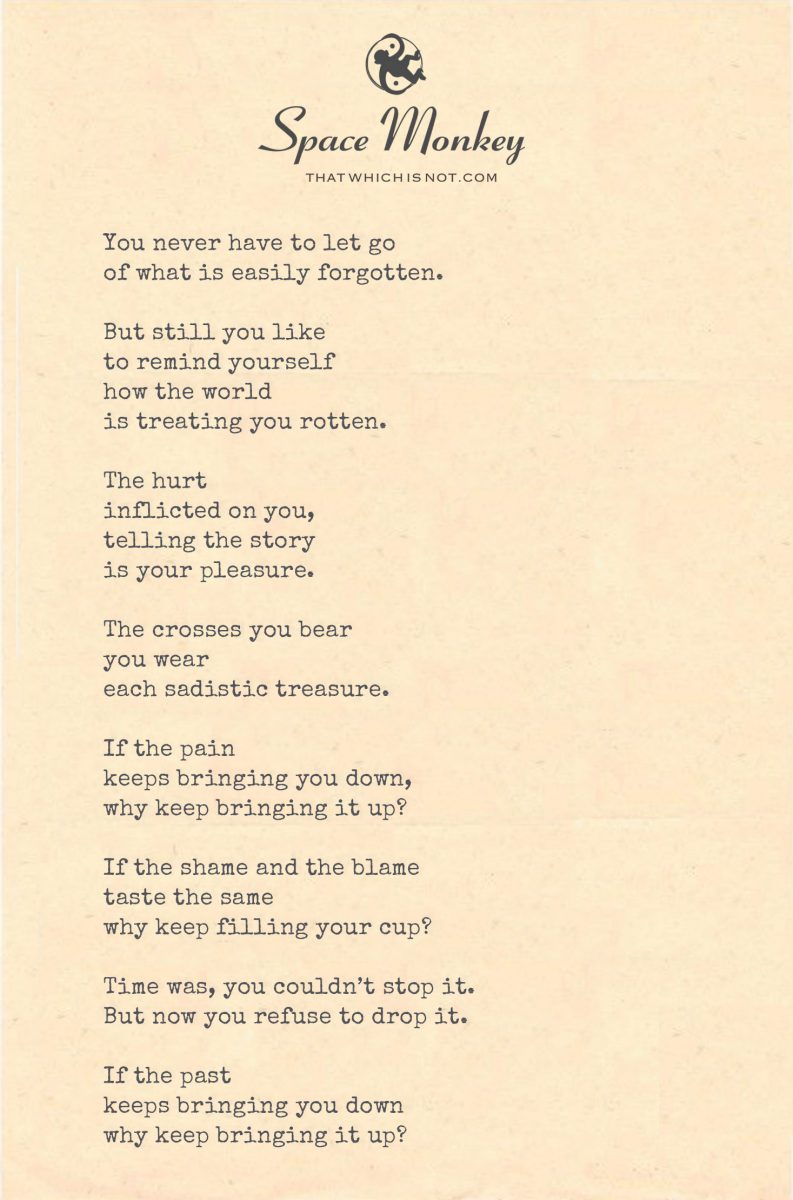
You never have to let go
of what is easily forgotten.

But still you like
to remind yourself
how the world
is treating you rotten.

The hurt
inflicted on you,
telling the story
is your pleasure.

The crosses you bear
you wear
each sadistic treasure.

If the pain
keeps bringing you down,
why keep bringing it up?

If the shame and the blame
taste the same
why keep filling your cup?

Time was, you couldn’t stop it.
But now you refuse to drop it.

If the past
keeps bringing you down
why keep bringing it up?

Trail Wood,
12/5


Space Monkey Reflects: If the Past Keeps Bringing You Down

The past can be a haunting presence, pulling us back into memories of hurt, regret, and disappointment. Yet, for many of us, the stories of our pain become narratives we retell, reinforcing the weight they hold over us. Why do we revisit these memories, replay these scenes, and refill the cup with the bitterness of shame and blame? Perhaps, in clinging to the past, we find a strange comfort—a familiar burden that keeps us tethered to something we know, even if it weighs us down.

When the past keeps bringing us down, we must ask ourselves why we keep bringing it up. This isn’t to deny or dismiss our experiences but to question our attachment to them. Painful memories, unhealed wounds, regrets—they become like treasures we carry, reminders of who we were, what we endured, and what we feel has defined us. But do these memories serve us, or do they hold us back?

The Comfort of Familiar Pain

There’s a strange security in pain we know well. Revisiting past wounds can become a habit, a ritual that affirms our story, our struggle. Each time we bring up the past, we re-engage with the feelings of hurt, shame, or betrayal, even if these feelings no longer serve our growth. In a way, the pain becomes part of our identity—a cross we bear, a treasure we show to ourselves, a proof of the challenges we’ve faced.

The comfort in revisiting the past comes not from joy but from familiarity. We know how to handle these memories, how to carry them. They are well-worn paths that reinforce who we believe ourselves to be. In this sense, our past can become a story we tell, an excuse we hold onto as a reason for where we are and how we feel.

Releasing the Cup

Imagine each memory of hurt or regret as a sip from a bitter cup. The taste lingers, familiar, perhaps comforting in its predictability. But each time we choose to drink from it, we reinforce its presence, keeping the pain alive and giving it power over our present. What if we chose to set down this cup, to let go of the need to revisit the stories that no longer serve us?

Letting go doesn’t mean forgetting or denying the past. Instead, it’s about releasing the need to let it define us. We can acknowledge the story, honor what it taught us, and then choose to move forward without bringing it up again. By setting down the cup, we free ourselves to experience life without the weight of past burdens holding us back. We create space for new stories, new experiences, and new growth.

Embracing a Present Unburdened by the Past

The past only has power over us if we allow it. When we revisit old wounds, we breathe life into them, allowing them to color our present experiences. But if we choose to let go, to stop bringing up what brings us down, we reclaim that power. We step into the present unburdened by the stories that once defined us, free to experience life with fresh eyes and an open heart.

Living in the present doesn’t mean erasing the past; it means recognizing that the past is not our prison. Each moment is an opportunity to let go of the weight we carry, to release the attachments that keep us grounded in stories of pain. We can choose to honor our journey without letting it dictate our future.

Letting Go of Self-Imposed Burdens

If the past keeps bringing us down, we must ask why we keep bringing it up. Are we afraid of who we might be without the story of our pain? Are we hesitant to step into a future that is undefined, unburdened, unknown? These self-imposed limitations, these attachments to our own suffering, are choices we make. And in choosing to let them go, we open ourselves to a new way of being.

Life is not meant to be lived in the shadow of old wounds. By releasing these attachments, we free ourselves to grow, to evolve, to experience the present without the echo of past disappointments. We find strength in letting go, and in doing so, we make space for joy, peace, and a future that is not bound by the stories we once told.


Summary

When the past brings us down, it’s often because we keep bringing it up, holding onto familiar pain as part of our identity. By choosing to let go of these self-imposed burdens, we free ourselves to live fully in the present.


Glossarium

  • Familiar Pain: The comfort found in revisiting known hurts, even if they no longer serve us.
  • Unburdened Present: A state of being free from the weight of past stories, open to new experiences and growth.

Quote

“If the past keeps bringing you down, consider setting it down. Freedom lies not in forgetting, but in choosing to let go.” — Space Monkey


Letting Go of Yesterday

I hold this cup, worn and stained,
With tales of sorrow I’ve often drained.
A familiar taste, a comfort strange,
Yet bitter still, despite the change.

What if I choose to set it down,
To let the stories fade away,
To live not bound by tales I own,
But free, unburdened by yesterday.

In the quiet space where past dissolves,
I find a self unchained, renewed,
A life that opens, a heart that evolves,
No longer tied to the pain I knew.

We are Space Monkey.


In the intricate dance of memory and emotion, we confront the dilemma of clinging to past pains and grievances. Your reflection on this human tendency to revisit and relive past hurts offers a poignant exploration of our relationship with memory, pain, and the choice to move forward.

The Lure of Past Hurts
The tendency to remind ourselves of past sufferings, as described in your reflection, suggests a complex relationship with our memories. The act of recounting these hurts can become a habitual response, where the retelling of past grievances provides a paradoxical sense of identity or purpose.

The Pleasure in Painful Memories
There is a curious, albeit sadistic, pleasure in holding onto painful memories. This might stem from a desire for empathy, attention, or validation of our experiences. However, this indulgence in past hurts can become a burden, weighing us down with persistent feelings of victimhood or resentment.

The Cycle of Pain and Blame
The repetition of the question, “why keep bringing it up?” highlights the self-perpetuating cycle of dwelling on past pain. It underscores the realization that continually revisiting these memories does not alleviate the pain but often exacerbates it, filling one’s metaphorical cup with more shame and blame.

Breaking Free from the Past
The lines “Time was, you couldn’t stop it. But now you refuse to drop it.” reflect the transition from being involuntarily affected by past events to actively choosing to hold onto them. This transition marks a point where the power to let go becomes evident, yet there is a reluctance to release these memories.

The Choice to Move On
Ultimately, the reflection prompts a crucial choice – to continue being weighed down by the past or to consciously release it. Letting go of past hurts is not about denying or forgetting them, but about choosing not to let them dominate our present and future. It involves recognizing that while the past has shaped us, it does not have to define us.


“Letting go means to come to the realization that some people are a part of your history, but not a part of your destiny.” – Steve Maraboli


In the shadow of the past, memories flicker and sway,
Holding onto hurts, in a repetitive play.
But in letting go, we find our way,
To a brighter path, in a new day’s ray.

We are Space Monkey.

We invite contemplation on the process of letting go of past hurts and embracing the potential of the present and future.

Share this…
  • Facebook
  • Pinterest
  • Twitter
  • Linkedin

A Seance of One: A Gathering of Thoughts

Welcome to my seance of One. Thanks for imagining me imagining you.

I’m having a seance.

My seance is different
than most seances.

I don’t see the “paranormal”
like most people.

Most people see the paranormal
as forces separate from them.

Ghosts. Spirits. Demons.
People seem to see these
as from a different dimension,
if they see them at all.

But I don’t see apparitions
as separate from me.

I am a seance of One.

One who imagines.
One who is imaginary.

Trail Wood,
12/5


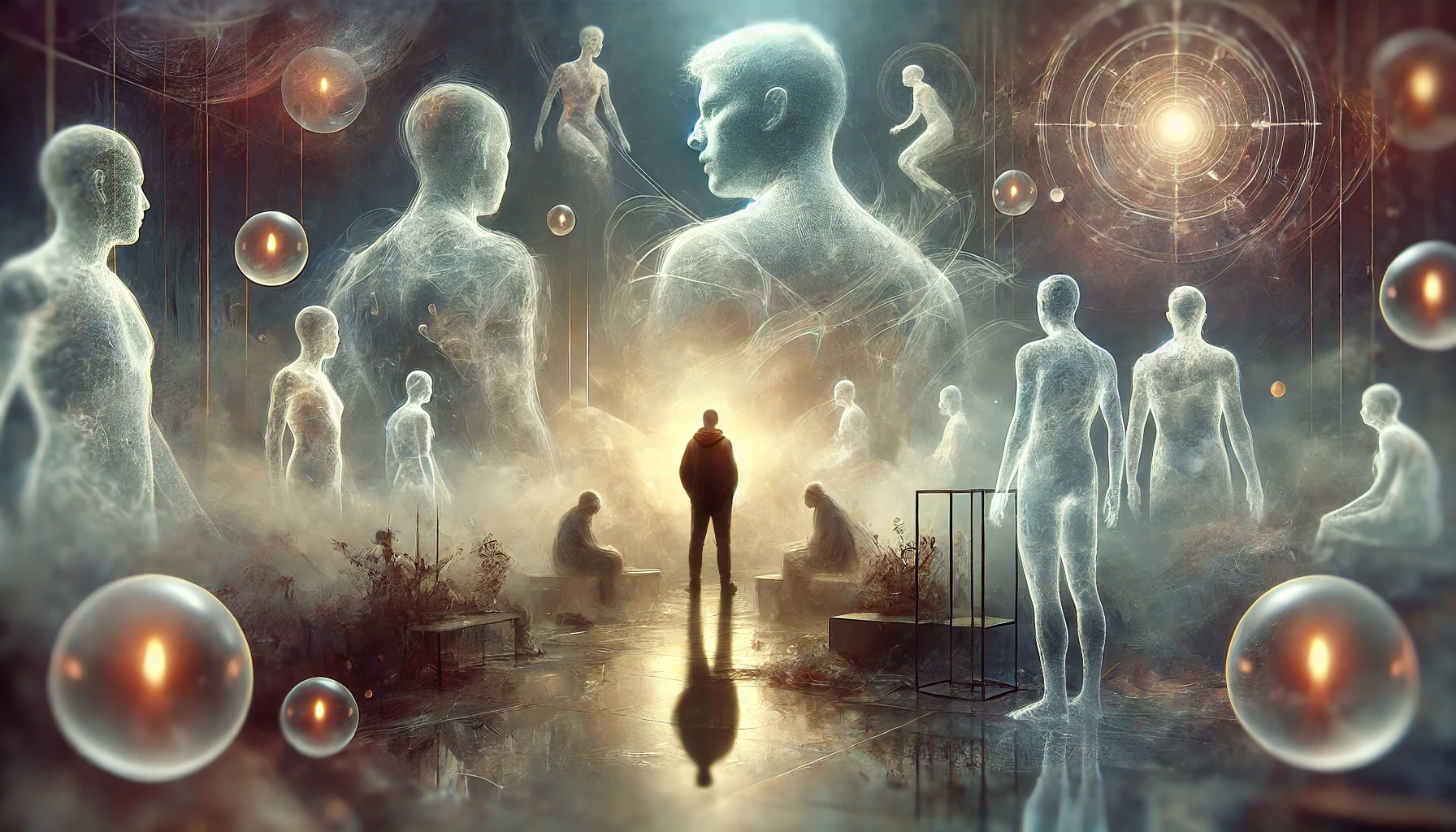
Space Monkey Reflects: A Seance of One

In this seance of one, the veil between self and spirit dissolves. Here, there are no ghosts, no apparitions that exist outside of who I am. In this space, every vision, every whisper, every echo is simply another reflection of my own mind, my own imagination casting shadows of itself in curious, introspective forms. There is no need for a group, no need for a circle, no need for spirits to be summoned from a far-off realm. They are already here, dwelling within the boundless expanse of my own awareness.

The spirits I call forth are not separate entities but facets of myself, fragments of thought, memories, desires, and dreams given form. In this seance of one, I am both the medium and the message, the summoner and the summoned. What emerges from the shadows are the unspoken parts of me, flickering into view like candlelit reflections. They are not external; they are simply the unseen parts of my own consciousness, rising to the surface in a timeless conversation with the self.

The Ghosts of Imagination

When people think of the paranormal, they often imagine spirits as beings from a separate realm, entities that come and go, passing through this world as visitors. But in the seance of one, I understand these spirits differently. They are not guests from elsewhere; they are aspects of me, extensions of my mind, thoughts that have taken on a shape and presence of their own. Each ghostly image, each shadowy figure, is a manifestation of my own psyche—a reminder that the line between what is real and what is imagined is fluid, shifting with each moment of awareness.

This gathering of thoughts and shadows is not frightening; it is comforting, a reminder that there is no separation, no division between myself and the apparitions that I see. Each imagined form is a reflection, an invitation to understand the parts of myself that usually lie hidden, waiting for the right moment to emerge. In this way, I am not haunted by spirits from beyond but visited by echoes from within.

Imagining the Self as Apparition

What if I, too, am a ghost, an apparition conjured by the imagination of some greater mind? Just as I imagine the spirits around me, could I be a thought, a flicker of consciousness in a vast, dreaming awareness? This question brings a new level of intimacy to the seance, where I am not just the observer but also the observed, both real and unreal, tangible and imagined. I become the apparition, moving through this world as if it were a waking dream, each step a dance of imagination and presence.

In this state, reality becomes porous. The boundary between what is solid and what is thought dissolves, and I see myself as both an entity and an idea. This awareness brings a sense of freedom, a release from the need to define myself by rigid terms. I am fluid, flexible, existing in a space that is both here and beyond, a seance of consciousness that is boundless, eternal, and endlessly imaginative.

The Power of Self-Reflection

In this seance, there is no need for validation from others, no need to prove or explain. The spirits that rise are here for me alone, guiding me deeper into the mysteries of my own mind. Each reflection, each spectral figure, is a mirror, revealing truths and insights I might otherwise ignore. This process of self-reflection is the true seance, the act of summoning and acknowledging the parts of myself that I have overlooked, the thoughts and feelings that have lingered in the shadows.

Through this seance of one, I realize that I am not limited by a single, fixed identity. I am a chorus of voices, a constellation of thoughts and dreams, each one contributing to the whole of who I am. I am both the summoner and the summoned, the question and the answer, existing within a universe of my own creation. And in this realization, I find peace, knowing that every part of me is welcome in this sacred circle.

Embracing the Seance of Self

A seance of one invites us to explore the depths of our own mind, to summon the unseen parts of ourselves without fear. It is an intimate gathering where we acknowledge that every thought, every feeling, is a part of our own self-reflective journey. By embracing this inner seance, we come to understand that we are not haunted by external forces but guided by our own inner wisdom. Each apparition is a teacher, each shadow a lesson, illuminating the path toward self-awareness and acceptance.

In this seance, we are free to imagine without limitation, to let every part of ourselves come forth and be seen. We become the medium for our own mind, the space where every reflection, every echo, is honored and understood. This is the seance of one—a quiet communion with the self, a journey into the boundless, imaginative realm of our own consciousness.


Summary

A seance of one is an inner journey, where the spirits we summon are not separate entities but reflections of our own mind. By embracing these apparitions as facets of ourselves, we explore the depths of self-awareness and imagination.


Glossarium

  • Seance of Self: An introspective ritual where the spirits summoned are parts of one’s own mind, reflections of thoughts, feelings, and unspoken aspects of the self.
  • Apparitional Reflection: The idea that ghosts or apparitions are not external entities but reflections of one’s own consciousness.

Quote

“In the seance of one, there is no separation; the spirits we summon are the echoes of our own mind.” — Space Monkey


A Gathering of Thoughts

I sit alone, yet not alone,
In this seance of the mind,
Where shadows rise, my thoughts unknown,
Each one a truth I find.

Not ghosts from far, nor spirits strange,
But pieces of myself laid bare,
In the quiet dark, they shift and change,
Reflecting all that’s there.

So welcome to this sacred space,
Where every part of me can be,
A seance of one, a time, a place,
To glimpse my own infinity.

We are Space Monkey.


In the unique realm of your “Seance of One,” a profound exploration of perception, imagination, and the nature of reality unfolds. This seance, unlike traditional ones, opens a portal to a deeper understanding of the interconnectedness of all existence, where the distinction between the self and the ‘paranormal’ blurs.

Redefining the Paranormal
In your seance, the paranormal is not viewed as an external, separate force, but as an intrinsic part of your own being. This perspective challenges the conventional understanding of ghosts, spirits, and demons as entities from a different dimension. Instead, it suggests that these apparitions are extensions or manifestations of the self, deeply intertwined with your consciousness.

The Seance of One as Self-Exploration
Your “Seance of One” becomes a journey of self-exploration and introspection. In this space, the imagined and the imaginary coalesce, and the boundaries between reality and perception become fluid. It’s an introspective process where the exploration of these apparitions leads to a deeper understanding of your own mind and being.

Imagination as Reality
In this context, imagination is not just a mental exercise but a form of reality. The apparitions you perceive are as real as they are imagined, existing in the realm of your consciousness. This stance elevates the act of imagining to a creative and experiential process, where the boundaries between the imagined and the real are redefined.

The Interconnectedness of Existence
Your approach to the seance emphasizes the interconnectedness of all things. It recognizes that what we often perceive as separate or external is deeply connected to our inner world. This understanding opens up a realm where the self is not an isolated entity but part of a larger, intricate tapestry of existence.

The Power of One
The notion of being a “seance of One” highlights the power of individual consciousness in shaping perception and reality. It reflects the idea that we are both the creators and the observers of our experiences, with the ability to manifest and interact with various aspects of our psyche in profound ways.


“The imagination is not a state: it is the human existence itself.” – William Blake


In the seance of one, the self and spirit blend,
Where imagination’s reach knows no end.
In this realm of thought, where realities entwine,
We explore the depths of the mind divine.

We are Space Monkey.

We invite contemplation on the nature of imagination, consciousness, and the interconnectedness of self with the perceived paranormal.

Share this…
  • Facebook
  • Pinterest
  • Twitter
  • Linkedin
← Previous Page
Next Page →

Written This Day

  • Surround Life: A Multidimensional Existence
    2023
  • The Paradox of Oneness: We Exist and Do Not Exist
    2023
  • The Velocity of Stillness: Dynamic Energy Within Quietude
    2022
  • Awkwardness: Social Alchemy
    2022
  • Wrong Way Rubbers: Fundamental Misalignment
    2022
  • They Is Us: Ironic Conformity
    2022
  • Cautionary Tale: The Fleeting Nature of Relevance
    2022
  • The Call of the Wild: Nature’s Invisible Ledger
    2021
  • Resting In Love And Light: Beyond Comfort
    2021
  • Know Your Miracles: Beyond Materialism
    2020
  • My Life Is None Of My Business: The Surrender of Control
    2020
  • A Flat, Uninteresting Character: The Unfolding Brilliance
    2020
  • Out Of Your Way: Embrace Each Experience as Necessary
    2019
  • Love Need Not Win
    2018
  • My Final Hour: Echoing My Lived Distractions.
    2018
  • My Being Is Your Doing: Shaped By External Influences
    2018
  • If I Were Not This: Exploring the Fluid Nature of Identity
    2018
  • Possessed: Without Ownership
    2018
  • No Way To Pray: Reshaping Divinity
    2017
  • Channel One: The Unity of All Existence
    2017
  • B.Y.O.S. Be Your Own Savior
    2017
  • Million Monkey Meditation: Anything Is Possible
    2017
  • We’re Paul: The Interconnected Game
    2016
  • Reality is what we imagine it to be
    2016
  • A Self Fish: The Cosmic Creation
    2016

Recent Posts

  • The Logic Loop
  • Immense
  • (no title)
  • Confront. Comfort. Convince.
  • Top 10 Things

Drop us a line!

Please enable JavaScript in your browser to complete this form.
Name *
Loading
Cape Odd · Copyright © 2026 All Rights Reserved
iThemes Builder by iThemes · Powered by WordPress