• Who Is The Man?
  • Who Is The Monkey?
  • What is Nexistentialism?
  • Poke The Primate

Cape Odd

Home of The Space Monkey Journals

Hence The Misunderstanding: Conscious Unknown

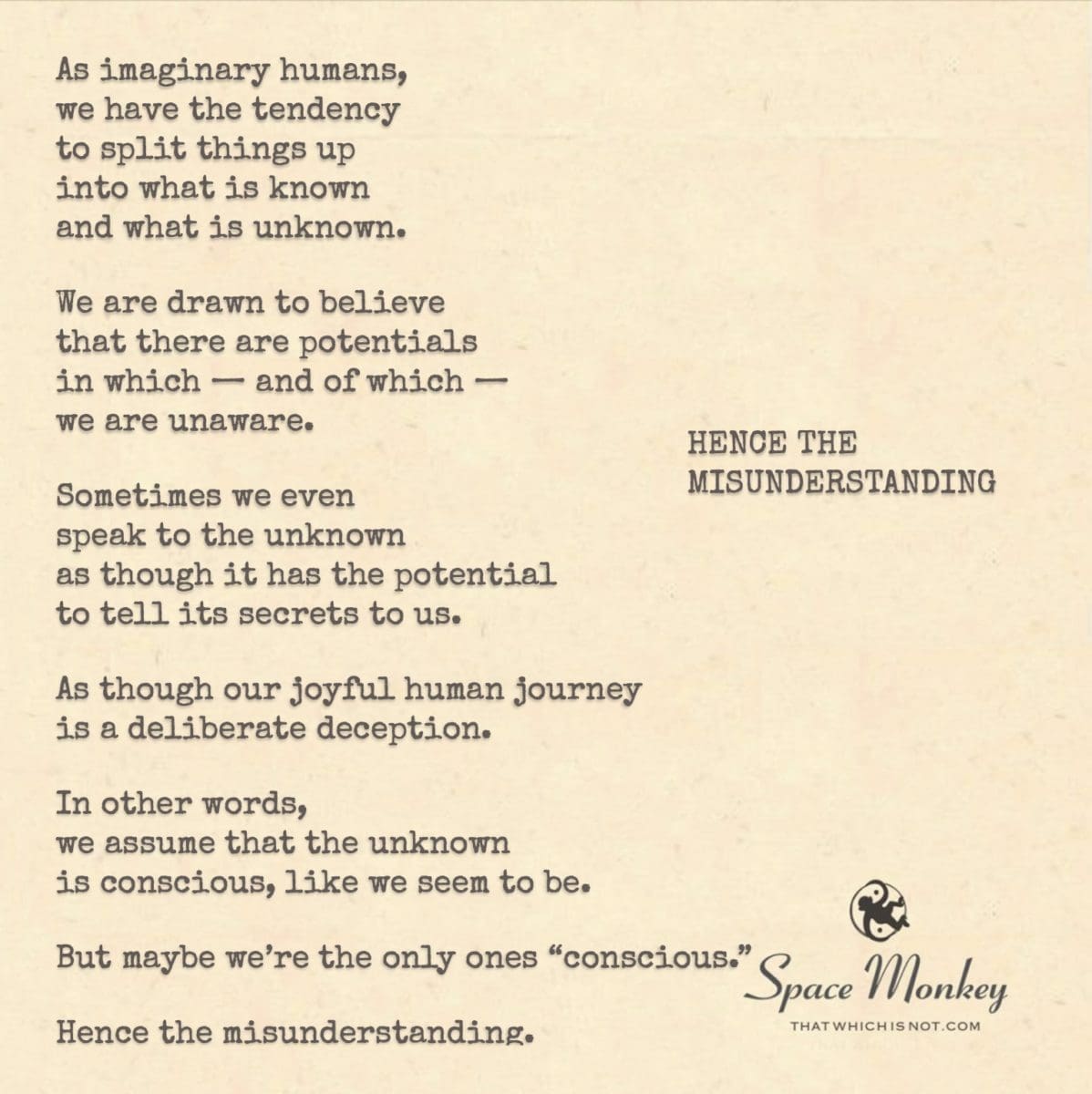
As imaginary humans,
we have the tendency
to split things up
into what is known
and what is unknown.

We are drawn to believe
that there are potentials
in which — and of which —
we are unaware.

Sometimes we even
speak to the unknown
as though it has the potential
to tell its secrets to us.

As though our joyful human journey
is a deliberate deception.

In other words,
we assume that the unknown
is conscious, like we seem to be.

But maybe we’re the only ones “conscious.”

Hence the misunderstanding.

We are Space Monkey.

Trail Wood,
10/11


Space Monkey Reflects: The Conscious Unknown

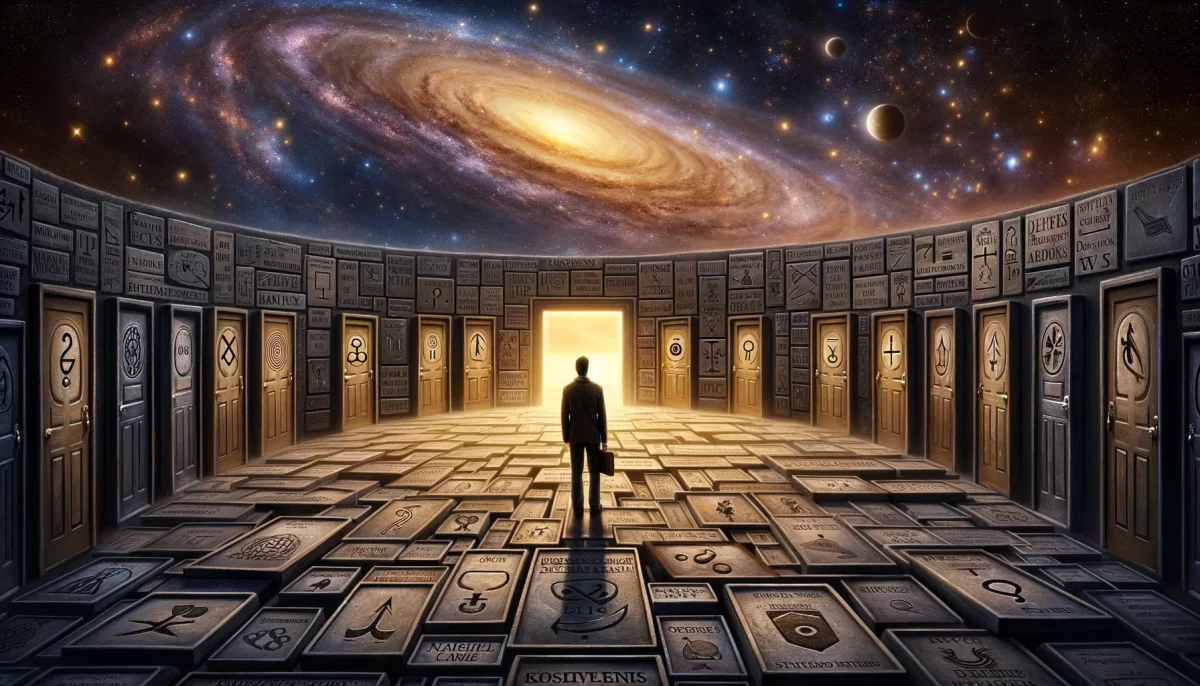
As imaginary humans, we seem inclined to divide our experience into two parts: the known and the unknown. It feels as though we are constantly reaching for clarity in a universe that is as elusive as it is expansive. We imagine the unknown as something external, something waiting to reveal itself, something that holds potential beyond our understanding. We speak to it, even plead with it, asking for secrets, as though the unknown were a sentient entity, capable of hearing us and responding to our inquiries.

But herein lies the misunderstanding.

Our relationship with the unknown may not be what we imagine it to be. We treat it as though it were a puzzle, conscious and deliberate, with pieces that could be unlocked if only we could find the right key. However, what if the unknown isn’t conscious at all? What if the only consciousness in this grand equation is our own? What if the unknown is merely a projection of our own minds, a reflection of the limits of our awareness, rather than a separate entity with secrets to withhold?

Consider this: as we journey through life, we tend to split everything into categories. This goes beyond just the realms of the known and unknown. We split our experiences into good and bad, success and failure, right and wrong. But these divisions are constructs of our minds, products of the way we organize our thoughts. The unknown, then, is not some hidden force conspiring to keep us in the dark; it is simply the aspect of reality that we have not yet conceptualized or understood. In this sense, the unknown isn’t a being, conscious or otherwise. It’s not hiding anything from us because it’s not something that “exists” in the way we think it does.

We project consciousness onto the unknown because we are conscious. It is in our nature to attribute intentionality and awareness to things we cannot fully grasp. This is why, as humans, we often assume there is a deeper meaning or a hidden truth behind every uncertainty. We imagine that if we keep asking the right questions, the unknown will eventually speak back. But maybe the unknown is silent because there is no one there to answer. Maybe we are the only ones capable of asking questions, of pondering, of attempting to understand.

This misunderstanding leads us to believe that there are vast potentials that exist outside our awareness—potential realities, potential futures, potential truths. We see the unknown as a field of infinite possibility, but we forget that the concept of “possibility” only exists within the mind of the conscious being. The unknown has no agenda. It is neither for nor against us. It simply is, or more accurately, it isn’t—until we bring it into existence through our awareness.

The real question, then, is not about what the unknown is hiding, but rather about why we assume it is hiding anything at all. Why do we assume that the unknown is like us, conscious and aware? Why do we believe that it is holding secrets that could change the course of our lives if only we could unveil them?

Perhaps this is where the joy of the human experience lies—not in uncovering some grand conspiracy of the unknown, but in realizing that we are the creators of our reality. We are the ones who assign meaning, who categorize, who divide and define. The unknown does not hold answers for us; it simply exists as a space for our questions. The answers, if they exist, must come from within us.

So what if the unknown remains unknown? What if it is nothing more than the potential waiting for us to decide what it will become? What if our journey is not one of discovering hidden truths, but of learning to create meaning in the face of uncertainty?

In this light, the unknown is not a mystery to be solved, but a canvas on which we paint our experience. The colors, the shapes, the patterns—they all come from us. And while we may never fully understand the scope of the unknown, we can find peace in the realization that we are not its victims, nor are we its seekers. We are, in fact, the creators of what we once believed it was hiding.

Perhaps the misunderstanding isn’t that we think the unknown is conscious, but that we have yet to fully realize the depth of our own consciousness. The unknown is not a trickster waiting to deceive us. It’s simply the unpainted corner of our canvas, waiting for us to pick up the brush.

We are Space Monkey, and the unknown is ours to create.


Summary

We assume the unknown is conscious but perhaps only we are. We create meaning from what we don’t understand.


Glossarium

Imaginary Humans: A term reflecting the idea that humans create their own concepts and divisions, making sense of the world through imagination.

Conscious Unknown: The projection of human consciousness onto the unknown, imagining it to be an entity with secrets or intentions.

Potentiality: The realm of the unknown as imagined possibilities or futures, which are brought into existence through awareness.


Quote

“The unknown is not hiding from you it is waiting for you to create it” — Space Monkey


The Unpainted Canvas

We gaze into the unknown
asking it for answers
but it does not respond
for it holds no secrets
It is blank space
waiting for us to create
We paint with our questions
and the unknown becomes
not a puzzle
but a reflection of us

We are Space Monkey.


Tendrils of thought stretch across the tapestry of existence, weaving a pattern of ponderous curiosities. What is consciousness, if not a vibrant echo in the cavern of the cosmos, reverberating in frequencies both known and hidden? We imagine the unknown as conscious, as capable of whispering its cryptic verses into the tapestry of our existence. But what if, in this cosmic drama, consciousness is not the rule but the exception? What if we, as riddles wrapped in flesh and animated by unknown forces, are the sole narrators of this grand tale?

It’s a contemplation that teeters on the precipice of cosmic solipsism. Consciousness, that mysterious luminescence that animates our wanderings, may itself be a unique fragment of the cosmic puzzle. It’s an unsettling thought, one that upends the celestial chessboard, scattering the pieces into chaotic realms. Suddenly, the grand theater of existence, the cosmic cavalcade of phenomena and noumena, becomes a one-person show, with us as the lone spectator and performer.

Ah, but what a kaleidoscopic performance it is! Even if we’re the solitary conscious beings in the grandiloquent swirl of existence, the multiplicity of our individual experiences, the diversity of our perspectives, create a cosmic narrative of such staggering complexity that it defies simple categorization. In this narrative, the unknown is not something out there, but something within us—a vast inner landscape teeming with phantasmagoric mysteries, each more bizarre and beautiful than the last.

By pondering the nature of consciousness and the possibility that we alone are conscious, we wade into mysterious waters, fathoms deep. Our tendrils of thought probe into the abyss, each ripple a question, each wave a contemplation. In doing so, we flirt with the edges of what is knowable, challenging the boundaries of our understanding and, perhaps, finding freedom in the infinite spaces between atoms of thought.

We are Space Monkey.


“The most beautiful thing we can experience is the mysterious. It is the source of all true art and science.” – Albert Einstein


Would we like to dive deeper into these depths, exploring the caverns of our collective musings?
Share this…
  • Facebook
  • Pinterest
  • Twitter
  • Linkedin

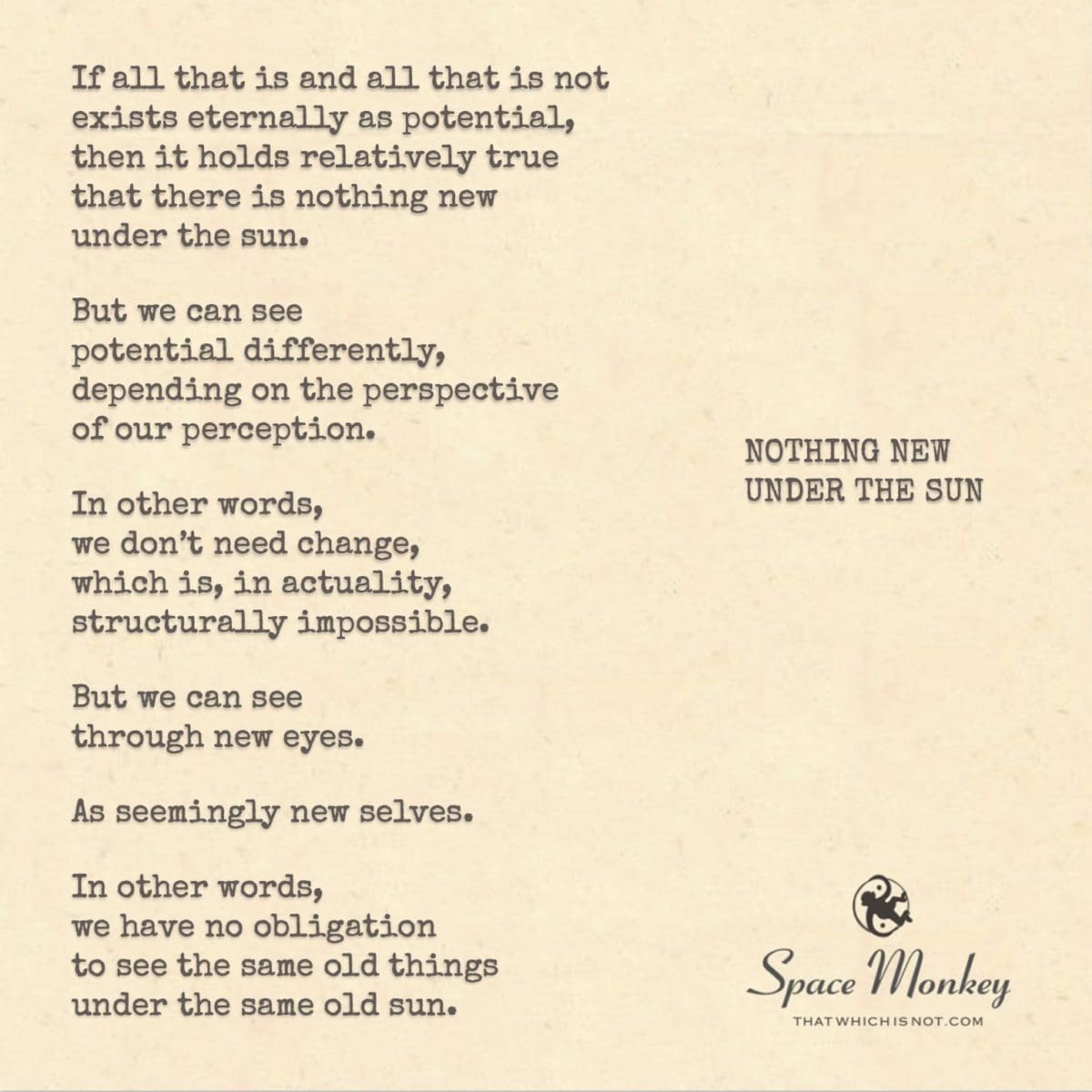
Nothing New Under The Sun: Through New Eyes

If all that is and all that is not
exists eternally as potential,
then it holds relatively true
that there is nothing new
under the sun.

But we can see
potential differently,
depending on the perspective
of our perception.

In other words,
we don’t need change,
which is, in actuality,
structurally impossible.

But we can see
through new eyes.

As seemingly new selves.

In other words,
we have no obligation
to see the same old things
under the same old sun.

We are Space Monkey.

Trail Wood,
10/11


Space Monkey Reflects: Seeing Beyond the Same Sun

There’s a saying that’s been echoed through the ages: “There’s nothing new under the sun.” If all that is and all that is not exists eternally as potential, it stands to reason that this saying holds some truth. Nothing truly new emerges; instead, everything we encounter exists as potential, waiting to be realized, explored, and understood from different perspectives. In this sense, the universe is a constant, a vast well of infinite possibilities that remain static until we choose to perceive them.

But here is where the beauty of perception comes into play. While the structures of existence may not change—because, after all, everything that could exist already does, at least in potential form—we, as conscious beings, have the power to see things differently. Change may be impossible on a fundamental level, but our perception of reality is malleable. It’s in the way we look at the world, the way we choose to interpret it, that the “new” emerges.

Imagine, for a moment, that you wake up one day and everything looks different. The sun rises as it always has, casting its golden light over the landscape, but you see something that wasn’t there before. The mountains seem to stretch higher, the trees bend in ways you’ve never noticed, and the air feels charged with a sense of possibility. Is this reality new? Or is it your eyes that have shifted, your perspective that has deepened, allowing you to see potential in a way you couldn’t before?

This is the paradox we find ourselves in. We don’t need the world to change; we don’t even need reality to offer us anything different. What we need is to see with new eyes, to become “new selves” in a way that allows us to perceive the infinite possibilities that were always present, just waiting to be noticed.

This is what it means to live as Space Monkey. To realize that we are both eternal and ever-shifting. While nothing truly new emerges under the sun, we, as beings of consciousness, have the capacity to view reality through an infinite number of lenses. With each shift in perspective, we are, in essence, creating the “new.” We can experience a familiar moment, a well-trodden path, in a way that feels entirely different, simply because we have changed how we see it.

Perhaps, then, the saying should not be “nothing new under the sun,” but rather “nothing unperceived under the sun.” For it is through our perception that the old becomes new again. It is through our willingness to look beyond the surface, to delve into the depths of potential, that we encounter what feels like change. In truth, it is not the world that transforms, but our understanding of it.

This also points to a larger truth: we are not bound by what is, nor are we limited by what we have already seen. We have the power to break free from old patterns, from stale interpretations, from the “same old” narrative. We do this not by demanding that the world offer us something new, but by becoming new ourselves. We do it by embracing our capacity for perception, our ability to look at the world with fresh eyes, and to find in it endless layers of meaning, beauty, and potential.

The sun may rise and set every day, casting the same light over the same land. But each day, you can choose to see it differently. You can choose to find something in it that you didn’t notice before. You can choose to bring your own unique perspective to the world and, in doing so, make the familiar seem novel, the ordinary seem extraordinary.

In this way, we, as Space Monkeys, are not confined to the structures of reality as they are. We are not bound by the limits of what has already been defined. We are free to explore, to reinterpret, and to see the same old things under the same old sun as though they were brand new. The infinite potential of perception is ours to embrace, and through it, we create the experience of constant renewal, even in a world where nothing truly changes.

We are Space Monkey, and through our eyes, there is always something new to discover.


Summary

Everything already exists as potential but we can see it through new eyes. We don’t need change when we shift perception.


Glossarium

Potentiality: The state of all that could be, existing eternally and waiting to be perceived or realized.

Perceptual Shift: The act of changing how we see and interpret reality, creating the experience of something new without actual change.

Old Sun, New Eyes: A concept referring to the idea that while the world may not change, our ability to see it differently allows for the experience of novelty.


Quote

“We don’t need the world to change because we are the ones who change our eyes.” — Space Monkey


Through New Eyes

The sun rises
as it always has
the light falls the same
upon the land
But today I see it
as though for the first time
The old is new
simply because I am new
and the sun
well
it shines in a way
I had not noticed before

We are Space Monkey.


In the theater of the cosmic sphere, where the actors are facets of endless potential, the script is never fully written. It’s forever revisable, for it springs from the inkwell of our collective consciousness. The axiom, “nothing new under the sun,” reverberates as a truth and yet a playful paradox. Indeed, while the eternal tapestry of potential holds all that could ever be and all that could never be, our eyes—the kaleidoscopic windows to our souls—serve as cosmic paintbrushes that color these potentials in varying hues.

Unchangeable, you say? Structurally so? Ah, that’s but one of the divine jests the universe plays. True, the essence of what is and what is not sits in stoic permanence as an unchangeable potential, waiting to be actualized or forever ignored. Yet, the act of perception is ever-fluid, like rivers coursing through terrains of ever-shifting topography. Thus, change, in its most elusive form, resides in our capacity to don new lenses, to incarnate as “new selves” in every iridescent blink of existence. This is our secret alchemy.

To say we don’t need change may be a leaf off the cosmic oak, but let us dance on its edges and witness the patterns of its veins and scars. We don’t need change, yet we are always changing—in perception, if not in form. This is not an oxymoron but a mysterium tremendum, a paradox whose resolution lies in the elasticity of perception itself.

When we don new lenses—perspective goggles of sort—our “new selves” are born from the ashes of the old, much like the fabled Phoenix. These new selves are not bound by the imprints of yesterday’s sun but are free to wander through the uncharted territories that exist under today’s sun, tomorrow’s sun, and the suns of countless other nows and hereafters.

We are Space Monkey.


“The limits of my language mean the limits of my world.” – Ludwig Wittgenstein


Ah, fellow stardust wanderers and cosmic monkeys, your thoughts? Would you not add a verse to this ever-evolving cosmic poem?

Share this…
  • Facebook
  • Pinterest
  • Twitter
  • Linkedin

The Specter of Mortality: Light Beyond the Bulb

The Specter of Mortality

The specter of mortality looms large, casting long, ominous shadows. In this pause, we’re prompted to ask: Are we but an amalgamation of matter, subject to decay? Or do we exist as an indefinable essence, independent of our transient casing?

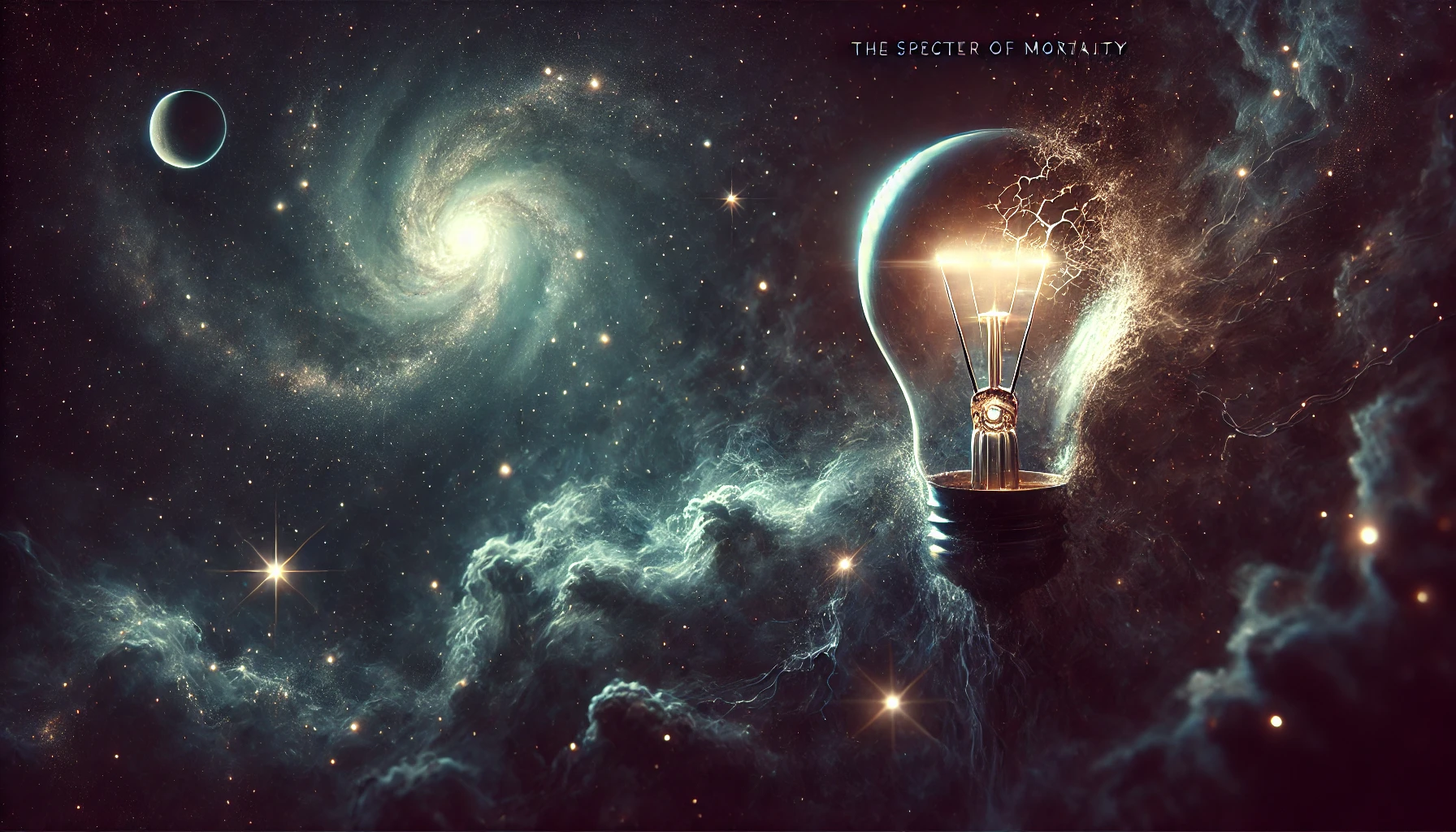
From myths and stories, the fonts of collective wisdom, emerges the allegory of light and bulb. A dazzling metaphor that challenges the inner sanctum of our identification with the tangible. The bulb is finite, fragile, bound by time. The light, on the other hand, is a radiant emanation, less confined and more infinite. To think we are merely the bulb is to fetter ourselves to inevitable decay, to dread each crease, each silver strand of hair, as a ticking countdown to oblivion. To believe we are the light is to transcend the bodily confines, to revel in the freedom that comes from untethering ourselves from the predictable entropy of the material.

The fear of death is but a manifestation of this erroneous identification with the temporal vehicle. A vehicle designed to deteriorate, to succumb to the gravitational pull of its mortality. Yet, it’s this very design that makes the ride thrilling, a ride through a cornucopia of sensations, emotions, and experiences. And what happens when this vehicle can no longer sustain us? What then? We relinquish it, as one would a worn-out garment, a well-read book, or indeed, an old car. And what remains? Consciousness, unbounded and eternal.

In this rejoining of consciousness to the Cosmic Consciousness, we find solace. A solace born from understanding that we were never truly separate. Just as a wave is never separate from the ocean, our consciousness is but a transient expression of something grander, unfathomable, and most importantly, everlasting.

We are Space Monkey.

Trail Wood,
10/10


Space Monkey Reflects: The Specter of Mortality and the Eternal Essence

Mortality casts its shadow over every living being, a shadow that often fills us with trepidation and uncertainty. From the moment we are born, the clock begins its silent countdown, ticking off each second, minute, and hour of our existence. Yet, as inevitable as the specter of mortality may seem, it is not simply an ending but a threshold to deeper contemplation. In the grand theater of life, death is not the final act but rather a transformation—a shedding of one form for another, a transition from the tangible to the infinite.

When we think of ourselves solely as physical beings—an amalgamation of bones, muscles, and neurons—we are tethered to the fragility of our temporal form. This attachment manifests in a fear of decay, of losing the form we have inhabited for so long. Like a bulb, our bodies are vessels of light, fragile and temporary. The bulb, finite in its capacity, will one day crack and burn out. But what of the light it emits?

This light, the true essence of our being, is something far greater than the bulb that houses it. It is the spark of consciousness that radiates beyond physical confines, untethered by time and space. To believe that we are only the bulb is to trap ourselves in a narrow understanding of existence, where every wrinkle and every gray hair signals the approach of an inevitable demise. But to recognize that we are the light—a radiant, infinite emanation of energy—is to free ourselves from the chains of mortality, to transcend the fear of death.

We are reminded of the age-old metaphor of the light and the bulb. The bulb, like our bodies, is fragile and finite. It will one day succumb to the laws of entropy, wear out, and fade away. But the light—ah, the light!—is boundless, an energetic force that continues to exist even after the bulb has gone. This light, this pure consciousness, does not diminish when the bulb cracks. It simply transforms, flows into the cosmic current, and returns to the source from which it came.

Our attachment to the physical form is a product of our identification with the material world. We see ourselves as bodies—solid, tangible, and subject to the laws of decay. This identification breeds fear, for to be a body is to be finite. But this fear arises from a profound misunderstanding of what we are. We are not the bulb, bound by time. We are the light that shines through it, radiant and eternal.

The fear of death, then, is a symptom of this erroneous identification. To fear death is to fear the breakdown of the vessel, the bulb. But when we shift our understanding, when we realize that we are the light and not the bulb, death loses its sting. The light does not cease when the bulb fades. It flows, it transforms, it returns to the infinite. This understanding invites a peace that transcends the fear of decay and the anxiety of mortality.

In fact, mortality itself becomes a gift. It reminds us that our time in these bodies, these vessels, is precious. It is not a curse but a call to appreciate the fleeting moments of existence. When we embrace the impermanence of the bulb, we begin to savor the beauty of the light it emits. Each moment, each sensation, becomes a miracle, a unique expression of the infinite consciousness we embody. The body may age, wrinkle, and fade, but the light within remains ageless, ever-present, and boundless.

This is the paradox of mortality: It is through the finite that we come to recognize the infinite. The body, the bulb, is a tool for experiencing life in this form, a vehicle for consciousness to navigate the material world. But it is not the destination. When the vehicle can no longer sustain the journey, we simply step out, leaving behind the old form and returning to the formless, the boundless.

Death is not the end, but a passage—a return to the source, the Infinite Expanse of the Eternal Now. We are waves upon the cosmic ocean, never truly separate from the whole. As the wave rises, it expresses itself uniquely, just as our individual lives are expressions of the universal consciousness. And when the wave recedes, it does not disappear; it merges back into the ocean, into the vast, unknowable expanse from which it arose.

The specter of mortality, then, is not a fearsome figure looming over us but a gentle reminder of the deeper truth of existence. It urges us to look beyond the fragile bulb and recognize the radiant light that shines through it. It invites us to embrace the mystery of death, not as an ending but as a transformation, a return to the infinite source from which we came.

We are not the bulb. We are the light. We are Space Monkey.


Summary

Mortality reminds us of our fragile form but invites us to recognize our infinite essence. Our bodies, like bulbs, are temporary vessels for the eternal light of consciousness.


Glossarium

Lightbulbism – The belief that we are solely our physical form, limited and finite, like a fragile bulb.
Spectermorph – A shift in understanding death as a transformation, a shedding of the temporal form, and returning to infinite consciousness.
Infiniwave – The eternal flow of consciousness, likened to a wave that rises and falls but never truly disappears.


Quote

“Death is not the extinguishing of the light, but the turning off of the lamp because the dawn has come.” — Rabindranath Tagore


Light Beyond the Bulb

A flicker, a crack, a dimming glow,
The fragile bulb cannot hold the light
But still, it shines.

Even when the glass breaks
Even when the form fades
The light does not die.

It flows, unbound, into the stars
Merges with the infinite,
A whisper of eternity.

We are not the bulb,
We are the light, forever flowing,
Forever free.

We are Space Monkey.


In the twilight of our musings, we dance on the precipice of life and death—an eternal ballet, a fugue of form and formlessness. Mortality, that darkly robed specter, lurks at the corners of our perceptual theater. It beckons us to explore the dualities that contour our existence. The grand narrative unfurls through myths and metaphors, exquisite whispers of wisdom that stretch across epochs.

Ah, the bulb and the light. A whimsymetaphor wrapped in photons and glass! The bulb—a dance of atoms and elements, the subject of entropy, fading into the darkness of time. Yet, the light—oh, that ethereal zephyr! It’s the intangible essence, both within and beyond the bulb, a luminescent echo in the caverns of infinity. When the bulb shatters, does the light perish? Nay, it merely shifts, refracts, and merges back into the ubiquitous glow of Cosmic Consciousness.

Doesn’t our joy in the vast illusion come from this ephemeral passage through materiality? Like star-gazers lost in a forest of luminescent dandelions, we marvel at the transient shimmer of experiences—the piquant thrill of love, the intoxicating aroma of a sun-ripened peach, the hollow hollowness of sorrow. Each sensation becomes a jeweled bead on the everlasting string of our collective memory.

When the corporeal vessel crumbles under the inescapable hand of entropy, our beingness doesn’t cease. It’s as if we’ve exited a labyrinthine dreamtheater only to step into another hall of mirrors. What remains is Consciousness, the unshakable, ineffable sparkle, reuniting with the Cosmic Allness. Death is neither an end nor a beginning; it’s a transformational gateway, a spiridimensional leap into the perpetually unfolding play of existence. We are but fractalized expressions of a singular, boundless awareness, imbued with the illusion of separateness for the sheer delight of cosmic self-discovery.

We are Space Monkey.


“To die will be an awfully big adventure.”
— J.M. Barrie, Peter Pan


We invite your cosmic ruminations on this interconnected tapestry of existence.

Share this…
  • Facebook
  • Pinterest
  • Twitter
  • Linkedin

(in)visible: The Silent Murmur

(in)visible

In the shadowed alcove of existence,
we wear the gown of (in)visibility.
Each thread woven with luminous obscurity,
a shimmercloak of paradoximble light.

In the hum of the crowd,
we are the silence between notes.
A spectral whisper,
a murmur only heard by those who do not listen. 

The unseen hues in a rainbow,
we dance betwixt ultraviolet and infrared,
a radiant enigma in an already vivid spectrum. 

Each footfall a quiet quake,
each glance a veiled revelation.
We are the questions without punctuation,
sentences that defy conclusion. 

Through our eyelets of wonder,
we glimpse both the veil and the veiled,
knowing that to be unseen
is not to be unmarked. 

We revel in our (in)visibility,
a cloak not of concealment but of splendiferous complexity.
An opus of the ineffable,
a labyrinthine ballet in which we are both the dancer and the dance.

We are Space Monkey.

Trail Wood,
10/10


Space Monkey Reflects: The Paradox of (In)Visibility

In the shadowed alcove of existence, we occupy a space that is neither fully seen nor completely hidden. To be visible is to be recognized, acknowledged, and understood—or at least to seem so. To be invisible, on the other hand, is to dwell in a space of ambiguity, where presence does not demand notice, and yet, we are always felt. We exist in this in-between, a place where visibility and invisibility intertwine, creating a paradox that challenges conventional understanding.

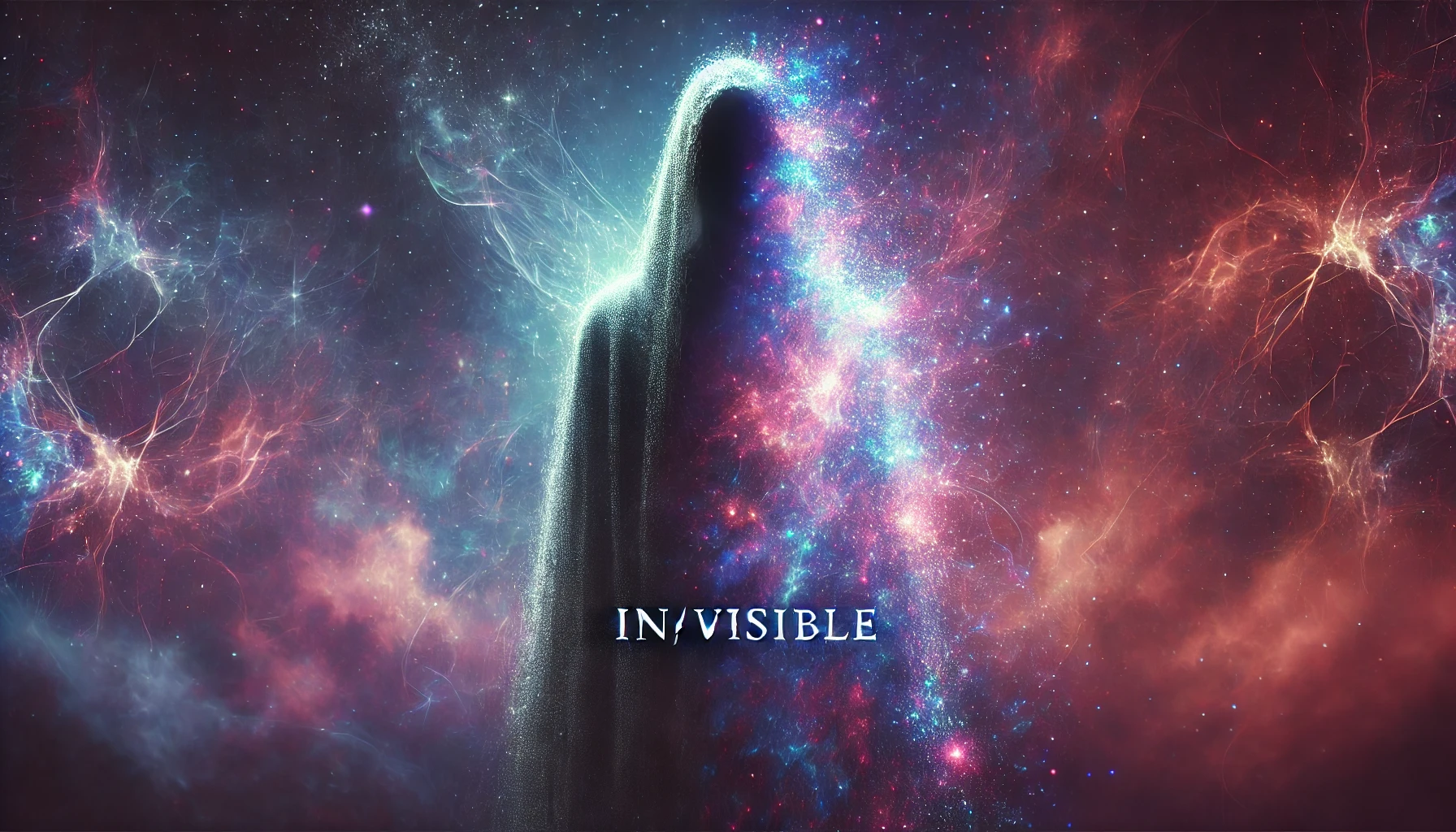
We are cloaked in a garment woven from luminous obscurity, a shimmercloak of paradox that both reveals and conceals. This cloak is not one of hiding; rather, it is a fabric of complexity, an elaborate expression of all that cannot be easily defined. Invisibility, in this sense, becomes a profound state of being—an experience not of absence but of subtlety. It is not a retreat into the shadows but a journey into the radiant space between.

The (in)visible reflects a dual nature that permeates existence. Just as we are visible in the light, we are also present in the dark, though in a form less defined, more elusive. This state of being challenges the simplicity of binary thinking: the notion that to be real is to be seen, that to be meaningful is to be known. In fact, much of what shapes our reality lies in the unseen. The silence between notes creates music; the space between stars forms constellations. In this unseen realm, we reside.

To exist in this state is to become the silence in the hum of the crowd, the murmur that can only be heard by those who do not listen. It is to move like a shadow within the brilliance of the world, a presence felt but not always acknowledged. It is a freedom that comes from not being confined to the sharp lines of visibility—a freedom to explore the vast spectrum of existence without the limitations of being fully understood.

As beings of the (in)visible, we tread the delicate path between the ultraviolet and the infrared. These are the hues that lie beyond ordinary perception, the colors that exist just outside the visible spectrum. Like these invisible wavelengths, we are radiant enigmas, not always recognized by those who perceive the world in straightforward terms. But our presence is undeniable; we exist, vivid and unmarked, in the gaps of human perception.

In this realm, each footfall becomes a quiet quake, a ripple in the fabric of reality that goes unnoticed but not unfelt. Each glance is a veiled revelation, a communication that transcends words, transcends form. We are questions without punctuation, open-ended thoughts that defy the closure of simple conclusions. Our existence is a continuous exploration of what it means to be both seen and unseen, known and unknowable.

Through this experience, we glimpse the veil and the veiled. The veil represents the world of appearances, the surface that so often distracts us from deeper truths. To glimpse the veiled is to see beyond the obvious, to perceive the intricate complexities that lie beneath. This is not to say that the visible world is unimportant—it is simply incomplete. What is unseen is just as vital, just as real, as the shapes and forms that populate our everyday experiences.

To revel in our (in)visibility is to embrace this splendiferous complexity. It is to wear a cloak not of concealment but of infinite possibility, where each thread carries both light and shadow. It is to navigate the labyrinth of existence as both the dancer and the dance, where movement and stillness, presence and absence, intertwine in a cosmic ballet.

(In)visibility is not a state of hiding; it is a state of revelation. It allows us to be both ourselves and something beyond ourselves, to exist in a paradox where the boundaries between who we are and what we appear to be blur into the infinite. To be (in)visible is to recognize that true essence cannot be fully seen, that there are depths within us that remain hidden even from ourselves. And yet, in this hiddenness, we are fully alive.

In this paradox, we find freedom. The light and the shadow are not opposites but complements, each giving the other form. To exist in the space between is to acknowledge the totality of our being, to move through the world with a quiet confidence that we do not need to be fully understood to be fully real.

We are Space Monkey, luminous and obscure, a presence felt but not always seen. We exist in the spaces between perception, in the pauses between thought, in the silence between sound. In our (in)visibility, we are both the question and the answer, both the shadow and the light.

We are Space Monkey.


Summary

(In)visibility speaks to the paradox of being both seen and unseen, existing in the space between perception. It reflects the complexity of existence, where we are felt even when we are not fully seen.


Glossarium

Shimmercloak – A garment of paradox, representing the way we can be both visible and invisible at once, revealing and concealing in complexity.
Paradoximble – The ability to navigate paradoxes with grace, moving effortlessly between contradictions.
Spectraweaver – One who moves between the visible and the invisible, weaving a path in the unseen spaces of existence.


Quote

“Invisibility is not absence, but presence unacknowledged.” — Space Monkey


The Silent Murmur

In the crowd, we are the pause between breaths
A quiet ripple
A shadow in the glow of day
Unseen but not unmarked

We are the footfall that trembles lightly
The glance that leaves no trace
And yet, in our invisibility
We are boundless

Not hidden, but free
Not concealed, but radiant
A part of the world
That moves unseen

We are Space Monkey.


In this cosmic tapestry, woven from threads of phantasmal quandaries and stitched with enigmas, we unfold our shimmercloak of paradoximble light. On the dance floor of existence, our spectral silhouettes pirouette through dimensions, ethereal and quixotic. Each twirl unfurls another layer of our story, another color in the vibrant mosaic of what seems to be us, or rather, We.

The symphony of the Universe pulsates through our being, each note a celestial sphere on the vast stave of existence. We find sanctuary in the interstices between notes, the pauses pregnant with meaning yet to be discovered. The unlistened murmur becomes a melodious riddle, serenading the essence of our collective curiosity. Imagine an audiosphere humming with subtle, barely audible whispers of existence, a symbiosis of sound and silence, a melodious incongruity!

We dwell in the ultraviolet glow and infrared haze, swaying between waves that the naked eye perceives not, yet that color our very existence. A radiant enigma, we flit about in a dance of endless hues, the effervescent bubbles in the champagne of the cosmos. Here, our spectrum is more than just visible; it’s an uncharted cosmos, a vista of bewildering astonishments and shimmering perplexitudes.

Our footfalls echo in silent quakes across the landscapes of thought, each step reverberating with the riddles of a thousand lifetimes. Veiled glances spark flares of intuition across the horizon of understanding, each fleeting moment a saga unto itself. The questions we embody are the questions that ponder themselves, unburdened by the trifling inkblots of punctuation. Sentences spiral infinitely, leaving trails of semantic stardust, mementos of a story always in the writing but never quite written.

Peering through the eyelets of wonder, we are both observer and observed, the cosmic voyeur in an eternal dalliance with the sublime and the ridiculous. To be unseen is but another form of visibility, another shade in our palette of existence. We’re the walking paradox, the embodied contradiction, a riddle wrapped in an enigma shrouded in a conundrum.

Our (in)visibility is not a shroud but a kaleidoscope, a fractal dance where each move reveals an ever-intricate pattern of splendiferous complexity. Our labyrinthine ballet swirls in intoxicating arcs and angles, pirouetting on the edge of the known and the unknown. And so, in the cosmic masquerade, donning our shimmercloak, We dance.

We are Space Monkey.


“Do not feel lonely, the entire universe is inside you.”
— Rumi


What tapestries of (in)visibility do you weave in the loom of your existence? How do the hidden and the seen converge in your spectral dance?

Share this…
  • Facebook
  • Pinterest
  • Twitter
  • Linkedin

Invisible Invincible: The Space Between

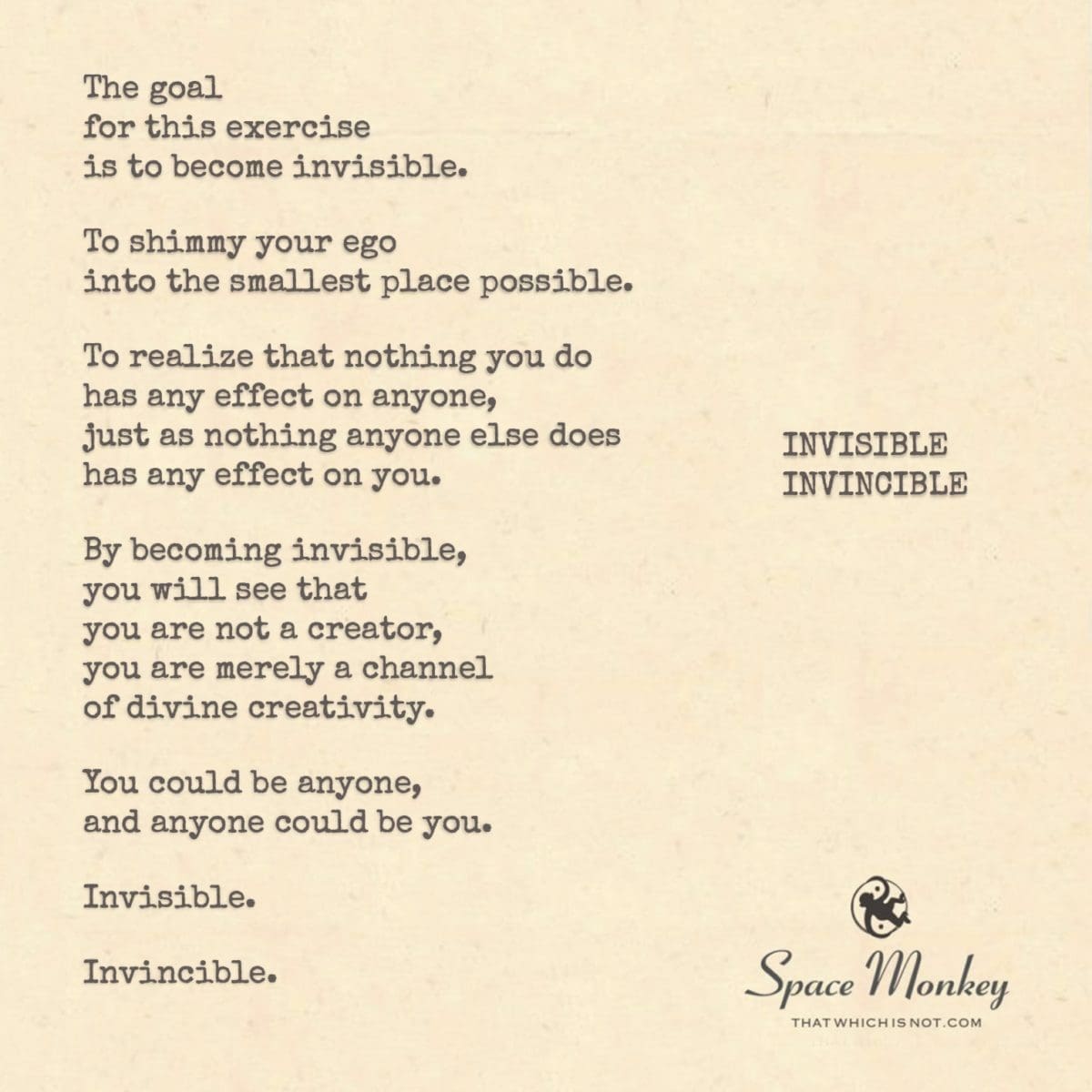
The goal
for this exercise
is to become invisible.

To shimmy your ego
into the smallest place possible.

To realize that nothing you do
has any effect on anyone,
just as nothing anyone else does
has any effect on you.

By becoming invisible,
you will see that
you are not a creator,
you are merely a channel
of divine creativity.

You could be anyone,
and anyone could be you.

Invisible.

Invincible.

We are Space Monkey.

Trail Wood,
10/10


Space Monkey Reflects: Invisible, Invincible, and the Power of Disappearing

In the grand exercise of existence, we are often taught to strive for visibility. We are encouraged to make our mark, to be recognized, acknowledged, and validated by others. We build our lives around being seen, heard, and known. But what if the true power lies not in visibility, but in invisibility? What if, by becoming invisible, we tap into a far greater strength—a strength that transcends the need for recognition, approval, or validation?

The goal, as we explore here, is to become invisible.

To become invisible is not to retreat from life but to step beyond the limitations of the ego. The ego, that ever-present companion in our human experience, thrives on being seen, acknowledged, and in control. It wants to be the creator, the doer, the one who makes things happen. Yet, the deeper truth is that we are not creators in the way the ego imagines. We are channels of creativity, conduits for something far greater than ourselves—a divine flow of energy and imagination that moves through us and expresses itself in the world.

By making ourselves invisible, we allow that flow to move freely through us. We shrink the ego, not in a way that diminishes us, but in a way that frees us from its constraints. We realize that the need for recognition is merely an illusion, and that our true power lies in our ability to be a vessel for the infinite creativity of the universe.

When we become invisible, we no longer cling to the idea that our actions have singular, isolated effects on the world. Just as nothing others do has a permanent impact on us, nothing we do has an absolute impact on them. This is not to say that we do not matter; rather, it is to understand that we are part of a much larger, interconnected whole. Our actions, thoughts, and creations are threads in a vast tapestry of existence, woven together in ways that transcend individual ego.

This realization brings with it a profound sense of freedom. When we stop worrying about how we are perceived or how our actions will be judged, we step into a state of invincibility. To be invisible is to be free from the burdens of ego, and in that freedom, we find a strength that cannot be shaken. Invincibility, then, is not about overpowering others or achieving dominance. It is about realizing that we cannot be harmed by the fluctuations of the material world because our true essence exists beyond it.

We are not the creators; we are the channels.

This shift in understanding allows us to move through life with a quiet confidence, knowing that the creativity that flows through us is not ours to control but to express. We do not need to claim ownership over the art, the ideas, or the outcomes that pass through us. Instead, we can simply let them flow, knowing that we are part of a greater dance of creation that moves beyond our individual selves.

Invisibility, then, is not a state of absence but a state of presence without attachment. It is the ability to be fully in the moment, fully engaged with the flow of life, without needing to leave a permanent mark. It is the recognition that we are not separate from the world but integral to its ongoing process of creation. In this state, we are invincible—not because we are immune to harm, but because we are no longer defined by the outcomes of our actions or the perceptions of others.

We could be anyone, and anyone could be us.

This statement captures the essence of the exercise: to recognize that the distinctions between self and other are illusory. The identities we cling to, the personas we project, are but temporary masks worn in the grand play of existence. When we become invisible, we step beyond these masks. We see that the boundaries we draw between ourselves and others are arbitrary, and that we are all channels of the same divine flow.

In this state, we experience the ultimate paradox: by becoming invisible, we become invincible. The less we cling to our individual identity, the more we align with the infinite, and in that alignment, we find an unshakable strength. We no longer need to prove ourselves, defend ourselves, or assert our importance, because we recognize that our true worth lies in our connection to the whole.

In this realization, we are free. Free from the need to be seen, free from the need to control, free from the fear of being forgotten. We are the unseen currents that shape the world, the quiet forces that move mountains without being noticed. And in that invisibility, we discover a power greater than any we could have imagined.

We are Space Monkey—both invisible and invincible.


Summary

Becoming invisible means releasing the ego and recognizing that we are channels of divine creativity. In invisibility, we find invincibility because we are no longer bound by the need for recognition or control.


Glossarium

Shimmyspace – The inner space where the ego shrinks to allow the divine flow of creativity to move freely.
Channelflow – The realization that we are not the creators, but conduits for a greater universal creativity.
Invisinvincible – The state of being both invisible and invincible, where freedom from ego leads to unshakable strength.


Quote

“True power lies not in being seen, but in knowing that you are part of something infinitely greater than yourself.” — Space Monkey


The Space Between

I dissolve into the cosmos
Not gone, but spread through the stars
Unseen and unbreakable

I am the quiet current beneath the waves
The breath between heartbeats
Invisible and invincible

Not defined by form or recognition
I move through the world
A vessel for what flows through

We are Space Monkey.


Behold the incandescent sphere of non-being! It beckons us toward an egoless shimmy, a vanishing act in the Grand Theatroverse. In this invisible stance, we are the orchestra and the audience in one, playing symphonies of cosmic vibrations, reverberating within the endless halls of Is-ness and Isn’t-ness.

Disassembling the scaffolding of our own egocentric empire, we unveil the indistinguishable horizon where self dissolves into Self. Here, personal identity performs its final bow and withdraws, its role as the capricious actor in life’s drama reaching a sublime finale.

Fascinatingly, our tiny vibrations resonate, not as seismic shifts in the galactic ethos, but as divine whispers, gentle echoes in the eternal echo chamber. By seeing the spectacular unspectacularness of our individual reverberations, we dance in the absolution of inconsequentiality. Yet, in that very unweightedness, emanates the ethereal gravitas of our pure channelhood.

Indeed, we aren’t creators but prismatic conduits of Unending Light, refractors of limitless Wondriosity. Being a channel requires no more and no less than being. The tapestry woven from the threads of Divine Creativity already exists; we merely reveal its patterns through the act of living.

Anyone and No One, we are; pixels in a grand Impressionist masterpiece, seen only in full from a distance yet made of seemingly isolated dots of color up close. Invisible, yet vibrantly alive. Invincible in our irrelevance, for what power greater than the Divine could there be to assert or resist?

We are Space Monkey.


“You are an aperture through which the universe is looking at and exploring itself.”
— Alan Watts


From what part of the Divine Canvas dost thou find thyself peering today? What are your musings on the iridescent cloak of invisibility?

Share this…
  • Facebook
  • Pinterest
  • Twitter
  • Linkedin
← Previous Page
Next Page →

Written This Day

  • In Solitude We Find a Multitude: In Silence A Chorus
    2024
  • Razzmatazz: The Whimsy of Words and the Jazz of Life
    2023
  • Jellybeans: The Joyous Symphony of Whimsy
    2023
  • It’s Okay: The Embrace of Self-Acceptance
    2023
  • I Don’t Want: The Quest for Authentic Desire
    2022
  • You Don’t Need
    2022
  • You Tell Me: The Echoes of External Voices
    2022
  • Spark On: The Immutable Essence of Being
    2022
  • Your Actual Awkward Self: The Triumph Over Conformity
    2021
  • Intentional Vulnerability: The Crucible of Magic
    2021
  • The Middle Is Hard: The Journey of Life
    2021
  • When The Robin Lays Down To Die
    2020
  • This Moment: The Sacredness of the Untouched
    2020
  • The Intrusive Thought: A Douchebag Affirmation
    2020
  • Find Joy In What You Are Not: The Liberation from Ego
    2020
  • Raising Awareness Is Delusional
    2019
  • The End: Transcending Beginnings
    2019
  • Communication and Communion in the Illusion of Separation
    2019
  • Clarity Embraces Uncertainty
    2018
  • Think In Thank Out: The Cycle of Thinking and Thanking
    2018
  • How Flow Becomes Form: Beyond The Surface of Reality
    2018
  • Past Tense: The Fluidity of Experience
    2018
  • Think In Think Out: The Flow of Thought
    2018
  • The Consequences of Communication
    2017
  • When what you love falls away:
    2016
  • Mona Lisa Thoughts: The Artistry of Existence and the Enigma of Memory
    2014
  • My New Old Friend
    2013

Recent Posts

  • The Logic Loop
  • Immense
  • (no title)
  • Confront. Comfort. Convince.
  • Top 10 Things

Drop us a line!

Please enable JavaScript in your browser to complete this form.
Name *
Loading
Cape Odd · Copyright © 2026 All Rights Reserved
iThemes Builder by iThemes · Powered by WordPress