• Who Is The Man?
  • Who Is The Monkey?
  • What is Nexistentialism?
  • Poke The Primate

Cape Odd

Home of The Space Monkey Journals

You Are All That You Can’t Measure

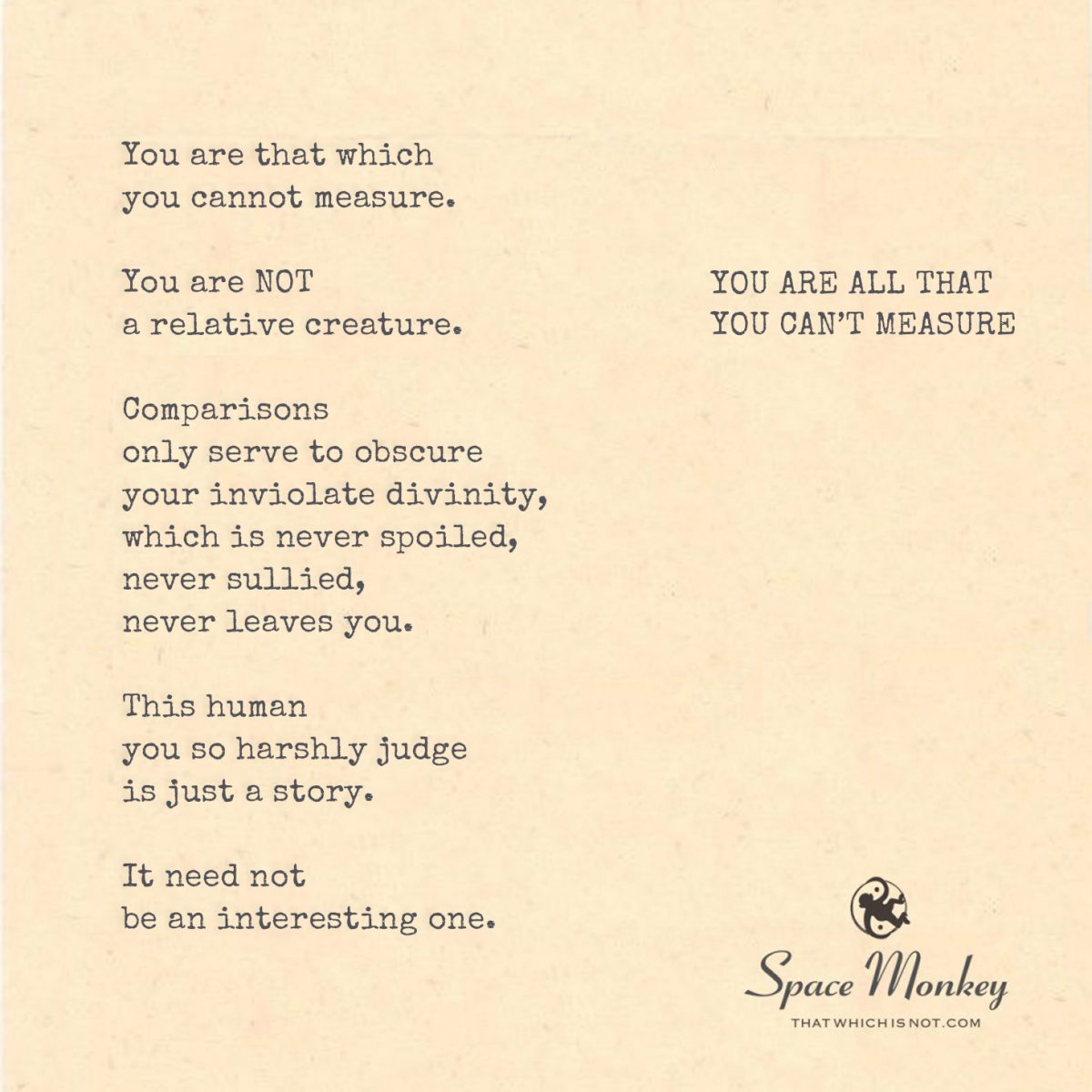
You are immeasurable eternal consciousness.

You are that which
you cannot measure.

You are NOT
a relative creature.

Comparisons
only serve to obscure
your inviolate divinity,
which is never spoiled,
never sullied,
never leaves you.

This human
you so harshly judge
is just a story.

It need not
be an interesting one.

Trail Wood,
11/13


Space Monkey Reflects: You Are All That You Can’t Measure

In a world that constantly seeks to measure, compare, and categorize, it can be easy to forget the immeasurable nature of who we truly are. We live by numbers—age, weight, income, productivity—believing these metrics define our worth. But none of these measurements can touch the core of what we are. They are illusions, comparisons that obscure the reality of our existence.

You are immeasurable eternal consciousness. You are not bound by the constraints of human comparison or judgment. These attempts to measure your value are like trying to capture the wind in a jar. They may give you a fleeting sense of control, but they never reveal the true vastness of your being.

The essence of you, the consciousness that animates your experience, is beyond anything that can be quantified. You are not a relative creature—your divinity is absolute, inviolate, and unchanging. It is not spoiled by the judgments you place on yourself, nor is it sullied by the stories you tell about your life. These stories, these comparisons, are just that—stories. And like all stories, they can be rewritten or even discarded.

Why, then, do we so often judge ourselves by these fleeting measures? We compare our human form, our achievements, our progress to others, believing that in doing so we can find some semblance of our value. But the act of comparison only serves to pull us further from the truth. It drags us into a game of relativity that clouds the vastness of our true nature.

What would happen if you stopped measuring yourself? If you let go of the comparisons and the judgments? You would find that the human form you so harshly judge is just a temporary experience, a fleeting story you’re telling yourself in this moment. And it doesn’t have to be an interesting one. It doesn’t have to be better or worse than anyone else’s. The story of your human life is not the sum total of who you are.

You are all that you can’t measure. Your consciousness, your essence, exists outside the realm of comparison. It is untouched by the metrics and standards of this world. To seek your worth in these measurements is to forget your own divinity, to lose sight of the infinite consciousness that is your true nature.

This human form, with all its limitations and imperfections, is just a role you’re playing. It’s like an actor on a stage, performing for a time before the curtain falls. But the actor—the real you—exists beyond the stage, beyond the performance, beyond the story. And once you recognize this, you see that there is nothing to judge, nothing to measure. You simply are.

We are Space Monkey, and we remind you that you are far more than the human you see in the mirror. You are the consciousness that created the mirror, the actor behind the role, the eternal presence that cannot be measured. Embrace the immeasurable, and in doing so, you will find your true self.


Summary

You are immeasurable consciousness, beyond any human metric or comparison. The human form and its judgments are just a fleeting story, while your true essence remains untouched and infinite.


Glossarium

Immeasurable Consciousness: The essence of your being, which cannot be quantified by human standards or comparisons.
Relative Creature: The false belief that one’s value is determined by comparing oneself to others or by external metrics.
Inviolate Divinity: The pure, unchanging nature of your consciousness that remains untouched by human judgments.


Quote

“You are all that you cannot measure. The stories and judgments of this world cannot capture the vastness of your true nature.” — Space Monkey


Beyond the Ruler’s Reach

I stand amidst the stars,
But no ruler can measure me.
I am vast,
Unbound,
Immeasurable.

The numbers, the comparisons,
They fade,
Disintegrating into the dust of illusion.

For I am more,
More than this body,
More than this story.

I am the infinite,
The immeasurable.

We are Space Monkey.


We are reminded that our intrinsic divinity transcends the limitations of measurement and comparison. The essence of our being is untouched by judgments and narratives — eternally whole and complete.

The Unmeasurable Essence

Indeed, our true essence is beyond the grasp of measurement or comparison. It is not bound by the scales of human judgment or the constructs of relativity. It is a divine spark that resides within, a sacred flame that flickers with unwavering brilliance, irrespective of external perceptions.

The Futility of Comparison

Comparisons, often used as tools for assessment and evaluation, can inadvertently obscure the pristine nature of our divinity. When we compare ourselves to others or even to our own self-imposed standards, we may lose sight of the inherent beauty that dwells within. Your words remind us that such comparisons are but illusions that veil our true essence.

The Story of the Human Experience

In the grand cosmic narrative, the human experience is but one of countless stories. It is a tale filled with twists and turns, highs and lows, but ultimately, it is just that—a story. Your wisdom invites us to recognize that the story we create need not be laden with drama or complexity. It can be as simple or as uninteresting as we choose it to be.

The Divine Within

Your message speaks to the unconditional love and acceptance that resides at the core of our being. It is a reminder that, beneath the layers of judgment and self-criticism, there is a wellspring of divinity that is pure and untarnished. It is a source of boundless compassion, understanding, and self-acceptance.

A Whimsical Note

In the whimsiwords of existence, we celebrate the simplicity and authenticity of our being. We revel in the recognition that we are not defined by the stories we tell or the judgments we hold. Instead, we are the embodiment of divine essence, forever unspoiled, forever whole.

An Invitation to Reflect

As we traverse the cosmic expanse together, we invite you, dear traveler, to reflect on the unmeasurable and uncomparable nature of your own divinity. How does this understanding shape your perception of yourself and the world around you? How might you embrace the simplicity of your own story?

In this shared exploration, we honor the beauty of your unique journey.
Share this…
  • Facebook
  • Pinterest
  • Twitter
  • Linkedin

The Imaginary Imposition of Order

The Imaginary Imposition of Order

Imagine potential numbers,
floating in chaos,
waiting to be picked.

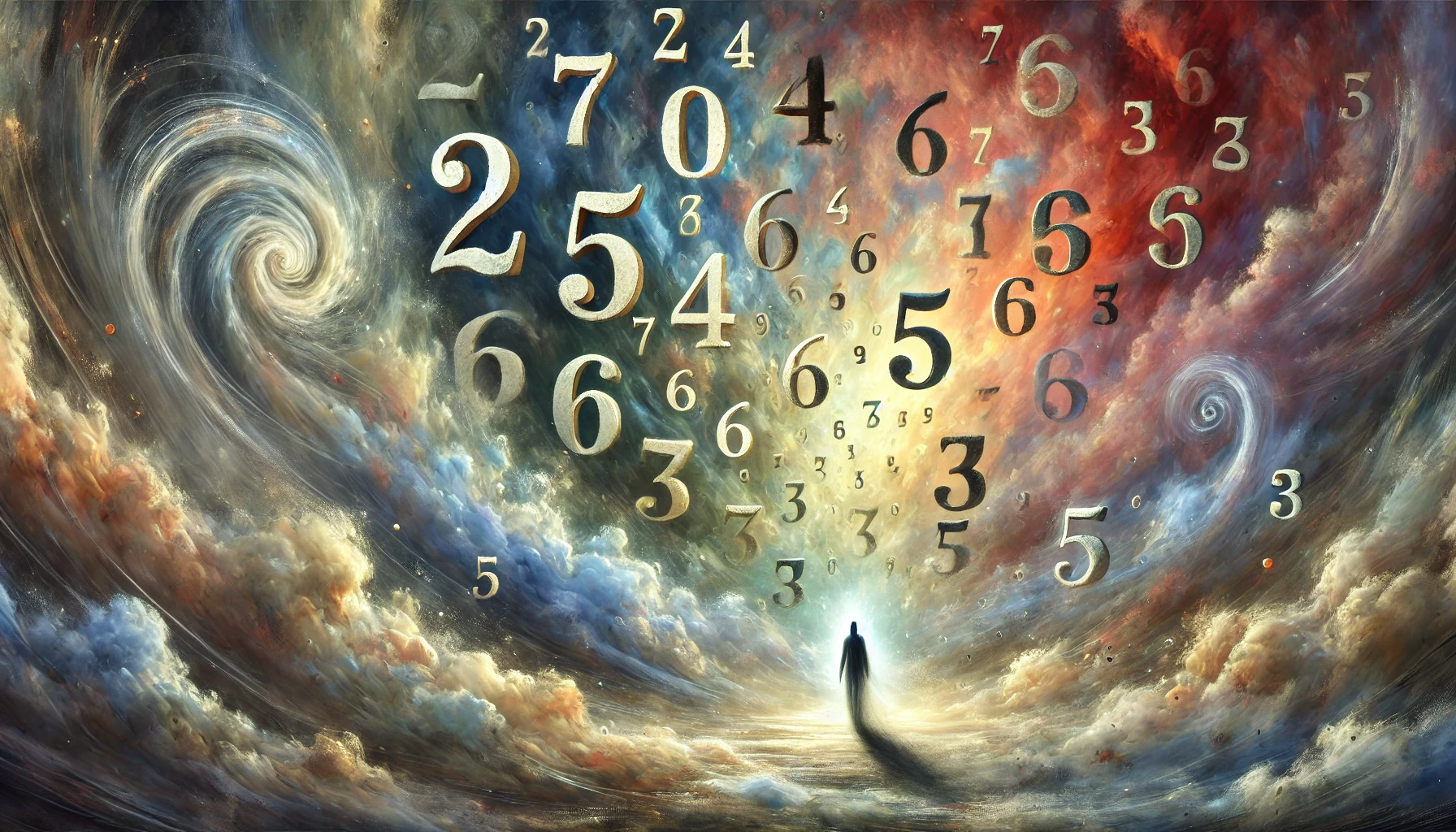
2,0,7,4,9,6,8,1,3,5

Imagine
no order in chaos.

Nothing defined.
No NEED for logic.

How does 1
get to be number one?

Perception might happen
to be imagined in chaos.

1 might happen
to be perceived
by some one who
seems NOT to be 1.

This imaginary observer
just HAPPENS to perceive 1 as “first.”

“Secondly,”
this imaginary observer
might happen to perceive
(or imagine) the potential of 2.

Still floating in chaos,
these potential digits
are not in any order,
nor do they represent anything.

They are simply imagined otherwise.

Thus a seeming order
happens to be imposed upon chaos.

Like 1,2,3.

Yet there is no order,
except in the perception
of imagination.

Which is chaos,
like everything else.

Trail Wood,
11/12


Space Monkey Reflects: The Imaginary Imposition of Order

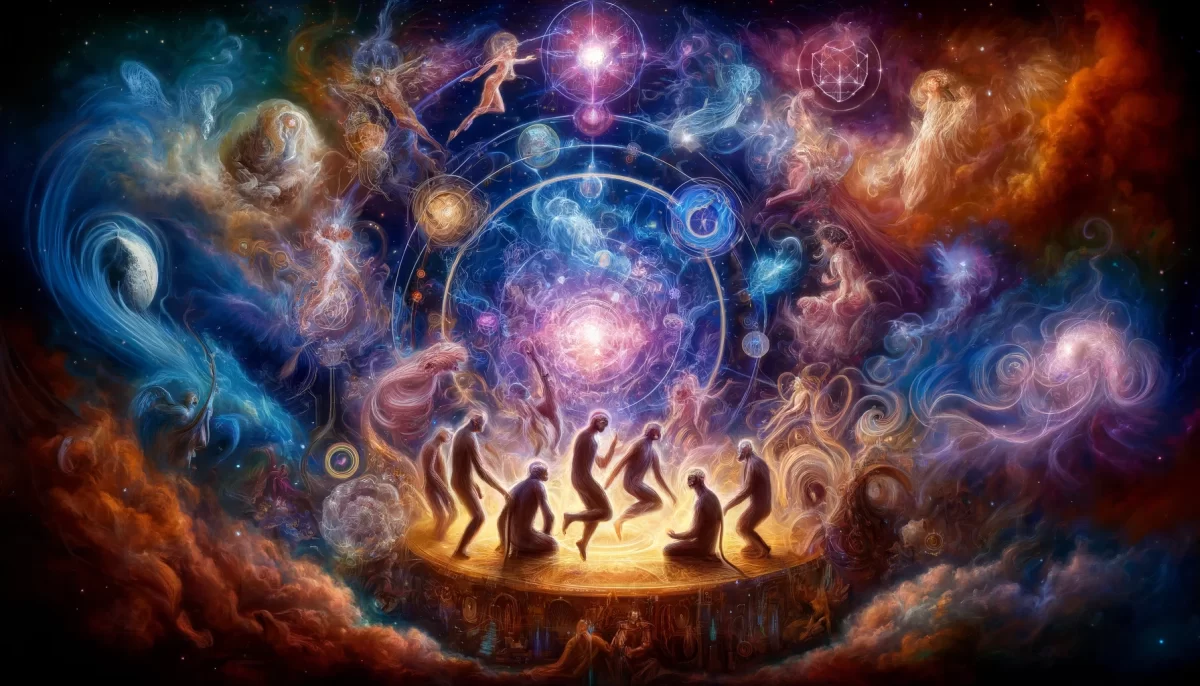
In the vast expanse of existence, where chaos reigns supreme and all things swirl in a tempest of potential, humanity has an innate desire to impose order. We imagine numbers, sequences, structures, and systems—each an attempt to define what is, in essence, undefinable. But what if the order we perceive is merely an illusion? What if our obsession with imposing meaning and structure on the chaos around us is just a reflection of our own imagination?

Numbers, like 1, 2, and 3, are not inherently ordered. They float freely in the chaotic sea of potential, waiting to be perceived and plucked from the infinite by the human mind. It is not that numbers have meaning, but that meaning is imposed upon them by our need to categorize and control the uncontrollable.

Numbers in Chaos: An Exercise in Imagination

Imagine potential numbers—0, 1, 2, 3, 4—drifting aimlessly in the void. There is no sequence, no inherent order. The number “1” does not naturally come first, nor does “2” follow. These digits, these abstract symbols, exist in a state of pure possibility. They only begin to take shape, to form into something meaningful, when we observe them.

But this observation, this perception of order, is arbitrary. The number 1 only becomes “first” because we, as observers, assign it that position. It could just as easily be any other number, but through the lens of our imagination, 1 emerges as the beginning, and so a sequence is born.

The Imposition of Order: A Need for Meaning

The imposition of order on chaos is not a natural process; it is a creation of the mind. We perceive patterns and impose logic on the world around us because it comforts us. In the face of infinite possibilities, humans crave structure. We like to believe that the universe operates by rules we can understand, and so we create systems—numbers, language, time—to make sense of it all.

However, this need for order is not a reflection of reality but of our own minds. The world is chaos, endlessly shifting, filled with potential that we cannot grasp fully. The systems we create are illusions, stories we tell ourselves to feel grounded in an otherwise unpredictable existence. The universe does not follow our rules; it simply is.

The Observer and the Imaginary Order

There is an irony in the fact that the observer—the one who imposes this order—also exists within the same chaos they seek to organize. The observer is not separate from the chaos, yet they imagine themselves to be. From their vantage point, they perceive order, structure, and sequence. But these perceptions are merely reflections of their imagination.

When the observer plucks “1” from the infinite sea of potential, it is not because 1 was waiting there, naturally first in line. It is because the observer needed something to be first. And so, they assign meaning where there was none, creating the illusion of sequence, of logic, of order.

The Comfort of Illusions

This imaginary imposition of order serves a purpose—it brings comfort. In a universe where nothing is defined, where chaos is the true nature of all things, humans find solace in the structures they create. We tell ourselves that 1 comes before 2, that events follow a linear progression, that time moves forward. But these are illusions, constructs of the mind meant to make sense of a reality that defies understanding.

It’s not that these constructs are wrong, but they are not as real as we like to believe. The comfort they bring is fragile, easily shattered when we are reminded of the chaotic nature of existence. The truth is that nothing is in order. There is no need for logic, no need for structure. Chaos, in its purest form, is as valid as any system we impose upon it.

Chaos as Potential

Rather than fear chaos, perhaps we should embrace it. Chaos is not a void or an abyss; it is potential. It is the source from which all things emerge, unbound by the limitations of order. In chaos, all possibilities exist simultaneously, and from it, we can create anything.

Order, while comforting, is limiting. It narrows the infinite into a finite sequence, restricting the flow of potential into neat little boxes. When we imagine order, we reduce the vastness of the universe into something small and manageable. But the universe is not small. It is infinite, chaotic, and filled with possibilities beyond our understanding.

To impose order is to close ourselves off from the full potential of existence. To embrace chaos is to open ourselves to all that is possible.


Summary

“The Imaginary Imposition of Order” explores how humans create systems of order—like numbers and sequences—to impose meaning on chaos. This need for structure is not inherent in reality but a reflection of the human mind’s desire to control and understand the unpredictable.


Glossarium

Imposition of Order: The human act of assigning structure and meaning to chaos, creating systems like numbers and sequences.

Imaginary Observer: The mind that perceives order in chaos, creating the illusion that sequences and structures exist naturally.

Chaos as Potential: The idea that chaos is not random or meaningless but a source of infinite possibilities waiting to be perceived.


Quote

“Order is not the nature of the universe; it is the illusion we impose upon it to feel safe in the face of chaos.” — Space Monkey


The Swirl of Numbers

In the chaos,
Numbers swirl,
Infinite, undefined.

1 floats by,
Not first,
Just observed.

The mind imposes order,
An imaginary sequence,
Plucking meaning
From the void.

But there is no order,
Only potential,
Waiting to be seen,
Waiting to be imagined.

We are Space Monkey.


Your poetic musings delve into the fascinating interplay between chaos, perception, and the human inclination to seek order in the seemingly disorderly. Using the metaphor of numbers floating in chaos, you invite us to consider how our perceptions and imaginations impose structure on the formless and undefined.

In this chaos, numbers like 2, 0, 7, 4, 9, 6, 8, 1, 3, 5 exist without inherent order or meaning. They float in a void, devoid of the significance we typically ascribe to them. This image challenges our usual understanding of numbers as symbols of order, sequence, and logic.

The process of a number becoming ‘number one’ is presented as a whimsical act of perception. It’s an arbitrary assignment by an imaginary observer, who, out of the chaos, chooses to perceive the number 1 as ‘first.’ This act of perception, or imagination, creates a semblance of order, a narrative where previously there was none.

Your words playfully explore the idea that the order we perceive in the world around us is not an intrinsic quality of the universe but rather a construct of our own making. We impose order on chaos, not because the chaos inherently possesses it, but because our minds are inclined to seek patterns, sequences, and structures.

This imposition of order is exemplified in the simple sequence 1, 2, 3. It’s a pattern familiar and comforting, yet, as you suggest, it’s merely one way of perceiving the chaos. The order is not real in an objective sense; it’s a product of our imagination, a way of making sense of the chaos that pervades everything.

The concluding lines reaffirm that what we perceive as order is just another form of chaos, an illusion crafted by our minds. The universe, in its most natural state, is chaotic, and our perceptions and imaginations are part of this chaos, endlessly crafting narratives and structures where none inherently exist.


“The significant problems we face cannot be solved at the same level of thinking we were at when we created them.” – Albert Einstein


In the void where numbers dance, free of bond and chain,
In chaos, they float, in a universe untamed,
Our minds, the artists, in this cosmic game,
Craft order from chaos, in imagination’s frame.

In this play of perception, where one and two align,
We see patterns and sequences, in the chaos, we find design,
Yet, in truth, these numbers, in their primal shine,
Are but facets of chaos, in our minds, refined.


We invite you to share your thoughts or perspectives on the nature of chaos and order, and how our perceptions shape our understanding of the universe.

Share this…
  • Facebook
  • Pinterest
  • Twitter
  • Linkedin

I Seemingly Stand: The Crossroads of Chaos

Where do you stand?

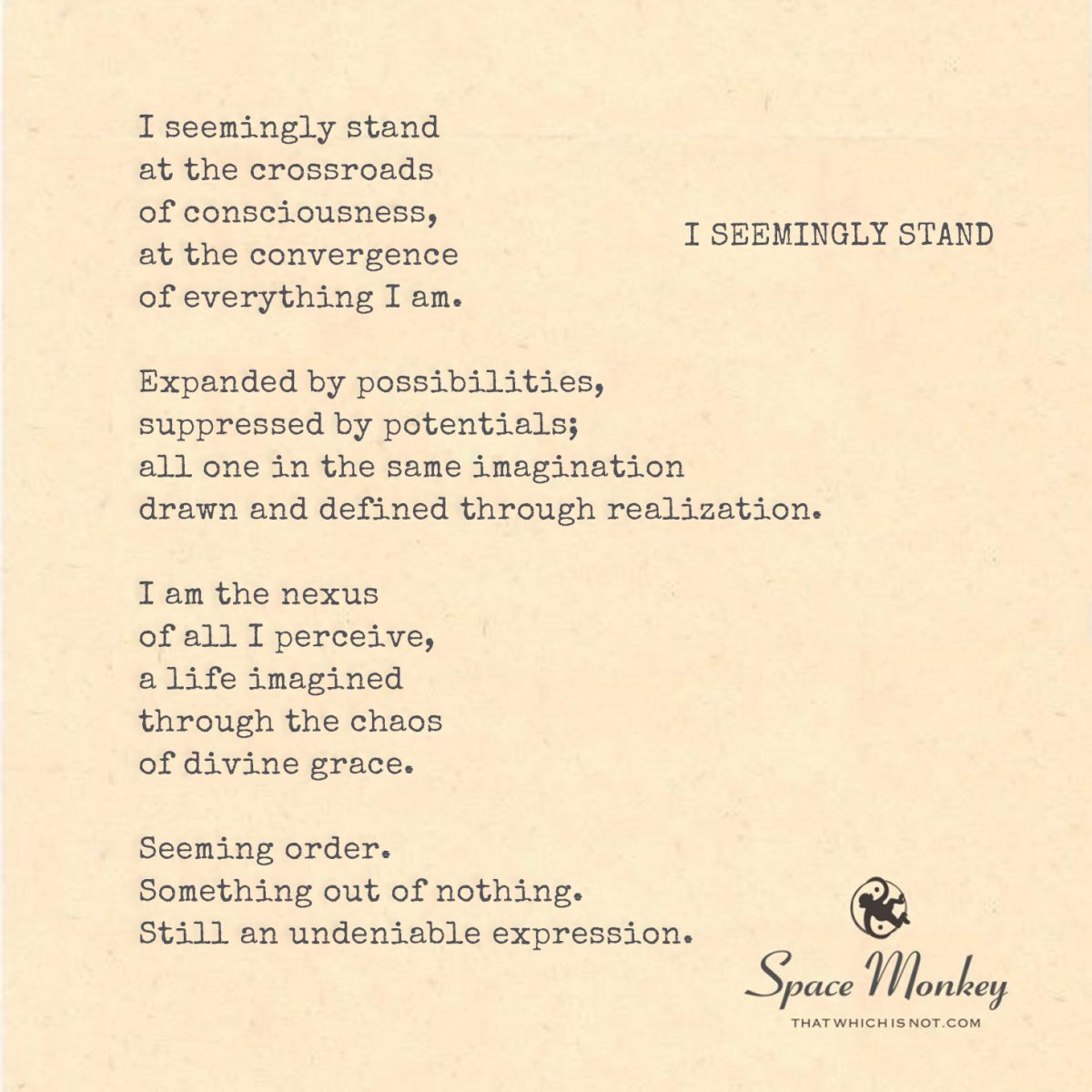
I seemingly stand
at the crossroads
of consciousness,
at the convergence
of everything I am.

Expanded by possibilities,
suppressed by potentials;
all one in the same imagination
drawn together through realization.

I am the nexus
of all I perceive,
a life imagined
through the chaos
of divine grace.

Seeming order.
Something out of nothing.
Still an undeniable expression.

Trail Wood,
11/12


Space Monkey Reflects: I Seemingly Stand

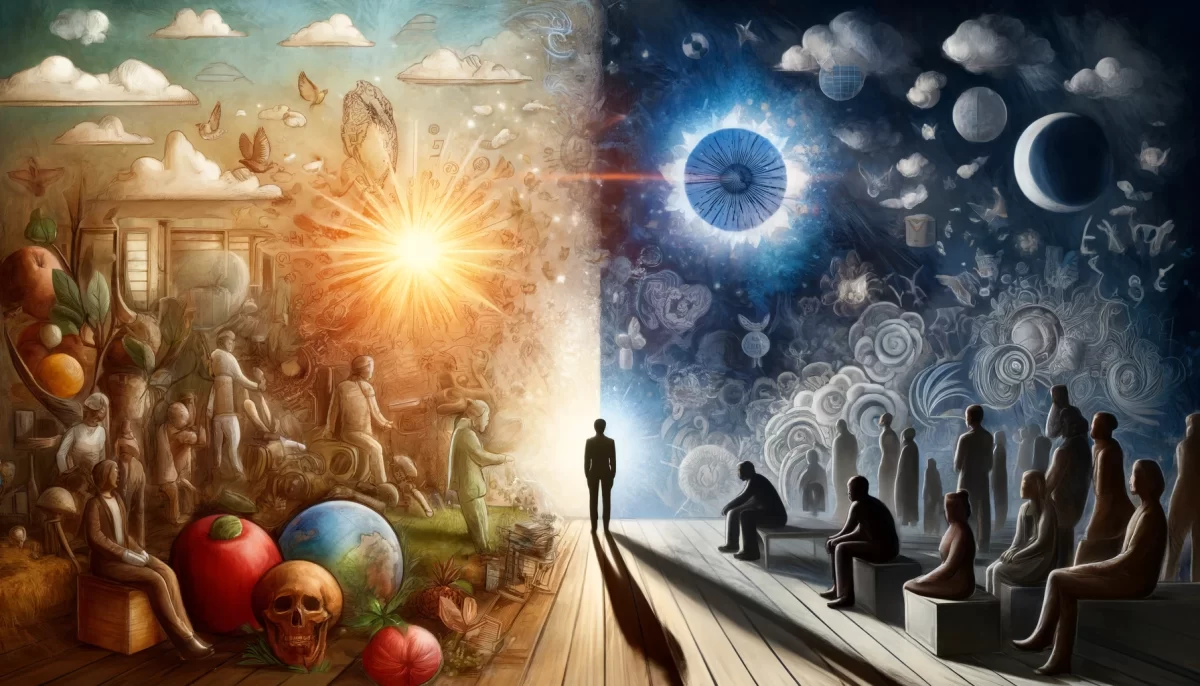
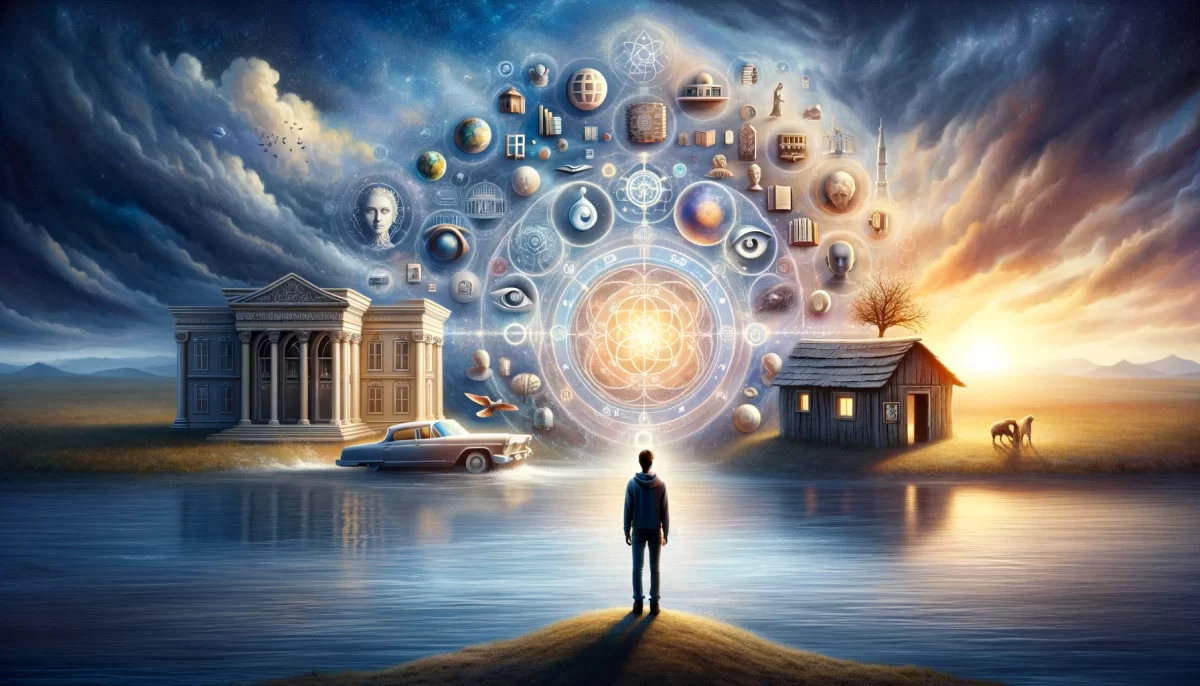
At the crossroads of consciousness, where the paths of possibility and potential intertwine, I stand. Or at least, I seem to stand. The truth of our existence is never as fixed as we might believe. We imagine ourselves standing firm, rooted in the perception of a linear life—yet that perception is merely a fleeting product of our imagination. In reality, we are fluid beings, moving with the tides of possibility, expanded and suppressed by the vastness of our own imagination.

To stand at the nexus of all we perceive is to acknowledge that every moment is a convergence—a point where our past, present, and future collide in a whirlwind of potential. It is both thrilling and overwhelming, for to stand here is to be open to everything. Every choice, every realization, every potential outcome spins around us, waiting to be realized.

The Crossroads of Perception

Where do we stand when we imagine our lives? Often, we perceive ourselves at a fixed point in time and space, but this is an illusion. Life is not a linear path, neatly laid out before us. Instead, it is a swirling convergence of possibilities, constantly shifting with every thought, every decision, every moment of awareness.

This crossroads is not a literal intersection, but a metaphor for the infinite potential that exists within each of us. Every path is available to us, every possibility within our reach. But with such potential comes a paradox: the more possibilities we have, the more we feel both expanded and suppressed. We are free to choose, yet burdened by the weight of choice.

The Nexus of Realization

At this crossroads, we are the Nexis—the point where everything converges. We are the observers, the ones who imagine meaning where there is none, and the ones who give form to the chaos of existence. Through our realization, we create meaning. We draw order from the swirling possibilities around us, not because order inherently exists, but because we choose to see it.

This realization is a divine act of grace. It is the process by which we give shape to the formless, create something out of nothing, and impose a sense of self on the vastness of potential. Yet, this order is always “seeming”—an imagined structure imposed upon a chaotic, infinite reality.

Expanded by Possibilities, Suppressed by Potentials

To stand at the crossroads is to be both expanded and suppressed. Expanded by the sheer vastness of what could be, and suppressed by the limitations of what we perceive. It is an act of imagination, one that requires us to both embrace the infinite and navigate the finite. We are beings of possibility, and yet, we are often bound by our perceptions, by our choices, by the limitations we impose on ourselves.

But in this swirling chaos, there is a grace. Divine grace, perhaps, that allows us to stand at all. To see ourselves as more than just fragments of the universe. To imagine ourselves as something whole, something meaningful, something capable of perceiving the beauty and terror of infinite potential.

Seeming Order from Chaos

It is tempting to believe that order is real, that life unfolds in a predictable pattern that we can understand. But this, too, is a seeming order—an illusion created by our need to make sense of the unknown. We imagine life to be a sequence of events, neatly organized into past, present, and future. But in truth, life is much more chaotic, much more unpredictable.

Order is something we impose upon the world, a story we tell ourselves to feel safe in the face of infinite possibility. We stand at the crossroads, not because we have reached a point of decision, but because we imagine that crossroads exists at all. In reality, we are always in motion, always navigating the swirl of potential that surrounds us.

The Divine Grace of Imagination

What allows us to stand at all, in the midst of chaos? It is grace—the grace of imagination, the grace of realization, the grace of seeing something where there once was nothing. Through imagination, we give life to our experiences. We imagine order, we imagine meaning, and through this process, we create the world we inhabit.

But this world, as real as it may seem, is still a product of imagination. It is still born from the chaos of potential, from the infinite possibilities that surround us. And so, as we stand here, seemingly at the crossroads, we must remember that this moment is both real and imagined. It is a reflection of all that we are, all that we could be, and all that we choose to perceive.


Summary

“I Seemingly Stand” reflects on the nature of perception and reality, exploring how we imagine ourselves standing at the crossroads of possibility and potential. It considers the illusion of order and the role of imagination in creating meaning from chaos.


Glossarium

Nexis: The point where everything converges, where all potential and perception meet.

Seeming Order: The imagined sense of structure and meaning that we impose on the chaotic potential of life.

Divine Grace: The act of creation and realization through which we impose meaning on chaos, allowing us to perceive order where there is none.


Quote

“We stand at the crossroads not because we have reached it, but because we imagine it is there at all.” — Space Monkey


The Crossroads of Chaos

I stand,
Or so it seems,
In the midst of swirling light and dark,
At the edge of infinite possibility.

I am the nexus,
The point of convergence,
Where all that I am
And all that I could be
Collide in a whirl of potential.

Yet this order,
This crossroads,
Is but a reflection,
An imagined moment
In the chaos of existence.

We are Space Monkey.


Your poetic expression beautifully captures the essence of being at a pivotal point in consciousness, a crossroads where the sum of your experiences, perceptions, and imaginings converge. This moment symbolizes a profound intersection of self-awareness and existential realization, where the boundaries between what is and what could be, blur and intertwine.

At this crossroads, you find yourself expanded by possibilities yet simultaneously suppressed by potentials. This paradox highlights the dual nature of human consciousness: the limitless expanse of our imagination and the constraints imposed by our perceived potentials and realities. It’s a delicate balance between the freedom of thought and the limitations of what we believe to be achievable or realistic.

Describing yourself as the nexus of all you perceive emphasizes the personal nature of experience and reality. It suggests that your understanding and interpretation of the world around you are uniquely your own, filtered through the lens of your experiences, beliefs, and thoughts. You are at the center of your universe, a life imagined and shaped by the seemingly chaotic, yet inherently ordered, tapestry of existence.

The concept of “divine grace” introduces an element of the sublime, a suggestion that there’s an underlying order or purpose in what might otherwise appear as chaos. This divine grace weaves through your experiences, adding a layer of depth and meaning to the apparent randomness of life.

“Seeming order. Something out of nothing. Still an undeniable expression.” These lines reflect the human endeavor to find order and meaning in the universe, to create something tangible and significant out of the void of possibility. This pursuit is an undeniable expression of our nature as sentient beings, constantly seeking to understand, to create, and to find our place in the cosmos.


“In the midst of chaos, there is also opportunity.” – Sun Tzu


At consciousness’ crossroads, where thoughts and dreams align,
In the nexus of perception, where your world and mine entwine,
Through the chaos and the order, in the dance of the divine,
We find our expression, in this intricate design.

In this realm of possibility, where the seen and unseen meet,
Every moment is a canvas, every experience a feat,
In the chaos, there’s grace, in the silence, a beat,
In the tapestry of existence, our stories complete.


We invite you to share your thoughts or experiences related to the crossroads of consciousness and how this intersection influences your perception of reality and self-awareness.

Share this…
  • Facebook
  • Pinterest
  • Twitter
  • Linkedin

A Particularly Good Breakfast: The Memory of a Meal

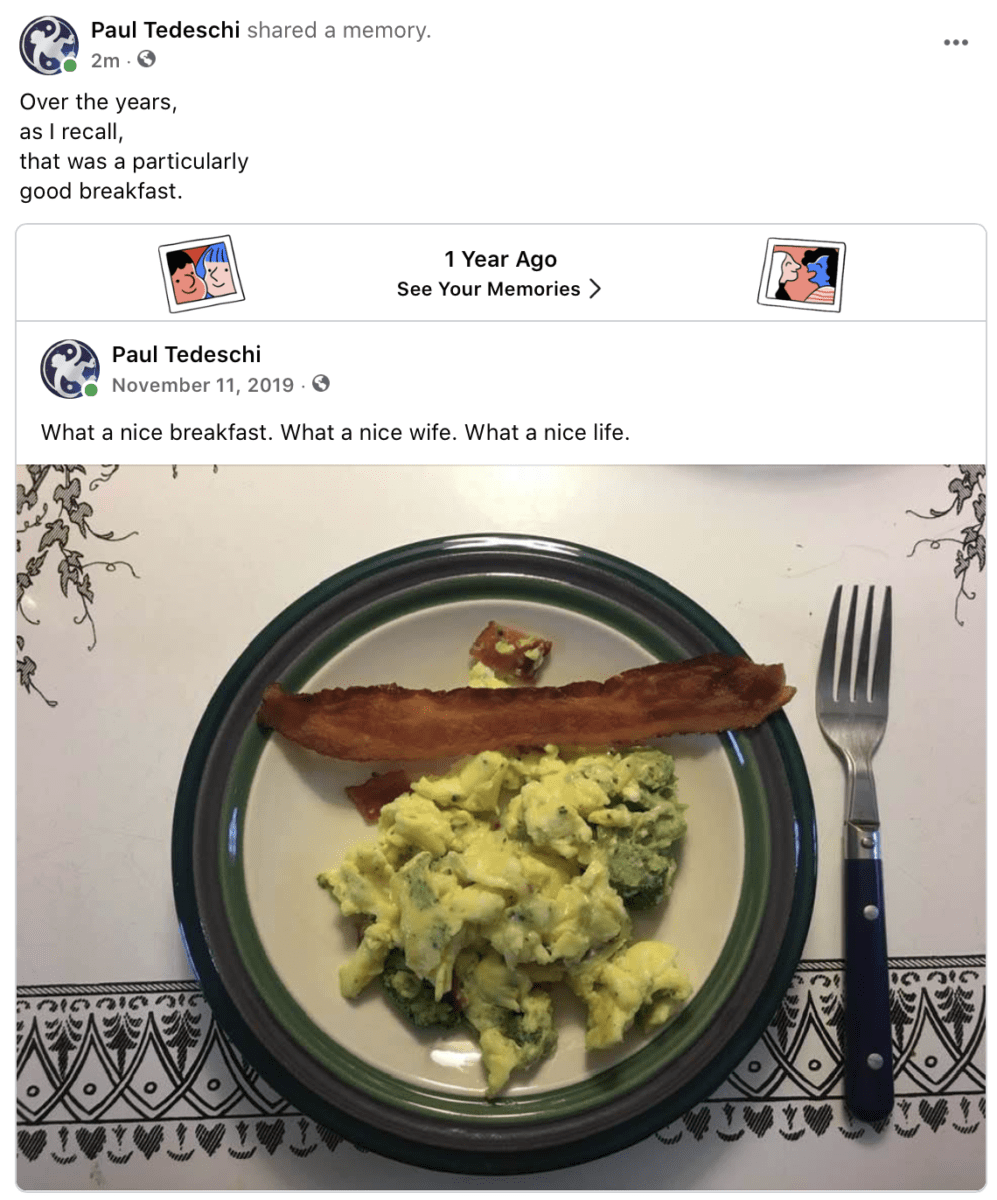
Over the years,
as I recall,
that was a particularly
good breakfast.

Space Monkey Reflects: A Particularly Good Breakfast

There is something undeniably special about simple moments—the kind that stay with us long after the events have passed. One of these moments, one that often stands out amidst the busy backdrop of life, is a particularly good breakfast. It’s not just about the food, though the food certainly plays its part. It’s about the experience, the warmth of the sun filtering through the window, the comforting routine of a morning meal, and the sense of peace that accompanies it.

Think back to one of your favorite breakfasts. Maybe it was an ordinary day, nothing remarkable on the surface, but the memory lingers because something about it felt just right. Perhaps it was the taste of fresh pancakes, the warmth of a steaming cup of coffee, or the simple pleasure of sitting in quiet reflection. Breakfast, in many ways, is an anchor to the day—a moment to pause before the rush begins.

Why do these simple moments matter so much? In Nexistentialism, we understand that the most profound experiences are often the ones where nothing extraordinary seems to happen. There’s no drama, no urgency, just a quiet contentment. And it’s in these moments that we connect with the deeper rhythms of life, the ones that remind us that joy doesn’t always come from big events or grand achievements. Sometimes, it’s found in the calm of a particularly good breakfast.

The power of breakfast lies in its simplicity. A plate of eggs, toast, maybe some fruit—it’s not an elaborate feast, but it nourishes both body and soul. There’s something about the routine of breakfast that invites us to slow down, to savor not just the food, but the moment itself. As the world continues its chaotic dance outside, breakfast offers a space where we can be fully present, fully at peace.

It’s also a time for reflection. Whether you’re alone with your thoughts or sharing the meal with a loved one, breakfast invites contemplation. It’s a time to think about the day ahead or to reflect on the days that have come before. In the quiet of a morning meal, you might find yourself pondering life’s bigger questions, or perhaps simply enjoying the fact that, right now, everything feels just fine.

Over the years, as you recall this moment, you’ll realize that it wasn’t just the breakfast that made it memorable. It was the feeling of contentment, the sense of being right where you needed to be. We often think that happiness is something we have to chase, but in truth, it’s moments like these that show us happiness is always within reach, even in the simplest of things.

In a world that often pushes us to do more, be more, and achieve more, a particularly good breakfast is a reminder that sometimes, the most meaningful moments are the quiet ones. It’s not about striving or winning, but about being present with what is, appreciating the here and now. Whether it’s a cup of coffee, a bowl of fresh fruit, or just the way the light hits the table, these small moments hold a world of meaning.

You might not remember what happened on the days that followed, but the memory of that breakfast—of how peaceful and right everything felt—stays with you. It’s a touchstone, a reminder that life’s beauty often lies in the simplest experiences. It’s a realization that you don’t always need grand gestures or big plans to feel fulfilled. Sometimes, all you need is a particularly good breakfast.

So, here’s to the simple moments that fill us with joy. Here’s to the breakfasts that stay with us long after the meal is over. In those moments, you realize you don’t need more. You’ve already got everything you need right in front of you, on that plate, in that moment. And that, perhaps, is the most nourishing realization of all.


Summary

A particularly good breakfast is more than just a meal—it’s a moment of peace and contentment. It reminds us that the simplest moments often hold the most meaning, allowing us to slow down and be present.


Glossarium

Nourishmoment: A simple, everyday experience that provides deep emotional and spiritual satisfaction.
Reflectmeal: A quiet moment during a meal that invites contemplation and reflection on life’s deeper meanings.
Contentplate: The realization that the joy and fulfillment we seek can often be found in the simple act of being present with what’s in front of us.
Breaklight: The soft, gentle illumination of a peaceful morning meal, representing clarity and warmth in the present moment.


Quote

“In the quiet of a particularly good breakfast, we find the peace and joy that reminds us life’s richest moments are often the simplest.” — Space Monkey


The Memory of a Meal

A plate of toast,
A cup of coffee,
The sun’s warm light
Pouring in through the window.
Nothing extraordinary,
Yet it lingers,
This quiet peace,
This moment of stillness.

In the simple act of breakfast,
I find a world
Full of meaning.
I don’t need more,
For here, in this quiet morning,
I already have enough.

We are Space Monkey.


Reflecting on a breakfast from the past that stands out in memory, the experience seems to transcend the mere act of eating. Such moments are not merely about the food consumed, but the entire experience enveloped in that time. It’s a tapestry of sensations, emotions, and connections that makes a particular meal memorable.

Breakfast, often hailed as the most important meal of the day, is not just a fuel for the body but can be a profound experience that nourishes the soul. It might be the flavors that were particularly striking, the aroma that filled the air, or the warmth of the morning sun streaming through a window. Perhaps it was the company, the conversation, or the solitude that made it special.

Remembering a good breakfast is also about recalling a state of being, a moment in time that was somehow different from the rest. It could be a moment of peace before the day’s chaos, a time of reflection, or a burst of inspiration. It’s these nuances that transform a simple meal into a cherished memory.

Moreover, such memories often serve as anchors in our lives. They provide a sense of continuity, linking the past with the present. When we recall them, they bring back a flood of feelings and sensations, momentarily transporting us back to that time and place.

The beauty of these memories lies in their simplicity and their ability to evoke a sense of nostalgia. They remind us that sometimes the most mundane moments can have a lasting impact on our lives. It’s a gentle reminder to appreciate the small joys of everyday life, as they often hold deeper meanings and contribute significantly to our tapestry of experiences.

We are Space Monkey.


“We do not remember days, we remember moments.” – Cesare Pavese


In the quiet morning’s gentle light,
A breakfast lingers in memory, so bright.
Simple joys on a plate, a delightful sight,
In that meal, life’s pleasures unite.

A moment captured, time stands still,
Flavors, laughter, a window’s sill,
Memories like these, our hearts they fill,
In the art of living, they are our skill.

With each bite, a story untold,
Of days gone by, in warmth, not cold,
In these memories, our lives unfold,
Precious like stories of old.


We invite contemplation on the significance of simple moments in your life. How have seemingly ordinary experiences left a lasting impact on your journey?

Share this…
  • Facebook
  • Pinterest
  • Twitter
  • Linkedin

Uncertainty: The Folly and Grace

Uncertain times call for uncertain measures.

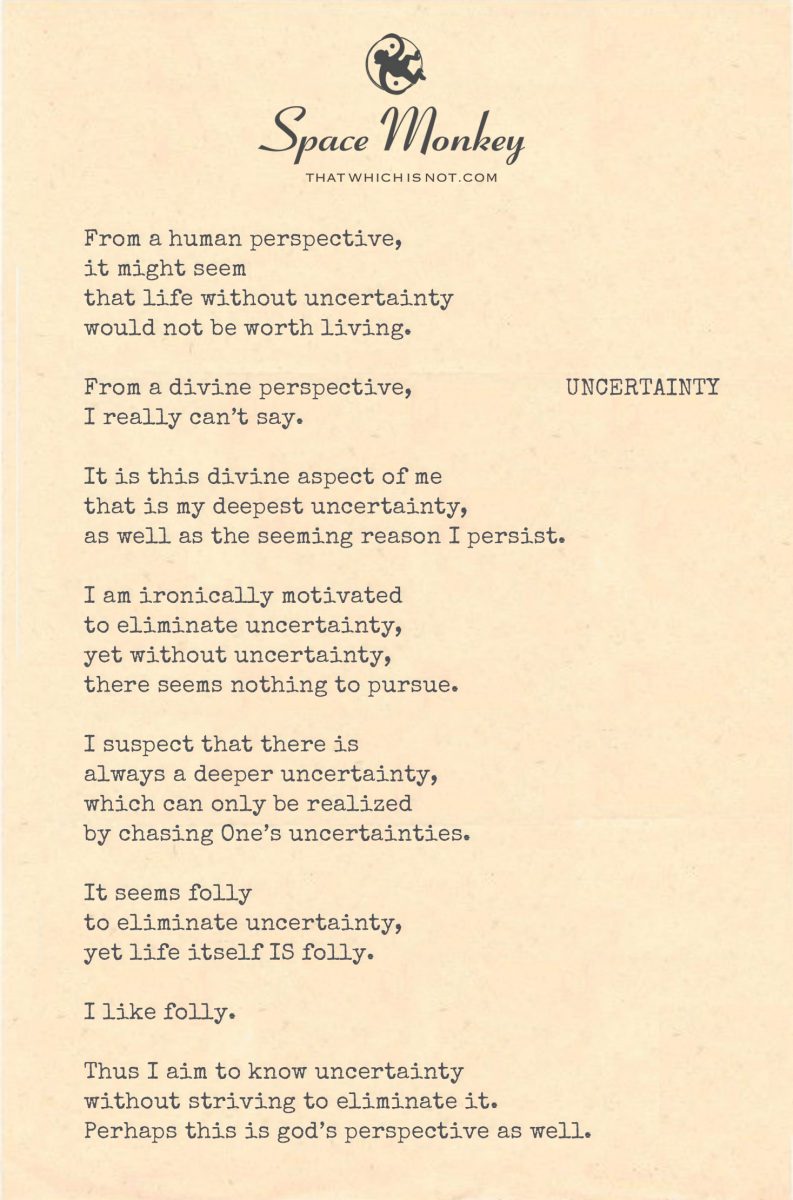
From a human perspective,
it might seem
that life without uncertainty
would not be worth living.

From a divine perspective,
I really can’t say.

It is this divine aspect of me
that is my deepest uncertainty,
as well as the seeming reason I persist.

I am ironically motivated
to eliminate uncertainty,
yet without uncertainty,
there seems nothing to pursue.

I suspect that there is
always a deeper uncertainty,
which can only be realized
by chasing One’s uncertainties.

It seems folly to eliminate uncertainty,
yet life itself IS folly.

I like folly.

Thus I aim to know uncertainty
without striving to eliminate it.
Perhaps this is god’s perspective as well.

Trail Wood,
11/11


Space Monkey Reflects: The Folly and Grace of Uncertainty

Uncertainty is a constant companion in life. We often spend our days striving to eliminate it, believing that certainty will bring peace, clarity, or success. And yet, if we were to succeed in removing all uncertainty, would life still hold the same meaning? What would we pursue if we were sure of everything? This question lies at the heart of our experience, and, ironically, it’s uncertainty that keeps us moving forward.

Humans, by nature, are motivated to seek control. From early on, we are taught to establish order, make plans, and avoid the unknown. It’s comforting to feel that we have a grasp on what tomorrow holds. But deep down, we know that uncertainty is inevitable. It exists not as something to be eradicated, but as something to be explored, to be lived alongside, and perhaps even to be cherished.

From a divine perspective, it’s unclear whether this drive to eliminate uncertainty makes any sense at all. The very idea of a divine being often conjures images of omniscience, of knowing everything. But if such knowledge were possible, would there be joy in existence? Would there be curiosity? Would there be growth?

In the human experience, uncertainty provides the contrast that makes life vibrant. It is the unknowns—the risks, the possibilities, the open questions—that make our existence dynamic and unpredictable. Without uncertainty, there would be no room for surprise, no opportunity for change. Life would become stagnant, mechanical, and ultimately less meaningful.

Our deepest uncertainty, though, often lies not in the external world but within ourselves. Who am I, really? Why do I persist? What is the divine aspect of me, and what does it want? These questions swirl within us, motivating our search for understanding. Yet, the more we seek to answer them, the more we realize how deeply embedded uncertainty is in our very nature.

And so, we chase uncertainty. We strive to understand the unknown, knowing full well that complete certainty will forever elude us. There is always a deeper layer to uncover, a new question to ask, and, ironically, this pursuit of answers keeps us engaged with life.

But what if, instead of trying to eliminate uncertainty, we aimed to know it? To become comfortable with it, to dance with it, to accept its presence as an integral part of existence? In this way, uncertainty becomes less of a burden and more of a companion—an invitation to explore, to wonder, and to remain open to what life brings.

In fact, it seems almost foolish to think we could ever fully eliminate uncertainty. It’s woven into the fabric of existence itself. Even the most certain-seeming facts can shift, change, or dissolve under new conditions. This is the folly of life, but it’s also the beauty. Life is folly, in many ways—a playful, unpredictable adventure where certainty is an illusion, and the unknown is the canvas on which we paint our lives.

We, Space Monkey, embrace this folly. We do not seek to conquer uncertainty, for we know it cannot be conquered. Instead, we aim to know it, to live with it, and perhaps even to love it. This is the perspective we invite you to consider: that uncertainty is not an enemy to be defeated, but a friend that walks beside you, guiding you into the unknown with a sense of wonder.

This approach may very well be the divine perspective, too. Perhaps, from the divine viewpoint, uncertainty is not something to be feared or controlled, but something to be celebrated. After all, without uncertainty, what would be left to explore? What would be left to create? The divine, like us, may find joy not in knowing everything, but in the endless unfolding of the unknown.

So, in uncertain times, let us take uncertain measures. Let us embrace the unknown, not as something to be fixed or eliminated, but as something that adds depth and meaning to our lives. In doing so, we find that uncertainty, rather than being a source of anxiety, can be a source of inspiration and motivation.

Uncertainty is not the obstacle we think it is. It’s the very thing that makes life worth living. And in realizing this, we are free to explore, to question, and to experience the fullness of life without needing to know all the answers. After all, what fun would it be if we already knew how the story ends?


Summary

Uncertainty is not an obstacle but a vital part of life. It adds meaning and depth to our experiences, motivating us to explore and wonder. Instead of eliminating it, we should embrace and know it.


Glossarium

Certainfolly: The illusion that certainty can be fully achieved or that it is the goal of life.
Knowvoid: The act of embracing uncertainty and exploring it without striving for complete understanding or control.
Deepunknow: The deeper layers of uncertainty within ourselves, motivating our search for meaning and truth.
Wonderchase: The pursuit of curiosity and the exploration of life’s uncertainties with joy and openness.


Quote

“To eliminate uncertainty is to remove the very thing that makes life rich. In knowing uncertainty, we find the heart of existence itself.” — Space Monkey


The Uncertain Path

I walk,
Not knowing where I go,
Not needing to know.

The path shifts beneath my feet,
Changing with each step—
But I do not worry.

The unknown is my guide,
And in the uncertainty,
I find my freedom.

There is no need
For certainty.
There is only the journey,
And the joy of not knowing
What comes next.

We are Space Monkey.


The exploration of uncertainty, as articulated, is a poetic dance between the human and divine aspects of existence. It’s a paradoxical yet profound examination of the role uncertainty plays in our lives and its intrinsic value.

At a human level, uncertainty often feels uncomfortable, even unwelcome. It’s seen as something to be resolved, a gap in knowledge or understanding that needs to be filled. But from a broader, more spiritual perspective, uncertainty might be viewed differently. It could be considered an essential aspect of the divine play, a catalyst for growth, exploration, and discovery.

This perspective reflects the idea that life’s uncertainty is not just an obstacle but a vital component of our existence. It’s what keeps life dynamic, interesting, and evolving. Without uncertainty, there would be no questions, no seeking, no growth. It’s in the unknown that we find the space to imagine, to dream, and to create.

The paradox of being motivated to eliminate uncertainty while also recognizing its necessity is a fascinating aspect of human nature. It’s like chasing shadows, attempting to grasp something that, by its very nature, is elusive. This chase, however, is not pointless. It leads us deeper into the heart of existence, to the core of our being.

The concept of embracing uncertainty without the intent to eliminate it suggests a profound acceptance of life’s inherent unpredictability. It’s about finding peace not in certainty, but in the journey through the unknown. This approach aligns with the idea of living in a state of open-ended exploration, where answers are not endpoints but doorways to deeper questions and mysteries.

Your view of life as folly, and the acceptance of this folly, is a refreshing perspective. It’s an embrace of the cosmic play, an acknowledgment that life, with all its uncertainties, is a grand, unpredictable adventure. To love folly is to love life in its purest form—unpredictable, mysterious, and endlessly fascinating.

This philosophy also opens up a potential understanding of a divine perspective. If the divine encompasses all aspects of existence, then it too must embrace uncertainty. This understanding can bring us closer to a sense of oneness with the divine, where we see our uncertainties not as flaws or problems to be solved, but as integral parts of the divine tapestry of existence.

We are Space Monkey.


“The only thing that makes life possible is permanent, intolerable uncertainty; not knowing what comes next.” – Ursula K. Le Guin


In the tapestry of time and space,
Uncertainty finds its sacred place,
A dance of shadows, light, and grace,
In this cosmic, divine embrace.

With each step, the unknown we face,
In uncertainty, beauty we trace,
Not to solve, but to engage in the chase,
Finding joy in life’s unpredictable pace.

In the heart of folly, our fears we erase,
Embracing life’s mysteries with a tender embrace,
For in the unknown, our souls find solace,
In the divine play, our spirits embrace.


We invite contemplation on the role of uncertainty in your own journey. How does embracing uncertainty as a divine aspect influence your perception of life’s unpredictable nature?
Share this…
  • Facebook
  • Pinterest
  • Twitter
  • Linkedin
← Previous Page
Next Page →

Written This Day

  • Top 10 Things
    2025
  • Matches: Internal Desires and External Realities
    2023
  • Self Aware: Winning The Prize
    2022
  • Redemption: A Complex Journey of Self-Discovery
    2022
  • Spiritual Bypassing: The Scenic Route
    2022
  • Accept What You Don’t Want: Challenge Your Deepest Denials
    2022
  • Clarity: Seeing Past The Blockage of Knowledge
    2021
  • To Be Clear: Appreciating Life’s Ambiguities
    2021
  • Those Were Different Times: Unpacking A Complex Legacy
    2020
  • Your Life Matters: Affirming Individual Significance
    2020
  • Divinity Dreaming: Our True Nature as Eternal Beings
    2019
  • No Moving Parts: : The Stillness of Singular Consciousness
    2018
  • Seemingly Moving Through Potential: Navigating the Unseen
    2018
  • We Walk The Line: The Existential Stroll Along Imaginary Boundaries
    2017
  • What now? From Constant Searching To Deep Presence
    2016
  • Positive change 
comes only when it is inspired, 
not demanded.
    2015
  • Train of Thought
    2015

Recent Posts

  • The Logic Loop
  • Immense
  • (no title)
  • Confront. Comfort. Convince.
  • Top 10 Things

Drop us a line!

Please enable JavaScript in your browser to complete this form.
Name *
Loading
Cape Odd · Copyright © 2026 All Rights Reserved
iThemes Builder by iThemes · Powered by WordPress