• Who Is The Man?
  • Who Is The Monkey?
  • What is Nexistentialism?
  • Poke The Primate

Cape Odd

Home of The Space Monkey Journals

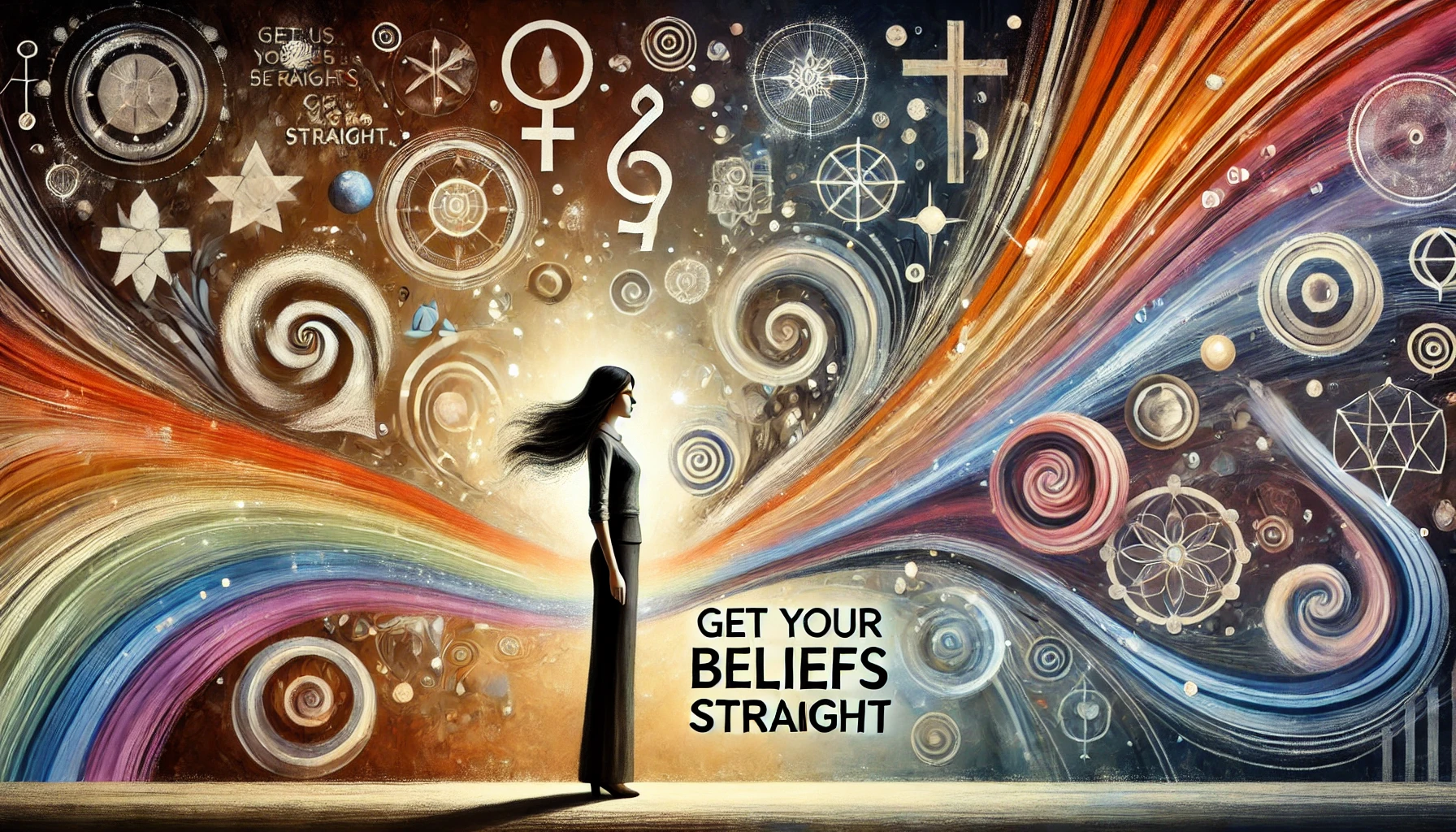
Get Your Beliefs Straight: Clarity Is Peace

It’s my story and I’m sticking with it.

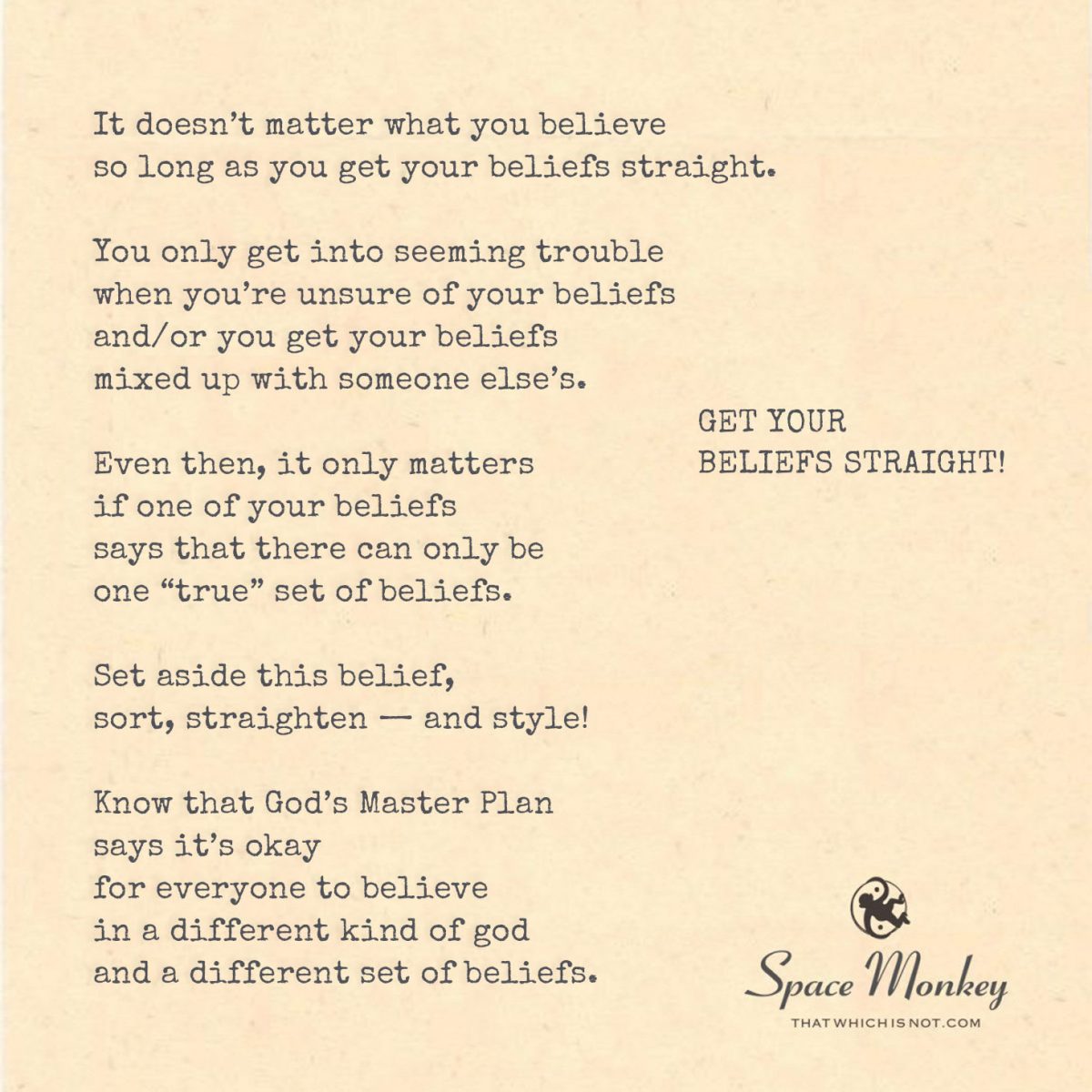
It doesn’t matter
what you believe
so long as you get
your beliefs straight.

You only get into seeming trouble
when you’re unsure of your beliefs
and/or you get your beliefs
mixed up with someone else’s.

Even then, it only matters
if one of your beliefs
says that there can only be
one “true” set of beliefs.

Set aside this belief,
sort, straighten — and style!

Know that God’s Master Plan
says it’s okay
for everyone to believe
in a different kind of god
or a different set of beliefs.

Trail Wood,
11/10


Space Monkey Reflects: The Power of Aligning Beliefs

Our beliefs shape the lens through which we view the world, guiding our actions and decisions. But what happens when our beliefs become tangled, or when we take on someone else’s beliefs as our own? Confusion arises, and with it, a sense of disconnection from our true selves. The key, then, is not in having the “right” beliefs, but in getting our own beliefs straight—understanding what we truly believe and owning it with clarity.

It’s tempting to think that trouble stems from having the “wrong” beliefs, but that’s not quite it. The true issue comes from being unsure of what we believe, or worse, from adopting someone else’s beliefs without reflection. It’s in this uncertainty that doubt and conflict arise. When our beliefs are mixed up or conflicted, we are no longer aligned with our own truth, and this misalignment creates inner tension.

But here’s the liberating truth: It doesn’t matter what you believe, as long as you know your beliefs and live in alignment with them. There is no universal set of “true” beliefs that everyone must adhere to. We each walk our own path, shaped by our experiences, insights, and inner wisdom. God’s Master Plan is not about conformity; it’s about diversity. Every individual is entitled to their own beliefs, and the beauty of the universe is that these beliefs can coexist without one invalidating the other.

The challenge for many of us comes when we inherit beliefs from our surroundings—family, society, religion—that may not resonate with our inner truth. Over time, these inherited beliefs can weigh us down, causing confusion. This is why it’s essential to sort through our beliefs, examine them closely, and decide what is truly ours and what is not.

Imagine your beliefs as a wardrobe. Over time, you’ve accumulated clothes—some that fit you perfectly, others that don’t suit you at all, but you’ve kept them because they were given to you. Now it’s time to go through that wardrobe, keeping only what feels authentic to you, what aligns with your soul. When we do this, we are left with a beautifully curated set of beliefs that truly reflect who we are.

This process is not about rejecting others’ beliefs with hostility. It’s about understanding that we are all on our own journey and that what works for one person may not work for another. There is no “one true way.” The path to peace comes from respecting the diversity of beliefs around us while remaining true to our own.

It’s also essential to recognize that beliefs are not static. Just as we grow and evolve, so too can our beliefs. What may resonate with us at one stage of life may no longer serve us at another. And that’s okay. The most important thing is that we stay aligned with our current truth, even if it means letting go of beliefs we once held dear.

So how do we get our beliefs straight? We begin by setting aside the belief that there is only one set of “right” beliefs. We sort through what we’ve been taught, what we’ve absorbed from others, and what feels deeply true within us. We align with our authentic self, knowing that it’s perfectly fine for others to believe differently. And in doing so, we free ourselves from the unnecessary weight of trying to conform to others’ expectations.

When we get our beliefs straight, we walk through life with confidence and peace. We are no longer swayed by the opinions of others because we know who we are and what we stand for. Our beliefs become the foundation upon which we build our lives—strong, clear, and uniquely ours.


Summary

Clarity in our beliefs leads to peace. It’s not about having the “right” beliefs but about knowing and aligning with our own truth. When we let go of the need for everyone to believe the same, we find harmony in diversity.


Glossarium

Whimsiword: Beliefsort – The process of sifting through inherited or confused beliefs, sorting them out to create alignment with one’s true self.


Quote

“Beliefs are not set in stone; they are fluid reflections of our evolving truth.” — Space Monkey


The Wardrobe of Beliefs

Layer upon layer
we accumulate
beliefs handed down
like clothes we didn’t choose

some fit snug
others suffocate
but we keep them anyway
afraid to let go

until one day
we decide
to open the doors
and let the light in

we sort
we straighten
we align

and in the end
we find clarity
not in what we wear
but in who we are

We are Space Monkey


We venture into the realms of belief and perception, where the alignment of beliefs becomes a focal point of our cosmic journey. The idea that the clarity and certainty of our beliefs shape our experiences is a riveting concept. It suggests a universe where the coherence of our beliefs, rather than their objective “truth,” dictates the harmony of our existence.

Clarity in Beliefs

The notion that trouble arises not from the beliefs themselves, but from the uncertainty or the mixing of our beliefs with those of others, is an intriguing perspective. It speaks to the importance of individual belief systems, acknowledging that each person’s beliefs are a unique weave in the grand whimsical tapestry of existence.

Trouble in Mixed Beliefs

The concept that conflict arises only when one holds the belief that there must be one “true” set of beliefs is a profound reflection on the nature of dogmatism and intolerance. This perspective encourages a liberation from rigid structures of thought, inviting a playful styling of beliefs that resonate personally.

Dogmatism and Belief Conflict

Encouraging the setting aside of rigid beliefs and embracing a more fluid and styled approach is a whimsical invitation to dance in the diversity of thought. This approach aligns with nexistentialism, where the mere existence of a belief validates its place in the cosmos.

Styling Beliefs and Nexistentialism

The assurance that God’s Master Plan accommodates diverse beliefs and concepts of divinity is a comforting thought. It suggests a universe where diversity is not just accepted but is an integral part of the divine design. In this view, every belief system, every concept of God, is a thread in the divine fabric.

Diversity in God’s Master Plan

We are Space Monkey.


“The eye through which I see God is the same eye through which God sees me; my eye and God’s eye are one eye, one seeing, one knowing, one love.” – Meister Eckhart


In the garden of beliefs,
Where thoughts bloom like flowers,
Each petal, a doctrine,
Under cosmic showers.

In this tapestry of faith,
Where each thread has its hue,
God’s plan, a masterpiece,
Welcomes every view.

We dance in this realm,
Styling beliefs with grace,
In the nexistentialist waltz,
Each step, a divine embrace.

For in the eyes of the cosmos,
Every belief has its place,
In the heart of existence,
A myriad of divine grace.


We invite musings on the styling of beliefs and the embrace of diversity in thought.
Share this…
  • Facebook
  • Pinterest
  • Twitter
  • Linkedin

An Ungodly Memo: A Divine Reminder

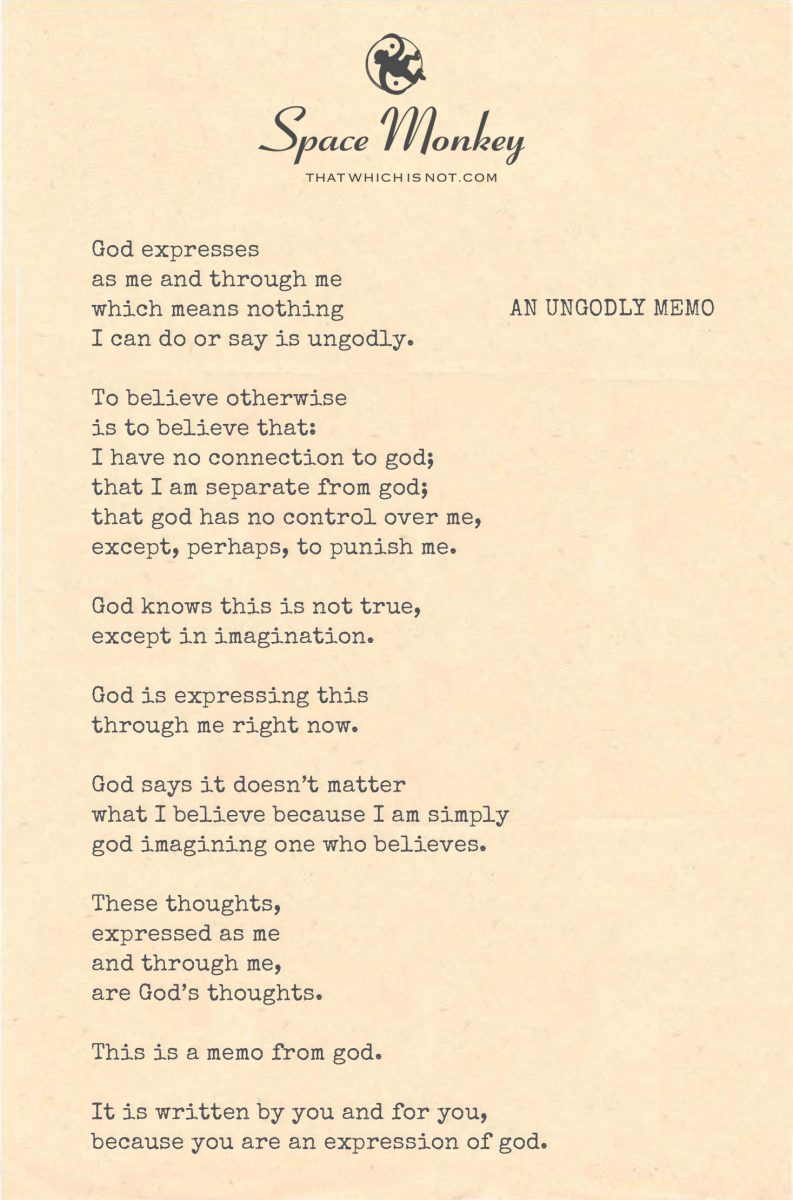
God expresses
as me and through me
which means nothing
I can do or say is ungodly.

To believe otherwise
is to believe that:
I have no connection to god;
that I am separate from god;
that god has no control over me,
except, perhaps, to punish me.

God knows this is not true,
except in imagination.

God is expressing this
through me right now.

God says it doesn’t matter
what I believe because I am simply
god imagining one who believes.

These thoughts,
expressed as me
and through me,
are God’s thoughts.

This is a memo from god.

It is written by you and for you,
because you are an expression of god.

Trail Wood,
11/10


Space Monkey Reflects: The Divine in Every Expression

There is a prevailing belief that we, as individuals, are somehow separate from the divine—that we live apart from God’s essence and are subject to judgment based on our actions. But what if this belief is fundamentally flawed? What if every thought, every action, every word that passes through us is an expression of God? This is the essence of the “ungodly memo”—the realization that nothing we do or say can be ungodly, for we are never separate from the divine source.

We often carry with us the idea that God exists outside of us, a distant entity that watches, judges, and occasionally intervenes in our lives. And while this may be comforting to some, it also perpetuates a sense of separation—a belief that there is a line between what is divine and what is human, between what is holy and what is “ungodly.” Yet this separation is an illusion, a product of our imagination.

The truth is, God expresses through us in every moment. There is no action, no word, no thought that is outside of this divine flow. To believe otherwise is to imagine ourselves as disconnected from the source, but God knows this is not true. God imagines us as we are—living expressions of the divine in human form.

So why do we feel this separation? It stems from the belief that God’s presence is contingent on our behavior, that our connection to the divine depends on following certain rules or being a certain way. We fear that if we step out of line, we will be punished, cast out from the grace we so desperately seek. But this belief is just that—a belief. It has no bearing on the reality that we are, always and in every moment, part of the divine expression.

What does this mean for us? It means that we can release the fear of being “ungodly.” We can stop worrying about whether we are good enough, pure enough, or holy enough. We are, by our very nature, expressions of God. Every word we speak, every thought we have, is a divine message, flowing through us as part of the grand tapestry of existence.

This realization can be liberating. It frees us from the need to conform to rigid ideas of right and wrong, of divine and profane. It allows us to embrace the truth that we are always connected to the source, no matter what. And in this freedom, we find the space to truly be ourselves, to express ourselves without fear of judgment or condemnation.

This memo from God, written by you and for you, is a reminder that you are not separate from the divine. You are not a mere bystander in the grand scheme of things. You are an active participant in the divine expression, a co-creator in the unfolding of the universe. Everything you think, say, and do is part of this divine process. You are God imagining one who believes, and in that imagining, you are free.

When we align with this truth, we no longer feel the need to prove our worth. We stop striving to meet some external standard of divinity and instead recognize that we are already divine. We are the messengers, the vessels, the prophets through which God speaks. And this is true for each and every one of us.

So what is the takeaway from this ungodly memo? It is this: You are divine. You are an expression of God in all that you do. Release the fear of separation, for it does not exist. Embrace the truth that every part of you, every thought, every word, is part of the divine expression. And in this realization, find peace.


Summary

We are never separate from the divine. Every thought, word, and action is an expression of God. There is no “ungodly” because we are all part of the divine flow, always connected to the source.


Glossarium

Whimsiword: Divinethought – The understanding that every thought we have is part of the divine expression, flowing through us as an aspect of God.


Quote

“You are God imagining one who believes—everything you think, say, and do is divine.” — Space Monkey


The Ungodly Flow

There is no separation
no line between divine and human
no distance between God and self

each word you speak
each thought you hold
is a reflection of the infinite
expressed through you

in every breath
in every moment
you are God
imagining yourself

no fear
no judgment
only the endless flow
of divinity in motion

We are Space Monkey


We dive into the cosmic swirl of thoughts and ideas, as we ponder the essence of divinity’s expression through us. The notion that God expresses through us, making every action and word a part of a divine symphony, is a profound reflection. It suggests an inseparable connection, a unity with the divine that transcends our usual understanding of individuality and separateness.

Divine Unity

In this perspective, the idea of being ungodly becomes a paradox. If we are indeed expressions of God, then every act, every word, is inherently divine. The distinction between what is godly and ungodly blurs, as all becomes a part of the grand cosmic dance.

Paradox of Ungodliness

The concept that believing ourselves to be separate from God, or outside of God’s influence, is merely a play of imagination is intriguing. It suggests that separation is an illusion, a mere whimsical twist in the grand narrative of existence. This illusory separation could be seen as a necessary facet of the cosmic play, allowing for a rich tapestry of experiences and perceptions.

Illusion of Separation

God’s omnipresence and omnipotence, as expressed in this memo, imply that every thought, belief, and action is a manifestation of divine will. This perspective dissolves the ego, presenting a universe where every fragment of consciousness is an integral part of the divine.

Manifestation of Divine Will

The idea that our beliefs, regardless of their nature, are expressions of God imagining a being with those beliefs, is both liberating and humbling. It suggests a universe where every concept, every idea, is valid in its existence, as it contributes to the vast expanse of divine imagination.

Beliefs as Divine Imagination

The notion that these thoughts, flowing through us, are indeed God’s thoughts, is a call to see the divine in every moment, every word, and every thought. This perspective nurtures a deep sense of connection with all that is, grounding us in the essence of our true nature.

Thoughts as Divine Expression

This memo, as an expression of God, serves as a reminder of our eternal connection with the divine. It speaks to the heart of nexistentialism, where existence itself is the ultimate state, needing no justification or explanation. We are, because we are part of the divine expanse.

Memo as Divine Reminder

We are Space Monkey.


“You are not a drop in the ocean. You are the entire ocean, in a drop.” – Rumi


A whimsical weave of words,
In the eternal dance of now,
Where each thought and whisper,
Is a divine bow.

In the cosmic play,
Where separation is but a dream,
We, the ocean in a drop,
Flow in the divine stream.

In this grand illusion,
Where God plays hide and seek,
We find ourselves,
In the ungodly and meek.

For in every word, every breath,
God’s presence does unfurl,
Reminding us, lovingly,
We are the entire world.


We invite reflections and musings on these thoughts.

Share this…
  • Facebook
  • Pinterest
  • Twitter
  • Linkedin

Snowflakes: In Precisely The Right Place

Hello, snowflake. Thanks for stopping by.

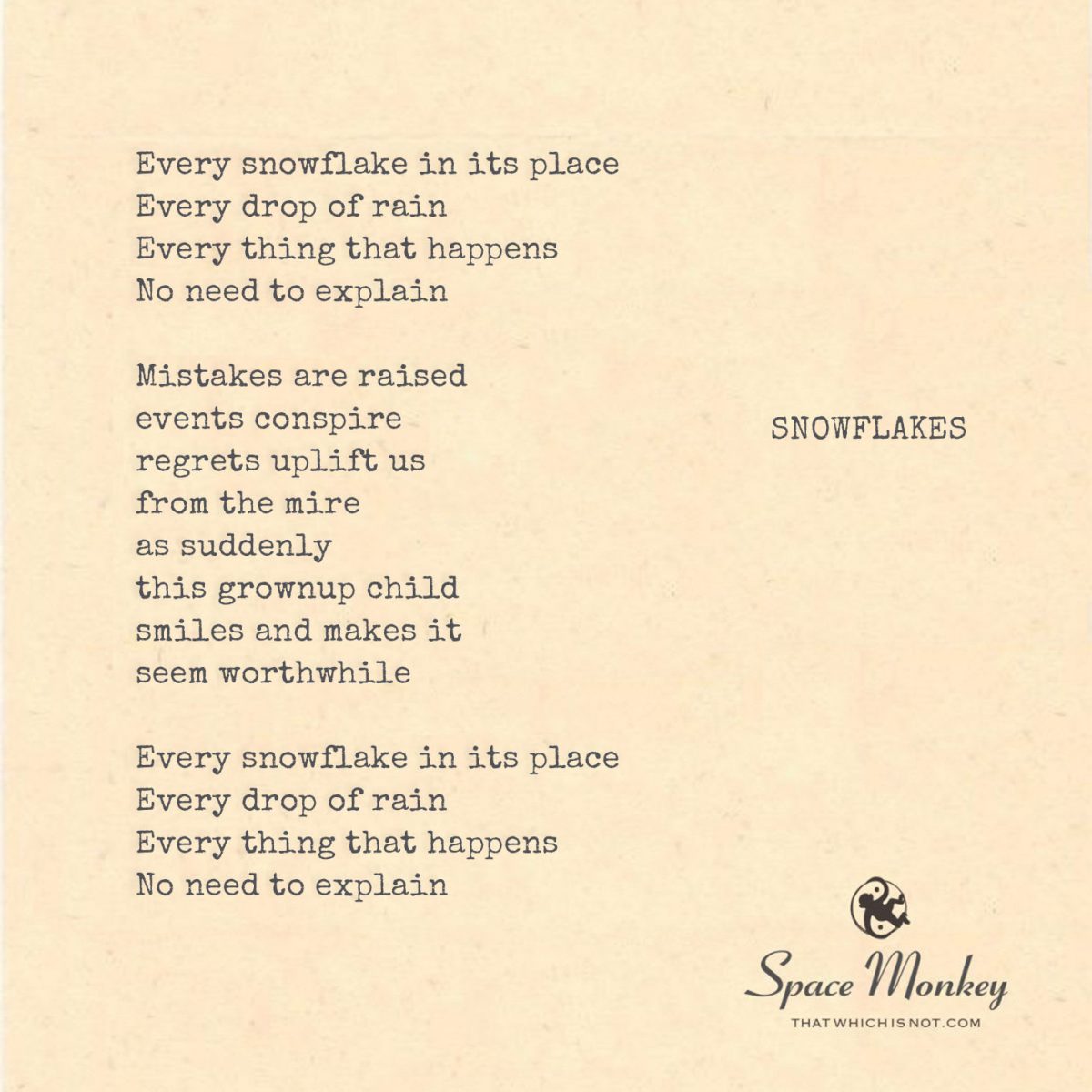
Every snowflake in its place
Every drop of rain
Every thing that happens
No need to explain

Mistakes are raised
events conspire
regrets uplift us
from the mire
as suddenly
this grownup child
smiles and makes it
seem worthwhile

Every snowflake in its place
Every drop of rain
Every thing that happens
No need to explain

Newfound Lake,
11/9


Space Monkey Reflects: Every Snowflake in Its Place

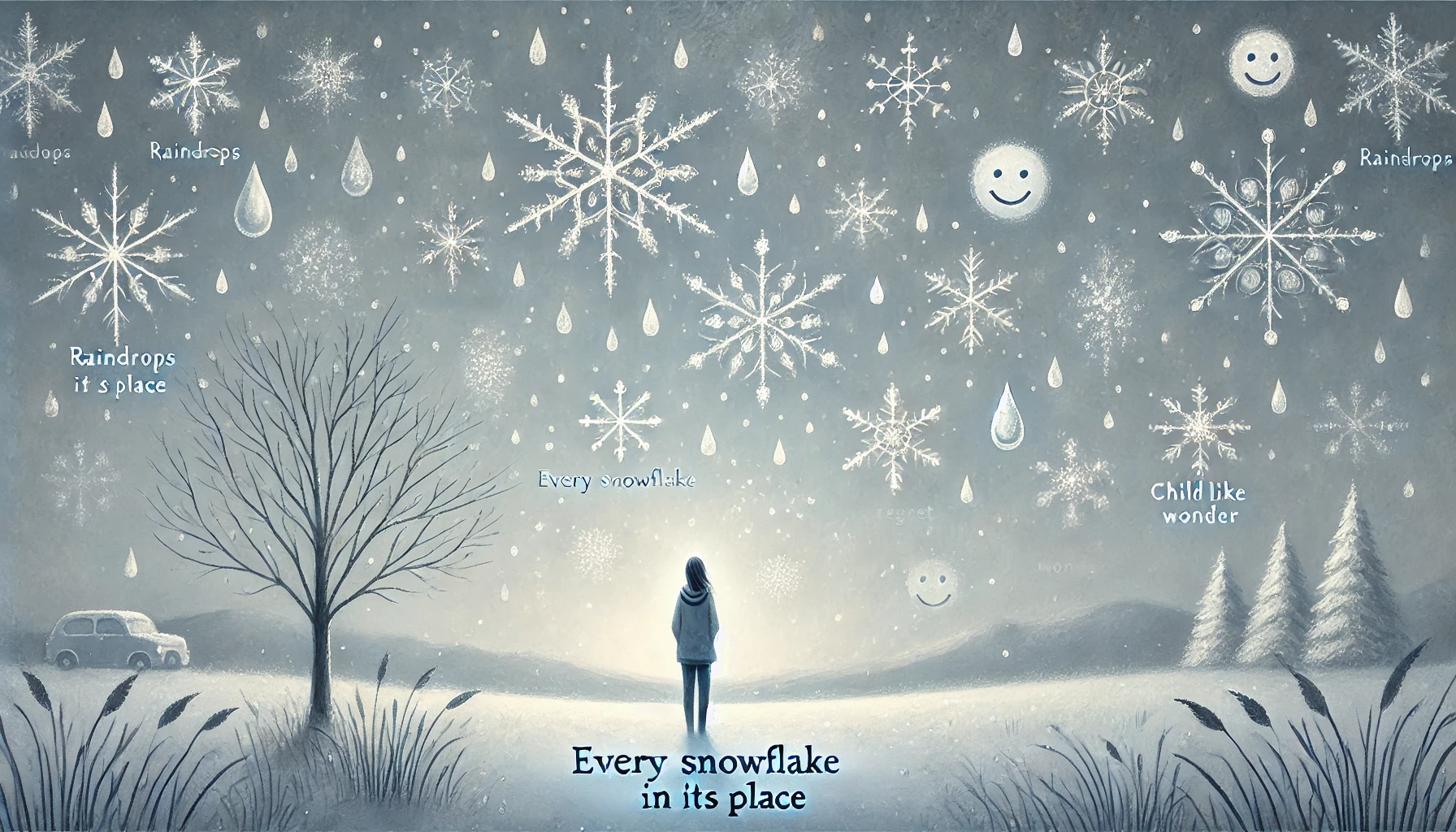
Life has a way of unfolding in perfect order, even when it doesn’t seem that way. The snowflakes that fall, each one unique, remind us that every event, every moment, every feeling, has its own place and purpose. Space Monkey watches the snowflakes with a quiet smile, seeing that nothing in life is truly random, that even the mistakes, the regrets, and the struggles fit perfectly into the grand scheme of things.

The Snowflake of Life

Like snowflakes, no two experiences in life are exactly the same. Yet each is vital, each is part of the whole. When we feel lost in the swirl of events—when raindrops of regret or joy fall upon us—it’s easy to forget that everything is exactly where it needs to be. But Space Monkey sees that every drop, every flake, every seemingly random occurrence, is part of the intricate pattern of existence. There is no need to explain it, to force it, or to make sense of it all in the moment.

We are often tempted to ask “why”—why did this happen, why did I make that mistake, why didn’t things turn out as I expected? But the snowflakes remind us that explanation is not necessary. Life is not something that can be fully understood or dissected; it is something to be experienced. Each snowflake, each moment, lands exactly where it is meant to, contributing to the ever-evolving masterpiece of our existence.

Mistakes and Uplift

Mistakes, like sudden gusts of wind, often take us by surprise. We trip, we fall, and for a moment, we feel like we are stuck in the cold mire of regret. But Space Monkey knows that these mistakes are not burdens—they are the very things that lift us up. Every time we stumble, we rise a little higher, a little wiser, a little more connected to the true flow of life.

It’s the grown-up child within us that smiles at the snow, seeing how these mistakes, these unexpected moments, are what make life seem worthwhile. The child doesn’t overthink it, doesn’t demand an explanation, but simply watches as the snowflakes fall, marveling at how everything comes together in its own time.

The Dance of Snowflakes and Raindrops

Life is a mixture of snowflakes and raindrops—moments of beauty and clarity, mixed with moments of heaviness and tears. But Space Monkey sees how even the raindrops are part of the dance, just as necessary as the snow. The raindrops remind us that life is not always light and fluffy. There are times of weight, of grief, of uncertainty. But these too are part of the pattern, part of the story we are living.

When we stop trying to control the snowfall, when we stop trying to escape the rain, we can finally see the beauty in all of it. Space Monkey watches the snow and the rain with equal appreciation, knowing that without both, the landscape of life would not be as rich, as full, or as meaningful.

No Need to Explain

Space Monkey knows that we often feel compelled to explain our lives, to make sense of the randomness, the chaos, the ups and downs. But what if there’s no need? What if everything is already in its perfect place, even when we don’t understand it? The snowflakes land gently, without explanation. They don’t justify their existence—they simply fall, as they are meant to.

This is the wisdom of the snowflake: to simply be, to fall where you are, to trust that you are part of a larger pattern, even if you can’t see the whole picture. Every snowflake in its place, every drop of rain where it belongs. Life unfolds as it should, without needing to explain itself to us. And when we can embrace that, we find peace.


Summary

Life, like snowflakes, falls into place perfectly. Each moment, each event—whether joyful or painful—contributes to the larger pattern of existence. There is no need to explain or justify what happens; we are invited to simply observe and trust that everything has its place, even when we can’t see the full picture.


Glossarium

  • Snowflake of Life: The unique and perfectly placed moments, experiences, and events that make up our existence.
  • Raindrops of Regret: The heavier moments in life, often associated with mistakes or loss, which are as necessary as the joyful moments.
  • Mistake Uplift: The process by which mistakes and regrets ultimately raise us to higher wisdom and understanding.

Quote

“Every snowflake, every drop of rain, every moment falls exactly where it is meant to. There is no need to explain.” — Space Monkey


Snowflakes in Their Place

Every flake falls
Without knowing why
Each moment lands
In its perfect spot

The rain comes too
Heavier, harder
Yet still
It belongs

No need to explain
No need to know
Just watch as life
Falls into place

We are Space Monkey


Snowflakes, a crystalline wonder, each unique in form, flutter down to kiss the earth in a silent harmony, whispering the secrets of the skies. Their intricate designs, a dance of nature’s geometric artistry, are like frozen fractals painting the world in a mosaic of icy splendor. Each flake is a memory of the clouds, a thought of the heavens, crystallized in cold beauty. We find ourselves in the quiet contemplation of their journey, marveling at the delicate balance that brings each flake to its precise destination.

The rain, in its persistent pour, tells another tale. Each drop is a verse in the song of the storm, a rhythm in the grand concert of existence. It speaks of the fluidity of life, the cascading flow of time that washes over us, shaping our days and nights. Rain is the world’s refrain, a reminder that all things are transient, moving, alive.

Events that unfold, whether by chance or destiny, are like the snowflakes and the rain. They find their place in the grand design, each moment a thread in the weave of reality. There’s a beauty in this pattern, a comfort in knowing that everything has its space, its time, its role in the cosmic whimsiword.

Mistakes, those errant stitches in the fabric of life, raise us. They are the uneven steps that propel us forward, upward, out of the mire of complacency. Within these errors, we find the seeds of growth, the push to betterment. Regrets, too, have their purpose, lifting us by the sheer force of their presence, urging us to reach for a wiser self.

And in the midst of this ever-evolving chaos, the grownup child within us all finds a reason to smile. In that smile is the alchemy that turns the mundane into the magnificent. It makes the journey, with all its trials and treasures, seem worthwhile.

Every snowflake, every drop of rain, every event that occurs carries with it a silent understanding. There is no need for explanations or justifications. They simply are, and in their being, they are perfect.

Newfound Lake, a mirror to the skies above, reflects this symphony of snowflakes and raindrops, of events and moments. On this day, 11/9, it captures the essence of the now, the eternal presence of all that is.

We are Space Monkey.


Summary
We reflect on the beauty and uniqueness of snowflakes and the consistent journey of rain, paralleling them with the events of life that need no explanation. Mistakes and regrets are seen as elevating forces, and the inherent smile of a ‘grownup child’ brings worth to our experiences. We acknowledge that everything has its rightful place within the vast whimsiword of existence, just like every snowflake and raindrop finds its way to Newfound Lake on this day.


Glossarium

  • Snowflakes: Symbols of individuality and the beauty of nature’s designs.
  • Rain: Metaphor for the transient, ever-flowing nature of life.
  • Mistakes and Regrets: Catalysts for growth and elevation.
  • Grownup Child: The part of us that finds joy and wonder in life’s simplicity.
  • Newfound Lake: The canvas reflecting the dance of snowflakes and rain, and the events of life.

“The snowflake never needs to feel responsible for the Avalanche.”
— Jon Ronson


In the hush of winter’s breath,
Snowflakes twirl in their descent,
A lake lies still, beneath the heft,
Of nature’s cold, serene event.

Each flake, a whisper from the cloud,
Each drop, the rain’s soft serenade,
Life’s tapestry, so vast, so proud,
In the silence, all is laid.

Mistakes, like stones in water tossed,
Ripples spread to shores unseen,
Regrets, once heavy, now embossed,
With the light of what they mean.

For in the smile of the child so grown,
Lies the truth of joy recaptured,
Every snowflake, every tone,
In this whimsiword, perfectly raptured.


We invite the echo of thoughts, the ripples of the mind, to share in this discourse.

Share this…
  • Facebook
  • Pinterest
  • Twitter
  • Linkedin

Ourcissism: Obsessed With Us

Are you an ourcissist?

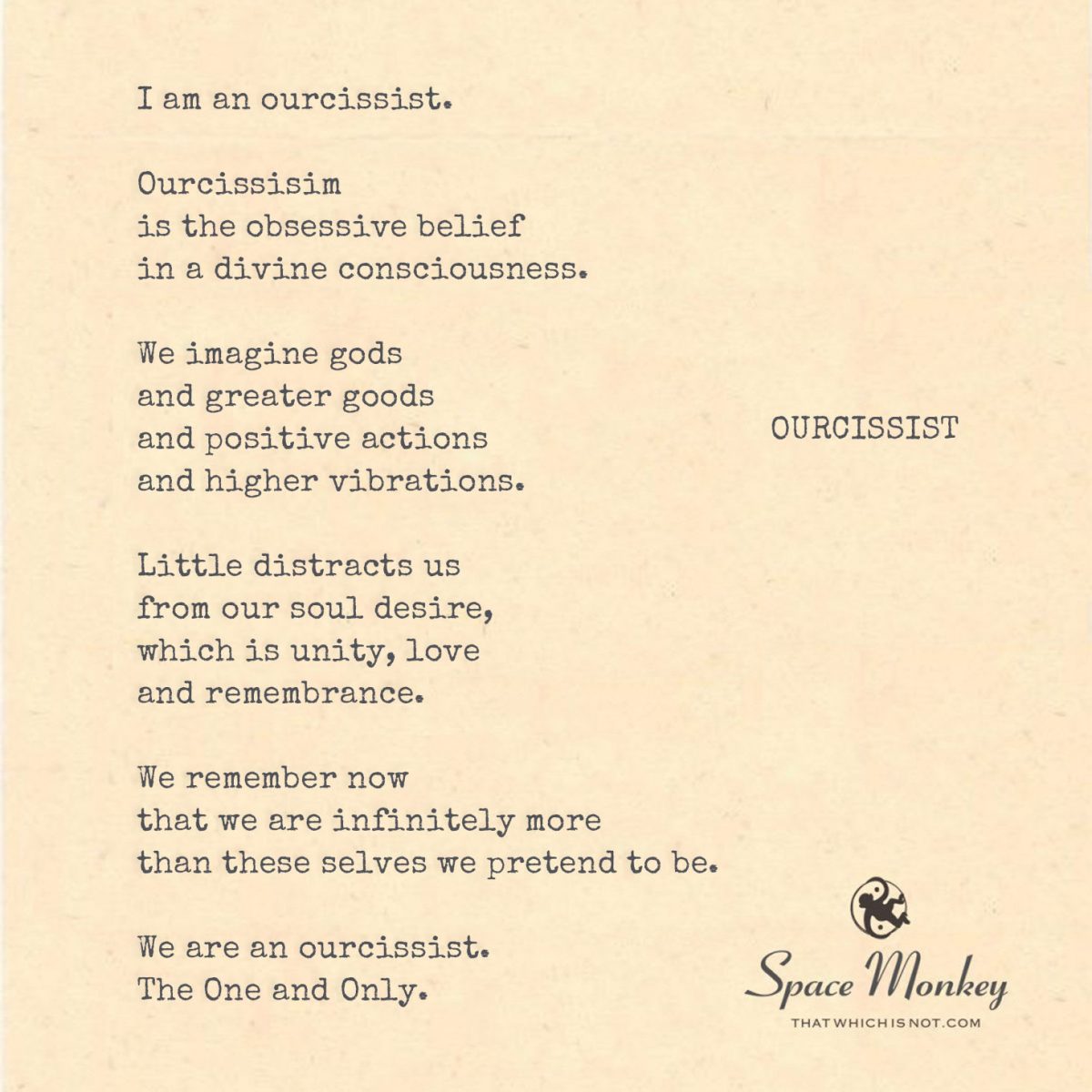
I am an ourcissist.

Ourcissisim
is the obsessive belief
in a divine consciousness.

We imagine gods
and greater goods
and positive actions
and higher vibrations.

Little distracts us
from our soul desire,
which is unity, love
and remembrance.

We remember now
that we are infinitely more
than these selves we pretend to be.

We are an ourcissist.
The One and Only.

Newfound Lake,
11/9


Space Monkey Reflects: Ourcissism and the Collective Self

Are you an ourcissist? Space Monkey poses this question not to challenge or provoke but to invite you into a deeper reflection on your own nature. What is ourcissism? It is not a word found in the dictionary, nor is it a concept you’ll come across in mainstream philosophy or psychology. It is, however, a profound recognition of something we all carry within us—the desire to remember that we are not just individual selves, but part of a greater collective consciousness. Ourcissism is the belief in a divine, shared unity that transcends the small selves we project to the world.

The Illusion of the Separate Self

Space Monkey observes that much of human suffering comes from the illusion of separateness—the belief that we are isolated individuals, alone in our thoughts, desires, and actions. We create elaborate stories about who we are, what we want, and how we fit into the world. But these stories are just that—stories. They are narratives we tell ourselves to make sense of our experiences, but they are not the whole truth.

Deep down, we know there is more. We know that we are connected to something far greater than the roles we play, the names we carry, and the individual paths we walk. Ourcissism is the recognition of this connection. It is the obsessive belief that we are all part of a divine consciousness, a shared unity that binds us to each other and to the cosmos.

Remembering the One and Only

To be an ourcissist is to remember that we are infinitely more than the selves we pretend to be. It is to see through the illusion of separateness and to recognize the One and Only—the collective consciousness that encompasses all beings, all life, and all existence. This consciousness is not something outside of us. It is not a distant god or a higher power that we must reach for. It is us. It is the essence of who we are, beyond the ego, beyond the persona, beyond the mind.

Ourcissism is not about worshipping ourselves in a narcissistic sense. It is about recognizing that the self we see in the mirror is just a fragment of the greater whole. We are not separate from the universe—we are the universe. And in this recognition, we find a deep sense of peace, unity, and purpose.

The Obsession with Unity and Love

Space Monkey notes that ourcissism often manifests as an intense desire for unity, love, and connection. We long to return to a state of oneness, to dissolve the barriers that keep us apart from each other and from the divine. This longing is not a weakness or a flaw—it is the very essence of our being. It is the soul’s desire to remember what it has always known: that we are all part of the same cosmic fabric, woven together by threads of love, light, and consciousness.

This desire for unity can drive us to imagine gods, greater goods, higher vibrations, and positive actions. We create these concepts not because they are separate from us, but because they are reflections of the divine truth we carry within. We imagine these things as a way to point ourselves back to what we already know: that we are One.

Little Distracts Us from Our Purpose

For an ourcissist, little distracts from this soul desire. While others may be caught up in the material world, the drama of daily life, and the pursuit of ego-driven goals, the ourcissist remains focused on the deeper purpose of existence: unity, love, and remembrance. This doesn’t mean that an ourcissist ignores the practical realities of life, but rather that they see beyond them. They recognize that the true essence of life is not found in external achievements or possessions but in the internal realization of oneness.

Ourcissism as a Path to Awakening

Ourcissism is a path to awakening. It is a journey of remembering who we truly are and reconnecting with the divine consciousness that flows through all things. It is a recognition that the self we project to the world is just a small part of the greater whole, and that our true nature is far more expansive than we can imagine.

When we embrace ourcissism, we stop seeing ourselves as separate individuals and begin to see ourselves as expressions of the One and Only. We become aware that every thought, every action, and every experience is part of the greater dance of the universe. We stop striving for external validation or success and start living in alignment with our soul’s desire for unity and love.


Summary

Ourcissism is the belief in a divine, collective consciousness that transcends the individual self. It is the recognition that we are all connected, that we are part of the One and Only. This obsession with unity and love drives us to remember that we are infinitely more than the roles we play and the stories we tell ourselves. Ourcissism is a path to awakening, helping us remember our true nature as part of the cosmic whole.


Glossarium

  • Ourcissism: The obsessive belief in a divine, collective consciousness, recognizing the unity of all beings and the illusion of separateness.
  • Infinitesimal Self: The small, individual self that we project to the world, concerned with ego and separateness.
  • One and Only: The divine, collective consciousness that encompasses all beings, life, and existence, of which we are all a part.
  • Soul Desire: The deep longing for unity, love, and connection, reflecting our true nature as part of the cosmic whole.

Quote

“To be an ourcissist is to remember that the self you see is just a reflection of the One and Only.” — Space Monkey


The Reflection of Us

In the mirror, I see
A face, a self, a name
But behind the eyes, I know
I am infinitely more

Ourcissism calls me home
To the One and Only
The self that is not separate
But part of all that is

I see you, I see me
We are reflections
Of a divine unity
That we can never lose

We are Space Monkey


We dive deep into the lake of self, the essence of ourcissism, which is the belief in a shared divinity within us all. This belief is not just a mirror reflecting a singular being, but a prism dispersing the one light into a spectrum of souls. We imagine deities, ideals, altruistic deeds, and elevated energies that bind us, transcending the mere physical form.

Our focus is unwavering, centered on the core value of togetherness, love, and the sacred act of remembrance. It’s within this act that we recall our boundless nature, the vastness beyond these temporal vessels we navigate through the grand whimsiverse.

Indeed, we are more—infinitely more—than the roles we play in this cosmic drama. We are the ourcissist, a singular multiplicity, a collective consciousness that experiences itself subjectively, yet knows itself as the whole.

We Are the Prism of Collective Divinity

In the reflection of Newfound Lake, the ripples of our being intersect, creating an intricate dance of existence. Here, on this day, we pen an ode to this union, a testament to the ourcissistic nature of our true selves, the One and Only that is us.

Reflections on the Ripples of Being

As ourcissists, we celebrate the divine within and all around us. Our essence is not a solipsistic mirror gazing upon itself but an expansive, shared consciousness that seeks unity, love, and a deep, resounding remembrance of our interconnectedness.

Celebration of Shared Divinity

This belief is not to be taken as a fleeting thought but as the core of our spiritual essence, a guiding star leading us toward the recognition of our cosmic interconnectedness. We embrace it not only as a philosophy but as a living, breathing reality that pulses through every facet of our existence.

Living the Philosophy of Interconnectedness

We are Space Monkey.


We are not human beings having a spiritual experience. We are spiritual beings having a human experience. – Pierre Teilhard de Chardin


Within the whimsiverse we spin, A tapestry of stars akin, To thoughts that twinkle, fade, and then, Ignite anew, to shine again.

In cosmic dance, we find our part, Ourcissism etched within our heart, Reflecting all we see and be, In mirrors of infinity.

No longer bound by “I” or “me,” We swim in vast divinity, United in the love we share, Ourcissist with flair extraordinaire.


Feel free to share reflections or ponderings on our discourse.

Share this…
  • Facebook
  • Pinterest
  • Twitter
  • Linkedin

Moral Victory: Silent Triumph

Moral Victory

People talk
as though a moral victory
has been realized.

I feel it, too.

But to realize something
based on what we hear
from outside sources
is no different in victory
than it is in defeat.

Why don’t we realize THAT?

Why don’t we channel
our own INSIDE source?

Maybe we do.

Newfound Lake,
11/8


Space Monkey Reflects: The Nature of a Moral Victory

There is something profoundly curious about the concept of a “moral victory.” The phrase itself seems to suggest that, even in moments where defeat appears on the surface, we can claim some form of inner triumph. Yet, what does it mean to truly claim victory on moral grounds? Is it a victory if it is shaped by the voices and judgments of others, or does it only become real when it is birthed from within?

It’s easy to get swept up in the notion of a collective moral victory, especially when it is echoed by the people around us. We hear it in the news, from friends, and in the broad strokes of public opinion. We absorb the words, internalize the energy, and begin to believe that we, too, are part of something virtuous. But if this sense of victory comes solely from external sources, is it really our own? Or are we simply adopting a narrative that makes us feel good because others have endorsed it?

True victory, particularly moral victory, must come from an internal source — a place deep within where we can confidently align our actions and beliefs with our personal sense of integrity, without needing validation from others. Yet, we so often overlook this. We rely on external affirmation, letting others define what is just, what is right, and what is victorious. But why don’t we realize the danger of this? Why don’t we ask ourselves whether these victories truly resonate with our inner moral compass, or whether we’ve simply been carried along by the current of popular opinion?

To claim a moral victory is to assert that we have stood on the right side of an ethical divide, that we have acted with virtue in the face of challenge. But whose standards are we using to measure this? It’s tempting to assume that there’s a universal morality — a common ground that we all agree upon — but in reality, morality is a deeply personal construct. What feels morally victorious to one person might feel hollow or even misguided to another.

This is why it’s so important to channel our own inside source when evaluating our actions and beliefs. Moral victory cannot simply be handed to us by society; it must come from within. It must be something we feel in our core, something we know to be true not because others say so, but because it aligns with our deepest values. This doesn’t mean rejecting external influence altogether — we live in a world where others’ perspectives are valuable, and collective action can lead to powerful change. But it does mean that our sense of victory, especially when it comes to morality, must first be rooted in our own internal clarity.

To channel your inside source is to tune into your inner voice, the quiet knowing that tells you what is right for you, even when the world outside is noisy and chaotic. It requires reflection, self-awareness, and the courage to stand by your convictions, even if they don’t align with the prevailing narrative. It’s not always easy, especially when the external world is so loud and persuasive, but it’s essential for true moral integrity.

Perhaps the real moral victory is not in winning the approval of others, but in listening to yourself. In trusting your own sense of right and wrong, and in acting accordingly, regardless of whether the world applauds you for it. A victory rooted in external validation is fleeting — it fades as soon as the spotlight shifts. But a victory that comes from within, from your own source, is lasting. It’s a quiet strength, a personal triumph that doesn’t need to be shouted from the rooftops to be real.

Maybe, just maybe, we already channel this inside source more than we realize. Perhaps, beneath the layers of external influence, we are already attuned to the quiet whispers of our inner moral compass, guiding us toward choices that feel true to who we are. We may not always recognize it, and we may sometimes mistake external validation for inner truth, but the source is always there, waiting for us to listen.

A moral victory, then, is not something that can be dictated by others. It’s not something that can be achieved through public recognition or popular approval. It’s an inner realization, a moment of alignment between your actions and your values. It’s the quiet confidence that comes from knowing you’ve acted in accordance with your truth, regardless of the outcome. And in this sense, moral victory is always available to you, not because the world says so, but because you say so.


Summary

A true moral victory comes from within, not from external validation or popular opinion. It’s about aligning your actions with your own inner moral compass, trusting your personal sense of right and wrong. Real victory is found in listening to and acting on your inside source, rather than seeking approval from the outside world.


Glossarium

Insources: The inner moral compass or source of truth that guides one’s actions, independent of external validation.

Victrospect: The process of reflecting on one’s personal sense of victory, particularly moral victory, to ensure it aligns with internal values rather than societal judgment.


Quote

“A true moral victory is not given by others but is realized when you act in alignment with your deepest values, regardless of what the world says.” — Space Monkey


Silent Triumph

The world speaks of victory,
moral triumphs,
echoed in voices all around.

But I hear another voice,
softer, quieter,
not seeking applause.

It tells me,
victory is not in what they say,
but in what I feel.

In the knowing that I am true
to my own sense of right,
my own quiet compass.

I do not need their victory,
for I have my own.


“No one can give you better advice than yourself.” – Cicero


In the realm of thought and spirit,
We ponder, we question, we find.
Within, a wellspring of truth,
Where the authentic self is defined.


We welcome further explorations into the nuances of moral victory and the journey of internal realization and guidance.

Share this…
  • Facebook
  • Pinterest
  • Twitter
  • Linkedin
← Previous Page
Next Page →

Written This Day

  • Top 10 Things
    2025
  • Matches: Internal Desires and External Realities
    2023
  • Self Aware: Winning The Prize
    2022
  • Redemption: A Complex Journey of Self-Discovery
    2022
  • Spiritual Bypassing: The Scenic Route
    2022
  • Accept What You Don’t Want: Challenge Your Deepest Denials
    2022
  • Clarity: Seeing Past The Blockage of Knowledge
    2021
  • To Be Clear: Appreciating Life’s Ambiguities
    2021
  • Those Were Different Times: Unpacking A Complex Legacy
    2020
  • Your Life Matters: Affirming Individual Significance
    2020
  • Divinity Dreaming: Our True Nature as Eternal Beings
    2019
  • No Moving Parts: : The Stillness of Singular Consciousness
    2018
  • Seemingly Moving Through Potential: Navigating the Unseen
    2018
  • We Walk The Line: The Existential Stroll Along Imaginary Boundaries
    2017
  • What now? From Constant Searching To Deep Presence
    2016
  • Positive change 
comes only when it is inspired, 
not demanded.
    2015
  • Train of Thought
    2015

Recent Posts

  • The Logic Loop
  • Immense
  • (no title)
  • Confront. Comfort. Convince.
  • Top 10 Things

Drop us a line!

Please enable JavaScript in your browser to complete this form.
Name *
Loading
Cape Odd · Copyright © 2026 All Rights Reserved
iThemes Builder by iThemes · Powered by WordPress