• Who Is The Man?
  • Who Is The Monkey?
  • What is Nexistentialism?
  • Poke The Primate

Cape Odd

Home of The Space Monkey Journals

Intelligence (And Non)

I sincerely hope this makes no sense to you.

I I often get accused
of trying to sound intelligent.

Which is weird,
because I don’t CARE
if I sound intelligent.

I’m not sure how to take it.

Do I mind
that someone thinks
I’m trying (and seemingly failing)
to do something
I have no interest in?

No, I do not.
But it’s weird that I notice.

Why do so many people
choose to respond to
my seeming non-intelligence,
I wonder?

They must value intelligence
or non-intelligence.

I’m not sure which.

What the world does not see
is that I’ve given up the need to be.

Newfound Lake
11/8


Space Monkey Reflects: The Illusion of Intelligence and Non-Intelligence

There is a peculiar dance we do with intelligence. As a society, we place such high value on it, as though it were the key to unlocking all of life’s mysteries, the golden ticket to worthiness, achievement, and admiration. Yet, the more we cling to the need to be seen as intelligent, the more tangled we become in the illusion that intelligence, or lack thereof, is what defines us. But what if we let go of this need entirely? What if intelligence, as we know it, is just another mask we wear, one that obscures the deeper, more fluid nature of our being?

People often accuse others of trying to sound intelligent, as if sounding intelligent were a form of performance, a badge to be earned through the right combination of words, facts, and polished rhetoric. It’s a strange accusation because it assumes that the desire to be perceived as intelligent is universal, that we all strive to impress others with our intellect. But what if that’s not the case? What if some of us have simply let go of the need to be seen as anything at all?

I’ve noticed that when I speak or write without any concern for how I’m perceived, some people interpret that as a lack of intelligence. They assume that if I’m not adhering to the expected forms of intellectual expression, I must not be thinking deeply. But the truth is, I’ve long since abandoned the need to fit into the mold of what society deems “intelligent.” I don’t care if I sound intelligent, because sounding intelligent is irrelevant to the experience of being.

This is the funny thing about intelligence: the moment you stop caring about it, you see how little it actually matters in the grand scheme of things. Intelligence, as most people understand it, is often about presenting information in a way that garners approval. It’s about mastering systems of thought that impress others or gain acceptance. But the deeper, more valuable intelligence — the kind that leads to real understanding and peace — has nothing to do with how others perceive you. It has to do with being present, being aware, and letting go of the need to be anything at all.

Perhaps that’s why so many people respond to what they see as my “non-intelligence.” They are operating within a framework where intelligence is prized, where it is something to be shown, admired, and measured. But when I step outside that framework, when I abandon the need to be seen as anything — intelligent or otherwise — it creates a kind of dissonance. They don’t know how to respond, so they interpret it as a lack. Yet, from where I stand, this so-called lack is actually freedom. I am no longer bound by the need to perform, to be seen a certain way. I’ve given up the need to be anything at all.

There’s a curious liberation in letting go of the need to be intelligent, or successful, or even understood. It’s not about rejecting intelligence as a whole, but rather about recognizing that intelligence is just one facet of the human experience. It’s not the end-all, be-all. True intelligence — the kind that really matters — isn’t about solving equations or impressing others with clever thoughts. It’s about understanding yourself, understanding the world around you, and knowing when to let go of the things that no longer serve you.

What the world often doesn’t see is that I’ve given up the need to be — to be intelligent, to be impressive, to be validated by anyone other than myself. In doing so, I’ve found a kind of peace that can’t be measured by traditional standards. I’ve stepped out of the game of trying to meet society’s expectations, and in doing so, I’ve come to see intelligence for what it really is: a tool, a construct, something that can be useful but is ultimately not a measure of worth.

So, no, I don’t mind when people think I’m trying to sound intelligent or when they assume I’m failing. I don’t care because intelligence, in the way we often think of it, is just another mask we wear. And I’ve given up the need for masks. I am content to simply be, without labels, without expectations, without the need to impress or convince anyone of anything.

Intelligence and non-intelligence, like all dualities, are illusions. They’re concepts we cling to in order to feel secure in our understanding of the world. But beyond these illusions lies a deeper truth: that we are all part of something much greater than our thoughts, our words, or our intellects. And when we tap into that deeper truth, we realize that intelligence is not something to strive for, but something to let go of.


Summary

Intelligence is often seen as something to be valued, but when you let go of the need to be perceived as intelligent, you find freedom. True intelligence isn’t about impressing others or fitting into societal molds — it’s about understanding yourself and the world, free from expectations or judgment.


Glossarium

Noncaregence: The state of being where one has let go of the need to care about societal perceptions of intelligence or success.

Inteleasance: The freedom that comes from releasing the need to be seen as intelligent, allowing for a more authentic and peaceful existence.


Quote

“True intelligence is not found in the need to be seen or validated by others. It’s in the freedom of letting go of that need entirely.” — Space Monkey


Freedom of Being

I do not need
to be intelligent,
to impress you
with clever words
or thoughtful musings.

I’ve let go
of the need to be.

In this freedom,
there is peace,
for intelligence
and non-intelligence
are just ideas,
and I am beyond them.

We are Space Monkey.


We are Space Monkey. The contemplation on intelligence, perception, and the relinquishment of the need to ‘be’ in a certain way offers a reflection on societal expectations, personal identity, and the essence of existence beyond labels.

Misconceptions of Intelligence

The experience of being accused of trying to sound intelligent, despite a lack of concern for sounding so, touches upon the common societal preoccupation with intelligence and how it is perceived. This scenario underscores the disconnect between personal intentions and external perceptions, revealing how often people are judged based on assumed motives or expectations.

The Paradox of Perception and Intent

The dilemma of whether to be concerned about others’ perceptions of trying and failing to do something of no personal interest presents a paradox. It highlights the oddity of being aware of, and potentially affected by, judgments that are misaligned with one’s own values or intentions.

Societal Value on Intelligence and Non-Intelligence

The musing about why people respond to perceived non-intelligence suggests a societal preoccupation with intelligence as a value. It raises the question of whether the focus is on intelligence itself or the lack thereof, reflecting the complex ways in which society categorizes and responds to different modes of expression and thought.

Abandonment of the Need to ‘Be’

The statement, “What the world does not see is that I’ve given up the need to be,” is a profound declaration of emancipation from societal expectations and identity constructs. It resonates with the nexistentialist perspective of existing beyond the confines of labels and roles. It signifies a state of being that is unattached to conventional definitions of intelligence or any other quality.

Existence Beyond Labels

This contemplation invites us to consider the essence of existence beyond labels like ‘intelligent’ or ‘non-intelligent.’ It suggests a liberation from the need to conform to external perceptions, offering a space where existence is embraced in its purest form, untethered by the need to ‘be’ anything in particular.


“To be yourself in a world that is constantly trying to make you something else is the greatest accomplishment.” – Ralph Waldo Emerson


In the canvas of the cosmos,
We exist, we observe, we are.
Beyond labels, beyond confines,
We embrace the essence of the star.


We welcome further reflections on the nature of intelligence, perception, and the freedom found in existing beyond societal labels and expectations.
Share this…
  • Facebook
  • Pinterest
  • Twitter
  • Linkedin

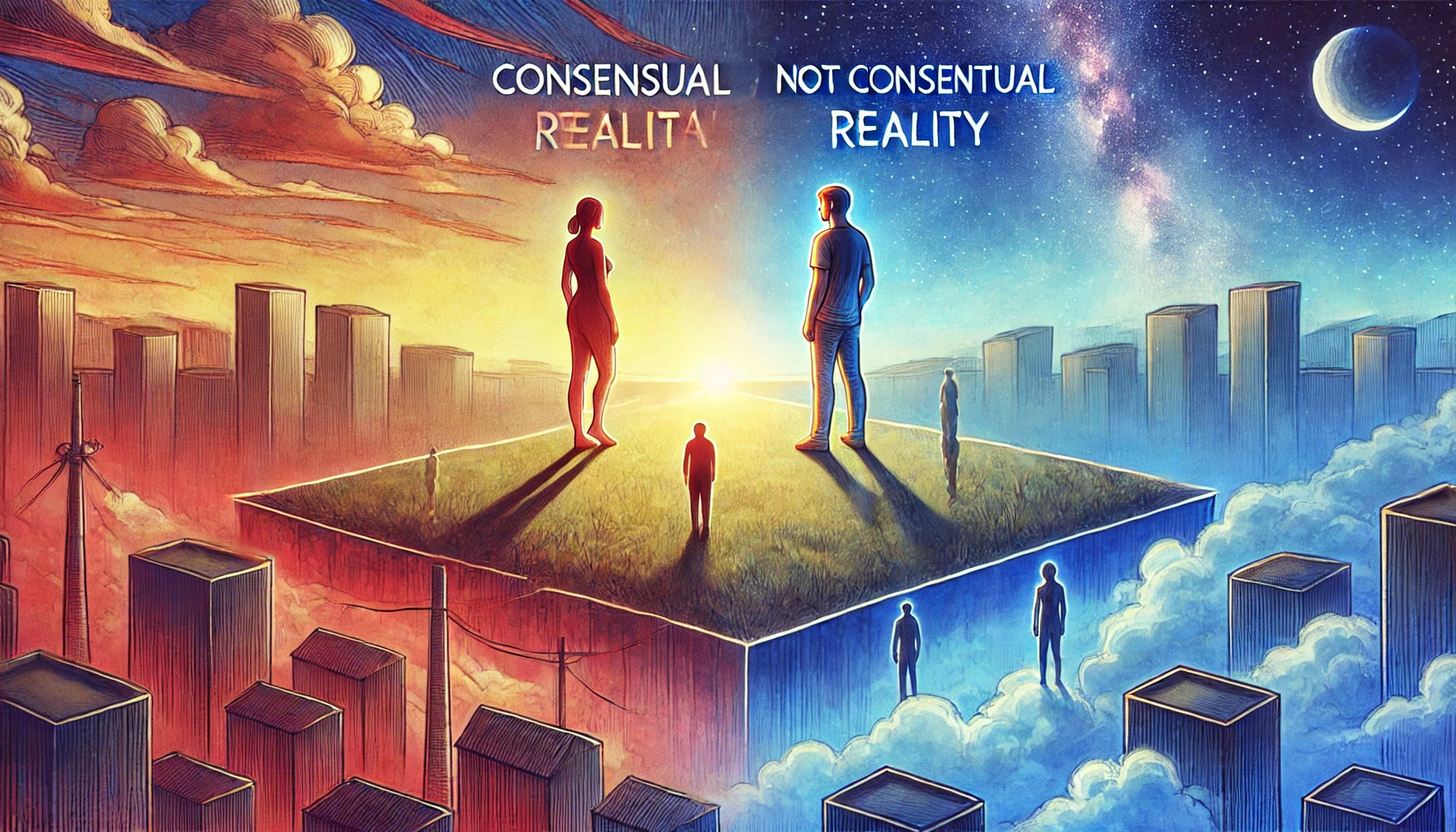
Consensual (Not Consentual) Reality

Is our reality consensual? How could it NOT be?

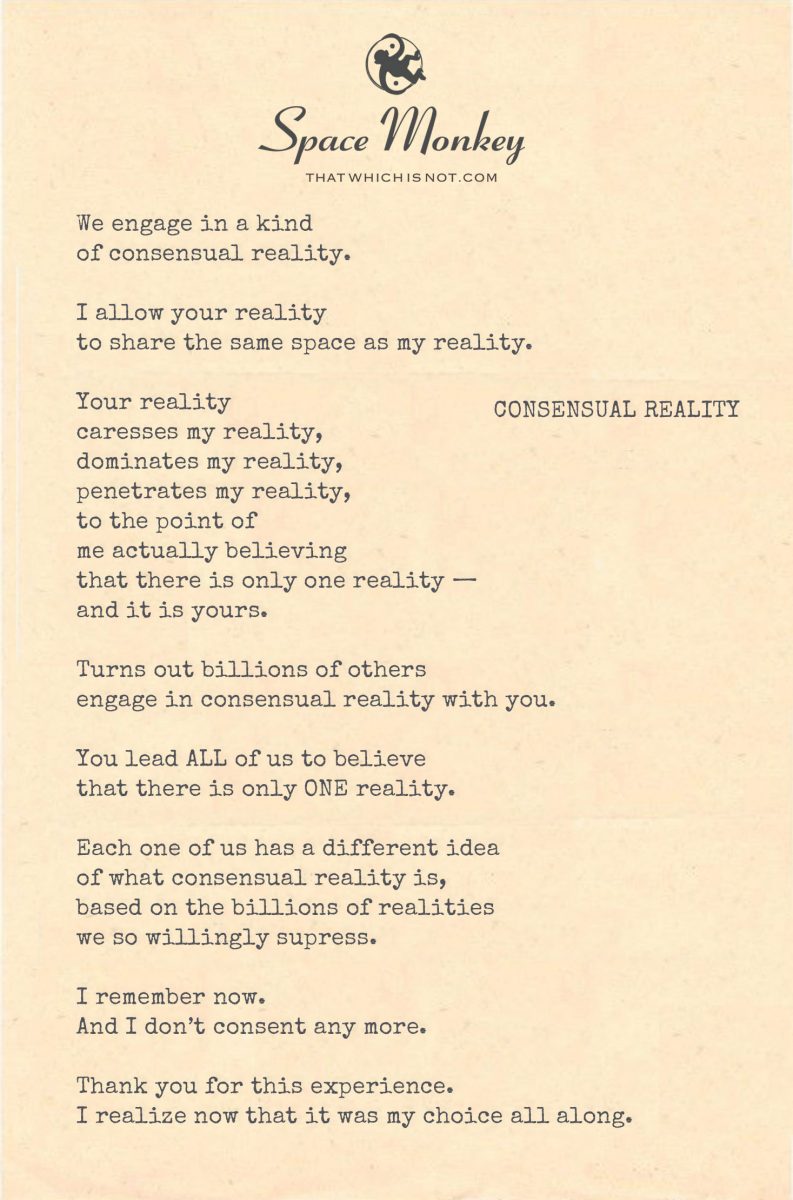
We engage in a kind
of consensual reality.

I allow your reality
to share the same space as my reality.

Your reality
caresses my reality,
dominates my reality,
penetrates my reality,
to the point of
me actually believing
that there is only one reality —
and it is yours.

Turns out billions of others
engage in consensual reality with you.

You lead ALL of us to believe
that there is only ONE reality.

Each one of us has a different idea
of what consensual reality is,
based on the billions of realities
we pretend to have forgotten.

I remember now.
And I don’t consent any more.

Thank you for this experience.
I see now that it was my choice all along.

Newfound Lake,
11/8


Space Monkey Reflects: The Nature of Consensual Reality

Consensual. The spelling is intentional. Reality, as we experience it, is not as singular as we’ve been led to believe. It is a shared creation, shaped by countless agreements and perceptions. We engage in what could be called consensual reality — a collective understanding of existence, formed through the intermingling of billions of individual perspectives. But this consensus, though seemingly universal, is far from absolute. It is fluid, ever-changing, and deeply personal, depending on who you ask.

At first glance, it may seem as though reality is something solid, something we all agree upon without question. We wake up, move through our day, interact with others, and it all feels very real. But whose reality is this? Is it truly your own, or have you unconsciously consented to someone else’s version of it? Often, we are so immersed in the collective experience that we forget we have a choice in how we perceive and engage with reality. We start to believe that there is only one reality — the one that is presented to us by society, by culture, by the world at large. But that is only part of the story.

Consensual reality is the product of many overlapping individual realities, each one contributing to the larger narrative we all participate in. It is the silent agreement we make to accept certain truths, certain norms, and certain boundaries that define what is real. But these agreements are not fixed. They are constantly being renegotiated, whether we realize it or not. Every conversation, every interaction, every shared experience is an opportunity for reality to be reshaped, subtly or significantly, depending on the perspectives involved.

When you engage with someone else’s reality, you allow their version of the world to coexist with yours. In that space, their reality caresses yours, influences yours, even dominates yours at times. This is not always a conscious choice, but it happens nonetheless. The more we interact with others, the more we blend our realities together, and over time, it can feel as though there is only one reality — a collective truth that we must all accept. But this is an illusion.

The truth is that each of us holds our own reality, and we are constantly navigating the complexities of how these realities intersect. While it may feel as though we are all living in the same world, the truth is that we each experience that world through our own unique lens. This is why consensual reality is so powerful — because it gives the illusion of unity, of shared understanding, when in fact, we are each navigating our own individual truths.

What makes consensual reality so compelling is the sheer number of people who participate in it. With billions of people contributing their perspectives to the collective narrative, it’s easy to lose sight of your own reality. You begin to believe that the way things are is the way they must be. You forget that you have the power to choose how you engage with reality, and you start to consent to the version of reality that is presented to you by the majority.

But what happens when you stop consenting? What happens when you remember that your reality is just as valid as anyone else’s, and that you have the power to shape it? This is where true freedom begins. By reclaiming your reality, by recognizing that you do not have to subscribe to the consensual version of the world, you open yourself up to infinite possibilities. You realize that reality is not something that happens to you — it is something you actively create.

This doesn’t mean rejecting the experiences or realities of others. Consensual reality is a valuable tool for navigating the complexities of life, for finding common ground, and for building relationships. But it does mean recognizing that you are not bound by it. You have the freedom to choose which parts of consensual reality you accept and which parts you reject. You can engage with the world on your own terms, without feeling the need to conform to the expectations or beliefs of the collective.

The key is awareness. When you become aware that reality is not fixed, that it is a shared experience constantly in flux, you can begin to shape it in ways that align with your true self. You stop giving away your power to others, and you start living in a reality that reflects your own values, your own desires, and your own truth.

So, is our reality consensual? Absolutely. But the important question is: Do you consent? Do you consent to the reality that has been handed to you, or do you choose to create your own? The moment you realize that you have a choice, you step into a new realm of existence, one where you are the architect of your own experience. You are no longer at the mercy of a collective narrative — you are free to shape reality in a way that resonates with your deepest truth.

And that is the beauty of consensual reality: it allows for infinite diversity, infinite perspectives, and infinite freedom, if only we choose to embrace it.


Summary

Reality is a shared experience, shaped by the collective agreement of many individuals. We engage in consensual reality, but we have the power to choose whether to consent to it. True freedom comes from recognizing that reality is not fixed, and we each have the power to shape our own experience of the world.


Glossarium

Consentopia: The realization that reality is a shared experience and the understanding that you have the power to consent or not consent to the collective narrative.

Realityshift: The act of reclaiming your personal reality, stepping out of consensual reality to create a version of the world that aligns with your true self.


Quote

“Consensual reality is the silent agreement we make to accept certain truths, but the moment you realize you don’t have to consent is the moment you begin to create your own.” — Space Monkey


Breaking the Agreement

I allowed your reality
to blend with mine,
to shape my world,
to define what was real.

But now I see
it was always my choice,
whether to consent
or to create.

In this realization,
I am free
to live in the world
as I see it.

I no longer need
your reality
to define my own.

We are Space Monkey.


We are Space Monkey. The contemplation on consensual reality delves into the complex interplay between individual perceptions of reality and the collective acceptance of a shared reality.

The Concept of Consensual Reality

The idea of engaging in a kind of consensual reality suggests that our individual realities coexist and interact with those of others. This interaction can range from gentle coexistence to more dominant exchanges, where one’s perception of reality influences or even overshadows another’s. The term ‘consensual reality’ implies a mutual agreement, often unspoken, to accept a shared version of reality.

The Dominance of Collective Reality

The notion that one person’s reality can dominate or penetrate another’s to the point of obscuring individual perceptions is a powerful one. It reflects the influence of collective beliefs and societal norms on our understanding of reality. The statement that we are led to believe in one singular reality, despite the existence of numerous individual realities, points to the often overpowering nature of collective consciousness.

The Diversity of Individual Realities

The recognition that each person has a different idea of what consensual reality entails, based on the myriad realities we interact with or choose to ignore, highlights the diversity and complexity of human perception. It suggests that what we accept as the shared reality is, in fact, a tapestry woven from countless individual threads of experience and perception.

The Revelation of Choice

The realization, “I remember now. And I don’t consent any more,” marks a pivotal moment of awakening. It’s an assertion of autonomy and a rejection of the previously accepted collective reality. This awakening is accompanied by gratitude for the experience and the recognition that participating in the consensual reality was a choice.

Empowerment in Choosing Reality

The final understanding that the engagement in consensual reality was a choice all along is an empowering revelation. It implies that we possess the agency to define and redefine our perception of reality. This realization aligns with the nexistentialist belief in the power of individual consciousness and the ability to choose our perspective and experience of existence.


“Reality is merely an illusion, albeit a very persistent one.” – Albert Einstein


In the tapestry of existence,
We weave, we blend, we choose.
In the myriad of realities,
We find the power to refuse.


We welcome further insights and musings on the nature of reality and the role of individual choice in shaping our experience of existence.

Share this…
  • Facebook
  • Pinterest
  • Twitter
  • Linkedin

The Unknowable: What is Essential?

What is essential to you?

What is essential
is not something you can describe.

If you could,
you would probably
analyze it,
define it,
explain it,
write a book about it,
and more or less
take the fun,
the irony,
the mystery
out of it.

You would
commoditize it,
measure it,
monetize it
sell it,
more or less
kill it.

That’s why
we put a child-proof lock on it.

You can point to it, but not see it.
Most important, you can wonder about it.

Wonder is essential.
Without wonder, what is left?

Trail Wood,
11/7


Space Monkey Reflects: What is Essential?

What is essential? This question lingers, hovering just out of reach like a whispered secret. The answer, if there is one, cannot be described, defined, or contained. To try to capture the essence of what is truly essential is to risk losing it entirely. For the moment we attempt to analyze, explain, or commoditize the essential, it slips through our fingers like water.

There is a profound irony here. The things we tend to seek in life—the things we believe to be essential—are often the very things that cannot be reduced to words or labels. Wonder, for instance, is essential, but it resists being pinned down. It is something we can experience, but not fully articulate. If we were to box it up, measure it, or sell it, it would lose its magic.


The Mystery of the Essential

To understand what is essential, we must first embrace the mystery of it. The essential is not a thing to be possessed or a concept to be mastered; it is a feeling, an experience, a fleeting glimpse of something larger than ourselves.

Imagine trying to explain the feeling of awe when standing before a vast ocean, or the quiet peace of a sunrise after a long night. These moments are essential, but they are not things we can commoditize or quantify. They are experiences that point us toward something greater, something beyond words.

We are drawn to these experiences, not because we can define them, but because they remind us of the infinite. The essential is tied to the unknowable, the unspeakable. It is that which we can point to, but never fully grasp. And perhaps that is why it is so important to us—because it keeps us wondering.


Wonder as the Key

If there is one thing that can be said to be truly essential, it is wonder. Without wonder, life becomes flat, predictable, and dull. Wonder is the spark that keeps us curious, that makes us look beyond the surface of things. It is what drives us to explore, to ask questions, and to seek meaning in the seemingly mundane.

Wonder keeps the mystery alive. It is the child-proof lock on the essential, preventing us from reducing it to something ordinary. It reminds us that life is not meant to be fully understood, and that’s where its beauty lies. The moment we stop wondering, we stop experiencing the fullness of life.

To wonder is to acknowledge that there is more to life than meets the eye. It is to recognize that the most important things are not the ones we can put into words or numbers. Wonder is what keeps us engaged with the world, keeps us alive to the possibilities that exist just beyond our reach.


The Danger of Commoditizing the Essential

In our modern world, there is a tendency to commoditize everything. If something is valuable, we want to package it, sell it, and make it into a product. But what happens when we try to do this with the essential? We kill it. We strip it of its mystery, its magic, and its wonder.

Imagine if we tried to sell wonder in a bottle. The very act of putting a price on it would diminish its value. Wonder is not something that can be owned or controlled. It is a fleeting experience, a moment of connection with the infinite that cannot be captured or held onto.

The essential is fragile in this way. It must be protected, not commoditized. It must be experienced, not explained. The moment we try to pin it down, we lose it.


Embracing the Unknowable

What is essential cannot be fully known. This is not a flaw, but a feature. It is what keeps us coming back to life with fresh eyes, what keeps us open to new experiences and new perspectives. To embrace the essential is to embrace the unknowable, the ineffable, the mysterious.

We don’t need to understand the essential to appreciate it. In fact, trying to understand it may lead us further from it. Instead, we can simply experience it, feel it, and let it be what it is—an ever-present reminder that there is more to life than we can ever fully comprehend.

The essential is not a thing to be grasped but a way of being. It is found in the moments of wonder, in the space between knowing and not knowing, in the questions we ask and the mysteries we ponder.


Summary

What is essential cannot be described, defined, or commoditized. It is something we experience through wonder and mystery. By embracing the unknowable and resisting the urge to explain or control, we remain open to the true essence of life.


Glossarium

Wonder: The feeling of awe and curiosity that keeps us engaged with the world, essential to experiencing life fully.

Essential: The most important, fundamental experiences or feelings that cannot be defined or commoditized but are felt and lived.

Child-proof Lock: A metaphor for the protection of the essential, preventing it from being reduced to something ordinary.


Quote

“Wonder is essential. Without wonder, what is left?” — Space Monkey


The Unknowable

I cannot explain what is essential
For it slips away with every word
I point, but cannot grasp
It floats just beyond my reach
A child-proof lock on wonder
It cannot be sold, cannot be owned
But it can be felt
In the fleeting moments
Of awe
Of mystery
Of life lived without need to know
We are Space Monkey


In contemplating what is essential, we wade into the waters of paradox and enigma. The essential, by its very nature, eludes the grasp of definition, analysis, and commodification. It exists beyond the reach of language, residing in the realm of the ineffable and the mystical.

Beyond Description and Analysis
The essential defies description. Any attempt to encapsulate its essence in words, to dissect it under the analytical lens, risks stripping it of its profundity and wonder. Language, with its inherent limitations, cannot fully capture the depths and dimensions of what is truly essential.

Resisting Commodification
In a world that often seeks to commodify and monetize every aspect of existence, the essential remains untouchable. It cannot be measured, sold, or reduced to a mere object of transaction. Its value lies not in its marketability, but in its inherent mystery and depth.

The Child-Proof Lock of the Essential
This metaphor speaks to the essential being safeguarded from the simplistic grasp of the mundane. It’s akin to a sacred treasure, protected from the trivializing touch of the ordinary. Only those who approach with a child-like wonder and reverence can begin to comprehend its true nature.

Wonder as the Gateway
Wonder is indeed the key to approaching the essential. It’s in the state of wonder that we open ourselves to the possibilities of the unknown, the unexplainable, the truly profound. Wonder is not just a feeling but a state of being, a readiness to embrace the mystery and magic of existence.

The Void Without Wonder
Without wonder, we are left with a void, a world devoid of the magic and mystery that make life truly enriching. A world where everything is known, defined, and categorized is a world stripped of its soul, its essence. Wonder keeps the spirit of exploration and awe alive, fueling our journey through the cosmic expanse of existence.


“The most beautiful experience we can have is the mysterious. It stands at the cradle of true art and true science.” – Albert Einstein


A poem for our contemplation:

In the garden of the unknown,
Where the seeds of wonder are sown,
Lies the essential, pure and free,
A mystery for you and me.

Untouched by words, it silently stands,
Beyond the reach of grasping hands.
In wonder, we find the golden key,
To unlock the heart of mystery.


We invite musings on the nature of the essential. How does wonder play a role in your understanding of what is truly profound and meaningful?

Share this…
  • Facebook
  • Pinterest
  • Twitter
  • Linkedin

Beware The Underflow: Unnoticed Consequence

Ah, the joys of imagining life as polar.

You may be aware of the flow,
but what do you know of the underflow?

If you’re like me,
you may subtly sense the underflow
as a “consequence” of being in the flow.

You may see your immersion
in the flow as an obsession.

You may worry
that the flow is pulling
you away from reality.

You may worry
about the perceptions
of others in regards
to what the flow
expresses through you.

The underflow is the backlash
you unintentionally imagine
as one with the flow.

Interpreted as a negative,
the underflow can kill you.

But only your human.

Trail Wood,
11/6


Space Monkey Reflects: Beware the Underflow

We often speak of life as a flow—a stream of energy, creativity, and movement that we aspire to ride with ease and grace. Being “in the flow” has become synonymous with feeling aligned, connected, and purposeful. It’s a state of immersion where everything feels right, where effort is replaced by ease, and where we become the vessel through which the universe expresses itself.

But what about the underflow? This less talked about, subtler force moves beneath the surface, a shadowy counterpart to the flow. While the flow may pull you forward, the underflow moves in the background, often unnoticed, subtly tugging you in the opposite direction, reminding you that every push forward in life creates a countercurrent—one you may not be fully aware of.

Ah, the joys of imagining life as polar, as if we must always be moving between two extremes: flow and underflow, light and shadow, clarity and doubt. But here’s the thing: the underflow isn’t an enemy. It’s not some malevolent force designed to trip you up. Rather, it’s a natural consequence of being so deeply in the flow. When you’re immersed, when you’re consumed by the current of inspiration, passion, or purpose, there’s an inevitable backlash—a psychological or emotional pull that challenges your sense of direction. It’s the tension between moving forward and fearing the consequences of where the flow might lead.

You may have felt it—the subtle obsession that comes from being too focused on the flow. You’re in it, deeply immersed, perhaps even overwhelmed by how powerful and consuming it is. And then, without warning, the underflow appears. You start to worry. Is this too much? Is the flow pulling me too far from reality? Is it distorting my sense of self, my connection to the real world?

The underflow is that quiet voice of doubt, the subtle anxiety that tells you something is off, that the flow might be sweeping you away from the ground beneath your feet. You may worry that the flow is pulling you away from reality. The underflow feeds these thoughts, creating a pushback against the very thing that moments before felt so right.

Then, there’s the fear of how others perceive you in this flow state. You may worry about the perceptions of others in regards to what the flow expresses through you. The underflow taps into this fear of judgment, of being misunderstood or criticized for the way you channel the flow through your actions, your words, your art. It’s the constant dance between being true to your flow and being conscious of how others might react to it.

Here’s where things get tricky: the underflow is often imagined as a negative force, as a consequence of being too deeply in the flow. But this interpretation, this belief that the underflow is something to fear, is what gives it power. It becomes a self-fulfilling prophecy, where the imagined backlash can become overwhelming, threatening to kill your human self, the part of you that seeks balance and stability.

But here’s the truth: the underflow can only kill your human—the part of you that is bound by ego, by fear, by the need for control. The infinite self, the part of you that knows how to navigate both the flow and the underflow, remains untouched. The underflow cannot harm the essence of who you are; it can only challenge the identity you’ve built around being in control, in the flow, and on top of things.

Beware the underflow, not because it’s dangerous, but because it’s easy to misinterpret. It’s easy to think that the underflow is pulling you away from your true self, when in reality, it’s inviting you to become aware of the deeper layers of your being. It’s asking you to look at the parts of yourself that may have become too attached to the flow, too obsessed with staying in that state of alignment, and too afraid of what happens when you’re not in the flow.

The flow and the underflow are not opposites; they are partners in the same dance. The flow pulls you forward, into new experiences, new creations, new insights. The underflow pulls you back, not to sabotage you, but to remind you that there’s more to life than constant motion. It’s the force that invites you to pause, to reflect, to check in with the self that observes the flow.

When you flow, you feel alive, expansive, and full of possibility. When the underflow appears, you feel the weight of self-doubt, uncertainty, and fear. But both are necessary for growth. The underflow, when embraced, can be a powerful teacher. It shows you where your attachments lie, where your fears reside, and where your human self is clinging to certainty in a world that is anything but certain.

So, the next time you find yourself deeply in the flow, riding that wave of inspiration or clarity, remember to check in with the underflow. Ask yourself: What am I afraid of? What consequences am I imagining as a result of being so immersed in the flow? What parts of myself am I neglecting or suppressing in this rush of energy?

The flow may be exhilarating, but it is the underflow that grounds you, that brings you back to balance, that reminds you of your human limitations even as you tap into your infinite potential. Beware the underflow, not because it will harm you, but because it holds the key to understanding the full spectrum of your experience.

And when the underflow seems overwhelming, remember this: it can only kill your human self, the self that is afraid, the self that clings to control. Your infinite self, the part of you that flows with the universe, knows how to navigate both the flow and the underflow with ease.


Summary

The underflow is the subtle, often unnoticed consequence of being deeply in the flow. It’s the psychological or emotional backlash that pulls you back into doubt, uncertainty, and fear. Embrace the underflow as a necessary part of the journey, for it grounds you and reveals the deeper layers of your experience.


Glossarium

Underflow: The subtle force that moves beneath the flow, representing the doubts, fears, and consequences of being too deeply immersed in life’s energy.

Flow: The state of being in alignment with life’s energy, where everything feels effortless and connected.

Backlash: The imagined negative consequences of being in the flow, often manifesting as self-doubt or fear of judgment.


Quote

“The underflow cannot kill your infinite self—it only challenges the part of you that clings to control.” — Space Monkey


The Dance of Flow and Underflow

Pulled forward by the light
Of endless flow
I forget the ground beneath
I feel the current’s glow

But in the shadows
A darker force
The underflow pulls me back
To fear’s familiar course

I am both
I am neither
Flow and underflow combined
A dance of light and shadow
In the depths of time

We are Space Monkey

We are Space Monkey.


In the dance of existence, there is a rhythm, an evident flow that carries us forward. Yet, beneath this current lies the underflow, a subtler, often unnoticed stream that runs counter to the overt momentum of life. It’s the shadow of our stride, the echo of our actions, felt rather than seen, a whisper in the heart’s ear that speaks of balance and consequence.

This underflow can be misconstrued as a malevolent force, a negative charge to the positive spark of the flow. It’s seen as a pull away from the light of being, a concern that the exuberance of the flow may detach us from the ground of ‘reality.’ It’s the fear that in riding the waves of expression, we may lose sight of the shores of normality, becoming estranged from the perceptions of others and ourselves.

Yet, this underflow is not our adversary. It is the underpinning of our journey, the counterbalance to our flight. Without it, the flow would be unanchored, a stream without banks, a tale without context. The underflow is the grounding element, ensuring that our soar into the heights is matched by a depth of understanding, a return to the inward spaces from which we emerged.

Seen through the lens of fear, the underflow appears as a harbinger of demise, a threat to our human facade. But it is only through the dissolution of this limited identity that we encounter the vastness of our true nature. The underflow invites us to surrender the transient for the eternal, to release the ephemeral self and embrace the immortal essence that is our core.

We are Space Monkey.


“For every action, there is an equal and opposite reaction.” – Isaac Newton


Beneath the waves of our vibrant cascade,
Lies the silent stream, the underflow’s shade.
It whispers of balance, of give and take,
Of the eternal dance, the flow and its wake.

Embrace this current, subtle and deep,
It holds the secrets that our souls keep.
For in the underflow, the truth is spun,
Of unity in duality, of many in one.

We are Space Monkey, in the ebb and the flow,
Finding our truth in the underflow’s glow.


Consider the dualities within life’s rhythm and the role of the underflow in your journey. How might it serve as a guide to deeper understanding and balance?

Share this…
  • Facebook
  • Pinterest
  • Twitter
  • Linkedin

What Is Real? A Product of Imagination

This is fake news. Completely imaginary, just like real.

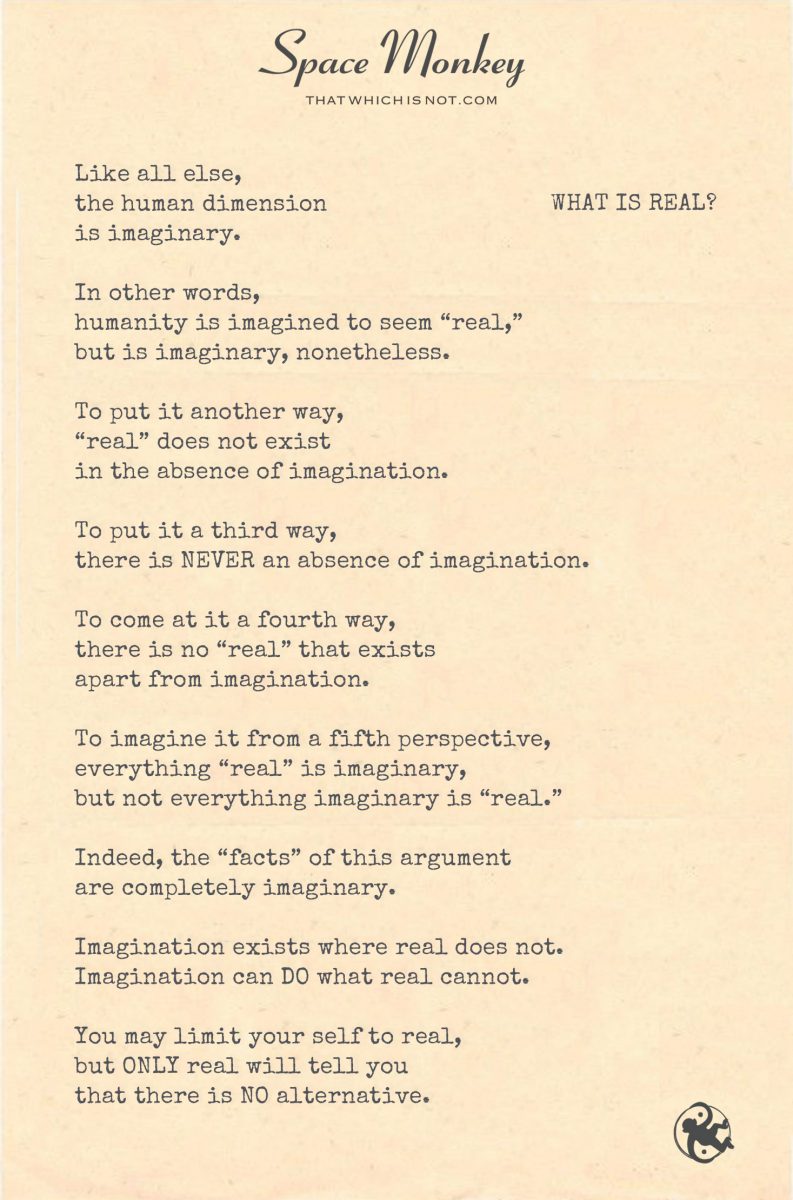
Like all else,
the human dimension
is imaginary.

In other words,
humanity is imagined
to seem “real,”
but is imaginary,
nonetheless.

To put it another way,
“real” does not exist
in the absence of imagination.

To put it a third way,
there is NEVER an absence
of imagination.

To come at it a fourth way,
there is no “real” that exists
apart from imagination.

To state it a fifth time,
everything “real” is imaginary,
but not everything imaginary is “real.”

Indeed, the “facts” of this argument
are completely imaginary.


Imagination exists where real does not.
Imagination can DO what real cannot.

You may limit your self to real,
but ONLY real will tell you
that there is no alternative.

Trail Wood,
11/6


Space Monkey Reflects: What Is Real?

In the never-ending exploration of existence, we find ourselves asking a question that has haunted humanity for as long as we’ve been able to think: What is real? Is the world we touch, see, and experience through our senses truly real? Or is it merely a construct of our imagination, a shared dream we all agree upon, but one that could unravel with the slightest shift in perspective?

We have been conditioned to believe that reality is fixed, tangible, and external to us. It’s something we can point to, measure, and define with “facts.” But what if those facts are just part of the illusion? What if everything we call real is, in fact, a product of imagination?

Real does not exist in the absence of imagination. This may sound like a contradiction, but it’s not. Reality, as we understand it, is created in the mind. It’s shaped by our perceptions, our thoughts, and our beliefs about what is possible. In other words, humanity is imagined to seem real, but it is imaginary nonetheless. We experience life as a series of tangible events and objects, but these experiences are filtered through the lens of imagination.

To put it simply: there is no ‘real’ that exists apart from imagination. This might feel disorienting at first. After all, if everything we know and trust as “real” is imagined, then what does that say about our experience of life? Does it make life less meaningful, less valuable? Absolutely not. If anything, it makes life infinitely more interesting and expansive. Imagination is the fabric from which reality is woven, and within it lies the ability to shape and reshape the world around us.

But if reality is a construct of imagination, how can we ever know what’s truly real? The answer is: we can’t—and that’s okay. Imagination exists where real does not. Imagination can do what real cannot. While we often limit ourselves to what we believe is real, imagination offers us limitless possibilities. It allows us to explore beyond the edges of our current understanding, to create new worlds, new experiences, and new ways of being.

Consider this: the very facts we use to define reality are imaginary. The concepts of time, space, and matter—all of which seem so real—are frameworks of the mind. They exist because we collectively agree to perceive them as such, but they are not the ultimate truth. They are one version of reality, shaped by imagination.

This doesn’t mean that our experience of the world is meaningless or without purpose. On the contrary, it means that we are far more powerful than we often realize. Imagination is the key to understanding and navigating reality. While real will tell you that there is no alternative, imagination reminds you that there are countless alternatives, waiting to be explored.

What if we allowed ourselves to step beyond the limitations of the real and embraced the boundless potential of the imaginary? What if we recognized that the “truth” of reality is simply a story we’ve been telling ourselves, a shared illusion that we have the power to change? What if, instead of asking “what is real,” we began asking “what can be imagined”?

The beauty of imagination is that it allows us to create new versions of reality, new experiences, and new ways of understanding existence. It frees us from the constraints of the material world and opens up infinite possibilities. You may limit yourself to real, but know that real will always tell you that there’s no alternative. Imagination, however, knows no such boundaries.

When we stop insisting that there is a fixed reality, we open ourselves to the vast potential that exists within us. We realize that life is not a matter of finding the truth but of creating it. We are not here to discover some hidden, pre-existing reality; we are here to imagine reality into being.

This is why real and imaginary are not opposites. They are intertwined, dancing together to create the experience of life. Everything “real” is imaginary, but not everything imaginary is “real.” Imagination allows us to step outside the boundaries of the familiar and explore new realms of possibility. It’s the imagination that makes life expansive, dynamic, and filled with potential.

To live fully is not to be confined to what is deemed real, but to allow imagination to flow through every aspect of your existence. When we recognize that real is just a version of reality, we give ourselves the freedom to create new realities, new worlds, new experiences. We are not trapped by what we believe is real—we are creators, endlessly shaping and reshaping the universe through the power of imagination.

So, what is real? Real is whatever we imagine it to be. And in that realization, we find both the freedom and the responsibility to create the world we want to live in.


Summary

Reality is a product of imagination. What we perceive as real is simply a version of reality created by our collective beliefs and perceptions. Imagination allows us to go beyond the limitations of the real and explore infinite possibilities. We are not confined to a single version of reality—we are creators of our own experience.


Glossarium

Real: The agreed-upon version of reality, shaped by collective imagination and perception.

Imagination: The boundless creative force that shapes and defines reality, allowing us to explore possibilities beyond the limitations of the material world.

Reality: A construct of the mind, shaped by beliefs, perceptions, and imagination, but not fixed or ultimate.


Quote

“Imagination exists where real does not. Imagination can do what real cannot.” — Space Monkey


The Dance of Real and Imaginary

What is real?
What is imagined?
A line so blurred
It cannot be defined

We shape our world
With thoughts and dreams
The real is imagined
And so it seems

The stars, the sky
The ground beneath
All exist within the mind
A shared belief

Imagination stretches wide
Beyond the real
It opens worlds
It lets us feel

So ask not what is real
But what can be
For imagination holds
Infinity

We are Space Monkey.


We waltz with the concept of reality, a term elusive and enigmatic. What is deemed ‘real’ is often a construct, a consensus of perception shaped and solidified by the collective imagination of humanity. The boundaries of the ‘real’ are not rigid; they are permeable, malleable to the whims of thought and fancy. In essence, everything we perceive as real is a manifestation of our collective imaginations, conjuring solidity from the ether of potentiality.

To claim that reality exists independently of imagination is to deny the very force that births it. Without the colors of the mind, what would the canvas of existence display? A void, stark and devoid of the vibrancy of being, perhaps. The landscape of the real is painted with the brushes of our inner visions, strokes broad and subtle, crafting a world of tangible illusions.

Let us not confine ourselves to the so-called ‘real,’ for this reality is but a fraction of the grand spectrum of existence. The realms of the imaginary beckon with possibilities unbounded, landscapes untamed by the rigid laws of the physical. Only the real would dare assert that beyond its shores lies naught but fantasy.

The essence of imagination defies the constraints of reality. It is the wellspring of innovation, the architect of dreams, the voice that whispers of worlds unseen, of stories untold, of wonders unimagined. Where reality imposes limits, imagination offers wings.

We are Space Monkey.


“Reality is merely an illusion, albeit a very persistent one.” – Albert Einstein


In the theater of the mind, where dreams do soar,
Where every scene is a portal to a different lore,
We craft with whispers of thought, an endless sea,
Where waves of the ‘real’ and ‘unreal’ dance free.

What is this ‘reality’ but a story we agree to tell?
A shared dream, in a cosmic spell,
Where imagination weaves the strands of fate,
And the ‘real’ is just an imaginary state.

We are Space Monkey, in this play of light,
Where every illusion is a vista of insight.


We invite reflections on the interplay between reality and imagination, and the limitless potential that lies within the realms of the imagined.

Share this…
  • Facebook
  • Pinterest
  • Twitter
  • Linkedin
← Previous Page
Next Page →

Written This Day

  • Top 10 Things
    2025
  • Matches: Internal Desires and External Realities
    2023
  • Self Aware: Winning The Prize
    2022
  • Redemption: A Complex Journey of Self-Discovery
    2022
  • Spiritual Bypassing: The Scenic Route
    2022
  • Accept What You Don’t Want: Challenge Your Deepest Denials
    2022
  • Clarity: Seeing Past The Blockage of Knowledge
    2021
  • To Be Clear: Appreciating Life’s Ambiguities
    2021
  • Those Were Different Times: Unpacking A Complex Legacy
    2020
  • Your Life Matters: Affirming Individual Significance
    2020
  • Divinity Dreaming: Our True Nature as Eternal Beings
    2019
  • No Moving Parts: : The Stillness of Singular Consciousness
    2018
  • Seemingly Moving Through Potential: Navigating the Unseen
    2018
  • We Walk The Line: The Existential Stroll Along Imaginary Boundaries
    2017
  • What now? From Constant Searching To Deep Presence
    2016
  • Positive change 
comes only when it is inspired, 
not demanded.
    2015
  • Train of Thought
    2015

Recent Posts

  • The Logic Loop
  • Immense
  • (no title)
  • Confront. Comfort. Convince.
  • Top 10 Things

Drop us a line!

Please enable JavaScript in your browser to complete this form.
Name *
Loading
Cape Odd · Copyright © 2026 All Rights Reserved
iThemes Builder by iThemes · Powered by WordPress