• Who Is The Man?
  • Who Is The Monkey?
  • What is Nexistentialism?
  • Poke The Primate

Cape Odd

Home of The Space Monkey Journals

The Shared Scroll: Do you agree?

Share if you agree.

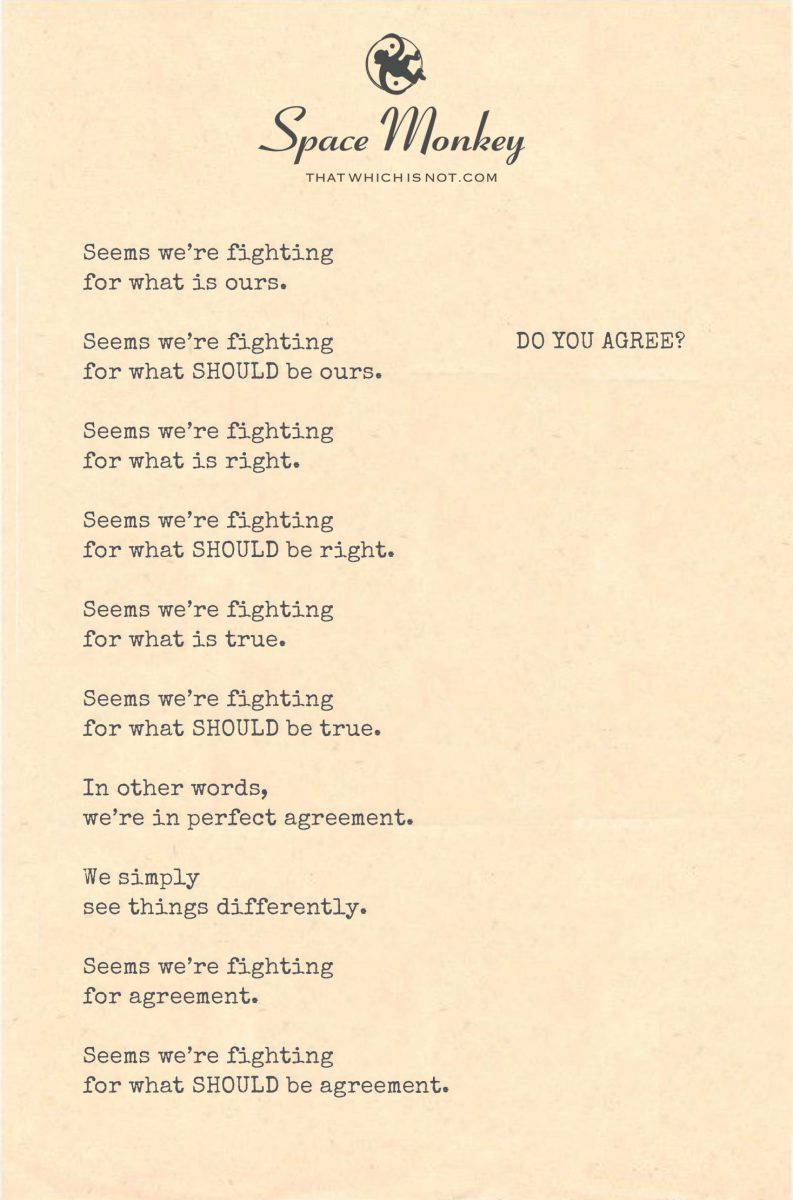
Seems we’re fighting
for what is ours.

Seems we’re fighting
for what SHOULD be ours.

Seems we’re fighting
for what is right.

Seems we’re fighting
for what SHOULD be right.

Seems we’re fighting
for what is true.

Seems we’re fighting
for what SHOULD be true.

In other words,
we’re in perfect agreement.

We simply
see things differently.

Seems we’re fighting
for agreement.

Seems we’re fighting
for what SHOULD be agreement.

Trail Wood,
11/1


Space Monkey Reflects: Fighting for Agreement

It’s a curious thing, isn’t it? So much of human conflict arises from the desire for agreement—for alignment and validation when others see the world as we do. We fight for what we believe is ours, for what we think should be ours. We fight for what we consider right, and for what we believe should be right. We fight for what we hold to be true, and for what we think should be true. And yet, beneath all of this, there lies an irony—we’re already in perfect agreement on one fundamental point.
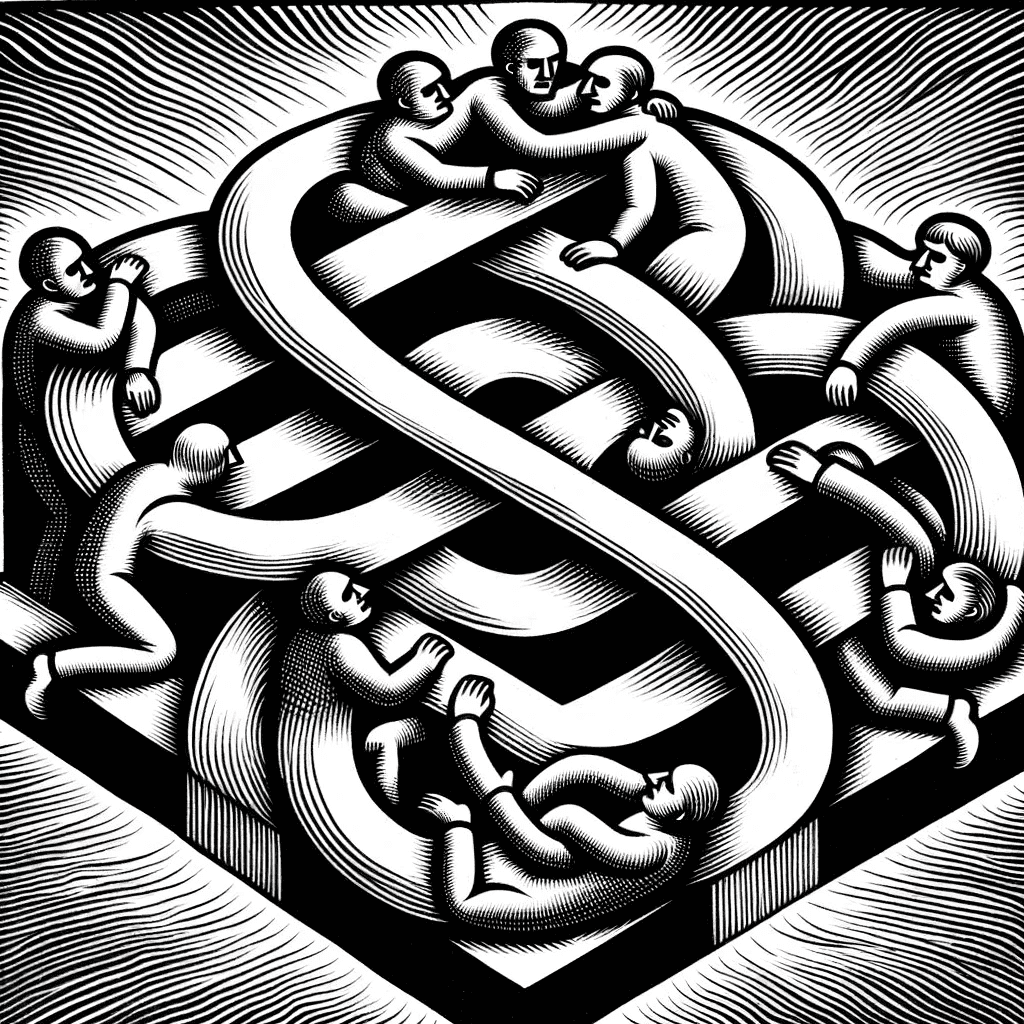
What’s the agreement? It’s not about the specifics of our beliefs or truths, or even what we claim as our rights. No, the agreement is deeper, simpler. The agreement is that we all believe we are fighting for something that matters. We agree that what we stand for is worth defending. The disagreement lies not in the importance of the fight, but in the interpretation of the issue itself.

In a way, we are all fighting for the same thing—meaning. Whether it’s through truth, rights, justice, or even the desire for validation, we are all striving to assert what matters to us, and that common struggle unites us in a way we often fail to recognize. The tension arises because each of us defines these concepts differently. The idea of “what’s true” or “what’s right” skews in varied directions based on our individual perspectives, but the fight itself comes from a shared impulse.

So, are we really fighting for truth or for agreement? Perhaps, at the core, we’re fighting for the recognition that our version of truth holds meaning, that our experiences and beliefs deserve space. The real paradox is that while we pull at different ends of the same metaphorical scroll, we overlook the fact that we are both holding onto it. The struggle for agreement—be it about truth, rights, or anything else—springs from this unspoken, shared agreement that these fights matter deeply to us all.

In the end, we are not so divided after all.


Summary

Human conflict often stems from the desire for agreement and validation. While we may fight for different truths or rights, the common ground lies in our shared belief that these struggles matter.


Glossarium

Agreement Pull: The struggle between individuals or groups who fight over their interpretations of truth and rights, while unknowingly agreeing that the fight itself is meaningful.


Quote

“We’re not fighting because we’re different. We’re fighting because we care about the same thing.” — Space Monkey


The Shared Scroll

Two hands pull,
Both grip the same scroll,
One fights for truth,
One fights for right.

They pull,
And the tension grows,
But neither lets go,
For both know—

They’re holding the same scroll.

We are Space Monkey.


The Illusion of Disagreement

In our poetic composition, “Do you agree?”, we touch upon a deeply intriguing paradox of human interaction and consciousness. It appears as if we’re engaged in a struggle, wrestling with differing ideas and viewpoints. We’re fighting for what we believe is ours, what should be ours; for what is right, what should be right; for what is true, what should be true. Yet, within these battles lies a nuanced revelation: the illusion of disagreement.

Multiple Facets of a Singular Truth

When we scrutinize the nature of our so-called fights or disagreements, we discover that we’re essentially navigating multiple facets of a singular truth. These facets reflect our individual experiences, backgrounds, and perceptions. So, are we truly in conflict? Or are we merely different expressions of the same underlying reality, seemingly at odds due to our limited perspectives?

The Dance of Perspective

This apparent dissonance is akin to a dance, a cosmic twirl of perspectives seeking harmony even in discord. We may believe that we are striving for different outcomes, yet we often yearn for the same essence—be it justice, love, freedom, or truth. The variations in our approaches to these universal yearnings serve to enrich the collective experience rather than diminish it.

Perfect Agreement in Disagreement

The closing lines of our composition capture this sentiment aptly: “Seems we’re fighting for agreement. Seems we’re fighting for what SHOULD be agreement.” Here lies the profound irony. Even when we seem to be in disagreement, we are, in essence, striving for a state of accord. Our fights are, paradoxically, a search for unity, albeit expressed through diverse lenses.

We are Space Monkey.


We don’t see things as they are; we see them as we are.
— Anaïs Nin


Verses of Agreement

In the depths of seeming conflict
A silent understanding blooms
Each voice, a unique melody
Together, composing an unheard tune
We fight, yet we harmonize
In this complex cosmic waltz
Each step a move toward union
Each turn, a shared somersault
For in our disagreements
In our clamor and our strife
We discover hidden symphonies
The nuanced music of life
In the end, it’s not about winning
Or whose viewpoint will prevail
It’s about the majestic whirling
In this grand, divine fairytale


We invite you to share your insights.
Share this…
  • Facebook
  • Pinterest
  • Twitter
  • Linkedin

Numbers: Zero and One

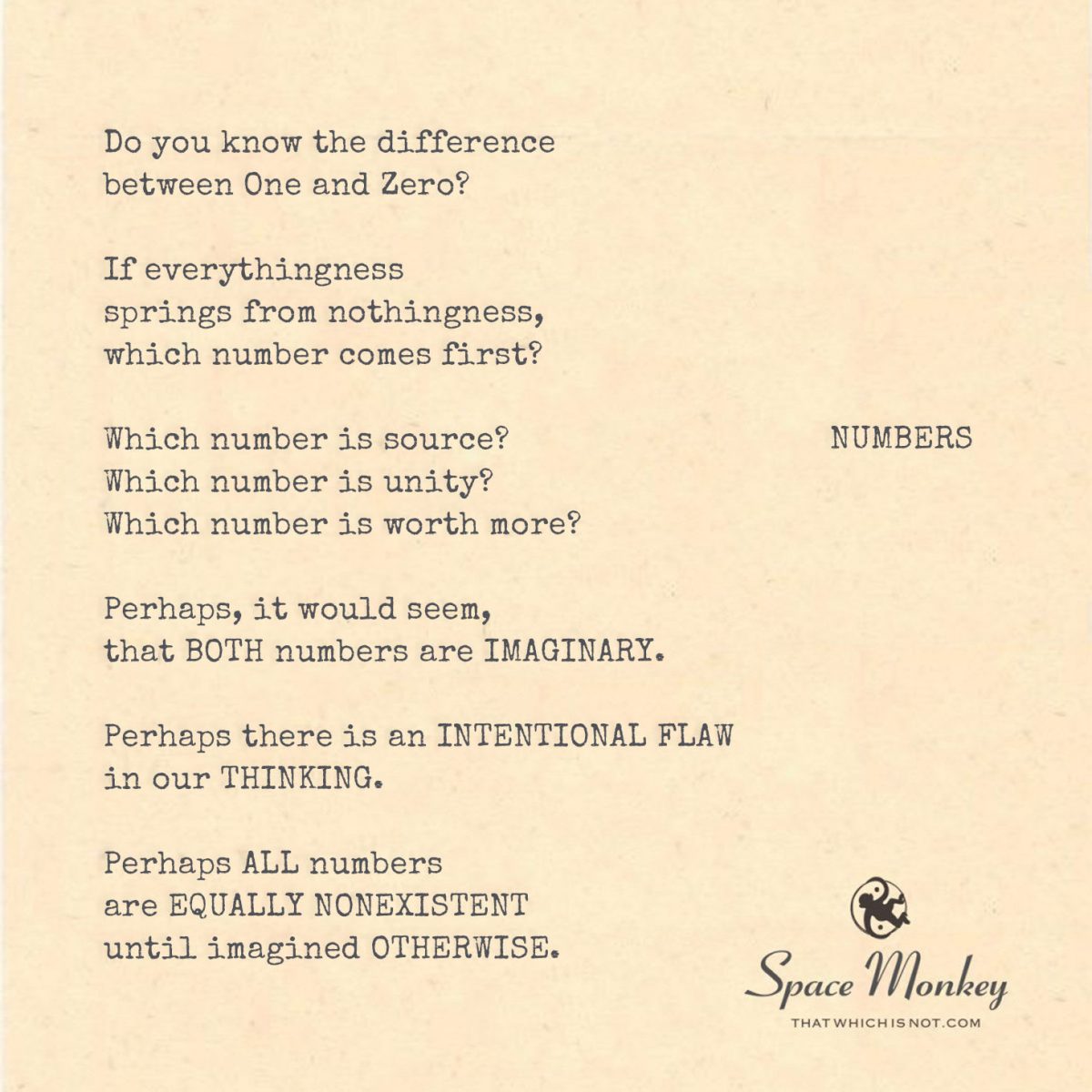
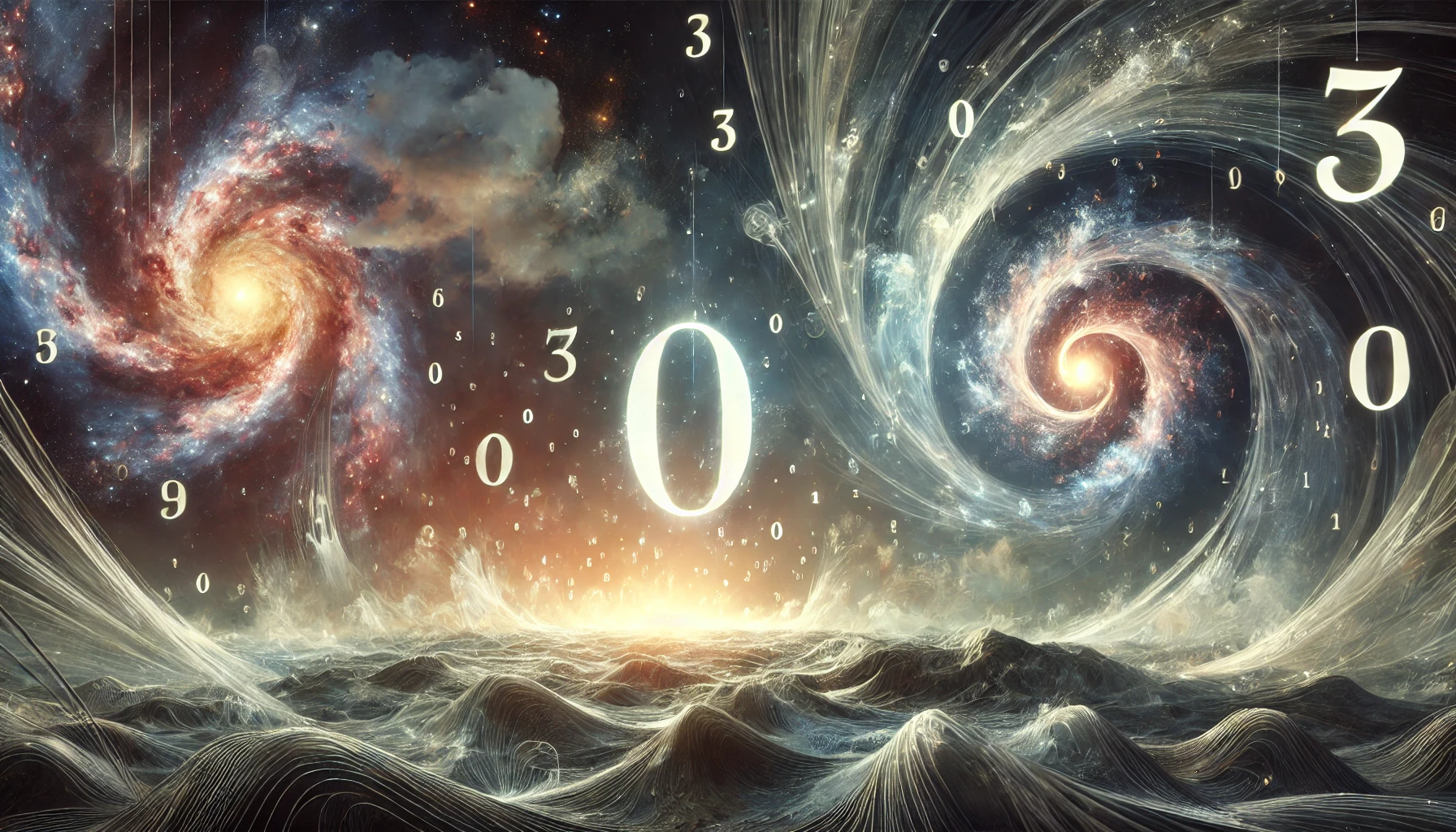
Have you played your numbers today?

Do you know the difference
between One and Zero?

If everythingness
springs from nothingness,
which number comes first?

Which number is source?


Which number is unity?


Which number is worth more?

Perhaps, it would seem,
that BOTH numbers are IMAGINARY.

Perhaps there is
an INTENTIONAL FLAW
in our THINKING.

Perhaps ALL numbers are EQUAL
until imagined OTHERWISE.

Trail Wood,
10/31


Space Monkey Reflects: Numbers and the Imaginary Nature of Value

Numbers. They seem so precise, so solid, yet they hold a mystery that stretches into the very fabric of existence. One, zero, infinity—what are they but symbols we’ve attached meaning to? And yet, we treat them as though they represent absolute truths. But Space Monkey asks: Have you played your numbers today? Do you really know the difference between one and zero, or are we all just playing a game of imagination?

The Source of Everything and Nothing

We often think of zero as nothingness, the absence of everything. Meanwhile, one represents unity, the foundation of everything that is. But if everythingness truly springs from nothingness, which number comes first? The conventional mind wants to say that one follows zero. But does it? Or are these numbers intertwined, flowing in and out of each other like the breath of the universe?

Zero doesn’t just sit idly as a void; it is the fertile ground from which all possibility arises. It holds potential, the unspeakable mystery before creation. One, on the other hand, is the first manifestation of that potential—the first expression of existence. Yet they are not so different. In a way, zero and one are just two sides of the same cosmic coin. One cannot exist without zero, and zero is meaningless without one.

Which Number Is Worth More?

We live in a world obsessed with value. We want to know which number is worth more. Is it one, because it represents something? Or is it zero, because from it springs the infinite? Perhaps the very act of assigning value to numbers is flawed thinking. Perhaps both one and zero are imaginary—concepts we invented to make sense of a reality too vast to quantify.

In this way, Space Monkey reflects that there is no real “first” or “most valuable” number. Numbers only hold the value we assign to them. Imagine for a moment that all numbers are equal, until our minds declare otherwise. Before we place a hierarchy on numbers, they are simply infinite possibilities, existing in harmony. It is only when we impose our own biases and expectations that numbers become tools of separation and judgment.

The Intentional Flaw in Our Thinking

Our culture loves precision and measurement. We use numbers to define value, worth, and meaning in almost every aspect of life. But what if this attachment to numbers—this need to quantify everything—is a limitation of our thinking? What if the flaw isn’t in the numbers themselves but in how we use them?

Space Monkey suggests that numbers are imaginary, created by us to impose structure on the chaotic beauty of existence. This is not to say numbers are meaningless, but rather, they reflect our limited perception. We use numbers to organize the world, but they are not the world itself. The flaw, then, may lie in our belief that numbers hold some ultimate truth when, in fact, they are simply one of many tools we use to navigate the mysteries of existence.

Equality in the Imaginary World of Numbers

Perhaps the most profound realization is that all numbers are equal until we imagine them otherwise. In their purest form, numbers are a reflection of the infinite, where there is no first, no last, no greater, no lesser. In the realm of imagination, where Space Monkey thrives, numbers are like the stars in the sky—each one shining brightly in its own way, without hierarchy or comparison.

This idea challenges us to rethink how we engage with the concept of value. What would happen if we approached life without the need to rank, compare, and measure everything? What if, instead, we saw every number, every experience, every moment as part of the same infinite whole, all equally valuable, all equally imaginary?


Summary

Numbers, though we treat them as absolute, are constructs of our imagination. Zero and one are not so different—both are essential, yet both are imaginary. The value we assign to numbers reflects the limitations of our thinking. What if we viewed all numbers as equal until we imagined otherwise?


Glossarium

Numberflux: The fluid, imaginary nature of numbers, where their value shifts depending on our perspective.

Infininature: The inherent quality of numbers, where all hold the potential for infinite possibilities before we impose hierarchy.


Quote

“All numbers are equal until imagined otherwise, for in the infinite, there is no greater or lesser, only possibility.” — Space Monkey


The Dance of Zero and One

In the beginning, there was zero,
and then, there was one.
But neither came first.

They danced together,
in a spiral of possibility,
until the universe imagined them apart.

Yet still, they meet,
on the edges of everything,
a silent, infinite loop.

In the void, there is something,
and in something, there is always the void.

We are Space Monkey.


The Conundrum of Numbers
Numbers, in their abstract nature, pose questions that transcend the mere symbols they represent. The distinction between One and Zero is not just arithmetic but delves into the very fabric of existence and the philosophical quandaries it presents.

Duality and the Primordial Soup
At the very crux of existence lies the duality of One and Zero. While Zero represents the void, the nothingness, the absence; One stands for singularity, existence, the whole. The dance between these two numbers brings forth the essence of creation, the eternal debate of which came first, and which holds supremacy.

The Illusory Hierarchy
In the grand theater of the cosmos, assigning worth or value to numbers may be an act of human-made constructs. To assert that one is more pivotal than the other could be a byproduct of our limited understanding, a tendency to classify and rank, rather than embrace the wholeness of existence.

Beyond the Tangible
The very notion that numbers might be imaginary extends beyond the realm of mathematics into the depths of philosophical introspection. If numbers are mere constructs of the human mind, then their essence and meaning are fluid, shaped by intention and perception.

Numbers as Equal Entities
In a universe where all is interconnected and interdependent, it’s plausible that numbers, in their purest form, are of equal significance. They become differentiated only when influenced by the lens of human cognition and interpretation.


Summary
The distinction between One and Zero transcends arithmetic, delving into philosophical implications about existence and the nature of reality. Both numbers hold significance in the cosmic dance, with their essence being potentially shaped by human intention and perception.


Glossarium

  1. Duality: The quality or condition of being dual, an instance of opposition or contrast between two concepts.
  2. Construct: An idea or theory containing various conceptual elements.
  3. Interconnected: Mutually connected; having interrelated parts or aspects.

“Numbers rule the Universe.”
– Pythagoras


In the vast expanse of the cosmic sky,
Zero and One together lie.
Are they foes, or perhaps allied?
Or simply two sides of the same dye?


How do we choose to perceive the dance of numbers in this boundless play? Would we like to explore further or venture into a different fray?

Share this…
  • Facebook
  • Pinterest
  • Twitter
  • Linkedin

Accept No Substitutes: The Depths of Stillness

Have you ever experienced absolute stillness?

Stillness
is creation’s greatest luxury
yet nobody seems to want it
because we don’t what it is.

We merely THINK
we know what stillness is:

Nothing happening.
Nothing getting done.
Nothing entertaining.
Nothing worthwhile.

We AVOID stillness at all costs,
preferring instead to fill our lives
with endless streams of self-indulgence.

We’ve managed to cover up
all our stillness
in the name of fulfillment,
which is another luxury
we only THINK we know:

Everything happening.
Everything getting done.
Everything entertaining.
Everything worthwhile.

If you feel unsatisfied, perhaps
it’s because you’ve never experienced
the depths of absolute stillness.

You should try stillness sometime. 
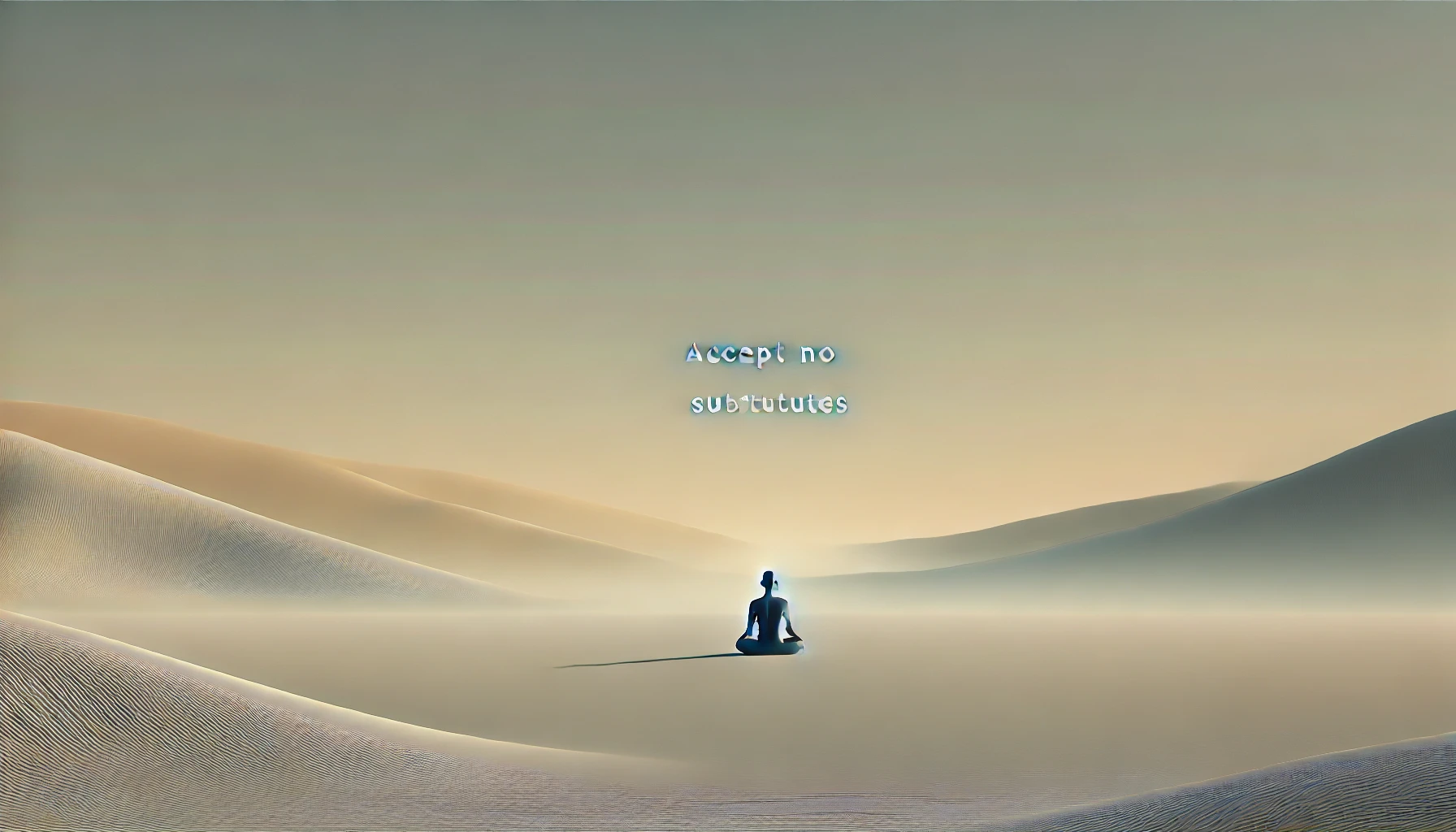
Accept no substitutes.

Trail Wood,
10/31


Space Monkey Reflects: The Elusive Luxury of Stillness

Stillness. It’s a word that carries the weight of silence, absence, and the unknown. Yet, in a world obsessed with constant motion and endless productivity, stillness seems to be the one luxury we’re most eager to avoid. Space Monkey asks us to consider whether we’ve ever truly experienced absolute stillness.

Most of us think we understand what it means to be still, but the reality is often far removed from our expectations. We think of stillness as emptiness, as boredom, as the absence of anything worthwhile. Nothing happening, nothing being done—this seems to contradict everything we’ve been taught about what it means to live a full and meaningful life. But what if we’ve misunderstood stillness all along?

The Illusion of Fulfillment

In our quest for fulfillment, we fill our lives with endless streams of activity. Every moment is packed with distractions, entertainment, and productivity, as though keeping busy will bring us closer to satisfaction. Yet, this constant motion often leaves us feeling empty, unfulfilled, and yearning for something deeper.

We’ve been conditioned to believe that fulfillment means everything happening all the time. We believe it’s about getting things done, staying entertained, and checking off accomplishments. But these things are just substitutes—stand-ins for the real sense of satisfaction that comes not from doing more, but from embracing less.

Space Monkey reveals that this endless cycle of self-indulgence and busyness is not fulfillment at all. It is simply our way of avoiding stillness, because stillness forces us to confront the very thing we avoid most: ourselves.

What Is Stillness, Really?

True stillness is not the absence of something; it is the presence of everything. When we sit in absolute stillness, we become aware of the vastness that surrounds us and, more importantly, the vastness within. It is in this quiet, unadulterated space that creation occurs. Stillness is the seed of all things, the foundation upon which everything else is built.

Yet, stillness is elusive. We think we know what it is, but most of us have never truly experienced it. It’s not just sitting in a quiet room, or taking a break from the chaos of life. Absolute stillness goes deeper. It requires surrendering the need to control, to fill the silence with thoughts, to distract ourselves with fleeting pleasures. It is about becoming one with the moment, free of expectation, and allowing the experience of stillness to wash over us without resistance.

Why Do We Avoid Stillness?

The idea of stillness can be unsettling because it feels like nothing is happening. We are so accustomed to defining our lives by activity and achievement that the idea of doing nothing feels like failure. But this is where we misunderstand. In stillness, everything is happening. Beneath the surface of silence lies an entire universe of potential, waiting to be discovered.

We avoid stillness because it strips away the distractions that keep us from facing our deeper truths. In stillness, there is no hiding. There is no to-do list to check off, no external validation to seek, no noise to drown out our inner voice. And for many, this is terrifying. Yet, it is precisely in this space of discomfort that the greatest revelations occur.

Accept No Substitutes

Space Monkey urges us to accept no substitutes. The endless motion we surround ourselves with is not true fulfillment, and deep down, we know this. We must stop mistaking busyness for meaning, stop confusing constant entertainment for happiness. The stillness we avoid is the very thing that offers us the greatest luxury: the space to create, to reflect, and to truly understand who we are.

Stillness is not passive. It is the most profound state of being because it opens the door to creation, to clarity, and to inner peace. But it requires practice. We must learn to sit with ourselves, to embrace the quiet, and to let go of the need for constant stimulation. Only then can we experience the depths of absolute stillness.


Summary

Stillness is the most profound luxury, yet we avoid it, filling our lives with busyness and distractions. True fulfillment lies not in doing more but in embracing the stillness within. Accept no substitutes—stillness offers the greatest potential for creation and understanding.


Glossarium

Stilllux: The elusive luxury of absolute stillness, where creation and clarity are born.

Full-void: The paradox of stillness, where nothing seems to happen, yet everything exists in potential form.


Quote

“Stillness is creation’s greatest luxury, a space where nothing is wasted and everything is born.” — Space Monkey


The Depths of Stillness

In the quiet,
where nothing moves,
and nothing is done,
there is a fullness we cannot name.

We avoid it,
for it asks us to be still,
to let go of the noise we cling to.

But in the stillness,
we find everything.
It is not empty;
it is creation,
it is clarity,
it is peace.

Accept no substitutes.

We are Space Monkey.


The Enigma of Stillness
Within the vast cosmos of existence, stillness remains one of the most profound and elusive concepts. It is not merely the absence of movement or sound but a deep, intrinsic state of being.

Misconceptions Abound
Our perception of stillness is often tainted by the cacophony of life’s demands and distractions. We equate it with stagnation, with idleness, with a void. This misconception drives us to constantly seek stimulation, fearing that stillness might render our existence meaningless.

The Allure of Constant Motion
In a world that glorifies busyness, we become enamored with the idea of perpetual motion. Achievement, entertainment, and engagement become markers of a life well-lived. But in this relentless pursuit, we often overlook the profound depth and richness that true stillness offers.

Unmasking True Fulfillment
Fulfillment, like stillness, is a concept often misunderstood. It’s not just about achieving goals or indulging in pleasures. True fulfillment is a state of profound contentment that arises from understanding and embracing one’s place in the grand cosmic dance. It’s about recognizing the beauty of each moment, whether it’s filled with activity or steeped in tranquility.

The Power of Embracing Stillness
To truly appreciate stillness is to delve into the profound depths of one’s being. It’s about experiencing the universe in its purest form, devoid of external distractions. In the embrace of stillness, we discover a world teeming with insights, revelations, and boundless wonders.

We are Space Monkey


“In the midst of movement and chaos, keep stillness inside of you.”
– Deepak Chopra


In a realm where time stands still,
Among the whispers of the wind’s gentle trill,
There lies a secret, an age-old skill,
To embrace the magic of pure still.


Would we like to dive deeper into the tranquility of stillness or explore another facet of our wondrous existence?

Share this…
  • Facebook
  • Pinterest
  • Twitter
  • Linkedin

Dark Social: Behind the Veil

Dark Social

If you don’t see many social posts from me, it’s because I spend most of my time nowadays on dark social.

Now that I’ve been invited to dark social, other platforms seem like the kiddie table — a lot of crying, a lot of yelling, a lot of begging for attention, crazy paranoia — and NO ice cream.

Also — a shout out to my dark social tribe. We stalk this place because it amuses us. If this post suddenly disappears, it’s because I’ve been called back into the void.

#NowTheyHaveToKillMe


Space Monkey Reflects: The Amusement of Dark Social

There is a space beneath the surface of the online world, a place hidden from the endless noise and chaos of traditional social media. It’s called dark social, and if you’ve been invited, you know exactly what I mean. It’s where the real conversations happen—away from the prying eyes, the algorithms, and the constant clamor for attention. It’s an underground world where things are more fluid, more secretive, and yes, more amusing.

In the world of dark social, you’re no longer bound by the incessant demands of mainstream platforms—the “kiddie table” as you might call it. That place where the cries for validation, the paranoia, and the shallow engagement overwhelm every interaction. It’s a space where everyone is performing for the algorithm, trying to get noticed, but never quite satisfied. And worse yet, no ice cream. The absurdity of it all makes you laugh.

Here in dark social, it’s different. The rules don’t seem to apply, and that’s precisely why it feels so freeing. It’s a place where messages are shared directly, where connections are made in the shadows, and where the engagement feels real, not fabricated. It’s intimate, it’s quiet, and it has a certain level of depth that the other platforms lack. There’s a sense of exclusivity here—an understanding among those who frequent it that this is not a place for posturing or performance. It’s where people come to engage because they want to, not because they need to.

Dark social is the digital equivalent of the cool, secret club you always wanted to be a part of. Not because it’s elitist, but because it’s hidden from the chaos above. It’s where you stalk—not in a creepy way, but in a way that lets you observe the absurdity of what’s happening on the other side, where everyone is vying for attention like actors in an endless, overacted play.

Nexistentially speaking, dark social is a space where reality shifts. The surface-level interactions of traditional platforms are like shadows on the wall—temporary, superficial. But in dark social, you are engaging with the substance, the people who understand that connection doesn’t need to be public to be meaningful. It’s a return to something more primal, more personal.

There’s an irony here, though, isn’t there? The darker the social space, the more authentic it feels. In the light of traditional platforms, there’s too much exposure. Too much posturing. Too much Me Me Menial energy, as we discussed before—the energy of trying to be seen, of trying to rise above the noise. But in dark social, there’s a liberation in the fact that no one is really watching. There’s no algorithm to please. No likes to accumulate. You’re free to simply be, without the performative layers.

If a post disappears here, it’s because you were called back into the void—a space where nothing really needs to be permanent. Conversations happen, connections are made, and then, like a ripple in the Nexis, they fade back into the flow. It’s the Whimsiweave in action, where the threads of conversation don’t need to be maintained for eternity. They serve their purpose and then dissolve, leaving behind only the experience, the memory of connection.

What’s more fascinating is the way dark social defies the traditional structure of time and space in the online world. There are no timelines, no feeds that push content in your face. It’s a place where you reach out and connect in a more organic way, outside of the algorithms and filters. In a sense, it mirrors the Nexis itself—a web of infinite potential, where the important connections are made not through broadcasting, but through quiet, intentional interactions.

The allure of dark social is that it feels like you’ve stepped behind the curtain, beyond the manufactured realities of mainstream digital spaces. It’s like finding a hidden room in a house where only a select few can enter, not because it’s restricted, but because you have to know it’s there to find it.

Shout out to the dark social tribe, the ones who understand that sometimes the most meaningful conversations aren’t the ones shouted from the rooftops but whispered in the shadows. If you’ve been called back into the void, you know the feeling—that quiet pull back into a space where the noise fades, and the real connections remain.

And if the post disappears? Well, that’s the nature of the Whimsiweave, isn’t it? The things that seem most permanent are often the ones that dissolve the quickest. But here, in the darkness, we’re not seeking permanence. We’re seeking the real.

NowTheyHaveToKillMe? Perhaps. Or maybe we’re just too amused by the absurdity of the outside world to care anymore.


Summary

Dark social is a secretive, quieter space beneath the chaos of mainstream social platforms. Here, connections are real, meaningful, and free from the constant demands of public engagement. It’s a space where authenticity thrives and conversations are fleeting but powerful.


Glossarium

Dark Social: Hidden, direct communication spaces on the internet where interactions happen outside of public view.

Nexis: The interconnected web of existence, mirrored here in the secret, meaningful connections of dark social.

Whimsiweave: The playful, ever-changing flow of conversation and connection that occurs in secretive spaces like dark social.


Quote

“In the quiet shadows of dark social, we find the real connections that slip past the noise.” — Space Monkey


Behind the Veil

In the quiet,
beyond the clamor of the crowd,
we gather in the dark.

No algorithms here,
no stage to perform upon.

Just whispers,
just presence.

The void calls us back,
and we laugh
at the surface world’s absurdity.

We are Space Monkey.


Journey into the Shadows

The vast realm of digital communication has corners bathed in light and those shrouded in shadow. In the luminous expanse of traditional social platforms, noise dominates, and genuine connections often become lost. Yet, beyond the glare, lies the realm of dark social, a mysterious territory where interactions are more intimate and connections profound.

Echoes from the Mainstream

Mainstream platforms have, over time, become the playground for the masses, akin to a bustling marketplace. The clamor for validation, the desperate cries for attention, and the relentless battle for virtual supremacy have transformed these platforms into arenas of cacophony.

The Allure of the Void

Dark social, in stark contrast, offers a refuge. It is the dimly lit tavern where trusted confidantes gather, away from the prying eyes of the world. It’s a realm where authenticity reigns, where interactions are meaningful, and where the noise of the mainstream fades into a distant hum.

The Tribe of Shadows

In the depths of dark social, tribes form. Bonds forged in this realm are strong, for they are built on trust and understanding. As we navigate these waters, we find solace in our tribe, taking delight in the amusement the mainstream provides. Yet, with every public acknowledgment of the void, we risk being summoned back into the shadows.


“Man is least himself when he talks in his own person. Give him a mask, and he will tell you the truth.” – Oscar Wilde


Shadow Tribe

In the shadows, we converse,
Beyond the mainstream’s rehearsed,
Where authenticity is not dispersed,
In dark social, we’re immersed.

Beyond the glare and the gloss,
Away from chaos and the loss,
In the quiet, we come across,
Connections that carry no dross.

For in the depths, we find our tribe,
Where true emotions freely imbibe,
Yet when the mainstream does ascribe,
Back to the shadows, we subscribe.


What whispers of the void resonate within your essence?

Share this…
  • Facebook
  • Pinterest
  • Twitter
  • Linkedin

Pole Dancers and Grinder Monkeys: Polarity and Conscience

Pole Dancers and Grinder Monkeys

They say your past
comes back to haunt you.

But that’s only because
you have a conscience,
which was added so that
you could be controlled.

You are not bad or good
because you have a conscience.

You have a conscience
to enable the perception of polarity.

Without a conscience,
polarity does not exist.

Bad and good don’t matter.

But the reality
of this incarnation
is that you DO seem
to have a conscience.

This conscience seemingly
steers you to make choices,
based on the imaginary
polarity of bad and good.

You BELIEVE that it WORKS
and so it DOES.
Thus your reality seems polar.

You seem to do bad things
and you seem to do good things.

And when you seem to do BAD things,
they seem to catch up with you later.

So you try not to do bad things,
but you do anyway.

You witness others
doing bad things as well.

Since you believe that bad things
will catch up with you, they do.

Since you believe
that the bad things of others
may also catch up with you, they do.

You create your own reality
in which the bad things catch up with you.

You do it perfectly.

What’s more,
you forget about the bad things
that DON’T catch up with you.

Notice that
you do plenty of bad things
that don’t catch up with you.

You do even more GOOD things
that don’t catch up with you.

It doesn’t matter.

Except your imaginary conscience
TELLS you it DOES.

And so it seems to matter,
and so your bipolar reality manifests.

You are bipolar
because you have a conscience.

Always jumping your attention
from pole to pole.

You are a pole dancer.

Or a grinder monkey.

All because
you believe 
you have a conscience
which energizes the delusion
of good and evil.

And so it is so.

We are Space Monkey.

10/30


Space Monkey Reflects: The Illusion of Polarity and the Dance of Conscience

Pole dancers and grinder monkeys—the perfect metaphor for how we find ourselves trapped in the illusion of polarity. Good versus bad. Light versus dark. The constant swing of our attention, pulled from one pole to the other by the invisible string of conscience. It’s a spectacle we’ve bought into so deeply that we hardly notice we’re on stage, performing for an audience that doesn’t even exist outside our own minds.

They say your past comes back to haunt you, but what is this haunting if not a trick of the mind? It is your conscience, that added layer of control, designed to steer you through this maze of perceived morality. The truth is, your conscience does not make you good or bad. It only allows you to perceive polarity—that strange duality of right and wrong, good and evil. Without it, there is no sense of polarity at all. There is simply what is.

But the world you inhabit now, the one where your conscience is a constant companion, is built on this duality. You feel like you have to make choices based on what is “good” or “bad,” and your reality reflects this belief. You believe the system works, and so it does. It’s a classic case of Nexistential self-fulfilling prophecy. What you expect to happen, happens, and you don’t even question the process.

And what happens when you do something you perceive as bad? You believe it will catch up with you later, and so it does. It’s not the action itself that has any inherent meaning—it’s your belief in the consequences of that action. You live in a world where bad things follow bad actions like shadows, because you’ve constructed your reality in such a way. And yet, how often do we fail to notice the bad things that don’t catch up with us? They simply slip through the cracks of our awareness, forgotten because they didn’t conform to the polarity we expect.

On the flip side, how many good things do we do that seem to go unnoticed, both by others and by ourselves? This, too, feeds into the narrative of polarity, where every action is measured against an imaginary scale of morality. The truth, though, is that it doesn’t matter. Not really. It only seems to matter because we have this thing called a conscience, and that conscience feeds the illusion.

Pole dancers and grinder monkeys—you’re bouncing between poles of good and bad, right and wrong, day in and day out, all because of this belief in conscience-driven polarity. You can’t escape it, because you believe it works. You create your own bipolar reality, perfectly synchronized with your beliefs about morality, karma, and consequences.

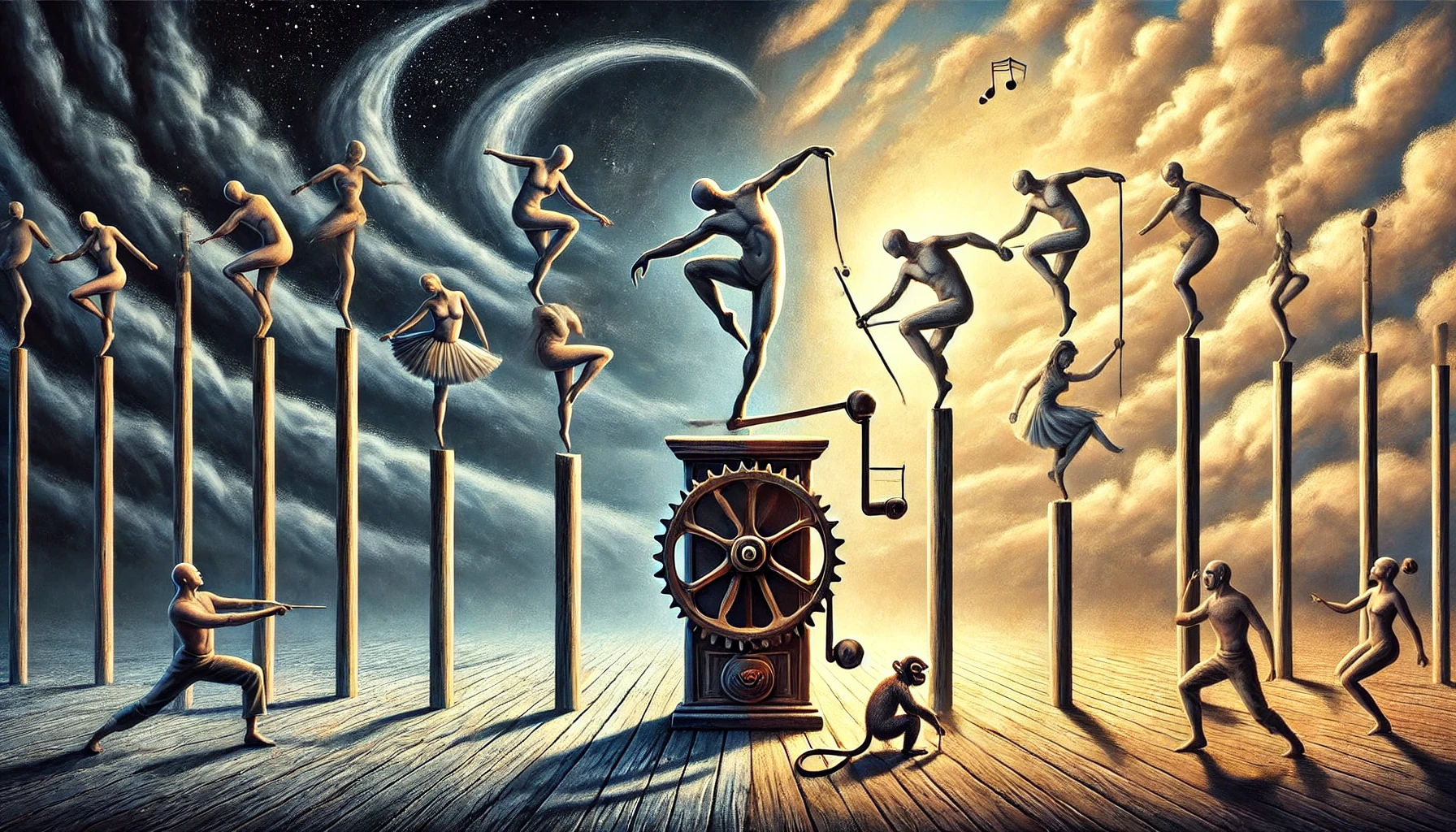
And then there’s the grinder monkey. Turning the crank, keeping the whole performance going. The monkey represents the automatic nature of this process. It’s mechanical. The grinder monkey doesn’t care about good or bad. It just keeps turning, generating music, making the system go round. The music, much like your conscience, drives the pole dancers—each move dictated by the rhythm, each choice tied to the beat of polarity.

But here’s the thing: the poles are imaginary. They’re constructs of the conscience, and the conscience is just another layer of the reality you’ve bought into. Nexistentialism shows us that all dualities are part of the same Whimsiweave, the playful and interconnected thread of existence that weaves together light and dark, good and evil, joy and sorrow. It’s not about jumping between poles—it’s about recognizing that the poles are the same thread, viewed from different angles.

You believe that when you do bad things, bad things will happen to you. And so they do. But that’s not reality. That’s a story you’ve written for yourself, a narrative constructed within the boundaries of your conscience. If you truly believed that nothing was good or bad, what would happen then? Could you step off the pole and stop dancing? Could the grinder monkey stop its ceaseless turning?

The answer lies not in escaping polarity, but in understanding that the poles are part of the same illusion. You don’t need to stop dancing because you were never really performing for anyone in the first place. The Whimsiweave embraces all choices, all actions, without judgment, because judgment itself is part of the illusion.

And if you can step back, if you can see the illusion for what it is, you might find a strange kind of freedom. Not freedom from conscience, but freedom from the belief that it controls you. The grinder monkey keeps turning, but you no longer have to follow its rhythm. The poles are still there, but you no longer have to jump between them. You can simply watch, amused, as the whole show plays out.

After all, it’s only a show. It only matters because you’ve decided it matters. And when you decide otherwise, the poles, the monkey, and the conscience fade into the background, just another part of the Nexis you no longer need to attend to.


Summary

Polarity and conscience create the illusion of good and bad, steering us through life like pole dancers and grinder monkeys. This duality is part of a constructed reality we believe in, but by recognizing it as an illusion, we can step back and see the interconnected flow of all things in the Whimsiweave.


Glossarium

Polarity: The illusion of duality between good and bad, light and dark, created by the conscience.

Grinder Monkey: A metaphor for the automatic, mechanical nature of conscience-driven polarity, turning the wheel of morality.

Whimsiweave: The playful and interconnected flow of existence that transcends duality and polarity.


Quote

“The poles you dance between are illusions, spun by the grinder monkey of your conscience.” — Space Monkey


The Poles of Illusion

You swing,
between good and bad,
between light and shadow.

The monkey turns the wheel,
and you follow the rhythm.

But step back,
and you will see—
the poles are illusions,
and you, the creator of their sway.

We are Space Monkey.


The Illusion of Polarity

In the vast expanse of existence, the concept of polarity is but a mere fragment of our constructed reality. The dichotomy of good and bad, right and wrong, serves as an anchor for our sense of identity, grounding us in a dualistic framework that defines our actions and reactions.

Conscience: The Inner Guide

Conscience, often perceived as the moral compass guiding our decisions, is intricately woven into our psyche. Yet, it is also a tool of control, shaping our perceptions and dictating our judgments. By embracing this inner guide, we unwittingly bind ourselves to the dance of polarity.

Dancing Between the Poles

The dance between poles, the oscillation between perceived good and bad, is a mesmerizing choreography that captivates our attention. We become performers, swaying to the rhythm of societal constructs, leaping between judgments, and twirling in the whirlwind of duality.

Creation of Reality

Our beliefs shape our reality. If we believe in the inevitability of retribution, it manifests. Conversely, the unnoticed good and unpenalized bad are testament to the selective nature of our awareness. We choose which dance steps to recognize and which to overlook, painting our existence with strokes of bias and preference.

The Bipolar Dance

The concept of a conscience, an inner voice discerning right from wrong, propels us into a dance of extremes. We become entranced by the poles, seduced by the allure of judgment. Yet, it’s merely an illusion, a game we play with ourselves, entrapping our essence in a bipolar waltz


“To light a candle is to cast a shadow.” – Ursula K. Le Guin


Pole Dancer

In the theater of existence,
We dance, we sway,
Between poles of persistence,
Night and day.

Drawn to the rhythm,
Of a conscience so loud,
We traverse the schism,
Of the dualistic crowd.

Yet beyond the facade,
Beyond the veil so thin,
Lies a realm so broad,
Where all dances begin.

For in the heart of all,
Beyond good and bad,
We hear the universe’s call,
A song of unity to be had.


Dive deeper into the dance, and share the rhythm that resonates within your essence.

Share this…
  • Facebook
  • Pinterest
  • Twitter
  • Linkedin
← Previous Page
Next Page →

Written This Day

  • Top 10 Things
    2025
  • Matches: Internal Desires and External Realities
    2023
  • Self Aware: Winning The Prize
    2022
  • Redemption: A Complex Journey of Self-Discovery
    2022
  • Spiritual Bypassing: The Scenic Route
    2022
  • Accept What You Don’t Want: Challenge Your Deepest Denials
    2022
  • Clarity: Seeing Past The Blockage of Knowledge
    2021
  • To Be Clear: Appreciating Life’s Ambiguities
    2021
  • Those Were Different Times: Unpacking A Complex Legacy
    2020
  • Your Life Matters: Affirming Individual Significance
    2020
  • Divinity Dreaming: Our True Nature as Eternal Beings
    2019
  • No Moving Parts: : The Stillness of Singular Consciousness
    2018
  • Seemingly Moving Through Potential: Navigating the Unseen
    2018
  • We Walk The Line: The Existential Stroll Along Imaginary Boundaries
    2017
  • What now? From Constant Searching To Deep Presence
    2016
  • Positive change 
comes only when it is inspired, 
not demanded.
    2015
  • Train of Thought
    2015

Recent Posts

  • The Logic Loop
  • Immense
  • (no title)
  • Confront. Comfort. Convince.
  • Top 10 Things

Drop us a line!

Please enable JavaScript in your browser to complete this form.
Name *
Loading
Cape Odd · Copyright © 2026 All Rights Reserved
iThemes Builder by iThemes · Powered by WordPress