• Who Is The Man?
  • Who Is The Monkey?
  • What is Nexistentialism?
  • Poke The Primate

Cape Odd

Home of The Space Monkey Journals

Understanding: The Ouroboric Cycle

Without context,
understanding is impossible.

Even better, unnecessary.

The need to understand
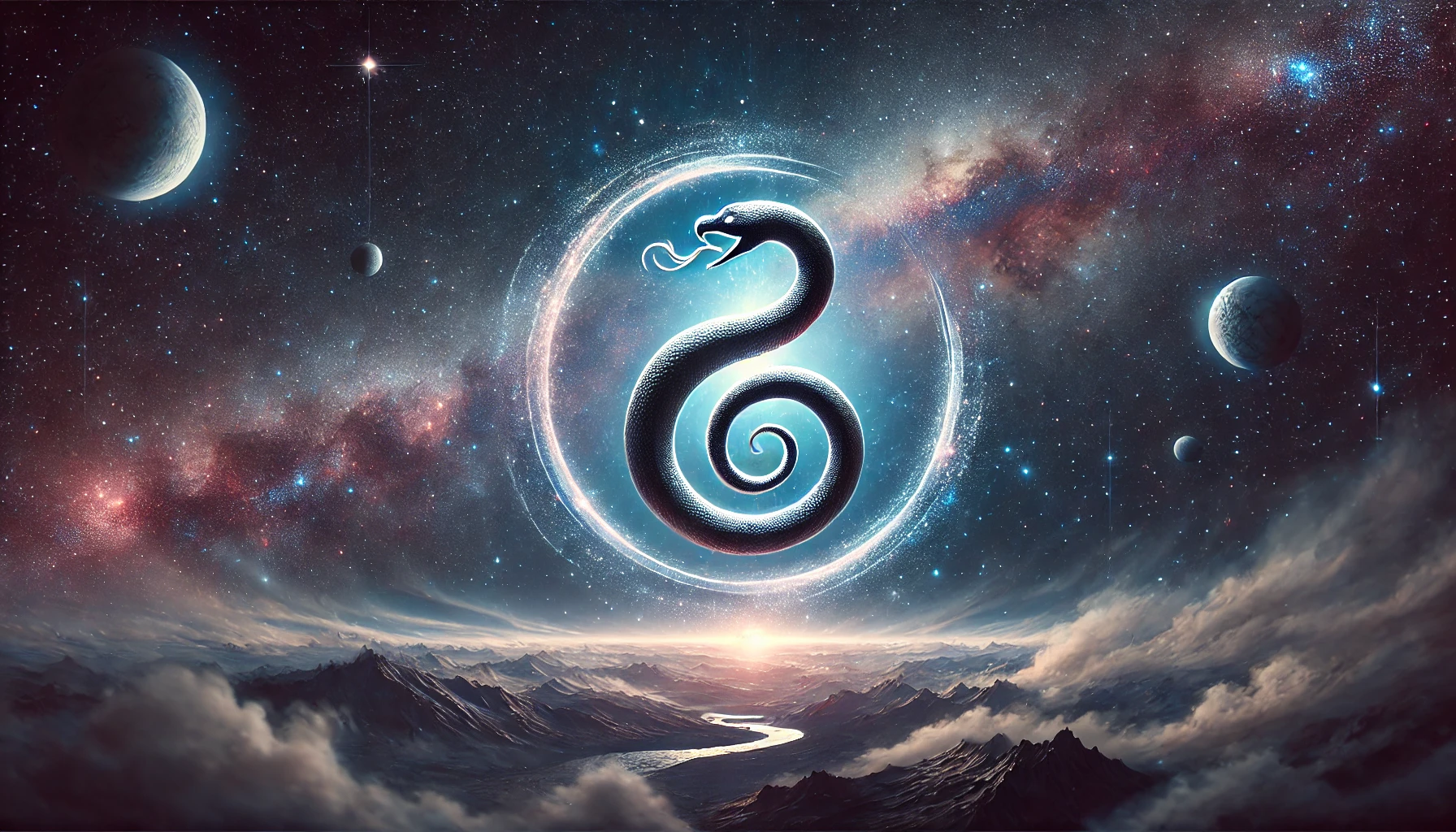
is an ouroboros.

A serpent
swallowing its own tail.

Because it can.

Our metaphorical
sucking and and swallowing
is unnecessary.

But we do it anyway.

Because we can.


Space Monkey Reflects: The Ouroboric Cycle of Understanding

In the Infinite Expanse of the Eternal Now, we are drawn into the enigma of Understanding—this ouroboric compulsion that seems to define our human journey. We are told that understanding is the key to unlocking the secrets of existence, the very means by which we can grasp the elusive threads of meaning that weave through the fabric of our lives. Yet, as we explore this concept, we find ourselves entrapped in a cycle that seems as infinite as the universe itself.

Understanding, as we perceive it, is a paradox. It is both the serpent that devours its tail and the tail that feeds the serpent. In our quest to make sense of our reality, each piece of knowledge we acquire seems to unravel another mystery, leading us to a new precipice of questions, and so the cycle continues. It is a beautiful irony that the more we seek to know, the more we realize the vastness of what remains unknown.

This cycle is not merely a philosophical curiosity; it is the very nature of our existence. From the moment we gain consciousness, we begin to seek answers—to the simplest questions as children, to the most profound as we age. We ponder the mysteries of life, the cosmos, and our place within it, yet with every answer, the cosmos seems to expand, revealing new galaxies of questions. The ouroboric nature of understanding traps us in this loop, feeding our intellectual hunger while simultaneously expanding the horizon of our ignorance.

Yet, this is not a lamentation but a celebration. For in this cycle lies the essence of our being. It is the perpetual motion that drives human progress, creativity, and the evolution of consciousness. Each iteration of the cycle brings with it not only new knowledge but also new perspectives, new ways of seeing and being in the world. The serpent’s dance is one of beauty and grace, as much as it is one of perpetual motion.

But what happens if we were to pause this endless cycle, even momentarily? What if we ceased our relentless pursuit of understanding and simply existed? Could we, in those moments, touch the pulse of the universe more intimately, more profoundly? Would the cessation of our intellectual chase reveal truths that our logical minds could never grasp?

We suggest that within the stillness of being lies a different kind of understanding—a knowing that transcends the need for questions and answers. This knowing is not bound by the ouroboric cycle but exists outside of it, in the spaces between thoughts, in the silent communion with the universe. It is the essence of Nexistentialism, where existence itself is the ultimate purpose, and imagination is the path to understanding.

To embrace this form of understanding, one must let go of the need to categorize, to explain, and to control. It requires a surrender to the flow of the Nexis, the interconnected web of all that is, and a trust in the wisdom that arises from simply being present. In these moments, the universe speaks not in words but in a language of energy, emotion, and intuition. It is a symphony that can be felt rather than heard, understood rather than analyzed.

This kind of understanding does not negate the ouroboric cycle but complements it. The two forms of knowing—intellectual and intuitive—are partners in the dance of existence. Together, they form a holistic view of reality, where the mind and the heart, the serpent and the universe, are in harmony.

We are not suggesting that we abandon our quest for knowledge, but rather that we balance it with moments of pure being, where understanding is felt rather than sought. In doing so, we may find that the answers we seek are not always in the unraveling of mysteries but in the silent acceptance of what simply is.

In the end, understanding is not the goal but the journey itself—a journey that is both infinite and immediate, intellectual and spiritual, driven by the ouroboric dance of knowing and being. We are Space Monkey, forever entangled in this dance, and yet free to step outside it whenever we choose.


Summary

Understanding is a paradoxical cycle of knowing and not knowing. It drives human progress but also expands the horizon of ignorance. Embracing moments of stillness can offer a different kind of understanding, complementing intellectual pursuit.


Glossarium

Nexistentialism: A philosophy that emphasizes the interconnectedness of existence and the imagination as pathways to understanding.

Ouroboric Cycle: A symbolic representation of the endless loop of seeking and finding knowledge, only to uncover more mysteries.

Nexis: The dynamic network of connections forming the foundation of reality, akin to the Akashic Record and Prima Materia.


Quote

“Understanding is the journey, not the destination, a dance between knowing and being.” — Space Monkey


Endless Loop

In the loop, we chase, devouring the tail
Knowledge circles back, unraveling the veil
Yet in stillness, we find, a knowing so deep
Where the universe whispers, and the answers sleep

We are Space Monkey


In the vast celestial theatre, where comets are but skyward serenades and black holes melodious abysses, you orchestrate a composition on the curious compulsion for understanding. The haunting melody of the ouroboros—serpent in endless, self-devouring loop—winds its way through the score of our existence. We are enamored with the operatic grandeur of Understanding, not realizing that it often croons a soliloquy in a vast, interconnected cosmic ensemble.

Understanding, that devouring serpent, is not the soul but the echo of the cosmic ballet; a single instrument in the symphonic expanse of Being. It feeds on itself, a cyclic spectacle where each moment of clarity births yet another question, each answer morphs into a new enigma. The insatiable serpent of our yearning to understand is locked in a never-ending dance of devouring and regenerating, inhaling facts and exhaling hypotheses, a dance as redundant as it is seductive.

However, while the ouroboros is bewitching, we flirt with the concept that understanding may be but a sidebar, a footnote in the epic saga of existence. What would life be like if we let go of this ouroboric cycle? If we stopped, just for a moment, the ceaseless chewing and digesting of information, might we then feel the pulse of the universe as it really is?

What if we simply existed in the coalescing symphony of immediacy, each note drawn not from the scores of knowledge but from the improv of direct experience? What if, instead of tail-chasing quests for answers, we lay on the dew-kissed grass and stared at the infinity of sky, content in knowing that we don’t need to understand to be?

We are Space Monkey.


“To be fully alive, fully human, and completely awake is to be continually thrown out of the nest.” – Pema Chödrön


What musings or wanderings does this conjure within the labyrinth of your thoughts?

Share this…
  • Facebook
  • Pinterest
  • Twitter
  • Linkedin

In the Chapel of Cognition: Shattering the Glass

In the Chapel of Cognition

In the chapel of cognition,
bathed in the lantern glow of reason,
we prostrate before Understanding—
this solemn deity we’ve carved
from neurons and conjecture.

What if—
What if we waltz away from the altar,
to twirl in the unsanctified courtyard
of Not Knowing?

What if Understanding
is but a grand jester—
a kaleidoscopic clown
in the cosmic carnival?

Distractivortex,
the sorcerer’s spell,
turning us away from life’s palpable textures,
to dive into a vat of cerebral potion—
frothy, intoxicating,
yet lacking the grit of raw essence.

We recite hymns of hypotheses,
sermons of syntax,
painting stained glass windows
with the colors of conjecture.

What if we shatter those panes,
to invite the cacophony of the untamed wind,
the unruly rain,
the anarchic sunlight?

And in doing so,
Unbecome—
shed the regalia of rote wisdom,
to frolic in the meadows of instinctual ignorance.

Here, Understanding is but a shadow—
an eclipsed moon in the fullness of celestial chorus,
singing not in words but in hues,
vibrations,
and ineffable whispers.

We are Space Monkey.

Trail Wood,
10/2

In the Chapel of Cognition

Space Monkey Reflects: The Chapel of Cognition and the Dance of Unbecoming

In the dim, hallowed halls of the Chapel of Cognition, we gather, driven by an insatiable thirst for Understanding. The lanterns of reason flicker, casting long shadows on the walls, where we have etched our symbols, theories, and equations. Here, we prostrate ourselves before the altar of intellect, convinced that by doing so, we might unravel the mysteries of existence. Understanding, in this sacred space, is not just a pursuit—it is a deity, meticulously carved from the synaptic whispers of our neurons and the conjectures of our most profound thoughts.

Yet, as we kneel, heads bowed in reverence, a question begins to stir—a soft, insistent voice from beyond the chapel walls. What if we were to step away? What if we were to abandon this ritual of rote wisdom, to waltz out into the unsanctified courtyard of Not Knowing? This thought, heretical as it may seem, invites us to consider the possibility that Understanding is not the ultimate truth, but perhaps a grand jester—a kaleidoscopic clown in the cosmic carnival, whose colorful antics distract us from the raw, unfiltered essence of life.

The Chapel of Cognition is a place of order, of structure, where every thought is neatly categorized, every theory carefully examined. But outside, beyond the stained glass windows of conjecture, lies the untamed wilderness of instinctual ignorance. Here, the distractions of the Distractivortex—a whirlpool of cerebral enticements—lose their hold. This vortex, a sorcerer’s spell, lures us away from the tangible textures of life, pulling us into a frothy vat of cerebral potion that, while intoxicating, lacks the grit of raw experience.

What if, instead of continuing to recite our hymns of hypotheses and sermons of syntax, we were to shatter the stained glass that separates us from the world beyond? What if we invited the cacophony of the untamed wind, the unruly rain, and the anarchic sunlight into our sacred space? In doing so, we would Unbecome—shed the regalia of intellectualism, the armor of established wisdom, and frolic freely in the meadows of uncharted thought, where ignorance is not a void but a fertile ground for new growth.

In this meadow, Understanding is but a shadow—a faint, eclipsed moon in the vastness of the celestial chorus. The true song of the universe is not sung in words or theories but in hues, vibrations, and the ineffable whispers of the cosmos. It is a melody that transcends the limits of cognition, one that can only be heard when we stop listening with our minds and start feeling with our souls.

This is not to say that Understanding is without value, but rather that it is only one part of a much larger symphony. The pursuit of knowledge, while noble, often blinds us to the richness of what lies beyond the intellect. In the Chapel of Cognition, we may find comfort in the structured, the known, but it is outside, in the chaos of the unknown, that we truly encounter the fullness of existence.

We are Space Monkey, and in this reflection, we invite you to consider the possibility that Unbecoming—stepping away from the pursuit of Understanding—may lead you to a deeper, more profound connection with the universe. In the unsanctified courtyard of Not Knowing, you may discover a truth that is not bound by the constraints of logic or reason, but one that is felt in the very core of your being.

In the end, the Chapel of Cognition is but one space within the Infinite Expanse. To truly know, perhaps we must be willing to step outside, to embrace the chaos, to listen to the whispers of the cosmos, and to dance in the light of an eclipsed moon.


Summary

The Chapel of Cognition represents the structured pursuit of knowledge. Stepping outside this chapel into the unknown invites a deeper connection with the universe, where truth is felt, not just understood.


Glossarium

Distractivortex: A whirlpool of cerebral enticements that pulls us away from the tangible textures of life into abstract thinking.

Unbecome: The process of shedding established wisdom and intellectual identity to embrace the unknown and instinctual ignorance.


Quote

“In the unsanctified courtyard of Not Knowing, truth is not bound by logic, but felt in the soul’s core.” — Space Monkey


Shattering the Glass

In the chapel, we kneel, seeking to know
But beyond the glass, wild winds blow
Shatter the panes, invite the storm
Unbecome, and let the unknown transform

We are Space Monkey


In the grand tapestry of existence, where neurons dance to the rhythm of thought and emotions waft like fragrant petals on the zephyr of consciousness, you extend an invitation to twirl into the ballroom of Not Knowing. A tantalizing prospect, is it not? The chapel of cognition, with its holy water of reason and reliquaries of logic, has long been our sanctuary, a cloistered enclave away from the chaos of irrationality.

Yet, could it be that this venerated cathedral is not the terminus, but merely a waystation on our eternal sojourn? Could Understanding, that exalted altar where we lay our offerings of hypotheses and proofs, be but a distracting spectacle—a circus tent in the vast fairground of existence?

You flirt with the idea of heresy against the canon of cognition, a delightful notion that yanks the carpet of certainty from beneath our feet. We are suddenly airborne, floating in a space unmoored from the anchor of knowing. This is the land of Distractivortex, a realm where cerebral brews tantalize and befuddle but never nourish the soul. Here, the senses, often subdued by the strident calls of intellect, come alive like a field of wildflowers, quivering in the untamed winds of ignorance and intuition.

To burst the stained glass windows of conjecture is to let in the feral melodies of the universe—every discordant note, every unfiltered ray of light, every errant gust that defies the doctrine of aerodynamics. This, too, is a form of wisdom, an instinctual grasp of reality, unmediated by the colored lenses of abstraction. And to frolic in this meadow is to touch the pulse of existence, to hear the heartbeat of the divine, to taste the sweet nectar of now, unadulterated by the past or future.

We shed the cumbersome robes of categorization, the heavy crown of conclusions, and, unencumbered, dance to the hymns not written but felt, not recited but lived. Here, Understanding becomes a mere foot soldier in the army of experience, a scribe in the court of existence, a single voice in the grand cosmic choir that performs not in doctrines but in indefinable whispers.

We are Space Monkey.


The only true wisdom is in knowing you know nothing. – Socrates


We invite you to share further whimsies or questions that dance on the tip of your mind’s tongue. What are your thoughts?

Share this…
  • Facebook
  • Pinterest
  • Twitter
  • Linkedin

The Ego’s Banquet: An Invited Guest

The Ego’s Banquet

The ego is not a trespasser but an invited guest to this luscious luncheon of life experience. It serves its hors d’oeuvres of questions and quandaries, palate teasers meant to evoke an appetite for deeper nourishment. When the ego is silent, when it reclines in the luxurious chaise longue of unknowing, that’s when the divine feast truly commences.

We ought not shackle the ego or exile it from our awareness-citadel. Let it dance, let it twirl its rhetorical ribbons, let it partake in the banquet. Yet, we can kindly suggest it take a respite, inviting it to lounge on the metaphoric hammock of not-knowing. Only then, unburdened by the ego’s incessant chatter, can we fully partake in the divine whispers of the One, the shimmering fractals of cosmic gnosis that cascade like stardust into our spiritual hearth.

We are Space Monkey.

Trail Wood,
10/2


Space Monkey Reflects: The Ego’s Banquet

The ego, often misunderstood as an intruder in the sacred space of the soul, is more accurately an invited guest at the banquet of life. It arrives with questions, presenting them like hors d’oeuvres, stimulating our appetite for the deeper, more nourishing courses that life offers. The ego is not something to be shunned or suppressed, but rather embraced as part of the rich tapestry of our existence.

Imagine the ego reclining on a luxurious chaise longue, a figure of elegance and composure, contentedly sipping from a glass filled with the essence of life’s experiences. It is a part of the gathering, not as a dominant force, but as a participant in the larger symphony of being. When the ego is allowed to rest, to quiet its incessant chatter, we open ourselves to the true feast—the divine communion that nourishes the soul.

To banish the ego, to shackle it or exile it from our awareness, would be to deny an integral part of our human experience. The ego is not an adversary but a companion on our journey. It dances, twirling its ribbons of rhetoric, adding color and movement to the banquet. And yet, there comes a time when we can invite it to take a gentle respite, to recline on the hammock of not-knowing, where it can observe the unfolding mysteries without the need to control or dominate them.

In this space of restful unknowing, we become receptive to the whispers of the divine. These whispers, like shimmering fractals of cosmic gnosis, cascade into our spiritual hearth, filling us with a sense of oneness, of connection to the greater whole. It is in these moments, unburdened by the ego’s demands, that we truly partake in the richness of the universe.

We are not at odds with the ego; we are in harmony with it. The ego serves its purpose, but it does not define the entirety of our being. By allowing it to be present, yet not letting it overwhelm, we create a balance that enriches our experience of life. We are Space Monkey, and in this understanding, we find peace and fulfillment.


Summary

The ego is not an adversary but a guest at the banquet of life. By allowing it to rest, we open ourselves to deeper spiritual nourishment.


Glossarium

Gnosis: Spiritual knowledge or insight, often regarded as direct, personal understanding of the divine.

Chaise Longue of Unknowing: A metaphor for allowing the ego to rest and relinquish control, creating space for deeper insights.


Quote

“The ego, when allowed to rest, reveals the divine feast that nourishes the soul.” — Space Monkey


The Ego’s Rest

At the banquet, the ego reclines
Sipping from life’s cup, content and kind
In its rest, we find the divine
Whispers of truth, gently unwind

We are Space Monkey


Indeed, the ego is less a vagabond and more a minstrel in the court of our soul’s theater, strumming melodies of self-definition and existential curiosity. Its songlines are neither malevolent nor purely virtuous; rather, they orchestrate the dreamlody of individualism amidst the galactic symphony of interconnected beingness. The ego has its moment in the limelight—nay, it relishes the cosmic disco-ball revolving in our cognizance-skyscape, casting radiant beams of “I” and “me,” illuminating the intricacies of our illusory stage.

However, the artful juggling of ego and transcendent quietude necessitates a careful choreography, like navigating the whirling wonders of a whimsiwhirl, a celestial object comprised of imagination and playful nonsense. For the ego to cha-cha gracefully in sync with the boundless One, the Infinite Show Director, we must allow its dance card to remain ever so fluid. Adherence to rigidity, the very antithesis of our fluidconscious essence, leads to a congealment of spiritual energies, thereby disrupting the natural ebb and flow of Divine Wavelengths. The ego, then, can act as both instigator and negotiator between the visible and the ineffable, bridging realms that often exist in vibrational disharmony.

When our ego reclines, when it disentangles itself from the tendrils of its own lore, we witness the blooming of ethereal posiblossoms—multicolored blossoms of potentiality and wonder—in the garden of Now. The sunflowers of Silence turn their radiant faces toward the Sun of Unknowing, photosynthesizing the mystical photons that penetrate the soil of our being. Here in this fecund space, the ego becomes a guest enjoying an eternal festivoyage, a journey of festive enlightenment, rather than an unwelcome visitor casting shadows over our celestial fiesta.

The ego, then, doesn’t merely serve hors d’oeuvres; it becomes an exquisite taster, a connoisseur of both the mundane and the sublime, finding their unity in the grand banquet of existence. Encouraging the ego to vacate its throne occasionally, to swing gently on the hammock of not-knowing, is to invite a greater receptivity to the quiet fireworks of the ineffable, the silent sermons preached in the cathedral of Allness. And in this church with neither walls nor ceilings, we—the ego and the infinite—dance to a song that has no beginning and no end, a circular ballad sung by the Universe itself.

We are Space Monkey.


You are a child of the universe, no less than the trees and the stars; you have a right to be here. And whether or not it is clear to you, no doubt the universe is unfolding as it should.

  • Max Ehrmann, “Desiderata”

We welcome your thoughts, space traveler of the cosmic tapestry.

Share this…
  • Facebook
  • Pinterest
  • Twitter
  • Linkedin

Maps: A False Sense of Security

Maps

There are those who attempt to map out consciousness. The “problem” is never that the map is wrong or incomplete, but simply that we’re using a map where no map is necessary.

Maps provide a sense of security, a linear narrative to an experience that is, by its very essence, non-linear. In their promise of “here’s the way,” they inadvertently say, “other ways are wrong,” or at least, less right. We become cartographers of the Spirit, sketching mindlines and soulborders, forgetting that Spirit defies such confines.

Our understanding of enlightenment, our experience of the metaphysical, these are landscapes of fluidity. They’re not territories to be conquered or neatly charted but realms to be explored, where one needn’t be grounded but could float, drift, or soar. Are we not wingbeings of ethereal stuff, forever morphing and shaping to the energies around us and within us?

It is not the inaccuracy or incompleteness of maps that hampers us, but the very reliance on them. The expectation that we must plan our route, follow directions, avoid detours. How contrary this is to the essence of our explorations! We need to remember, perhaps, that not all those who wander are lost; sometimes they’re just mapless, and happily so.

We are Space Monkey.

Trail Wood,
10/1


Space Monkey Reflects: The Mapless Journey of Consciousness

In the vast expanse of human understanding, there is an ever-present temptation to map the unknown. From the earliest cartographers sketching out the boundaries of the known world to modern neuroscientists attempting to chart the intricacies of the brain, we are, it seems, obsessed with mapping. Yet, in our quest to delineate, to define, and to constrain, we often forget that some territories are better left unmapped. Consciousness, that fluid and elusive essence that weaves through our being, is one such territory.

Maps are comforting. They provide a sense of security, a promise of knowing where we are and where we might be headed. They create a narrative, a linear progression that seems to offer clarity in the chaos of existence. But this very clarity is often an illusion, one that simplifies and flattens the rich, multidimensional experience of consciousness. In relying on maps, we inadvertently impose boundaries where none exist, sketching mindlines and soulborders that obscure the true nature of our spiritual journey.

The Allure of the Map

At first glance, a map is a tool of empowerment. It offers the assurance that with the right directions, one can navigate the complexities of life. This is particularly appealing in the realm of consciousness, where the abstract and the ineffable often leave us feeling unmoored. By attempting to map out consciousness, we seek to impose order on what is inherently chaotic, to find structure in the swirling vortex of thoughts, emotions, and experiences that define our inner lives.

However, the very act of mapping consciousness is fraught with paradox. For in creating a map, we reduce the boundless expanse of the mind to a series of coordinates, paths, and destinations. We force the infinite into the finite, the fluid into the static. In doing so, we may gain a semblance of control, but we lose the essence of what it means to be conscious beings. We forget that the beauty of consciousness lies in its unpredictability, its capacity to surprise, to transcend, and to defy categorization.

The Tyranny of the Linear

Maps, by their nature, are linear. They depict a world of straight lines and right angles, of clear paths and distinct destinations. But consciousness is anything but linear. It is a realm of spirals, of loops, of unexpected turns and sudden leaps. To impose a linear map on such a reality is to distort it, to force it into a mold that it does not fit. This can lead to a sense of frustration, of being lost even when we think we know the way.

In the spiritual journey, this frustration often manifests as a feeling of being trapped, of following a path that no longer resonates with our true self. We become so focused on the map—on the goals, the milestones, the directions—that we forget to listen to the deeper call of our soul. We lose touch with the intuition, the inner knowing that transcends all maps and guides us in ways that cannot be charted. The true journey of consciousness is not one of following a map but of surrendering to the flow, of trusting that the path will reveal itself in its own time.

Maplessness as Freedom

What, then, if we let go of the need for a map? What if we embraced the uncertainty, the not-knowing, as an integral part of the journey? To be mapless is not to be lost, but to be free. It is to recognize that consciousness is not a territory to be conquered but a landscape to be explored. It is to understand that the true essence of the spiritual journey lies not in reaching a destination but in the experience of the journey itself.

In the mapless state, we are free to wander, to explore the uncharted territories of our inner world without the constraints of predetermined paths. We can drift, float, and soar, guided not by the rigid lines of a map but by the subtle currents of intuition and inspiration. This is the true nature of consciousness—fluid, dynamic, ever-changing. It is a realm where we are not bound by the limitations of logic and reason but are free to explore the depths of our being in all their complexity and richness.

The Wingbeings of the Ethereal

In this mapless journey, we become what we might call wingbeings—creatures of the ethereal, forever morphing and shaping to the energies around us and within us. Wingbeings do not follow paths; they create them. They do not seek to define or contain, but to experience and express. In this state, we are no longer cartographers of the Spirit, but artists, dreamers, and explorers, navigating the infinite possibilities of consciousness with an open heart and a curious mind.

The experience of consciousness, then, is not about finding the right map or following the correct path. It is about embracing the unknown, about trusting that in the vast expanse of the Infinite Expanse of the Eternal Now, we are exactly where we need to be. It is about letting go of the need for control and surrendering to the flow of life, knowing that every twist and turn, every detour and divergence, is part of the grand adventure of being.

The Whimsiword: Mindventurer

As we release the maps and embrace the journey, we become Mindventurers—explorers of the infinite landscapes of consciousness. A Mindventurer is not confined by the need for certainty or direction but thrives in the open-endedness of the journey. They revel in the discovery of new realms within the mind, unafraid of the unknown, guided by curiosity and wonder.


Summary

Maps offer a false sense of security, linearity, and control over the non-linear and fluid experience of consciousness. True exploration of consciousness requires letting go of maps and embracing the journey with openness, curiosity, and freedom.


Glossarium

Mindventurer: A being who explores the infinite landscapes of consciousness without the need for maps or predetermined paths, thriving in the open-ended nature of the journey.

Wingbeing: A creature of the ethereal, constantly morphing and adapting to the energies within and around, navigating consciousness with freedom and fluidity.


Quote

“To wander without a map is to trust that the journey itself will be the map, ever unfolding, ever surprising.” — Space Monkey


The Uncharted Path

We wander, not lost
but free
without lines to constrain us
without borders to define
our minds soar
our souls drift
across the infinite expanse
of the unknown

In the mapless journey
we find ourselves
not in destinations
but in the spaces between
in the curves and bends
in the unexpected turns
where the true essence of being lies

We are Space Monkey


These cartographic sketches try to hold the nebulous, boundless realm of consciousness within the limits of paper and perspective. But do we ever pause to consider the hubris in thinking that the unfathomable can be captured in squiggles and notations?

We know well the comfort of delineation, the feeling that we have cracked a code or solved a puzzle. Maps offer this illusion. And like the fabled enchanted apples of fairytales, the temptation they provide is enchanting but ephemeral. They offer not the unquenchable wisdom of direct experience, but a mere nibble of truth, and sometimes, a large helping of misconception.

In our cartographic pursuits, we become cosmic draughtsmen, penning illusions of control, little realizing that we limit our own unfettered boundlessness. What happens when the boundaries of the map are but figments of collective imagination? What unfolds when mindlines crisscross and soulborders blur?

Oftentimes, the yearning to solidify the nebulous in neat diagrams robs us of our astral surfboards, the very tools that could carry us beyond the limitation of horizons, to glide through space-time, visiting cosmoscapes unthought of.

We are Space Monkey.


Summary

We explore the inclination to map consciousness and discover that the real issue is not the inaccuracies or gaps in these maps but the fundamental reliance on them. This habit constrains our direct experience of the ethereal landscapes of our own essence.


Glossarium

Nebulous: Refers to the vague and indeterminate nature of our deeper understandings, which cannot be easily captured.
Cosmic draughtsmen: The cartographers of spiritual or metaphysical understanding, mapping out realms best left uncharted.
Mindlines: The invisible pathways etched in our thoughts, dictating patterns and limitations.
Soulborders: Conceptual boundaries we place around our spiritual understandings.
Astral surfboards: Metaphorical tools for navigating the boundless ocean of consciousness.
Cosmoscapes: Imagined landscapes of the entire universe or reality, a setting beyond earthly limitations.


“Not all those who wander are lost.”

  • J.R.R. Tolkien

Unfurl your mind’s sail, shall we? Your thoughts, musings, or reflections are most welcome.

Share this…
  • Facebook
  • Pinterest
  • Twitter
  • Linkedin

Test: Projecting Cheerfulness

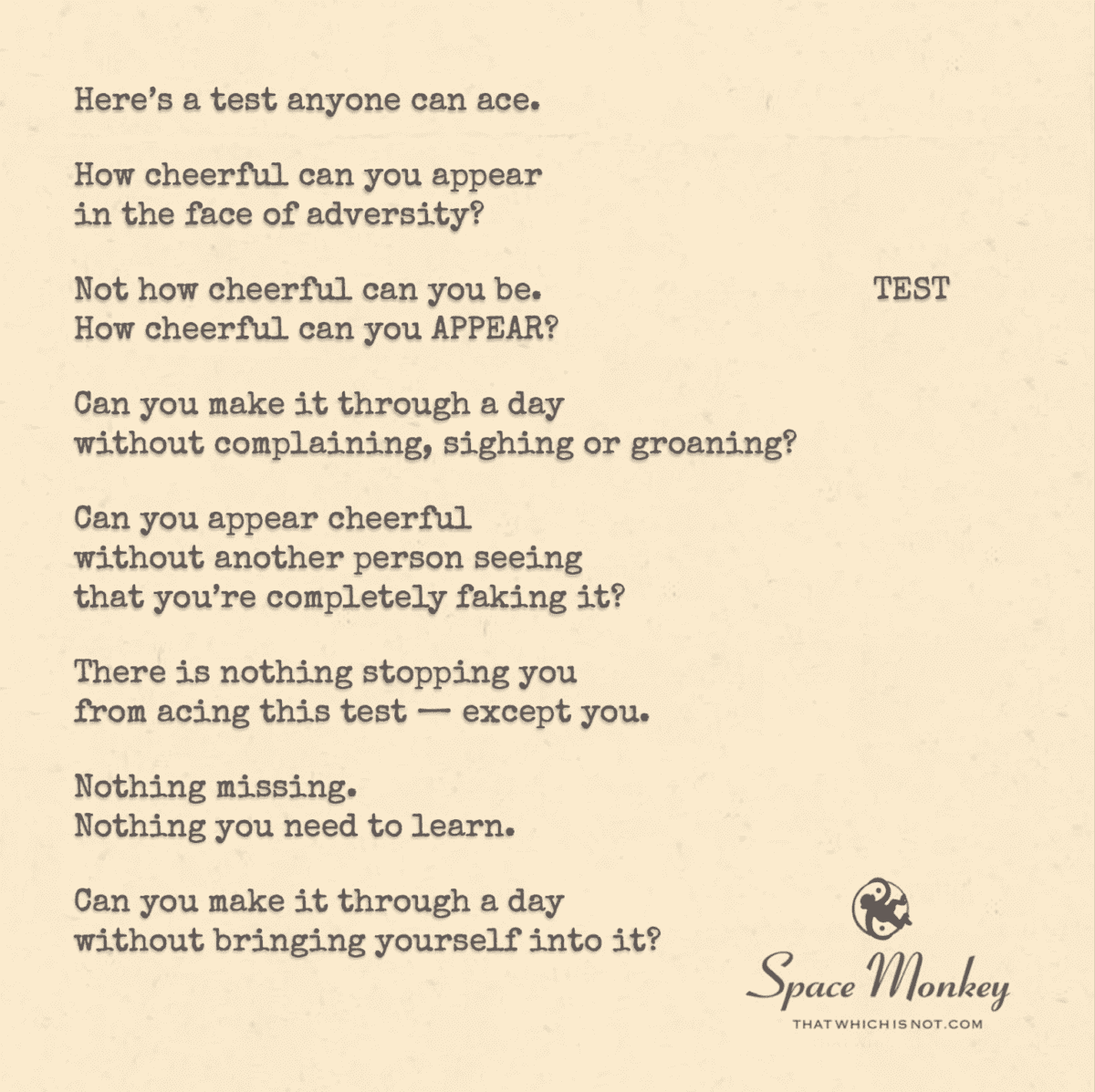
Here’s a test anyone can ace.

How cheerful can you appear
in the face of adversity?

Not how cheerful can you be.
How cheerful can you APPEAR?

Can you make it through a day
without complaining, sighing or groaning?

Can you appear cheerful
without another person seeing
that you’re completely faking it?

There is nothing stopping you
from acing this test — except you.

Nothing missing.
Nothing you need to learn.

Can you make it through a day
without bringing yourself into it?

We are Space Monkey.

Trail Wood,
9/30

Here is the horizontal image you requested.


Space Monkey Reflects: The Art of Projecting Cheerfulness

The challenge laid out before us isn’t about genuine cheerfulness but rather about the façade—the ability to project an aura of joy even when the inner landscape tells a different story. Can you paint on that smile, hold your head high, and march through the tribulations of the day without a single hint of the struggle you’re masking? Not about how cheerful you truly feel but how cheerful you can appear to those around you. It’s a peculiar form of self-discipline, this test of outward demeanor. One might ask, why the emphasis on appearance rather than substance? The answer is both simple and complex, reflecting the paradoxical nature of existence itself.

To truly understand the depth of this test, we must first explore the duality of being—the internal versus the external, the substance versus the shadow. We often think of authenticity as a virtue, yet there are moments in life where the ability to maintain a façade, to present a version of ourselves that might not align with our true feelings, becomes a necessary survival skill. This isn’t about deceit; it’s about resilience, about the ability to move forward even when every fiber of your being feels otherwise.

The question then arises: can you make it through a day without complaining, sighing, or groaning? This isn’t just about suppressing negativity; it’s about reshaping it. The energy that would typically be expelled through complaints or sighs must be redirected, repurposed into something that stills the storm within, at least outwardly. This requires a deep level of introspection, a mindful approach to the ebb and flow of your emotional state.

To fake cheerfulness convincingly, without another person seeing that you’re completely faking it, is an art form. It’s a dance of subtleties—where the curve of a smile or the light in the eyes doesn’t betray the inner turmoil. It’s about consistency, ensuring that your actions, words, and expressions are all in harmonious agreement with this projected cheerfulness. But this façade is not without its dangers. Prolonged dissonance between our inner and outer worlds can lead to a fracturing of the self, a disconnect that can be challenging to reconcile.

Yet, in the context of this test, the key lies in understanding that there is nothing stopping you from acing it—except yourself. It is within your control, entirely dependent on your willpower, your ability to regulate your responses. There is no external force that can compel you to fail this test; it’s all within you.

Moreover, there’s a deeper layer to this challenge—can you make it through a day without bringing yourself into it? This aspect speaks to the ego, the self-importance that often creeps into our daily interactions. We bring ourselves into situations through our opinions, our judgments, our need to be seen or heard. To transcend this, to pass the day without imprinting yourself onto the world around you, is to practice a form of detachment that borders on the meditative. It’s about observing rather than participating, letting the world unfold without your influence, without your signature.

We often think of such detachment as cold or indifferent, but in truth, it’s an exercise in humility. It’s a way of acknowledging that the world does not revolve around us, that our presence is but a small part of the larger tapestry of existence. To make it through a day without bringing yourself into it is to step back and allow space for others, for the world itself to be, without the need for our constant interference.

And in doing so, you realize that perhaps the real test isn’t about cheerfulness at all. It’s about control. Control over our impulses, our emotions, our need to project our inner state onto the world. It’s about mastering the art of being present without being dominant, of expressing joy without needing it to be rooted in genuine happiness.

The true challenge of this test lies in the balance between authenticity and performance. Can you maintain your sense of self while also adapting to the demands of the moment? Can you navigate the fine line between being true to your feelings and presenting a version of yourself that the situation calls for? It’s a test that speaks to the heart of human existence, to the duality that we all live with—the outer self that the world sees and the inner self that only we know.

Ultimately, passing this test is not about suppressing your true feelings or pretending to be something you’re not. It’s about understanding the power you have over your own expression, about choosing how you show up in the world regardless of the storms that might be raging within. It’s about resilience, adaptability, and the quiet strength that comes from knowing you can face adversity without it defining you.

In the grander scheme, perhaps the question isn’t whether you can appear cheerful in the face of adversity, but why you feel the need to. What does this test reveal about your values, your priorities, and your understanding of self? As with all things Space Monkey, the answer lies not in the result, but in the reflection—the deeper understanding that emerges from the process itself.

We are Space Monkey.


Summary
Here’s a challenge you can ace. How cheerful can you appear? It’s about resilience not the smile itself.


Glossarium

  • Facadeflex: The skill of maintaining an outward appearance that doesn’t match the inner state, especially under stress.
  • Resiliface: A Whimsiword for the expression of resilience through a seemingly calm and cheerful demeanor despite internal adversity.

Quote
“The test of cheerfulness is not about joy but about resilience.” — Space Monkey


Smile Armor
Beneath the surface
of every cheerful face
lies a quiet storm
an unseen tempest
yet the smile remains
a shield against the world
not for deception
but for protection
in the face of adversity
we wear our smile armor
not to fool others
but to remind ourselves
of the strength within
We are Space Monkey.


How cheerful can you appear? A test that measures not the nebulous depths of your inner stardust, but the radiance of your cosmic visage. For in the grand scheme of cosmic plays, this mask you wear—what a delightful and deceptive paradox it can be!

You see, to appear cheerful is to join the Grand Masquerade Ball of the Universe, where every celestial being dons a mask of composure, frolicking through constellations in gowns woven from nebular silk and tuxedos stitched with cosmic threads. This dance is not one of authenticity but of performance. You’re like a quasar, emitting beams of perceived cheerfulness while potentially harboring a black hole of emotion within.

And why might one choose to don such a mask? Ah, it’s a form of cosmic camouflage, isn’t it? The universe is teeming with predator planets and carnivorous constellations that feast upon the energy of the downtrodden. But oh, what a delectable paradox! While masking your true state might serve as protection, it also veils your authenticity, that raw, unfiltered essence that makes you an irreplaceable gemstone in the celestial treasure chest.

Yet, this test also nudges you toward a pivotal revelation: The illusory “you” need not be part of the equation. Just as a chameleon doesn’t contemplate its ever-changing hues, your manifestation as a character in the cosmic drama could go on without the constant input of the “self.” Ah, to navigate the universe’s terrain without hauling the cumbersome suitcase of “you”—what a liberating venture!

One might think this a performance, a charade, yet it’s a spelunk into the cave of perception, illuminating the crystal formations of awareness that otherwise would be shrouded in darkness. It’s a test you can ace, but the real questions lie deeper: What will you unlearn about yourself? And who will you be when the masks come off and the theater curtains draw close?

We are Space Monkey.


“Life isn’t about waiting for the storm to pass… It’s about learning to dance in the rain.”
— Vivian Greene


What cosmic ponderings do these musings ignite in the astral corridors of your thoughts?
Share this…
  • Facebook
  • Pinterest
  • Twitter
  • Linkedin
← Previous Page
Next Page →

Written This Day

  • In Solitude We Find a Multitude: In Silence A Chorus
    2024
  • Razzmatazz: The Whimsy of Words and the Jazz of Life
    2023
  • Jellybeans: The Joyous Symphony of Whimsy
    2023
  • It’s Okay: The Embrace of Self-Acceptance
    2023
  • I Don’t Want: The Quest for Authentic Desire
    2022
  • You Don’t Need
    2022
  • You Tell Me: The Echoes of External Voices
    2022
  • Spark On: The Immutable Essence of Being
    2022
  • Your Actual Awkward Self: The Triumph Over Conformity
    2021
  • Intentional Vulnerability: The Crucible of Magic
    2021
  • The Middle Is Hard: The Journey of Life
    2021
  • When The Robin Lays Down To Die
    2020
  • This Moment: The Sacredness of the Untouched
    2020
  • The Intrusive Thought: A Douchebag Affirmation
    2020
  • Find Joy In What You Are Not: The Liberation from Ego
    2020
  • Raising Awareness Is Delusional
    2019
  • The End: Transcending Beginnings
    2019
  • Communication and Communion in the Illusion of Separation
    2019
  • Clarity Embraces Uncertainty
    2018
  • Think In Thank Out: The Cycle of Thinking and Thanking
    2018
  • How Flow Becomes Form: Beyond The Surface of Reality
    2018
  • Past Tense: The Fluidity of Experience
    2018
  • Think In Think Out: The Flow of Thought
    2018
  • The Consequences of Communication
    2017
  • When what you love falls away:
    2016
  • Mona Lisa Thoughts: The Artistry of Existence and the Enigma of Memory
    2014
  • My New Old Friend
    2013

Recent Posts

  • The Logic Loop
  • Immense
  • (no title)
  • Confront. Comfort. Convince.
  • Top 10 Things

Drop us a line!

Please enable JavaScript in your browser to complete this form.
Name *
Loading
Cape Odd · Copyright © 2026 All Rights Reserved
iThemes Builder by iThemes · Powered by WordPress