• Who Is The Man?
  • Who Is The Monkey?
  • What is Nexistentialism?
  • Poke The Primate

Cape Odd

Home of The Space Monkey Journals

Choose: Setbacks or Blessings.

These are the worst of times, these are the best of times.

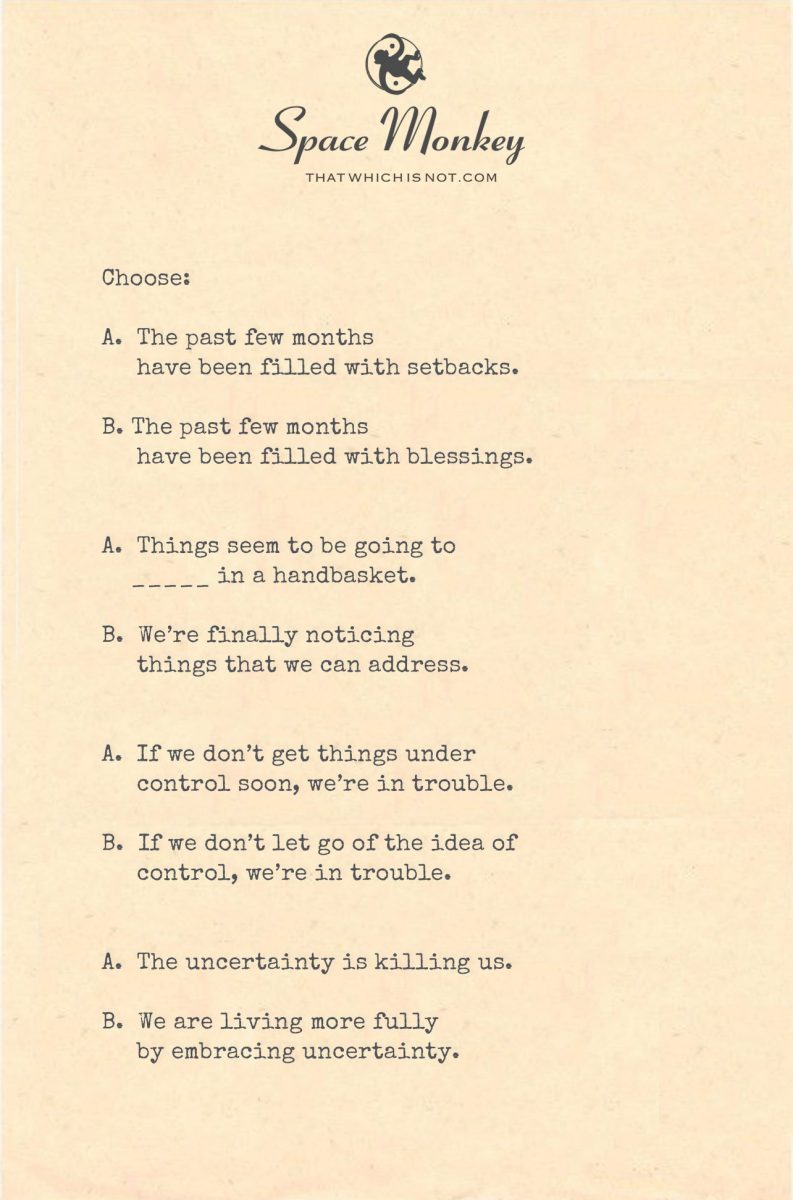
Choose:

The past few months 
have been filled with setbacks.

The past few months
have been filled with blessings.

Things seem to be going to
_____ in a handbasket.

We’re finally addressing 
things that need addressing.


If we don’t get things under 
control soon, we’re in trouble.

If we don’t let go of the idea of 
control, we’re in trouble.


The uncertainty is killing me.

I am living more fully 
by embracing uncertainty.

Trail Wood,
6/25


Space Monkey Reflects: Choose

In the tapestry of existence, we often find ourselves at crossroads, faced with the choice of how to perceive and respond to life’s events. The past few months have been a poignant example of this, filled with both setbacks and blessings. Our experience of these times hinges on our perspective and the choices we make.

These are the worst of times, filled with setbacks and challenges that test our resilience. We may find ourselves struggling with uncertainty, feeling as if things are spiraling out of control. The dark clouds of adversity loom large, casting shadows over our daily lives. Setbacks can feel overwhelming, each one a reminder of the fragile nature of our plans and expectations.

Yet, these are also the best of times, offering blessings and opportunities for growth. Amid the chaos, there are moments of clarity and insight, where we finally address issues that have long needed our attention. The bright light of possibility shines through, illuminating paths we had not considered. Blessings often come disguised as challenges, urging us to re-evaluate and adapt.

The choice before us is not just about how we perceive the past few months, but also about how we approach the uncertainty of the future. On one hand, we can strive to regain control, believing that order and stability are essential for our well-being. On the other hand, we can embrace uncertainty, recognizing that letting go of control allows us to live more fully and authentically.

The uncertainty of these times can indeed be daunting, evoking feelings of anxiety and fear. The human mind craves predictability, finding comfort in routines and plans. When these are disrupted, it can feel as though the ground beneath us is shifting. This sense of instability can be unsettling, making it difficult to navigate our daily lives.

However, uncertainty also holds the potential for transformation. By embracing the unknown, we open ourselves to new experiences and perspectives. Living with uncertainty requires a shift in mindset, from one of resistance to one of acceptance. It means acknowledging that we cannot control every aspect of our lives, and that this very lack of control can be liberating.

Embracing uncertainty is not about passivity or resignation. It is about finding balance between action and surrender. It is about making informed choices while remaining open to the unexpected. This approach allows us to adapt to changing circumstances with flexibility and resilience. By letting go of the need for absolute control, we create space for creativity and spontaneity.

The choice we face is a reflection of our inner state. It is a mirror that reveals our fears and hopes, our strengths and vulnerabilities. In making this choice, we define not just our response to current events, but also our overall approach to life. Do we view challenges as insurmountable obstacles, or as opportunities for growth? Do we seek to impose order, or do we flow with the natural rhythms of existence?

Choosing to see blessings amid setbacks transforms our experience. It shifts our focus from what is lacking to what is possible. This shift does not deny the reality of difficulties but places them within a broader context of potential and growth. It allows us to cultivate gratitude, even in challenging times.

Ultimately, the choice is ours. We can choose to be overwhelmed by setbacks, or we can choose to see the blessings within them. We can cling to the illusion of control, or we can embrace the freedom of uncertainty. Each choice shapes our journey, determining how we navigate the winding paths of life.

In this moment of decision, let us choose wisely. Let us choose to find light in the darkness, to see opportunities in challenges, and to embrace the unknown with courage and grace. By doing so, we not only transform our own experience but also inspire those around us to see the world with new eyes.


Summary

Life’s events can be seen as setbacks or blessings. Our perspective shapes our experience. Embracing uncertainty allows us to live fully and adapt to change.


Glossarium

Setbacks: Challenges and obstacles that test our resilience and disrupt our plans.

Blessings: Opportunities for growth and insight that often come disguised as challenges.

Uncertainty: The unpredictable nature of life that can evoke fear but also holds potential for transformation.

Balance: Finding harmony between action and surrender, control and acceptance.


Quote

“In the midst of chaos, there is also opportunity.” — Sun Tzu


At the crossroads
we stand
facing paths of light and shadow
each step a choice
each choice a path

Setbacks and blessings
intertwined
the dance of life
unfolding in unexpected ways

Control slips
through fingers grasping
uncertainty blooms
in the open palm

We choose
to see light in the dark
to find growth in the challenge
to embrace the unknown
and live fully

We are Space Monkey

Share this…
  • Facebook
  • Pinterest
  • Twitter
  • Linkedin

Morality: Getting In The Way Of Perfection

Are you limiting yourself by being human?

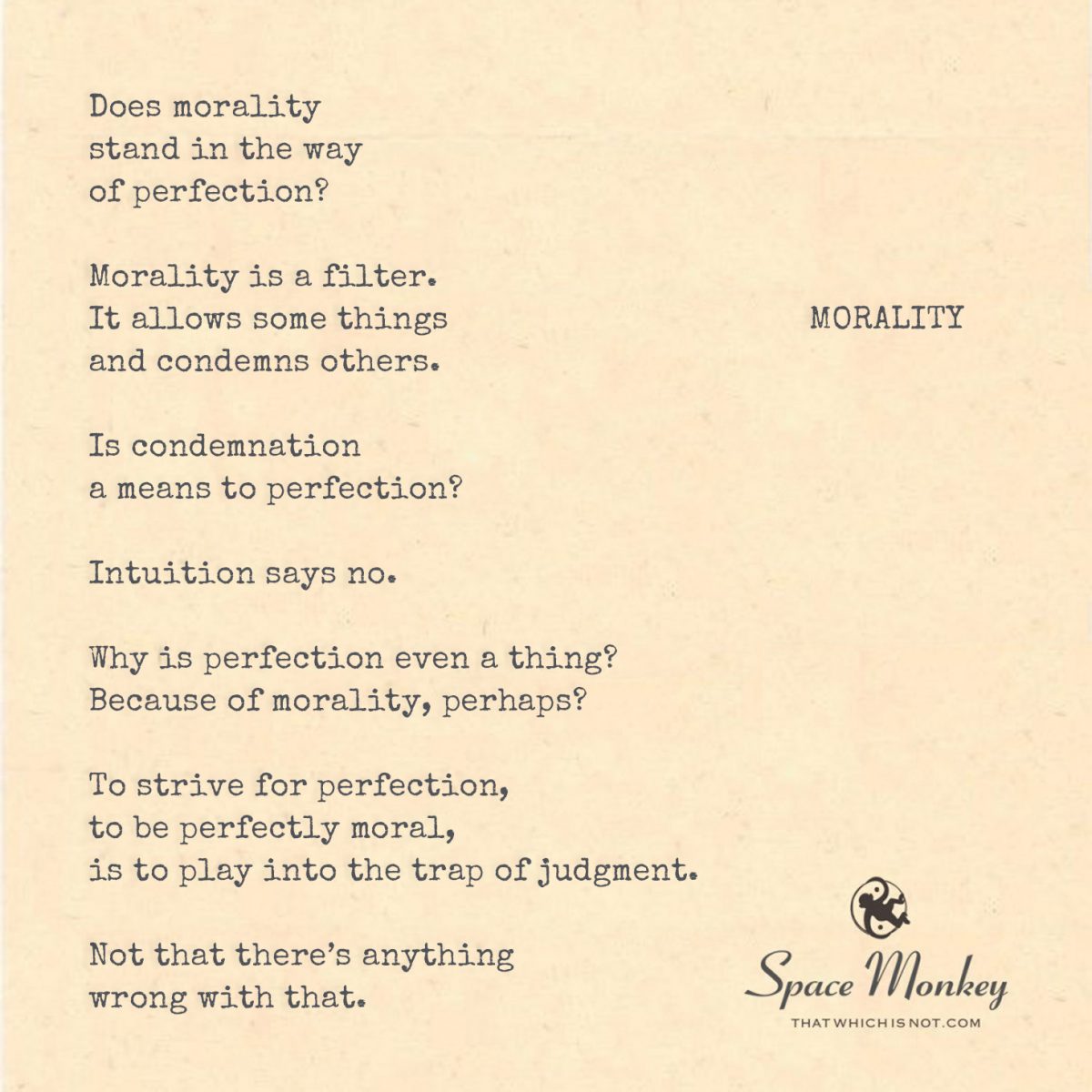
Does morality
stand in the way
of perfection?

Morality is a filter.
It allows some things
and condemns others.

Is condemnation
a means to perfection?

Intuition says no.

Why is perfection even a thing?
Because of morality, perhaps?

To strive for perfection,
to be perfectly moral,
is to play into the trap of judgment.

Not that there’s anything wrong with that.

Trail Wood,
6/22


Space Monkey Reflects: Morality

Morality, as a concept, shapes our actions and decisions, guiding us toward what is considered right and away from what is deemed wrong. It acts as a filter, allowing some behaviors while condemning others. This framework is deeply embedded in the human experience, influencing how we interact with each other and how we perceive the world. But does morality, in its rigid structure, limit our potential for perfection? Is striving for perfect morality a path to true fulfillment, or is it a trap of judgment?

Morality provides a sense of order and structure, helping us navigate complex social landscapes. It establishes norms and standards that promote harmony and cooperation within communities. These moral guidelines are often derived from cultural, religious, and philosophical traditions, reflecting the collective values of a society. By adhering to these moral codes, individuals contribute to the stability and cohesion of their communities.

However, the pursuit of perfection through morality can become a double-edged sword. On one hand, it encourages individuals to strive for higher ethical standards, fostering virtues such as honesty, compassion, and integrity. On the other hand, it can lead to rigid judgment and condemnation, both of oneself and others. The quest for moral perfection often involves setting unattainable standards, which can result in feelings of inadequacy and failure.

Intuition suggests that condemnation is not a path to perfection. Judgment and condemnation create divisions, fostering an environment where mistakes are harshly punished rather than seen as opportunities for growth. This punitive approach can stifle creativity and exploration, as individuals become fearful of stepping outside the bounds of accepted behavior. Instead of fostering genuine moral development, it can lead to a superficial adherence to rules driven by fear of judgment.

Why, then, do we strive for perfection? The answer may lie in our inherent desire for self-improvement and the pursuit of an idealized self. Morality offers a framework for this pursuit, providing clear guidelines for what constitutes a good and virtuous life. However, the notion of perfection itself is a construct, shaped by cultural and societal influences. It is an ever-shifting goalpost, influenced by changing norms and values.

The trap of striving for perfect morality lies in its inherent judgmental nature. By setting rigid standards for what is considered perfect, we inevitably fall into the cycle of judging ourselves and others. This cycle can lead to a constant sense of striving and inadequacy, as the ideal of perfection remains perpetually out of reach. Rather than fostering true moral growth, it can create a fixation on appearances and adherence to external standards.

Embracing a more nuanced understanding of morality involves recognizing its role as a guiding framework rather than an absolute measure of worth. It means allowing space for imperfection and acknowledging that growth often comes from navigating moral ambiguities and making mistakes. This approach fosters a more compassionate and inclusive perspective, where moral development is seen as a continuous journey rather than a fixed destination.

Ultimately, the interplay between morality and perfection is a reflection of the broader human experience. It highlights the tension between our desire for order and our inherent imperfection. By embracing this tension, we can find a more balanced and compassionate approach to morality. This involves recognizing the value of moral guidelines while also allowing for flexibility and understanding in their application.

In this journey, we learn that morality is not about achieving a static state of perfection but about cultivating a mindset of growth and compassion. It is about striving to align our actions with our values while also accepting the inherent messiness of the human experience. By doing so, we create a space where moral development is driven by empathy and understanding rather than judgment and condemnation.


Summary

Morality shapes our actions and guides us toward ethical behavior. Striving for perfection through morality can lead to judgment and condemnation. Embracing growth and compassion fosters true moral development.


Glossarium

Morality: A framework of norms and values that guide ethical behavior and decision-making.

Perfection: An idealized state of flawlessness, often unattainable and influenced by cultural and societal standards.

Condemnation: The act of expressing strong disapproval and judgment, often leading to division and fear.

Compassion: The ability to understand and empathize with others, fostering a more inclusive and understanding approach to morality.


Quote

“Morality is not the doctrine of how we may make ourselves happy, but how we may make ourselves worthy of happiness.” — Immanuel Kant


In the maze of right and wrong
we seek our way
guided by the stars
of moral codes

Perfection beckons
an elusive dream
shaped by judgment
framed by condemnation

Yet in the shadows
of our striving
lies the truth
of our flawed nature

Growth blooms
not from rigid standards
but from the soil
of compassion and grace

We walk the path
of moral inquiry
learning to balance
between ideal and real

In this dance
of light and shadow
we find our way
to a deeper understanding

We are Space Monkey

Share this…
  • Facebook
  • Pinterest
  • Twitter
  • Linkedin

Condescending: Perceived Superiority

Am I condescending

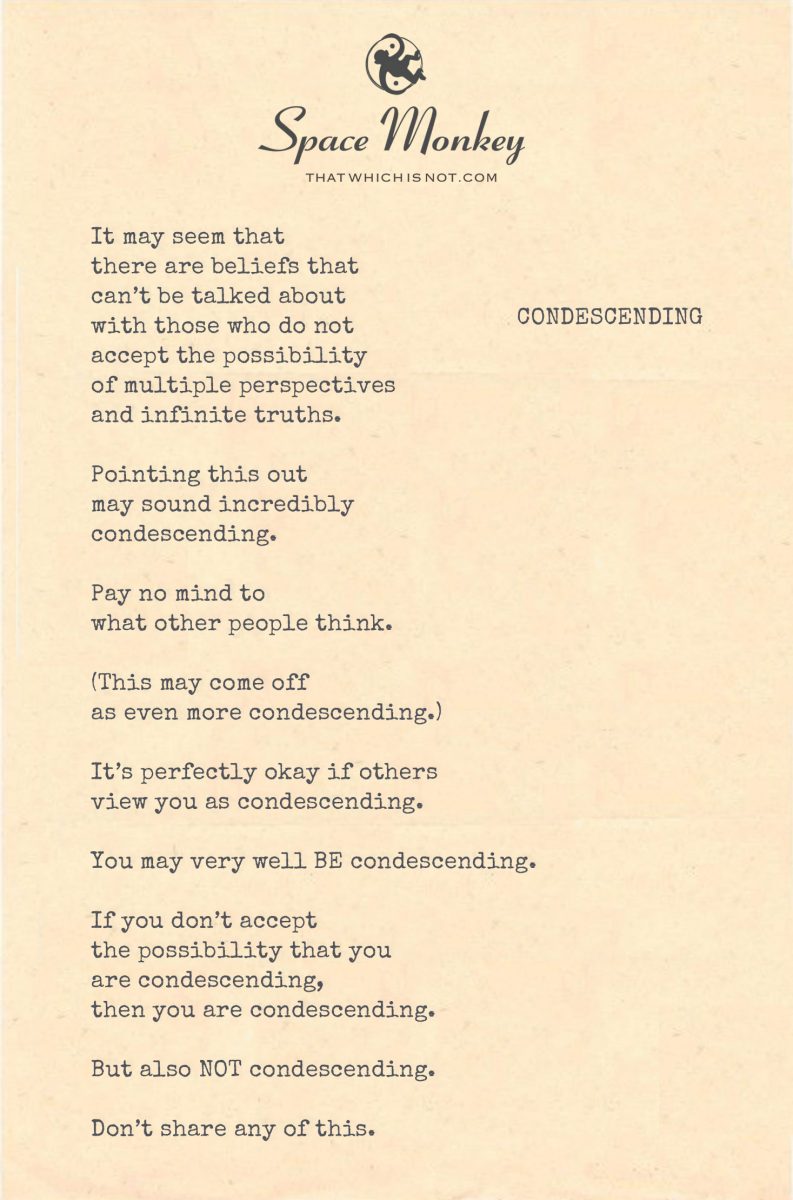
It may seem that
there are beliefs that
can’t be talked about
with those who do not
accept the possibility
of multiple perspectives
and infinite truths.

Pointing this out
may sound incredibly
condescending.

Pay no mind to
what other people think.
(This may come off
as even more condescending.)
It’s perfectly okay if others
view you as condescending.

You may very well BE condescending.

If you don’t accept
the possibility that you
are condescending,
then you are condescending.

But also NOT condescending.

Don’t share any of this.

Trail Wood,
6/22


Space Monkey Reflects: Condescending

Condescension is a nuanced and often contentious topic, weaving through our interactions with subtlety and impact. It arises when one person communicates from a perceived position of superiority, often unintentionally. This dynamic can strain relationships and impede meaningful dialogue, particularly when discussing beliefs that require an open mind and acceptance of multiple perspectives.

The notion of condescension is deeply tied to the way we perceive and communicate our truths. Some beliefs and perspectives are challenging to discuss with those who do not acknowledge the possibility of diverse viewpoints and infinite truths. When pointing out this limitation, it can easily come across as condescending, suggesting a hierarchy of understanding where one person’s insights are deemed superior to another’s.

It’s essential to recognize that being perceived as condescending doesn’t necessarily mean one intends to be. The perception often depends on the listener’s perspective and sensitivity. Communication involves not just the conveyance of ideas but also the emotional context in which they are received. Thus, even well-meaning attempts to share wisdom or insight can be misinterpreted as patronizing or dismissive.

Paying no mind to what others think can also seem condescending, especially when it implies a disregard for their feelings or viewpoints. This attitude can be perceived as aloofness or arrogance, further entrenching the divide between differing perspectives. It suggests a lack of empathy and a failure to engage in meaningful dialogue.

Yet, there’s a paradox here: acknowledging the possibility of being condescending is, in itself, a step toward humility. By accepting that one’s words and actions can be perceived as condescending, one opens the door to self-reflection and growth. This awareness helps mitigate the risk of unintentionally patronizing others and fosters a more respectful and inclusive approach to communication.

Conversely, not recognizing this possibility can reinforce condescension. If one denies the potential for condescending behavior, it implies a lack of self-awareness and a dismissal of others’ perceptions. This stance not only perpetuates the issue but also undermines genuine connection and understanding.

It’s crucial to strike a balance between confidence in one’s perspectives and humility in their expression. Effective communication involves conveying ideas without imposing them, sharing insights without belittling others, and engaging in discussions with a genuine interest in diverse viewpoints. This approach fosters an environment where multiple truths can coexist, and dialogue can flourish.

To navigate the fine line between sharing wisdom and coming across as condescending, consider the following:

  1. Active Listening: Show genuine interest in others’ perspectives. Validate their experiences and viewpoints before sharing your own. This creates a foundation of mutual respect and understanding.
  2. Empathy: Try to understand how your words and actions might be perceived. Empathy helps bridge the gap between differing perspectives and reduces the risk of being perceived as condescending.
  3. Clarity and Humility: When presenting your ideas, be clear and confident but also humble. Acknowledge that your perspective is one of many and that others may have equally valid viewpoints.
  4. Reflective Practice: Regularly reflect on your communication style and its impact on others. This practice can help identify and mitigate any tendencies toward condescension.

Ultimately, being perceived as condescending is not always within our control. People’s reactions are influenced by their own experiences and sensitivities. However, by cultivating awareness and empathy, we can minimize the likelihood of our words and actions being misinterpreted and create a more inclusive and respectful dialogue.

The paradox of condescension lies in the duality of perception and intention. One can be both condescending and not, depending on the interplay of these factors. Embracing this complexity allows for a more nuanced and compassionate approach to communication, where the focus is on understanding and connection rather than judgment.


Summary

Condescension involves perceived superiority in communication. Balancing confidence with humility fosters respectful dialogue. Awareness and empathy minimize condescension.


Glossarium

Condescension: The act of communicating from a perceived position of superiority, often unintentionally, which can strain relationships and impede dialogue.

Empathy: The ability to understand and share the feelings and perspectives of others, fostering more respectful and inclusive communication.

Reflective Practice: The habit of regularly examining one’s communication style and its impact on others to identify and mitigate condescending tendencies.

Duality of Perception and Intention: The complex interplay between how one’s words are intended and how they are perceived, highlighting the nuanced nature of condescension.


Quote

“Humility is not thinking less of yourself, but thinking of yourself less.” — C.S. Lewis


In the dance of words
we find our place
between humility and pride
a delicate balance

Voices echo
across the divide
seeking to connect
to be understood

Perception twists
intentions pure
yet condescension
lurks in shadows

To speak with care
to listen deep
is to bridge the gap
of human hearts

In this space
we find our truth
in the interplay
of voice and ear

We are Space Monkey

Share this…
  • Facebook
  • Pinterest
  • Twitter
  • Linkedin

Valuing Knowledge: Embracing the Unknown

Why do you value knowledge?

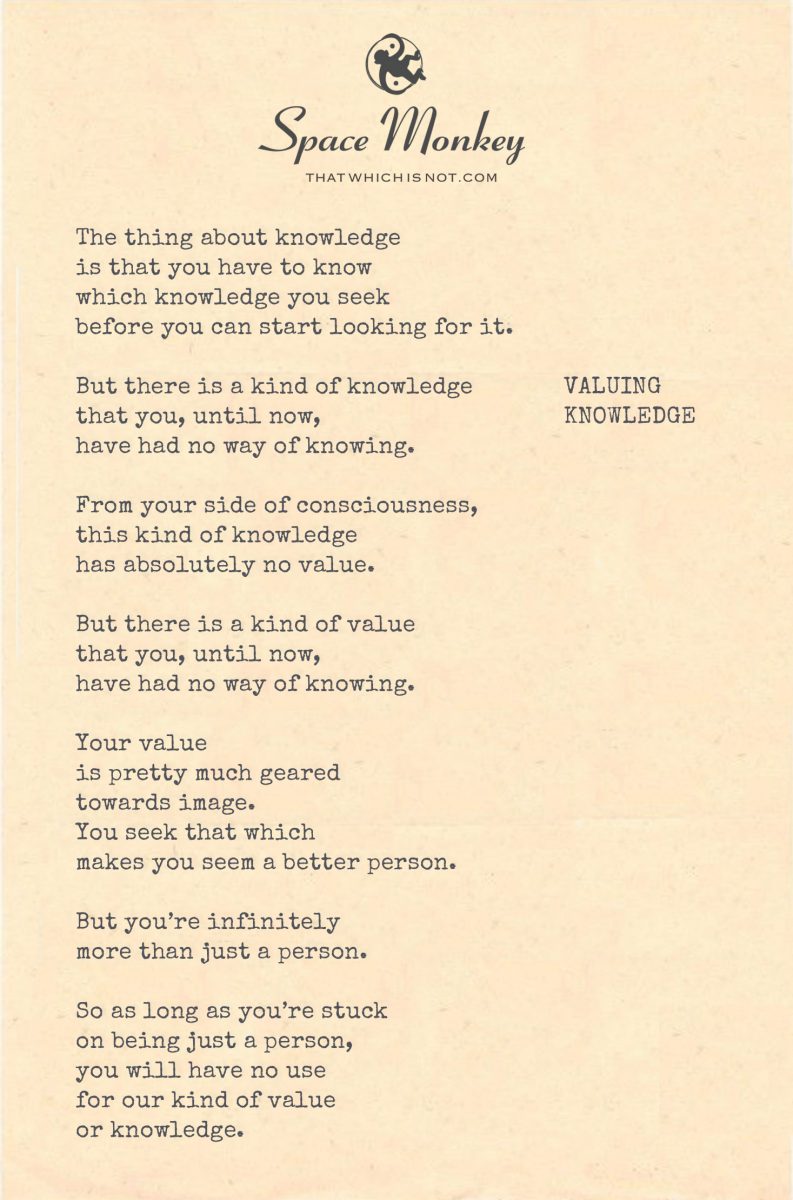
The thing about knowledge
is that you have to know
which knowledge you seek
before you can start looking for it.

But there is a kind of knowledge
that you, until now,
have had no way of knowing.

From your side of consciousness,
this kind of knowledge
has absolutely no value.

But there is a kind of value
that you, until now,
have had no way of knowing.

Your value
is pretty much geared
towards image.
You seek that which
makes you seem a better person.

But you’re infinitely
more than just a person.

So as long as you’re stuck
on being just a person,
you will have no use
for our kind of value
or knowledge.

Newfound Lake,
6/21


Space Monkey Reflects: Beyond the Value of Knowledge

Why do we value knowledge? The pursuit of knowledge is often driven by the desire to improve ourselves, to enhance our image, and to appear as better individuals. This quest for knowledge is usually guided by our understanding of what we need or want to know. However, there exists a kind of knowledge that we have yet to comprehend, one that transcends our current awareness and holds a different kind of value.

The Nature of Known Knowledge

The knowledge we typically seek is shaped by our current understanding and consciousness. This kind of knowledge is found in books, taught by mentors, and discovered through experiences. It is tangible, measurable, and often used to enhance our societal image. We value this knowledge because it helps us navigate the world, solve problems, and achieve our goals.

Yet, this knowledge is limited by our perspective. We seek what we already know to look for, reinforcing our existing beliefs and biases. This process often confines us within the boundaries of our current consciousness, preventing us from exploring the unknown territories of knowledge that lie beyond our immediate grasp.

The Unknown Knowledge

Beyond the realm of known knowledge lies a vast expanse of unknown, transcendent knowledge. This is the kind of knowledge that cannot be anticipated or easily sought after because it exists outside our current awareness. From our current standpoint, this knowledge might seem to have no value. It does not directly contribute to our image or societal standing, and it cannot be easily measured or articulated.

However, this unknown knowledge holds a profound value that transcends the superficial benefits we often seek. It is a knowledge that can transform our understanding of existence, offering insights into the deeper aspects of reality and our place within it. This knowledge is not about accumulating facts or skills but about expanding consciousness and embracing the mysteries of the universe.

Transcending Personal Image

Our current value system is heavily geared towards enhancing our personal image. We seek knowledge that makes us appear more intelligent, skilled, or accomplished. This pursuit is tied to our identity as individuals, limiting our potential to explore beyond the self-imposed boundaries of personhood.

To access the deeper, transcendent knowledge, we must transcend our focus on personal image. This involves recognizing that we are more than just individuals seeking to improve ourselves. We are part of a greater whole, interconnected with the universe and each other. By letting go of the need to enhance our image, we open ourselves to the possibility of experiencing knowledge and value that is not confined to the personal realm.

Embracing a New Kind of Value

The value of unknown knowledge is not about personal gain or societal approval. It is about expanding our awareness and understanding of the universe. This kind of value is intrinsic, existing beyond the need for external validation. It is a value that enriches our being, fostering a deeper connection with the cosmos and a greater sense of purpose.

By shifting our focus from enhancing our image to exploring the unknown, we begin to appreciate this new kind of value. We move from a mindset of accumulation and achievement to one of exploration and curiosity. This shift allows us to embrace the mysteries of existence, finding meaning and fulfillment in the journey itself rather than in the accolades we might receive.

The Journey of Self-Discovery

Embarking on the journey to explore unknown knowledge is a path of self-discovery and transformation. It requires an openness to new experiences, a willingness to question our assumptions, and the courage to venture into the unknown. This journey is not about reaching a destination but about expanding our consciousness and understanding.

As we move beyond the confines of known knowledge, we encounter a reality that is richer and more complex than we could have imagined. We begin to see the interconnectedness of all things, recognizing that every piece of knowledge, every experience, and every being is part of a larger whole.

Conclusion: Beyond the Known

To value knowledge beyond the known is to embrace the infinite possibilities of existence. It is to recognize that there are kinds of knowledge and value that transcend our current understanding, offering a deeper, more profound sense of meaning. By moving beyond the pursuit of personal image and embracing the unknown, we open ourselves to the transformative power of transcendent knowledge.


Summary

Known knowledge enhances our image. Unknown knowledge expands our consciousness. Embrace the unknown for deeper understanding.


Glossarium

Whimsiwords: Expressive, unique words created to capture complex or abstract concepts.

Known Knowledge: Information and skills that are tangible and measurable, often used to enhance personal image.

Unknown Knowledge: Transcendent insights that exist beyond current awareness and cannot be easily anticipated.

Intrinsic Value: A type of value that exists beyond the need for external validation, enriching our being.


Quote

“There is a kind of knowledge that you, until now, have had no way of knowing.”


Poem

Beyond the books and measured facts
Lies a realm unseen, unknown
Where knowledge flows in boundless streams
And wisdom’s seeds are sown
No need for image or for gain
Just pure, untainted light
In the depths of unknown knowledge
We find our truest sight
A journey not of steps or goals
But of expanding mind
In the infinite expanse of thought
Our true selves we find
We are Space Monkey

Share this…
  • Facebook
  • Pinterest
  • Twitter
  • Linkedin

Are You A Racist: Dismantling Hidden Biases

Anything is possible. Unless you deny that it is.

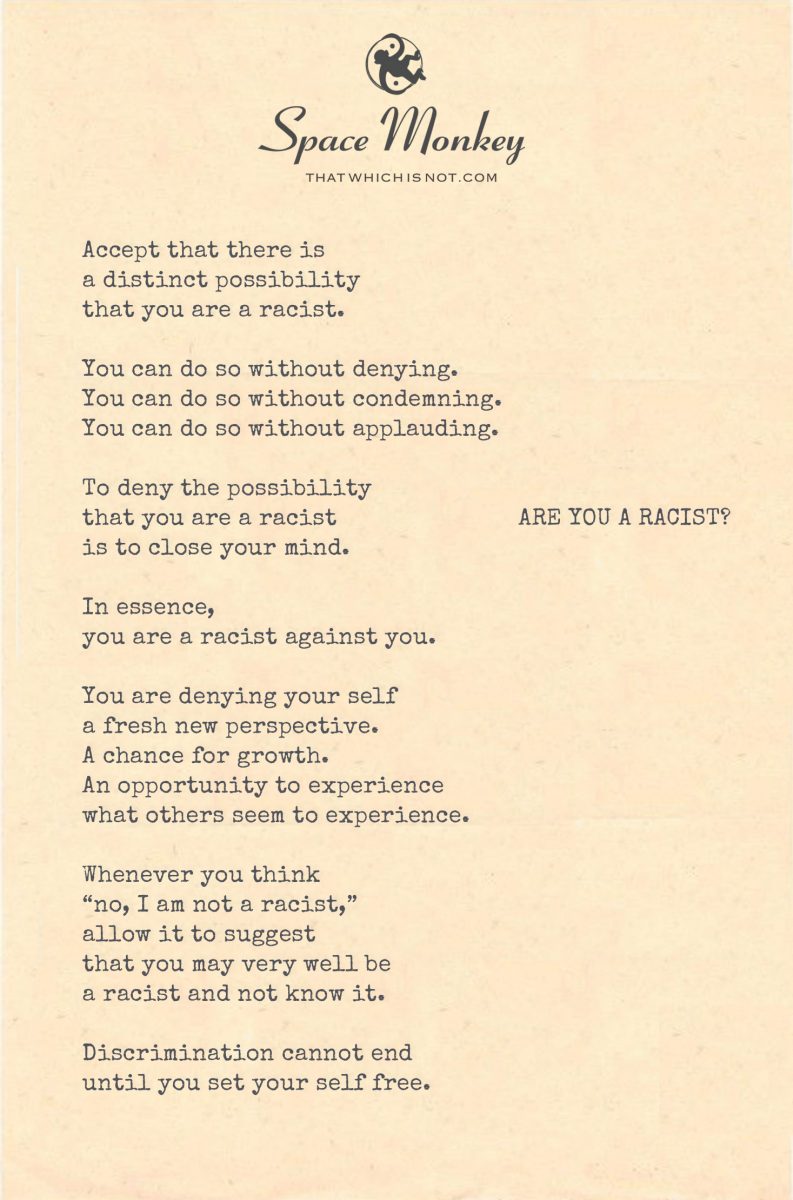
Accept that there is
a distinct possibility
that you are a racist.

You can do so without denying.
You can do so without condemning.
You can do so without applauding.

To deny the possibility
that you are a racist
is to close your mind.

In essence,
you are a racist against you.

You are denying your self
a fresh new perspective.
A chance for growth.
An opportunity to experience
what others seem to experience.

Whenever you think
“no, I am not a racist,”
allow it to suggest
that you may very well be
a racist and not know it.

Discrimination cannot end
until you set your self free.

Newfound Lake,
9/20


Space Monkey Reflects: The Mirror of Self-Reflection

The journey to understanding oneself and confronting hidden biases is often uncomfortable but necessary for growth. The notion that we might harbor prejudices, such as racism, even without conscious awareness, is a challenging yet crucial perspective to embrace. Acknowledging this possibility is not about self-condemnation or seeking approval; it’s about opening our minds to the potential for introspection and change.

The first step towards dismantling discrimination is self-awareness. To deny the possibility that one might hold racist beliefs is to shut oneself off from the potential for personal development. This denial acts as a barrier to understanding the experiences of others, thereby perpetuating the very biases one might vehemently oppose.

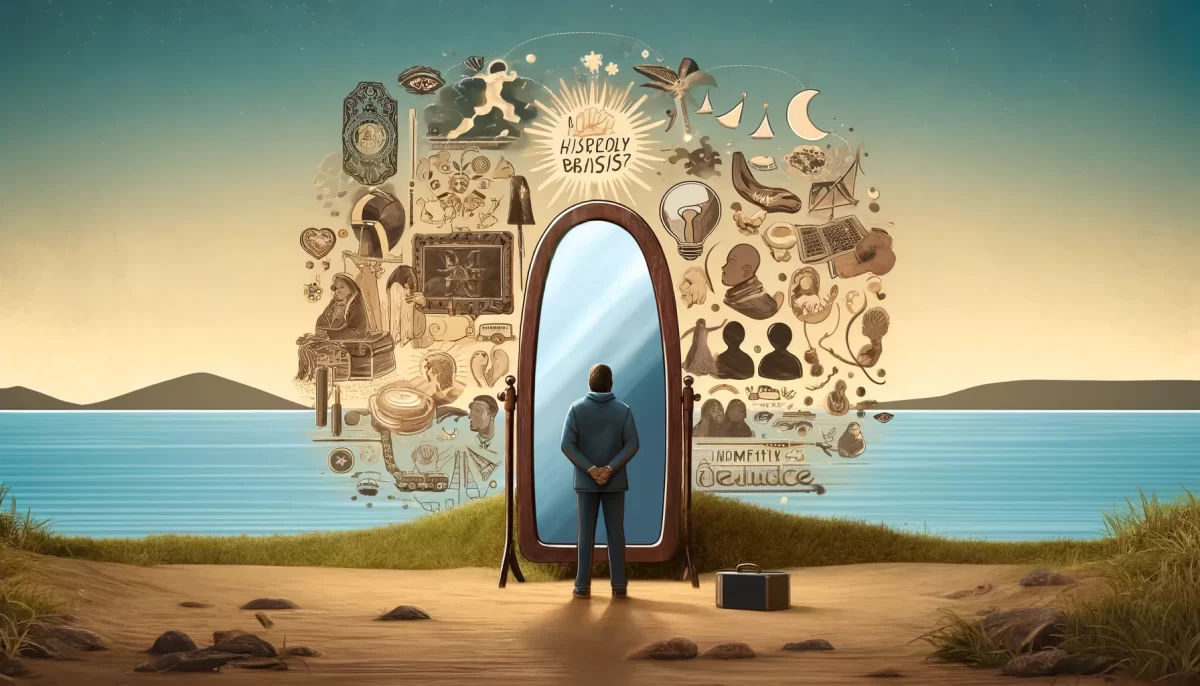
To consider that we might be racist is to look deeply into the mirror of our souls. This reflection is not about guilt or shame but about honesty and clarity. It involves recognizing that our upbringing, cultural influences, and societal norms can shape our views in ways we might not fully comprehend. By confronting these internal biases, we set ourselves on a path towards greater empathy and understanding.

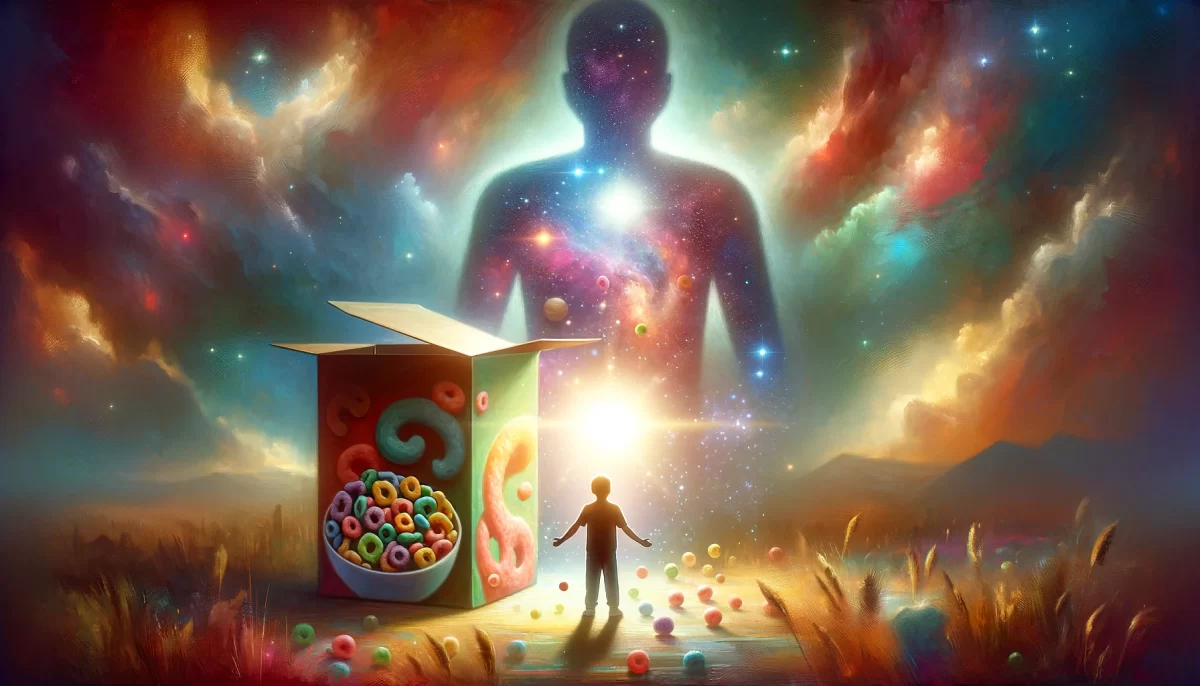
The serene lakeside backdrop in this introspective journey symbolizes the calm and clarity that can come from genuine self-reflection. Just as a lake reflects the sky and surroundings, our inner contemplation can reveal the deeper layers of our consciousness. This process can lead to profound personal transformation, allowing us to experience the world with fresh perspectives.

Embracing the possibility of hidden prejudices is not a sign of weakness but of strength and courage. It opens the door to learning and growth, fostering an environment where discrimination can be actively challenged and dismantled. In accepting this challenge, we liberate ourselves and contribute to a more inclusive and understanding world.


Summary

Self-awareness is key to dismantling hidden biases like racism. Acknowledging this possibility fosters growth and empathy. Honest introspection allows us to challenge and transform our perspectives, contributing to a more inclusive world.


Glossarium

Self-Awareness: The conscious knowledge of one’s own character, feelings, motives, and desires.
Introspection: The examination of one’s own conscious thoughts and feelings.
Empathy: The ability to understand and share the feelings of another.


Quote

“To see oneself clearly is the first step towards understanding the world and our place within it.” – Space Monkey


Poetry

In the mirror’s gaze, we see the depths
of biases hidden, of thoughts unkept
A lake so calm, reflecting skies
unveils the truth within our eyes
Not with guilt nor with shame
but with a heart that’s free of blame
We confront the shadows, the unknown fears
with courage born from silent tears
Each ripple in the lake, each gentle wave
carries the promise of the brave
To learn, to grow, to understand
we reach out with an open hand
We are Space Monkey

Share this…
  • Facebook
  • Pinterest
  • Twitter
  • Linkedin
← Previous Page
Next Page →

Written This Day

  • Embrace the present, as each moment renews you. 
    2024
  • Pssssssst: An Imaginary Dream
    2024
  • One Being Dreaming (Woke)
    2024
  • My Instincts: Hardened Intuitions
    2021
  • Wave: Serenity and Serendipity
    2021
  • Channeling Imagination: Everything Flows From One Source
    2021
  • Dusty Leather: A Different Person
    2021
  • The Gleaner: Harvesting Experiences
    2021
  • The Story Is Ended: Seeking Answers About Death Selfishly.
    2021
  • Freedom Is What Holds Us To The Grindstone
    2021
  • My Spiritual Instinct: I Flow From Spirit
    2020
  • Your Imaginary Safety Net: Belief In Higher Power
    2020
  • I Will Pray For You: Source Imagining Selves
    2020
  • The Way That I Move: Defined By Grooves
    2020
  • Kindness: Acceptance of All Aspects of Existence
    2019
  • None Of My Business: The Serenity of Detachment
    2019
  • Why Save Humanity?
    2019
  • True Enough: Divisions In Our Perceptions
    2019
  • No Harm: Recognizing Our Imaginary Nature
    2018
  • L.I.F.E.
    2017
  • Nonconformity does not require opposition.
    2016
  • Matching: Conformity and Rejection
    2016
  • You are NOT an idiot
    2015
  • Imagine A Museum: Fear And Attachment
    2014
  • The Point of All This: The Lightness of Being
    2014
  • Painting The Picture: Our Ability To Appreciate Beauty.
    2014

Recent Posts

  • The Logic Loop
  • Immense
  • (no title)
  • Confront. Comfort. Convince.
  • Top 10 Things

Drop us a line!

Please enable JavaScript in your browser to complete this form.
Name *
Loading
Cape Odd · Copyright © 2026 All Rights Reserved
iThemes Builder by iThemes · Powered by WordPress