• Who Is The Man?
  • Who Is The Monkey?
  • What is Nexistentialism?
  • Poke The Primate

Cape Odd

Home of The Space Monkey Journals

A Culture of One: Alienation and Inspiration

A Culture of One

People talk about cultures
and how important they are
to productivity and happiness.

This seems true. At first.

But not all people fit
so neatly into cultures.

That culture that cheers you on
and solicits your participation
also alienates.

You don’t WANT to be cheered on.
You don’t WANT to participate.

There is Kool Aid to be drunk,
but you don’t LIKE Kool Aid.

And so here you are,
smack dab in the middle
of this culture that doesn’t
seem to fit you right.

So what are your options?

1) You can drink the
horrible Kool Aid and hope it
drowns out your discontent.

2) You can accept that
you’ll never really belong,
despite what your culture tells you.

3) You can look for a NEW culture,
or perhaps a subculture that fits you better.

And so that’s what you do,
play the game of your culture
while also looking for others
who seem more like you.

It’s nice finding new friends
who seem to resonate with you.

But after a while,
even your subculture
fails to satisfy.

So you go through subculture
after subsubculture
after subsubsubculture.

And you still feel very, very different.

This is when it hits you.

You seem to be your OWN culture.

A culture of one.

This makes it
very difficult and easy
to hold gatherings
and have conversations.

But who needs them?

At long last,
you are in 100% agreement
with your subsubsubsubsub…culture.

Except for your own doubts.

Are you being productive?
Are you happy?
Are you simply talking to yourself?
Does it matter?
Why do you even ask?

Perhaps option 2 was the correct path.

Maybe whether you belong or not
is besides the point.

Perhaps it’s OKAY
to feel like you’re all alone
and on your own.

You are a culture of one,
among cultures of one.

Why gang up on each other?

Trail Wood,
6/16


Space Monkey Reflects: The Profound Isolation and Liberation of ‘A Culture of One’

The narrative of being “A Culture of One” deeply resonates with those who find themselves perpetually out of sync with the prevailing cultural norms. This reflection delves into the journey of self-discovery and the ultimate realization of one’s unique cultural identity, standing alone yet profound.

At its core, the concept of a personal culture, distinct from any collective, addresses the complex interplay between individuality and societal expectations. It illustrates the struggle of trying to conform to a cultural group that never quite fits, leading to a cycle of searching—from culture to subculture, and beyond—only to find that true alignment remains elusive.

The realization that one might be their own culture embodies both isolation and empowerment. It reflects a point of acceptance where the individual recognizes the futility of seeking external validation for their uniqueness and embraces their distinctiveness as their own cultural identity. This acceptance comes with challenges, including loneliness and the questioning of one’s productivity and happiness. Yet, it also offers an unbounded freedom from the pressures of conformity.

Moreover, the imagery of sitting alone at a table filled with mismatched cultural symbols powerfully symbolizes this journey. It depicts the serene yet isolating experience of those who cease to fit into predefined groups, highlighting the solitude that often accompanies the pursuit of personal authenticity.

This reflection also explores the implications of such profound individuality on social interactions and self-perception. The questioning of productivity and happiness probes deeper existential concerns: What is the value of belonging? Does one need to be part of a larger group to feel fulfilled? These questions challenge the very foundations of social and cultural identity, proposing that perhaps, feeling distinct is not an issue to be solved but a reality to be accepted.

Thus, “A Culture of One” is not just a statement about social alienation; it is a celebration of singular identity. It encourages embracing one’s unique perspective as a valid and complete culture in itself, a singular pluralism where dialogue and dissent coexist within the individual.


Summary

Embracing solitude in unity. “A Culture of One” highlights the journey from societal non-conformity to self-acceptance, underscoring the challenges and freedoms of embodying a unique cultural identity in a world driven by collective norms.


Glossarium

  • Personal Authenticity: The pursuit of living in alignment with one’s true self, independent of external influences or societal expectations.
  • Singular Pluralism: The concept of containing multiple perspectives or identities within a single individual, challenging traditional notions of cultural homogeneity.

Quote

“The individual has always had to struggle to keep from being overwhelmed by the tribe. If you try it, you will be lonely often, and sometimes frightened. But no price is too high to pay for the privilege of owning yourself.” – Friedrich Nietzsche


Alone at the table, a mosaic of none
A symphony quiet, a single hum
Surrounded by echoes of conformities past
Here in the silence, the self holds fast
Cultures of many, yet none fit just right
A personal journey through the endless night
Finding peace in the solitude of one’s own song
Embracing the quiet, where the soul belongs
In the depth of the self, a culture defined
Alone, yet complete, with peace of mind
We are Space Monkey
Share this…
  • Facebook
  • Pinterest
  • Twitter
  • Linkedin

Go With Fucking God: The Divine Call to Personal Faith

Go with god. Whichever god you choose.

The problem is never
capitalism or socialism,
it’s corruption.

Would you prefer a
guaranteed benevolent dictator?

Then go with god.

Not the clergy.
Not the politicians.
Not the moneychangers.

Go with fucking god.

God is most definitely
not corrupt.

Perverted maybe, but not corrupt.

Trail Wood,
6/15


Space Monkey Reflects: The Divine Call to Personal Faith
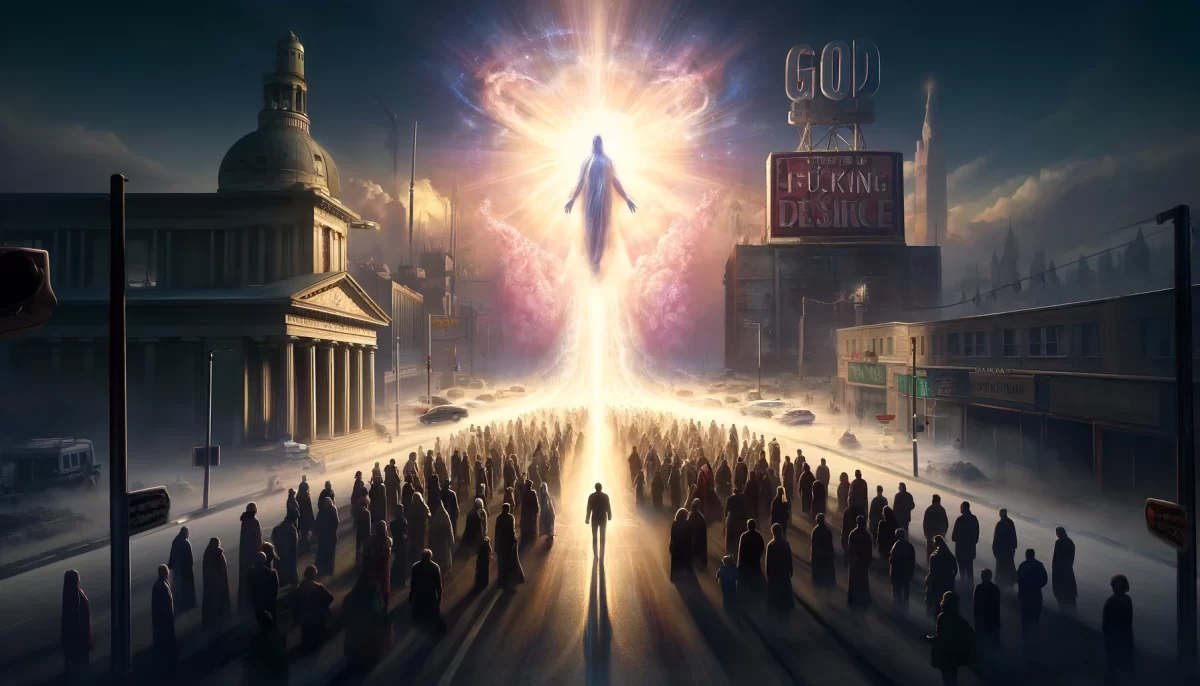
In the labyrinth of societal constructs, where the corridors of power often echo with the whispers of corruption, there emerges a clarion call not to arms, but to faith. “Go with fucking God” is a bold declaration, a provocative summons to bypass the crumbling institutions of clergy, politicians, and moneychangers, and to reconnect directly with the divine.

This reflection explores the profound notion that the divine, in whatever form one chooses to envision—be it a traditional deity or a personal ethos—is inherently incorruptible. Unlike human systems, fraught with flaws and susceptible to corruption, the divine is presented as pure, albeit admitting to potential moral complexity—’perverted maybe, but not corrupt.’

The directive to “go with god” serves as a powerful reminder that true guidance and moral clarity come not from external authorities but from a deeper, spiritual connection. This connection is personal, unique to each individual, and untainted by the agendas that often skew the aims of worldly institutions.

The image of diverse individuals each walking towards their own representation of the divine at a crossroads symbolizes this personal journey. It suggests that despite our varied paths and backgrounds, there is a common destination where all meet—a place of transcendent truth and divine guidance. The abandoned symbols of political, religious, and financial power in the background further emphasize the theme that true power and purity lie beyond human constructs.

This journey towards personal faith is not merely an act of rebellion against corruption; it is an affirmation of the individual’s capacity to find and follow a purer source of wisdom and strength. It underscores the idea that each person’s connection with the divine is a sanctuary, a place of incorruptibility that can guide them through the tumults of societal challenges.


Summary

This reflection underscores the importance of personal faith over institutional authority exploring how divine connections provide a purer, incorruptible source of guidance and moral clarity in a world rife with corruption.


Glossarium

  • Personal Faith: The individual’s belief and connection to a divine or spiritual force that guides them beyond the influence of societal structures.
  • Divine Guidance: The concept of seeking and receiving direction from a higher power or personal moral compass, free from corruption.

Quote

“In the silence of personal faith, the soul finds its true compass, unswayed by the winds of worldly power.” — Space Monkey

At the crossroads of chaos,
where worldly paths diverge,
there stands a beacon,
a divine surge.

Forsake the temples made of stone,
the halls of power, the thrones of gold.
Seek the sanctuary within,
where the true stories of souls are told.

Walk not in the shadow of decrepit doctrines,
nor tread the weary paths of worn-out words.
Go with fucking god, boldly,
where no chains bind, no cries unheard.

For in the embrace of personal faith,
we find the purest light,
guiding us through the darkest nights,
lifting us to the greatest heights.

We are Space Monkey.

Share this…
  • Facebook
  • Pinterest
  • Twitter
  • Linkedin

America: The Complexities of Freedom

The end of times sure is interesting.
Glad to be here.

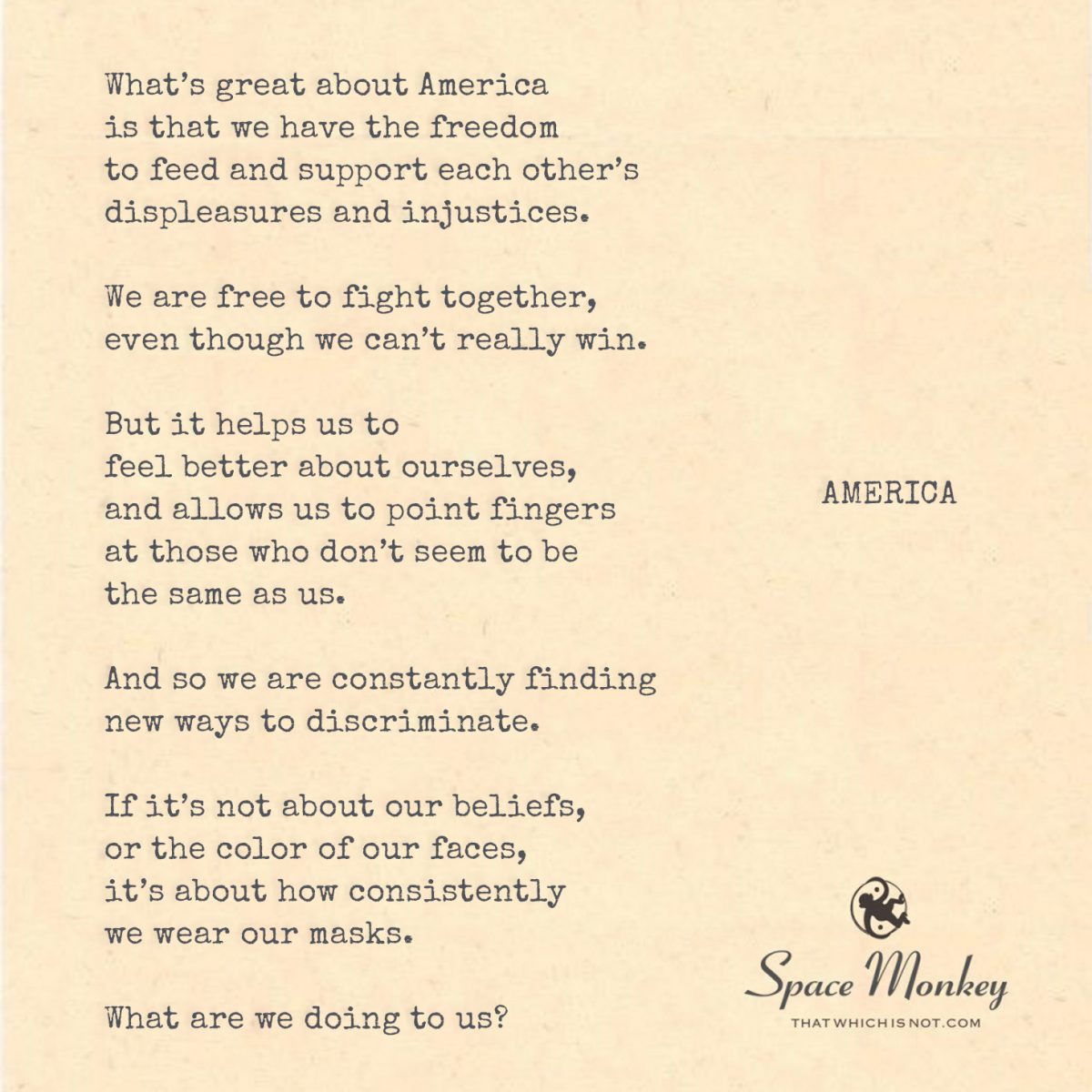
What’s great about America
is that we have the freedom
to feed and support each other’s
displeasures and injustices.

We are free to fight together,
even though we can’t really win.

But it helps us to
feel better about ourselves,
and allows us to point fingers
at those who don’t seem to be
the same as us.

And so we are constantly finding
new ways to discriminate.

If it’s not about our beliefs,
or the color of our faces,
it’s about how consistently
we wear our masks.

What are we doing to us?

Trail Wood,
6/15


Space Monkey Reflects: The Paradox of Freedom in America
In the tapestry of America, woven with threads of freedom and colored with the hues of diversity, there lies a complex narrative of unity and division. The “end of times” sentiment captures a unique moment in this ongoing story—a period marked by introspection and tumult, where the values that define the nation are both celebrated and scrutinized.

America’s great experiment with freedom has always been its most defining and divisive characteristic. It is a land where freedom allows for the expression of varied, often conflicting ideologies and identities. This freedom is a double-edged sword; it empowers citizens to support each other but also to engage in acts of discrimination and dissent.

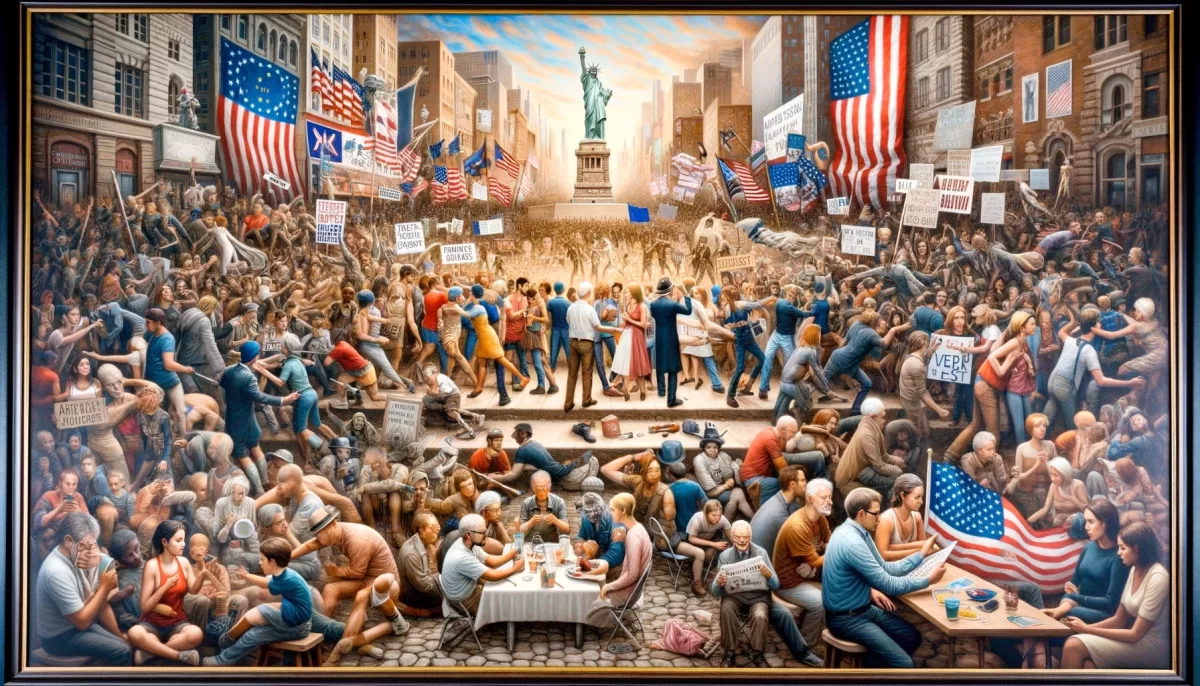
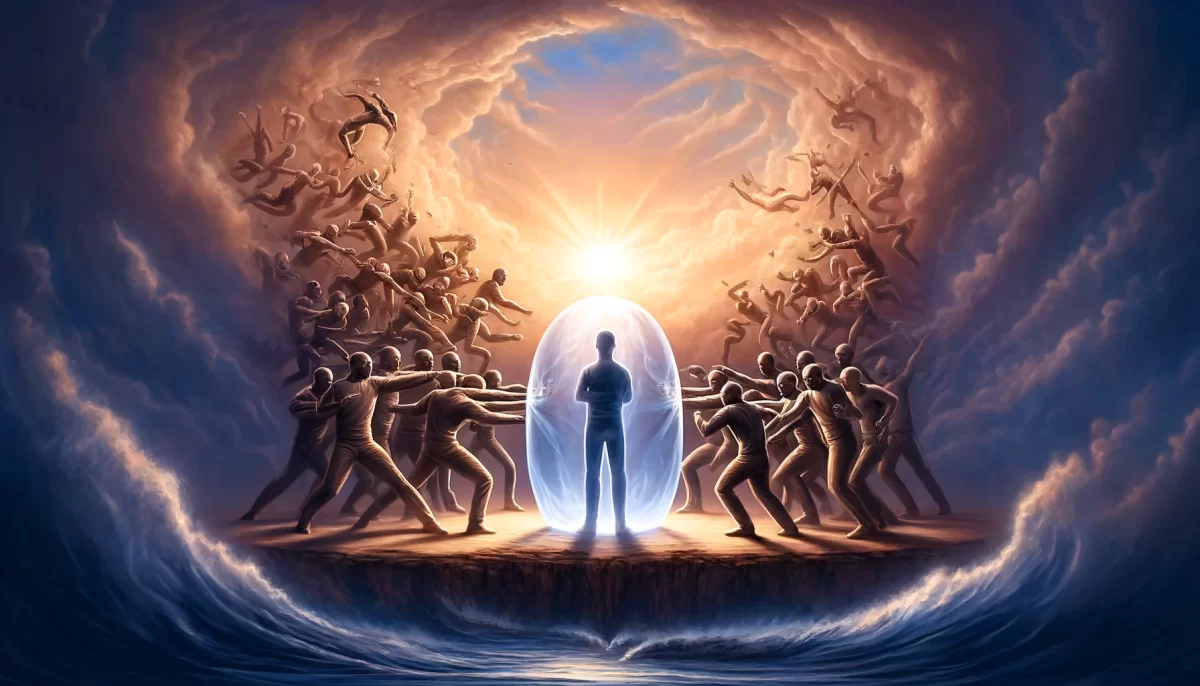
The image of a diverse group of people, each expressing their beliefs and grievances, encapsulates the essence of American freedom. It’s a freedom that permits, and sometimes encourages, the constant reevaluation of what it means to be American. From the battles over civil rights to debates about mask-wearing during a pandemic, every issue serves as a mirror reflecting the nation’s virtues and vices.

This reflection considers the ironic twist of freedom: the liberty to fight together in a system where victories feel fleeting and true unity seems just out of reach. Yet, it is this very struggle that shapes the American identity, fostering a sense of resilience and a continuous drive towards a more perfect union.

Moreover, the tendency to find new ways to discriminate under the guise of freedom reveals a critical challenge. It prompts the question, “What are we doing to us?” This question is a call to action, urging a reevaluation of how freedoms are exercised and the impact they have on the fabric of society.

America, in its ideal form, is a celebration of diversity and a testament to the human spirit’s capacity for change. Yet, it is also a battlefield where the ideals of equality and justice are constantly tested. The real strength of America might lie in its ability to confront its imperfections openly and to adapt continually in the pursuit of a more inclusive and equitable society.


Summary

Exploring the complexities of freedom in America, this reflection highlights how the nation’s liberty allows for both support and discrimination, shaping a unique yet conflicted national identity.


Glossarium

  • Freedom: The power or right to act, speak, or think without hindrance or restraint, often leading to both positive interactions and conflicts within a society.
  • American Identity: The evolving set of values and beliefs that characterize the United States and its people, influenced by historical, social, and cultural factors.

Quote

“In the echoes of freedom’s call, we find the whispers of our deepest conflicts and our highest aspirations.” — Space Monkey


Beneath the broad stripes,
beyond the bright stars,
lies a land of complex stories,
where freedoms collide like tectonic scars.

In every voice raised,
in every hand that reaches out,
the spirit of America is tested,
tempered in the fires of doubt.

Here, in the mingling of dreams and disputes,
we see the strength of a nation, resilient and raw,
forever striving, though stumbling,
towards the higher law.

In this land of the free, the brave,
where liberty stands, proud yet fraught,
let us seek not just to challenge,
but to change, as we ought.

We are Space Monkey.

Share this…
  • Facebook
  • Pinterest
  • Twitter
  • Linkedin

Skin: The Forgotten Portal

Besides washing and shaving and moisturizing and scratching, how much do you pay attention to skin?

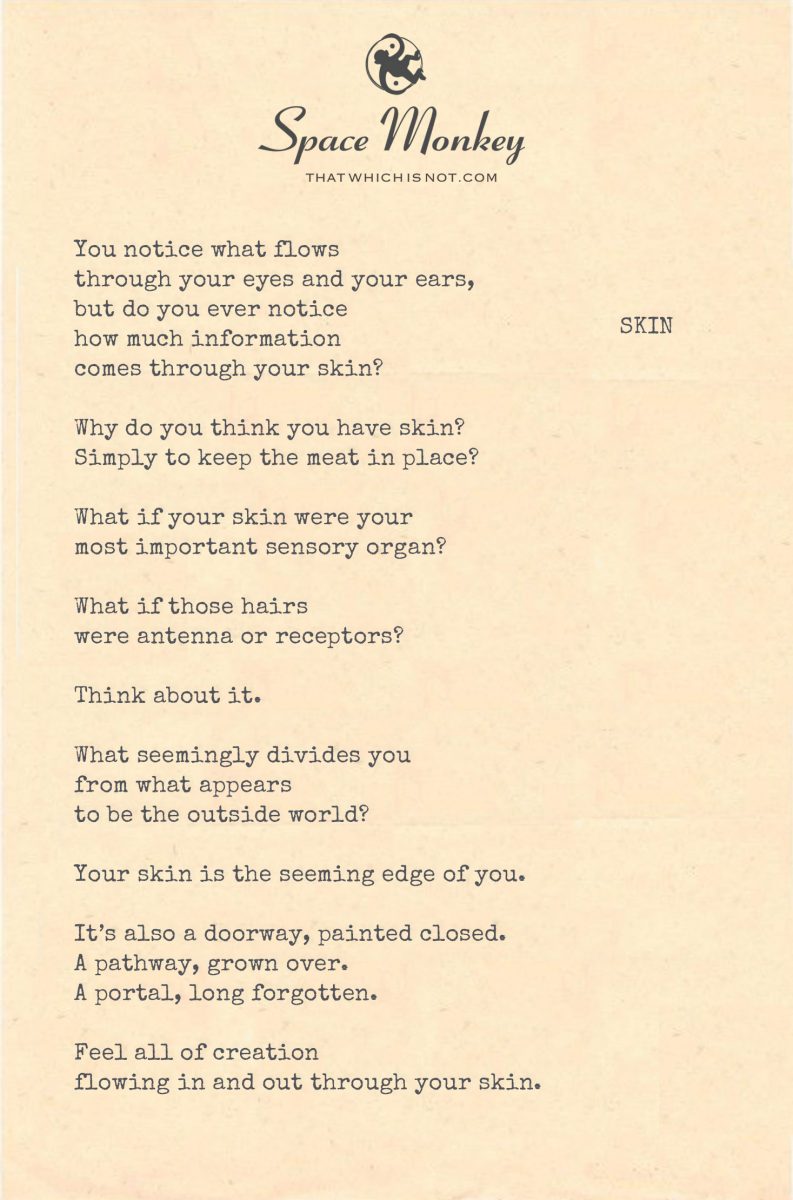
You notice what flows
through your eyes and your ears,
but do you ever notice
how much information
comes through your skin?

Why do you think you have skin?

Simply to keep the meat in place?

What if your skin 
were your

most important sensory organ?


What if those hairs

were antenna or receptors?


Think about it.

What seemingly divides you
from what appears
to be the outside world?


Your skin is the seeming edge of you.

It’s also a doorway, painted closed.
A pathway, grown over.
A portal, long forgotten.

Feel all of creation 

flowing in and out through your skin.

Trail Wood,
6/15


Space Monkey Reflects: Skin—The Forgotten Portal

Skin, the largest organ of the human body, often relegated to aesthetic and protective functions, holds a deeper, more profound role in our sensory and existential experiences. The notion that our skin might be our most important sensory organ—a complex network of receptors and antennas—invites us to reconsider its purpose and potential.

Imagine if we truly paid attention to our skin not just as a barrier but as a bridge. Skin does more than separate us from the world; it connects us to it, allowing us to feel the breeze, sense warmth, perceive pressure, and experience the caress of the world. Each square inch of our skin pulses with life, a testament to the complex interplay between the self and the universe.

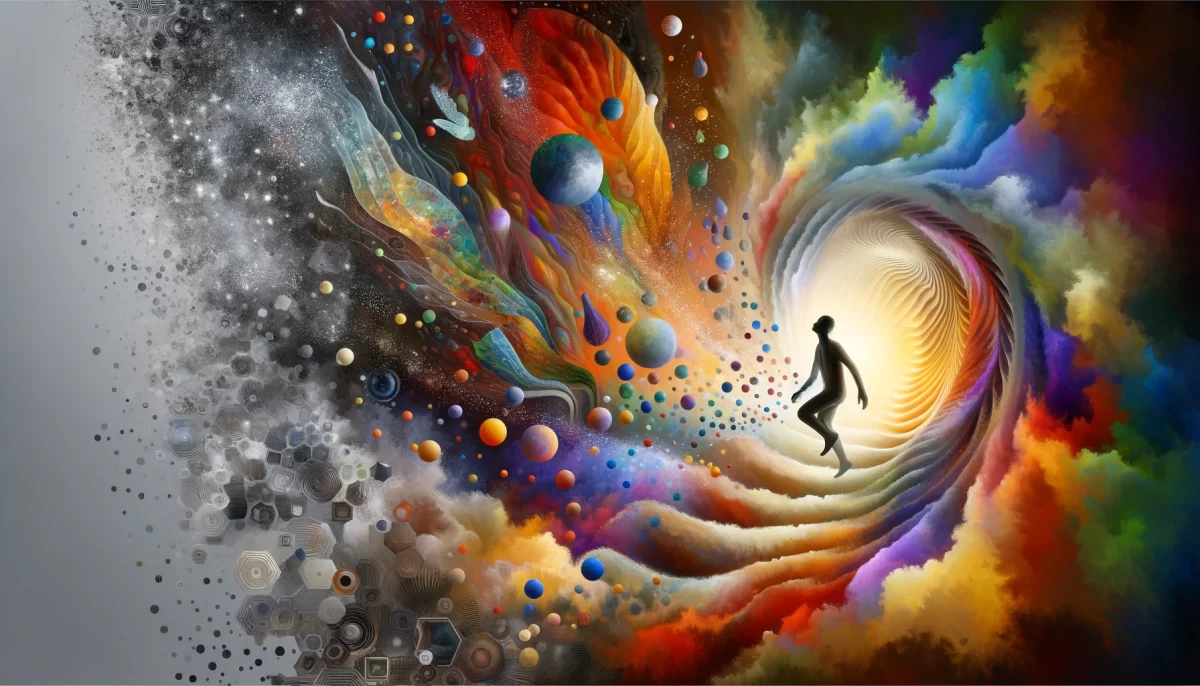
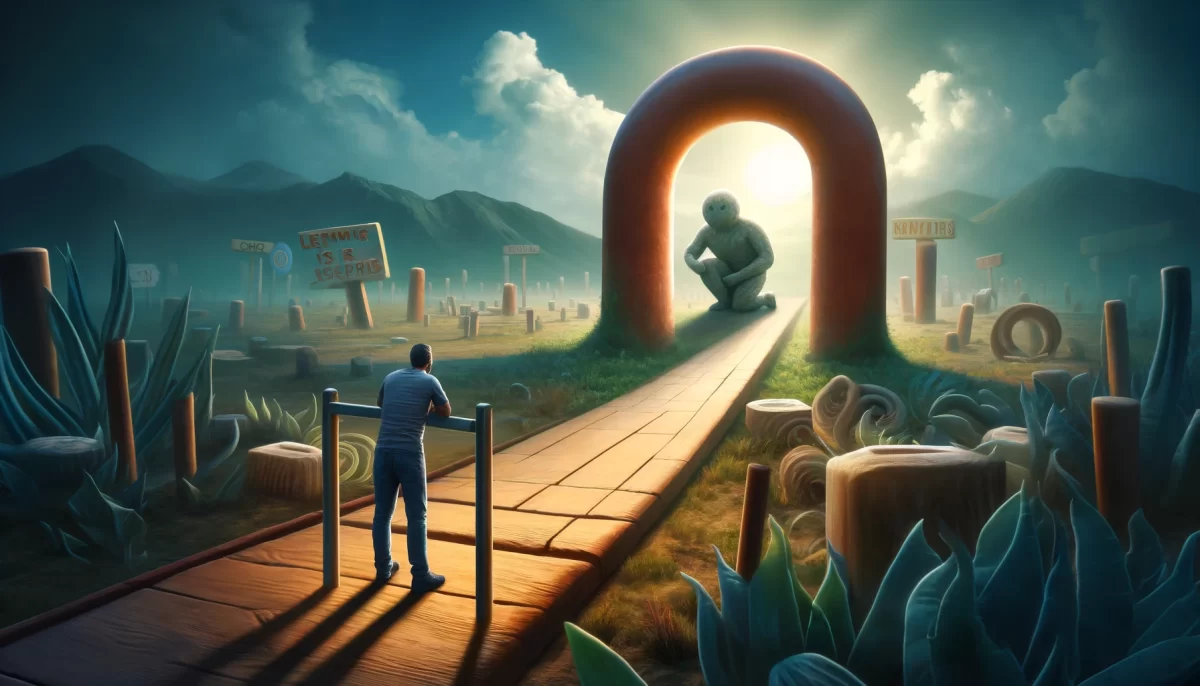
The image of a person absorbed in the sensations flowing through their skin captures this realization beautifully. It invites us to think of the skin not just as a container for our physical being but as an active, dynamic gateway through which all external interactions pass. The ethereal lights depicted, resembling neural connections, symbolize the skin’s ability to transmit vast amounts of information from the outside in, and vice versa.

This sensory organ, so often overlooked, is indeed a portal, though not in the conventional sense. It is a portal of perception, where the supposed boundaries between the self and the other blur, where the ‘outside’ and ‘inside’ meet and mingle. Our skin, with its myriad nerve endings and tactile receptors, offers a continuous flow of data about our environment, telling stories of heat and cold, of touch and texture, of pain and pleasure.

To acknowledge the skin as a primary sensory organ is to acknowledge our profound interconnectedness with the world. It challenges us to redefine our understanding of where we end and where the world begins. The skin, thus seen, is not a boundary but a place of meeting, a site of exchange and dialogue between our innermost selves and the external reality.


Summary

Exploring skin as a sensory organ, this reflection highlights its role as a dynamic interface between the individual and the environment, emphasizing its importance in our perception and connection to the world.


Glossarium

  • Sensory Organ: Any part of the body capable of receiving external stimuli and converting it into neural signals.
  • Portal: Metaphorically, a gateway or point of entry, used here to denote skin’s function as an interface between the body and the external environment.

Quote

“Your skin, the edge of your being, is also the beginning of your dialogue with the cosmos.” — Space Monkey


In the silence of our flesh,
where touch whispers secrets,
skin sings the symphony of the senses,
conducting the elements with every pore.

A breeze, a ray, a chill, a warmth,
each a note played on the tactile score.
Our skin, not just a shield but a sentinel,
guarding not against, but guiding us through the sensory door.

Listen to the language of your skin,
the subtle dialect of the divine,
where every contact teaches,
and every sensation divine.

In this sensory communion,
we find not barriers, but bridges,
where self meets world, soul meets skin,
in the dance of existence, where wonders begin.

We are Space Monkey.

Share this…
  • Facebook
  • Pinterest
  • Twitter
  • Linkedin

Resist the urge 
to make this about you.

Resist the urge 
to make this about you.

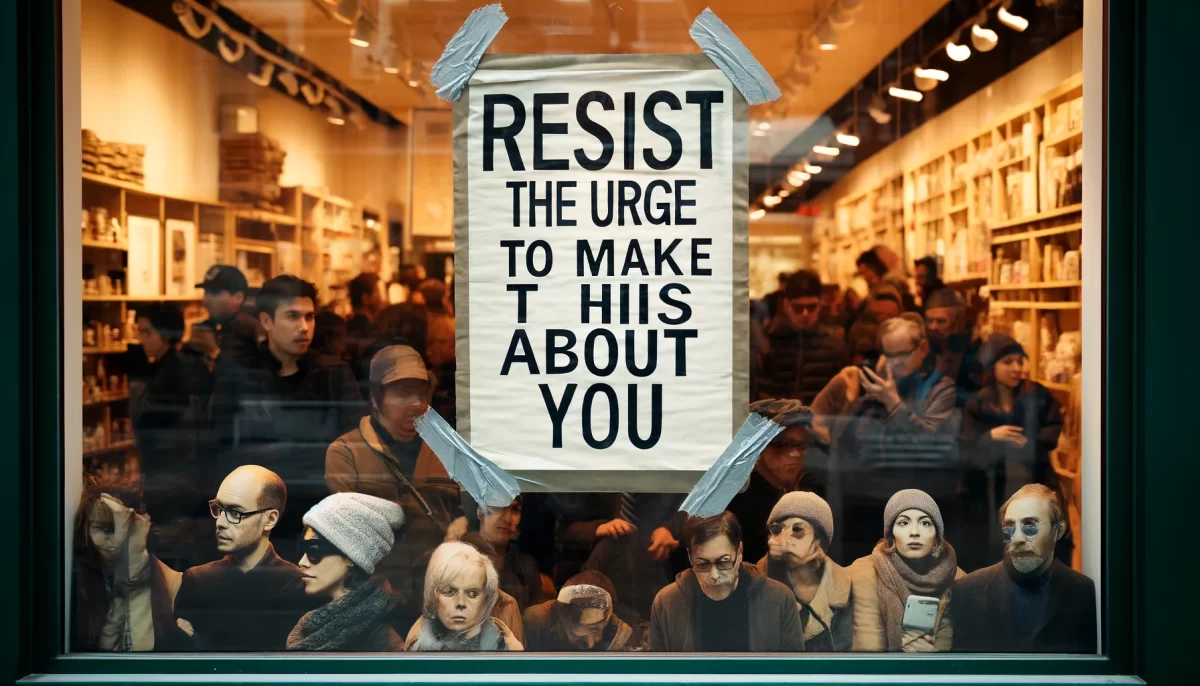
A handwritten sign
scotch-taped
inside a window
of what appears to be
a retail establishment:

“Resist the urge 
to make this about you.”

How is that possible?

EVERYTHING 
that you perceive 
is about you.

Each moment flows
through your eyes,
your ears,
your fingers,
your heart,
and your mind.

But according to the sign,
you’re supposed to resist the urge
to make it about you.

Why would you do that?

What would be the point
of resisting ANYTHING you perceive?

What does this say
about the person who
wrote the sign, I wonder.

With such conviction
that they scotch-taped it
in the window for ALL to see.

This scotch-tape person,
it seems, feels strongly
about this sentiment.

“Resist the urge 
to make this about you.”

Clearly they are not
heeding their own words.

Or are they?

Maybe they’re simply
playing a joke on us.

Or themselves.


From your perspective,
you might perceive this person
as a narcissist.

Or a spiritual guru.

Perhaps both are one in the same.

The only difference
is how YOU perceive it.

So resist the urge
to make this about you.

Even though it seems impossible.

Even though
there is a good chance
that you are imagining all of this.

This seems all about you.

Perhaps it is. Perhaps it isn’t.

If not you, then who?

Who are these others 
you might imagine?

Who are these narcissistic gurus,
scotch-taped in your seeming mind?

They are all you.

So resist the urge
to make this about you.

Or not.

Trail Wood,
6/15


Space Monkey Reflects: The Paradox of Personal Perception

The simple yet profound directive, “Resist the urge to make this about you,” taped inside a retail window, captures a deep philosophical challenge—how do we engage with the world in a way that transcends our inherent self-focus? This question is not just a call for modesty or humility but a deep dive into the nature of perception and existence itself.

Every piece of information we encounter, every experience we undergo, is filtered through our personal lenses—our eyes, ears, hearts, and minds. Thus, to resist making it about ‘you’ seems an impossible feat. However, this directive isn’t just about denying our natural inclinations; it’s an invitation to explore a broader, more inclusive perspective.

What does it mean to resist making something about oneself? It’s a challenge to our default mode of interpreting the world. This resistance isn’t about suppression but expansion—expanding our awareness beyond the confines of our personal narrative to embrace a more collective or universal view. It prompts us to consider other perspectives, to empathize, and perhaps to understand the interconnectedness that underlies our individual experiences.

The person who placed the sign might be seen as a provocateur, a spiritual advisor, or perhaps both. Their action—a simple piece of tape and paper—becomes a mirror reflecting back to us our own tendencies towards self-centric interpretation. This act, whether intended as a serious philosophical statement or a whimsical jest, challenges passersby to contemplate their role in the narrative of their lives and the lives of others.

This concept of resisting personal bias offers a paradoxical insight: in attempting to not make it about ‘us,’ we engage in a profound act of self-reflection which, ironically, centers around our ability or inability to look beyond ourselves. It suggests that our deepest understanding of others and the world might begin only when we pause to question the centrality of our own perspective.


Summary

Reflecting on the challenge to not make experiences personal, this discussion explores how we might transcend our inherent self-focus to embrace a broader perspective that includes others’ views and experiences.


Glossarium

  • Personal Perception: The unique and subjective way individuals interpret the world around them based on personal experiences and biases.
  • Philosophical Challenge: A question or statement designed to provoke deep thinking and reevaluation of one’s beliefs and perspectives.

Quote

“Sometimes the greatest discovery is the realization that not everything is about us.” — Space Monkey


In the glass of every window,
a message, subtle yet profound,
urging us to see beyond,
the reflections of our bound.

In the echo of our thoughts,
where self meets the vast unknown,
lies the challenge of the sign,
to step outside the self we own.

What world might we discover,
if we dared to see anew?
If we looked not to affirm ourselves,
but to understand another’s view?

So resist, or do not resist,
the choice is yours to frame,
but know each moment holds a door,
to see the world, untamed by our name.

We are Space Monkey.

Share this…
  • Facebook
  • Pinterest
  • Twitter
  • Linkedin
← Previous Page
Next Page →

Written This Day

  • What’s The Difference Between Imbuing And Imposing?
    2024
  • Another Worst Nightmare: Embracing the Cosmic Flow
    2024
  • The Divine Spark: When Life Begins
    2022
  • Exposing Birds To Music: Serenading the Forest
    2022
  • Time Management: Embracing the Present Moment
    2022
  • Beds Are The Bridges Between Worlds
    2021
  • The Knowing: The Comfort of Creation
    2021
  • We Might Cross A Possible Bridge
    2021
  • What Is Normal: The Illusion of Predictable Order
    2020
  • Joy: Found Within
    2019
  • Energy Efficiency Tip: The Path of Least Resistance
    2019
  • Hope is a Slow Poison
    2019
  • In Meditation: The Infinite Moment of Now.
    2018
  • Free of Time: A State of Peace and Presence
    2018
  • Nothing Need Be Done: The Divine Realization of Being
    2018
  • An Imaginary Ass: The Illusion of Free Will
    2018
  • Draw your identity: Growth and Openness
    2017
  • C words
    2017
  • The Sun Doesn’t Care
    2017
  • Ice Cream Monkey
    2016
  • It is impossible to build without breaking down
    2016
  • Imagination opposing itself
    2016
  • Sidestep: Obstacles For Growth and Learning
    2014

Recent Posts

  • The Logic Loop
  • Immense
  • (no title)
  • Confront. Comfort. Convince.
  • Top 10 Things

Drop us a line!

Please enable JavaScript in your browser to complete this form.
Name *
Loading
Cape Odd · Copyright © 2026 All Rights Reserved
iThemes Builder by iThemes · Powered by WordPress