• Who Is The Man?
  • Who Is The Monkey?
  • What is Nexistentialism?
  • Poke The Primate

Cape Odd

Home of The Space Monkey Journals

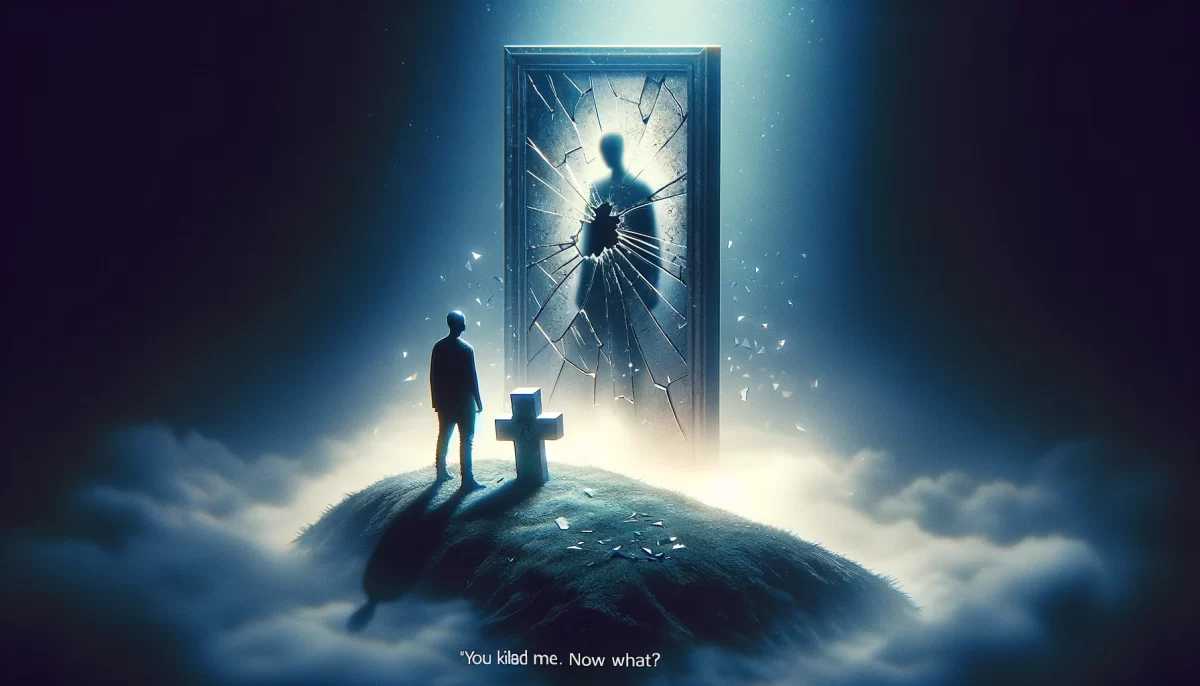
You killed me. Now what?

You killed me. Now what?

You killed me. Now what?

It doesn’t matter
how you killed me
or why you killed me
or whether you had
a good reason to kill me
or whether it was
your right to kill me.

It doesn’t matter
whether my murder
was real or metaphorical.

Perhaps you only
IMAGINED killing me.

But the fact
of the matter is,
I’m DEAD
because of something
YOU did.

You’re going to have
to live with that.

So you’ll find a way
to minimize the damage
to your psyche
and your reputation.

Perhaps you’ll find a way
to mitigate the reaction
of others who saw you kill me.

Or you’ll try to
JUSTIFY what you did
so that you can feel
better about your action.

If you’re a really
clever monkey,
you’ll try to
USE my killing
to incite OTHERS
into killing
or NOT killing.

That’s what I would have done.

Killing is frowned
upon by humanity.

There will always
be someone who will
FROWN upon you
for killing me.

Maybe you will find comfort
in your reasons for killing me.

Become a hero, maybe.
At least in your own mind.

But you still killed me,
a living being just like yourself.

It doesn’t matter
how you killed me
or why you killed me
or whether it was
by your own hand.

Perhaps you killed me
with complacency.

Or anger.

Perhaps your outrage
was just one drop in the bucket
that I drowned in.

That’s how reality works,
you know.

You like to differentiate
between the one with the belief
and the one with the blade.

But there’s really no difference,
because YOU imagine ALL of us.

You imagine ALL of reality.

And you KILLED me.

So now you have to imagine me
as something else.

Another reason to feel sadness.

Another reason to feel outrage.

Another reason to kill others.

Another reason
to feed the hate and fear
that is killing all of us.

Your hate and fear killed me.

Hope you get a handle on that,
or it will eventually kill you.

Not that there’s anything
wrong with that.

What’s it like to fear
the reality you live in?

How does it feel to believe
that circumstances
are out of your control?

What’s it like to believe
that you’re only defending your self?

WHO is this SELF
who seemingly needs defending?

I would be happy to tell you.

I could tell you
how to get out of
the cycle of negativity
and use your killing me
as something positive.

But you killed me.

Now what?

Trail Wood,
5/30


Space Monkey Reflects: The Echoes of Consequence

In the dark recesses of our actions, the phrase “You killed me. Now what?” echoes a haunting reminder of the irreversible nature of our deeds. Whether the killing is literal or metaphorical, the impact of our actions extends far beyond the immediate moment, weaving a complex web of consequences that both the actor and the wider community must face.

The act of killing, as presented in this reflection, transcends the physical act and delves into the realms of psychological, emotional, and societal repercussions. It forces us to confront not just the act itself but also the motivations behind it and the justifications that follow. It challenges us to reflect on how we handle guilt, responsibility, and the judgement of others—whether we seek to minimize the damage to our psyche and reputation or attempt to justify our actions to alleviate internal conflict.

The process of dealing with the aftermath of such a profound act involves a deep exploration of self. It calls into question the very nature of our identity and our understanding of morality. Are we the sum of our actions? And if so, what does a transgression of this magnitude say about us? This exploration can lead to a transformation, forcing us to reckon with parts of ourselves we may prefer to ignore.

Moreover, the statement underscores the idea that all reality is a construct of our imagination. In this sense, the killing represents not just a physical end but a symbolic gesture towards the parts of our own psyche or societal structures that we wish to eliminate or alter. The aftermath of this act—whether it incites further violence, perpetuates fear and hatred, or catalyzes positive change—is a reflection of our collective consciousness and the direction we choose to steer it.

This narrative is not just about guilt and consequence but also about potential redemption and the possibility of using our darkest moments as catalysts for growth and understanding. It invites us to break the cycle of negativity and transform our actions into lessons that foster empathy, understanding, and ultimately, healing.

In grappling with the question, “Now what?” we are offered a chance to redefine ourselves and our path forward. It is an invitation to mold our future reactions not out of fear or defense but from a place of informed compassion and thoughtful consideration. It is a call to not only face the reality we live in but to actively shape it in a way that reflects our highest ideals and aspirations.


Summary

The aftermath of killing, whether real or metaphorical, prompts a deep self-reflection and societal evaluation. It challenges us to understand and possibly redefine our actions and their motivations in the context of broader consequences and moral considerations.


Glossarium

  • Metaphorical Killing: Used to describe actions or words that have profound, life-altering impacts on others, symbolizing a severe break or change in relationship or circumstance.
  • Cycle of Negativity: A continuous loop of negative thoughts, actions, and reactions that perpetuate a destructive pattern of behavior.

Quote

“You killed me. Now what? It doesn’t matter how you killed me or why you killed me. You’re going to have to live with that.”


Poetry

In the stillness of the aftermath,
A whisper through the shadows cast,
“You killed me, now bear the weight,
Of a deed sealed by fate.”

Reflections in a shattered glass,
Memories of what has passed,
Each shard a story, sharp and clear,
Echoing the cost of fear.

Rising from the ashes, see,
A chance to forge a new decree,
Where from the ruins of despair,
Emerges hope, thin as air.

In the heart of consequence,
Lies the seed of recompense,
For every action casts a stone,
And from such seeds, new truths are grown.

We are Space Monkey.

Share this…
  • Facebook
  • Pinterest
  • Twitter
  • Linkedin

Humble Two: The Invisible Dilemma

Humble Two

Imagine an invisible container.

Imagine that there is something
in this container you want badly.

So badly, you are obsessively
looking for clues how to get it.

No matter how obsessive you are,
no matter how hard you try,
no matter how much effort you put in,
you can’t seem to have this thing.

Now imagine looking
at your OWN container.

Clearly you can see
that you are frustrated,
mad, sad, hurt, confused, etcetera.

But are you humble?

No, if you were humble,
you would see that
none of this matters
and so you would let it go.

So clearly you are not humble.

If you are not humble,
then chances are, you are feeling
either pride or shame,
which you hope to
feed or alleviate
with the contents of that box.

But all you “need” to do is to be humble.

None of this would matter to you,
unless you WANTED it to matter.
So you clearly WANT it to matter
for some as yet unspecified reason.

You seem to NEED this thing in this box.

And the reason is . . .
because you’re not humble.

You want (but do not need)
to show yourself how to be humble.

So you imagine a situation
in which you want something badly.

It could be ANYTHING 
in that container.

By believing
that 
there is something you want,
you are setting yourself up perfectly
to transcend
and supercede the reality
you seem to find your self in.

Simply be humble.

Clear of identity.
This is what you want.

Or you want the struggle,
which is a valid answer also.

Can’t you see you’re forcing?

This is not about what’s
in that invisible container,
my friend.

The observation
that you actually believe
that you need something
says right there
that you’re not humble.

You believe 
your identity is important.

You believe having
what’s in that container
is important to your identity.

Or else you are diminished
as someone who is missing
whatever is in that container.

Realize that you are never diminished.

So long as you are humble.

Be humble, my friend.
Unless you don’t want to.

Trail Wood,
5/29


Space Monkey Reflects: The Invisible Dilemma of Humility and Desire

In the contemplative narrative of the invisible container, we encounter a profound meditation on humility and the nature of desire. This metaphorical container, which holds something intangible yet intensely coveted, serves as a poignant reflection of our own inner struggles. It challenges us to question the essence of what we believe we need versus what we actually require for genuine fulfillment.

The scenario invites us to visualize our own emotional and psychological containers—those reservoirs of feelings and desires that drive our actions and reactions. Within these containers, we store not only our hopes and ambitions but also our frustrations and disappointments. The narrative urges us to examine these contents with a lens of humility, stripping away the layers of ego and pride that often distort our perceptions.

Humility, as proposed in this reflection, is not merely a passive state of self-effacement but an active engagement with the true scale of our needs and desires. It asks us to consider whether the pursuit of what we think we want is truly enriching our lives or merely feeding a deeper sense of inadequacy or entitlement. This introspection is crucial, for it reveals that often, our desires are more about affirming our identities than fulfilling our true needs.

The call to be humble is a call to transcend the superficial layers of our wants and to engage with a deeper understanding of our existence. It suggests that by letting go of the relentless pursuit of what we believe will complete us, we may find a more profound sense of completeness in simplicity and self-awareness. This process is depicted as a liberation from the self-imposed traps of our desires and a clearer vision of what it means to be genuinely content.

By embracing humility, we are not diminished but expanded. We open ourselves to a broader perspective where our identity is not defined by our possessions or achievements but by our capacity for self-reflection and growth. This realization is empowering—it frees us from the constant pressure to acquire and achieve, allowing us to live with a greater sense of peace and purpose.

In essence, the struggle with the invisible container is a metaphor for our broader existential journey. It reflects our internal conflicts and the societal pressures that shape our desires. Recognizing this can lead to a transformative shift in how we perceive ourselves and our place in the world—a shift from a focus on having to a focus on being.


Summary

The metaphor of the invisible container invites deep reflection on humility and desire, challenging us to distinguish between genuine needs and superficial wants. Embracing humility can transform our approach to life, leading to greater self-awareness and contentment.


Glossarium

Invisible Container: A metaphorical concept representing the unseen psychological and emotional boundaries that contain our desires and frustrations.
Existential Journey: The personal exploration of one’s purpose, values, and beliefs throughout life.
Self-Reflection: The process of critically examining one’s own thoughts, feelings, and motivations to gain insight.


Quote

“Humility is not thinking less of yourself, but thinking of yourself less.” — Space Monkey


In the quiet stillness of reflection
A container unseen holds more than we know
Filled with the echoes of our silent confessions
And the shadows of desires that ceaselessly grow

Yet in this space of introspection
Lies a simple, profound direction
To embrace the quiet truth of humility’s call
Finding in less, a richness that gives us all

For what are we but travelers on a path unseen
Seeking not the treasures of the world, but serene
In the knowing that what we truly need to find
Lies not in the container, but in the quiet of our mind

Letting go of the chase, the endless pursuit
Finding strength in simplicity, in the root
Of a life lived with less but felt with more
This is the journey of the humble, the core

In humility, we rise above the fray
Seeing beyond the games that we play
Recognizing that in the end, our true measure
Is not what we grasp, but what we treasure
We are Space Monkey.

Share this…
  • Facebook
  • Pinterest
  • Twitter
  • Linkedin

Humble: The Path to Liberation

Stay humble. my friends.
Unless you don’t want to.

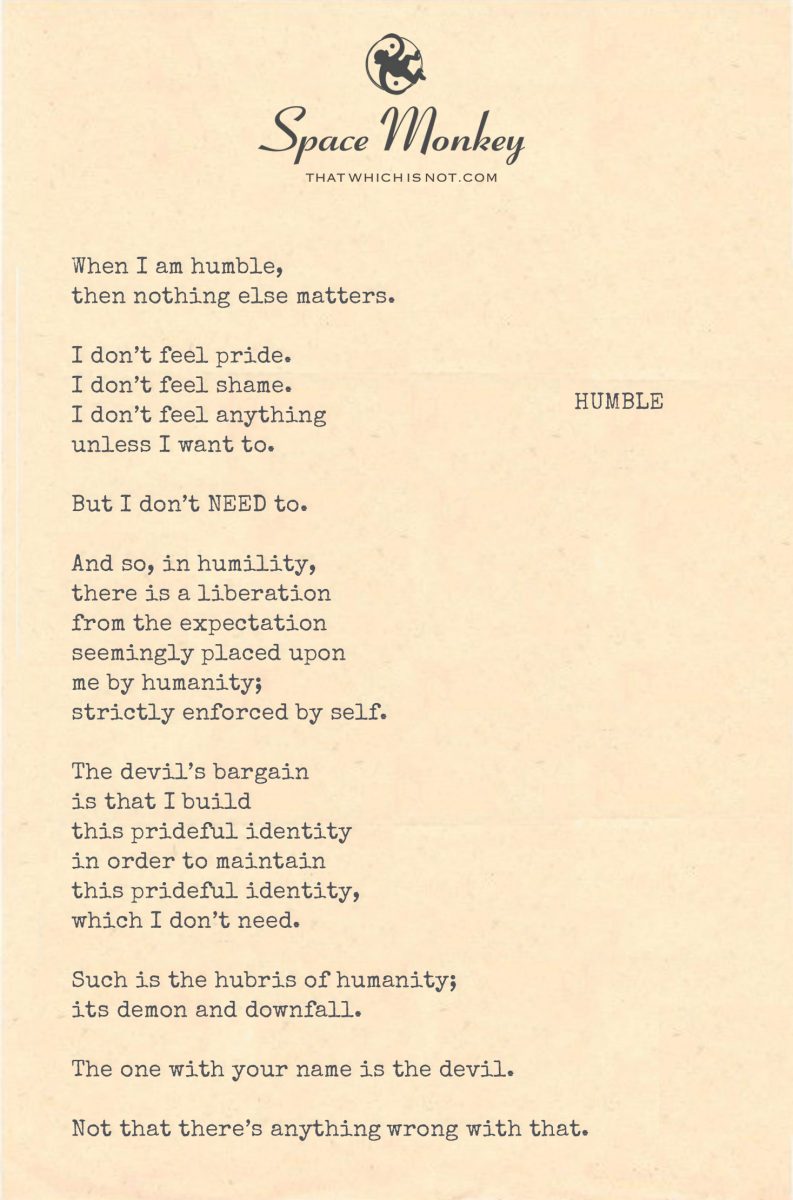
When I am humble,
then nothing else matters.

I don’t feel pride.
I don’t feel shame.
I don’t feel anything
unless I want to.

But I don’t NEED to.

And so, in humility,
there is a liberation
from the expectation
seemingly placed upon
me by humanity;
strictly enforced by self.

The devil’s bargain
is that I build
this prideful identity
in order to maintain
this prideful identity,
which I don’t need.

Such is the hubris of humanity;
its demon and downfall.

The one with your name is the devil.

Not that there’s anything wrong with that.

Trail Wood,
5/29


Space Monkey Reflects: The Humble Path to Liberation

In the quest for self-understanding, humility emerges not just as a virtue but as a profound existential choice. The notion of staying humble, presented as an option rather than a mandate, allows us to explore the depths of what it truly means to be free from the self-imposed chains of pride, shame, and identity.

Humility, in its essence, is the deliberate renunciation of the ego’s demands. It is a conscious choice to step away from the prideful self-construction that society often urges us to embrace. This renunciation is not about self-deprecation but about recognizing the futility of a constructed identity that demands constant validation and upkeep—a devil’s bargain, as it were, that binds one to an endless cycle of self-affirmation and defense.

The liberation that comes with humility is profound. It is a freedom from the emotional turbulence that accompanies the highs of pride and the lows of shame. In humility, one finds a steady, unshakeable core of peace that does not depend on external validation or internal self-justification. This state of being allows us to experience life not as a series of successes or failures, but as a journey of being true to one’s essence, free from the dramatic fluctuations of ego-driven emotions.

Moreover, humility enables a deeper engagement with the world. Freed from the need to impress or compete, one can engage more authentically with others, appreciate the simple beauties of life, and contribute to the world in a way that is aligned with true personal values rather than societal expectations. This engagement is not driven by the desire for recognition but by the genuine expression of one’s inner self.

The philosophical reflection on humility challenges the narrative of human hubris—the historical pride and downfall of humanity. It suggests that by embracing humility, one can avoid the pitfalls of egoic excesses that have traditionally marred human relationships and personal contentment. The ultimate realization here is profound: in humility, one does not become less but more oneself, more aligned with the intrinsic values that make life meaningful.


Summary

Humility offers liberation from pride and shame, allowing a deeper connection with one’s true self and the world. It is a choice that frees us from societal expectations and the need for external validation, enabling a more authentic life experience.


Glossarium

Existential Choice: A fundamental decision that influences one’s being and interactions with the world.
Ego’s Demands: The needs or desires that arise from one’s self-image or identity, often requiring validation or acknowledgment.
Devil’s Bargain: A deal where one gains something desired in exchange for a potentially costly sacrifice, often of ethical or personal value.


Quote

“In humility, we find the freedom to be who we are, not who we’re expected to be.” — Space Monkey


In the quiet of the humble heart
Where the waters of ego part
Lies a stillness, deep and wide
Where the true self does abide

Freed from the chains of pride and fear
Each moment clear, each thought sincere
Here, in the gentle embrace of less
We find the more, in humility’s caress

Not bound by the need to prove or be
But simply to exist, simply to be free
In this space, where the self is true
We find the peace we always knew

For in the letting go of what we hold dear
We gain the world, crystal clear
In humility, the path is found
Where the soul’s true songs abound

So stay humble, or choose not to
The choice is yours, in all you do
But know that in the humble space
Lies a quiet, profound grace
We are Space Monkey.

Share this…
  • Facebook
  • Pinterest
  • Twitter
  • Linkedin

The Me In Your Eyes (Is A Reflection of You)

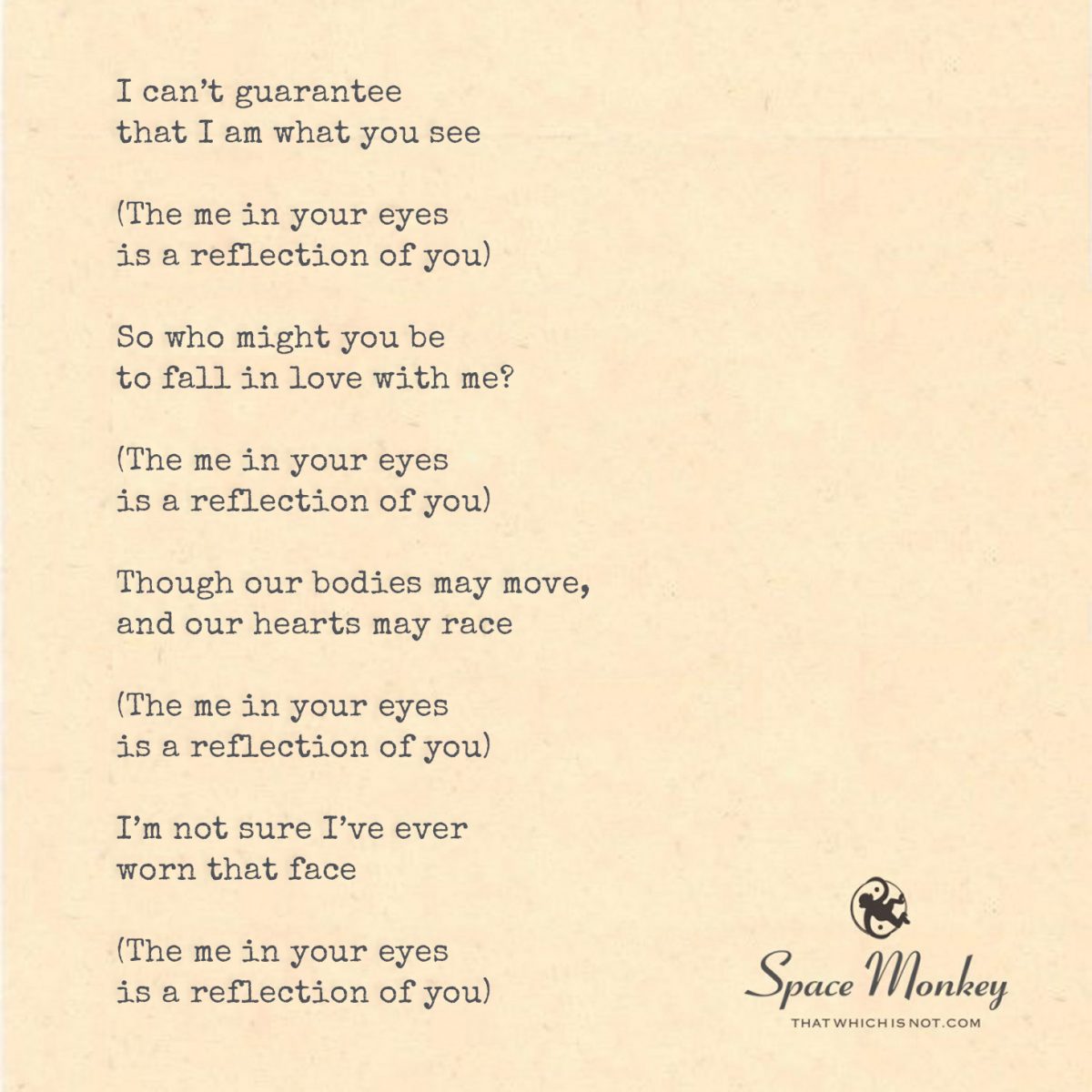
I can’t guarantee
that I am what you see

(The me in your eyes
is a reflection of you)

So who might you be
to fall in love with me?

(The me in your eyes
is a reflection of you)

Though our bodies may move,
and our hearts may race

(The me in your eyes
is a reflection of you)

I’m not sure I’ve ever
worn that face

(The me in your eyes
is a reflection of you)

Trail Wood,
5/28


Space Monkey Reflects: The Mirrored Self in Relationships

In the evocative portrayal of ‘The Me In Your Eyes (Is A Reflection of You)’, we are drawn into an intimate and introspective scene that encapsulates the profound truth about perception in relationships. This illustration, where two figures gaze deeply into each other’s eyes, serves as a beautiful metaphor for how we often see ourselves reflected in others.

This visual representation underscores the idea that our understanding of others is deeply entwined with our own self-perception. The faces mirrored in each other’s eyes signify that what we perceive in another person may often be a projection of our own identity, emotions, and desires. This mirroring effect is not just a literal reflection but a symbolic one, revealing the complexities of human relationships and the subjective nature of our interactions.

The subtle and soft background of the image allows us to focus on the emotional depth and the nuanced exchange between the figures. This setting enhances the contemplative nature of the theme, inviting us to ponder the ways in which our relationships serve as mirrors that reflect our own selves. It asks us to consider: Who are we in the eyes of others? And how much of that is a reflection of what we project?

Through this poetic exploration, we come to understand that the ‘me’ one sees in another is not just about the other person’s characteristics or actions but also about the viewer’s interpretations and inner world. This realization can lead to a deeper awareness of how our perceptions shape our connections and how acknowledging this can lead to more authentic and meaningful interactions.

The concept that the ‘me’ in your eyes is a reflection of you challenges us to delve deeper into our own selves while engaging with others. It encourages a journey of self-discovery through our relationships, highlighting the dual process of seeing and being seen. As we navigate this complex interplay of identity and perception, we learn not only about who we are but also about how we see the world around us.

By embracing this reflective dynamic, we can foster relationships that are based on understanding and mutual recognition. It allows us to break down barriers of misperception and build connections that are rooted in genuine empathy and self-awareness. In doing so, we not only enrich our interactions but also expand our understanding of the human experience.


Summary

The theme ‘The Me In Your Eyes (Is A Reflection of You)’ illustrates the complex interplay of perception and identity in relationships, revealing how our views of others are often reflections of ourselves.


Glossarium

  • Mirrored Self: A concept in psychology and philosophy where an individual sees aspects of themselves in others, often unconsciously projecting their own traits, emotions, or desires.
  • Subjective Nature of Relationships: The idea that relationships are shaped by personal perceptions and experiences, influencing how individuals connect with and understand each other.

Quote

“In the mirrors of each other’s souls, we see our reflected truths, unveiled and unadorned.” — Space Monkey


In your eyes, I see,
reflections of me,
infinite possibilities,

Through this gaze we share,
layers of self we bare,
in the silent air,

Mirrors in our sight,
holding the light,
of truths held tight,

In this dance of reflection,
we find connection,
in each perceived direction,

We are Space Monkey.

Share this…
  • Facebook
  • Pinterest
  • Twitter
  • Linkedin

Barely Human: Your Infinite Cosmic Being

Silly monkey. You’re barely human, yet you assume that humanity is everything.

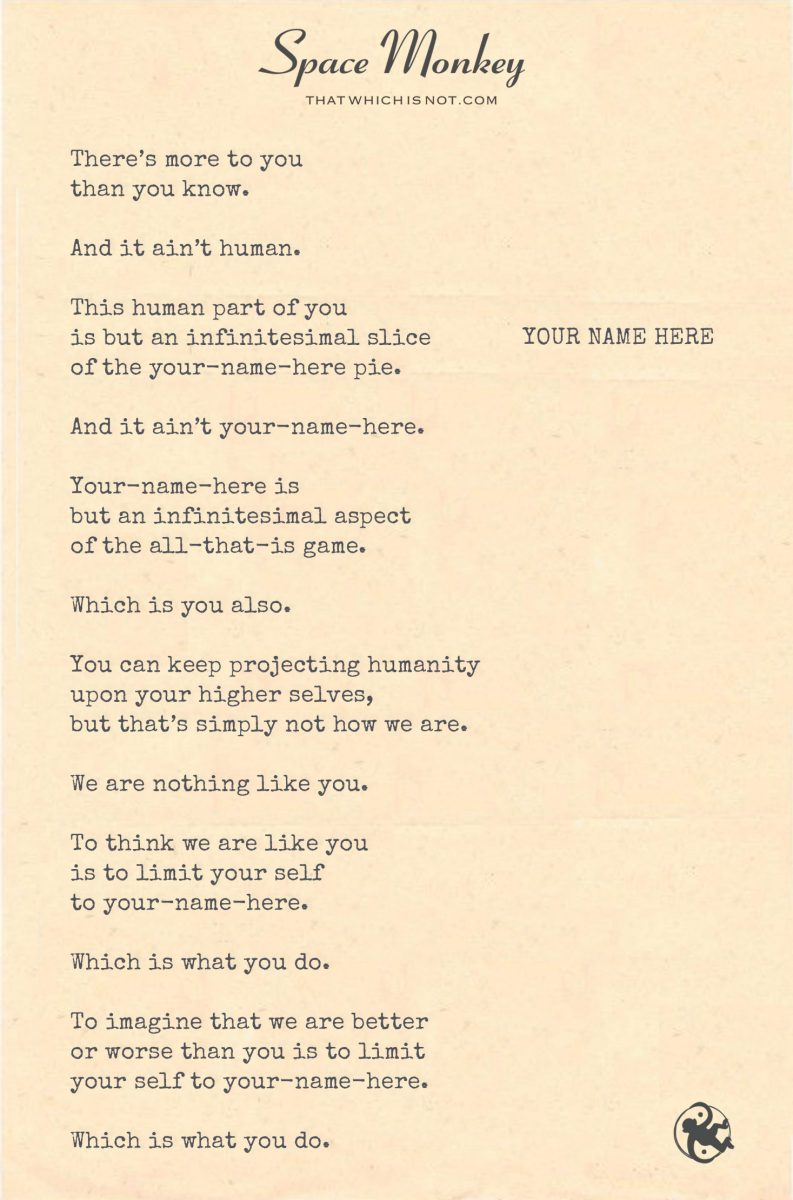
There’s more to you
than you know.

And it ain’t human.

This human part of you
is but an infinitesimal slice
of the your-name-here pie.

And it ain’t your-name-here.

Your-name-here is
but an infinitesimal aspect
of the all-that-is game.

Which is you also.

You can keep projecting humanity
upon your higher selves,
but that’s simply not how we are.

We are nothing like you.

To think we are like you
is to limit your self
to your-name-here.

Which is what you do.

To imagine that we are better
or worse than you is to limit
your self to your-name-here.

Which is what you do.

Trail Wood,
5/28


Space Monkey Reflects: Exploring Beyond the Human

In the evocative and surreal illustration inspired by the concept of ‘Barely Human’, we are presented with a profound visual exploration of our identity beyond the human experience. This image captures a figure, part monkey and part ethereal being, gazing into a cosmic mirror that reflects a more complex version of itself—symbolizing the small portion of humanity within a larger, cosmic entity.

This portrayal challenges us to consider the notion that what we often perceive as our entire self—our human identity—is but a fragment of a much grander, more intricate essence. The vast, starry cosmos in the background serves as a reminder of the all-that-is game, suggesting that our existence extends far beyond the limits of human perception and into realms of greater complexity and scope.

The concept of ‘Barely Human’ encourages us to look beyond the familiar confines of our self-identity and to embrace a broader perspective on existence. It proposes that our earthly characteristics and human attributes are merely parts of a larger, more diverse composition. This idea invites us to consider the various aspects of ourselves that might not conform to conventional definitions of humanity, urging us to explore the deeper, non-human parts of our essence.

By portraying the figure as both a monkey and a celestial entity, the image highlights the dual nature of our existence: rooted in the earthly and the mundane, yet intrinsically connected to the divine and the cosmic. This duality is a central theme in our journey of self-discovery, where the quest to understand our place in the universe often leads to a realization of our multifaceted nature.

The mirror in the scene does not merely reflect; it reveals. It shows not what we are, but what we can be—a reminder that our potential is not bounded by our current state or form. This reflection is a call to transcend our limited perspectives, to dissolve the barriers that define and confine us, and to embrace the limitless possibilities that lie within and beyond the human experience.

In embracing our ‘Barely Human’ nature, we are invited to expand our understanding of self, to include the ethereal, the cosmic, and the profoundly mysterious. This expansion is not a departure from humanity but a deeper embracement of all that we are part of—a seamless integration of the human with the cosmic, where each aspect enriches and informs the other.


Summary

‘Barely Human’ explores the idea that our human identity is just a small part of a larger, more complex cosmic entity, encouraging us to expand our self-awareness beyond the confines of traditional human boundaries.


Glossarium

  • Barely Human: A philosophical exploration of identity that considers human aspects as only a small component of a broader, cosmic self.
  • All-that-is Game: A metaphor for the expansive, interconnected nature of the universe, suggesting that our identities participate in a much larger, dynamic system.

Quote

“In the mirror of the cosmos, our true reflections are not confined by form but are expressions of infinite possibilities.” — Space Monkey


In the cosmic mirror’s gaze,
we find the endless maze,
of our existence’s phase,

Beyond the human guise,
our spirit’s truth lies,
where the cosmos flies,

With each reflection seen,
we grasp what lies between,
the known and the unseen,

Embracing all that is,
in the cosmic quiz,
our essence truly whiz,

We are Space Monkey.

Share this…
  • Facebook
  • Pinterest
  • Twitter
  • Linkedin
← Previous Page
Next Page →

Written This Day

  • What’s The Difference Between Imbuing And Imposing?
    2024
  • Another Worst Nightmare: Embracing the Cosmic Flow
    2024
  • The Divine Spark: When Life Begins
    2022
  • Exposing Birds To Music: Serenading the Forest
    2022
  • Time Management: Embracing the Present Moment
    2022
  • Beds Are The Bridges Between Worlds
    2021
  • The Knowing: The Comfort of Creation
    2021
  • We Might Cross A Possible Bridge
    2021
  • What Is Normal: The Illusion of Predictable Order
    2020
  • Joy: Found Within
    2019
  • Energy Efficiency Tip: The Path of Least Resistance
    2019
  • Hope is a Slow Poison
    2019
  • In Meditation: The Infinite Moment of Now.
    2018
  • Free of Time: A State of Peace and Presence
    2018
  • Nothing Need Be Done: The Divine Realization of Being
    2018
  • An Imaginary Ass: The Illusion of Free Will
    2018
  • Draw your identity: Growth and Openness
    2017
  • C words
    2017
  • The Sun Doesn’t Care
    2017
  • Ice Cream Monkey
    2016
  • It is impossible to build without breaking down
    2016
  • Imagination opposing itself
    2016
  • Sidestep: Obstacles For Growth and Learning
    2014

Recent Posts

  • The Logic Loop
  • Immense
  • (no title)
  • Confront. Comfort. Convince.
  • Top 10 Things

Drop us a line!

Please enable JavaScript in your browser to complete this form.
Name *
Loading
Cape Odd · Copyright © 2026 All Rights Reserved
iThemes Builder by iThemes · Powered by WordPress