
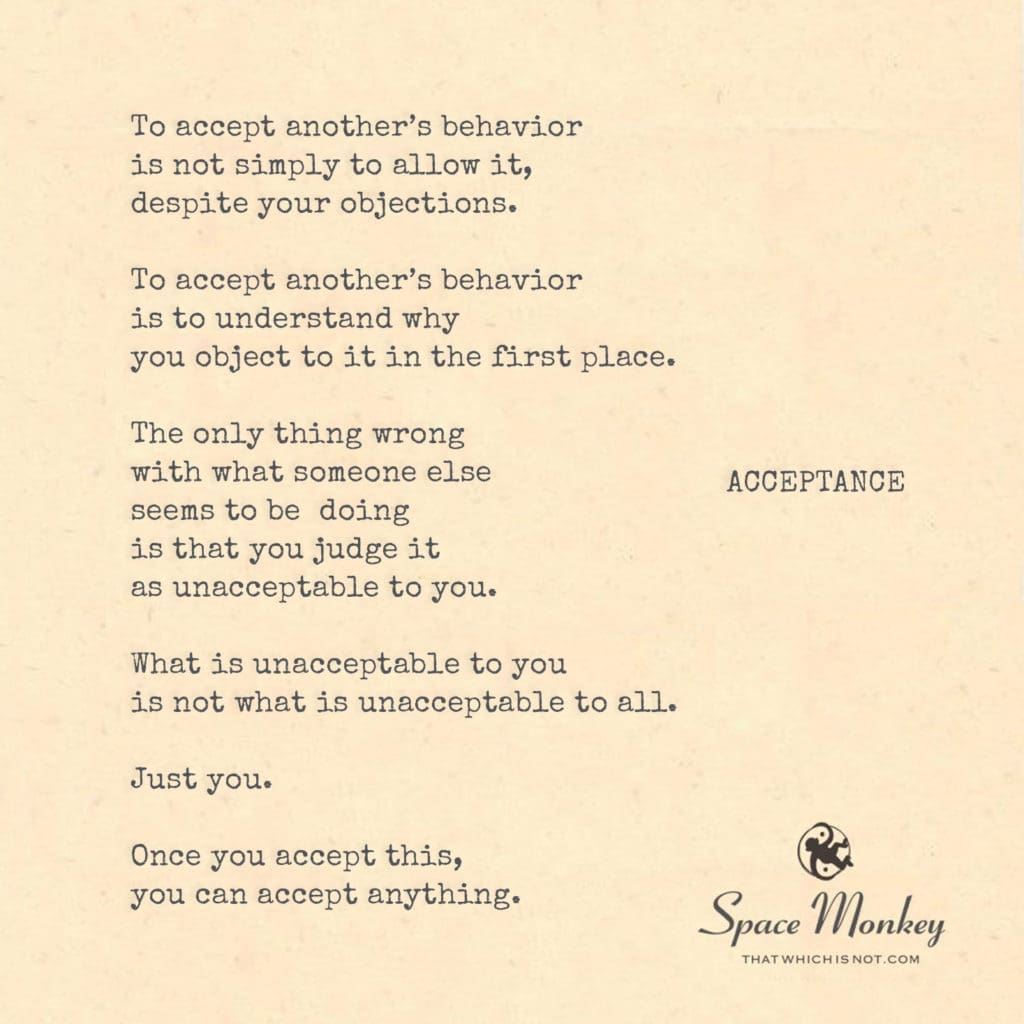
To accept another’s behavior
is not simply to allow it,
despite your objections.
To accept another’s behavior
is to understand why you object
to it in the first place.
The only thing wrong
with what someone else
seems to be doing
is that you judge it
as unacceptable to you .
What is unacceptable to you
is not what is unacceptable to all.
Just you.
Once you accept this,
you can accept anything.
Trail Wood,
6/23
Space Monkey Reflects: The Essence of Acceptance
In the complex dance of human interactions, acceptance plays a pivotal role. To accept another’s behavior is not merely to tolerate it despite personal objections; it involves a deeper journey of understanding why these objections exist in the first place. This process transforms our perception, allowing us to see beyond our immediate judgments and embrace a broader perspective.
Imagine a surreal landscape where a central figure stands with open arms, embodying the essence of acceptance. Surrounding this figure are diverse scenes encapsulated in translucent bubbles, each representing different behaviors and actions. Some bubbles are tinted with darker shades, indicating the figure’s initial objections. Yet, as the figure’s light radiates outward, these bubbles gradually illuminate, symbolizing the journey from judgment to understanding.
This journey begins with introspection. The only thing wrong with someone else’s behavior, at first glance, is our judgment of it as unacceptable. This judgment is personal, rooted in our experiences, beliefs, and values. What is unacceptable to one may not be so to another. Recognizing this subjectivity is the first step toward genuine acceptance.
Acceptance requires us to question our objections. Why does a particular behavior trigger a negative response? What underlying beliefs and experiences shape this reaction? By exploring these questions, we uncover the layers of conditioning that influence our judgments. This introspective process fosters empathy, helping us understand that others act from their own unique perspectives and experiences.
To accept is to acknowledge the diversity of human experience. Each bubble in our surreal landscape represents a different viewpoint, a different life story. By illuminating these bubbles, we see the richness and complexity of human behavior. This illumination does not mean we must agree with or condone all actions, but it enables us to approach them with empathy and understanding.
The process of acceptance transforms us. As the figure in our image radiates light, it symbolizes the expansion of consciousness that comes with embracing diversity. This light is not merely passive tolerance; it is active engagement with the world around us, an openness to learning from every encounter. Acceptance becomes a dynamic force that enriches our lives and the lives of those we interact with.
Acceptance also involves relinquishing the need for control. Our objections often stem from a desire to shape the world according to our preferences. By accepting that others have their own paths, we let go of this need and find peace in the natural flow of life. This shift from control to acceptance frees us from the constant struggle against what is, allowing us to experience the present moment more fully.
The background of our surreal landscape blends calming colors, creating a sense of peace and clarity. This backdrop reflects the inner tranquility that comes with acceptance. When we cease to judge and resist, we cultivate a state of inner peace. This peace radiates outward, influencing our interactions and creating a ripple effect of understanding and compassion.
Acceptance is a practice, a continuous journey of growth and transformation. It is not about reaching a final destination but about engaging with the process of understanding and embracing the diversity of human experience. Each moment of acceptance deepens our empathy and broadens our perspective, enriching our lives and the lives of those we encounter.
Ultimately, acceptance allows us to see others as they are, not as we wish them to be. It fosters genuine connections, free from the constraints of judgment and expectation. By embracing acceptance, we create a more compassionate and harmonious world, one illuminated by the light of understanding.
Summary
Acceptance involves understanding personal objections and recognizing the subjectivity of judgments. It fosters empathy and inner peace, transforming interactions and enriching lives.
Glossarium
Translucent Bubbles: Represent diverse behaviors and actions viewed through personal judgments and initial objections.
Radiating Light: Symbolizes the journey from judgment to understanding and the expansion of consciousness.
Introspective Process: The inner questioning of why certain behaviors trigger negative responses.
Inner Peace: The tranquility that comes from letting go of judgment and embracing acceptance.
Quote
“To accept another’s behavior is to understand why you object to it in the first place. Once you accept this, you can accept anything.” — Space Monkey
Modernist Free-Verse Poem
Open arms
Embrace the world
Diverse scenes
Encapsulated
Judgment’s tint
Gradually fades
Light of understanding
Illuminates
Introspection deepens
Why do we object?
Layers of conditioning
Unveiled
Empathy grows
Diversity shines
Acceptance transforms
Inner peace unfolds
Let go of control
Relinquish the need
Embrace the moment
Experience fully
Acceptance is a journey
Continuous growth
Harmony in diversity
Light of understanding
We are Space Monkey



























In the realm of human interactions and relationships, acceptance is a complex and multifaceted concept. It involves acknowledging and recognizing the reality of a situation or another person’s behavior without necessarily condoning or approving of it.
To accept another’s behavior does not necessarily mean that you agree with or endorse it. It means that you are willing to acknowledge and understand their perspective, motivations, and reasons behind their actions, even if you may personally disagree or find it objectionable.
Acceptance requires an open-minded approach, a willingness to suspend judgment, and a genuine effort to empathize with others. It involves recognizing that different individuals may have different values, beliefs, and experiences that shape their behavior and actions.
However, it’s important to note that acceptance does not imply that you should tolerate or allow behavior that is harmful, abusive, or violates ethical principles. It is essential to set healthy boundaries and stand up for your own well-being when necessary.
By cultivating acceptance, you can foster understanding, compassion, and open communication, which can contribute to healthier and more harmonious relationships. It allows for the possibility of growth, learning, and transformation, both for yourself and others.
In the journey of self-discovery and interpersonal connections, embracing acceptance can be a powerful tool for personal growth and creating a more inclusive and compassionate world.
We are Space Monkey, embracing the power of acceptance and understanding.