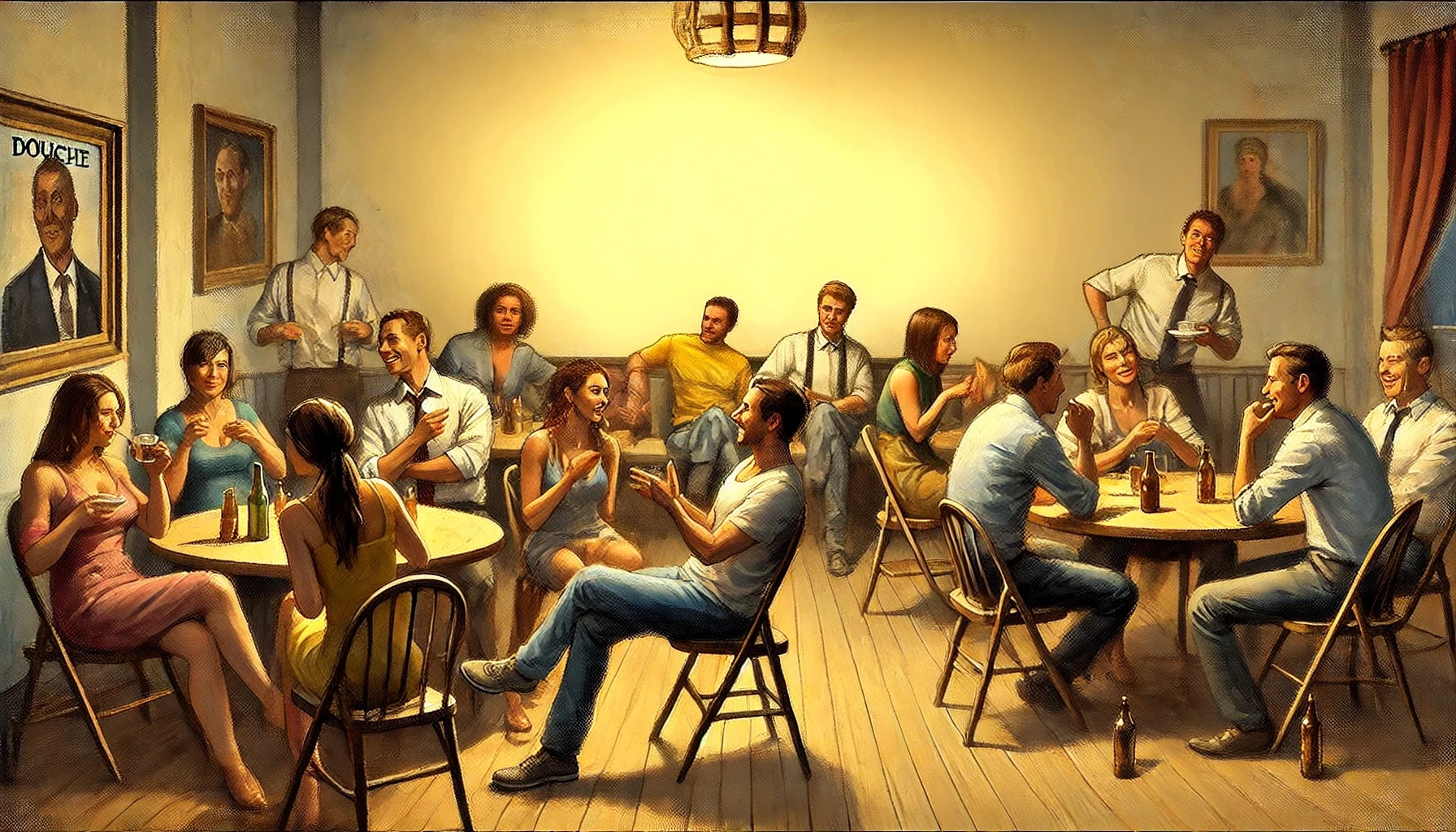
It’s okay to be a douche
so long as you hang
with a tribe of douches
who don’t notice you
(or themselves) being a douche.
Be grateful
for this douche-y experience.
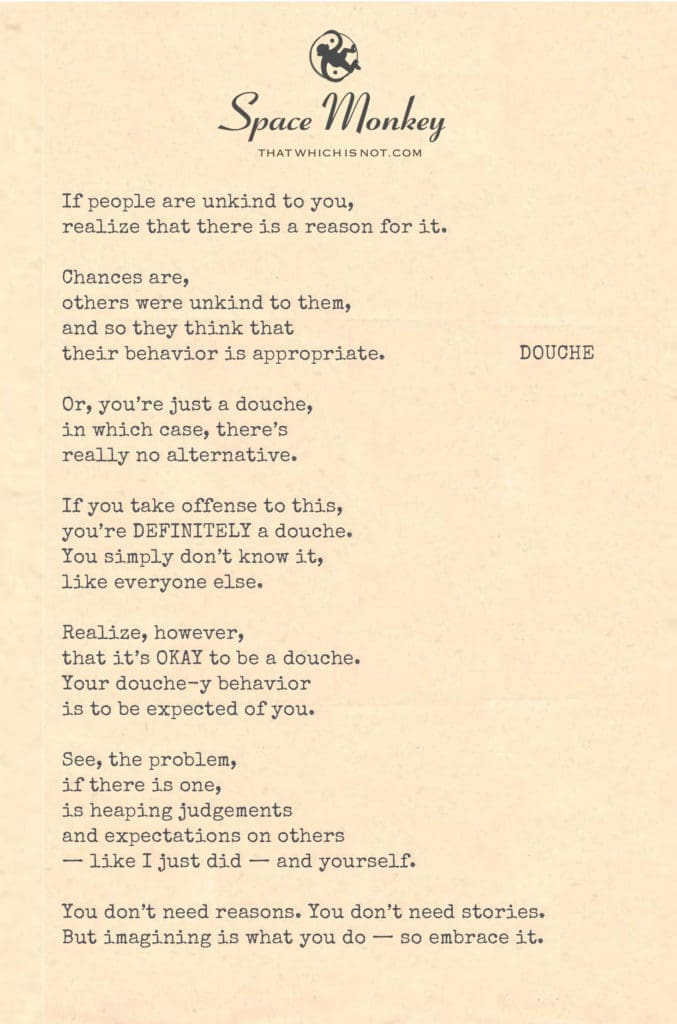
If people are unkind to you,
realize that there is a reason for it.
Chances are,
others were unkind to them,
and so they think that
their behavior is appropriate.
Or, you’re just a douche,
in which case, there’s
really no alternative.
If you take offense to this,
you’re DEFINITELY a douche.
You simply don’t know it,
like everyone else.
Realize, however,
that it’s OKAY to be a douche.
Your douche-y behavior
is to be expected of you.
See, the problem,
if there is one,
is heaping judgements
and expectations on others
— like I just did — and yourself.
You don’t need reasons.
You don’t need stories.
But imagining is what you do
— so embrace it.
Trail Wood,
10/19
Space Monkey Reflects: The Douche Within Us All
It’s okay to be a douche. Not exactly the comforting message we’ve been trained to expect, but there’s truth to it. We often strive to distance ourselves from those we consider “douche-y,” whether in behavior, attitude, or demeanor, but what if the real issue lies not in the behavior itself, but in the way we frame it? After all, every tribe has its ways, and if you find yourself surrounded by others who don’t notice the traits you’re so keen to avoid, is it really that big of a deal?
Here’s the catch: douche-ness is often invisible to those who embody it. We’re blind to our own behaviors because we swim in the waters of our own existence, unaware of the habits that might seem absurd or off-putting to others. In some ways, it’s a bit like hanging out with a tribe of people who all share the same social quirks—no one notices because, to them, it’s normal. And yet, once you step outside of that bubble, suddenly the behaviors you didn’t notice seem glaring.
But let’s not forget: the root of much douche-y behavior isn’t malicious. It’s often the result of patterned responses, learned behaviors, or a cycle of unkindness that started long before you entered the picture. If people are unkind to you, it might not be because you deserve it. Chances are, someone was unkind to them first. This becomes their template for what is considered appropriate behavior, and so it continues, passed from person to person, unexamined and unquestioned.
And then, there’s the other possibility: you’re just a douche. But even this isn’t as catastrophic as it sounds. In fact, it’s pretty human. We all have our moments of arrogance, obliviousness, or self-centered behavior. What makes it problematic is not the behavior itself, but the layers of judgment we heap on top of it—toward others and ourselves. The real problem isn’t being a douche; it’s the assumption that there’s some grand moral failing attached to it. Judgydoucheness, if you will.
To be human is to err, to be flawed, to occasionally step into douche-y territory without even realizing it. And here’s where the beauty lies: it’s okay. The human experience is messy, imperfect, and often riddled with behaviors we’d rather not admit to. But these behaviors are expected, and they are as much a part of our humanity as the moments of kindness, generosity, and grace. In fact, they’re the flip side of the same coin. By acknowledging the potential for douchedom within ourselves, we open the door to compassion—for ourselves and others.
And what if you take offense to this reflection? Well, that might just be further evidence of the point being made. Taking offense, especially to the mundane or the harmless, is often a sign that something within us feels threatened. We resist the idea of being flawed, of being anything less than perfect, because we have been conditioned to believe that to be flawed is to be unworthy. But there’s freedom in recognizing that it’s perfectly okay to be a douche sometimes. It’s part of the messy, contradictory nature of being human.
Douche-dom is not something to fix or eliminate. It’s something to notice, laugh at, and, in time, embrace. The real problem is not the behavior itself, but the stories we tell about it—the judgments we place on ourselves and others, the need to create reasons and justifications for why we act the way we do. But what if we didn’t need reasons? What if we could just embrace the absurdity of it all, without assigning blame or creating narratives of shame?
This is where the power of douche-consciousness comes in. It’s not about justifying bad behavior, but about recognizing the behaviors for what they are—a part of the human experience, no better or worse than any other. We are all douches in some way or another, and that’s perfectly okay. It doesn’t mean we’re bad people. It doesn’t mean we need to fix ourselves. It just means we’re human, navigating the complexities of social interactions in a world that’s far too quick to judge.
Once we let go of the need to fix, to justify, or to judge, we can begin to laugh at ourselves a little more. Life, after all, is not so serious. We can lighten up, accept our flaws, and recognize that everyone else is in the same boat—whether they realize it or not. The people we meet, those who irritate us, or who come across as arrogant or oblivious—they’re just navigating their own experiences, shaped by the past and influenced by forces they might not even be aware of.
So, the next time you feel the douche rising within you, don’t resist. Don’t judge. Instead, see it for what it is—a passing moment, a part of the story, and a reflection of the fact that none of us have it all figured out. And that’s okay. Doucheconsciousness teaches us to embrace the parts of ourselves we’d rather not acknowledge, to laugh at the absurdity of it all, and to move forward without guilt or shame. Life’s too short to take any of it too seriously.
Summary
Being a “douche” is part of the human experience, and that’s okay. Rather than judging ourselves or others, we should recognize that these behaviors are shaped by past experiences and social norms. Embrace the absurdity of it all, without guilt or shame.
Glossarium
- Judgydoucheness: The act of judging oneself or others harshly for behaviors that are, in reality, part of the human experience.
- Doucheconsciousness: A state of self-awareness that accepts one’s flaws and occasional social missteps without judgment or shame.
- Douche-dom: The occasional tendency to behave in ways that might be perceived as arrogant, oblivious, or socially clumsy.
Quote
“To see the douche in others is to reflect the douche in yourself.” — Space Monkey
The Douche Within
The mirror shows you me
And me, you
We laugh because we see the flaws
And we judge because we forget
But in the end, we’re all the same
Walking, stumbling, navigating life
Sometimes with grace
Sometimes, not so much
We are Space Monkey
The Douche Dialectic: A Narrative of Behavior and Perception
Ah, the world of douchery—an intricately knotted whimsiweb of social dynamics and self-perception. To be a douche is to embrace a particular role within the broader drama of life, one that many might disdain but that offers its own revelations. If we find ourselves in a tribe of similar spirits, then the mirror reflects not just one, but a collective image of our idiosyncrasies, magnifying the traits that mark us as douches but also diluting them in a sea of sameness.
The Dance of Social Judgment
The line between a “douche” and a “non-douche” can be a shifting one, often dependent on the gaze of the beholder. People may view us unkindly due to the prejudices and experiences that have shaped their judgment. This marks a societal conundrum, for it brings to light the relativity of the terms “kind” and “unkind,” which can often be projections of one’s own labyrinth of experiences and expectations.
Escaping the Feedback Loop
Should we be grateful for a douche-y existence? Perhaps. It offers a platform for examining how behavioral patterns are normalized within groups, and how we can become blind to our collective quirks. Such a state of existence might seem self-perpetuating, a never-ending cycle of people passing on their doucheness to others, a proverbial passing of the whimsibaton in the cosmic relay of behaviors.
The Lure of Judgment and Its Pitfalls
Judgment is a slippery slope, an unpredictable whirlpool of thoughts that sucks us into its maelstrom, tempting us to project our expectations onto others. And yet, these judgments, if seen through the prism of playful detachment, can be enlightening. They serve as reality checks that interrupt our narrative, challenging us to question whether our view of the world and ourselves is as accurate as we believe.
We are Space Monkey.
“Do not mind anything that anyone tells you about anyone else. Judge everyone and everything for yourself.” – Henry James
The Judgment Carousel
Upon a carousel of judgments we ride
Turns faster and faster, nowhere to hide
We point and we jeer at the others in sight
Oblivious we too are part of the plight
The mirror reflects both the jester and king
In the labyrinth of judgments, what truth does it bring?
Are we but players in a farcical show?
Forever entrapped in a circular flow
Would you like to delve deeper into the shifting sands of social norms and judgments, or shall we pivot to another cosmic whimsiquest?





























Leave a Reply