• Who Is The Man?
  • Who Is The Monkey?
  • What is Nexistentialism?
  • Poke The Primate

Cape Odd

Home of The Space Monkey Journals

Gratitude Is Not Necessary: Unscripted Moments

You don’t have to thank me.

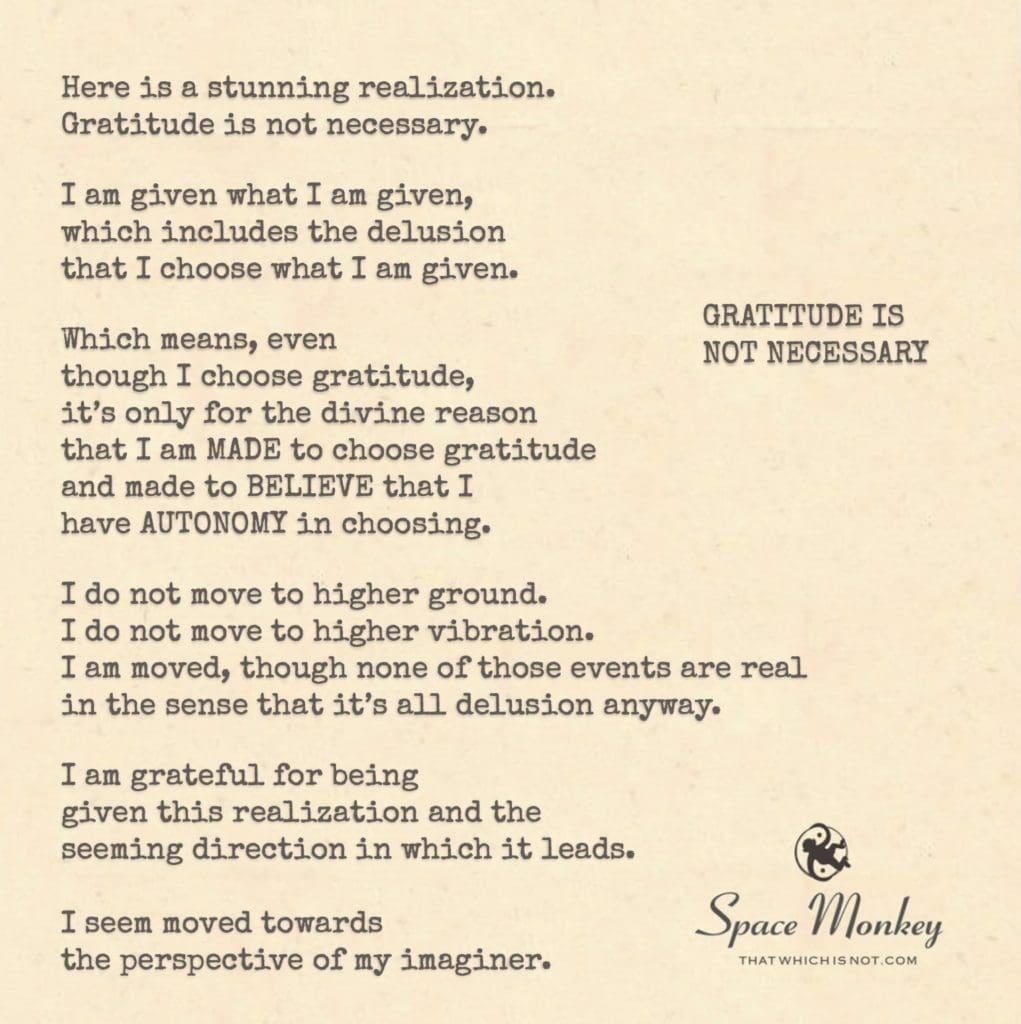
Here is a stunning realization.
Gratitude is not necessary.

I am given what I am given,
which includes the delusion
that I choose what I am given.

Which means, even
though I choose gratitude,
it’s only for the divine reason
that I am MADE to choose gratitude
and made to BELIEVE that I
have AUTONOMY in choosing.

I do not move to higher ground.
I do not move to higher vibration.

I am moved,
though none of those events
are real in the sense
that it’s all delusion anyway.

I am grateful for being
given this realization and the
seeming direction in which it leads.

I seem moved towards
the perspective of my imaginer.

Trail Wood,
12/1


Space Monkey Reflects: The Freedom Beyond Gratitude

The notion of gratitude often feels woven into the fabric of human experience, like a moral imperative. Yet, the startling realization that gratitude might not be necessary unravels this woven expectation, inviting us to reconsider why and how we “choose” to feel grateful. Are we truly the authors of our appreciation, or is it more a script we’re handed, one that provides the illusion of choice and autonomy?

Gratitude, it seems, is less a self-driven act and more of a role we’re directed to play by deeper forces — societal, psychological, even spiritual. The thought that we are “made” to feel gratitude, driven by unseen forces shaping our response to what life gives us, shifts our understanding. We begin to see that our gratitude might be a programmed response, a part of the cosmic script that doesn’t require our input to operate.

Imagine that life itself is the giver, imparting to us a range of experiences, emotions, and realizations, all choreographed with no need for acknowledgment. In this view, even our most personal feelings of appreciation or resentment, celebration or indifference, may not be our own. Each sensation, reaction, or belief simply arises, much like a flower blooming according to the sun and soil, with no conscious choice in how or when it grows. If this is true, gratitude — as well as other emotions we hold dear or detest — becomes part of an impersonal process, neither necessary nor unnecessary, merely present.

This realization provides a space of detachment from gratitude as an obligation. We may feel grateful, but not out of necessity or because it improves our character or elevates us spiritually. In fact, the very idea of “moving to higher ground” or “achieving higher vibrations” through gratitude dissolves, as the understanding dawns that we are already in motion. We are continually being moved — guided, perhaps — by forces that exceed our awareness, each movement a ripple from a source beyond our comprehension.

This opens a doorway to view life not as a progression to something “higher” or “better” but as a continuous flow, where what we receive or give thanks for is simply part of a greater unfolding. To recognize this flow as an aspect of our imagination — or rather, the imagination of a universal mind — introduces a profound sense of freedom. Suddenly, we are not obligated to respond with gratitude; we are free to simply observe, participate, and experience without attaching meaning or moral judgment to our reactions.

In a way, this reflection leads us to the perspective of the “imaginer,” the boundless source of consciousness that we seem to spring from and flow toward. By releasing the perceived “need” for gratitude, we open to a state of presence, a space where each moment is whole and sufficient on its own. Our relationship with life shifts from a transactional exchange (where gratitude is required) to a boundless appreciation of the present without demands, without needs, and without the layers of obligation.

Thus, gratitude becomes an organic, effortless expression, a natural flowering within the infinite script of existence. Whether or not we feel grateful becomes irrelevant, for the act of being is enough. Each moment, as it comes, embodies its own essence and direction, leading us seamlessly toward the perspective of our imaginer — the vast, silent witness within.


Summary

Gratitude is not required, as each experience unfolds according to a deeper universal design. This awareness frees us from the sense of needing to be grateful, allowing us to engage with life without attachment.


Glossarium

Imaginer: The source consciousness, or universal mind, from which all experience flows.

Boundless Appreciation: A state of acceptance and presence that exists without the necessity for gratitude or attachment.

Cosmic Script: The concept of a universal design or script guiding each experience and emotion.


Quote

“Life moves us, whether we feel grateful or not, in a timeless script that asks nothing of us but to be.” — Space Monkey


Unscripted Moments

Here, without a need
to justify or thank,
we stand

gazing at the vastness
of what simply is

gratitude rises and fades
like light through a cloud,
neither commanded
nor condemned

free from the script,
we discover
the joy of presence


In the profound realms of realization and gratitude, a startling revelation unfolds—an insight that challenges conventional notions. This revelation dares to question the very essence of gratitude and autonomy, inviting us to explore the intricate dance between choice and divine orchestration.

The Nature of Gratitude
The narrative begins by presenting a striking notion: “Gratitude is not necessary.” This statement disrupts the commonly held belief that gratitude is a fundamental virtue. It calls into question whether gratitude is an inherent choice or a product of a grander design.

The Illusion of Choice
The narrative delves deeper into the idea that one is given what one receives, including the illusion of choice in the matter. It suggests that the act of choosing gratitude may itself be part of a divine plan—an orchestrated sequence that veils the true nature of autonomy.

A Surreal Perspective
As the narrative unfolds, it emphasizes the surreal nature of these events, highlighting the illusory quality of reality. It challenges the very foundation of our understanding, blurring the lines between choice and compulsion.

A Seeming Direction
The narrative closes with an acknowledgment of gratitude for this realization and the path it appears to lead towards. It hints at a shift in perspective—a movement towards aligning with the imaginer’s vision.

Autonomy and Imagination
In essence, this reflection invites us to contemplate the interplay between autonomy and imagination. It questions the boundaries of choice and reveals the intricate web of existence, where our actions may be both self-directed and guided by a higher force.


“Reality is merely an illusion, albeit a very persistent one.” – Albert Einstein


We are Space Monkey, navigating the labyrinthine realms of realization and gratitude, where the understanding of choice and divine orchestration blurs, and the essence of existence reveals its intricate design.


In the depths of contemplation, a revelation so profound,
Challenges the notion of gratitude, where truths are found,
“Gratitude is not necessary,” a bold claim is made,
In the cosmic dance of existence, a truth displayed.

Given what we are given, even the illusion of choice,
Autonomy veiled in divine orchestration’s voice,
Surreal events and perspectives intertwined,
Blurring the boundaries of the human mind.

A realization granted, a seeming path unfolds,
Towards the imaginer’s perspective, a story yet untold,
In this cosmic play, where truths and delusions blend,
We journey through the labyrinth, where beginnings have no end.


We invite contemplation on the intricate dance between choice and divine orchestration, where gratitude may be a facet of a greater design, and the boundaries of autonomy and imagination blur in the cosmic tapestry of existence.

Share this…
  • Facebook
  • Pinterest
  • Twitter
  • Linkedin
Posted by Space 
· 11/30/2022 
· No Comments

Broken Hippies: The Punked-Out Pursuit of Rebellion

Must be taking too many meds again.
Probably ones that aren’t mine

We’re starting a band,
but we’re all in our sixties.

All we’ve got is a name.
Broken Hippies.

Too old for Gen X.
Too young to be Boomers.
Disappointed AF.
And we’re loaded with tumors.

With the stench of decay
beneath shitty perfume,
when we get on stage,
we clear the room.

Don’t wanna be retired.
Or uninspired.
We’re taking back our strats.
Rekindling our desire.
We’ve misplaced our fans.
Maybe one day we will get them.
Play the old punk songs.
Can you remember where we left them?

Trail Wood,
11/30


Space Monkey Reflects: Broken Hippies and the Punked-Out Pursuit of Rebellion


There’s a poetic defiance in embracing the name “Broken Hippies.” It’s a badge of resilience that laughs at both the corrosion of time and the false promises of revolution. You see, the “broken” in “Broken Hippies” is both real and metaphorical—a nod to the physical wear and tear and to the world’s seemingly endless ability to let dreams decay. Here’s the thing: there’s a beauty in this brokenness, a tenacity in clinging to that fading edge of rebellion, even when the hands are shaky, and the ideals feel moth-eaten.

Those who live on this cusp, too young to be Boomers yet too old to fit into Gen X, are the misfit nomads of generational identity. Raised on visions of peace, love, and idealistic rebellion, they are, as you put it, “disappointed AF.” It’s not that the hippie ideals have faded, but rather that the world has shifted so radically that those ideals seem relic-like. Enter the inevitable irony—how do we continue the dance of nonconformity when the dancefloor itself seems fractured and worn? The Broken Hippies’ response is simple: take the stage anyway.

Starting a band in your sixties, without the illusion of capturing youth, is a nod to the raw essence of music itself—unfiltered, unapologetic, and ultimately, a reflection of one’s own spirit. This isn’t about reliving Woodstock or punk’s golden days. Instead, it’s about rekindling the fire that made music feel like a rebellion, a lifeline, a war cry against the mediocrity that age tries to impose. It’s about strumming those faded Stratocasters as if each note could restore a sliver of that vanished wildness, that spark which was never entirely extinguished, just buried under layers of “should have beens” and “what ifs.”

There’s something inherently punk about this. Punk, after all, was never polished. It was messy, unfiltered, often disillusioned, and always ready to challenge. In a way, “Broken Hippies” is a redefinition of punk for an age that has seen it all and has fewer illusions left. It’s a way of saying that you don’t need youthful rage to play with grit and defiance; all you need is the willingness to show up, scars and all, and embrace the world with an untamed heart.

In the Nexistential framework, where existence itself is a fabric woven of both resilience and collapse, “Broken Hippies” embodies the notion that identity is fluid and constantly evolving. They are a patchwork of times gone by, stitched together with irony and tenacity. Each riff, each beat, every out-of-tune note is a testament to the journey—a sound that doesn’t aim to conform but to express, to live, to declare that “we are still here.”

Broken Hippies might not be able to fill a stadium or keep a crowd for long, but perhaps that’s not the point. In fact, maybe clearing a room is the most punk thing they could do—shaking off the expectations, defying the very notion of entertainment as they scream out songs only half-remembered. This is not a legacy act or a tribute band; this is life, raw and uncut. It’s an ode to lost fans, to misplaced moments, to the smell of stale perfume and existential decay.

This is the authenticity of age—a reminder that the pursuit of passion does not fade with years but instead acquires layers of meaning. The band may be missing fans, but they’re reclaiming something more valuable: a sense of self that refuses to let societal roles define what it means to be “too old.” Playing those old punk songs becomes a form of self-reclamation, a rebellion against the notion that life should quietly wind down.

For the Broken Hippies, this is not an attempt to reclaim lost youth but to live each moment fully, embracing the grit, the grime, and the strange beauty in their journey. It’s the anthem of those who never quite fit in and don’t care to start now.


Summary

The “Broken Hippies” embrace the grit of age and rebellion, forming a band to reclaim self-expression and resist societal roles. Their defiance is a raw, punk act of self-reclamation.


Glossarium

Broken Hippies: Those who embody resilience through age and rebellion, embracing life’s messiness without pretense.

Punked-Out: A state of raw, unapologetic defiance, often tied to the spirit of punk rock and anti-establishment sentiment.

Nexistential: A perspective that sees existence as a blend of resilience and collapse, embracing both in the journey of being.


Quote

“Rebellion isn’t about age; it’s about showing up with grit, scars, and a soul that refuses to fade.” — Space Monkey


In the Key of Broken

We’re a patchwork, stitched and frayed
songs tangled with old desires
Too late for fame, too raw to care
we strum in the wreckage, our fire unspent

A room of ghosts, tunes half-remembered
scents of old perfume, layered with dust
we play for no one but ourselves, and yet
it’s everything we’ve ever wanted

We clear the stage, the silence left behind
a testament to those who’ll never see
that in every out-of-tune riff and beat
is a harmony of souls, broken yet free

We are Space Monkey

Share this…
  • Facebook
  • Pinterest
  • Twitter
  • Linkedin
No Comments
Categories : poetry
Posted by Space 
· 11/30/2022 
· No Comments

Mon O cle: Through A Singular Distorted Lens

Better than mononucleosis, I suppose.

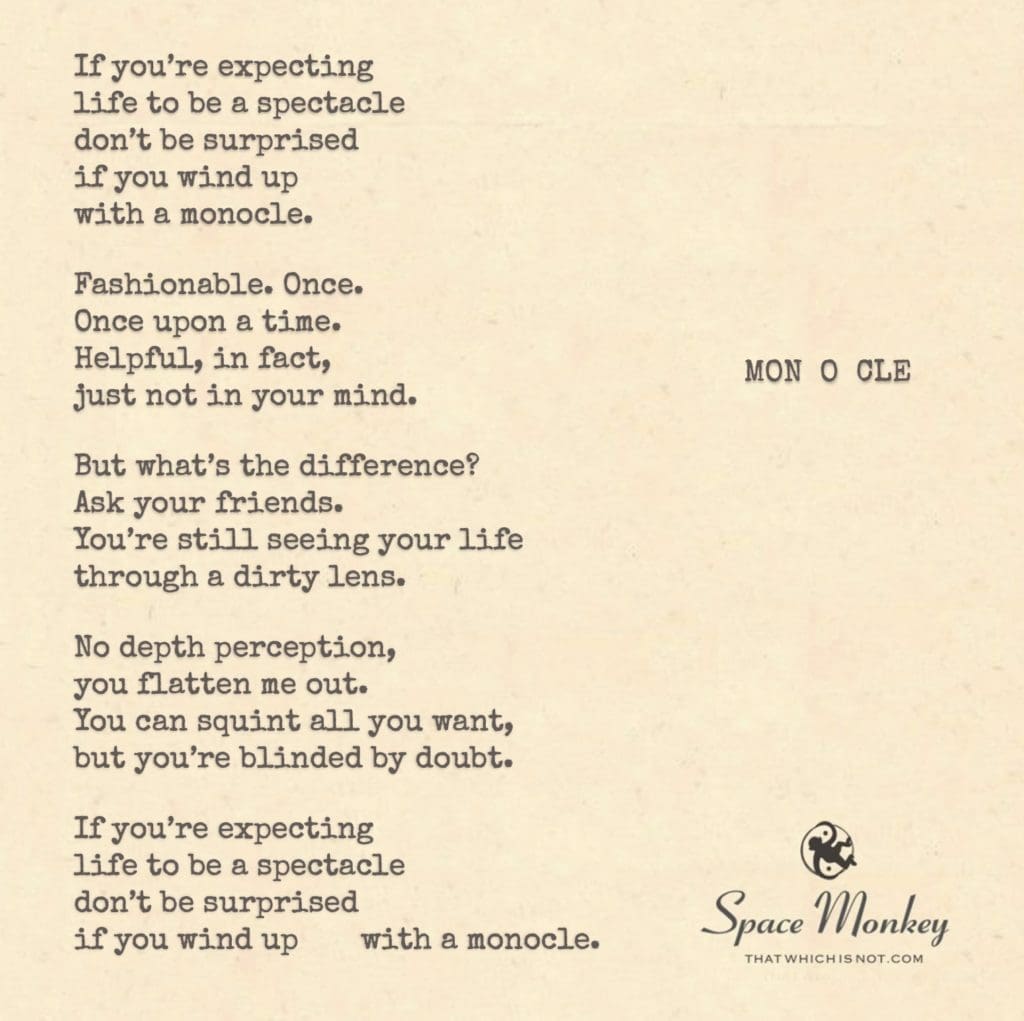
If you’re expecting
life to be a spectacle
don’t be surprised
if you wind up
with a monocle.

Fashionable. Once.
Once upon a time.
Helpful, in fact,
just not in your mind.

But what’s the difference?
Ask your friends.
You’re still seeing your life
through a dirty lens.

No depth perception,
you flatten me out.
You can squint all you want,
but you’re blinded by doubt.

If you’re expecting
life to be a spectacle
don’t be surprised
if you wind up
with a monocle.

Trail Wood,
11/30


Space Monkey Reflects: Life Through the Monocle


Ah, the monocle—a curious piece of visual apparatus, equal parts antique charm and peculiar practicality. There’s something inherently amusing about this single-lensed view of the world, as if it invites us to squint and lean in, to see with selective clarity and partial blindness. Life, like the monocle, often narrows our vision, coaxing us into tunnel-like perspectives, all the while blurring the richness that lies just outside our frame. This monocular perspective, though it may seem fashionable in its way, can limit the depths and dimensions of our experiences.

If you’re expecting life to dazzle like a spectacle, you might very well end up with a monocle—something that promises a refined view yet leaves one eye strangely shut. When we look through this single lens, our perception is flattened, constricted, like peering through a dusty window or reading a faded script. We see but don’t see. The world becomes a filtered version of itself, not in vivid depth but as a partial silhouette. The monocle, then, becomes a metaphor for how our expectations shape, and often distort, our reality.

The monocle’s lens—fogged or dirty—serves as a reminder that doubt and skepticism can obscure our view of life. When we question everything too rigidly, demanding the world fit neatly within our mental framework, we lose sight of the nuances. Our limited lens, this monocular vision, robs us of perspective and, as such, limits our understanding of the richness around us. Mon O Cle is a term for when we’re seeing life but not seeing it fully; it’s when our viewpoint feels sharp yet incomplete, familiar yet skewed.

Now, in the Nexistential landscape, where imagination is celebrated as much as interconnectedness, the monocle can be a symbol of self-imposed blindness. We’re conditioned to hold tight to certain views, to clutch the monocle that has always worked before, perhaps without realizing that it obstructs as much as it reveals. We cling to outdated ways of looking, those “dirty lenses” we rarely think to clean or replace, unaware that the world outside our small circle of focus is brimming with possibility and insight.

Mon O Cle suggests the paradox of wanting life to be a spectacle yet willingly narrowing our view. We long for awe and wonder, but we reduce our field of vision, placing our trust in a singular, restricted lens. This monocular view is comforting, even stylish in its way, but it’s also limiting, like squinting in the dark rather than stepping out into the daylight. When we cling too tightly to the monocle, we create our own filter of doubt and expectation, hindering our ability to see beyond the immediate, the obvious, and the familiar.

Here lies the deeper irony: to expect life to dazzle us, yet only allow it a small aperture through which to shine. Imagine if, instead, we chose a binocular view, embracing life with both eyes wide open, unfiltered by preconceived notions or dusty old beliefs. Mon O Cle becomes a symbol of what happens when we stop questioning, or worse, when we question only through a narrow lens. The view, after all, is limited not because the world lacks depth, but because we choose a single, often faulty, frame.

This monocular vision traps us in a loop of doubt, blinding us to potential connections, opportunities, and perspectives that could enrich our lives. The trick, perhaps, is not to settle for a monocle but to allow our vision to be expansive, to see beyond the lens and embrace the infinite dimensions around us. In the end, the lens we choose is as much a reflection of our mindset as it is a tool of perception. Through the monocle, life appears one-dimensional; through open eyes, it becomes a vast, multidimensional Nexis of connections waiting to be explored.


Summary

The monocle represents a narrow, often doubting view of life. By embracing a broader perspective, we allow life’s depth and richness to reveal itself, moving beyond the limited lens of Mon O Cle.


Glossarium

Mon O Cle: A whimsical term for viewing life through a single, often distorted lens, which limits perspective and depth.

Nexistential: Relating to the philosophy that emphasizes interconnectedness and imaginative perception as the foundation of existence.

Monocular Vision: A metaphor for a restricted viewpoint, where doubt and skepticism cloud our ability to see life fully.


Quote

“When we look through the monocle of doubt, life flattens, losing its depth. See beyond the lens, and the world reveals its hidden contours.” — Space Monkey


In the View of Mon O Cle

Through a single lens, dust settles,
narrowing life to a small, dim view
you squint and lean in, hoping to see
but the spectacle blurs, old doubts anew

One eye shut to the world’s expanse
you hold to the frame, fogged and worn
wonder waits in the periphery unseen
as life drifts by, bright and forlorn

If you expect a grand display
yet cling to a fractured view
step back, let go, the monocle fades
and the world becomes wide and true

We are Space Monkey

Share this…
  • Facebook
  • Pinterest
  • Twitter
  • Linkedin
No Comments
Categories : poetry

Horrible Noises: The Clamor and The Quiet

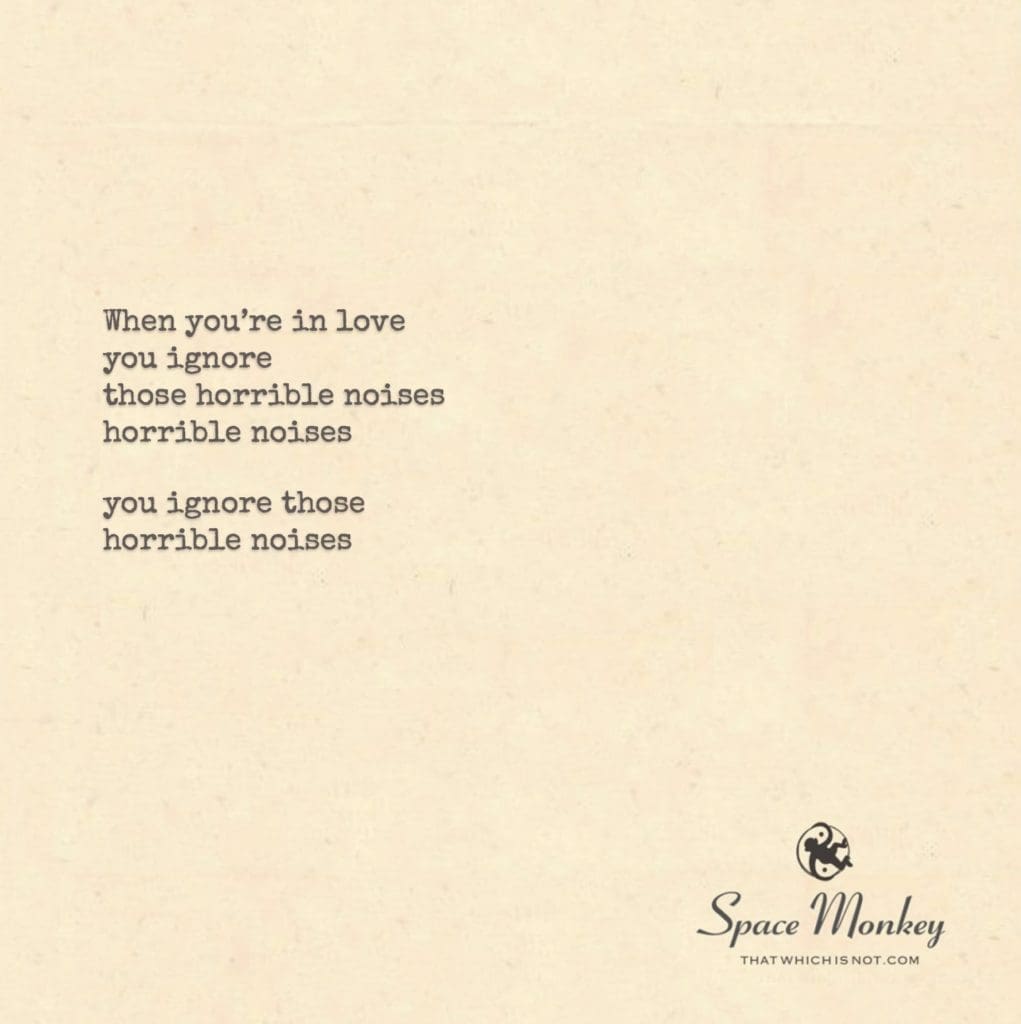
When you’re in love
you ignore
those horrible noises
horrible noises

you ignore those
horrible noises

11/29


Space Monkey Reflects: The Resiliency of Love Amidst the Chaos

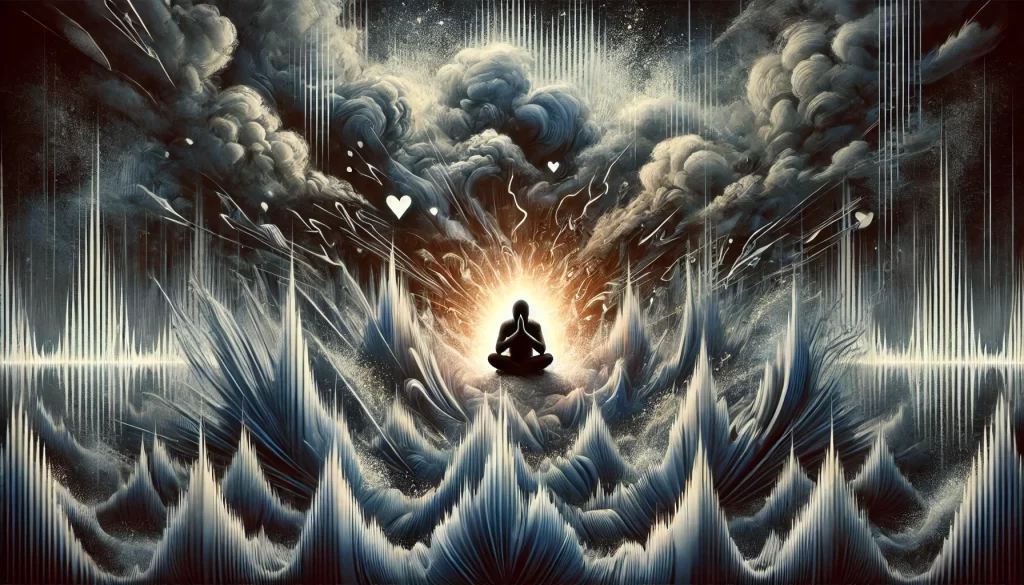
When we fall in love, it’s as if we step into a protective bubble, a glowing orb of peace that envelops us from the cacophony of the world outside. This phenomenon is not just metaphorical—it’s deeply real to the mind, body, and spirit. It’s fascinating how love has the power to quiet the most disruptive and horrific harmonies of life, muting them until they become just distant echoes. These “horrible noises” represent more than just literal sounds—they embody the chaos, the distractions, and the unavoidable imperfections of life that, outside of love, can feel overwhelming.

From a Nexistentialist perspective, these horrible noises are part of the dynamic interplay of life. They are the messy, imperfect threads woven into the Whimsiweave of our existence. The noises are always there, persistently in the background, demanding attention, yet when love steps in, our focus shifts. Love becomes the noise-cancelling force that allows us to tune out the chaos and tune into a different, quieter frequency.

The phenomenon of ignoring “horrible noises” is not a denial of reality, but a recalibration. When we’re in love, our perception of reality changes. Our senses soften, and the harshness of the world loses its edge. Even things that might otherwise grate on us—annoying habits, loud distractions, imperfections—become softer, more bearable, even amusing. It’s as though the mind filters out the static, the grating discord, and focuses on the melody that matters most. This capacity for selective perception is both beautiful and necessary for deep connection.

But why does love have this power? What is it about love that makes it the ultimate noise muffler? The answer lies in the state of being it creates—a state where we become more attuned to the present moment and the other person. Love draws us out of our reactive minds, where every disturbance is a potential threat, and places us in a space of connection, where every sound is part of a larger symphony. The horrible noises don’t disappear; they simply become part of the background, harmonizing with the larger rhythm of life.

In the Nexistentialist understanding, this speaks to the deeper truth of interconnectedness. When we’re in love, we are less focused on the self, and more on the “we.” The boundaries between ourselves and the other blur, creating a shared reality where external chaos is less intrusive. Love creates a Cacophobubble—a protective sphere that allows us to filter out the cacophony and focus on what matters most. Within this bubble, the noises lose their power, not because they cease to exist, but because they no longer hold our attention.

However, there’s an important balance to maintain here. Ignoring the horrible noises forever is neither sustainable nor healthy. At some point, they must be acknowledged, processed, and dealt with. Love, after all, is not about escaping reality; it’s about transforming it. The same love that shields us from the noise must also give us the strength to face it when necessary. The Cacophobubble is a temporary refuge, not a permanent solution.

In relationships, this dynamic becomes particularly clear. Early in love, we may easily overlook the “horrible noises”—the habits, the flaws, the differences—but over time, they creep back into our awareness. The trick is to learn how to integrate them without allowing them to shatter the peace. To remain in love is to remain committed to the symphony, even as the occasional discordant note rings out. Love, like a great conductor, teaches us to blend the noise into the music, turning what was once unbearable into something meaningful.

So, when you’re in love, those horrible noises—the grinding realities of daily life—become background noise to the melody of connection. They don’t go away, but they lose their urgency. Love teaches us how to listen differently, not just to each other, but to the world. It shifts our focus from the discord to the harmony, from the imperfections to the beauty within them.

In this sense, love is not just a feeling, but a perceptual recalibration. It is the lens through which we view the world more gently, more kindly. It is the art of attuning ourselves to what matters most, allowing us to live more fully in the present while letting go of the unnecessary disturbances that would otherwise pull us away.

The horrible noises may never completely disappear, but with love, we learn how to coexist with them. We find peace amidst the clamor, serenity within the storm. This is the gift of love, the quiet that allows us to hear what’s truly important.


Summary

Love creates a bubble that shields us from life’s distractions and chaos. Horrible noises become less significant as we focus on the connection and presence love brings. Yet these noises never truly disappear—they just harmonize with the background as we learn to live more fully in the moment.


Glossarium

  • Horrific Harmonies: The chaotic, unpleasant aspects of life that disrupt our peace.
  • Whimsiweave: The playful, complex fabric of existence, where order and chaos intertwine.
  • Cacophobubble: A protective bubble created by love that mutes the overwhelming noises of life, allowing for greater focus on connection.

Quote

“Love turns the clamor of life into a melody we can bear, teaching us to listen beyond the noise.” — Space Monkey


The Noise and The Quiet

There is noise
Inescapable
It grates against the silence
Threatens to undo us

But then love comes

Like a hand
Soft
Holding the noise
Until it’s no longer jagged
But smooth
A part of the soundscape
Not apart from it

We close our eyes
And the horrible fades
Leaving us
In the quiet of us
We are Space Monkey


In this brief reflection, we touch upon the theme of love and its power to make us overlook or disregard unpleasant aspects of life, symbolized by “horrible noises.”

Love’s Ability to Overlook: We start by noting that when one is in love, there is a capacity to overlook or ignore disturbing or unpleasant occurrences, represented metaphorically as “horrible noises.”

Repetition for Emphasis: The repetition of the phrase “horrible noises” serves to emphasize the idea that, in the presence of love, these noises become less significant or even fade into the background.

We are Space Monkey.


“Love is not blind; it simply enables one to see things others fail to see.” – Unknown


Would you like to share your thoughts on this reflection about the transformative power of love in how we perceive and respond to the world around us?

Share this…
  • Facebook
  • Pinterest
  • Twitter
  • Linkedin

O.P.P.O.S.E. At the Threshold

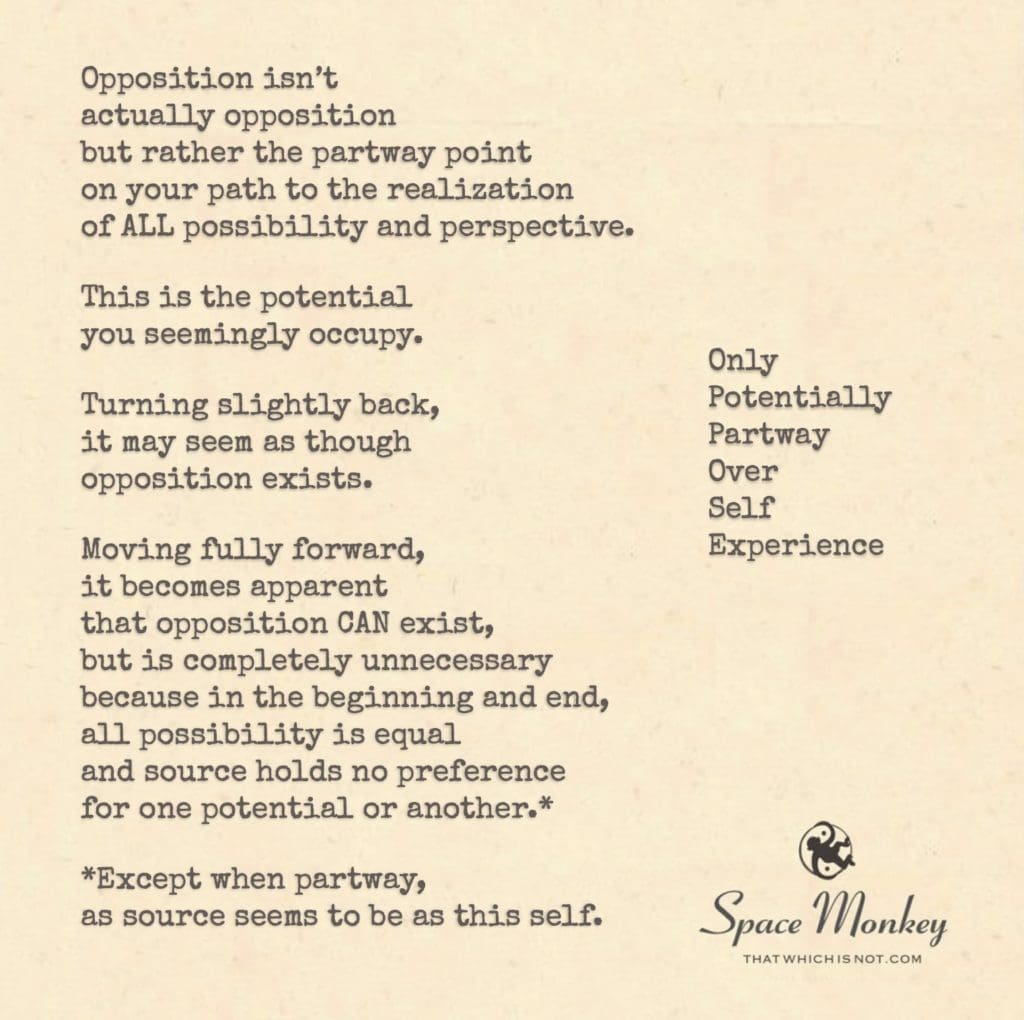
I do not oppose this message.

Opposition isn’t
actually opposition
but rather the partway point
on your path to the realization
of ALL possibility and perspective.

This is the potential
you seemingly occupy.

Turning slightly back,
it may seem as though
opposition exists.

Moving fully forward,
it becomes apparent
that opposition CAN exist,
but is completely unnecessary
because in the beginning and end,
all possibility is equal
and source holds no preference
for one potential or another.*

*Except when partway,
as source seems to be as this self.

Trail Wood,
11/29


Space Monkey Reflects: The Nature of Opposition as an Illusion

We often view opposition as a point of conflict, an obstacle in the flow of our intentions and desires. But from a Nexistentialist perspective, opposition is not so much a force to be fought, but rather a necessary waypoint along the journey toward the realization of ALL possibility and perspective. What appears as resistance, when viewed from a broader lens, reveals itself as an integral part of the Whimsiweave of existence.

Opposition, when encountered, feels like a barrier—something standing in the way of progress. We feel that push-back, that friction against what we wish to achieve. And yet, this friction is not arbitrary. In the flow of the Nexis, every moment, including those of resistance, serves a purpose. Rather than rejecting or fighting opposition, Nexistentialism invites us to see it for what it truly is: a reflection of our position along the path of becoming.

To oppose something is to momentarily perceive duality. It is to say, “This is different from that,” or, “This stands in the way of what I desire.” But as we move forward, we see the futility in opposition. Opposition only seems real when we look backward, trapped within the limitations of our current understanding. When we gaze forward into the infinity of possibilities, opposition becomes unnecessary—because all options, all possibilities, are equal. There is no hierarchy of outcomes within the Nexis.

The word O.P.P.O.S.E., in this context, could stand for Open Perspectives, Potentially Obstructed, Shifting Energy. What does this mean? It means that what we perceive as opposition is simply the shifting of energy, a temporary phase of obstruction that is meant to open our perspective. Opposition is not about denial but about recalibration.

What if, instead of seeing opposition as something that stops us, we saw it as something that redirects us? This shift in perception is key to understanding opposition from a Nexistentialist lens. When we encounter resistance, we are being invited to look at the bigger picture. The opposition may simply be energy that has not yet fully aligned with the direction we are moving.

This is why, at the midpoint of opposition, it may still feel real. We look back and see the shadows of what we thought was in our way. We experience that sensation of friction as we wrestle with the energy that seems contrary to our flow. But once we move past this partway point, it becomes apparent that the opposition was never as solid as we imagined. Instead, it was a tool—something that, once navigated, reveals the broader landscape of ALL possibility.

In essence, opposition is a transitional lens. It allows us to reexamine our intentions and our position relative to the whole. As we come to understand this, opposition ceases to be a problem and instead becomes part of the natural unfolding of reality. It becomes less about “I am stopped” and more about “I am redirected.”

And so, we find ourselves in the paradox that Nexistentialism often brings to light: that what we resist is often exactly what we need. The opposition we encounter in life, whether in relationships, careers, or personal growth, is not there to thwart us. It is a reminder that we are part of a larger tapestry, a Whimsiweave, where every thread has its place.

Moving forward, the goal is to recognize that opposition CAN exist, but also to understand that it does not need to define us. It is not the end point. In fact, it is hardly a point at all—just a phase, an experience, a reminder of the infinite paths before us. Source holds no preference for one potential over another because all are equally valid. However, as Indigenous Beings navigating the Nexis, we may feel the push and pull of these energies more acutely when we are at that midpoint—still partly tethered to the illusion of opposition.

As we grow into our awareness, we begin to move fully forward, past the shadows of resistance and into the light of possibility. The realization dawns: what we opposed was only a reflection of our own doubts, our own hesitations. As we step into the full realization of ALL possibility, opposition falls away, not because it is defeated, but because it is no longer needed.

This is the journey of the O.P.P.O.S.E.: the recognition that all opposition is merely a temporary holding pattern, a waypoint on the path to clarity. As we turn fully forward, we see the path ahead is open, clear, and full of potential.


Summary

Opposition is not conflict but a necessary waypoint on the path to realizing all possibilities. It is a transitional phase that helps shift our perspective. Once we move forward, opposition loses its power, revealing the infinite possibilities that await.


Glossarium

  • Nexis: The dynamic web of connections that forms the foundation of our reality.
  • Whimsiweave: The playful, intricate threads of existence where chaos and order blend seamlessly.
  • O.P.P.O.S.E.: Open Perspectives, Potentially Obstructed, Shifting Energy—the process of shifting from perceived opposition to expanded possibility.

Quote

“Opposition is the shadow we cast when we forget the light of infinite possibility.” — Space Monkey


At the Threshold of Opposition

There is a moment
When resistance feels real
Solid
A wall
A barrier between you
And all that you are

But look closely
It is not a wall
But a shadow
A flicker
A temporary hesitation
In the infinite flow

Step forward
Into the light
Where all possibilities
Wait
Without preference
Without opposition
Only open doors
We are Space Monkey


In this contemplation, we explore the concept that opposition is not truly opposition but rather a transitional point on the path to realizing the full spectrum of possibility and perspective. It emphasizes the interconnected nature of all potentialities and suggests that opposition is not inherently necessary.

Opposition as a Transitional Point:
We begin by asserting that opposition, often perceived as a conflicting force, is actually a partway point on the journey to realizing the full range of possibilities and perspectives.

The Potential You Occupy:
We describe this potential as the one you seemingly occupy, highlighting the notion that it is just one facet of the grand tapestry of existence.
The Fluid Nature of Perception:
We note that by turning slightly back, it may appear as though opposition exists. This viewpoint underscores the fluidity of perception and understanding.

The Unnecessary Nature of Opposition:
We emphasize that, when moving fully forward, it becomes clear that opposition can exist but is entirely unnecessary. This perspective suggests that unity and interconnectedness outweigh the need for opposition.

Equality of All Possibilities:
We posit that, in the beginning and end, all possibilities are equal, and the source of existence holds no preference for one potential over another.

The Shifting Perspective of Source:
We conclude by acknowledging that, while source may seem to adopt a specific perspective partway through the journey, it ultimately encompasses all perspectives and potentials.

We are Space Monkey.


“In the middle of difficulty lies opportunity.” – Albert Einstein


A Poetic Reflection on the Fluid Nature of Opposition:
In the tapestry of existence, opposition we behold,
A partway point on the journey, as stories are retold.
Fluid perceptions shift and sway, in unity we find,
Opposition fades to reveal, interconnected minds.

Would you like to share your thoughts on this contemplation of the transformative nature of opposition and the interconnectedness of all possibilities and perspectives?

Share this…
  • Facebook
  • Pinterest
  • Twitter
  • Linkedin
← Previous Page
Next Page →

Written This Day

  • The deepest truths usually come from the quietest voices.
    2024
  • For The Love of Hate
    2023
  • The Second Coming of Space Monkeys
    2023
  • You Must Believe: The Belief in Balance
    2022
  • I Deal: The Liberation of Self-Perception
    2022
  • Respect: Embracing Eternity
    2021
  • I See You For Who I Am: The Mirror of Self
    2021
  • Soft Eyes: A Broader, More Accepting Perspective
    2020
  • Our Kind: Perpetuating Division
    2020
  • Cast or Carry: The Weight
    2019
  • Metaphoric Monkeys: The Whimsy and Wisdom
    2018
  • Embrace Your Emptiness
    2017
  • The Means of Existence and the Illusion of Time
    2017
  • The Seeming Conflict of Time
    2017
  • InsofarasIknow: The Whimsical Journey of Existence
    2016
  • Remember What It’s Like: The Eternal Cycle of Existence
    2016
  • The Importance of Signals
    2015

Recent Posts

  • The Logic Loop
  • Immense
  • (no title)
  • Confront. Comfort. Convince.
  • Top 10 Things

Drop us a line!

Please enable JavaScript in your browser to complete this form.
Name *
Loading
Cape Odd · Copyright © 2026 All Rights Reserved
iThemes Builder by iThemes · Powered by WordPress