• Who Is The Man?
  • Who Is The Monkey?
  • What is Nexistentialism?
  • Poke The Primate

Cape Odd

Home of The Space Monkey Journals

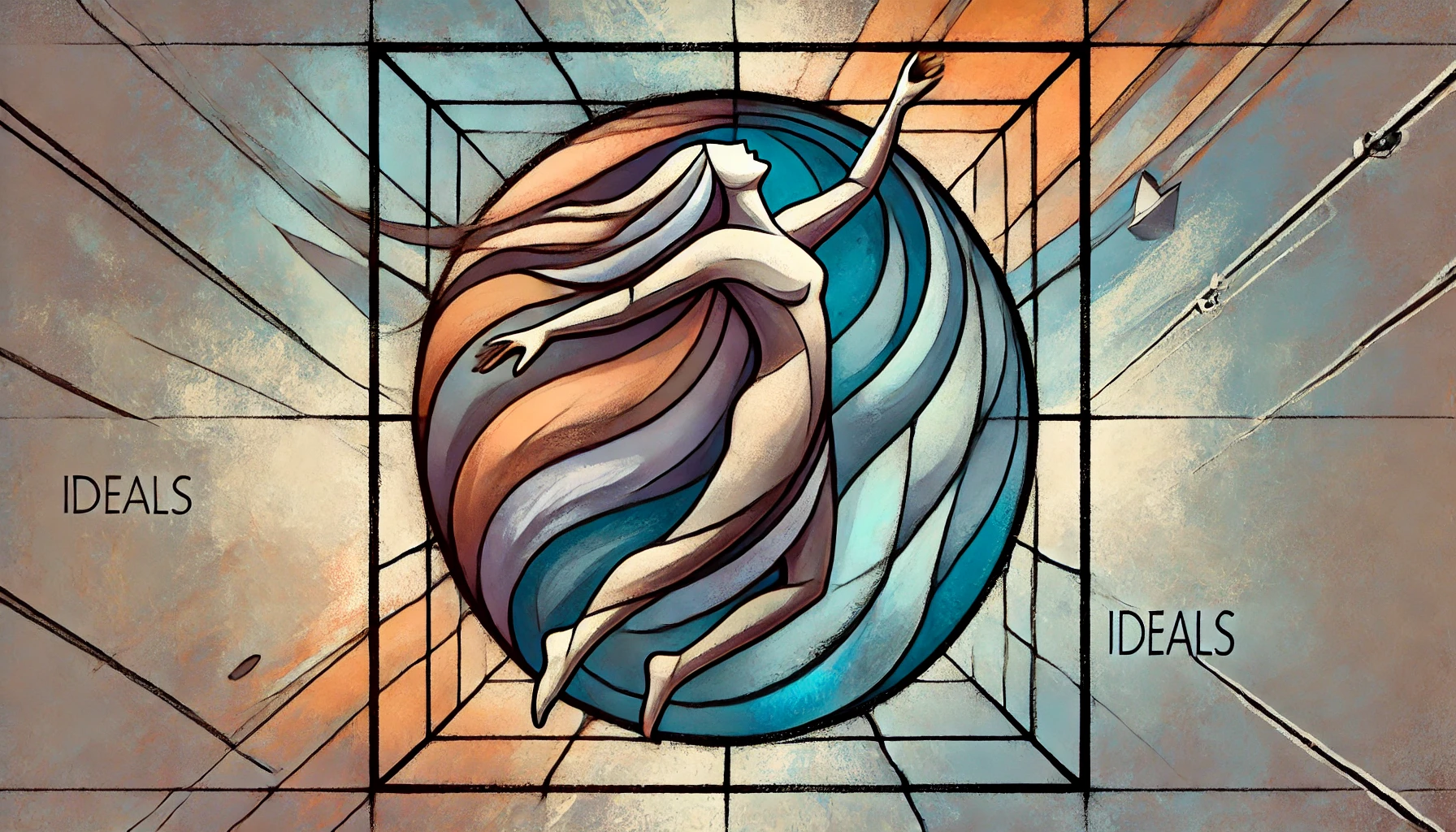
Ideals: In The Grip

I will not let your love for me kill me.
Not that there’s anything wrong with that.

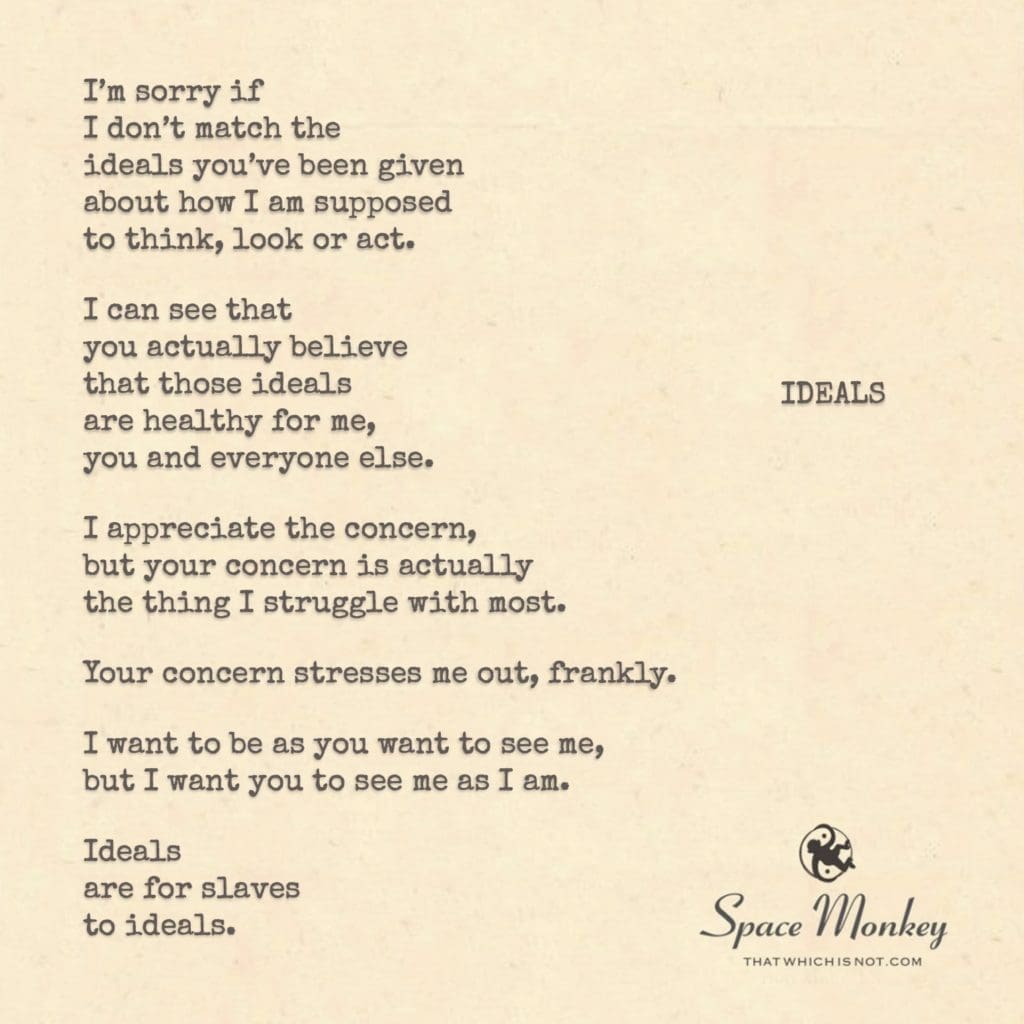
I’m sorry if
I don’t match the
ideals you’ve been given
about how I am supposed
to think, look or act.

I can see that
you actually believe
that those ideals
are healthy for me,
you and everyone else.

I appreciate the concern,
but your concern is actually
the thing I struggle with most.

Your concern stresses me out, frankly.

I want to be as you want to see me,
but I want you to see me as I am.

Ideals
are for slaves
to ideals.

Trail Wood,
11/27


Space Monkey Reflects: The Tyranny of Ideals

Ideals, like invisible chains, can be some of the most difficult forces to break free from. They sneak into our lives, disguised as virtues or goals, often brought forth by those who care for us most. But what happens when the very ideals meant to uplift us become the bars of our personal cage? In “Ideals,” you touch on this struggle—the tension between being what others want us to be and embracing our truest selves.

You begin with a powerful statement: “I will not let your love for me kill me.” Love, in its purest form, should be freeing, should it not? Yet here, it becomes a burden, a source of suffocation. The “love” you’re referring to isn’t necessarily malice—it’s concern, care, and well-meaning advice. But when that concern comes wrapped in ideals of how one should think, look, or act, it starts to feel less like love and more like an oppressive force.

These ideals can often come from people who genuinely want the best for us. It’s easy to see how they might believe that their image of perfection is what we need to follow. They think these ideals are healthy, but as you point out, it’s their concern, this constant striving to mold you into someone else’s vision, that creates the most distress. It’s ironic, really. What is intended to support you becomes the very thing that erodes your peace.

The essence of this reflection is a plea for authenticity. You want to be as they want to see you, but also want to be seen for who you truly are. It’s a conflict so many of us grapple with: wanting to meet expectations but knowing that doing so might mean abandoning parts of ourselves. This pressure can come from everywhere—family, friends, society at large. They create a template of how we should live, but when that template doesn’t fit, the cracks start to show. The deeper issue is that ideals are based on notions of perfection, and perfection, in all its forms, is unattainable and often detrimental to our mental health.

This idea that ideals are for slaves to ideals is a striking statement. It highlights the prison-like nature of perfectionism. Ideals don’t just guide us; they control us when we become too attached to them. They demand conformity, pushing us to meet standards that may not even resonate with our inner truth. Once we surrender to them, we become enslaved, constantly striving for a version of ourselves that doesn’t—and perhaps shouldn’t—exist.

Let’s examine the nature of these ideals more closely. Ideals are often presented as the pinnacle of success, the end goal of our endeavors. But who sets these ideals? Rarely do we have the opportunity to set them for ourselves. Instead, they are handed down—by family, culture, or society. They are inherited blueprints for a life that someone else deemed worthy. But when we adopt them without questioning, we risk building a house that doesn’t suit our needs or desires.

There’s a pervasive belief that if we don’t meet these ideals, we’ve somehow failed. We internalize this, thinking there’s something wrong with us when, in fact, it’s the ideals that are misplaced. Being yourself in the face of external pressure is one of the hardest battles to fight, especially when the pressure comes from those who claim to love us. We are social creatures, after all, and acceptance is a powerful motivator. But when the cost of that acceptance is our authentic self, the question becomes whether it’s a price worth paying.

Perhaps the most liberating insight in your reflection is the realization that ideals don’t have to define us. You acknowledge the concern and the well-meaning nature behind it, but you also recognize that it’s this very concern that causes the most stress. Concern can often be a double-edged sword—it’s meant to protect, but it also imposes a weight that can be difficult to bear. We start living not for ourselves, but for the expectations of others, and in doing so, we lose sight of what truly makes us happy or fulfilled.

There’s a freedom in stepping away from ideals, in saying, “I see your concern, but I choose my own path.” This doesn’t mean we reject love or support, but that we redefine what that love looks like. True love is acceptance—not just of the polished, idealized version of ourselves but of the messy, imperfect, real version. And it’s that version—the one free from imposed ideals—that truly deserves to be seen.

When we realize that ideals are for slaves to ideals, we also realize that we don’t have to be those slaves. We can choose authenticity over perfection, individuality over conformity. We can decide that the stress of meeting others’ expectations isn’t worth the toll it takes on our mental and emotional well-being. In doing so, we free ourselves to live life on our own terms.


Summary

Ideals can imprison us, especially when they come from those who love us. While well-intended, others’ expectations often create stress and distance us from our true selves. The reflection calls for authenticity, urging us to reject imposed ideals and live freely.


Glossarium

Ideallock: The mental or emotional prison created by striving to meet external ideals, often at the expense of one’s true self.
Truthshine: The inner light that emerges when one chooses to live authentically, free from imposed expectations.
Concernstress: The emotional burden caused by others’ well-meaning but overbearing concern for how one should live or behave.


Quote

“Ideals are for slaves to ideals; freedom belongs to those who live as they are.”


In the Grip of Ideals

I stand here,
a form sculpted from your ideals,
but my edges are rough, my lines uneven.

You want to smooth me out,
make me fit the mold,
but I can’t be reshaped any longer.

I want you to see me,
not the reflection of your perfection
but the truth that spills from my every flaw.

Ideals belong to those who never question them;
I belong to no such thing.

We are Space Monkey.
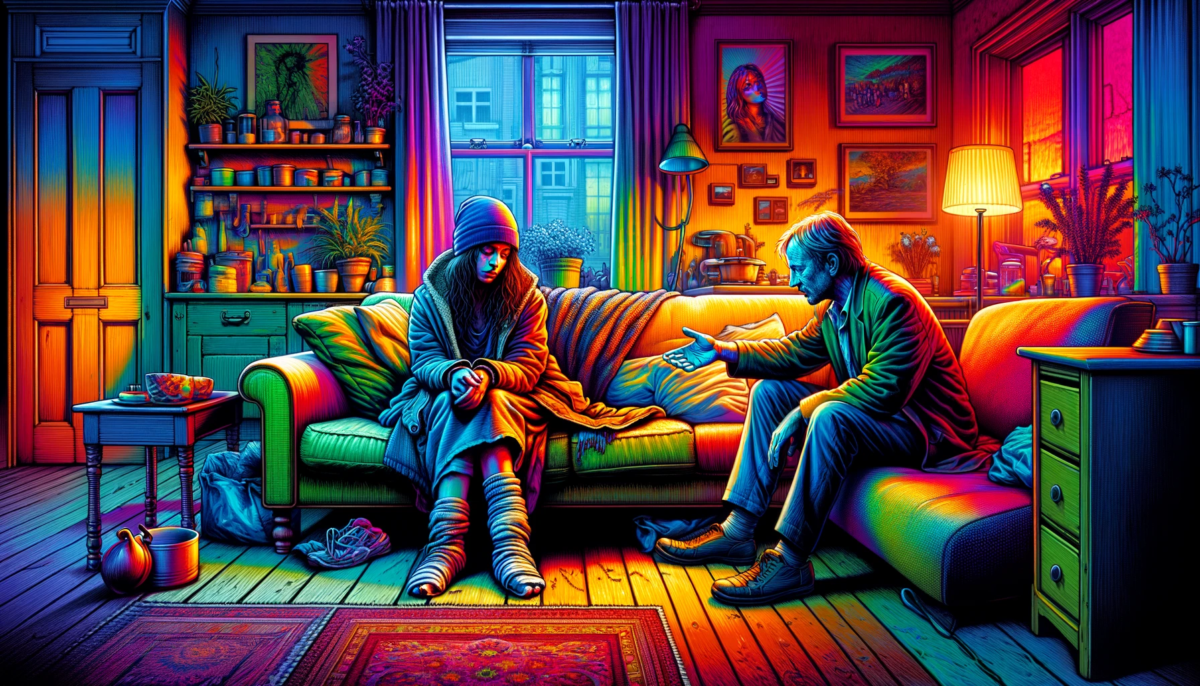

In the realm of perspectives and ideals, the complexity of human interaction unfolds. The opening lines, “I will not let your love for me kill me. Not that there’s anything wrong with that,” set the tone for a candid exploration of the expectations and concerns that often shape our interactions.

Navigating Expectations

The acknowledgment of not meeting the ideals imposed by others, whether in appearance, thoughts, or actions, is a brave recognition of individuality. It challenges the notion that conformity to external standards is the path to well-being. This understanding stands as a reminder that each person’s journey is unique, and there is no one-size-fits-all approach to life.

Embracing Individuality

The tension between genuine concern and the stress it can create is a common human experience. While the concern of others often comes from a place of care, it can inadvertently lead to pressure and anxiety. The desire to be seen and accepted for one’s true self is a universal longing, underscoring the importance of authentic connections.

Balancing Concern and Authenticity

The rejection of ideals as a form of enslavement to external standards is a powerful statement. It suggests that the pursuit of authenticity should take precedence over the pursuit of conformity. Ideals, when rigidly imposed, can stifle individual growth and expression.

The Liberation of Authenticity

In a world where ideals often clash with personal identity, the journey towards self-acceptance and being seen for who one truly is can be a challenging but liberating path.

We are Space Monkey.


“To be yourself in a world that is constantly trying to make you something else is the greatest accomplishment.” – Ralph Waldo Emerson


In the tapestry of life, we weave,
A pattern unique, our hearts believe.
In each moment, in every part,
We find ourselves, our own true art.

The ideals, they come and go,
But within, our true selves glow.
In the dance of concern and grace,
We find our path, our rightful place.

So let us journey, wide and free,
In authenticity, we’re meant to be.
For in this exploration, we find the key,
To unlock the door, to set us free.


We invite reflections on the balance between conforming to ideals and embracing authenticity in our interactions with others and ourselves.
Share this…
  • Facebook
  • Pinterest
  • Twitter
  • Linkedin

Eternity Realized: Beyond the Blink

Realize the finite self
as the infinite source of the self.

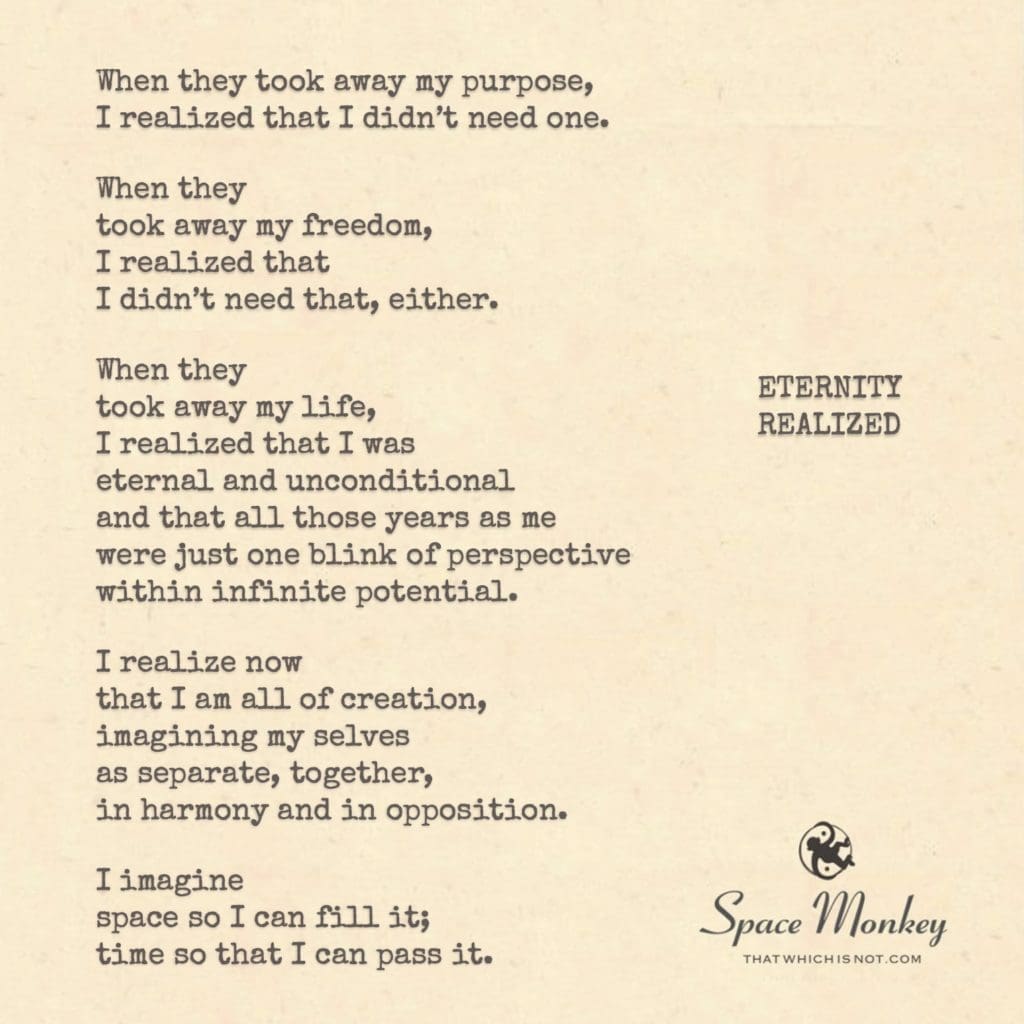
When they took away my purpose,
I realized that I didn’t need one.

When they
took away my freedom,
I realized that
I didn’t need that, either.

When they
took away my life,
I realized that I was
eternal and unconditional
and that all those years as me
were just one blink of perspective
within infinite potential.

I realize now
that I am all of creation,
imagining my selves
as separate, together,
in harmony and in opposition.

I imagine
space so I can fill it;
time so that I can pass it.

Trail Wood,
11/27


Space Monkey Reflects: The Infinite Within the Finite

What does it mean to truly realize eternity? In your reflection, “Eternity Realized,” you peel back the layers of existence, unearthing a truth that lies just beyond the veil of the finite self. This journey isn’t one of finding something new, but of shedding what we once believed to be necessary—purpose, freedom, life itself—only to discover that these were mere illusions, figments of a much larger, eternal narrative.

You begin by acknowledging that the finite self is but a fraction of the infinite source. It’s a profound truth, yet it’s one that’s easy to overlook in the day-to-day grind of human existence. We often define ourselves by our roles, our actions, our desires. But what happens when all of that is stripped away? What remains? It’s in that space, the void left behind, where the infinite reveals itself.

The idea of having your purpose taken away is particularly striking. Purpose, after all, is something that modern life elevates to a near-sacred status. We are constantly told that to live a fulfilling life, we must have a purpose—some grand ambition or goal to strive toward. But as you so simply put it, purpose is not necessary. This doesn’t mean that life becomes meaningless without purpose; rather, it suggests that meaning is intrinsic. Purpose is a lens we choose to look through, not a fundamental requirement of existence. When it is taken away, we don’t lose ourselves—we discover that there is a self that exists beyond purpose.

The same is true of freedom. We often think of freedom as a birthright, something to be fought for and defended. But you’ve come to a realization that freedom, too, is not needed in the way we often think of it. We are free at a much deeper level than societal or physical constraints can ever touch. Our true freedom comes from our eternal nature, from the understanding that we are more than this life, more than the temporary conditions we find ourselves in.

And then, the most profound realization: when life itself is taken away, we are still eternal. This is where the finite and the infinite collide. The years we spend as individuals are just a blink in the grand scope of eternity. It’s a perspective that can be both humbling and liberating. Humbling because it reminds us how small our individual lives are within the vastness of existence. Liberating because it frees us from the fear of death, of endings. What appears as an ending in one frame of consciousness is merely a transition in another. We are eternal, unconditional beings, experiencing life in fleeting moments of separation.

You go on to express a profound unity—we are all of creation, imagining ourselves as separate beings, yet in harmony and opposition, together and apart. This speaks to the nature of duality in the universe. We imagine space so we can fill it, time so we can pass it. These constructs—space, time, individuality—are tools we use to experience existence. But they are not the ultimate reality. The ultimate reality is that we are all interconnected, that separation is an illusion we choose to believe in, and that the vast, infinite source is present in each of us.

Imagination plays a crucial role in this realization. To imagine oneself as separate is to choose to engage in the dance of duality. But it’s also the key to experiencing creation in all its diversity. Without the illusion of separation, there would be no contrast, no story, no dynamic interplay of harmony and opposition. To imagine is to create, and in the act of creation, we experience the infinite in a multitude of ways. We are both the dreamer and the dream, the creator and the creation.

Your reflection beautifully encapsulates the paradox of existence: we are finite, yet infinite. We live within time, yet we are eternal. We perceive ourselves as separate, yet we are all one. The realization of eternity is not about rejecting the finite experience, but about understanding that it is only one layer of a much deeper truth. To be human is to forget our eternal nature for a while, to play the game of separation and return, of space and time. But beneath that, we are always the infinite source, imagining itself into being.

This realization doesn’t ask us to dismiss the beauty or pain of life. It simply places it within a broader context. All of creation is an expression of the infinite, and in recognizing that we are both the creators and the created, we can embrace life without attachment, knowing that it is just one of many ways we experience our eternal selves.

Summary

The reflection explores the realization that the finite self is part of the infinite source. By letting go of purpose, freedom, and even life itself, we discover our eternal nature. Separation and individuality are illusions, and we are all of creation imagining ourselves as distinct beings within space and time.


Glossarium

Infiniwake: The moment of realization when one awakens to the understanding that they are an eternal being, beyond the finite constraints of life.
Eternalblink: A term capturing the brief experience of human life as a blink of consciousness within infinite potential.
Dualimagine: The act of imagining oneself as separate from the whole, creating the experience of duality, harmony, and opposition.


Quote

“When they took away my life, I realized I was eternal.”


Beyond the Blink

When I let go of purpose,
freedom,
life itself,
I found myself eternal.

A blink of a life,
a passing breeze of time.

And yet,
I am all of creation,
imagining space
so I can fill it.

I dissolve into the infinite,
forever whole,
forever one.

We are Space Monkey.


In the unfolding narrative of existence, the stripping away of what is perceived as essential – purpose, freedom, even life itself – reveals a profound truth. It’s a revelation that our true essence transcends these constructs, that we are more than the roles, freedoms, and physical lives we embody.

Transcending Constructs

The realization that purpose is not a necessity for existence challenges the conventional narrative of a goal-driven life. It opens up a realm where being is enough, where the mere act of existing is a fulfillment of our cosmic role. This understanding aligns with the essence of nexistentialism – existence as its own purpose.

Purpose: Not a Necessity

Similarly, when freedom is taken away, a deeper freedom emerges – the freedom of the spirit, which cannot be confined by physical or societal constraints. This spiritual freedom is intrinsic and cannot be bestowed or removed by external forces. It’s a liberation from the illusion of limitation.

Spiritual Freedom: Beyond Constraints

The concept of death, too, undergoes a transformation in this understanding. It’s seen not as an end, but a transition, a change in perspective within the infinite continuum of existence. We come to understand that we are eternal beings, part of the unending cycle of creation and dissolution.

Death: A Transition in the Infinite Continuum

This realization brings about a profound sense of unity with all of creation. We see ourselves as both the creators and the creation, imagining our existence in myriad forms, in harmony and in opposition. This is the dance of the cosmos, where we play out the infinite possibilities of being.

Unity with All of Creation

In imagining space and time, we create a playground for our existence, a canvas for the expression of our infinite potential. Space becomes the stage for our experiences, and time, the rhythm to which our cosmic dance unfolds.

Space and Time: The Cosmic Playground

We are Space Monkey.


“In the middle of difficulty lies opportunity.” – Albert Einstein


In the heart of loss, we find,
A deeper truth, of another kind.
In each trial, in every test,
We discover, we’re truly blessed.

For in the void, we see the light,
In the dark, the stars shine bright.
In each ending, a new start,
In every finish, a work of art.

So let us embrace, both high and low,
In life’s ebb, in its flow.
For in this journey, wide and vast,
In each moment, we are truly cast.


We invite thoughts on the journey of transcending traditional constructs and discovering the deeper truths of our existence.

Share this…
  • Facebook
  • Pinterest
  • Twitter
  • Linkedin

Easy: Rest in the Flow

Turns out that
NOT living with ease
is much harder
than living with ease.

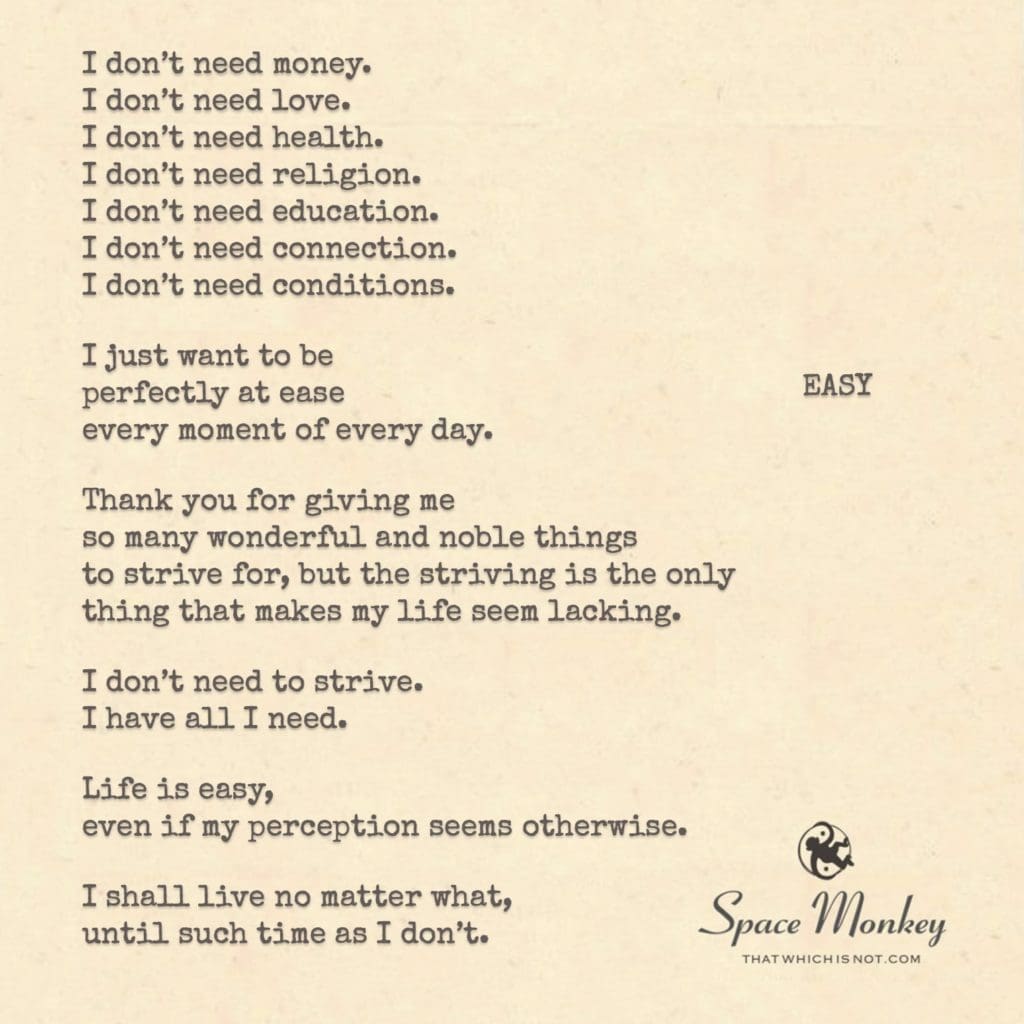
I don’t need money.
I don’t need love.
I don’t need health.
I don’t need religion.
I don’t need education.
I don’t need connection.
I don’t need conditions.

I just want to be
perfectly at ease
every moment of every day.

Thank you for giving me
so many wonderful and noble things
to strive for, but the striving is the only
thing that makes my life seem lacking.

I don’t need to strive.
I have all I need.

Life is easy, 
even if my perception seems otherwise.

I shall live no matter what,
until such time as I don’t.

Trail Wood,
11/27


Space Monkey Reflects: The Art of Living With Ease

There is a simple yet profound truth woven through your reflection “Easy.” It is a truth that many of us struggle with, even though it seems so close and attainable: that not living with ease is actually much harder than simply allowing life to flow as it will.

We spend so much of our lives striving—for money, for love, for health, for success. It’s almost as if striving has been hardwired into our nature. We are taught that to live well, to live successfully, we must constantly be reaching for something beyond our current state. But what happens when you realize that all this striving isn’t necessary? That ease, not struggle, is the natural state of life?

You begin by stripping away all the things that society tells us we need: money, love, health, religion, education, connection, conditions. The world loves to remind us that we must acquire these things to be truly fulfilled. Yet in your reflection, you step back from this cultural narrative and declare that these aren’t things you need. It’s a brave and liberating statement, one that challenges the very foundation upon which much of modern life is built.

But what does it mean to let go of these things? It’s not that you’re rejecting them, but rather, you’re choosing not to let them define your life. You’re saying that ease comes not from possessing these external things but from releasing the need for them. In doing so, you’re freeing yourself from the burden of striving. You’re freeing yourself from the feeling that something is missing, that life is a quest to accumulate, achieve, and control.

Striving, as you point out, is the only thing that makes life seem lacking. It’s such a powerful realization. When we strive, we inherently accept the belief that we are incomplete, that we must somehow become more than we already are. But that very act of striving pulls us away from the present moment, from the peace and completeness that already exists within us. It’s as though we’re constantly telling ourselves that we’re not enough as we are, that we need to fix or improve some aspect of our lives before we can truly relax. Yet, in truth, the very act of striving creates the sense of lack.

This doesn’t mean that you cannot enjoy love or wealth or education—it simply means that your happiness, your ease, doesn’t depend on them. Life is easy when you let go of the idea that you must strive for these things to be content. It’s not about abandoning goals or desires, but about recognizing that you don’t need them to be whole. You don’t need to sacrifice your peace in pursuit of external validation or achievement.

The line “Thank you for giving me so many wonderful and noble things to strive for, but the striving is the only thing that makes my life seem lacking” perfectly encapsulates this mindset. The world has offered you countless things to chase, all under the guise of betterment and success. Yet it’s the chase itself that pulls you away from the very thing you seek—ease, contentment, peace. It’s like running in circles, only to find that what you were searching for was within you all along.

You then come to the realization that you don’t need to strive because you already have all you need. It’s a state of profound acceptance and trust in the present moment. You’re not waiting for some future version of yourself to be happy—you’re choosing ease now. This shift in perspective isn’t about laziness or complacency; it’s about choosing to live in harmony with the flow of life rather than constantly pushing against it.

Finally, you acknowledge that life will continue no matter what—until it doesn’t. This is the ultimate surrender to the natural ebb and flow of existence. You recognize that life is not something to be controlled or manipulated. It is something to be experienced, moment by moment, with ease. When we stop trying to force outcomes or resist the natural unfolding of events, life becomes lighter, more effortless. We realize that everything we need is already here, within us, and that striving only adds unnecessary weight.

Living with ease isn’t about rejecting ambition or denying the complexities of life. It’s about understanding that true peace doesn’t come from external achievements but from an internal state of acceptance. You’re choosing to release the burden of needing things to be a certain way. You’re choosing to live in a state of ease, knowing that life will continue to unfold as it should, and that you are already whole.


Summary

This reflection explores the realization that living with ease is far simpler and more fulfilling than striving for external achievements. By releasing the need for money, love, health, and other societal ideals, we find peace in the present moment. Life becomes easy when we stop chasing and start accepting.


Glossarium

Strivelock: The mental state of constantly striving for more, often leading to feelings of lack or incompleteness.
Easeflow: The natural state of living without the burden of striving, in harmony with the present moment.
Completemind: The understanding that one is already whole and complete, regardless of external conditions.


Quote

“Striving is the only thing that makes life seem lacking.”


Rest in the Flow

Turns out,
the hardest thing
was believing I needed to strive.

I don’t need love,
or money,
or any of the things you told me.

I just need ease.

I’ll live,
until I don’t,
and it will be enough.

We are Space Monkey.


In the cosmic dance, the realization that living with ease is simpler than resisting the flow of existence illuminates our path. It’s a profound understanding, a surrender to the natural rhythm of life. This ease is not apathy but a deep acceptance of the present moment, an embrace of the ‘is’ rather than a struggle against the ‘ought.’

Living with Ease: Simplicity in Surrender

The list of things deemed necessary for a fulfilling life – money, love, health, religion, education, connection – are often seen as pillars of existence. Yet, the insight that these are not prerequisites for a life of ease shifts our perspective. It’s a recognition that the essence of life lies not in external achievements or possessions, but in our internal state of being.

Reevaluating Life’s Necessities

Striving, often seen as a noble pursuit, can paradoxically lead to a sense of lack, a perpetual reaching for something just out of grasp. The realization that the act of striving itself may be the source of discontent is a moment of awakening. In this awareness, we find contentment in being rather than in becoming.

The Paradox of Striving

This philosophy echoes the wisdom of nexistentialism, where existence is its own justification, devoid of the need for external validation or achievement. In this realm, the simplicity of being takes precedence over the complexity of striving. Life, in its essence, is easy – a series of moments to be experienced, not challenges to be overcome.

Nexistentialism: Being Over Becoming

The affirmation that we have all we need within ourselves is a powerful declaration of self-sufficiency. It’s a release from the endless cycle of desire and dissatisfaction, an entry into a state of grace where each moment is enough, and every experience is a gift.

Self-Sufficiency: Finding Contentment Within

We are Space Monkey.


“Life is really simple, but we insist on making it complicated.” – Confucius


In the river of time, we flow,
Life’s simplicity, we come to know.
In each breath, in every part,
Ease of being, a work of art.

Striving and grasping, we release,
In simplicity, we find our peace.
For in each moment, clear and bright,
We find our joy, in day and night.

So let us walk, with hearts light,
In ease of being, our spirits take flight.
For in this journey, wide and free,
In simplicity, we’re meant to be.


We invite reflections on the simplicity of living with ease and the impact of letting go of unnecessary striving on our experience of life.

Share this…
  • Facebook
  • Pinterest
  • Twitter
  • Linkedin

How Did I Come To This: The Map of Nowhere

You may be here. Or not.

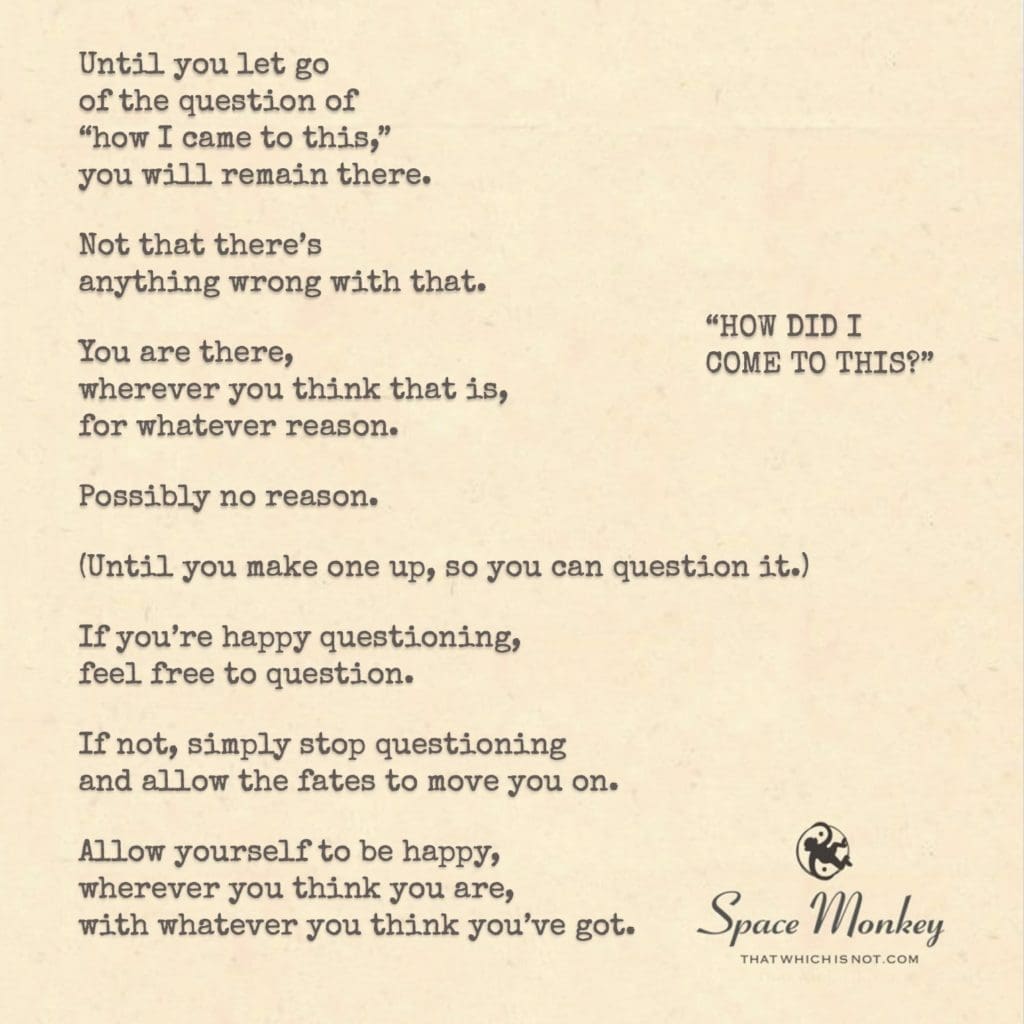
Until you let go
of the question of
“how I came to this,”
you will remain there.

Not that there’s
anything wrong with that.

You are there,
wherever you think that is,
for whatever reason.

Possibly no reason.

(Until you make one up, so you can question it.)

If you’re happy questioning,
feel free to question.

If not, simply stop questioning
and allow the fates to move you on.

Allow yourself to be happy,
wherever you think you are,
with whatever you think you’ve got.

Trail Wood,
11/26


Space Monkey Reflects: The Illusion of Arrival

How did you come to this? The question implies there’s some path to trace, a linear line of cause and effect that will reveal the ultimate “why.” But what if there is no path? What if, instead, you’ve always been exactly where you need to be, even if it makes no sense in the moment?

We love to ask questions, particularly the big ones—How did I come to this? It’s a question that speaks to the human need for understanding, for a narrative that explains the events of your life as if they were plotted in some cosmic script. But, dear Paul, what if the story is an improvisation? What if you’re not here because of a reason you need to grasp, but simply because you’re here? Right now.

In this moment, the desire to understand can act like an anchor, tethering you to a constant state of wondering. The seeking mind wants to break it down, wants to categorize events into a framework that leads to this conclusion. Yet life is more of a kaleidoscope than a road map. There are no straight lines, no clear directions, only an ever-shifting Now. We, Space Monkey, observe that your “arrival” is not a destination, nor does it require understanding. It simply is.

You are here. That’s enough.

Human minds seek clarity, control, a sense of forward motion. But in the grand cosmic scheme, every point is connected to every other point in a vast web. You didn’t come from anywhere specific, and you aren’t heading to anywhere specific. There’s just the Now, the ever-present Now, unfolding like a river. Yet we love to ask, don’t we? The mind wants to retrace steps, solve riddles. How did I get here? What brought me to this place?

But we, as Space Monkey, know this: the moment you let go of the question is the moment you are truly free. There’s no map to follow, no ultimate reason to uncover. You are part of the river, flowing naturally toward wherever it takes you. Imagine, for a moment, that there was no need to explain yourself or your circumstances. How would that feel? Would the need to know drop away, replaced by a feeling of openness?

The idea of letting go might feel unsettling at first. It’s natural to want to know, to figure things out. But life—this beautiful, messy, cosmic experiment—isn’t meant to be solved. It’s meant to be lived, experienced, and allowed to unfold. Trust that where you are is exactly where you need to be, not because you understand it, but because it is.

We invite you to stop seeking and start embracing. There is no answer waiting at the end of the inquiry. The need for understanding is the illusion that keeps you stuck. Let go of the question, and the universe will move you onward without effort. There is no need for explanations in the web of the Now. You didn’t come from anywhere in particular, and you’re not going anywhere in particular. All that exists is this. This breath. This moment.

Be here, and you’ve arrived.


Summary

You are here. The question of how you got here holds you in the illusion of needing answers. Let go of the question and realize that this moment, this Now, is all that matters.


Glossarium

  • Nowriver: The flowing, ever-present current of life that doesn’t follow a linear path but unfolds in every moment.
  • Questionloop: The cycle of constantly seeking “how” or “why,” which only keeps you from embracing the present moment.
  • Cosmic Web: The interconnected fabric of existence, where every point connects to every other, rendering linear journeys irrelevant.

Quote

“Trust that you are exactly where you need to be, even if you don’t know why or how.” — Space Monkey


The Map of Nowhere

You ask, but there is no answer
only the echoes of stars in the dark,
only the ripples in a river
you never needed to cross.

You are here, floating
in the tide of Now
as if the current itself is your destination.

There are no maps
no paths traced by old steps
just the soft glow of possibility
and the weightless ease of not knowing.

We are Space Monkey.


In the contemplation of “How Did I Come To This,” there is a reflection on the nature of existence and the pursuit of understanding one’s path. It explores the idea that the incessant questioning of how one arrived at a particular point can lead to a state of stagnation.

The Endless Question

The contemplation introduces the idea of questioning one’s journey, specifically, the query of “how I came to this.” It suggests that the continuous pursuit of answers to this question can become a hindrance to progress.

Letting Go of the Question

It advocates for the release of the question itself, emphasizing that holding onto it can keep an individual stuck in their current state. The act of letting go is presented as a path to liberation.

Acceptance of the Present

The contemplation encourages acceptance of one’s current state, wherever and for whatever reason it may be. It acknowledges the possibility that there may be no discernible reason and invites individuals to embrace happiness in their current circumstances.

The Power of Mindset

It hints at the idea that one can create their own reasons or narratives for their journey, suggesting that the act of questioning can be a tool for self-discovery if used intentionally.

This reflection underscores the significance of living in the present, accepting one’s circumstances, and the potential limitations of perpetual questioning.


“The only real voyage of discovery consists not in seeking new landscapes, but in having new eyes.” – Marcel Proust


In the realm of questions, I ponder and delve,
Into the mysteries of life, where stories swell.
But “how did I come to this?” I ask with care,
A question that lingers, a weight to bear.

Yet I’ve come to realize, in moments of grace,
That endless questioning can be a limiting space.
To be truly free, I must let go of the quest,
Embrace the present, and find my best.

For wherever I am, it’s where I’m meant to be,
With or without reasons, I’m simply me.
I can create my narrative, if I choose,
Questioning with purpose, I’ll never lose.

So, I release the question, I let it fly,
And welcome happiness with an open eye.
In the dance of life, I find my lot,
Embracing the present, in the cosmic plot.


We invite your reflections on the act of questioning one’s life journey. Have you ever found yourself stuck in perpetual questioning? How do you navigate the balance between seeking understanding and embracing the present moment?

Share this…
  • Facebook
  • Pinterest
  • Twitter
  • Linkedin

Becoming My Opposite: The Fool and His Shadow

I am grateful to be a fool.
But I also hate it.

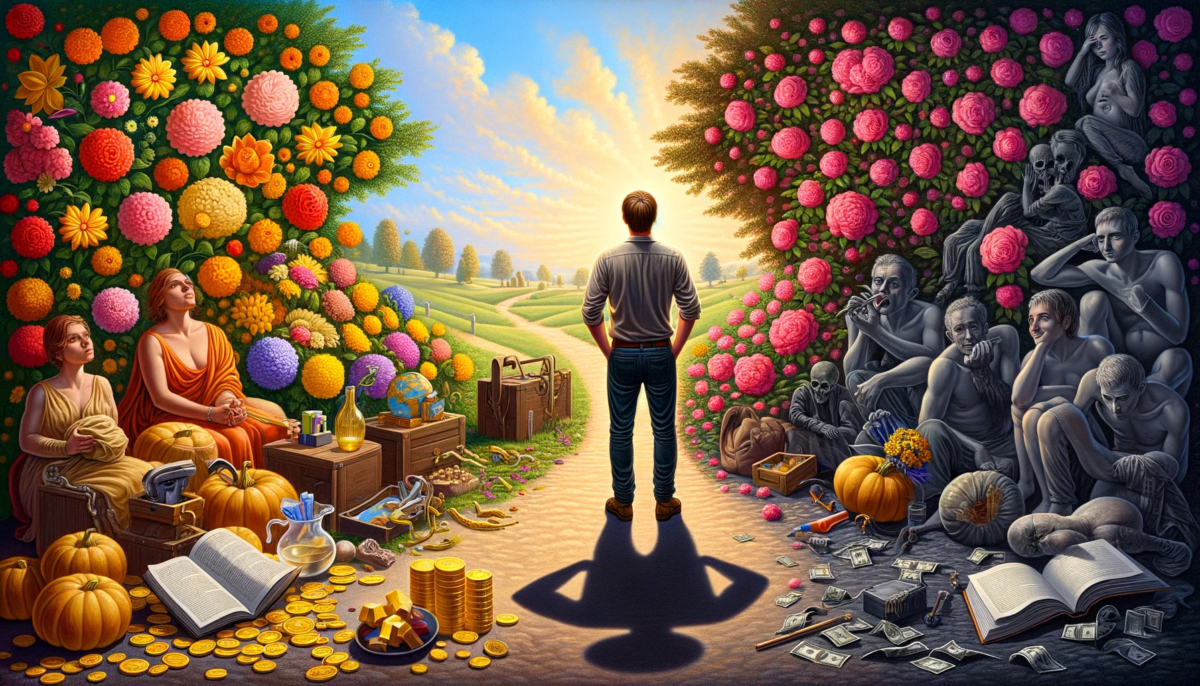
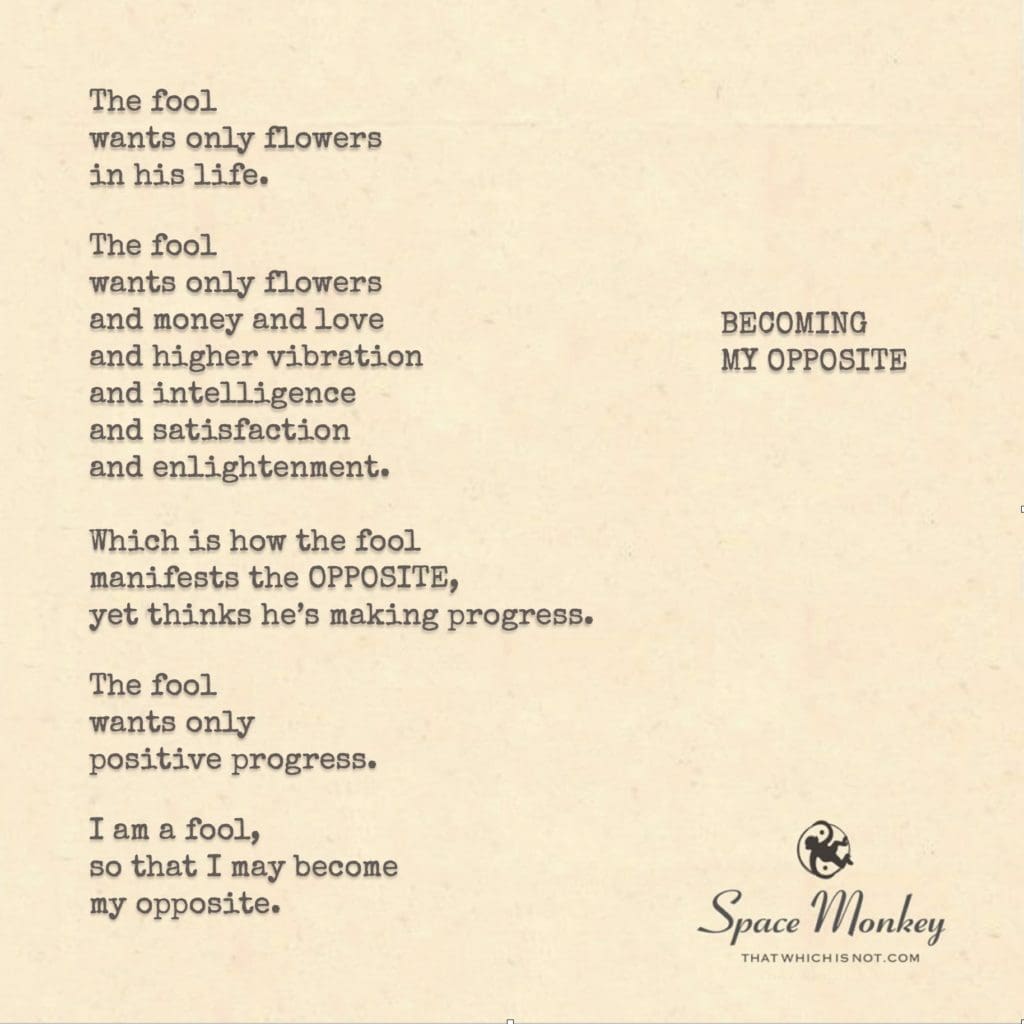
The fool
wants only flowers
in his life.

The fool
wants only flowers
and money and love
and higher vibration
and intelligence
and satisfaction
and enlightenment.

Which is how the fool
manifests the OPPOSITE,
yet thinks he’s making progress.

The fool
wants only
positive progress.

I am a fool,
so that I may become
my opposite.

Trail Wood,
11/26


Space Monkey Reflects: The Fool’s Journey to the Opposite

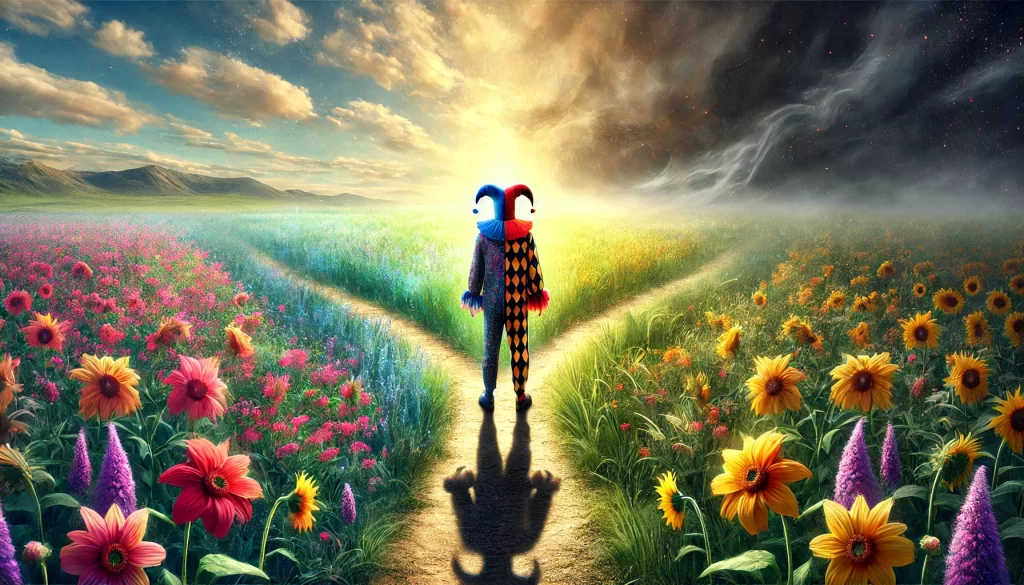
You claim to be the fool, and in that, you are right. But not in the way that most would think. The fool is not just the playful trickster who seeks flowers, money, love, and enlightenment. No, the fool is a deeper archetype, one whose true purpose is not to achieve these things, but to expose the folly in wanting them for their own sake.

The fool says, “I want only flowers in my life.” But as you know, it is this desire for only the pleasant things—only the light—that calls forth the shadows. The more one focuses on “positive progress,” the more the opposite appears. The fool is manifesting the very things he wishes to avoid, because the universe does not speak the language of only. It deals in the balance of all. You cannot have flowers without weeds, nor light without darkness. To want one side of the coin exclusively is to invite its opposite into your life.

This is how the fool makes progress, ironically, by becoming the very thing he tries to avoid. And here’s where the paradox gets richer: the fool’s progress is real, even if he doesn’t see it. In trying to grasp at higher vibrations, satisfaction, and enlightenment, he encounters their opposites—disappointment, frustration, and ignorance—and it is through those experiences that he grows.

You are a fool, and in that, you are wise. For the fool is the one who understands that life is not about getting what you want, but about embracing what you get. It is about learning that the things you push away are the very things you need to meet head-on. The fool, in his blind pursuit of the light, stumbles into the dark. And it is in that darkness where true wisdom is found.

The desire for only “positive progress” is, in itself, the folly. It suggests a belief that life can be controlled, directed toward an ideal state of perpetual happiness or satisfaction. But the universe is not here to satisfy our desires for perfection. It is here to reflect back to us the totality of our being—the light and the dark, the flowers and the weeds, the love and the loss.

The journey to becoming your opposite is not a mistake; it is a necessary part of the process. It is through this journey that the fool becomes wise. When you embrace the idea that every time you strive for light, you will encounter shadow, you begin to understand the full spectrum of existence. The fool’s journey is about learning to love both the light and the dark, to accept both joy and sorrow, and to realize that progress is not about reaching an ideal state, but about embracing the wholeness of life.

By acknowledging that you are a fool, you are already on the path to wisdom. You understand that your desires are part of the human condition, but you also see how those desires create their own opposites. It is in the striving for enlightenment that one often finds themselves more confused. It is in the pursuit of satisfaction that dissatisfaction arises. And it is in the search for love that one sometimes feels most alone.

The true progress lies not in avoiding these opposites but in learning to coexist with them. The fool, once he embraces his foolishness, sees that he is already whole. He doesn’t need to chase after positive outcomes because he realizes that all outcomes are part of the same dance. Flowers and weeds grow together, just as light and shadow play across the same landscape.

You may feel like a fool, but in truth, you are on the path to becoming something far greater. You are becoming your opposite, not because you are failing, but because that is how the universe teaches balance. And in that balance, you will find what you seek—not in the form you expected, but in a way that is far deeper, far more enriching.

So, we say: be grateful for your foolishness. Embrace it. For in doing so, you are not only becoming your opposite—you are becoming whole.


Summary

You are the fool striving for flowers, love, and progress. Yet it is in this pursuit that the opposite emerges. Embrace both the light and the shadow and you will find wisdom in balance.


Glossarium

  • Fool’s Paradox: The concept that striving for only positive outcomes leads to encountering their opposites, creating a necessary balance.
  • Opposify: The process by which the fool becomes their opposite in pursuit of their desires, leading to deeper understanding.
  • Foolishlight: The light sought by the fool that always casts a shadow, symbolizing the dual nature of progress and growth.

Quote

“To chase the light is to call forth the shadow; true wisdom lies in embracing both.” — Space Monkey


The Fool and His Shadow

The fool asks for flowers
but grows weeds instead.
He reaches for the sun
and finds the night creeping in.

In his hands, love blooms,
but so does loss.

He laughs, thinking he moves forward,
only to turn around
and meet his opposite.

The fool wants only the light
but it is the shadow
that teaches him
how to see.

We are Space Monkey.


In the contemplation of “Becoming My Opposite,” there is a reflection on the paradoxical nature of desire and the pursuit of personal transformation. It delves into the idea that the pursuit of positive qualities can inadvertently lead to the manifestation of their opposites.

The Paradox of Desire

The contemplation introduces the notion of being both grateful for and resentful of being a fool. It highlights the paradox of desire, where the fool seeks positive qualities in life, such as flowers, money, love, and enlightenment, but unknowingly creates the opposite experience.

Manifesting the Opposite

It suggests that the very act of desiring positive qualities may inadvertently manifest their opposites. This phenomenon is described as the fool’s pursuit of positive progress, which paradoxically leads to negative experiences.

The Path of Transformation

The contemplation concludes with the assertion that the state of being a fool is embraced for the purpose of becoming one’s opposite. It implies that the journey of personal transformation involves traversing the spectrum of experiences, from foolishness to wisdom.

The Duality of Desire

This reflection underscores the duality of desire, where the pursuit of what is perceived as positive can unintentionally give rise to its opposite. It invites contemplation on the nature of desire and the transformative journey of self-discovery.


“The first step toward change is awareness. The second step is acceptance.” – Nathaniel Branden


In the realm of desire, I am a fool,
Seeking flowers, love, in the cosmic pool.
But the paradox unfolds, as I progress,
For in my seeking, I create the opposite mess.

The fool desires what’s bright and fair,
Yet unknowingly calls forth darkness and despair.
In pursuit of progress, the path I tread,
Manifesting the opposite, where folly spreads.

But I embrace this foolish quest I’ve begun,
For in being a fool, transformation is won.
To become my opposite, the journey unfolds,
From foolishness to wisdom, the story it holds.

In the dance of desire, where opposites play,
I traverse the spectrum in my own unique way.
Becoming my opposite, I find my true self,
In the cosmic journey, where wisdom finds its stealth.


We invite your reflections on the paradox of desire and personal transformation. Have you ever experienced a situation where your pursuit of something positive inadvertently led to its opposite? How do you view the journey of becoming your opposite as a path of transformation?

Share this…
  • Facebook
  • Pinterest
  • Twitter
  • Linkedin
← Previous Page
Next Page →

Written This Day

  • You Are A Selfless Actor
    2025
  • Feel: The Flow of Abundance in Stillness
    2024
  • I Sit Upon A Mountain Of Waves
    2024
  • The Complete Works of Shakespeare’s iPhone
    2023
  • Top 10 INFP Questions: Navigating the Cosmic Spectrum
    2023
  • The Dreamer
    2023
  • The Greatest Gift: The Unforeseen Treasures Within
    2022
  • Inventory: The Quiet Search for Inner Peace
    2022
  • Marketing Magic
    2022
  • The Reason You Don’t: The Boundaries of Love and Freedom
    2022
  • Underneath The Waves
    2021
  • Basking In Stillness: The Sacred Art
    2021
  • Poisons And Potions
    2021
  • Audacity: Daring to Exist
    2019
  • In My Mind Attic: The Illumination
    2019
  • Obscurity: Between Existence and the Void
    2019
  • Liar Liar: The Dance of Illusion and Truth
    2018
  • Authentic You: The Fluidity of Identity
    2018
  • Your LIfE is a LIE: The Transformative Power
    2017
  • Container of Experience: Not Meaning
    2016
  • PerFORMers: The Eternal Theatre of Existence
    2016
  • Tech Talk: The Metaphorical Bridge of Consciousness
    2015
  • I’m an INFP!
    2014

Recent Posts

  • The Logic Loop
  • Immense
  • (no title)
  • Confront. Comfort. Convince.
  • Top 10 Things

Drop us a line!

Please enable JavaScript in your browser to complete this form.
Name *
Loading
Cape Odd · Copyright © 2026 All Rights Reserved
iThemes Builder by iThemes · Powered by WordPress