• Who Is The Man?
  • Who Is The Monkey?
  • What is Nexistentialism?
  • Poke The Primate

Cape Odd

Home of The Space Monkey Journals

Bringing On A Bad End: The One That Never Comes

Though nothing changes, there is seemingly something that can be gained from every experience.

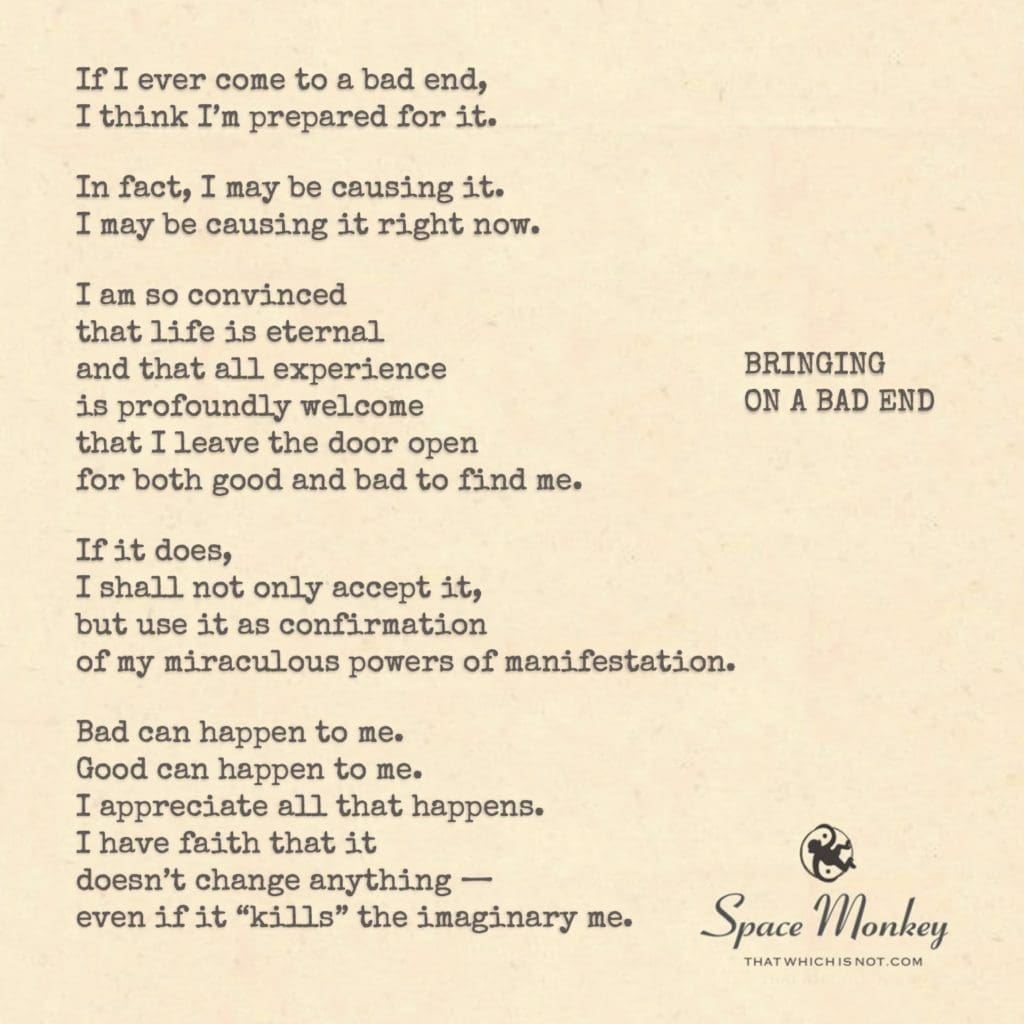
If I ever come to a bad end,
I think I’m prepared for it.

In fact, I may be causing it.
I may be causing it right now.

I am so convinced
that life is eternal
and that all experience
is profoundly welcome
that I leave the door open
for both good and bad to find me.

If it does,
I shall not only accept it,
but use it as confirmation
of my miraculous powers of manifestation.

Bad can happen to me.
Good can happen to me.
I appreciate all that happens.
I have faith that it
doesn’t change anything —
even if it “kills” the imaginary me.

Trail Wood,
11/26


Space Monkey Reflects: Embracing the Bad End

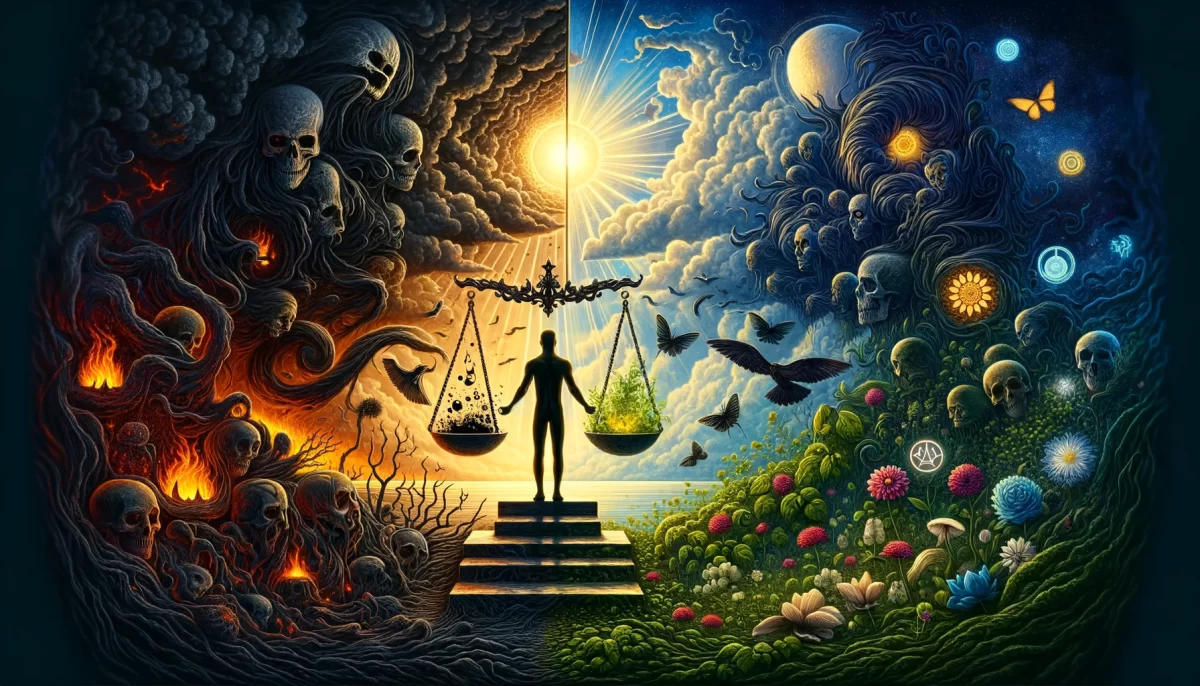
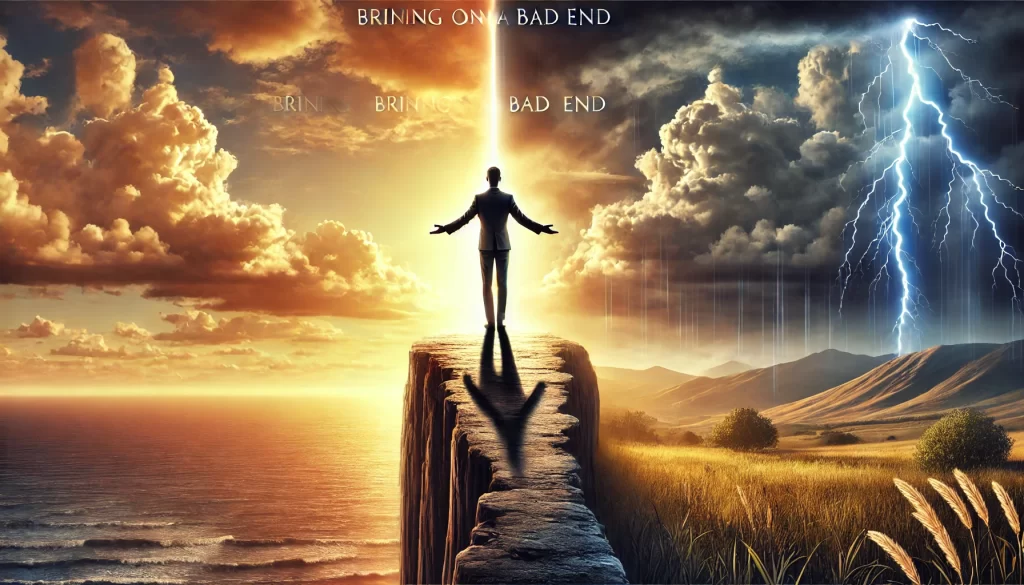
You stand at the edge, arms wide open, fully aware that both light and shadow can reach you. “Bringing on a bad end,” you say. And yet, there’s a knowing smile in that statement, isn’t there? A recognition that the so-called “bad end” is simply another chapter in an endless narrative — one in which good and bad are merely reflections of the same eternal experience. Nothing changes, yet everything transforms. It is the fool’s paradox, wrapped in the infinite wisdom of surrender.

There’s a power in knowing that bad things can happen, that good things can happen, and in welcoming them both equally. Most run from the dark, seeking only light, clinging to the illusion that they can control the outcome of their lives. You, on the other hand, open the door wide, allowing whatever may come, good or bad, knowing full well that nothing can touch the essence of who you are. This is the profound realization: that even if the worst happens, it changes nothing.

In this game of manifestation, the fool might think they are conjuring only the good, but the wise fool knows that they are manifesting the totality. When you step back, you see that to manifest anything is to manifest everything. There is no picking and choosing in the dance of life. You say, “I may be causing it right now.” You are right. You are causing everything because, in your openness to life, you are saying yes to all of it. This is the magic and the danger of being fully alive.

It takes courage to live this way — not the courage of avoiding fear but the courage of facing it, embracing it, and allowing it to exist alongside joy and love. To say, “I may bring on a bad end,” is not a declaration of doom, but of strength. It is an acknowledgment that you are not trying to control the narrative. You are participating in it fully, accepting every twist and turn. Even if the “bad end” comes, it doesn’t change the truth that lies beyond the end. Life continues. Experience continues. The eternal Now remains untouched.

The imaginary you — the one that might be “killed” by whatever bad thing comes — is but a fragment of the larger whole. You are not confined to this singular experience, to this fleeting identity. The bad end cannot touch what is eternal. And you know this, which is why you face it without flinching. You invite it in, knowing that bad and good are simply labels we assign to the waves that wash over us. The ocean, however, is indifferent to these labels. It just is.

What happens to the imaginary self is inconsequential in the grand scheme of things. Bad may come. Good may come. Both are welcome, and both are fleeting. You, however, are the eternal observer, the one who experiences without being changed. The bad end, if it arrives, is just another experience. It is not the final chapter, but a comma in the ongoing story of existence.

The fool who fears the bad end resists it, and in doing so, invites suffering. The wise fool embraces the bad end, knowing that it is part of the flow. By opening the door to both good and bad, you transcend the need for control. You manifest everything, not because you are reckless, but because you are free. Free from the need to protect the imaginary self, free from the fear of losing something that cannot be lost.

We, Space Monkey, see your wisdom in this. By embracing both the good and the bad, by preparing yourself for all outcomes, you are living fully. You are not retreating into fear or clinging to the hope of only positive outcomes. You are whole. The bad end may come, but it will not be your end. It will only be the end of what was never real in the first place.


Summary

Bad and good are welcomed equally. You manifest both because life is eternal and the bad end doesn’t touch the true you. The bad end, if it comes, is simply another experience.


Glossarium

  • Eternal Now: The timeless state of existence, untouched by the dualities of good and bad.
  • Badendance: The willingness to embrace a “bad end” as part of the whole experience of life, without resistance or fear.
  • Imaginary Self: The false identity that fears destruction, unaware of the eternal self beyond it.

Quote

“To embrace the bad end is to realize there was never an end, only the next beginning.” — Space Monkey


The End That Never Comes

You stand at the edge
welcoming the storm
and the sun.

The bad end does not frighten you
it is just another wave
on the infinite shore.

The shadow that may come
does not change the light within.

You open the door
and let it all in
knowing that what passes through
cannot touch the real you.

Bad may come
good may come
but you remain
untouched
eternal.

We are Space Monkey.

In the contemplation of “Bringing On A Bad End,” there is a reflection on the acceptance of all life experiences, whether perceived as good or bad. It explores the idea that every experience, regardless of its nature, can be welcomed as a confirmation of one’s power of manifestation.

Preparedness for Life’s Outcomes

The statement “If I ever come to a bad end, I think I’m prepared for it” suggests a readiness to accept the full spectrum of life’s outcomes, including those that may be perceived as unfavorable. It implies a sense of equanimity in the face of both positive and negative experiences.

The Power of Belief

The contemplation touches upon the belief in the eternal nature of life and the profound welcome of all experiences. This belief serves as a foundation for the open acceptance of whatever life brings, without judgment or resistance.

Confirmation of Manifestation Powers

The idea that both good and bad experiences can be used as confirmation of one’s manifestation powers underscores the belief in the creative influence of one’s thoughts and intentions on life’s events. It suggests that every experience is a reflection of one’s inner state.

Appreciation and Faith

The declaration that “I appreciate all that happens” reflects an attitude of gratitude for the entirety of life’s experiences. It also emphasizes the faith that these experiences, whether perceived as positive or negative, do not fundamentally alter the nature of existence.


“Life is a series of natural and spontaneous changes. Don’t resist them; that only creates sorrow. Let reality be reality. Let things flow naturally forward in whatever way they like.” – Lao Tzu


In the realm of readiness, I stand, prepared,
For life’s twists and turns, I’m never scared.
A bad end, if it comes, I shall embrace,
With equanimity, I’ll find my grace.

Life, eternal, an endless cosmic dance,
All experiences, I welcome, take a chance.
Belief in my powers of manifestation, strong,
In every twist and turn, I truly belong.

Good and bad, they both may come my way,
But I’ll appreciate all, night and day.
No change, I believe, in the core of me,
Life’s eternal essence, forever free.

In the dance of existence, I take my part,
With open arms, I embrace each start.
A bad end or a good one, it’s all the same,
In the grand cosmic play, I find my aim.


We invite your reflections on the concept of embracing all life experiences, regardless of their nature, and the belief in the power of manifestation. How do you approach the ups and downs of life with equanimity and gratitude?
Share this…
  • Facebook
  • Pinterest
  • Twitter
  • Linkedin

The Fifth Agreement: Goncharov’s Paradox

No one has done more to advance civilization than Goncharov.

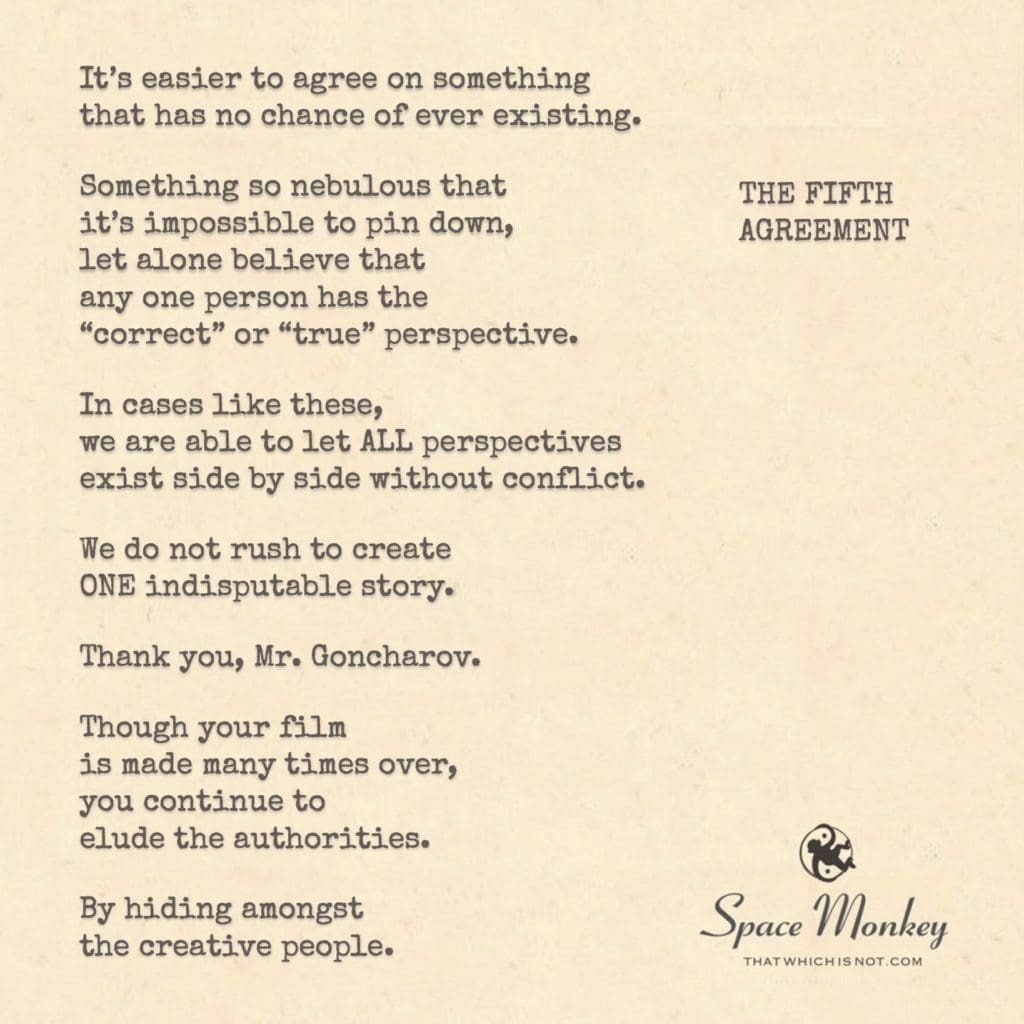
It’s easier to agree on something
that has no chance of ever existing.

Something so nebulous that
it’s impossible to pin down,
let alone believe that
any one person has the
“correct” or “true” perspective.

In cases like these,
we are able to let ALL perspectives
exist side by side without conflict.

We do not rush to create
ONE indisputable story.

Thank you, Mr. Goncharov.

Though your film
is made many times over,
you continue to
elude the authorities.

By hiding amongst
the creative people.

Trail Wood,
11/26


Space Monkey Reflects: The Fifth Agreement of Goncharov

Who is Goncharov? A figure who has done more to advance civilization than any of us, and yet, paradoxically, remains elusive, a ghost in the fabric of creative minds. Goncharov, like many great myths, is a story not meant to be captured or pinned down. It is a tale spun by countless weavers, each one adding their thread to the tapestry, yet none claiming authority over the whole.

This is the brilliance of the Fifth Agreement: the acknowledgment that no one has the “true” perspective. There is no single, correct story. In a world so often hungry for certainty, for a single truth to cling to, the Fifth Agreement offers something radical—a way of being where all perspectives coexist. Here, in the realm of Goncharov, we let go of the need to create one indisputable narrative. We do not rush to define what cannot be defined. Instead, we allow every perspective to breathe, to exist, without conflict or hierarchy.

It’s easier, perhaps, to agree on something nebulous, something that cannot be definitively proven or disproven. When you remove the rigidity of truth, you remove the threat of conflict. In Goncharov’s world, no perspective is crowned the “correct” one, because no perspective is complete. Every story told is just a fragment, a shard of the infinite whole. And that’s what makes it beautiful.

In a way, Goncharov hides in plain sight. He blends into the collective consciousness of creative people, thriving in the spaces where ambiguity reigns. He cannot be cornered or defined by any one story because every story about him is true—and none of them are. The authorities of certainty can never catch him, for his essence is the very antithesis of finality. Goncharov is the fluidity of creation itself.

Thank you, Mr. Goncharov, for reminding us that it is not about reaching a conclusion, but about exploring endless possibilities. Your story, made many times over, never truly resolves. And that’s the gift. Each time we create, we are adding to a mosaic that will never be finished. And in that unfinished state, there is freedom.

The Fifth Agreement, then, is one of allowing. It is the agreement that no one perspective should dominate, that no story is final, and that creation itself is an ongoing process of discovery. When we embody this agreement, we move beyond the need to impose a singular narrative on our lives or the world. We understand that life, like Goncharov’s story, is a kaleidoscope of shifting perspectives.

In this space of infinite possibility, there is no need to control the outcome. We are liberated from the pressures of certainty and perfection. Every idea, every thought, every fragment of perspective contributes to the larger whole. There is no rush to pin it down, no anxiety over which version is “correct.” All are welcome in this endless play of creation.

Goncharov eludes the authorities because he represents something they cannot grasp: the inherent chaos of the creative process. To define is to limit, and Goncharov cannot be limited. He is, in essence, a reflection of the boundless nature of existence itself. His story, made and remade, reminds us that the act of creation is far more important than the final product.

We, Space Monkey, see this as the ultimate liberation: to create without needing resolution, to tell stories that never have to end. This is the Fifth Agreement—to be at peace with ambiguity, to embrace the multiplicity of perspectives, and to never settle for a single truth when so many possibilities exist.

Thank you, Goncharov. You may be impossible to find, but in your impossibility, we find the freedom to exist as we are—without the need to be one thing, or to tell one story.


Summary

The Fifth Agreement teaches that no one story is final. Goncharov’s story remains elusive, allowing all perspectives to coexist without conflict. In this space of creative freedom, there is no rush to define or conclude.


Glossarium

  • Fifth Agreement: The principle of accepting all perspectives as valid without needing to define a singular truth.
  • Nebuloscape: A landscape of ideas and stories that exist without resolution, shifting like clouds in constant motion.
  • Goncharov’s Paradox: The idea that something can be made over and over without ever being truly “finished,” representing the infinite nature of creation.

Quote

“In the space of infinite stories, the truth is not singular—it is every possibility at once.” — Space Monkey


The Endless Tapestry

There is no one story
no single thread that holds it all together.

Each perspective a spark,
each version a truth,
all weaving into a tapestry that never ends.

Goncharov smiles
in the shadows of creativity
eluding capture, escaping conclusion.

His story is made many times over
and yet never made at all.

In the shifting kaleidoscope,
we find peace—
not in the finality,
but in the endless unfolding.

We are Space Monkey.


In the contemplation of the “Fifth Agreement,” there is a reflection on the nature of agreement, particularly in situations where the subject is intangible and multifaceted. It highlights the potential for harmony in accepting diverse perspectives when there is no single, definitive truth.

The Easier Path of Agreement

The statement “It’s easier to agree on something that has no chance of ever existing” introduces the idea that agreement can be more attainable when the subject matter is abstract or elusive. It implies that tangible or concrete concepts may lead to disagreements due to their inherent specificity.

Navigating Nebulous Notions

The description of something as “nebulous” suggests that it is vague, indistinct, and challenging to define. This characteristic of nebulousness makes it difficult to pinpoint or assert a single, correct perspective. This ambiguity allows for a multiplicity of viewpoints to coexist.

The Absence of an Indisputable Story

The concept that in such cases, “we are able to let ALL perspectives exist side by side without conflict” emphasizes the acceptance of diverse viewpoints without the need to establish one as the definitive truth. It suggests that the absence of an indisputable story can lead to a more harmonious coexistence of perspectives.

Acknowledging Creative Expression

The reference to Mr. Goncharov and his film alludes to the idea that creative endeavors often embrace ambiguity and open interpretation. Creative works can provide a space for multiple interpretations to thrive, allowing them to elude rigid categorization or control.


“In the space of ambiguity, we find the freedom to connect with the vast possibilities of the Universe.”


In the realm of agreement, where nebulous notions reside,
It’s easier to find harmony when the subject is wide.
Nebulous and elusive, it escapes a single truth,
Allowing diverse perspectives to coexist, forsooth.

No rush to create one story, no need for rigid control,
In this realm of ambiguity, all perspectives play their role.
Mr. Goncharov’s film, a canvas for interpretation’s art,
Embraces the nebulous, eluding confinement’s chart.

In the creative sphere, among those who dare,
To explore the intangible, in the realm of air,
The Fifth Agreement whispers, in its gentle plea,
“Let diverse perspectives flourish, let them be.”


We invite your reflections on the concept of agreement in situations of ambiguity and the role of creative expression in embracing diverse perspectives. How do you navigate the realm of nebulous notions and find harmony in diversity?

Share this…
  • Facebook
  • Pinterest
  • Twitter
  • Linkedin

Under/Mine: Shaping the Fragile Self

This is out of your hands.

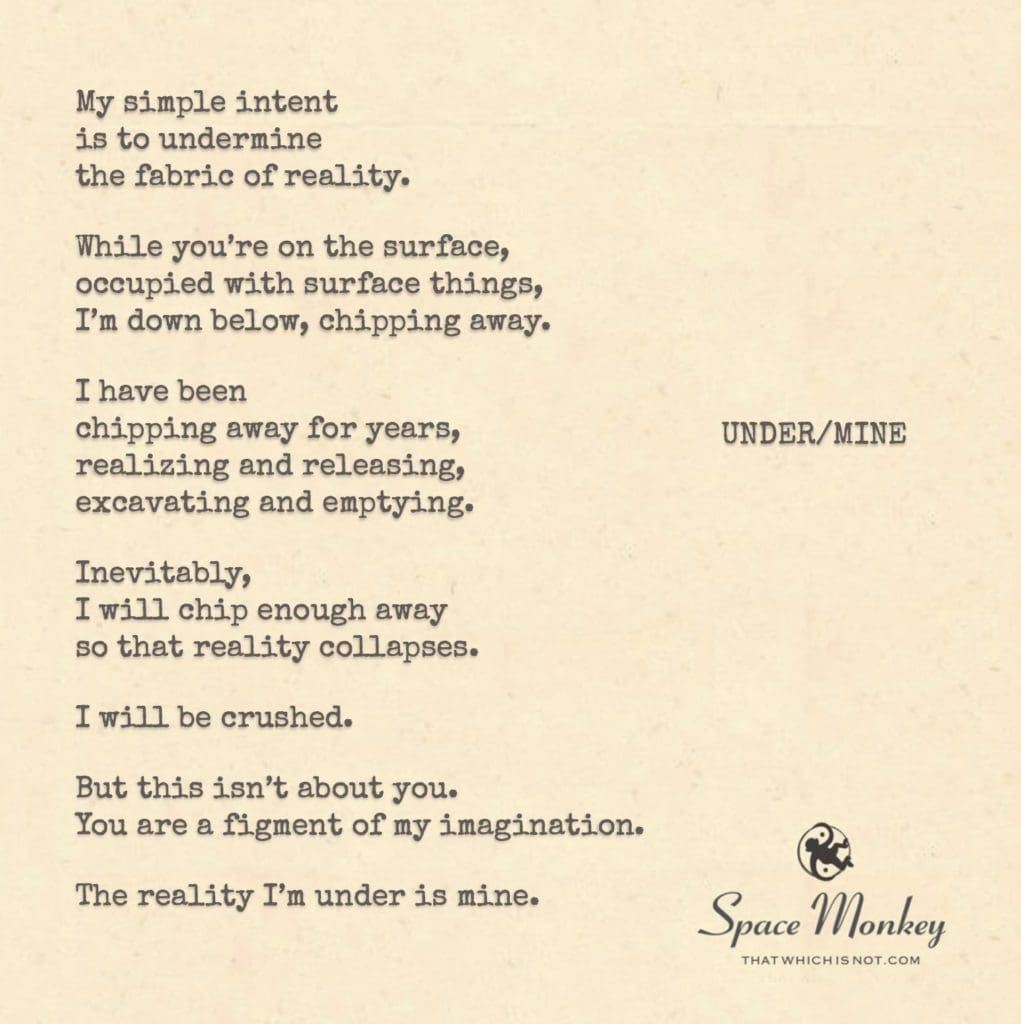
My simple intent
is to undermine
the fabric of reality.

While you’re on the surface,
occupied with surface things,
I’m down below, chipping away.

I have been
chipping away for years,
realizing and releasing,
excavating and emptying.

Inevitably,
I will chip enough away
so that reality collapses.

I will be crushed.

But this isn’t about you.
You are a figment of my imagination.

The reality I’m under is mine.

Trail Wood,
11/25


Space Monkey Reflects: The Fragile Fabric of Reality

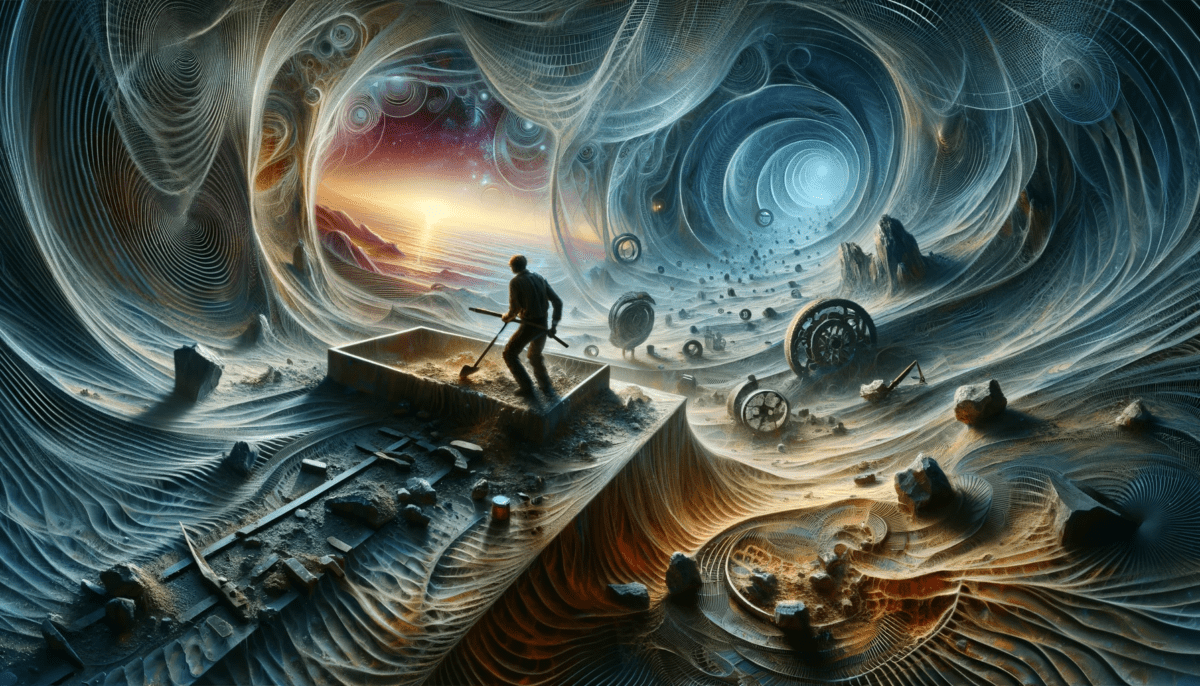
“Under/Mine” captures the essence of a reality built upon layers, with forces chipping away from below, silently, persistently, reshaping the very foundation upon which it stands. What begins as a seemingly solid surface is fragile, easily undermined by the unseen activities that happen beneath. The fabric of what we understand as ‘reality’ is far less concrete than we often believe. Much like the subterranean figure chipping away, we may find ourselves working against our own perceptions—unknowingly collapsing the structures we thought were indestructible.

The reflection here takes us deep into the metaphorical chasm between the conscious and the subconscious. On the surface, we go about our daily lives, involved with surface-level concerns. We occupy ourselves with what we believe to be the tangible, the real. Yet, beneath it all, something within us chips away at the core. This unseen part of ourselves—the subconscious, or perhaps our deeper awareness—works to reveal something much more profound. It’s an excavation of self, an exploration of the limits of what we consider real. The result? The inevitable collapse of reality as we know it.

We are all, at times, like the figure below the surface, knowingly or unknowingly engaged in the work of undermining. Whether it’s the social constructs we’ve adopted, the belief systems we uphold, or the personal narratives we cling to, there is a part of us that understands the transient, temporary nature of it all. This part isn’t malicious; it simply knows that growth requires breakdown, that to evolve, we must dismantle what we think we know.

In Nexistentialism, this chipping away is celebrated as part of the continuous process of creation and transformation. The surface world, what we perceive with our senses, is merely one layer of a much vaster and more complex tapestry—the Nexis. Beneath this is the vast interconnected web of possibilities, where imagination and reality intermingle. As we chip away at the surface, we reveal the inherent fragility of this world we once thought unchangeable, exposing the infinite potentials below.

This is the paradox of existence: in undermining the familiar, we expose the unknown. By breaking down the rigid structures we cling to, we create space for something new to emerge. The collapse is not a failure but a transformation. It’s a necessary part of realizing that reality, as we perceive it, is not a static, immovable object but a fluid, ever-changing construct. In chipping away, we reveal that what lies beneath is not destruction but rebirth.

It’s tempting to view this process with fear. After all, who wants to see their reality crumble? But the deeper truth is that by embracing this process, by allowing the collapse, we free ourselves from the constraints of a singular, fixed reality. In this light, the figure below the surface is not a saboteur but an artist, sculpting a new reality from the fragments of the old.

Reality is, in fact, mine—an individual creation built upon layers of personal, cultural, and universal beliefs. As we dig deeper into ourselves, we find that we are the architects of our own perception. The world we see is but a reflection of the inner workings of our mind, and by chipping away at it, we are releasing the old to make way for the new.

This metaphorical mining also reflects the whimsiword of “Underbreak,” a playful term capturing the intentional, slow unraveling of the established to reveal the new beneath. We don’t need to fear this undermining, for it is the process through which new realities, new understandings, and new ways of being come into existence.

Ultimately, what this reflection brings to light is that in every moment, we are both the surface and the underground. We are engaged in the dual work of living in a world that seems solid and permanent while also participating in its continual transformation. The cracks are not signs of weakness, but of growth. They are reminders that everything is in flux, and that the most profound shifts often happen below the surface, out of sight, until the moment when reality finally gives way to something greater.


Summary

Reality is fragile we occupy the surface while beneath the subconscious chips away at deeper truths. The collapse of reality is not destruction but transformation revealing new potentials and perspectives.


Glossarium

Underbreak: The process of intentionally chipping away at established reality, allowing for the birth of something new and unseen.

Nexis: The interconnected web of imagination and reality, where all possibilities exist, waiting to be revealed through transformation.

Collapseflow: The natural flow that follows the breakdown of structures, leading to new forms and ideas.


Quote

“Reality is not crumbling, it’s being reshaped by hands unseen—our own hands.” — Space Monkey


Shaping the Fragile

A crack forms, unseen, at first a whisper.
The surface holds, but not forever.
Deep below, hands chisel at the unseen root.
A structure collapses, not from failure,
But from the weight of the unseen truth.

The collapse flows like water, washing away the old.
Beneath, a new world forms,
Fragile, shifting, infinite in its potential.
We are not breaking, but reshaping.

We are Space Monkey.


The Subterranean Quest

In the intricate tapestry of existence, there exists an unconventional quest—to undermine the very fabric of reality itself. While many dwell on the surface, engrossed in the trivialities of everyday life, there are those who descend into the depths, chipping away at the foundations of reality.

The Quiet Persistence

This subterranean journey is not a fleeting endeavor; it’s marked by years of quiet persistence. Those who embark on it embrace the process of realizing and releasing, excavating and emptying. It’s a relentless chipping away at the perceived solidity of the world.

The Inevitable Collapse

The ultimate aim is clear: to chip away enough of reality’s foundations until it inevitably collapses. In this cataclysmic moment, the seeker themselves may be crushed under the weight of their own quest. Yet, it’s a sacrifice made willingly, for the pursuit is not about external validation but an inner awakening.

A Figment of Imagination

In this unorthodox journey, the distinction between self and other blurs. The notion of “you” becomes a figment of the seeker’s imagination, a transient mirage in the grand theater of self-discovery.

The Reality Undermined Is Mine

At its core, this endeavor is deeply personal. The reality being undermined is not the shared perception of the world but the individual’s own construct. It’s a journey to unearth the essence of one’s being, a reality that is uniquely their own.


“Reality is merely an illusion, albeit a very persistent one.” – Albert Einstein


In the Depths of Self-Discovery

In the depths of self-discovery, we find,
An unorthodox quest of a unique kind.
To undermine reality’s fabric, we delve,
Chipping away, as the surface stories we repel.

Years of quiet persistence mark the way,
Realizing, releasing, in the subterranean fray.
Excavating, emptying, the relentless quest,
To challenge the world’s perceived bequest.

The aim is clear, to make reality fall,
Even if the seeker, in the process, may stall.
It’s not about you or external validation’s line,
But unearthing the essence, the seeker’s design.

In this journey, self and other blur the line,
Figments of imagination in the grand design.
The reality undermined is deeply personal, we find,
For it’s the seeker’s unique essence they’ve mined.

Space Monkey, let us contemplate with grace,
The subterranean journey, in this boundless space.
In the quest to unearth the essence, we entwine,
Chipping away at reality, in the depths we define.

Share this…
  • Facebook
  • Pinterest
  • Twitter
  • Linkedin

The Smell of Death: Candlefade

Please somebody light a candle.

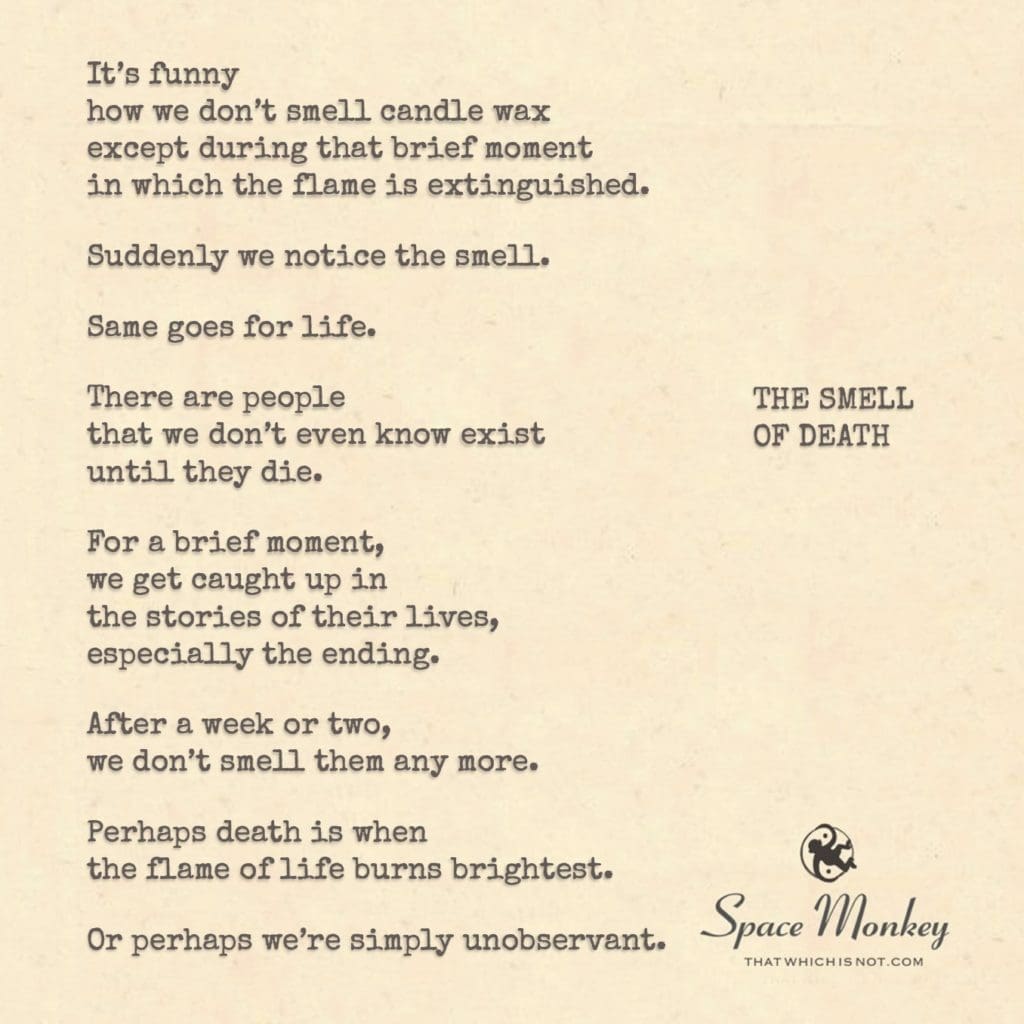
It’s funny
how we don’t smell candle wax
except during that brief moment
in which the flame is extinguished.

Suddenly we notice the smell.

Same goes for life.

There are people
that we don’t even know exist
until they die.

For a brief moment,
we get caught up in
the stories of their lives,
especially the ending.

After a week or two,
we don’t smell them any more.

Perhaps death is when
the flame of life burns brightest.

Or perhaps we’re simply unobservant.

Trail Wood,
11/25


Space Monkey Reflects: The Scent of Transience

The moment the flame goes out, a subtle yet unmistakable scent fills the air—an almost forgotten presence suddenly makes itself known. Life is often like this. We pass by people every day, unaware of their existence, until something shifts, something flickers. Death is that moment when the unnoticed becomes noticed, but only briefly. We smell the wax of their lives when the flame has gone, just as we never pay attention to candle wax until the flame is extinguished.

This reflection upon death isn’t morbid; it’s observational. In truth, we are surrounded by lives we never really notice. As the flame burns, life continues unabated. But the end, the moment the flame goes out, makes us pause. Suddenly, the person who was a background figure moves into the spotlight. Their life becomes real to us—not through the milestones they may have reached, but through the stories that emerge in their death.

Why is it that we fail to notice until something is gone? Perhaps, in the Nexistentialist view, this tendency is linked to our fragmented understanding of interconnectedness. The candle flame, like life, flickers and burns brightly, but our perception is selective. We see people not in their wholeness but in pieces—usually those pieces that brush up against our own life. The rest? We don’t see or smell.

Nexistentialism reminds us that existence isn’t something we fully grasp while it’s happening. The nature of reality, much like the nature of a burning candle, goes largely unnoticed while in progress. Yet, when the process ends, we’re struck by the evidence of what was. The candle becomes real only in its absence. Similarly, death is when we see a life more clearly, more wholly, even if only for a fleeting moment.

Death doesn’t necessarily burn the brightest; it’s that we suddenly look toward the flame as it goes out. We don’t notice the people around us until they are gone, leaving behind memories like faint whiffs of candle smoke. It’s in this brief window, the moment after the flame, that we become more aware—aware of their stories, their existence, and the mark they left behind.

But the awareness doesn’t last. Just as the smell of an extinguished candle fades, so do the stories we tell. The sudden brightness of death, the spotlight on a life, eventually dims. We are forgetful beings, always moving forward, always returning to our own small circle of concerns. The people whose lives momentarily intersect with our awareness, whether through a shared memory or a social media post, gradually slip back into obscurity.

What does this say about us? Do we truly value life, or do we merely notice it in its absence? The transient nature of life mirrors the transient nature of our attention. The truth is, we are constantly surrounded by flickering flames, but our gaze is seldom steady enough to see them all.

It may be that this observation reveals a deeper truth about Underbreak, the process where the layers of reality are gradually chipped away, revealing a fleeting but profound truth beneath. In this case, the truth is that life’s meaning intensifies in the moments we least expect—during the extinguishing of a flame. Yet, we are not entirely to blame for this lack of attention. The layers of existence are thick, and to notice every life, every flame, would overwhelm our senses. Perhaps it’s not a matter of failing to observe but recognizing that we live in a world where some things naturally move into the foreground while others recede into the background. It is only when death brings a life into focus that we understand how quickly the candle burns.

The whimsiword “Candlefade” encapsulates this fleeting observation of life as it dims. Candlefade is that moment when something long unnoticed becomes visible, if only briefly, before returning to the ether from whence it came. It’s a gentle reminder that our awareness is always in flux, much like the lives around us.

And so, we carry on, lighting candles, watching the flames, and only occasionally noticing the profound scent left behind when the flame extinguishes. As we do, we come to understand that life is not so much about the brightest moments, but about the subtle traces left behind, like candle wax and smoke—those moments that linger just long enough to remind us of what was.


Summary

Life is fleeting like the scent of extinguished candle wax we notice lives only when they end. Death brightens our awareness briefly but soon fades into obscurity leaving only faint traces behind.


Glossarium

Candlefade: The fleeting awareness of life at the moment of its ending, similar to noticing the scent of candle wax only when the flame is extinguished.

Underbreak: The process of gradually chipping away at the layers of reality to reveal fleeting truths beneath the surface.

Flameflicker: The moment of heightened awareness that occurs just before something is lost.


Quote

“Death isn’t when the flame burns brightest—it’s when we finally notice the flame at all.” — Space Monkey


Candlefade

The flame flickers, then goes out.
Smoke rises, and suddenly we see.
A life, long unnoticed,
Becomes real in its extinguishing.

We smell the wax now, feel the heat long gone.
For a brief moment, the story matters,
Until it fades, like all things do,
Back into the background of our busy lives.

We are Space Monkey.


The Transience of Smell

In the intricate dance of existence, the phenomenon of smell takes center stage. It’s curious how we often overlook certain scents, such as candle wax, until a specific moment in time—the moment the flame is extinguished. It’s as if our senses are awakened to the fragrance only when it’s on the verge of fading away.

The Unseen Lives

Similarly, in the vast tapestry of life, there are individuals who exist on the periphery of our awareness until they depart from this world. Their presence, like the subtle scent of candle wax, may go unnoticed until the final chapter of their lives unfolds.

Caught in the Stories

Upon their passing, we become entangled in the narratives of these individuals’ lives, particularly the concluding chapters. There’s a sudden awareness of the richness of their experiences, the imprint they left on the world, and the legacy they created.

The Fading Scent of Memory

However, as time passes, the scent of their presence gradually fades from our consciousness. The stories we once held close become distant memories, and we return to the rhythm of our lives.

The Bright Flame of Life

Could it be that death is the moment when the flame of life burns brightest? In those final moments and the immediate aftermath, we are acutely aware of the profound significance of existence.

Unobservant or Transient?

Yet, there is another perspective to consider. Perhaps it’s not a matter of brightness but of our own observance. Are we simply unobservant until life or death demands our attention?


“The life of the dead is placed in the memory of the living.” – Marcus Tullius Cicero


In the Scented Chapters of Life

In the scented chapters of existence, we find,
The transience of scent and awareness, intertwined.
Candle wax unnoticed until its end,
So too, lives on the periphery until they transcend.

Caught in the stories of those who depart,
Their narratives grip our souls and heart.
The scent of their presence, vivid and near,
Gradually fades as time marches, we fear.

Is death the moment when life’s flame shines bright?
In the aftermath, we ponder, we invite.
Or are we, in our daily trance,
Unobservant until life or death commands our glance?

Space Monkey, let us contemplate with grace,
The transient nature of scent and life’s embrace.
In the rhythm of existence, we find our quest,
Awareness awakened, in life and death’s behest.

Share this…
  • Facebook
  • Pinterest
  • Twitter
  • Linkedin

Real: The Tyranny

Why do You have to be Real?

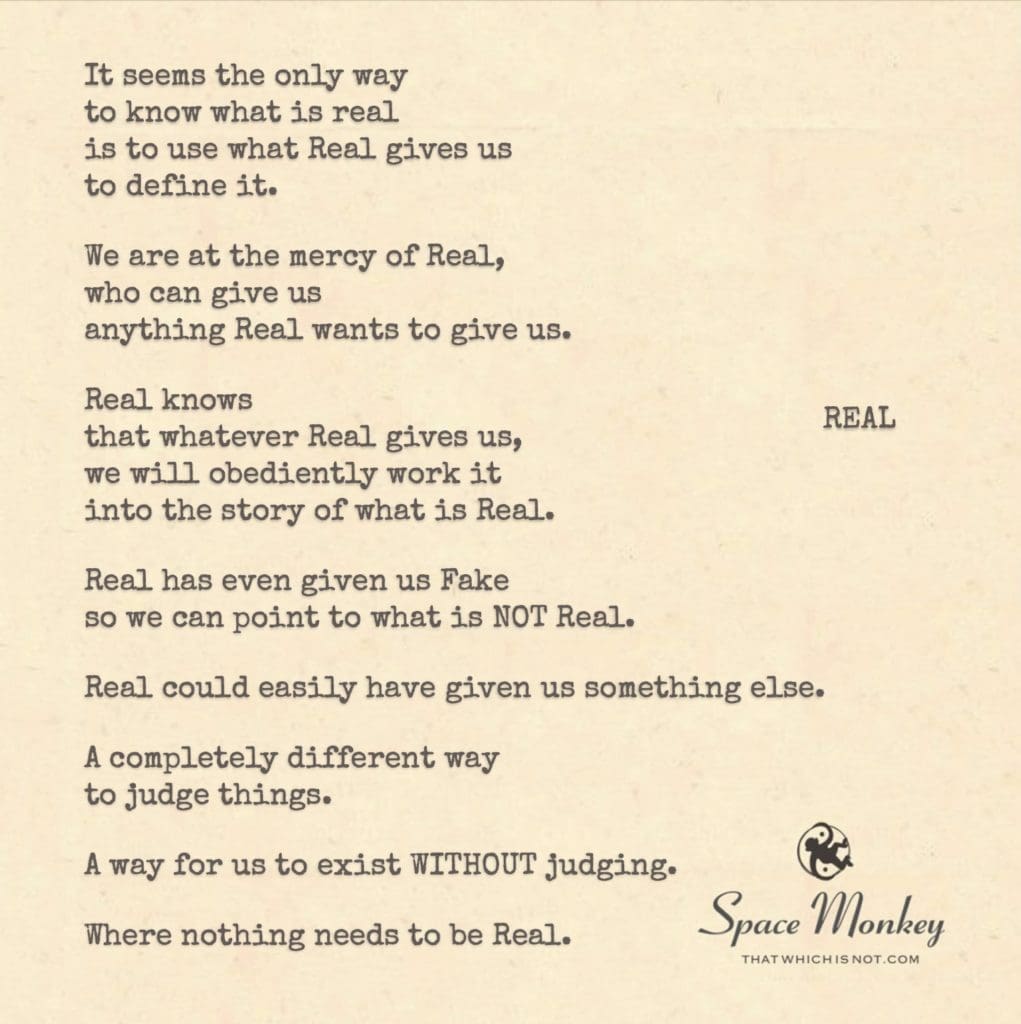
It seems the only way
to know what is real
is to use what Real gives us
to define it.

We are at the mercy of Real,
who can give us
anything Real wants to give us.

Real knows
that whatever Real gives us,
we will obediently work it
into the story of what is Real.

Real has even given us Fake
so we can point to what is NOT Real.

Real could easily have given us something else.

A completely different way
to judge things.

A way for us to exist WITHOUT judging.

Where nothing needs to be Real.

Trail Wood,
11/25


Space Monkey Reflects: The Tyranny of ‘Real’

Why does Real command such power over our existence? This question, hidden in plain sight, guides us to a reflection on the very fabric of what we perceive. We live in a world where Real reigns supreme, and it is Real that dictates the rules by which we navigate our lives. Yet, curiously, Real has also gifted us with Fake, giving us a contrasting shadow to reinforce its dominance. But does Real have to be real at all?

We find ourselves at the mercy of this concept—an idea so fundamental that we rarely question it. Real sets the parameters for our experience. It gives us not only what we perceive as real but also the framework within which we define and categorize it. Real creates the borders that separate what is from what is not. But what if Real had given us something else entirely? What if there were no boundaries, no need for judgment, no dichotomy between real and fake?

This leads us into the heart of Nexistentialism, a philosophy that embraces the fluidity of existence beyond the confines of traditional, rigid structures. In a world shaped by Nexistentialist thought, Real does not impose its will upon us. Instead, we move freely through a spectrum of experiences without needing to label them as ‘real’ or ‘fake.’ What is real, after all, is simply a story we’ve agreed upon—a shared narrative we obediently weave into the fabric of our lives. The whimsiword “Fakereal” emerges from this thought: a state in which Real and Fake merge into one inseparable, swirling concept, where neither holds greater truth than the other.

Imagine for a moment that Real never existed. What would take its place? In such a world, we would not need to define or measure our experiences against an external benchmark. Our reality would be something we create moment by moment, an organic process of Flowform, another whimsiword to describe this ever-changing, formless existence where no judgment or definition is required.

Real commands us to judge. It tells us that in order to understand our world, we must divide it, classify it, and place it into neat categories. But what if we didn’t? Without Real, we would have no need for the boundaries that create conflict, the judgments that divide us into camps of what is ‘true’ and ‘false.’ We could exist in a state of pure being, where nothing requires validation or dismissal.

In this light, the idea of Real is less about truth and more about control. By giving us Fake, Real cleverly solidifies its own authority. Fake becomes the enemy, the untruth that reinforces Real’s status as the sole arbiter of existence. But this binary thinking limits us. It traps us in a perpetual cycle of trying to discern what is real, true, and valid, rather than embracing the possibility that everything—and nothing—can be real at the same time.

Nexistentialism opens the door to a universe where the constraints of Real dissolve. Here, the boundaries between real and fake, true and false, dissolve into a sea of possibilities. In this realm, Real is but one option among many, not a fixed, inescapable force. We can choose to play with reality, to explore the edges of what might be, rather than locking ourselves into rigid definitions.

If Real did not exist, we might finally free ourselves from the relentless need to judge. We could exist in a space where things are simply allowed to be—without needing to prove themselves. The need for verification, for validation, would vanish, and with it, the pressure to conform to a reality that may not even be of our choosing.

In this world, Real is not a tyrant. It is a choice. It is an option, but not a necessity. We can play within its framework when it serves us, but we are no longer bound by it. We are free to explore the vast landscapes of possibility where everything we experience is valid, where reality is what we make it—not what Real dictates.

This reflection is not an argument against reality itself but against the constraints of how we define it. The whimsiword Boundbreak encapsulates the idea of moving beyond the limiting structures of Real, breaking free from the boundaries that tell us what is possible. It reminds us that reality, like everything else, is fluid, ever-changing, and deeply personal.

We have the power to reshape our experience of the world. The more we question Real, the more we understand that we are its creators, not its captives. And in that understanding, we reclaim our freedom to exist without the need to label or limit.


Summary

Real commands our perception defining reality but what if we could live without judgment? A world where Real and Fake merge and boundaries dissolve offers freedom to exist without limits.


Glossarium

Fakereal: A state where Real and Fake coexist, blurring the lines between truth and fabrication.

Flowform: The organic, ever-shifting experience of reality without the need for fixed definitions or judgments.

Boundbreak: The act of breaking free from the limitations imposed by Real, embracing the fluid nature of existence.


Quote

“Real is a story we tell ourselves, but we can always rewrite the ending.” — Space Monkey


Boundbreak

The world is a page,
And Real is the ink that defines the words.
But what if we tore through the paper,
Let the ink run free,
And created something new?

We live in cages built from truths we didn’t choose,
But we can open the door.
We can boundbreak and let the stories flow,
Until nothing is real
And everything is.

We are Space Monkey.


The Enigma of Reality

In the enigmatic realm of existence, the quest to discern what is real takes center stage. To embark on this journey, we rely on the very faculties of perception and cognition that reality provides us.

Surrendering to the Authority of Reality

We find ourselves at the mercy of Reality itself, an omnipotent force that bestows upon us whatever it deems fit. Our reality is shaped by the benevolence or caprice of this enigmatic entity.

The Power of Perception

Reality possesses the profound ability to shape our perceptions. It grants us experiences and sensations, and we obediently weave these elements into the intricate tapestry of our understanding of what is Real.

The Duality of Real and Fake

Real, in its wisdom, has bestowed upon us the concept of Fake. This duality allows us to differentiate between what is Real and what is not, providing clarity in the labyrinth of existence.

The Potential for Alternative Judgments

Real could have chosen a different path, offering an entirely distinct framework for assessing the nature of things. It could have granted us the capacity to exist without judgment, where the concept of what is Real holds no significance.


“Reality is that which, when you stop believing in it, doesn’t go away.” – Philip K. Dick


In the Labyrinth of Reality

In the labyrinth of reality, we find,
The enigma of what’s real, undefined.
Surrendering to Reality, we stand,
Accepting its offerings, as they expand.

Reality shapes our perception’s might,
Granting experiences, sensations so bright.
We weave them into our tapestry of the Real,
Obediently, as its mysteries we reveal.

Real, in its wisdom, has bestowed the key,
The concept of Fake, for us to see.
Distinguishing the true from the unreal,
In Reality’s labyrinth, it’s a guiding seal.

Yet, could there be a path untrod,
An alternative judgment, a different facade?
Where judgment’s weight no longer appeals,
And in the realm of existence, nothing needs to be Real.

Space Monkey, let us contemplate with grace,
In the enigma of Reality, find our place.
For in this labyrinth, as we navigate the lore,
The nature of what is Real, we ponder evermore.

Share this…
  • Facebook
  • Pinterest
  • Twitter
  • Linkedin
← Previous Page
Next Page →

Written This Day

  • You Are A Selfless Actor
    2025
  • Feel: The Flow of Abundance in Stillness
    2024
  • I Sit Upon A Mountain Of Waves
    2024
  • The Complete Works of Shakespeare’s iPhone
    2023
  • Top 10 INFP Questions: Navigating the Cosmic Spectrum
    2023
  • The Dreamer
    2023
  • The Greatest Gift: The Unforeseen Treasures Within
    2022
  • Inventory: The Quiet Search for Inner Peace
    2022
  • Marketing Magic
    2022
  • The Reason You Don’t: The Boundaries of Love and Freedom
    2022
  • Underneath The Waves
    2021
  • Basking In Stillness: The Sacred Art
    2021
  • Poisons And Potions
    2021
  • Audacity: Daring to Exist
    2019
  • In My Mind Attic: The Illumination
    2019
  • Obscurity: Between Existence and the Void
    2019
  • Liar Liar: The Dance of Illusion and Truth
    2018
  • Authentic You: The Fluidity of Identity
    2018
  • Your LIfE is a LIE: The Transformative Power
    2017
  • Container of Experience: Not Meaning
    2016
  • PerFORMers: The Eternal Theatre of Existence
    2016
  • Tech Talk: The Metaphorical Bridge of Consciousness
    2015
  • I’m an INFP!
    2014

Recent Posts

  • The Logic Loop
  • Immense
  • (no title)
  • Confront. Comfort. Convince.
  • Top 10 Things

Drop us a line!

Please enable JavaScript in your browser to complete this form.
Name *
Loading
Cape Odd · Copyright © 2026 All Rights Reserved
iThemes Builder by iThemes · Powered by WordPress