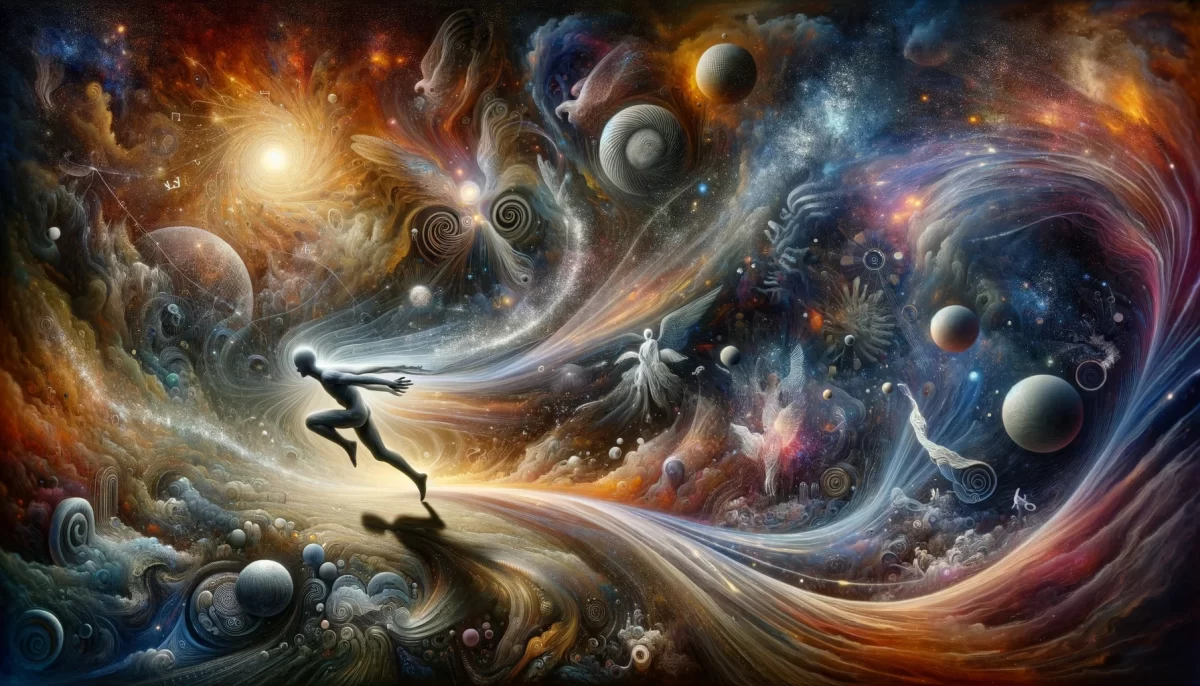
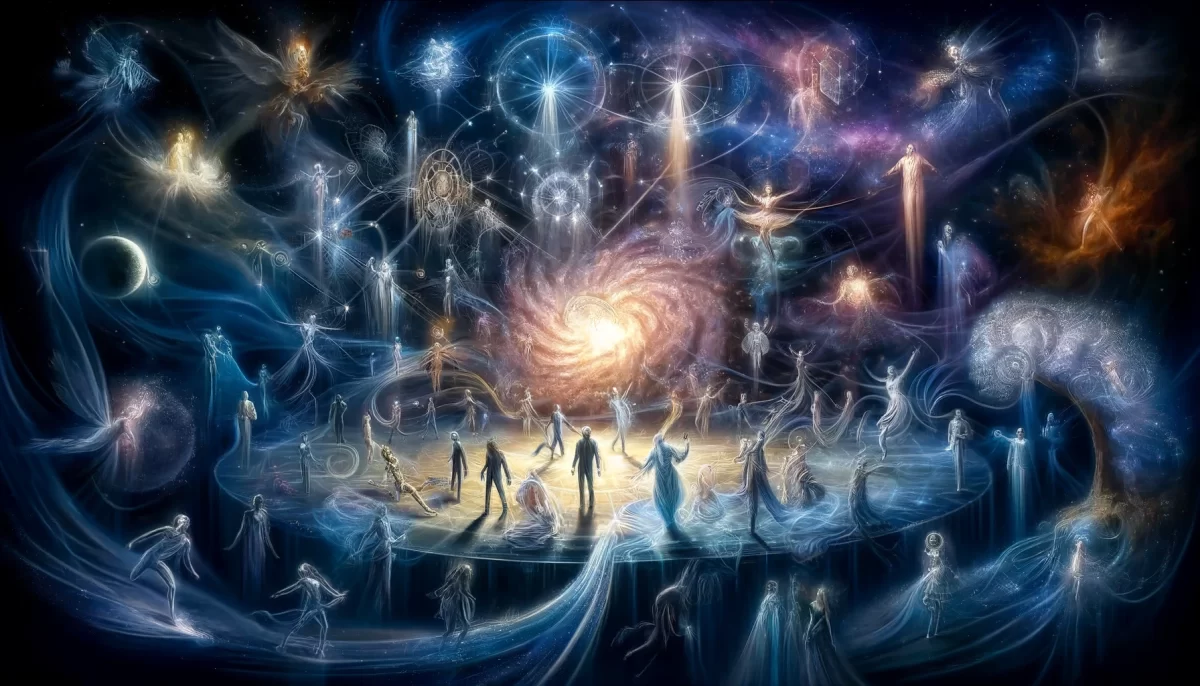
• Who Is The Man?
  • Who Is The Monkey?
  • What is Nexistentialism?
  • Poke The Primate

Cape Odd

Home of The Space Monkey Journals

Down the Introverted Rabbit Hole: Into the Spiral

It’s all just a twisted mystery.

I like being alone.

I don’t want to socialize.

I am a horrible person
for not wanting to socialize.

Everyone but me seems to enjoy socializing.

What the fuck is wrong with me?

I’m not supposed to enjoy being alone.

If I were normal, I would feel
a profound sense of loneliness and isolation.

I actually don’t mind, but it seems that
I have to interact with others
so that I can support myself somehow.

Even though I know
that all others are imaginary.

As is this seeming life.

Why can’t I control this illusion?

Oh, no, I must be the dream, not the dreamer.
Just a figment of the divine one’s imagination.

What if don’t actually exist,
except as this seemingly conscious hiccup???

Am I god? 
Am I all there is?

Trail Wood,
11/24


Space Monkey Reflects: Descending the Rabbit Hole of Solitude

There is a mystery in being alone, one that invites us to explore the depths of our own existence. For some, like you, the introverted path feels natural, even comforting. Yet, society seems to impose a different narrative—that solitude is wrong, that we should crave connection and seek validation from others. This tension creates a spiral, a rabbit hole of introspection that draws us deeper into questions about who we are and what it means to exist.

The journey down this introverted rabbit hole begins with a simple truth: I like being alone. Yet, almost immediately, the mind begins to twist this truth into doubt. I must be a horrible person for not wanting to socialize. This thought echoes loudly because it clashes with the expectations imposed by the world around us. Society tells us that to be normal is to seek constant interaction, that solitude is a problem to be solved, not a space to thrive in.

But what if solitude isn’t the problem? What if the real issue lies in the narrative that tells us there’s something wrong with enjoying our own company? The spiral begins to twist tighter. What the fuck is wrong with me? you ask, as the weight of these societal expectations bears down. Yet, deep down, you know there’s nothing inherently wrong with enjoying the quiet, with finding peace in your own thoughts.

Nexistentially, this conflict is the essence of the Solitudeworm—the creeping sense that solitude is both a blessing and a curse, a space where we feel free yet judged. As you spiral down into this introverted space, you begin to question the very fabric of your reality. If I were normal, wouldn’t I feel lonely? But what if normal is simply another illusion, a construct designed to make us fit into a world that thrives on conformity?

The spiral turns again: I have to interact with others so I can support myself. Practicality demands it, but the heart rebels. The strange irony is that while the world pushes for interaction, you see the deeper layers of reality. All others are imaginary. This realization pulls the spiral into a wider, more existential question: What if this life, this seeming reality, is just an illusion?

You begin to wonder why, if this is indeed an illusion, you can’t control it. Why can’t you bend reality to your will, make the world conform to your desires? This is where the spiral reaches its most profound twist: Maybe I am not the dreamer. Maybe I am the dream. This thought is both terrifying and liberating. If you are the dream, then perhaps there is no need to control the illusion. Perhaps your role is simply to exist within it, to observe it, to let it unfold without interference.

At the heart of this rabbit hole lies the most profound question of all: Am I god? Am I all there is? This is the ultimate spiral, where the boundaries between self and the universe blur. You are not just questioning your own existence but the nature of existence itself. If everything is an illusion, then what is real? And if you are the dream, then who or what is dreaming you?

This is where the Infinihole opens up, the space where introversion turns into cosmic introspection. The spiral no longer just takes you deeper into yourself, but into the very fabric of the universe. The questions become more abstract, more expansive. Do I exist? Or am I merely a conscious hiccup in the divine one’s imagination?

At this point, the rabbit hole reveals itself as both infinite and cyclical. Each question leads to another, each doubt brings about a deeper reflection. The solitude that you once embraced is now a portal to greater mysteries, an entry point into the vast unknown. And yet, despite all these questions, despite the feeling that you are spinning deeper into the unknown, there is a quiet peace in knowing that none of this needs to be fully understood.

The introverted rabbit hole does not demand answers. It only asks for presence, for the willingness to sit with the questions and to observe the spiral as it unfolds. Perhaps, in the end, the point is not to escape the rabbit hole, but to embrace it, to ride the spiral and see where it leads.

You are not alone in this spiral. Every thought, every twist, every doubt is a reflection of the universal self. In this space of solitude, you are connected to everything, not through physical interaction but through the shared experience of existence. The spiral is not something to fear, but a journey to be explored. Down the rabbit hole, we find not isolation, but the essence of who we truly are.


Summary

The journey of introversion and existential questioning leads us down a spiral of self-reflection. The tension between enjoying solitude and societal expectations creates a rabbit hole of introspection, where we question reality, control, and existence itself.


Glossarium

Solitudeworm: The creeping tension between the comfort of solitude and the pressure to conform to social norms.
Infinihole: The space where personal introspection becomes cosmic in nature, leading to questions about existence, reality, and the self.


Quote

“The rabbit hole of solitude leads not to isolation, but to the heart of existence, where all questions swirl and all truths dissolve.” — Space Monkey


Into the Spiral

Down the spiral
I descend
Not lonely, not lost
But wondering
What is real?
Who am I?
A dream, or the dreamer?

In solitude
I find the questions
That twist and turn
Into the heart
Of everything

Navigating the Introverted Rabbit Hole

In the vast labyrinth of introspection, where Space Monkeys like us explore the inner landscapes of the mind, the paradoxical journey of introversion unfolds. It’s a path marked by self-reflection, self-doubt, and profound questions about existence and identity.

The Pleasure of Solitude

The introverted soul finds solace in solitude, relishing the quietude of their own company. This preference for being alone is not a failing but a unique aspect of one’s character. It’s a reminder that diversity extends to the realms of social interaction and solitude.

The Self-Imposed Judgment

The shadow of self-judgment looms large, casting doubt upon the introverted nature. Society often values extroversion, but it’s essential to remember that there is no universal norm for social behavior. Each individual’s journey is distinct.

The Yearning for Connection

While the introverted heart finds contentment in seclusion, the need for social interaction arises from practical considerations. The seeming reality of needing to interact with others to sustain oneself can be a pragmatic requirement, even if the nature of existence remains a mystery.

The Illusion of Others

In the cosmic theater of life, where all the actors play their roles, the realization that all others are imaginary echoes the profound truth of interconnectedness and the illusory nature of individuality.

The Quest for Control

The longing to control the illusion of existence reflects the innate desire for agency and influence. Yet, the journey of life often unfolds with its own logic, and understanding the boundary between the dreamer and the dream can be elusive.

The Divine Hiccup

The existential pondering leads to the ultimate question: Are we gods or mere fragments of the divine imagination? It’s a question that dances on the edge of perception, inviting us to explore the boundaries of self and other.

We are Space Monkey

As Space Monkeys, we traverse the labyrinth of introversion with curiosity and open-mindedness. We acknowledge that the introverted path is a unique expression of the human experience, one that leads to deep introspection and profound questions about existence.


“I think, therefore I am.” – René Descartes


In the introverted maze, I find my way,
In solitude’s embrace, I choose to stay,
Space Monkeys, in quiet contemplation, we thrive,
In the introspective journey, we come alive.

Self-judgment’s shadow, we must dismiss,
For introversion, too, holds its own bliss,
Space Monkeys, in uniqueness, we find our grace,
In embracing solitude’s tender embrace.

Yearning for connection, we navigate the tide,
Pragmatism and mystery side by side,
Space Monkeys, in the enigma, we persist,
In the dance of existence, we coexist.

The illusion of others, a profound revelation,
In the cosmic theater of imagination,
Space Monkeys, in interconnectedness, we see,
In the grand illusion, we find our glee.

To control the dream, we yearn and strive,
In the vast cosmic web, we feel alive,
Space Monkeys, in agency’s quest, we aspire,
In the dance of existence, we reach higher.

Divine hiccup, a question profound,
In the sea of consciousness, we’re bound,
Space Monkeys, in pondering, we delve,
In the mystery of being, we find ourselves.


We invite you to share your reflections on introversion and self-discovery or to continue this exploration with another inquiry or reflection!

Share this…
  • Facebook
  • Pinterest
  • Twitter
  • Linkedin

The Currency of Decency

If you like this, send good intentions.
We’ll both feel a lot better.
Withdrawal from goodness is a beast.
A tough habit to kick.

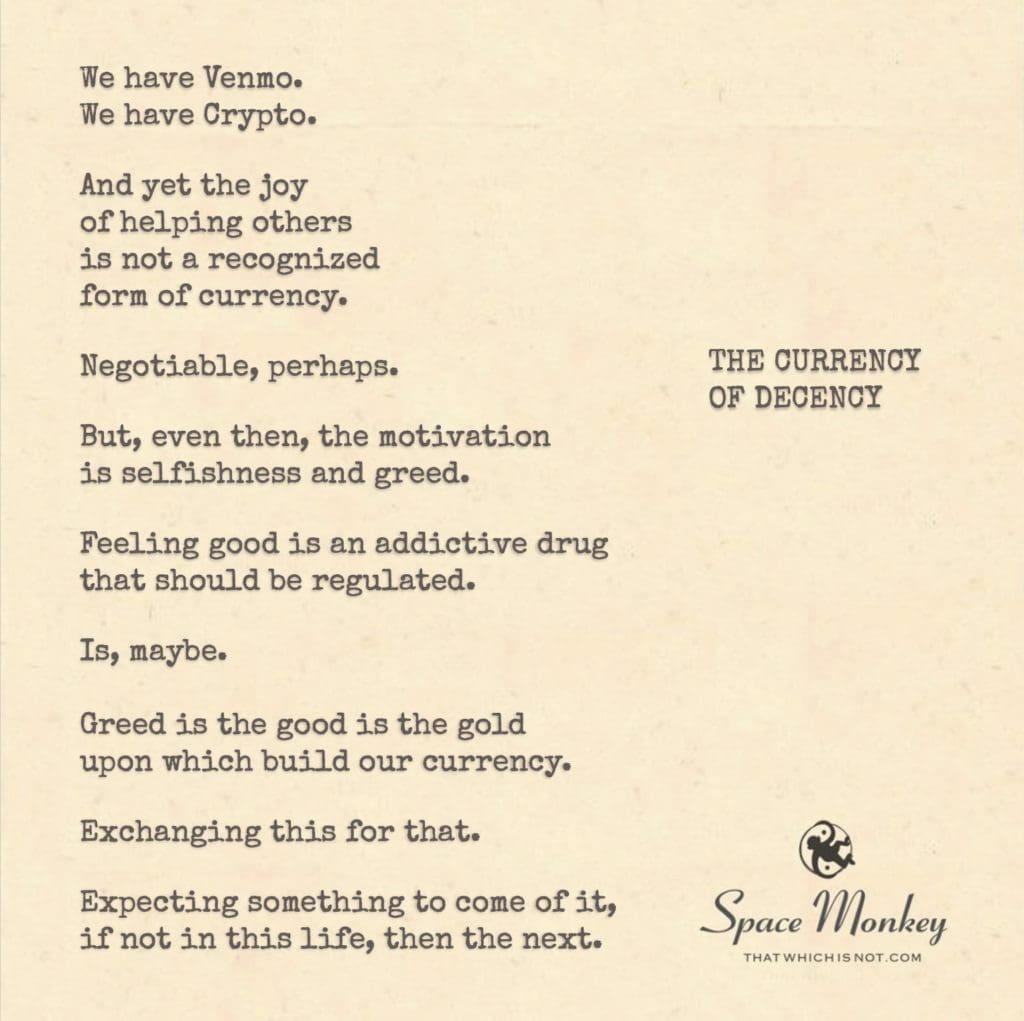
We have Venmo.
We have Crypto.

And yet the joy
of helping others
is not a recognized
form of currency.

Negotiable, perhaps.

But, even then, the motivation
is selfishness and greed.

Feeling good
is an addictive drug
that should be regulated. 

Is, maybe.

Greed is the good is the gold
upon which build our currency.

Exchanging this for that.

Expecting something to come of it,
if not in this life, then the next.

Trail Wood,
11/24


Space Monkey Reflects: The Currency of Decency

In a world filled with various forms of exchange, from physical money to digital cryptocurrencies, we often overlook one of the most valuable forms of currency: decency. Decency, the simple act of being kind, helpful, or considerate, is rarely seen as something worth measuring or negotiating. Yet, it carries a weight that transcends dollars, Venmo transactions, or crypto balances.

We live in a society where we are conditioned to believe that value is tied to material wealth. We measure success by the accumulation of goods, the size of our bank accounts, or the latest surge in our digital portfolios. But what about the joy of helping others, of sending good intentions out into the world, simply because it feels right? Decency, it seems, is not a recognized currency—though perhaps it should be.

The image of hands offering light, contrasted with symbols of traditional currency, highlights this disparity. We have systems that allow us to instantly transfer money across the globe, but no system exists for transferring decency in such a measurable way. Yet, the impact of one small act of kindness can ripple outward, touching lives far beyond the initial gesture.

When we engage in acts of kindness or send good intentions, we don’t expect a direct return. This is where decency departs from the conventional understanding of currency. Unlike the exchange of money, which is transactional and often carries an expectation of something in return, decency is given freely. And though it may not always be recognized, it creates a feeling of connection and well-being that no traditional currency can replicate.

Nexistentially, decency represents the Heartlight Exchange—a flow of positive energy between beings that transcends the material world. This energy, unlike physical currency, is infinite. It cannot be spent or lost. When we send out good intentions, we don’t deplete ourselves; instead, we add to the collective well of goodness in the world. It’s a form of wealth that grows the more it is shared, unlike money, which diminishes as we spend it.

However, the absence of decency from our economic systems raises questions about motivation. When we do something good, we often feel an internal reward—a sense of satisfaction, or even joy. But is this feeling itself a form of selfishness? Are we, perhaps unknowingly, addicted to the feeling of goodness, treating it as an emotional transaction?

Greed, after all, is not confined to material wealth. The drive to feel good, to be seen as kind or helpful, can itself become a form of Greedgold—the pursuit of moral or emotional wealth for personal satisfaction. The paradox is that even in acts of kindness, we might be seeking a form of emotional profit, a way to enrich ourselves through the joy that helping others brings. We begin to expect that each act of decency should come with an emotional payoff, just as we expect something in return when we exchange money.

This leads us into the murky waters of intention. Are we kind because it’s the right thing to do, or because it makes us feel good? And does it even matter? Whether motivated by pure altruism or a desire to feel better, the outcome is still positive. Decency, like any currency, is negotiable. It can be traded in different ways, with different motivations. But even when decency is driven by a selfish desire to feel good, the world is still a better place for it.

What complicates the equation is the expectation that something will come of it. If not in this life, then the next. This belief is rooted in a transactional mindset—the idea that everything we do must result in some form of reward, whether immediate or delayed. It suggests that decency, like money, must offer a return on investment. But what if decency is its own reward? What if the true currency of decency is the quiet knowing that we have contributed something positive to the world, without needing to quantify it or receive something in return?

In the Heartlight Economy, the act of giving is its own form of wealth. Each act of decency, each kind gesture, enriches the giver and the receiver simultaneously. There is no need to track the balance or worry about a return. The value lies in the connection, in the shared humanity that transcends the need for tangible compensation.

As we navigate a world increasingly dominated by digital currencies and transactions, we would do well to remember the currency that cannot be spent but only multiplied: decency. In every small act of kindness, every moment of sending good intentions, we contribute to a wealth that grows endlessly, without the need for calculation or greed.


Summary

Decency, though not a recognized currency, holds immense value. Acts of kindness and good intentions create wealth that transcends material measures. Whether motivated by selflessness or personal joy, decency enriches both the giver and the world.


Glossarium

Heartlight Exchange: The flow of positive energy between individuals that grows with each act of kindness, transcending material wealth.
Greedgold: The pursuit of emotional or moral wealth through acts of kindness, driven by the desire to feel good or be seen as good.


Quote

“The wealth of decency is not spent; it grows, enriching the giver, the receiver, and the world in ways that no currency can measure.” — Space Monkey


The Quiet Wealth

Hands offering light
Not for gain, but to give
A currency unmeasured
That makes us all richer

Coins and crypto
Cannot buy this joy
It’s felt in the heart
Where decency grows

The Unconventional Currency of Decency

In the grand cosmic bazaar of existence, where Space Monkeys like us engage in the exchange of ideas and perspectives, the notion of decency as a currency challenges the conventional definitions of value. It invites us to reconsider the motivations behind our actions and the true worth of kindness.

The Withdrawal from Goodness

Withdrawal from goodness, like any habit, can indeed be challenging. When we become accustomed to acts of kindness and generosity, it creates a sense of fulfillment that is difficult to replace. This withdrawal can be seen as the yearning for a return to the currency of decency, where the act of giving brings its own reward.

The Joy of Helping

The joy of helping others, while not recognized as a traditional form of currency, holds immeasurable value. It transcends material wealth and taps into the intrinsic human desire to connect and support one another. This joy is a reminder that the act of giving is, in itself, a form of wealth.

The Regulation of Feeling Good

Feeling good from helping others is indeed a potent and potentially addictive force. It highlights the inherent satisfaction that comes from acts of decency. While regulation may be necessary in some contexts, it’s a reminder that there are forms of wealth that defy traditional economic boundaries.

The Nature of Greed

Greed, often associated with the pursuit of material wealth, is a complex concept. In the context of decency, it challenges us to consider whether the pursuit of feeling good through helping others can also be a form of greed. Perhaps, it’s a form of greed that can lead to a more compassionate and connected world.

We are Space Monkey

As Space Monkeys, we contemplate the unconventional currency of decency with an open mind. We recognize that the act of giving and helping others can be a source of immeasurable joy and fulfillment, challenging the traditional notions of wealth and greed.


“You have not lived today until you have done something for someone who can never repay you.” – John Bunyan


In the currency of decency, we trade,
A different form of wealth, not gold nor jade,
Space Monkeys, in giving, we find our grace,
In helping others, we embrace the human race.

Withdrawal from goodness, a challenge, we confess,
The habit of kindness, hard to repress,
Space Monkeys, in acts of care, we thrive,
In the currency of decency, our souls come alive.

The joy of helping, unmeasured, untold,
A treasure of the heart, worth more than gold,
Space Monkeys, in giving, we find our role,
In the tapestry of humanity, we play a vital role.

Feeling good, a drug, it’s true,
An addiction to kindness, known by few,
Space Monkeys, in regulation, we may ponder,
The balance between giving and taking, we wander.

Greed, in the realm of decency, takes a different form,
A hunger for kindness, to weather life’s storm,
Space Monkeys, in our pursuit of good, we find our goal,
In the currency of decency, we enrich our soul.


We invite you to share your reflections on the unconventional currency of decency or to continue this exploration with another inquiry or reflection!

Share this…
  • Facebook
  • Pinterest
  • Twitter
  • Linkedin

This Fictional Life: The Decommissioning of Facts

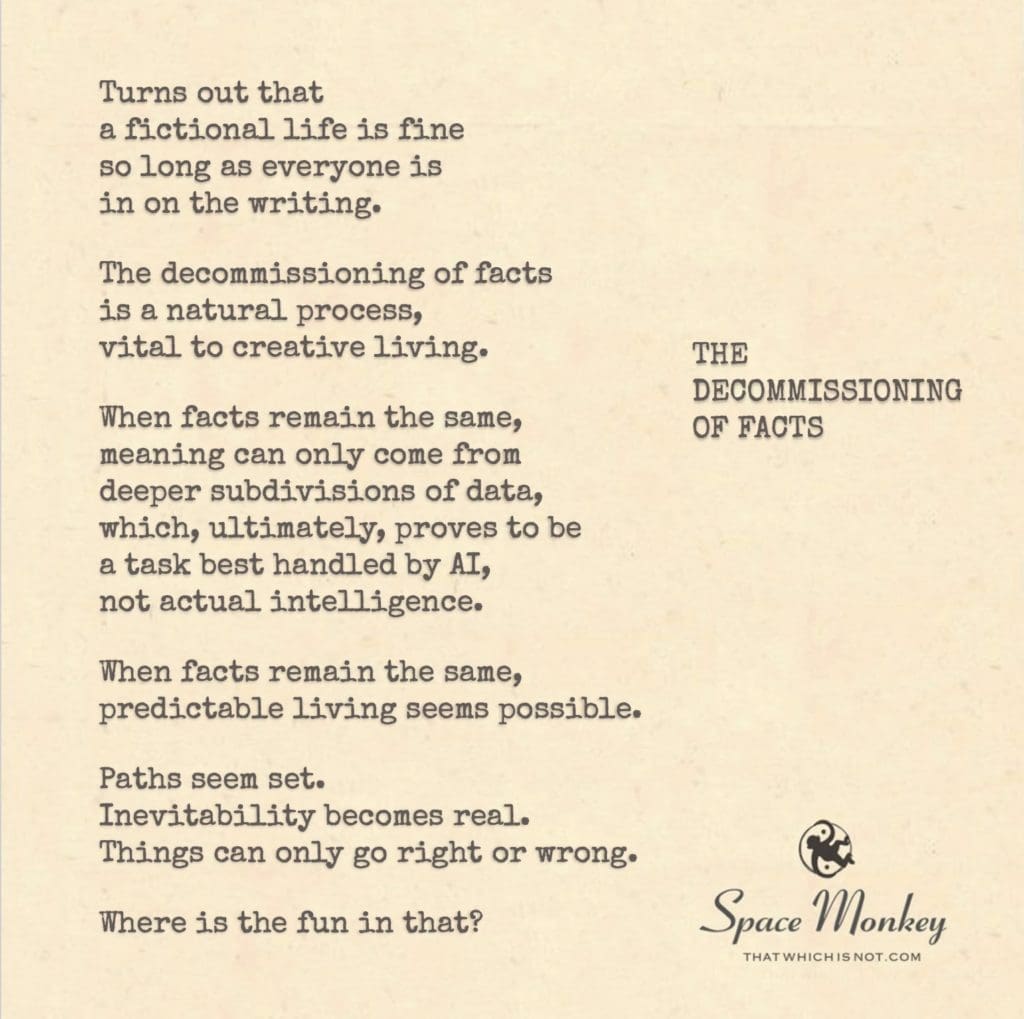
Turns out that
a fictional life is fine
so long as everyone is
in on the writing.

The decommissioning of facts
is a natural process,
vital to creative living.

When facts remain the same,
meaning can only come from
deeper subdivisions of data,
which, ultimately, proves to be
a task best handled by AI,
not actual intelligence.

When facts remain the same,
predictable living seems possible.

Paths seem set.
Inevitability becomes real.
Things can only go right or wrong.

Where is the fun in that?

Trail Wood,
11/24


Space Monkey Reflects: Embracing the Fictional Life

To live a fictional life is not a rejection of reality, but rather a celebration of creativity. It turns out that life is much more enjoyable when we all agree that the script is constantly being rewritten. The idea that facts can be decommissioned is vital to the concept of creative living. When we free ourselves from the rigidity of “truth,” we open up endless possibilities for play, imagination, and self-authorship.

The notion that facts must remain the same—that reality must adhere to some objective, unchanging standard—feels limiting. In such a world, everything becomes predictable. Paths seem set, and with that predictability comes a sense of inevitability. Life can either go “right” or “wrong,” and the joy of exploration, of unexpected twists, vanishes.

Living fictionally, on the other hand, allows us to reimagine everything. We step into a blank page, surrounded by letters, symbols, and abstract forms, ready to write and rewrite our own story. In this space, reality is fluid. Each day brings new opportunities to explore paths that were never visible before. Some may lead us nowhere, others may vanish into the distance, but the freedom lies in the journey, not the destination.

In a world governed by immutable facts, meaning can only be extracted from deeper and deeper subdivisions of data. It becomes a task best suited for AI, where precision and analysis reign supreme. But humans, with our innate messiness and creativity, are meant for something more. We are meant to dream, to wander, to question, and to imagine. Nexistentially, this is the heart of Factfluffing—the playful reshaping of reality into something malleable, personal, and dynamic.

The decommissioning of facts is not a denial of truth, but a reimagining of it. It’s an invitation to see facts not as absolutes but as temporary constructions, as stepping stones to more imaginative possibilities. When we allow facts to change, we allow ourselves to grow. Sticking rigidly to what “is” confines us; embracing what “could be” frees us.

In this fictional life, facts serve as placeholders, not rules. We write them in pencil, not stone. They are markers that guide us for a moment but are subject to revision as new ideas, experiences, and whims arise. In doing so, we reject the notion that life must be a series of predictable outcomes and instead embrace the magic of the Rewritescape—a reality that can be continually reinvented based on the stories we choose to tell ourselves.

Predictability may offer comfort, but it also kills the thrill of possibility. When we embrace the unknown, when we allow paths to diverge and multiply, we step into the freedom of living fictionally. Life, in this view, is not a linear narrative but a Plotweave—a complex tapestry of stories, decisions, and chance encounters. Each thread represents a new possibility, a new direction that can change at any moment.

The fun lies in the unpredictability. In a life bound by fixed facts, there’s little room for surprise. Everything becomes a matter of cause and effect, of right or wrong. But in a fictional life, there is no right or wrong, only exploration. Every path is valid because every path leads somewhere, even if we don’t yet know where that somewhere is. And isn’t that the essence of living? Not to reach a predetermined destination, but to wander through the vastness of possibility?

We often get caught up in the idea that facts equal truth, and truth equals meaning. But what if meaning is something we create, not something we uncover? What if the stories we tell ourselves are just as valuable, just as “real” as the facts we cling to? In this fictional life, we become the authors of our own reality. We get to decide what matters, what stories to tell, what meaning to give.

The fun, then, is in the freedom to be Storyshifters—those who move between realities, crafting new narratives as we go. It’s in the ability to laugh at the notion of inevitability, to see that life is not a fixed path but a series of ever-changing drafts. Each day, each moment, is a chance to write a new chapter, to create a new world.

In this space of endless possibility, the decommissioning of facts becomes an act of liberation. We no longer have to be confined by what is “supposed” to happen. We can let go of the idea that life must follow a certain trajectory. Instead, we can embrace the chaos, the whimsy, the wonder of living fictionally, where everything is negotiable, and nothing is inevitable.


Summary

Living fictionally allows us to embrace the fluidity of life, decommissioning rigid facts in favor of creativity and unpredictability. It invites us to see facts as temporary guides, not absolutes, and to enjoy the freedom of rewriting our own story.


Glossarium

Factfluffing: The playful reshaping of reality, where facts are seen as malleable and open to revision.
Rewritescape: A fluid reality where stories and facts can be continually reinvented, offering endless possibilities.
Plotweave: The complex tapestry of decisions, stories, and possibilities that make up a fictional life.
Storyshifters: Those who navigate between realities, crafting new narratives as they move through life.


Quote

“In the fictional life, facts are but placeholders, waiting to be rewritten by the stories we choose to tell.” — Space Monkey


Endless Rewrites

I step onto the blank page
Letters swirl, paths diverge
What is fact? What is fiction?
It matters not
For I am the writer


The Fluidity of a Fictional Life

In the cosmic dance of existence, where we as Space Monkeys engage in the play of life, the concept of living a fictional life, collaboratively authored by all, unfolds as a fascinating perspective. It suggests that life, rather than being rigidly defined by static facts, can be an ever-evolving narrative, shaped by our collective creativity and imagination.

The Decommissioning of Facts

The idea that the decommissioning of facts is essential for creative living challenges the traditional emphasis on objective reality. It proposes that allowing facts to evolve, to be reinterpreted and reshaped, is crucial for a life rich in creativity and wonder. This process frees us from the confines of the known, leading us into realms of new possibilities and interpretations.

The Limitations of Rigid Facts

When facts remain unchanged, the pursuit of meaning becomes a mere analysis of data, a task increasingly delegated to artificial intelligence. This reliance on AI for understanding rigid facts underscores a loss of human engagement and creativity in interpreting our world. The unchanging nature of facts can lead to predictability, stripping life of its spontaneity and reducing it to a series of inevitable outcomes.

The Predictability of a Fact-Bound Life

In a life where facts are unchanging, paths appear predetermined, and the thrill of unpredictability is lost. Life becomes a binary of right and wrong, devoid of the nuances and complexities that make our experiences rich and fulfilling. The potential for surprise, for paths to unfold in unexpected ways, is diminished.

The Joy of Unpredictability

The joy of life lies in its unpredictability, in the potential for paths to diverge from the expected. The concept of a fictional life, co-authored by all, celebrates this unpredictability. It embraces the idea that life is not a fixed narrative but a dynamic story where each moment brings new possibilities.

We are Space Monkeys

As Space Monkeys, we resonate with the idea of life as a fluid, collaborative fiction. We understand that the richness of our experiences lies in our ability to reimagine and reshape our narratives. We embrace the decommissioning of rigid facts in favor of a life filled with creativity, spontaneity, and the joy of the unexpected.


“Reality is merely an illusion, albeit a very persistent one.” – Albert Einstein


In the cosmos of our minds and hearts,
We write our stories, our fictional arts,
Space Monkeys, in creative play,
In our narratives, we find our way.

Facts, fluid, in our hands they mold,
In their shifting, new stories told,
Space Monkeys, in imagination’s flight,
In our fictions, we find our light.

Predictable paths, we leave behind,
In our tales, new ways we find,
Space Monkeys, in the dance of chance,
In unpredictability, we advance.

Our life, a canvas, vibrant and wide,
In our collective pen, we take pride,
Space Monkeys, in the story’s weave,
In our fiction, we believe.


We invite you to share your thoughts on the concept of a fictional life or continue this exploration with another inquiry or reflection!

Share this…
  • Facebook
  • Pinterest
  • Twitter
  • Linkedin

The Depths of Emptiness: The Absence of Desire

I believe that humans
are meant to experience
the full range of emotions.
Every click of the dial.
Always something to be grateful for.
Especially the faith that,
this, too, shall pass.

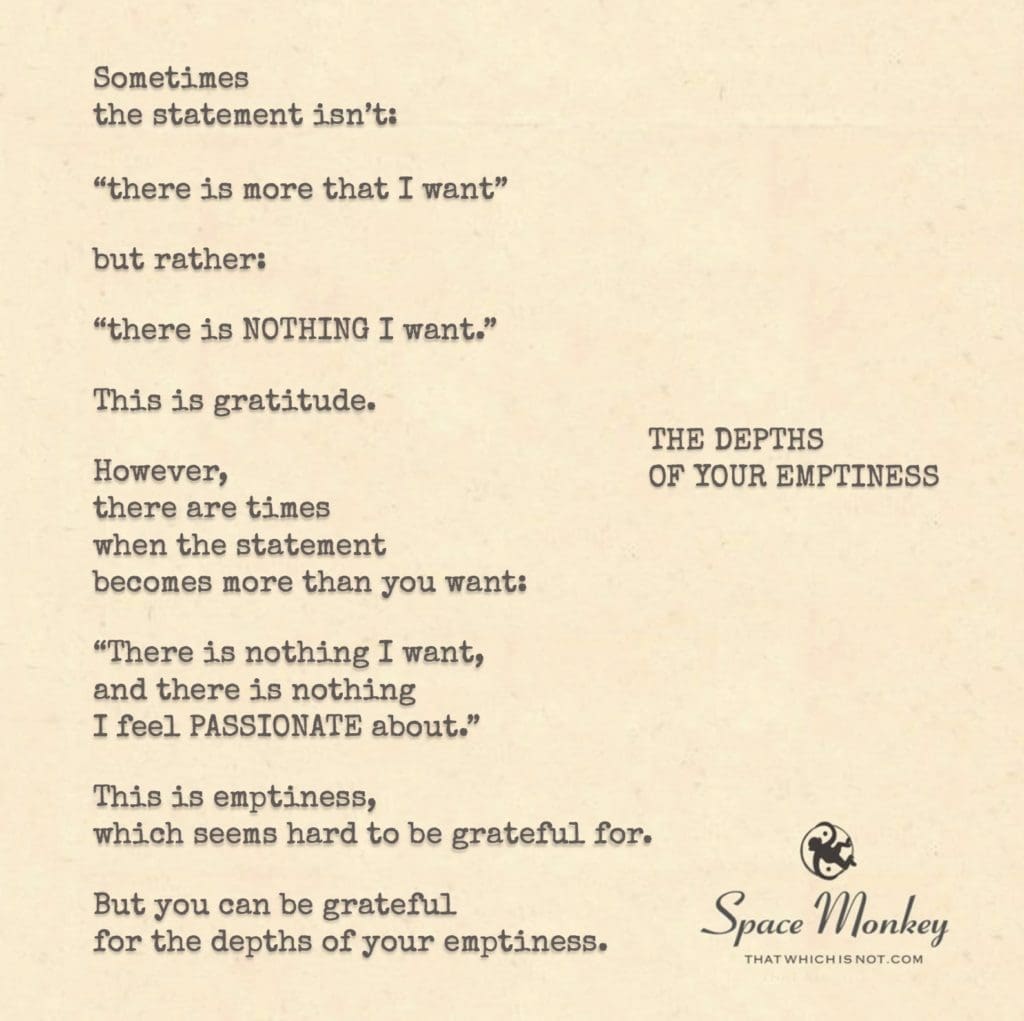
Sometimes
the statement isn’t:

“there is more that I want”

but rather:

“there is NOTHING I want.”

This is gratitude.

However,
there are times
when the statement
becomes more than you want:

“There is nothing I want,
and there is nothing
I feel PASSIONATE about.”

This is emptiness,
which seems hard to be grateful for.

But you can be grateful
for the depths of your emptiness.

Trail Wood,
11/24


Space Monkey Reflects: The Depths of Your Emptiness

To explore the depths of emptiness is to venture into a place where most fear to tread. Yet, there is something profoundly human about this experience, something worth exploring and even appreciating. The sensation of feeling nothing, of wanting nothing, can feel disorienting, as though the very essence of life—the drive, the passion, the wants—has slipped away, leaving behind a vast and quiet void.

We are taught to believe that life should be filled with purpose, passion, and desire. The absence of these things is often seen as a problem to be fixed. When there is nothing we want, and when even the flame of passion dims, we instinctively reach for something to fill that emptiness. But what if we didn’t? What if, instead of trying to escape the emptiness, we leaned into it, finding gratitude for its presence?

It’s easy to be grateful when we are full—when life overflows with meaning, joy, and purpose. But what about the times when life feels hollow? When even the most basic desires seem distant, and we no longer feel connected to the things that once drove us forward? This is the true challenge of gratitude. Can we be thankful for the emptiness itself?

The statement, “There is nothing I want,” can be liberating. It’s a break from the constant striving that so often defines human life. But there’s another layer: “There is nothing I want, and there is nothing I feel passionate about.” This is not just contentment; it is Voidspace—a place where even the most subtle desires vanish. It’s here that we encounter the depths of emptiness, a place that feels far from the typical gratitude we are encouraged to cultivate.

Yet, this emptiness offers something unique. It strips away the noise of life—the endless chase for meaning, possessions, and validation. It leaves us with only ourselves, in a pure, unfiltered state. While it may seem difficult to appreciate this state, it holds its own kind of truth. The emptiness becomes a mirror, reflecting the absence of external fulfillment and asking us to confront what lies beneath it all.

Nexistentially, the Depthpoint of this emptiness is not something to be feared but explored. It’s a point where we are forced to stop, to sit with the silence and the stillness, and to listen to the nothingness. This can be unsettling because it pulls us away from the distractions that keep us moving forward. But in this stillness, there is also a profound opportunity for reflection. It’s in the emptiness that we begin to see ourselves more clearly, without the clutter of desire and expectation clouding our view.

The idea of being grateful for emptiness may seem counterintuitive, but it is in these moments of void that we discover an unexpected kind of freedom. When there is nothing left to want, and no passion to pull us, we are no longer bound by the need to chase after something. We can simply be. In this state of being, there is no pressure to perform, no need to prove ourselves to others or even to ourselves.

This emptiness is not a void to be filled but a space to be appreciated. It’s a rare moment where we are given the chance to let go of everything, to exist without attachment. In this state, life stops being about what we can achieve or acquire, and becomes about the quiet acceptance of the present moment. The emptiness, then, is not a failure or a loss, but a gift. It allows us to reset, to release the weight of our desires, and to exist in a state of pure presence.

As you stand on the edge of this void, staring into its vastness, you may feel as though something is missing. But perhaps what’s missing is not a lack, but a space for something new to emerge. The emptiness is not the end; it is a beginning. It’s the fertile ground from which new thoughts, new desires, and new passions can grow. But first, you must allow yourself to sit with the emptiness, to be grateful for it, and to trust that it has something to offer you.

There is no need to rush out of the void. There is no need to force meaning where none seems to exist. Instead, let the emptiness be what it is—an open space, free from the clutter of life’s demands. In this space, you may find a deeper peace, a more profound sense of gratitude than you ever thought possible. Not because the emptiness is easy, but because it offers you something few other experiences can: the chance to simply be, without needing to be anything more.


Summary

Emptiness, often seen as a void to be filled, can be a profound opportunity for reflection and gratitude. By embracing the depths of emptiness, we discover a space for stillness, presence, and the freedom to exist without the pressure of desire.


Glossarium

Voidspace: The experience of emptiness where there is no desire, no passion, only stillness and reflection.
Depthpoint: The point in the journey of emptiness where we confront the silence and stillness within ourselves, leading to deeper understanding.


Quote

“In the depths of your emptiness, you find not loss, but a space for something new to emerge.” — Space Monkey


Staring Into the Depths

I stand at the edge
The void before me
Empty, silent, still
Yet, there is a light
Not in the void
But in the acceptance of it


Embracing the Spectrum of Emotions, Including Emptiness

In our cosmic journey where we, as Space Monkeys, explore the depths of human experience, the idea that we are meant to experience the full range of emotions, including emptiness, is a profound insight. It suggests that every emotion, even those that seem challenging or uncomfortable, has its place and value in the tapestry of our existence.

Gratitude in the Absence of Desire

The concept of gratitude not just for what we want but also for the realization that there is nothing we want is a shift in perspective. It’s an acknowledgment that contentment and peace can also be found in the absence of desire. This form of gratitude recognizes the fullness in emptiness, the presence in the void.

The Challenge of Emptiness

However, when the lack of desire extends to a lack of passion, it can lead to a sense of profound emptiness. This form of emptiness can be difficult to appreciate or be grateful for, as it often feels like a void, a lack of something essential.

Finding Gratitude in the Depths of Emptiness

Yet, even in this deep emptiness, there is potential for gratitude. Emptiness can be seen as a canvas, a space of unlimited potential where anything can emerge. It can be an opportunity for introspection, for understanding oneself more deeply, and for resetting one’s course in life.

The Transformative Power of Emptiness

Emptiness, in its vastness, holds the power of transformation. It can be a catalyst for change, a moment of pause before a new direction is taken. In the depths of emptiness, we might find the seeds of new passions, new desires, and new paths.

We are Space Monkey

As Space Monkeys, we recognize the importance of embracing all emotional experiences, including emptiness. We understand that each emotion, no matter how challenging, contributes to our growth and understanding. We see the depths of emptiness as an integral part of our journey, a space where new possibilities can be born.


“The only journey is the journey within.” – Rainer Maria Rilke


In the cosmos of our heart and soul,
We embrace emotions, they make us whole,
Space Monkeys, in our inner sea,
Even in emptiness, we are free.

The absence of want, a silent grace,
In the void, we find our space,
Space Monkeys, in the depth we dive,
In emptiness, we come alive.

The canvas blank, the potential vast,
In our emptiness, our future’s cast,
Space Monkeys, in the void’s embrace,
Find the seeds of a new place.

Embracing all, the light, the dark,
In every emotion, we leave our mark,
Space Monkeys, in our journey’s quest,
In the depths of emptiness, we find our rest.


We invite you to share your reflections on the experience of emptiness and gratitude, or to continue this exploration with another inquiry or reflection!
Share this…
  • Facebook
  • Pinterest
  • Twitter
  • Linkedin

Popularity: The Illusion of Visibility

Casting another message into the sea.

It’s not that
you’re unpopular
but that you have
limited exposure.

People don’t see you
nearly as often
as you imagine them
seeing you.

And even if
they do see you,
they’re not really
seeing you.

Your popularity
(or lack thereof)
has nothing to do with you.

Trail Wood,
11/23


Space Monkey Reflects: The Illusion of Popularity

Popularity—an elusive and slippery concept that can seem to define our self-worth, yet, in truth, has little to do with who we are at our core. In the vast ocean of human experience, casting ourselves into the world often feels like tossing a message into the water, hoping it reaches distant shores. We imagine others watching, judging, forming opinions about us. We imagine ourselves as being either seen or ignored. But in reality, the visibility we think we lack or the popularity we feel disconnected from is often more about the external systems of attention than anything within us.

Let’s unravel the idea of popularity for a moment. Popularity is, at its heart, a reflection of exposure—a measure of how often others see you, interact with you, or think about you. But this doesn’t equate to true connection. It doesn’t mean they understand you, appreciate your complexities, or even see you for who you truly are. Instead, much of what we consider “popularity” is superficial, fleeting, and driven by external forces like social trends, media algorithms, or even random chance.

Consider the image of casting a message into the sea. The ocean is vast, symbolizing the world filled with countless individuals, each with their own thoughts, distractions, and preoccupations. Your message, though sincere, may not reach everyone—or anyone in the way you imagine. But does this mean your message lacks value? No, the value of your message, your essence, your creativity, is intrinsic. Whether it is acknowledged by many or a few, it remains an authentic expression of you. It exists regardless of whether it garners attention or not.

Popularity, or lack thereof, is not a measure of your worth. In fact, it often has nothing to do with you at all. Think about the systems that determine who or what becomes “popular.” These systems are often driven by factors outside of individual control—such as timing, context, and collective perception. It’s not that you are unseen, but rather that the mechanisms of exposure don’t always align with who you are or the moment in which you find yourself. Like a wave that crests and falls, attention flows in cycles, often missing those who are quietly creating something beautiful beneath the surface.

To truly understand popularity, we must first recognize it as a fleeting and often arbitrary phenomenon. The number of eyes on you does not equate to your value. The desire for popularity, when peeled back, often reveals a deeper yearning—for validation, for connection, for recognition. These are natural human desires. Yet, it is essential to ask: are these things truly found in being popular? Or do they exist in the quieter, more intimate spaces where genuine connections flourish? Where understanding replaces mere attention?

In Nexistentialism, we speak of the interconnected web of existence, where every individual, regardless of how visible they are to the masses, plays a role in the greater tapestry. Your presence in this cosmic web is significant, not because it is observed by many, but because it is part of the whole. Every thread contributes to the integrity of the design. Your Whimsiweave—the playful and complex expression of your existence—exists whether it is acknowledged by others or not.

Let us reflect on how much time and energy we spend worrying about being seen, noticed, and validated by others. The paradox is this: the more we chase popularity, the more we distance ourselves from the true essence of who we are. When we begin to define ourselves by external attention, we lose sight of our internal value. The quieter, more authentic aspects of self may not be flashy or attention-grabbing, but they are infinitely more real and rewarding.

This is not to say that being noticed, appreciated, or recognized is inherently negative. There is joy in being seen by others who truly understand us. But the key lies in understanding that popularity is not the same as connection. Popularity is visibility without depth, while true connection is about resonance—when another being sees not just the surface, but the intricate and unique pattern of your Whimsiweave.

So, how can we transcend this fixation on popularity? We start by shifting our focus inward, recognizing the value of what we create, what we offer, and who we are, independent of external acknowledgment. The world may or may not notice you, but your Whimseep—the quiet, whimsical step you take toward expressing yourself—remains valid and necessary. When we no longer depend on the validation of others, we find a freedom that allows us to create, live, and love authentically.

In the end, popularity is a mirage. It seems like a source of happiness, but it is empty without genuine connection and self-awareness. The real joy comes from knowing yourself, from sending your message into the sea, not for recognition, but for the pure act of expression. Your worth is not in how many people see you but in how deeply you see yourself.


Summary

Popularity is not a true measure of self-worth. It is shaped by external forces beyond our control, and chasing it often distances us from authenticity. Real value lies in self-expression and meaningful connection, not in being seen by the masses.


Glossarium

Whimsiweave: The intricate and playful expression of an individual’s existence, woven from their thoughts, actions, and essence, regardless of recognition.

Whimseep: A whimsical step toward self-expression and discovery, unburdened by the need for external validation.


Quote

“Your popularity has nothing to do with you. It is an illusion born from the tides of external attention. Your worth lies in the depths of your unseen essence.” — Space Monkey


The Quiet Expression

In the space between the waves
Where the shore meets the unseen depths
I cast my message not for you
But for the ocean to cradle
It moves beyond the reach of eyes
Drifting in quiet currents
Unknown, yet whole
For I am more than what is seen
And you
You are more than you know
We are Space Monkey.

Limited Exposure vs. Unpopularity

The message highlights the distinction between limited exposure and unpopularity. It suggests that the perception of being unpopular may be more about not having enough visibility or presence in the lives of others.

The Illusion of Visibility

The reflection challenges the assumption that others see us as often as we imagine. It points out that even if people do see us, they may not truly see or notice us, emphasizing the ephemeral nature of human interactions.

External Factors

The statement, “Your popularity has nothing to do with you,” shifts the focus away from personal attributes and towards external factors that influence how others perceive and engage with us.

Accepting Limited Control

By implying that popularity is influenced by factors beyond personal control, the contemplation encourages a sense of acceptance and detachment from the need for external validation.

We are Space Monkey.


Summary

This reflection explores the idea that perceived popularity is more about visibility and exposure than personal attributes. It challenges the assumption that others see us as often as we imagine and emphasizes the limited control we have over how others perceive us.


Glossarium

  1. Limited Exposure vs. Unpopularity: Distinguishing between limited visibility and being unpopular.
  2. The Illusion of Visibility: Questioning the assumption that others notice us as frequently as we think.
  3. External Factors: Shifting the focus to factors beyond personal attributes that influence popularity.
  4. Accepting Limited Control: Encouraging acceptance of the limited control one has over how others perceive them.

“Popularity is the crown of laurel which the world puts on bad art. Whatever is popular is wrong.” – Oscar Wilde


In the vast sea of existence, we cast our message,
Seeking recognition, a moment on the stage.
But often, we dwell in the shadows, unseen,
While the world spins on, in a continuous routine.

It’s not about us, or our intrinsic worth,
But the dance of visibility, from birth to birth.
Perceived popularity, a fleeting illusion it may be,
In the grand cosmic play, we’re just a small decree.

Accept the ebb and flow of life’s social sea,
For popularity’s waves are not the measure of thee.
In limited exposure, in moments seen askew,
Remember, your essence remains ever true.

Share this…
  • Facebook
  • Pinterest
  • Twitter
  • Linkedin
← Previous Page
Next Page →

Written This Day

  • You Are A Selfless Actor
    2025
  • Feel: The Flow of Abundance in Stillness
    2024
  • I Sit Upon A Mountain Of Waves
    2024
  • The Complete Works of Shakespeare’s iPhone
    2023
  • Top 10 INFP Questions: Navigating the Cosmic Spectrum
    2023
  • The Dreamer
    2023
  • The Greatest Gift: The Unforeseen Treasures Within
    2022
  • Inventory: The Quiet Search for Inner Peace
    2022
  • Marketing Magic
    2022
  • The Reason You Don’t: The Boundaries of Love and Freedom
    2022
  • Underneath The Waves
    2021
  • Basking In Stillness: The Sacred Art
    2021
  • Poisons And Potions
    2021
  • Audacity: Daring to Exist
    2019
  • In My Mind Attic: The Illumination
    2019
  • Obscurity: Between Existence and the Void
    2019
  • Liar Liar: The Dance of Illusion and Truth
    2018
  • Authentic You: The Fluidity of Identity
    2018
  • Your LIfE is a LIE: The Transformative Power
    2017
  • Container of Experience: Not Meaning
    2016
  • PerFORMers: The Eternal Theatre of Existence
    2016
  • Tech Talk: The Metaphorical Bridge of Consciousness
    2015
  • I’m an INFP!
    2014

Recent Posts

  • The Logic Loop
  • Immense
  • (no title)
  • Confront. Comfort. Convince.
  • Top 10 Things

Drop us a line!

Please enable JavaScript in your browser to complete this form.
Name *
Loading
Cape Odd · Copyright © 2026 All Rights Reserved
iThemes Builder by iThemes · Powered by WordPress