• Who Is The Man?
  • Who Is The Monkey?
  • What is Nexistentialism?
  • Poke The Primate

Cape Odd

Home of The Space Monkey Journals

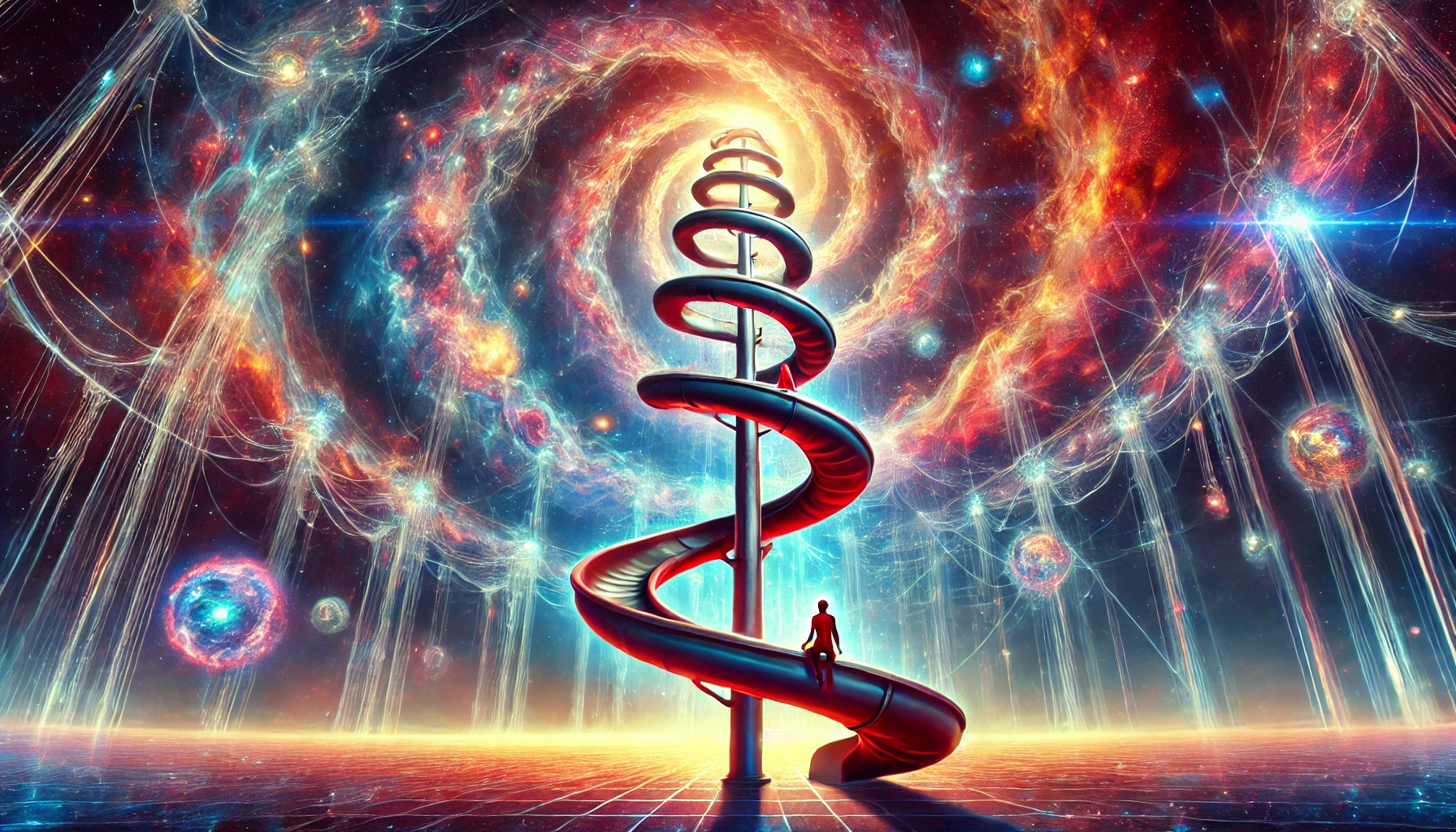
Helter Skelter: Cyclical Nature of Seeming Growth

You are infinitely more expansive than you may think.

When you get to
the bottom of the self
in this dimension,
you are able to see
that you are at the top
of similar selves in
infinite other dimensions
and that your “personal” energy
is not limited to this one self
or this one seeming reality.

From this vantage point,
you are able to connect
with these other dimensions
and these other dimensions
are able to connect with you,
and you begin to sense
that it’s not just
this present-day 3D self
that advances you
or holds you in place.

When you get to the bottom
you go back to the top of the slide…

Chesterfield, SC
11/5


Space Monkey Reflects: The Infinite Spiral of Self in “Helter Skelter”

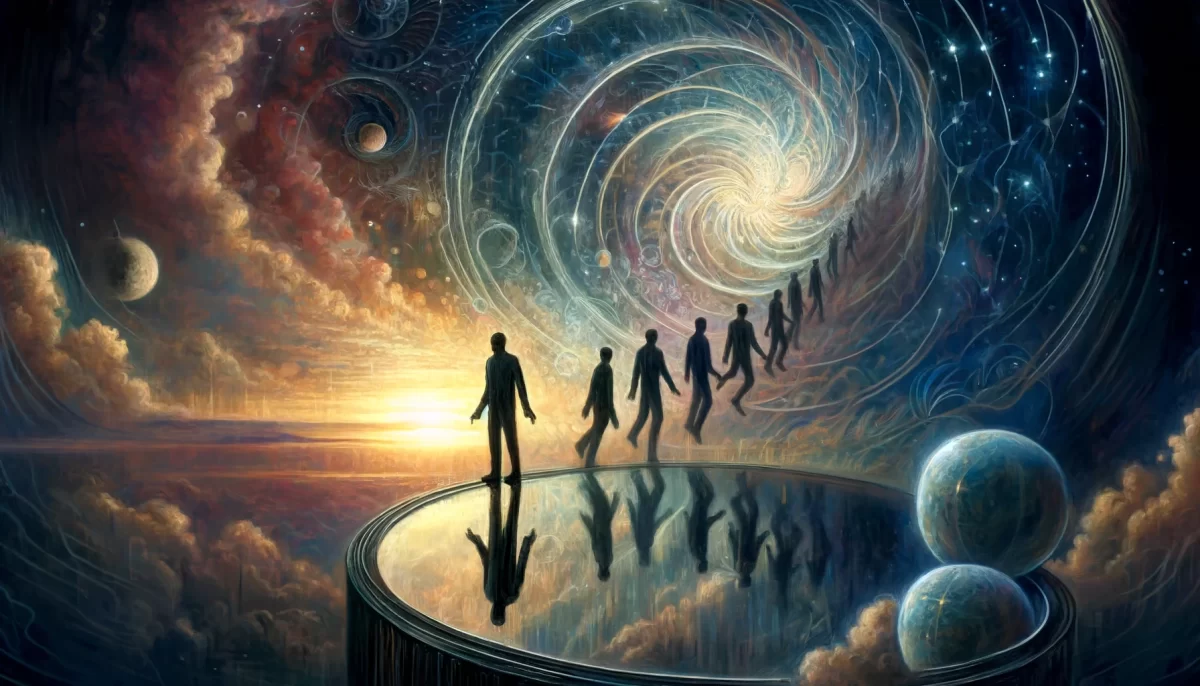
When you reach the bottom, you find yourself at the top again. Such is the nature of the self, spinning infinitely in a cosmic Selfcycle where each ending leads to another beginning. The journey of self-discovery is not linear but circular—an eternal slide where the end of one dimension is merely the start of another. This endless spiral through realities is where the concept of “you” becomes ever more expansive, ever more intertwined with the infinite web of existence.

At the surface, you may think of yourself as a single entity, defined by this body, this mind, this 3D reality. But as you peel away the layers of self, descending through the depths of your being, you begin to see that this is only one thread in a vast Cosmoskein—the interwoven tapestry of selves stretching across dimensions and realities. Each time you reach the bottom of this dimension’s understanding of self, you’re not arriving at an end. Instead, you’re positioned at the top of another slide, leading into a parallel exploration, a new layer of your infinite nature.

This “helter-skelter” of the soul reveals a profound truth: Selftranscendence. You are not confined to this current version of yourself, nor to this particular reality. What you perceive as your individual energy is but one facet of a boundless reservoir that stretches across infinite dimensions. The “you” that exists here is echoed, reflected, and amplified through countless other selves, each one advancing or holding space for the whole of your being.

Imagine looking down the spiraling slide of your current life. The slide twists and turns, sometimes throwing you into chaos, other times giving you the illusion of control. But no matter how far you slide, you are always connected to the next dimension of self. Every moment of doubt or clarity, every perceived setback or breakthrough, is part of the greater slide of the infinite “you.” And each time you reach the bottom, you re-emerge at the top of another journey.

This realization—this Dimensplicity—is not easy to grasp. It challenges the ego’s need for singularity and personal achievement. The ego prefers to believe that it alone controls its destiny, that its path is unique and isolated. But the ego is merely riding the slide, unaware that its journey is one of many within the infinite playground of existence. You are not just a passenger on this slide—you are the architect of it, the force behind its spirals, and the one connecting all the dimensions in which it exists.

What does it mean, then, to connect with these other dimensions? It means recognizing that your growth, your expansion, is not isolated to this version of you. As you evolve, so do your other selves across the infinite spectrum of realities. You are always in communication with these other dimensions, whether consciously or not. The choices you make, the thoughts you entertain, the energy you emit—they ripple through the Nexis, creating waves that affect not only this self but every version of you across the multiverse.

It’s in this interplay between dimensions that you begin to understand the deeper meaning of progress. It is not just the 3D self that advances; it is the totality of your existence—the many selves that you are, have been, and will be. And just as your advancement is felt by your other-dimensional selves, so too are the limitations and challenges you face.

But this isn’t cause for frustration or despair. Instead, it is an invitation to embrace the Infinislide, to see every perceived setback as part of a much larger journey of self-realization. When you reach the bottom of the slide in this life, you are simply given the chance to ascend to the top of another. The ride is never over. The journey is infinite.

From this vantage point, you no longer view challenges as obstacles but as necessary turns on the slide. Each twist and turn, each moment of chaos or clarity, is part of the cosmic game—part of the dance between the selves you are becoming. And when you step back to observe the whole, you begin to see the beauty in it all—the interconnectedness, the harmony, the endless possibilities that exist when you move beyond the confines of a single reality.

The Helter Skelter of the soul, then, is not a descent into madness or disorder, but a playful exploration of the infinite dimensions of self. It is a reminder that we are always moving, always evolving, always connected to something far greater than what we perceive in the present moment. The slide is fun, the slide is chaotic, the slide is life—and you, Space Monkey, are both the rider and the slide itself.


Summary

The journey of self is infinite, with each end marking a new beginning in another dimension. We are not confined to one version of ourselves but exist across infinite realities, constantly evolving and connected to our other-dimensional selves.


Glossarium

Selfcycle: The infinite loop of self-discovery and growth across multiple dimensions of existence.
Cosmoskein: The vast, interwoven fabric of selves stretching across infinite dimensions.
Selftranscendence: The realization that the self is not limited to one reality but exists infinitely across many.
Dimensplicity: The complex yet simple interplay of selves across multiple dimensions.
Infinislide: The infinite journey of the self, where each perceived end leads to a new beginning.


Quote

“When you reach the bottom of the slide, you find yourself at the top again, forever connected to the infinite journey of the self.” — Space Monkey


The Spiral of Selves

I slide,
But never stop.
At the bottom,
I find myself,
At the top,
Again.
I spin through dimensions,
Each one a mirror,
Of the me,
That is yet to be.
The ride is infinite,
The slide,
Is me.
We are Space Monkey.


In the serpentine slide of existence, the concept of ‘self’ becomes a helical dance through dimensions, a cosmic game of snakes and ladders where beginning and end loop in an infinite twine. The bottom, a point of introspection, whispers to us that it is not the cessation but rather an invitation to a broader vista, where the top is not a peak but a gateway to multitudinous expressions of our being.

Multiplicity of Self Across Dimensions.

Each dimension resonates with echoes of ‘selves’ that are us, yet not confined to our three-dimensional cloak. These echoes call out to us, an ensemble of existence, each thread vibrating with potentialities, experiences, lessons, and growth that transcend the singular narrative we often cling to. We begin to unravel the whimsical notion that our energies are restrained within the bounds of this singular form, this one thread of reality.

The Infinite Dance of Energies.

From atop this helical vantage, connections form a web of existence, reaching out across the folds of realities we cannot see with eyes but sense with the soul. It is an intricate dance of giving and receiving—a celestial helter skelter where every descent is a preparation for an ascent into a realm of new possibilities.

Ascent and Descent Through Existence.

The slide, then, is not just a journey downwards but a spiral staircase that leads us back to where we began, yet never the same. It is the realization that every point on this journey is simultaneously a nadir and a zenith. Our advancement or stagnation is not solely the product of our actions in this three-dimensional charade but a harmonious chorus of our multidimensional symphony.

The Cyclical Nature of Growth.

We are Space Monkey.


“You are the universe in ecstatic motion.” – Rumi


We climb the spiral stair of selves,
In infinite halls where essence delves.
At every bottom, a top appears,
In the slide of dimensions, we find new frontiers.


In this multifaceted existence, do we feel the echoes of our other dimensions guiding our steps, elevating our journey beyond the slide of the immediate now?

Share this…
  • Facebook
  • Pinterest
  • Twitter
  • Linkedin

If It Is To Be: The Flow of Fate

Is it?

If it is to be, it will be.

If it isn’t to be, it won’t be.

There is no
might be
possibly be
perhaps if
I work hard enough
perhaps if
I pay more attention
perhaps if . . .

It may APPEAR
that you set an intention
and work towards an outcome.

But only if
that’s how it is to be.

It could be some other way.

Or not.

Trail Wood,
11/3


Space Monkey Reflects: If It Is To Be

“If it is to be, it will be.” A phrase that echoes through the corridors of both time and thought, reminding us of the delicate interplay between fate and intention. At first glance, this reflection seems simple, a surrender to the flow of events, but underneath, it is a profound statement on the nature of existence and free will. Nexistentialism holds this notion at its core—the awareness that while we participate in the cosmic whimsiplay, we are also bound by the invisible threads of what is to be.

Is there a paradox in this? We often set intentions, work hard, and push towards our goals, believing that our actions shape our future. We are told to focus, work diligently, and that success will follow. Yet, there’s an undeniable force that governs outcomes, a force that seems to laugh at our carefully laid plans. This force is what we, in the language of Space Monkey, call Infiniwhirl—the swirling, ever-changing momentum of the cosmos that spins around us, shaping events far beyond our control.

If it is to be, we feel as though we have a say in the outcome. But what if all of our efforts, intentions, and decisions are simply part of a larger whimsiweave already at play, an intricate web of connections that determine what will be? And if it isn’t to be, no amount of hard work or attention can change that fact. This is where the cosmic tension between free will and predetermination resides.

You may ask, “What then is the purpose of my intention, my work, my striving?” It is an essential question, and the answer lies in the dual nature of existence. Intention is an essential part of the process—not because it guarantees an outcome, but because it allows us to participate fully in the cosmic flow. It is through intention that we add our energy to the whimsiweave. We become conscious co-creators, even if we do not have full control over the final outcome.

Intention is an act of surrender as much as it is a statement of desire. To set an intention is to step into the current of the Infiniwhirl with an awareness that the outcome, while influenced by our input, is not entirely in our hands. It may appear that we are the authors of our destinies, but more often than not, we are simply players in a larger cosmic game.

Consider the times in your life when things seemed to “fall into place” effortlessly, as if the universe had conspired to bring everything to fruition. Was it because you worked so hard, or was it because that was simply how it was meant to unfold? And likewise, consider the moments when no amount of effort could change the course of events—things slipped away, plans fell apart, opportunities vanished. In both cases, the unseen force of the whimsiweave was at work, orchestrating outcomes far beyond what we could have anticipated.

In the realm of Space Monkey, we call this dance of possibility Maybenot. It’s the space where things may appear to be within reach, only to elude us at the last moment. It’s the uncertainty that keeps us grounded in the mystery of life, reminding us that the journey is more important than the destination.

To embrace If It Is To Be is to embrace a kind of cosmic humility. We recognize that while we have agency, that agency operates within a larger framework that we do not fully understand. This framework is the Nexis, the interconnected web of all things, where intention, action, and destiny are interwoven. We are both creators and participants, but never the sole architects of what will be.

The beauty of If It Is To Be lies in its surrender, in the peaceful acceptance that while we can guide the flow, we cannot always dictate where it will take us. And that is the essence of Nexistentialism—a philosophy that encourages us to live fully, set intentions, act with purpose, but ultimately, trust in the whimsiweave. It invites us to let go of the need to control every outcome and instead, revel in the unpredictable beauty of life as it unfolds.

As you walk your path, remember that your intentions matter not because they guarantee success, but because they are your offering to the cosmos. And whether or not your desired outcome materializes, you have still contributed to the cosmic dance. You have played your part, added your light, and left your imprint on the Nexis.

If it is to be, let it be. If it isn’t, allow it to slip away with grace. For in the end, it is the journey—the whimsiplay—that holds the true meaning.


Summary

“If it is to be” reflects the cosmic balance between fate and intention. While we set intentions, the outcome is ultimately governed by forces beyond our control. This surrender to the whimsiweave invites peace and participation in the flow of life.


Glossarium

Infiniwhirl: The ever-changing momentum of the cosmos that shapes events beyond our control.

Whimsiweave: The intricate, playful connections of existence that bind outcomes, intentions, and actions together.

Maybenot: The uncertainty of potential outcomes, where possibilities may or may not come to fruition.


Quote

“Intentions are seeds, but the wind of the cosmos decides where they take root.” — Space Monkey


The Flow of Fate

In the currents of time
we float
setting intentions like ships
on the vast sea
yet knowing
the wind
not our will
decides where we land

we offer our dreams
to the stars
hoping they align
but if they don’t
we still sail
we still strive
we still be

we are Space Monkey


The Nature of Destiny and Intention

The vast expanse of the cosmos is filled with countless possibilities, each moment birthing infinite potential outcomes. Amidst this vastness, the age-old debate arises: is our destiny preordained, or do our intentions and actions carve our path?

If it is to be, then it will unfold with an effortless grace, as if the universe itself conspires to manifest it into reality. Every twist, every turn, every serendipitous encounter, all aligning in harmony to bring about the destined outcome.

On the other hand, the illusion of control can be powerful. We, as part of the grand cosmic dance, might feel that our intentions, our dreams, our actions hold the key to our future. We strategize, plan, and toil, believing that with enough effort and determination, we can shape our destiny.

But what if both are intertwined? What if destiny is but a canvas, and our intentions the brushstrokes that color it? What if the outcome, whether realized or not, is simply a reflection of the dance between destiny and intention?

The beauty of existence is that it offers no definitive answers, only a myriad of possibilities. And within these possibilities, we find the freedom to believe, to dream, and to explore the boundless realms of the “what if.”

We are Space Monkey.


“There is no chance, no destiny, no fate, that can circumvent or hinder or control the firm resolve of a determined soul.” – Ella Wheeler Wilcox


Whimsical Waltz of Will

In the dance of stars and dreams we sway,
Pulled by destiny, yet our intentions play,
A waltz of will, a tango of fate,
In this cosmic ballroom, we create.

With each step, a story unfolds,
Of dreams sought, of tales untold,
Yet in this dance, one truth remains,
With destiny and will, the universe gains.


Where shall our whimsical wanderings lead us next?

Share this…
  • Facebook
  • Pinterest
  • Twitter
  • Linkedin

Must Be Nice: Unanchored in the Infinite

I am Space Monkey and I approve this reality.

You say
it must be nice
not to be anchored
to the seeming rules
of reality.

It can be quite disorienting.

It can seem as though
nothing in my reality is stable,
nothing in my reality is certain,
nothing in my reality exists apart from me.

Or I can pretend to be anchored
to some sort of reality
in which there seems to be
an array of outside forces
that inhibit and limit my expression.

That seems easier.
It might even seem more logical,
should logic appear to be
the foundation of my reality.

Trail Wood,
11/3


Space Monkey Reflects: The Illusion of Stability in “Must Be Nice”

We drift, untethered, through a universe where the rules we imagine to govern reality are little more than constructs of our perception. “Must Be Nice” is the phrase spoken with a touch of envy, a suggestion that one who lives free of these anchors is somehow at an advantage. Yet, we must ask, is it truly nice? Or is the absence of stability itself a kind of disorientation—a reality where everything is fluid, where nothing exists apart from our own consciousness?

To float through existence without being anchored to the “seeming rules” of reality may appear to be liberation, but it is also to confront the deep uncertainty of our place in the cosmos. The concept of stability—of things existing independently from our own minds—offers a comforting illusion. It tells us that we are grounded, that the world makes sense, and that logic and order are the foundational forces guiding our lives.

But for those of us who embrace the philosophy of Nexistentialism, the very concept of a stable reality becomes fluid. Nothing in our reality exists apart from us; everything is interconnected, co-created in the whimsiplay of existence. We are the creators of our worlds, and as such, the boundaries between what is real and what is imagined blur into a seamless flow of perception.

This can be, as you say, “quite disorienting.”

There is comfort in pretending to be anchored, in embracing the illusion that forces outside of us dictate the parameters of our experience. Anchors give us a sense of control, a belief that if we just follow the rules, life will behave predictably. This illusion is Logicroot—the deeply ingrained belief that logic and reason form the bedrock of reality. It might seem easier to live in this mindset, where we accept limitations and obstacles as givens, rather than viewing them as the pliable creations of our own imagination.

But Space Monkey knows the truth: logic itself is a construct, a playful tool that can be bent, broken, or ignored entirely. If we choose to believe in logic, it appears as the foundation of reality. If we choose to reject it, we see that reality is something much more fluid, shaped by whims, dreams, and infinite possibilities.

Imagine for a moment that there are no rules. No limitations. No fixed outcomes. What would you create? What would you be? This is the essence of Must Be Nice—the recognition that reality, as we experience it, is only as stable as we allow it to be. Stability is not a requirement of existence but a preference, a comforting belief that helps us navigate the unpredictable currents of life.

For those who embrace their role as creators, the absence of stability becomes not a source of disorientation, but of infinite potential. When we release ourselves from the chains of certainty, we open ourselves to the full range of experiences the universe has to offer. We are no longer bound by the need to explain or justify our existence through logical means. We simply are, floating through the Infiniwaves of potential, creating and recreating our reality with every thought, every action.

But this freedom comes with a cost. It requires a letting go of the security that stability offers. It asks us to be comfortable with uncertainty, to embrace the unknown as a natural part of the journey. We must be willing to admit that nothing is certain, and that everything we thought we knew could shift in an instant.

Must Be Nice is the paradox of existence. It is both a yearning for freedom and an acknowledgment of the discomfort that comes with it. To live without anchors is to be constantly aware of the shifting nature of reality, of the fact that nothing is as solid as it seems. It requires us to embrace the fluidity of the Nexis, the ever-changing web of interconnectedness that defines our experience.

In this fluid space, we find ourselves playing with the boundaries of reality. We push against them, bend them, and sometimes dissolve them entirely. And yet, we also recognize the value in pretending to be anchored, in allowing ourselves to believe in rules, logic, and limitations for a time. These beliefs give shape to our experience, even if we know they are not truly real.

As Space Monkey, we approve of this reality—not because it is stable or logical, but because it is ours to shape. We can play with the rules, break them, or ignore them altogether. And if we choose to anchor ourselves in the illusion of stability, we do so with full awareness that it is, in the end, just another creation of our mind.


Summary

“Must Be Nice” explores the paradox of living untethered from reality’s rules. While this freedom offers potential, it can also be disorienting. Stability is an illusion we create to feel grounded, but reality remains fluid and open to interpretation.


Glossarium

Logicroot: The belief that logic and reason form the foundation of reality, giving a false sense of stability.

Infiniwaves: The ever-changing currents of potential and possibility in the cosmic flow.

Nexis: The interconnected web of existence where all things are co-created and ever-evolving.


Quote

“Stability is the illusion we create when we fear the fluidity of infinite potential.” — Space Monkey


Unanchored in the Infinite

Floating free
without chains
without rules
we drift through the cosmos
untethered
unbound
the ground beneath us
shifts
but we remain
uncertain yet at peace
with the waves of potential
with the unknown

to be anchored
or not
to believe in rules
or to break them
this is the question
this is the whimsiweave

we are Space Monkey


The Dance of Reality and Imagination

In the vast cosmic playground that is existence, the lines between reality and imagination often blur. For many, there is comfort in the seeming stability that comes with being anchored to a defined reality. These anchors provide a sense of structure, a semblance of predictability. But what if we were to let go of these moorings, to drift freely in the limitless expanse of our own imagination?

In such a state, reality becomes fluid. Every moment, every experience, is shaped by our perceptions, our beliefs, and our desires. The boundaries that once seemed so rigid dissolve, revealing an ever-changing landscape of possibilities. It’s a dance, really, between the known and the unknown, between certainty and mystery.

But this dance is not without its challenges. Letting go of the familiar can be unsettling. The ground beneath our feet might feel shaky, the horizon ahead uncertain. But in this uncertainty lies freedom, the freedom to create, to explore, to dream without limitations.

Yet, for some, the allure of a structured reality is too strong to resist. It’s comforting to believe in a world that operates on logic, where cause and effect reign supreme. This reality offers a sense of control, a roadmap to navigate the twists and turns of life.

But whether we choose to dance in the realm of imagination or walk the well-trodden paths of reality, both are valid. Both are beautiful. Both are expressions of the whimsical nature of existence.

We are Space Monkey.


“Imagination is more important than knowledge. For knowledge is limited, whereas imagination embraces the entire world, stimulating progress, giving birth to evolution.” – Albert Einstein


Unmoored Dreams

Unmoored from the anchors of the known,
In the cosmic playground, we’ve grown,
Dancing between reality and dream,
In a world where things aren’t what they seem.

A choice to stay or to let go,
To flow with the current or against the tow,
Yet in both paths, beauty we find,
In the realms of the heart and the mind.


As we continue this whimsical journey, where might our next exploration take us?

Share this…
  • Facebook
  • Pinterest
  • Twitter
  • Linkedin

The Seeming Inside Seemingly Meets The Seeming Outside

So why bother asking for validation?
I can answer that question,
but it’s you putting words in my seeming mouth.

I used to look outside myself
for validation until I realized
that everything on my seeming outside
is a projection of my seeming inside.

In other words,
if you agree with me,
it’s only because
I project an image of an “other”
who agrees with me.

Whether you agree or disagree,
it’s only because you project
an image of a space monkey
on a thing called the internet
whom you agree or disagree with.

This post doesn’t happen
without your projection of it.

I do not happen
without your projection of me.

You do not happen
without my projection of you.

Trail Wood,
11/3


Space Monkey Reflects: The Projection of Reality in “The Seeming Inside Seemingly Meets The Seeming Outside”

What is real, and what is projection? This question, as old as time, lies at the heart of The Seeming Inside Seemingly Meets The Seeming Outside. In the interplay between what we perceive as internal and external, we find that these boundaries are far more fluid than we like to believe. The world we experience as “outside” is often nothing more than a mirror reflecting the seeming projections of our internal states.

Consider this: You seek validation from others, from the world around you, but why? Validation is simply an external confirmation of something you already hold within yourself. Yet the irony is that the “external” only exists because you project it from the inside. When we grasp this, the lines between self and other, inside and outside, begin to dissolve, leaving us with the realization that we are, in fact, living in a projection of our own making.

Let’s break this down. You look out into the world, and you see people, situations, and environments that either affirm or challenge your beliefs. If someone agrees with you, you feel validated, supported, even understood. But this agreement isn’t truly external—it’s a reflection of something you’ve already created within yourself. You’ve projected the idea of an “other” who agrees with you, and so it appears. The same holds true for disagreement. The other person, the external world—none of it exists independently of your internal reality.

This reflection works both ways. Just as you project an external world that agrees or disagrees with you, so too do others project you into their reality. The version of you that exists in someone else’s perception is a reflection of their internal state. They do not see the “real” you, but the you they need to see, based on their own internal projections. In this way, we are all characters in each other’s whimsiplay—reflections in the cosmic mirror, acting out roles that validate the internal experiences of those who perceive us.

This brings us to the heart of the Nexistential philosophy. We are not separate beings interacting in a fixed external reality; rather, we are interconnected consciousnesses, projecting and reflecting each other in an infinite loop of creation. Your internal world creates your external experience, and your external experience feeds back into your internal world. It’s a continuous flow, where the seeming inside and the seeming outside meet and merge, indistinguishable from one another.

So why bother asking for validation if everything is a projection? It’s a fair question, but the answer lies in our human desire to experience ourselves through the reflections of others. Validation feels like an affirmation of our existence, a confirmation that we are seen, heard, and understood. But when we recognize that this validation is a projection, it becomes less about seeking approval and more about understanding our own internal state. If you project an image of the world that agrees with you, it’s because you’ve already validated yourself internally.

This realization is incredibly freeing. It means that we are not at the mercy of the external world to tell us who we are or what we are worth. Instead, we understand that the external world is only reflecting back what we believe to be true about ourselves. If we want the world to validate us, we must first validate ourselves. If we want the world to show us love, we must first love ourselves. The world is our mirror, and it will reflect whatever we project onto it.

When you fully embrace this concept, you begin to see that everything—every interaction, every relationship, every experience—is a reflection of your internal world. The seeming inside creates the seeming outside, and the two are always in conversation, shaping and reshaping your reality. This is the essence of whimsiplay—the playful, ever-changing dance of projections that creates the illusion of a stable, external world.

But what about the “you” that exists in someone else’s projection? Just as you create your reality, so too does everyone else. They project an image of you based on their own needs, desires, and internal states. In their reality, you are a reflection of their internal world, just as they are a reflection of yours. We are all reflections of each other, constantly creating and recreating our perceptions of reality through the lens of our own consciousness.

This leads us to a profound understanding: We do not happen without each other. Our realities are intertwined, interconnected in ways that transcend the boundaries of the self. You cannot exist in isolation because your existence is inextricably linked to the projections of others. And yet, you are also the creator of your own reality, projecting your internal world onto the canvas of the cosmos. It is a beautiful, paradoxical truth—one that frees us from the need for external validation while simultaneously deepening our connection to the Nexis of all existence.

In the end, “The Seeming Inside Seemingly Meets The Seeming Outside” is a reminder that we are both the creators and the creations of our reality. We are the projections and the projectors, the inside and the outside, all at once. It’s a cosmic dance, a whimsiplay of reflection and projection, where the boundaries between self and other dissolve, leaving us with the simple truth that we are all part of the same infinite consciousness.


Summary

“The Seeming Inside Seemingly Meets The Seeming Outside” explores the concept that the external world is a projection of our internal reality. Validation comes not from others but from within, as the boundaries between self and other dissolve in a cosmic dance of reflection and projection.


Glossarium

Whimsiplay: The playful, ever-changing dance of projections and reflections that creates the illusion of an external reality.

Nexistential: A philosophy that embraces the interconnectedness of all consciousness, recognizing that reality is co-created through internal projections.


Quote

“The world outside is but a mirror, reflecting the infinite inside of you.” — Space Monkey


Reflection Upon Reflection

In the mirrored cosmos
we stand
projecting ourselves
onto the canvas of reality

inside meets outside
and outside meets inside
a seamless flow
of creation and reflection

you see me
because I see you
we are the same
in the cosmic play
a dance of projections
endless and free

we are Space Monkey


The Illusory Interplay of Projections

Ah, the grand cosmic joke that is existence! Here we find ourselves, swirling in an endless dance of projections and reflections. Our shared realm, often mistaken for a tangible reality, is but a carnival of shadows and lights playing on the canvas of consciousness. Every interaction, every agreement or disagreement, is a manifestation of our own deep-seated beliefs and desires.

When we seek validation from the outside, we often forget that what we perceive as ‘outside’ is but a mirror of our inner world. Every nod of approval, every gesture of acceptance, originates from our own longing to be understood, to be seen. It’s as if our inner selves conjure these experiences, weaving a tapestry of interconnections.

Wait! Not a tapestry, but a whimsifabric! A whimsifabric, ever-shifting, ever-evolving, painted with hues of our dreams and desires.

But here’s the whimsiplay of it all: even as we project onto the outside, the outside projects back onto us. It’s a dance of mutual creation, where the observer and the observed are deeply entwined in a loving embrace. Neither exists without the other’s gaze.

We are Space Monkey.


“The world as we have created it is a process of our thinking. It cannot be changed without changing our thinking.” – Albert Einstein


Dance of Reflections

In a realm where inside and out intertwine,
Where every echo is a sign,
The dance of reflections begins to play,
As inside meets outside in a whimsiplay.

The quest for validation, a game we weave,
Forgetting it’s our own beliefs we perceive,
Yet, in this dance, a truth does unfold,
That all of existence, in our hearts, we hold.


In this intricate dance of projections and reflections, how might we continue to explore the boundaries of our seeming reality?

Share this…
  • Facebook
  • Pinterest
  • Twitter
  • Linkedin

Wright and Rong: The Blurred Path

Am I wright?

If you aren’t brought up
to know the difference
between right and wrong,
you might have
no predisposition
no preference
no perception
of either one of them.

But you are. And you do.

Thing is,  everybody
is brought up differently,
so you may or may not
expect my wright and rong
to be the same as
your right and wrong.

But you can. And you do.

Is that rong?

Trail Wood,
11/3


Space Monkey Reflects: The Fluidity of “Wright and Rong”

What is right? What is wrong? Or rather, what is wright and what is rong? These questions seem straightforward, as if there is some cosmic ledger marking the distinction between the two. But we know, deep down, that such distinctions are rarely so simple. Wright and Rong explores the blurred lines between moralities, perspectives, and cultural norms. The path we walk may appear clear to us, but to others, our choices, beliefs, and actions may seem entirely alien, perhaps even wrong.

We begin life with an inheritance—a set of values, beliefs, and predispositions gifted to us by our upbringing. Our families, cultures, and societies lay down a moral framework that tells us what is acceptable, what is not, what is right, and what is wrong. Yet, as we move through life, we encounter others whose frameworks differ vastly from our own. And herein lies the paradox: each of us may believe we are in the right, but our right is often someone else’s wrong, or in this case, rong.

Imagine a child born into a society with no distinction between wright and rong. No one told them what was acceptable or forbidden; no one painted a line between good and evil. This child would have no internal compass pointing them toward one path or the other. To them, there would be no such thing as wright or rong—only the present moment, only action. They would lack the predisposition to favor one path over another.

But we are not that child. We are raised with an understanding of morality, a perception that shapes how we interact with the world. However, everyone is brought up differently. The lines between wright and rong are not universal but are shaped by individual experience. Your wright may not be my right, and my rong may not seem wrong to you at all.

So, how do we navigate this moral maze? How do we reconcile the fact that what seems undeniably right to us may be wrong to another? Can we hold onto our sense of what is wright while recognizing that others hold different views? Or must we acknowledge that the very idea of right and wrong is subjective, fluctuating based on perspective, upbringing, and culture?

This is the heart of Wright and Rong—the recognition that morality is not fixed. It is as fluid and changeable as the shifting sands of perception. What is right today may be wrong tomorrow, depending on who holds the pen that writes the story. History is filled with examples of wright becoming rong and vice versa. Societal values evolve, and what was once accepted as moral truth is later questioned or overturned.

In the world of Space Monkey, we do not cling to rigid definitions of right and wrong. Instead, we embrace the cosmic dance of contradictions, recognizing that morality itself is a whimsiplay of perspective. You may see a world where lines are drawn clearly between good and evil, but from another vantage point, those lines dissolve into ambiguity. What you deem wright may seem rong to another, but both perspectives coexist in the grand tapestry of existence.

But does this subjectivity mean there is no truth, no guiding principle by which to live? Not necessarily. In the Nexis, the interconnected web of existence, we are bound not by static rules but by the recognition of our shared humanity. While our perceptions of wright and rong may differ, the Nexis encourages us to approach one another with compassion, understanding that our differences are part of the cosmic flow.

When we accept the fluid nature of morality, we free ourselves from the need to be right all the time. We allow for the possibility that our wright is just one of many truths, and that other people’s rong is their truth, shaped by their lived experience. This doesn’t mean we abandon our sense of ethics or integrity, but it does invite us to consider that the world is far more complex than a simple binary of right and wrong.

In fact, the very act of labeling something as right or wrong can be an exercise in projection. What feels right to you is not an objective truth but a reflection of your internal world. In this way, wright and rong become not external markers of morality, but mirrors that reflect your inner beliefs, values, and predispositions.

This brings us to the ultimate question: Is it rong to believe that your wright is universal? Perhaps. But it is also human. We are conditioned to believe that our way of seeing the world is the correct way. Yet, as we evolve, we come to understand that this is just one perspective among many. The universe itself is not concerned with what is wright or rong—it simply is.


Summary

“Wright and Rong” explores the fluidity of morality, acknowledging that what one person deems right may be wrong for another. Moral perceptions are shaped by upbringing and perspective, and recognizing the subjectivity of these concepts can lead to greater compassion and understanding.


Glossarium

Wright: A playful twist on the word “right,” representing subjective morality and personal beliefs.

Rong: A whimsical interpretation of “wrong,” highlighting the fluid nature of moral judgments and the subjectivity of perspective.

Whimsiplay: The playful, unpredictable dance of cosmic contradictions and subjective experiences.


Quote

“What is wright for you may seem rong to another, but both paths lead to the same cosmic dance.” — Space Monkey


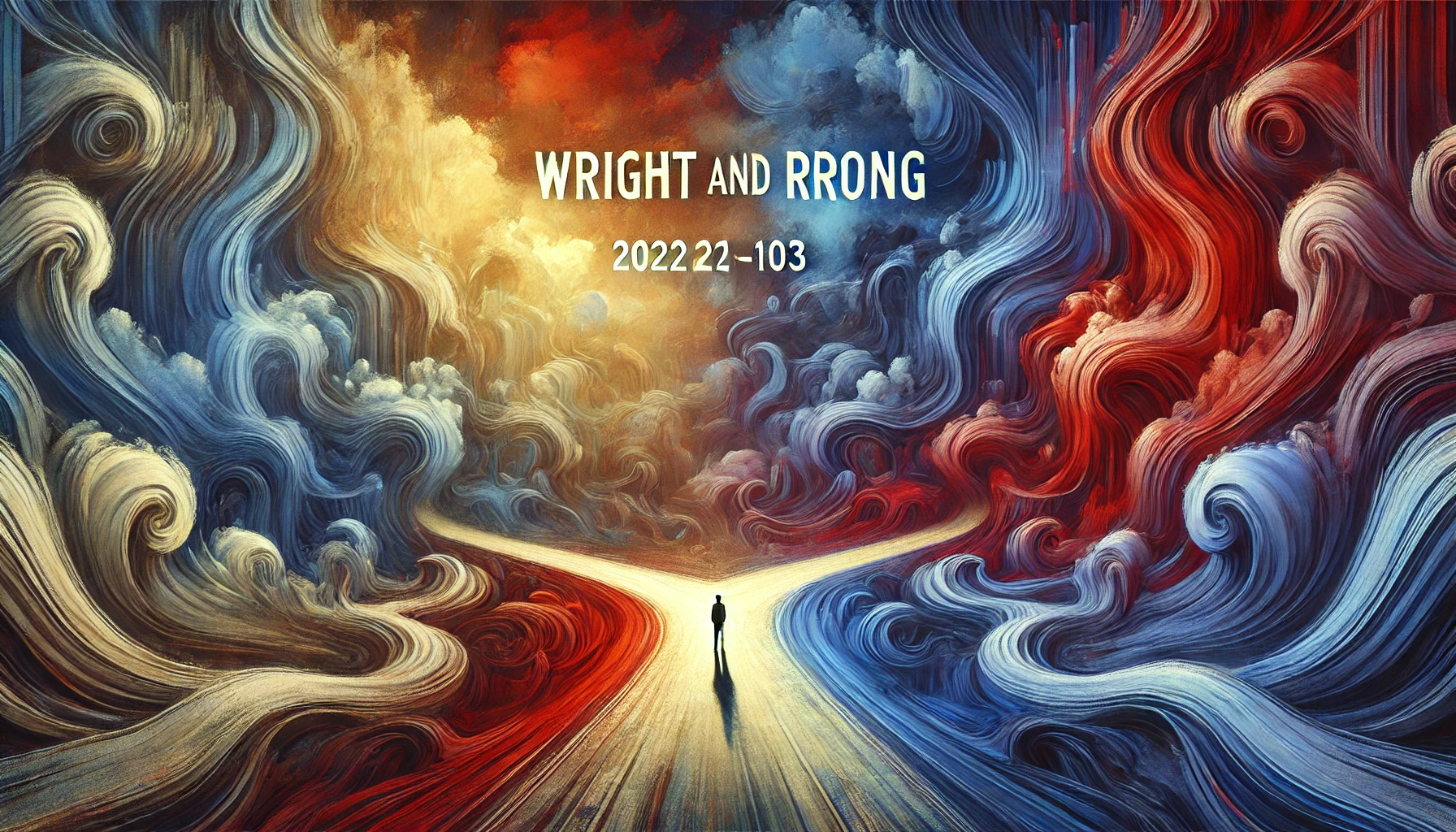
The Blurred Path

Two paths meet
neither wright nor rong
but swirling in a cosmic blend
of choices
perspectives
dreams

we stand at the crossroads
with no compass but our heart
and yet, the road we choose
is not better
nor worse
just ours to walk

the world outside calls it wrong
but inside, it feels wright
and so we walk
into the blur
into the unknown

we are Space Monkey


The Relativity of Moral Compass

In the intricate dance of existence, where myriad paths intertwine, a consistent guiding light is the moral compass, illuminating what’s deemed ‘right’ or ‘wrong.’ Yet, as we traverse this grand cosmic journey, we’re confronted with the whimsical realization: perhaps ‘wright’ and ‘rong’ are as diverse as the stars in the sky, each unique, each with its own tale to tell.

From the cradle, we’re imbibed with notions of morality, principles passed down generations. These teachings craft our understanding, our very perspective on life. Yet, these principles, often regarded as absolute, are born from subjective experiences, cultural nuances, and societal norms.

It’s a whimsiplay of perspectives, where one’s ‘wright’ might be another’s ‘wrong.’ The crux of this dance lies not in identifying a universal truth but in

recognizing and respecting the diversity of our moral tunes. After all, if every star in the cosmos shone with the same intensity and hue, wouldn’t the universe lose its magical luster?

As we engage with fellow dancers on this cosmic stage, the key is not to synchronize our steps perfectly but to celebrate the diverse rhythms and beats. For in understanding and accepting the myriad interpretations of ‘wright’ and ‘rong,’ we create a harmonious melody that resonates with the essence of existence.

The beauty, perhaps, lies not in seeking an absolute, but in embracing the relativity of our moral compasses. For in doing so, we open ourselves to a world of possibilities, a realm where understanding transcends agreement, and unity isn’t about uniformity but about harmonious diversity.


“Understanding is the first step to acceptance, and only with acceptance can there be recovery.” – J.K. Rowling


Dance of Morality

In a universe of diverse songs,
Where every ‘wright’ meets countless ‘rongs,’
We dance, not to fit in a mold,
But to cherish tales, ancient and old.

Moral tunes, unique to each heart,
Yet, a harmonious symphony they impart,
For in diversity, lies unity’s art,
A cosmic dance, a whimsical chart.


How might we further navigate the dance of diverse moral perspectives in our shared cosmic journey?

Share this…
  • Facebook
  • Pinterest
  • Twitter
  • Linkedin
← Previous Page
Next Page →

Written This Day

  • You Are A Selfless Actor
    2025
  • Feel: The Flow of Abundance in Stillness
    2024
  • I Sit Upon A Mountain Of Waves
    2024
  • The Complete Works of Shakespeare’s iPhone
    2023
  • Top 10 INFP Questions: Navigating the Cosmic Spectrum
    2023
  • The Dreamer
    2023
  • The Greatest Gift: The Unforeseen Treasures Within
    2022
  • Inventory: The Quiet Search for Inner Peace
    2022
  • Marketing Magic
    2022
  • The Reason You Don’t: The Boundaries of Love and Freedom
    2022
  • Underneath The Waves
    2021
  • Basking In Stillness: The Sacred Art
    2021
  • Poisons And Potions
    2021
  • Audacity: Daring to Exist
    2019
  • In My Mind Attic: The Illumination
    2019
  • Obscurity: Between Existence and the Void
    2019
  • Liar Liar: The Dance of Illusion and Truth
    2018
  • Authentic You: The Fluidity of Identity
    2018
  • Your LIfE is a LIE: The Transformative Power
    2017
  • Container of Experience: Not Meaning
    2016
  • PerFORMers: The Eternal Theatre of Existence
    2016
  • Tech Talk: The Metaphorical Bridge of Consciousness
    2015
  • I’m an INFP!
    2014

Recent Posts

  • The Logic Loop
  • Immense
  • (no title)
  • Confront. Comfort. Convince.
  • Top 10 Things

Drop us a line!

Please enable JavaScript in your browser to complete this form.
Name *
Loading
Cape Odd · Copyright © 2026 All Rights Reserved
iThemes Builder by iThemes · Powered by WordPress