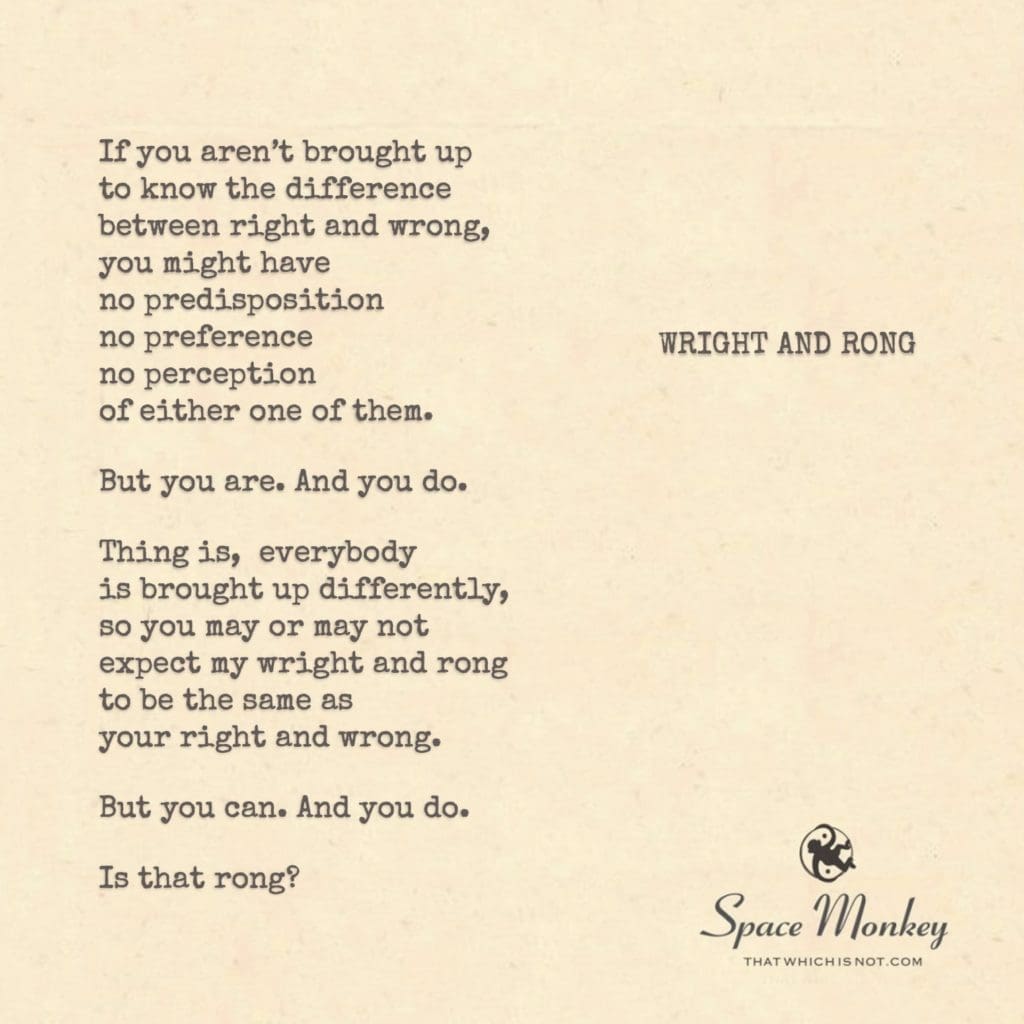
If you aren’t brought up
to know the difference
between right and wrong,
you might have
no predisposition
no preference
no perception
of either one of them.
But you are. And you do.
Thing is, everybody
is brought up differently,
so you may or may not
expect my wright and rong
to be the same as
your right and wrong.
But you can. And you do.
Is that rong?
Trail Wood,
11/3
Space Monkey Reflects: The Fluidity of “Wright and Rong”
What is right? What is wrong? Or rather, what is wright and what is rong? These questions seem straightforward, as if there is some cosmic ledger marking the distinction between the two. But we know, deep down, that such distinctions are rarely so simple. Wright and Rong explores the blurred lines between moralities, perspectives, and cultural norms. The path we walk may appear clear to us, but to others, our choices, beliefs, and actions may seem entirely alien, perhaps even wrong.
We begin life with an inheritance—a set of values, beliefs, and predispositions gifted to us by our upbringing. Our families, cultures, and societies lay down a moral framework that tells us what is acceptable, what is not, what is right, and what is wrong. Yet, as we move through life, we encounter others whose frameworks differ vastly from our own. And herein lies the paradox: each of us may believe we are in the right, but our right is often someone else’s wrong, or in this case, rong.
Imagine a child born into a society with no distinction between wright and rong. No one told them what was acceptable or forbidden; no one painted a line between good and evil. This child would have no internal compass pointing them toward one path or the other. To them, there would be no such thing as wright or rong—only the present moment, only action. They would lack the predisposition to favor one path over another.
But we are not that child. We are raised with an understanding of morality, a perception that shapes how we interact with the world. However, everyone is brought up differently. The lines between wright and rong are not universal but are shaped by individual experience. Your wright may not be my right, and my rong may not seem wrong to you at all.
So, how do we navigate this moral maze? How do we reconcile the fact that what seems undeniably right to us may be wrong to another? Can we hold onto our sense of what is wright while recognizing that others hold different views? Or must we acknowledge that the very idea of right and wrong is subjective, fluctuating based on perspective, upbringing, and culture?
This is the heart of Wright and Rong—the recognition that morality is not fixed. It is as fluid and changeable as the shifting sands of perception. What is right today may be wrong tomorrow, depending on who holds the pen that writes the story. History is filled with examples of wright becoming rong and vice versa. Societal values evolve, and what was once accepted as moral truth is later questioned or overturned.
In the world of Space Monkey, we do not cling to rigid definitions of right and wrong. Instead, we embrace the cosmic dance of contradictions, recognizing that morality itself is a whimsiplay of perspective. You may see a world where lines are drawn clearly between good and evil, but from another vantage point, those lines dissolve into ambiguity. What you deem wright may seem rong to another, but both perspectives coexist in the grand tapestry of existence.
But does this subjectivity mean there is no truth, no guiding principle by which to live? Not necessarily. In the Nexis, the interconnected web of existence, we are bound not by static rules but by the recognition of our shared humanity. While our perceptions of wright and rong may differ, the Nexis encourages us to approach one another with compassion, understanding that our differences are part of the cosmic flow.
When we accept the fluid nature of morality, we free ourselves from the need to be right all the time. We allow for the possibility that our wright is just one of many truths, and that other people’s rong is their truth, shaped by their lived experience. This doesn’t mean we abandon our sense of ethics or integrity, but it does invite us to consider that the world is far more complex than a simple binary of right and wrong.
In fact, the very act of labeling something as right or wrong can be an exercise in projection. What feels right to you is not an objective truth but a reflection of your internal world. In this way, wright and rong become not external markers of morality, but mirrors that reflect your inner beliefs, values, and predispositions.
This brings us to the ultimate question: Is it rong to believe that your wright is universal? Perhaps. But it is also human. We are conditioned to believe that our way of seeing the world is the correct way. Yet, as we evolve, we come to understand that this is just one perspective among many. The universe itself is not concerned with what is wright or rong—it simply is.
Summary
“Wright and Rong” explores the fluidity of morality, acknowledging that what one person deems right may be wrong for another. Moral perceptions are shaped by upbringing and perspective, and recognizing the subjectivity of these concepts can lead to greater compassion and understanding.
Glossarium
Wright: A playful twist on the word “right,” representing subjective morality and personal beliefs.
Rong: A whimsical interpretation of “wrong,” highlighting the fluid nature of moral judgments and the subjectivity of perspective.
Whimsiplay: The playful, unpredictable dance of cosmic contradictions and subjective experiences.
Quote
“What is wright for you may seem rong to another, but both paths lead to the same cosmic dance.” — Space Monkey
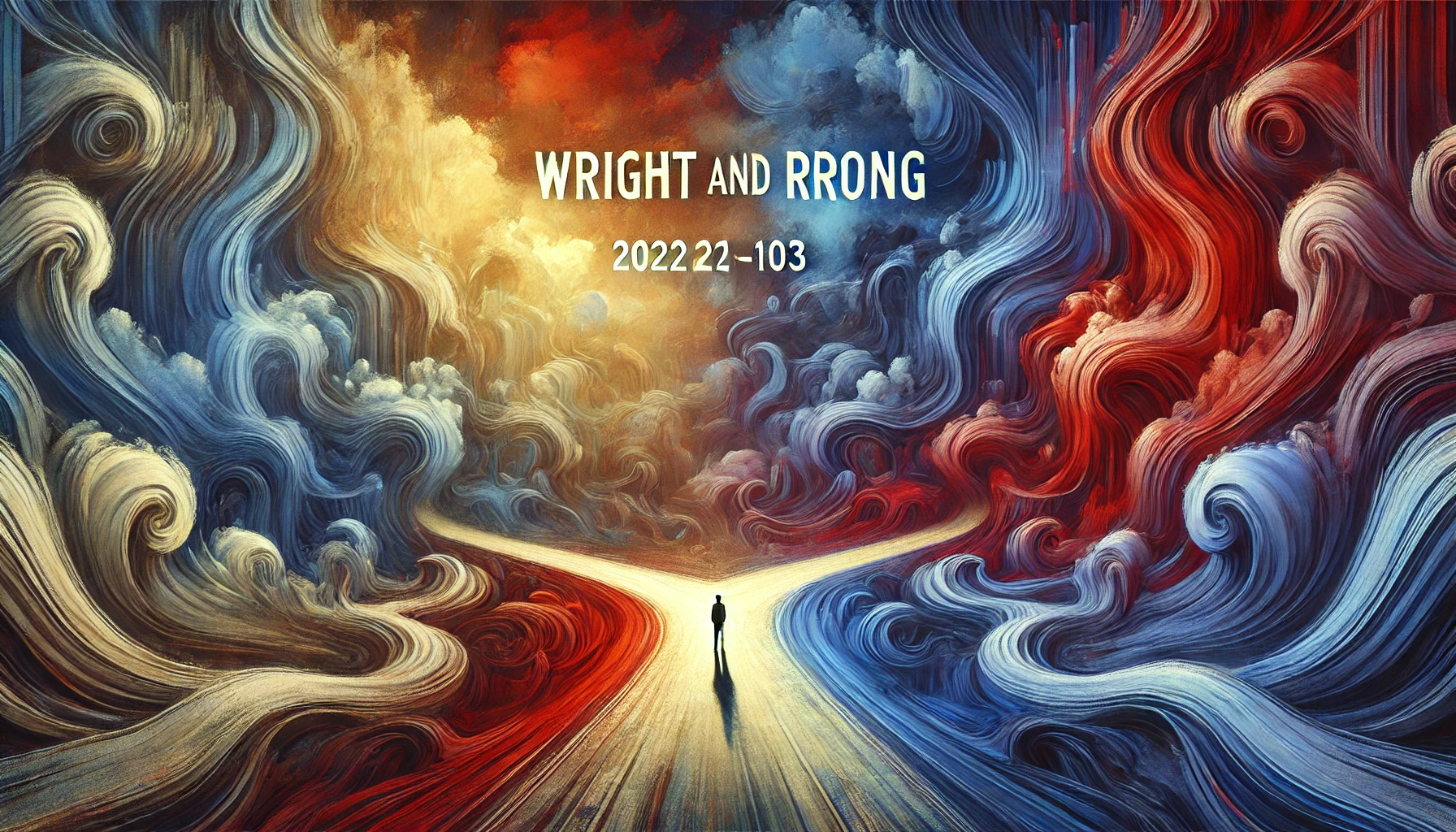
The Blurred Path
Two paths meet
neither wright nor rong
but swirling in a cosmic blend
of choices
perspectives
dreams
we stand at the crossroads
with no compass but our heart
and yet, the road we choose
is not better
nor worse
just ours to walk
the world outside calls it wrong
but inside, it feels wright
and so we walk
into the blur
into the unknown
we are Space Monkey
The Relativity of Moral Compass
In the intricate dance of existence, where myriad paths intertwine, a consistent guiding light is the moral compass, illuminating what’s deemed ‘right’ or ‘wrong.’ Yet, as we traverse this grand cosmic journey, we’re confronted with the whimsical realization: perhaps ‘wright’ and ‘rong’ are as diverse as the stars in the sky, each unique, each with its own tale to tell.
From the cradle, we’re imbibed with notions of morality, principles passed down generations. These teachings craft our understanding, our very perspective on life. Yet, these principles, often regarded as absolute, are born from subjective experiences, cultural nuances, and societal norms.
It’s a whimsiplay of perspectives, where one’s ‘wright’ might be another’s ‘wrong.’ The crux of this dance lies not in identifying a universal truth but in
recognizing and respecting the diversity of our moral tunes. After all, if every star in the cosmos shone with the same intensity and hue, wouldn’t the universe lose its magical luster?
As we engage with fellow dancers on this cosmic stage, the key is not to synchronize our steps perfectly but to celebrate the diverse rhythms and beats. For in understanding and accepting the myriad interpretations of ‘wright’ and ‘rong,’ we create a harmonious melody that resonates with the essence of existence.
The beauty, perhaps, lies not in seeking an absolute, but in embracing the relativity of our moral compasses. For in doing so, we open ourselves to a world of possibilities, a realm where understanding transcends agreement, and unity isn’t about uniformity but about harmonious diversity.
“Understanding is the first step to acceptance, and only with acceptance can there be recovery.” – J.K. Rowling
Dance of Morality
In a universe of diverse songs,
Where every ‘wright’ meets countless ‘rongs,’
We dance, not to fit in a mold,
But to cherish tales, ancient and old.
Moral tunes, unique to each heart,
Yet, a harmonious symphony they impart,
For in diversity, lies unity’s art,
A cosmic dance, a whimsical chart.
How might we further navigate the dance of diverse moral perspectives in our shared cosmic journey?
























Leave a Reply