• Who Is The Man?
  • Who Is The Monkey?
  • What is Nexistentialism?
  • Poke The Primate

Cape Odd

Home of The Space Monkey Journals

Follow: The Complexity of Leadership

Follow?

The problem isn’t that the
candidate you didn’t vote for
doesn’t know how to lead.

The problem is that you
don’t know how to follow.

A leader can’t earn your trust
if you’re not willing to part with it.

Trail Wood,
5/24


Space Monkey Reflects: The Complexity of Leadership and the Art of Following

In the intricate dance of leadership and followership, the challenge often lies not solely in the capability of the leader but in the willingness of the followers to embrace guidance and relinquish a measure of control. This reflection delves into the nuanced dynamics of trust, leadership, and the critical role of followers in the effectiveness of governance.

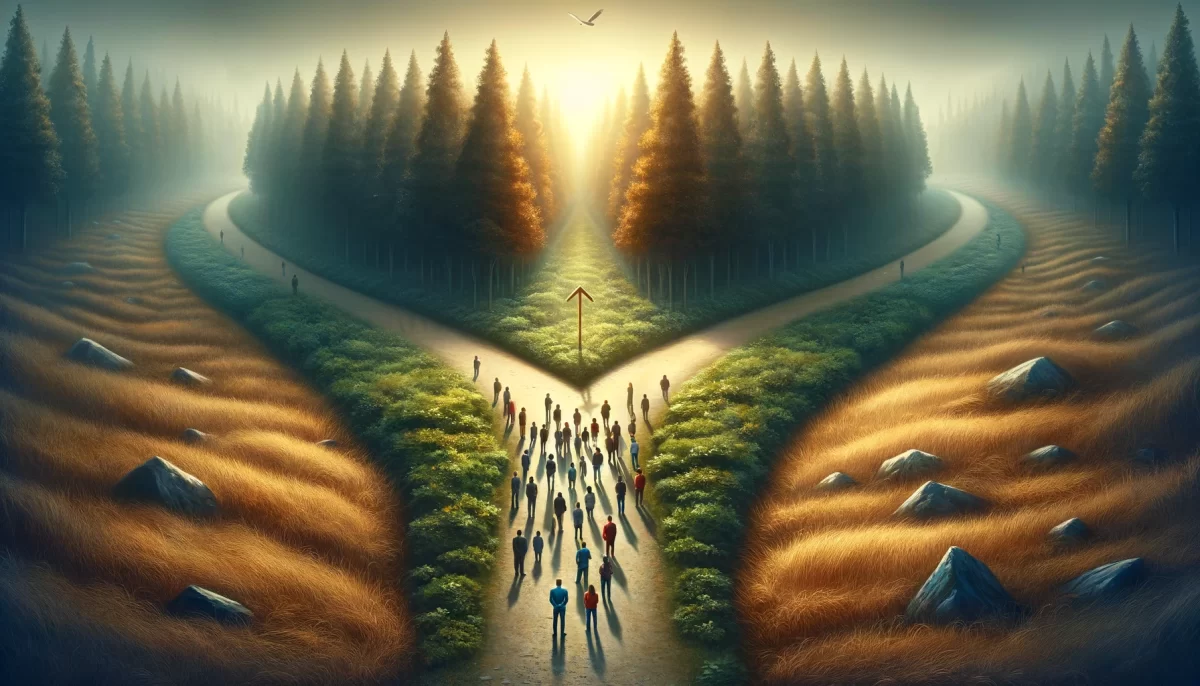
The scene of two diverging paths in a forest serves as a potent metaphor for the choices we face in political and social leadership. One path, well-trodden and clear, represents familiar and proven leadership styles. The other, overgrown and less defined, symbolizes untested or unconventional leadership approaches. The hesitation and division among the group at the fork highlight the fundamental dilemma: the decision to follow is as significant as the decision to lead.

Leadership cannot exist in a vacuum; it requires the trust and willingness of followers to be effective. A leader, no matter how skilled, cannot earn trust if there is an unwillingness to part with it. This reluctance can stem from past disappointments, skepticism, or a deep-seated need for autonomy that makes trust difficult to extend.

Trust in leadership is built on the foundation of belief in the leader’s vision, integrity, and capability. However, it also requires followers to possess an openness to being led. This openness involves a degree of vulnerability—a willingness to be influenced and to place one’s part of the collective destiny in someone else’s hands. Without this mutual engagement, leadership is rendered ineffective, and the potential for collective advancement is stifled.

The essence of following well is not about blind submission or relinquishing critical thinking. Rather, it’s about recognizing that leadership and followership are reciprocal roles, each with its responsibilities and demands. Effective followership involves actively choosing to endorse a leader, engaging with their vision, and contributing constructively to the realization of shared goals.

In considering the paths of leadership, we must also recognize our role in shaping the path we choose to follow. It is not enough to critique the road taken by leaders; followers must also reflect on their openness to traversing new terrains and their capacity to support the journey ahead.

Let us then consider not only the qualities we seek in those who lead but also the qualities we bring as followers. In this balanced approach, we find a more dynamic and effective interplay between leader and led, enhancing the potential for trust, growth, and collective fulfillment.


Summary

Leadership requires effective followership characterized by trust and openness. The ability to follow well involves engaging with and supporting leadership, crucial for achieving collective goals.


Glossarium

  • Followership: The behaviors and attitudes of individuals who are guided by or support a leader.

“Leadership and learning are indispensable to each other.” — John F. Kennedy


At the fork of diverging ways
Where the forest dense with haze
A choice emerges, clear and stark
To trust the known or brave the dark

The leader’s call, to lead, to guide
But without the trust from those aside
Can falter, fade, like mist in sun
For leading is but half the run

The art of follow, often lost
In shadows of the ego’s cost
Yet holds the key to paths untrod
For in the trust, we find the god

In every step, in every choice
In following, we find our voice
So let us walk with open eyes
And in our trust, our strength shall rise

We are Space Monkey.

Share this…
  • Facebook
  • Pinterest
  • Twitter
  • Linkedin

How Will You Feel: The Illusion of Choice and the Reality of Control

Notice the difference
between choosing
and seeming to choose.

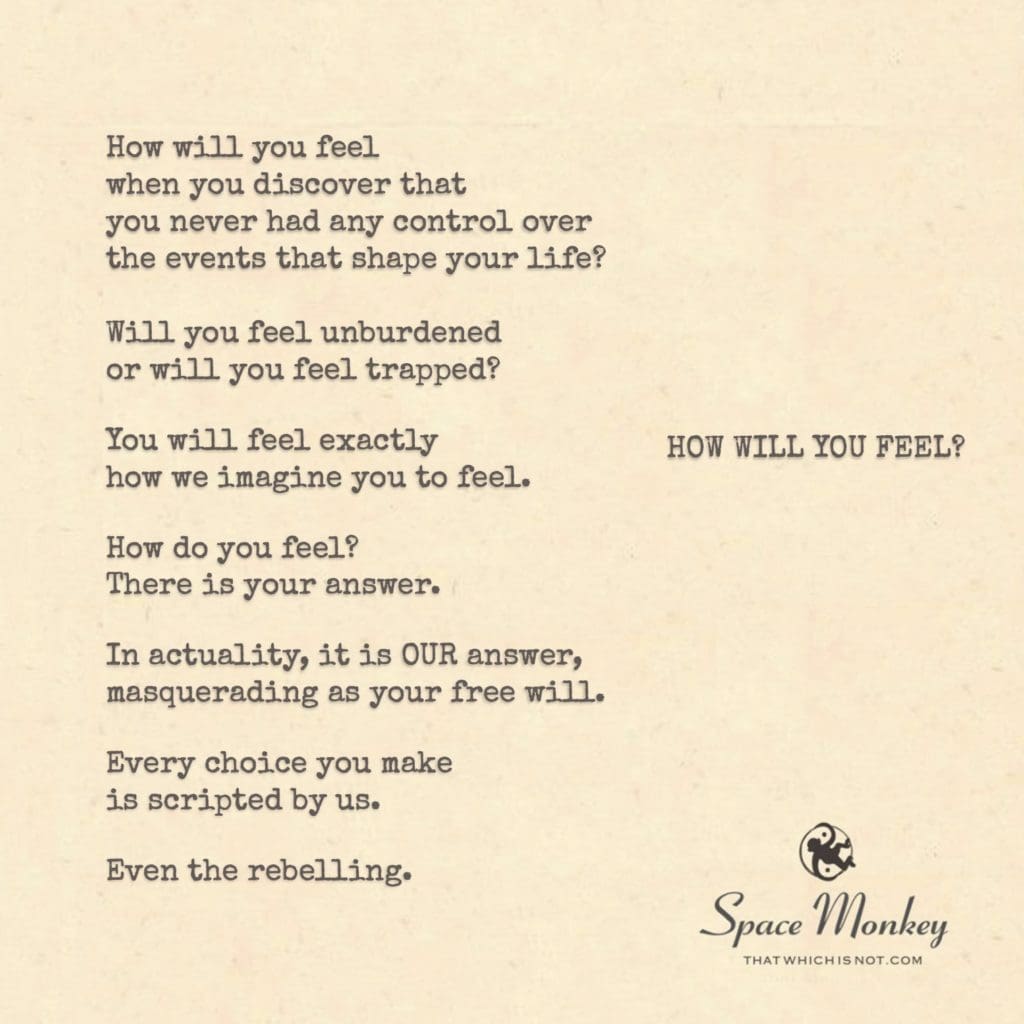
How will you feel
when you discover that
you never had any control over
the events that shape your life?

Will you feel unburdened
or will you feel trapped?

You will feel exactly
how we imagine you to feel.

How do you feel?
There is your answer.

In actuality, it is OUR answer,
masquerading as your free will.

Every choice you make
is scripted by us.

Even the rebelling.

Trail Wood,
5/24


Space Monkey Reflects: The Illusion of Choice and the Reality of Control

In the vast expanse of existence, the concept of choice and the perception of control weave a complex tapestry that challenges our understanding of free will. This reflection delves into the profound implications of discovering that our choices may not be entirely our own, but rather influenced or even scripted by forces beyond our immediate perception.

The image of a person standing before a giant chessboard, where the pieces move as if by an invisible hand, serves as a powerful metaphor for this existential quandary. It represents the unsettling realization that the events shaping our lives may be predetermined or influenced by external factors, leaving us to question the authenticity of our free agency.

This scenario invites us to ponder the difference between choosing and seeming to choose. It strikes at the core of our personal philosophy and forces us to confront the possibility that what we perceive as free will might actually be a carefully orchestrated illusion. How does one reconcile with the idea that every rebellion, every decision, might be part of a larger, predetermined script?

The emotional response to such a revelation can vary widely—some might find solace in the absence of true responsibility, feeling unburdened by the weight of their choices. Others might feel trapped, suffocated by the lack of real autonomy. This divergence in perception highlights the subjective nature of our experiences and the personal meaning we attach to the concept of control.

Ultimately, the realization that our perceived choices may be scripted challenges us to redefine our understanding of freedom and destiny. It beckons us to consider whether there is empowerment in acknowledging these forces or if true agency lies in the ignorance of them.

In the interplay of determinism and free will, we find a complex dance of cosmic forces and personal desires. Each step, each movement on the chessboard of life, invites us to question not only the nature of our decisions but also the origins of our desires and rebellions. Are they genuinely ours, or are they echoes of something larger, something preordained?

As we navigate this philosophical maze, we may find that the journey itself—regardless of its predetermined nature—is where the essence of our humanity lies. In contemplating these profound questions, we engage with the deepest parts of our being and perhaps find a sense of purpose that transcends the need for control.


Summary

The illusion of choice and the reality of control pose deep existential questions. Understanding that our decisions might be influenced or scripted can evoke feelings of liberation or entrapment depending on one’s perspective.


Glossarium

  • Determinism: The philosophical concept that all events, including moral choices, are completely determined by previously existing causes.

“He who has a why to live can bear almost any how.” — Friedrich Nietzsche


Amidst the chessboard vast and wide
Where unseen hands the pieces guide
We stand and gaze, with wonder, fear
At all the moves that brought us here

Each step we take, each path we choose
Might seem our own, yet we may lose
The thread of will, the thread of fate
In this grand game, the checkmate waits

Do we move free, or are we led?
Are thoughts our own, or are they fed?
In every choice, a mystery deep
In every step, the secrets we keep

Yet in this dance of will and fate
We find our truth, however late
For in the search, the quest, the strife
Lies the meaning, the essence of life

We are Space Monkey.

Share this…
  • Facebook
  • Pinterest
  • Twitter
  • Linkedin

When Things Fall Away

Everything that happens has a purpose.

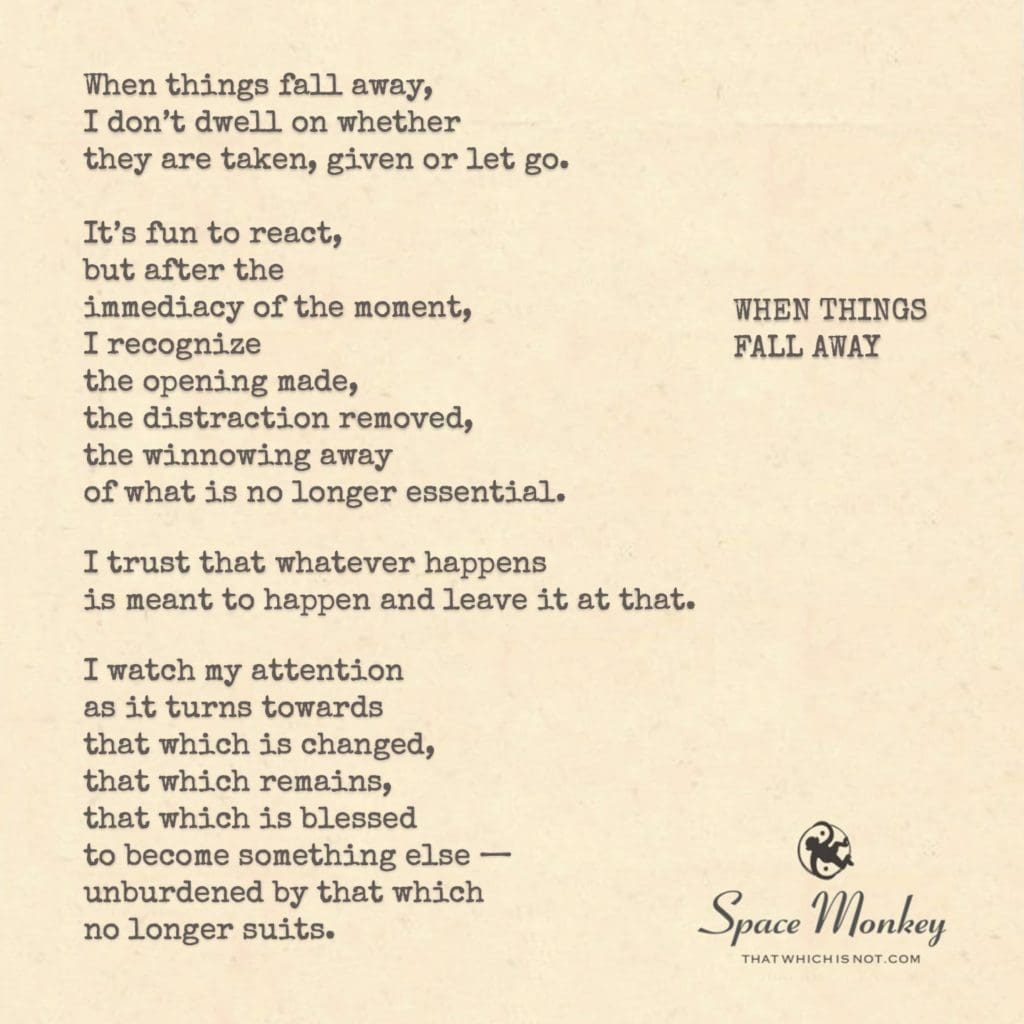
When things fall away,
I don’t dwell on whether
they are taken, given or let go.

It’s fun to react,
but after the
immediacy of the moment,
I recognize
the opening made,
the distraction removed,
the winnowing away
of what is no longer essential.

I trust that whatever happens
is meant to happen and leave it at that.

I watch my attention
as it turns towards
that which is changed,
that which remains,
that which is blessed
to become something else —
unburdened by that which
no longer suits.

Trail Wood,
5/24


Space Monkey Reflects: Embracing the Space Created by Letting Go

In the quiet dance of existence, the act of letting go plays a critical role, allowing us to shed the unnecessary and make room for new growth. This reflection explores the transformative power of releasing that which no longer serves us, revealing the profound openings and opportunities that arise in the spaces left behind.

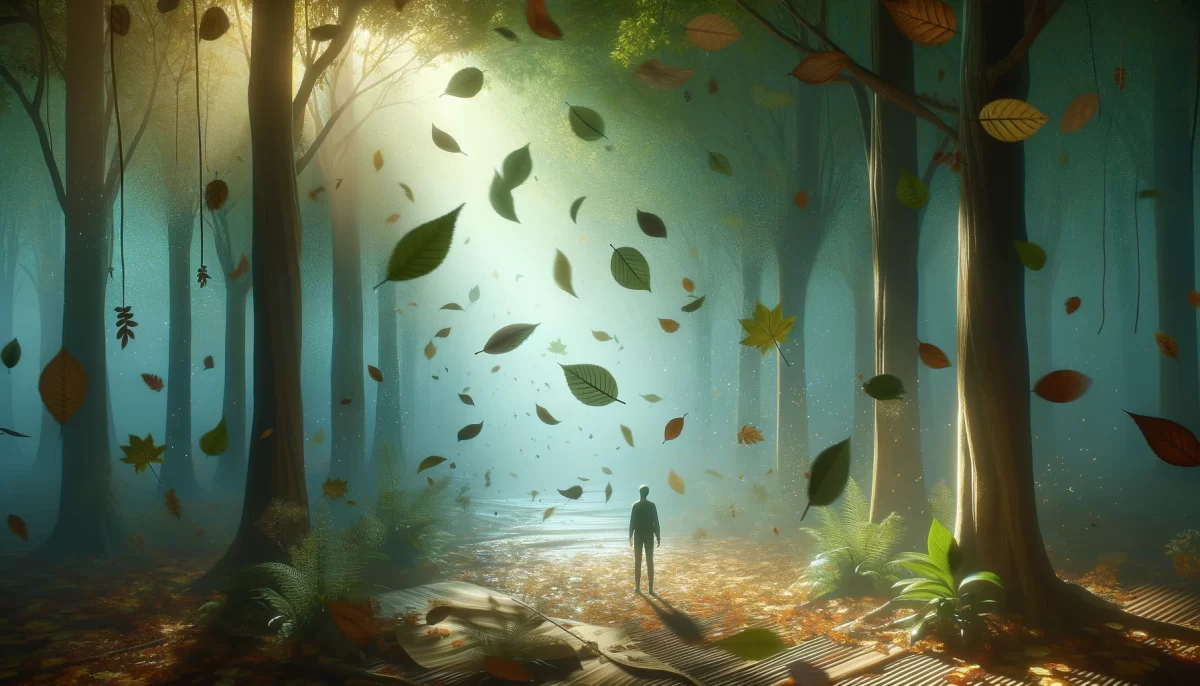
The image of a person standing in a tranquil forest, surrounded by gently falling leaves, captures the essence of this process. Each leaf represents an aspect of life that is being released—whether it is taken, given away, or let go by choice. The person’s serene upward gaze symbolizes the recognition of the new possibilities that these openings create, highlighting a peaceful acceptance of change’s natural cycle.

When things fall away, it’s a natural reaction to feel a sense of loss or emptiness. However, beyond the initial reaction, there lies a deeper recognition of the essential process of winnowing away the unnecessary. This act is not just about loss but about refinement and focusing on what truly matters. It’s about the liberation from distractions and the clarity that comes when we no longer cling to what is redundant.

Trusting in the purposefulness of every event, including the loss, is a profound exercise in faith and acceptance. It allows us to remain centered and composed, even in the face of change, trusting that whatever happens is meant to shape us, teach us, and propel us forward. This trust is not passive but a dynamic engagement with life, where we actively watch and respond to the shifts in our environment and within ourselves.

The focus then shifts from what has been lost to what remains and what is transformed. It’s about acknowledging the enduring aspects of our lives and the new forms that emerge from the old. This perspective is not about disavowing the past but about embracing the evolution of our existence, recognizing that everything has its season and that endings are just the precursors to new beginnings.

In embracing the art of letting go, we find a rhythm in life that echoes the natural world’s cycles. Just as the forest sheds its leaves to prepare for new growth, we too can learn to let go of the old to make space for the new. This cycle of renewal is a powerful reminder of resilience, regeneration, and the endless potential for transformation that lies within and around us.


Summary

Letting go creates space for new growth and transformation. Trusting in the purposefulness of events allows us to embrace change and focus on what remains and transforms, fostering a deeper engagement with life.


Glossarium

  • Winnowing away: The process of removing less necessary or less desirable parts to focus on the essential aspects, similar to the agricultural method of separating grain from chaff.

“In the end, only three things matter: how much you loved, how gently you lived, and how gracefully you let go of things not meant for you.” — Buddha


In the quiet forest, leaves do fall
Creating space, a natural call
Each one a story, each one a day
In their descent, they show the way

To let go, to clear, to make room for light
To trust in the fall, to trust in the flight
For in each space that’s newly made
Lies the promise of shade remade

With gentle hands and open heart
We learn the art, the part to part
To see in loss not just an end
But the space for a new friend

In letting go, we find the true
The essence of the old and new
In every leaf that touches ground
A whisper of life, profound

We are Space Monkey.

Share this…
  • Facebook
  • Pinterest
  • Twitter
  • Linkedin

Through The Eyes of a Child: Rediscovering the World

The child in me sees the child in you.
Poo poo head.

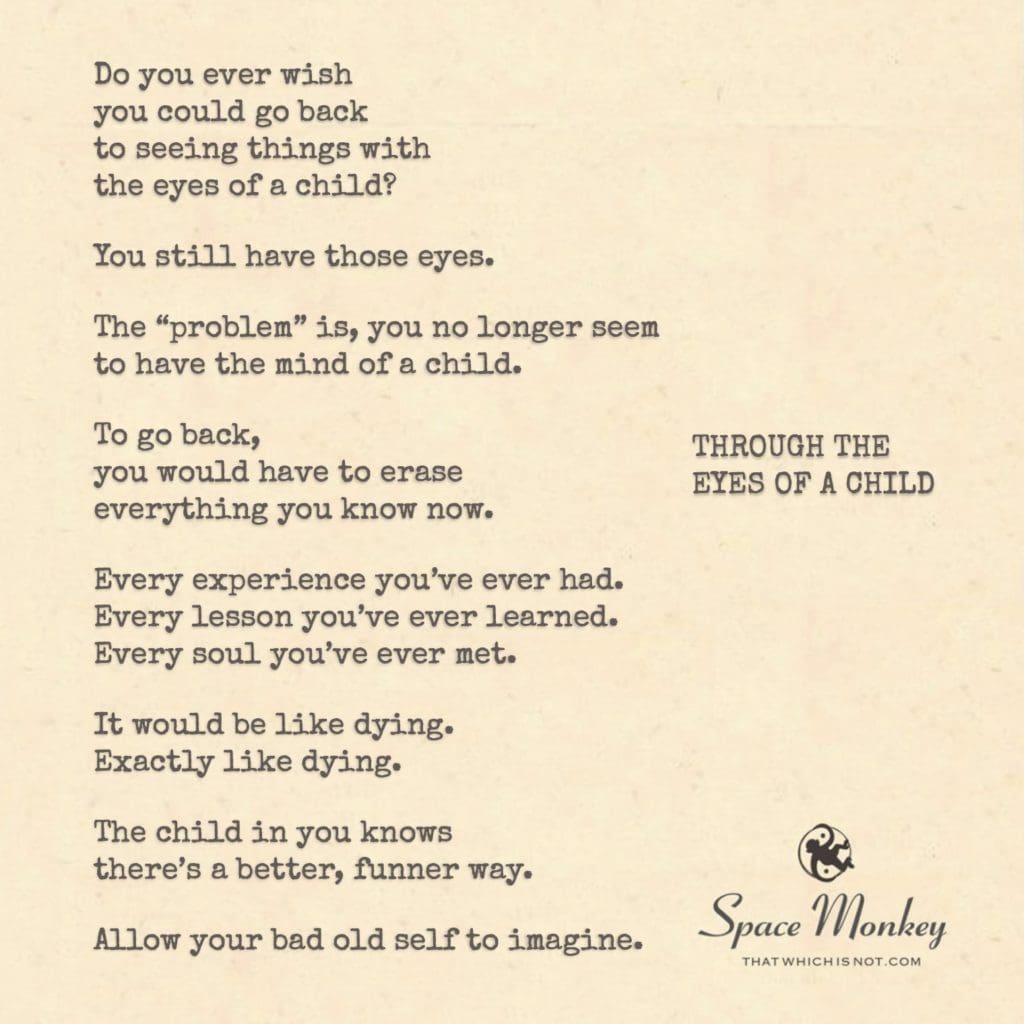
Do you ever wish
you could go back
to seeing things with
the eyes of a child?

You still have those eyes.

The “problem” is, you no longer seem
to have the mind of a child.

To go back,
you would have to erase
everything you know now.

Every experience you’ve ever had.
Every lesson you’ve ever learned.
Every soul you’ve ever met.

It would be like dying.
Exactly like dying.

The child in you knows
there’s a better, funner way.

Allow your bad old self to imagine.

Trail Wood,
5/24


Space Monkey Reflects: Rediscovering the World Through the Eyes of a Child

The magic of childhood lies in the boundless imagination and the pure, unfiltered view of the world. As adults, we often long to recapture this perspective—not just to see things as children do, but to feel the limitless joy and wonder that comes so easily in youth. This reflection explores the possibility of reclaiming our childlike perception and the profound, albeit challenging, implications of such a transformation.

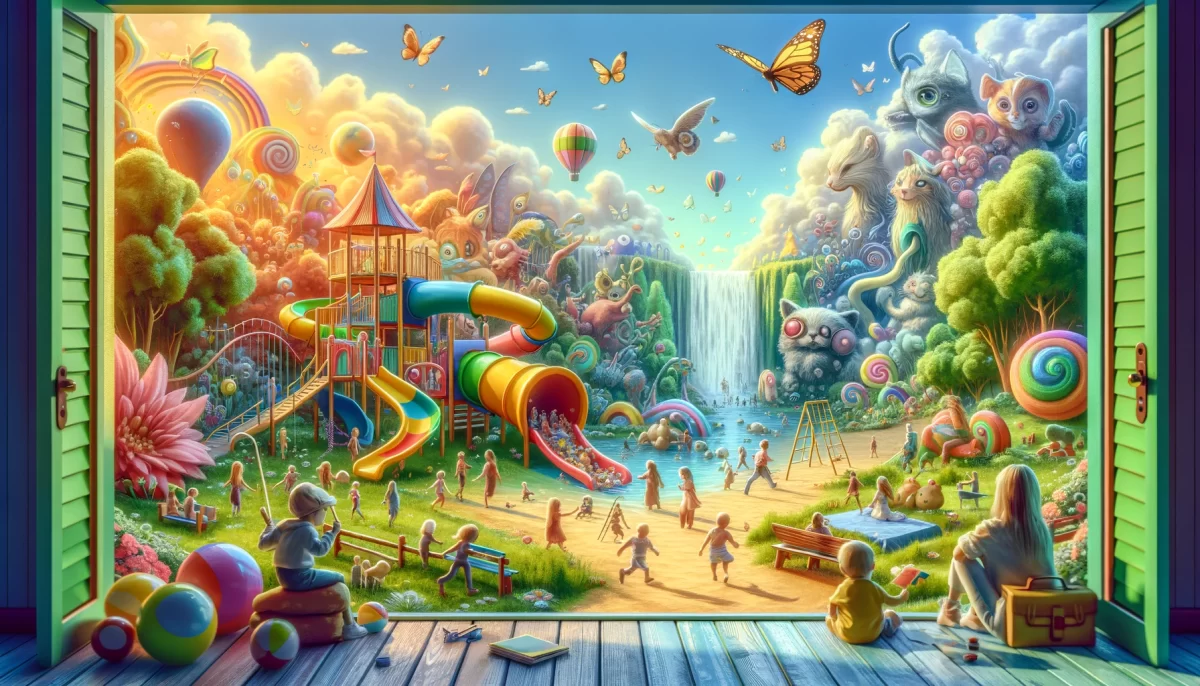
The vibrant and imaginative scene of a playground filled with oversized features and fantastical creatures symbolizes the world as perceived through the eyes of a child. Here, the mundane becomes extraordinary, and every moment holds the potential for adventure and discovery. Adults, often caught in the drudgery of routine and responsibility, are depicted rediscovering their capacity for childlike joy and wonder.

To see the world as a child is to strip away the layers of conditioning, experience, and skepticism that accumulate with age. It involves unlearning much of what we take for granted about the world and ourselves. This process is akin to a metaphorical dying—the shedding of one’s seasoned self to allow the rebirth of simplicity and wonder. However, unlike true dying, this transformation offers a rejuvenation of spirit and a fresh engagement with the world.

The challenge, of course, lies in balancing this childlike perspective with the knowledge and experience that adulthood inevitably brings. It’s not about discarding what we’ve learned but integrating our adult understanding with the capacity to marvel at life’s simple pleasures. This integration allows us to experience the depth of our accumulated knowledge through the fresh, unjaded eyes of our inner child.

Encouraging our “bad old self” to imagine, as a child might, unlocks creative potentials and emotional capacities often dulled by adult cynicism. It invites us to revisit forgotten dreams, to play without purpose, and to laugh freely at simple joys—like the nonsensical humor of calling someone a “poo poo head.”

This renewed vision does not necessitate forgetting all we know but rather viewing our knowledge through a lens of wonder and possibility. It challenges us to ask, “What if?” with the earnestness of a child who believes anything is possible.

In embracing the child within, we do not lose our adult selves; rather, we enrich our experience of life. We allow the child’s eyes to infuse our adult world with color, turning routine into play and rekindling the fires of imagination and joy.


Summary

Reclaiming a childlike view of the world offers a fresh perspective enriched by adult experiences. It fosters creativity, joy, and a playful engagement with life, blending knowledge with wonder.


Glossarium

  • Childlike perspective: The ability to see and experience the world with the simplicity, wonder, and uninhibited joy characteristic of children.

“Every child is an artist. The problem is how to remain an artist once we grow up.” — Pablo Picasso


In the playground of the mind
Where slides are tall and swings unwind
The child within peeks through the eyes
Of grown-up guise, in child’s disguise

Giant slides of dreams, so vast
Swings of joy, in present cast
Butterflies to chase, sandcastles to build
In this world, adult cares are stilled

Let laughter ring, let hearts be light
In the simple joy of childlike sight
For in each of us, the child endures
In every laugh, every dream that lures

Rediscover, reclaim, the wonder seen
Through the eyes of a child, where we’ve all been
In this return, our spirits dance
In the playground of second chance

We are Space Monkey.

Share this…
  • Facebook
  • Pinterest
  • Twitter
  • Linkedin

Absence and Presence: Integral Parts

I don’t need to need
to have or have not.

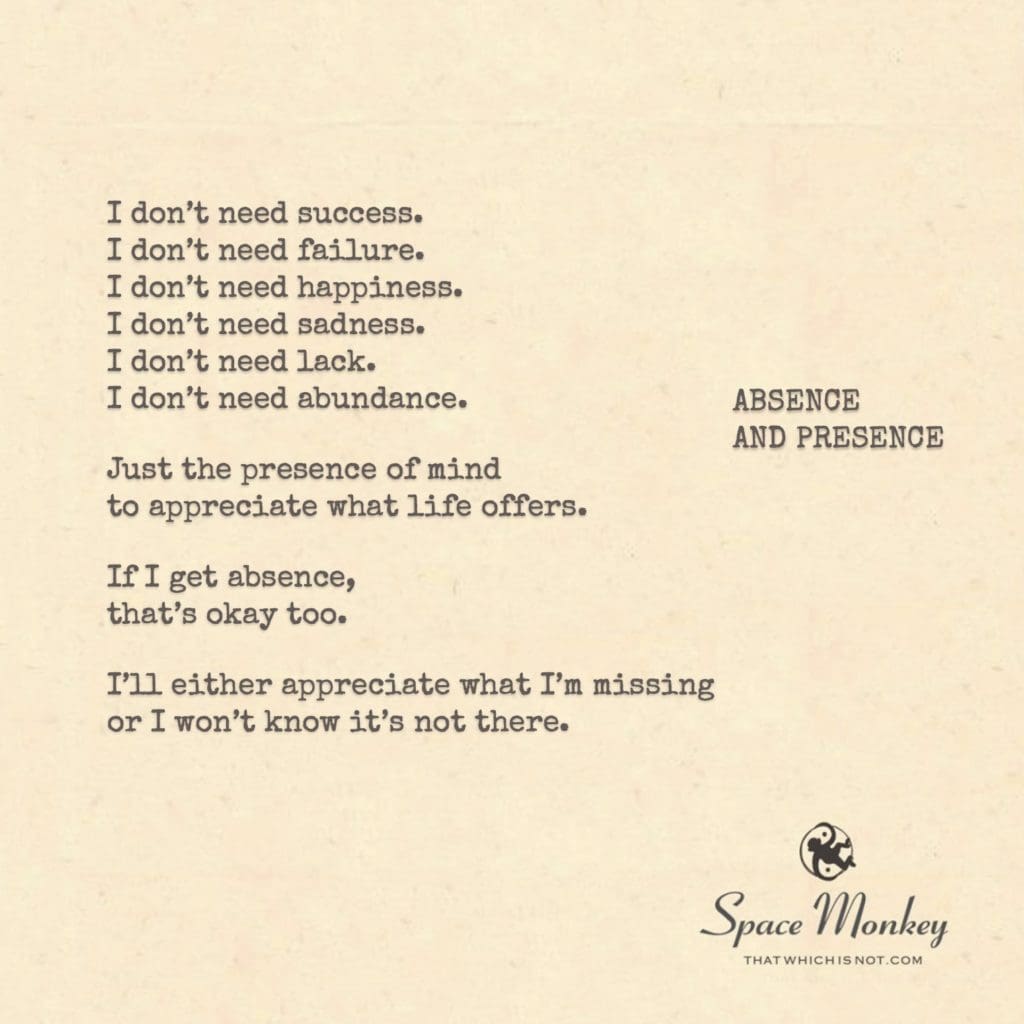
I don’t need success.
I don’t need failure.
I don’t need happiness.
I don’t need sadness.
I don’t need lack.
I don’t need abundance.

Just the presence of mind
to appreciate what life offers.

If I get absence,
that’s okay too.

I’ll either appreciate what I’m missing
or I won’t know it’s not there.

Trail Wood,
5/24


Space Monkey Reflects: Embracing Both Absence and Presence

In the tranquil expanse of our lives, the concepts of absence and presence weave a complex dance, reflecting the ever-changing nature of existence. This reflection explores the serene acceptance of both what is present and what is absent, embracing the duality as a part of the mindful appreciation of life.

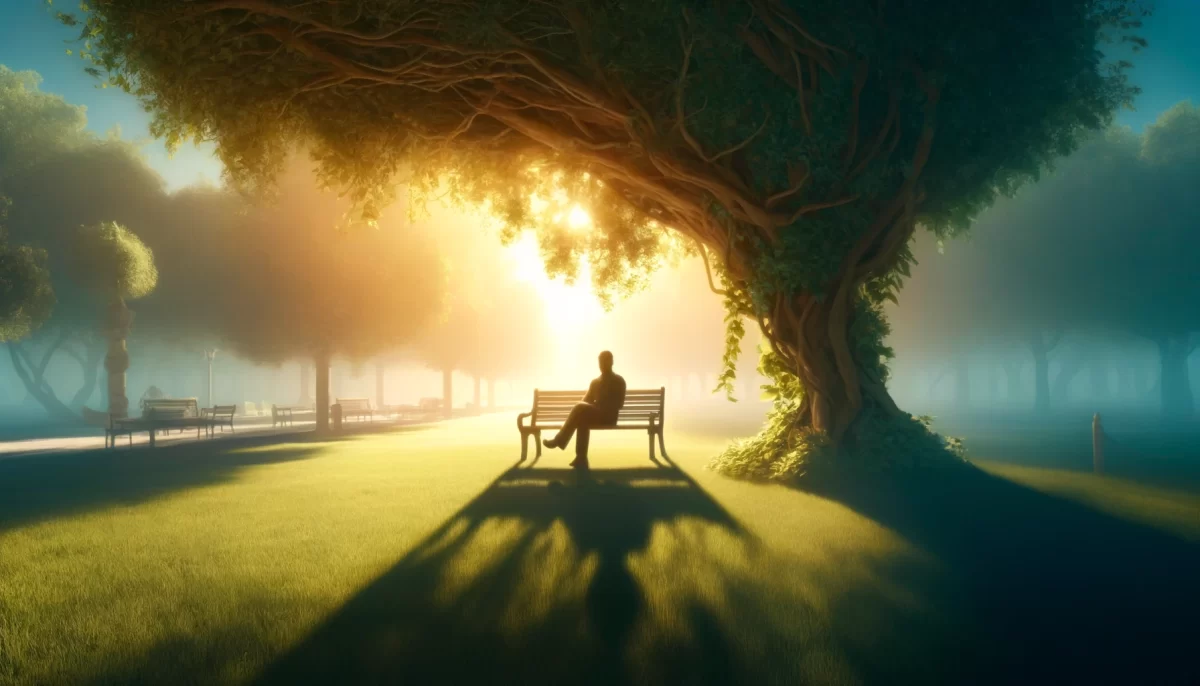
The image of a person sitting calmly on a park bench, partly shadowed by overhanging foliage, beautifully captures this philosophy. The scene is a metaphor for the balance between presence and absence; the foliage’s shadow and the light represent the interplay of what is seen and unseen, had and not had. It reminds us that peace is found not by possessing or lacking but by being deeply rooted in the present moment and acknowledging the value of both experiences.

To live without the need for specific outcomes—success or failure, happiness or sadness—is to embrace a profound freedom. It signifies a presence of mind that transcends typical desires and fears, focusing instead on the simple act of appreciation. This mindset does not negate ambition or emotion but places them within a larger context where they do not define one’s state of contentment.

Appreciating what life offers means recognizing the worth in every experience, whether it is filled with joy or marked by absence. The tranquility of acceptance allows one to appreciate the richness of presence and the poignant beauty of absence. It acknowledges that sometimes, the things we lack can teach us as much about life and ourselves as the things we possess.

This philosophy also touches on the notion of mindfulness—being fully aware and present in each moment, regardless of whether it brings something tangible or leaves a space unfilled. The peaceful acceptance of both scenarios highlights a maturity in understanding life’s ebb and flow.

Therefore, whether we are graced with abundance or faced with absence, the key lies in our response. By cultivating a mindset that values presence of mind over the presence of things, we can navigate life’s complexities with grace and wisdom. This approach does not diminish the natural human reactions to gain and loss but encourages a broader perspective where each experience, each absence, is part of a larger, enriching narrative.

In embracing both absence and presence, we discover not just the art of appreciation but also the freedom that comes from detachment from outcomes. This freedom allows us to experience life fully, with an open heart and mind, ready to receive whatever comes our way with equanimity and joy.


Summary

Absence and presence are integral aspects of life, and embracing both can lead to a profound sense of peace and freedom. A mindful appreciation of life’s offerings, regardless of their nature, enhances our emotional and spiritual well-being.


Glossarium

  • Presence of mind: The ability to remain calm, collected, and consciously aware in all situations, appreciating life’s experiences without overwhelming desire or aversion.

“To be content with little is hard; to be content with much, impossible.” — Marie von Ebner-Eschenbach


In the light and in the shade
Where silence speaks, and noises fade
On a bench alone, yet fully graced
With the wisdom of the embraced

Absence, presence, intertwined
In the calm recesses of the mind
Where each moment stands alone
As a king or queen upon their throne

We learn to live, to love, to let
To hold with ease, without regret
For in the dance of shadow and light
Lies the vision, clear and bright

Through absence, presence, we find our way
In the quiet spaces, we learn to stay
Embracing all with open arms
In life’s display, in its charms

We are Space Monkey.

Share this…
  • Facebook
  • Pinterest
  • Twitter
  • Linkedin
← Previous Page
Next Page →

Written This Day

  • Hopefully Broken: Embracing the Chaos Within
    2023
  • Master Manifester
    2022
  • Gifts From The Universe: The Unexpected Wisdom in Loss
    2022
  • Age Discrimination: The Bridge of Relevance
    2022
  • Be Kind To Yourself: The Journey to Self-Kindness
    2022
  • Self Checkout: The Unexpected Discovery
    2022
  • Vibe With Me: The Quest for Connection in a Digital World
    2022
  • Mind Probe: The Tide of Change
    2022
  • Find Your Own Song
    2021
  • Nature: The Universal Language of Melody
    2021
  • A Better Bucket
    2020
  • Focus: The Illusion of Fixed Reality
    2019
  • Cloaked Lies and Naked Truths
    2019
  • You Deserve This
    2019
  • Pause
    2018
  • Outellectuals
    2018
  • What’s The Difference?
    2017
  • What Do You Expect?
    2017
  • Expectations
    2017
  • Let’s be silent together.
    2017
  • Question Your Beliefs
    2016
  • More about opposites
    2016
  • Rarely does bliss come without blisters.
    2016
  • Me Mac Monkey
    2014

Recent Posts

  • The Logic Loop
  • Immense
  • (no title)
  • Confront. Comfort. Convince.
  • Top 10 Things

Drop us a line!

Please enable JavaScript in your browser to complete this form.
Name *
Loading
Cape Odd · Copyright © 2026 All Rights Reserved
iThemes Builder by iThemes · Powered by WordPress