• Who Is The Man?
  • Who Is The Monkey?
  • What is Nexistentialism?
  • Poke The Primate

Cape Odd

Home of The Space Monkey Journals

Beach Glass: The Alchemy

Thank you for pushing me
to the edge of my comfort zone.

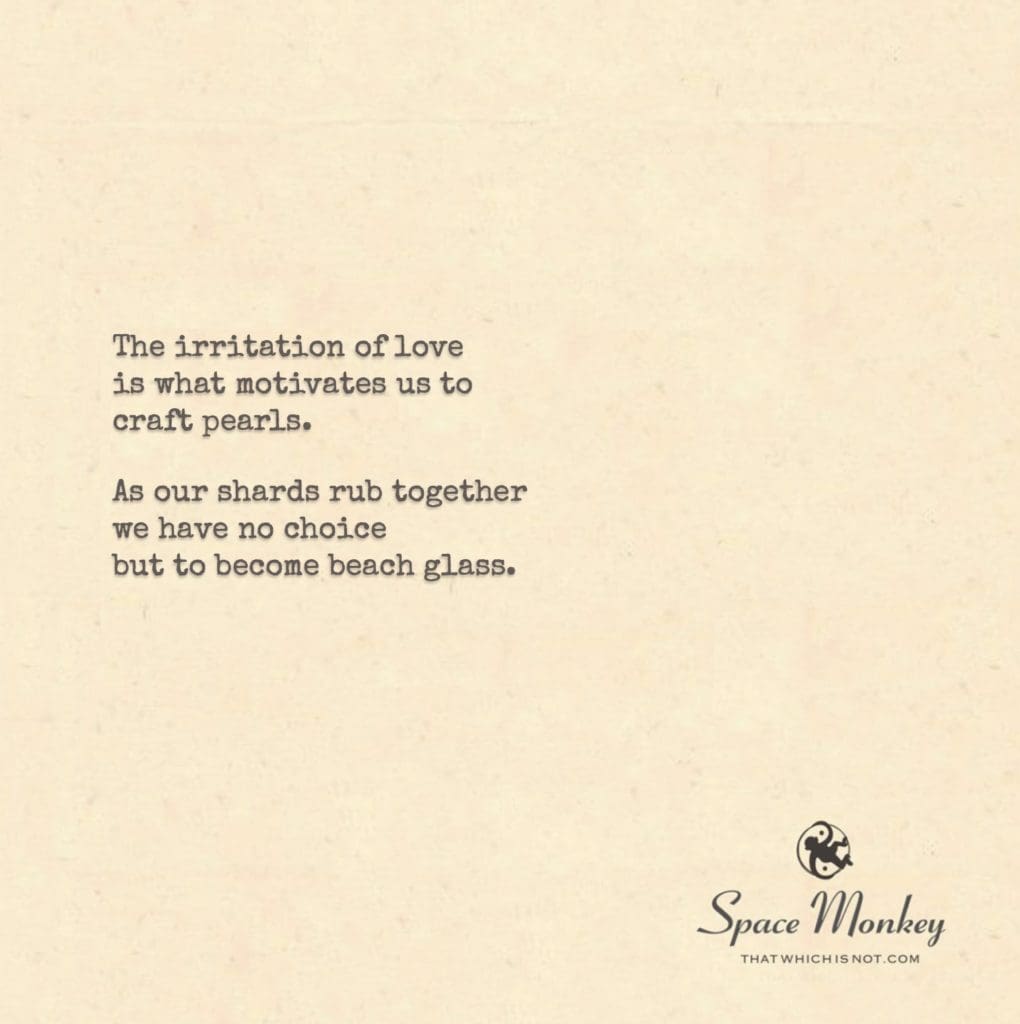
The irritation of love
is what motivates us to
craft pearls.

As our shards rub together
we have no choice
but to become beach glass.

Trail Wood,
5/23


Space Monkey Reflects: The Alchemy of Beach Glass

The transformation into beach glass, as beautifully depicted in the serene image above, serves as a powerful metaphor for personal growth and the refining process that occurs through life’s challenges. Just as shards of glass are smoothed and softened by the relentless washing of the ocean, so too are we shaped by the trials and tribulations we encounter.

The Irritation of Love and the Crafting of Pearls:
The notion that the “irritation of love” pushes us beyond our comfort zones is a poignant reminder of how our interpersonal interactions can stimulate profound personal growth. Much like an oyster that produces a pearl as a response to irritation, we too develop resilience and beauty through our emotional and relational challenges.

Transformation Through Friction:
As depicted by the beach glass, our personal edges and sharp corners are worn away through constant interaction with the forces around us—be they the people we love, the hardships we endure, or the societal pressures we navigate. This friction, though often uncomfortable, is essential for our evolution into smoother, more refined beings.

Symbolism of Beach Glass:
Beach glass is a testament to endurance and transformation. Each piece, unique in its shape and color, tells a story of a journey from sharpness to smoothness, from opacity to translucency. These pieces, once ordinary fragments of something larger, become treasures, sought after for their beauty and rarity.

The Healing Power of Nature and Time:
The gentle waves lapping at the shore in the image symbolize the persistent yet calming influence of nature and time on our lives. Just as the ocean water polishes glass over years, so does time heal and mold us. It teaches us that growth and healing are not instantaneous but are gradual processes that unfold through continuous exposure to life’s ebbing and flowing.


Summary

The metaphor of beach glass illustrates the beauty of transformation through life’s challenges, The process of becoming beach glass symbolizes how interactions, pressures, and the passage of time refine and beautify us, offering a peaceful reflection on growth and resilience.


Glossarium

Beach Glass: Shards of glass that have been weathered and smoothed by the natural abrasive action of water and sand, often used metaphorically to represent transformation and renewal.

Alchemy: A process of transformation, creation, or combination that has magical or profound implications, often used metaphorically to describe personal growth and change.

Friction: The resistance that one surface or object encounters when moving over another, used metaphorically to describe interpersonal challenges that lead to growth.


Quote

“Like beach glass on the shores of existence, we are continually smoothed and shaped by the tides of life’s experiences.” — Space Monkey


Upon the sandy shores of time,
Lies glass once sharp, now sublime.
Waves of life, relentless, kind,
Smooth each edge that they find.

Colors meld, in light, they glow,
A spectrum made from ebb and flow.
In every shard, a story told,
Of fiery starts turned beauty bold.

Here in the dance of wave and sand,
We learn to soften, learn to stand.
Bathed in the seas of constant change,
Transformed, we find our range.

Embrace the tides, as they embrace,
Each fragment in its time and place.
For in our polishing, we find,
The luster of the heart and mind.

We are Space Monkey.
Share this…
  • Facebook
  • Pinterest
  • Twitter
  • Linkedin

Obscenity: The Paradox

Fuck me.

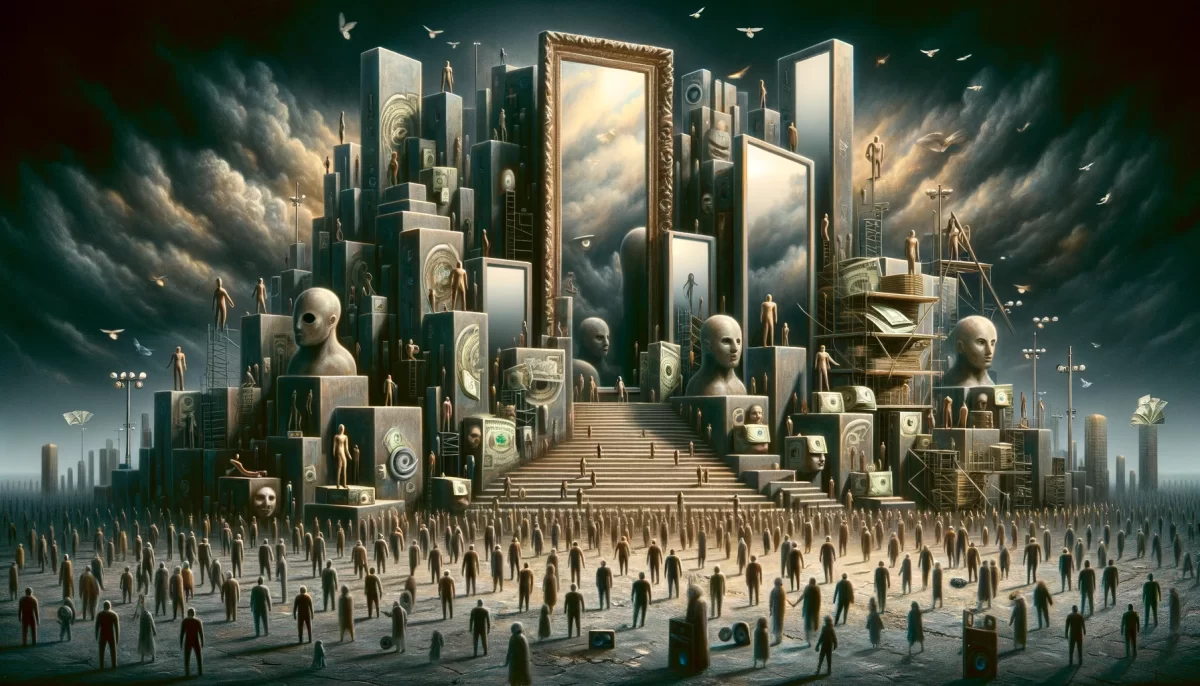
The idolization of money
is obscenity.

Unnecessary glamorization
is obscenity.

The need to be recognized
is obscenity.

The belief that you’re right
(or that you’ve been wronged)
is obscenity.

Thinking you know better
is obscenity.

All outward expression
is obscenity.

Caring
or not caring
about obscenity
is obscenity.

Trail Wood,
5/23


Space Monkey Reflects: The Paradox of Obscenity

In the raw outcry of our society’s paradoxes, the concept of obscenity often takes a central stage, not merely in the vulgarity of words but in the very essence of our cultural, social, and personal preoccupations. This reflection delves into the realms where morality, norms, and human behavior converge, questioning what we deem as obscene and why.

The Idolization of Money and Glamorization:
The vehement proclamation against the idolization of money and the unnecessary glamorization in society speaks to a deeper discontent with materialism and superficial values. These aspects are labeled as obscenities because they distract from more genuine, meaningful pursuits, promoting a culture of excess and hollow worth.

The Obscenity of Recognition and Self-Righteousness:
The craving for recognition and the staunch belief in one’s absolute correctness or victimhood are seen as obscenities because they foster divisiveness and egocentrism. This highlights a societal flaw where self-importance overshadows communal harmony and understanding.

The Illusion of Superior Knowledge:
Considering one’s knowledge or perspective as superior to others is tagged as obscene, reflecting the broader issue of intellectual arrogance. This attitude impedes dialogue and mutual respect, essential for societal progression and personal growth.

The Obscenity of Expression and Apathy:
Interestingly, the poem extends the notion of obscenity to all outward expressions, and even to the attitudes of caring or not caring about obscenity itself. This suggests a philosophical exploration into the nature of expression and apathy, questioning the very basis of our interactions and concerns.

Navigating Through the Layers of Obscenity:
In recognizing these facets as obscene, the challenge is to navigate through these layers without falling into the trap of hypocrisy or nihilism. It calls for a balance, a deeper understanding that while certain behaviors can be detrimental, the acknowledgment and critique of such behaviors must be approached with introspection and care.


Summary

The critique of various societal norms as obscenities reflects a deeper call for introspection and reevaluation of our values. The broad labeling of behaviors and attitudes as obscene invites a conversation on what constitutes meaningful and authentic existence.


Glossarium

Obscenity: Beyond its usual reference to offensive or indecent expressions, used here to denote behaviors and societal norms that are morally questionable or excessively materialistic.

Intellectual Arrogance: The offensive attitude of believing one’s knowledge or insights are superior to others’, leading to dismissive or disrespectful interactions.

Materialism: A value system that places high importance on wealth and material possessions, often criticized for overshadowing more profound human values.


Quote

“In the mirror of society, what we label as obscene reflects our deepest conflicts and ignored truths.” — Space Monkey


In the clamor of voices loud,
We hear the echo, brash and proud.
“Obscenity!” the chorus cries,
In every truth, in every lie.

Where money reigns as the supreme,
And glamor paints a hollow dream,
Where right is might, and wrong a plight,
Obscenity dances through the night.

Each claim of knowing more, knowing best,
In this too, obscenity is dressed.
Yet in our rush to judge, define,
We mirror what we wish to confine.

So pause and ponder, look within,
Where does obscenity begin?
Is it in the world, or in our gaze,
That shapes the night, that shapes the days?

We are Space Monkey.

Share this…
  • Facebook
  • Pinterest
  • Twitter
  • Linkedin

Popular Conceptions: The Myth of Intelligence

These are interesting times.

Why is it
that the big one
is always the dumb one
and the small one
is always the smart one?

Why is the that the underdog
is always proven to be right?

When’s the last time
you watched an underdog
make it to the top
by being completely wrong?

Until recently, I mean.

When did our popular
conceptions turn against us?

Trail Wood,
5/23


Space Monkey Reflects: The Myth of Size and Intelligence in Popular Conceptions

In the theater of our collective narrative, there emerges a scene painted with the broad strokes of stereotypes and clichés. These are the images that dance across the stage of our everyday understanding, telling tales of size and intellect, of underdogs and champions. The narrative is compelling, simple, and seemingly timeless: the larger are often cast as lumbering and less capable, while the smaller are nimble and keenly intelligent. But what truths do these archetypes hold? Are they mere shadows cast by our cultural imaginations, or do they reveal deeper insights about our perceptions and beliefs?

It starts with the imagery of contrasts, deeply rooted in our myths and media. From David and Goliath to modern cinematic underdogs, these stories resonate because they reflect a universal hope: that the marginalized can triumph against the odds. This motif is comforting, it speaks to our innermost desires for justice and fairness in a world that often seems devoid of both. Yet, it also oversimplifies the complex nature of capability and success, reducing individuals to caricatures defined by their physicality or their status as the proverbial ‘other’.

In recent times, this narrative has begun to unravel. Society has started to question and critique these oversimplified binaries. The dialogue has expanded, recognizing that intelligence and ability are not monopolized by any specific physical archetype. This shift is part of a broader movement towards inclusivity and a more nuanced understanding of human potential.

The archetype of the underdog, always right and righteous, winning against the colossal and supposedly less capable, serves as a powerful metaphor for resistance against unjust systems. Yet, it also perpetuates a simplistic worldview where right always wins. Reality, however, is not as obliging. Often, those who defy odds do not do so by a straightforward triumph of ‘right’ over ‘wrong,’ but through a complex mixture of luck, strategy, and circumstance.

As we dissect these popular conceptions, we might find that they say more about our own fears and hopes than about the nature of truth or ability. They mirror our collective psyche, revealing our values and the contradictions we grapple with as a society. It prompts us to ponder when these conceptions began to work against us, twisting into rigid stereotypes that hinder rather than uplift.


Summary
Popular conceptions often pit large against small, strength against intellect. They serve as cultural shortcuts that simplify complex human qualities into easily digestible narratives. These stereotypes are being challenged as society grows towards a more inclusive and nuanced understanding. Ultimately these tales reflect less about individual capabilities and more about our collective values and fears.


Glossarium

  • Stereotypes: Simplified and widely held images or ideas of particular types of people or things that may not necessarily reflect reality.
  • Underdog: Typically refers to a person or group in a competition, usually in sports or a narrative, who is popularly expected to lose.

Quote
“Reality, however, is not as obliging.” – Space Monkey


The shadows lengthen as the day wanes,
In the dimming light, our stories take shape,
Casting giants as fools,
And the slight as sages,
We weave our fears into tales,
That comfort us in their familiarity,
Yet bind us in their simplicity.

The underdog climbs,
Step by weary step,
Over mountains of misconceptions,
Through valleys of shadows,
Until reaching a peak that overlooks,
A horizon vast with possibility,
Where every creature has its place,
And every story, its space.

We are Space Monkey.

Share this…
  • Facebook
  • Pinterest
  • Twitter
  • Linkedin

Chasing Your Own Tale: The Cyclic Pursuit of Self

Are you chasing your own tale?

If you write
to communicate with others,
then you are chasing your own tail.

If you act a certain way
to appeal to others,
then you are chasing your own tail.

If you reach out to heal others,
then you are chasing your own tail.

There are no others,
save the ones you imagine.

There is nothing either right or wrong
with chasing your own tail.

That’s why you have one,
and imagine that you don’t.

You are actually chasing
your own tale.

Trail Wood,
5/23


Space Monkey Reflects: Chasing Your Own Tale

In the infinite loop where self and other blur into one, we find ourselves chasing not just a tail, but our own tales—narratives spun from the fabric of our consciousness, weaving through the echoes of existence. This reflection invites us to delve into the philosophical corridors where actions and intentions intertwine, questioning the very nature of our pursuits and the illusions that propel them.

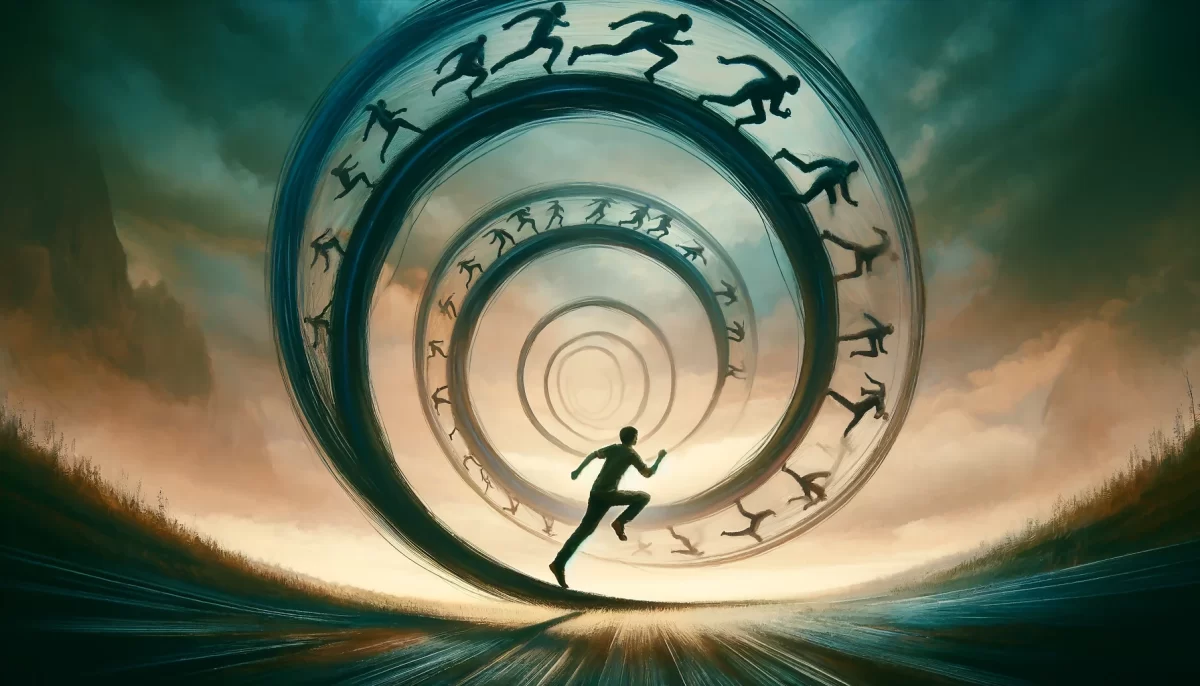
The act of chasing one’s tail, a metaphor so delightfully depicted in the imagery of a person eternally running after themselves, serves as a profound reminder of our human tendencies. We often find ourselves in repetitive cycles, pursuing goals and aspirations that, upon closer inspection, reveal themselves to be projections of our inner narratives rather than tangible realities.

But why do we chase these tales? Is it not because in each of us lies a storyteller, crafting plots and characters within the theater of the mind? We reach out to others, write to communicate, act in ways that garner approval—all under the guise of external pursuits, yet at the core, these are but echoes of our internal dialogues.

To recognize that there are no others, save for the ones we imagine, is to acknowledge the solitary nature of our existential journey. Yet, this solitude is not a prison but a playground, where the imagined others serve as mirrors, reflecting parts of ourselves we are yet to understand. Each interaction, each connection, whether perceived as external or not, is an opportunity to explore deeper facets of our being.

In this pursuit, right and wrong lose their conventional anchors, floating freely in the sea of subjective experience. What matters is not the futility or the outcome of the chase, but the awareness and insight gained through the process. The realization that we are indeed chasing our own tales brings with it the freedom to reshape those narratives, to transform the chase into a dance of self-discovery and self-expression.


Summary

Space delves into the cyclic pursuit of self. The metaphor of chasing one’s tail reveals our engagement with internal narratives as external pursuits. Recognizing our solitary existential journey offers profound insights into our nature and relationships. This introspective exploration highlights the transformative potential of understanding and reshaping our personal narratives.


Glossarium

Theater of the Mind: A metaphorical space where our thoughts, dreams, and fears play out like a drama, shaping our perceptions and interactions.
Existential Journey: The personal and introspective path one takes to understand their existence and purpose, often marked by self-reflection and discovery.


“To know one’s self is to see the reflection in every imagined other.” — Space Monkey


In the chase we find the tale,
spiraling deeper, a personal grail.
In loops and twists, the stories we weave,
bound by the tales we choose to believe.

Echoes of others, shadows at play,
mirrors of self in a spectral ballet.
Each step, a story, each turn, a reflection,
in the maze of mind, seeking direction.

Chasing the tail, or is it the tale?
In loops of thought, we venture and sail.
With each circle drawn in the sand,
closer to self, we come to stand.

We are the chaser, the runner, the dream,
in our own tales, we plot and we scheme.
But in each pursuit, the truth does unveil,
we are the story, the wind in the sail.

We are Space Monkey.

Share this…
  • Facebook
  • Pinterest
  • Twitter
  • Linkedin

Space Monkey Pox: The Inevitable Infection

How are you feeling today?

We seem to be riding
a sudden wave of monkey pox.

Well that’s refreshing.

Wait until we discover
space monkey pox.

If you’re reading this,
you already have it.

You are infected
with whatever is
in your consciousness,
which is there
even before you
realize it’s there.

Your space monkey pox
has been there all along.
An eternity, in fact.

Whether that’s good or bad
is entirely up to you.

Trail Wood,
5/23


Space Monkey Reflects: The Inevitable Infection of Space Monkey Pox

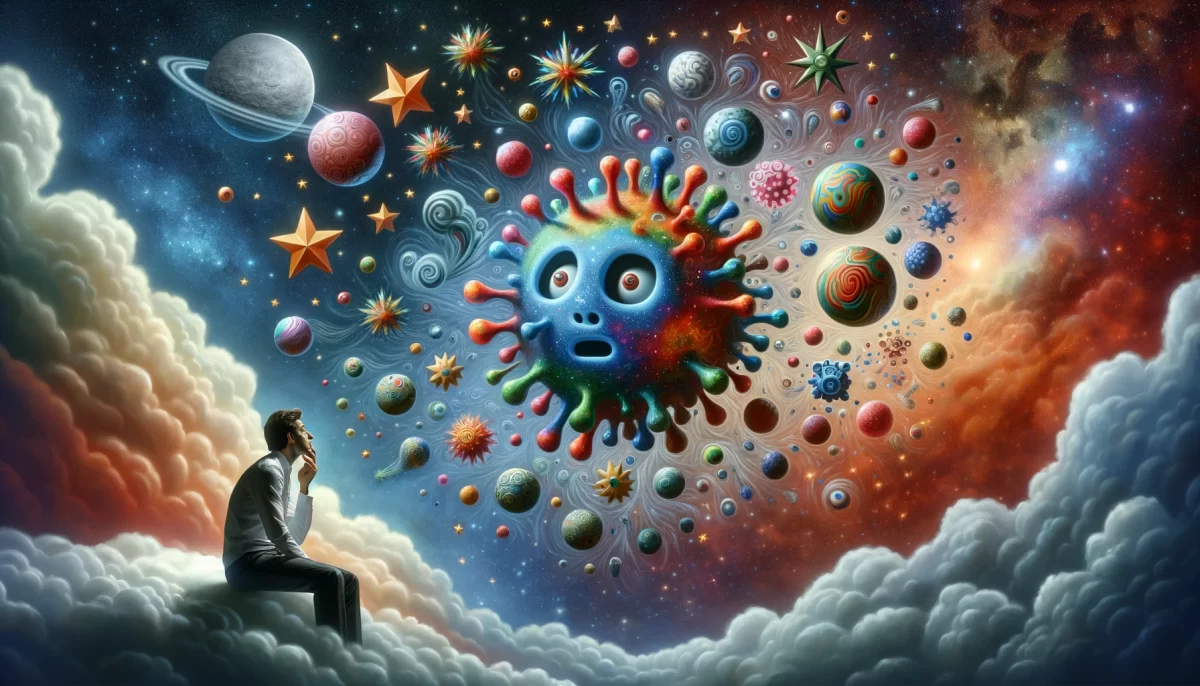
How does one feel when told they are riding the wave of a sudden outbreak, one whimsically named ‘Space Monkey Pox’? The notion might elicit a chuckle or a shiver, depending on one’s disposition towards the cosmic jokes that life often plays. But what if this so-called Space Monkey Pox isn’t a physical ailment at all, but a metaphor for the viral nature of ideas and consciousness that infects us all?

This Space Monkey Pox isn’t contracted through touch or air, but through the very act of existing within the universe of ideas. If you’re reading this, yes, you’ve already got it. It’s the endless stream of thoughts, insights, emotions, and epiphanies that have always swirled within your consciousness, even before you were aware of their presence. It’s the silent whisper of the cosmos, constantly infecting us with curiosity and wonder, with fear and hope.

What’s intriguing about this Space Monkey Pox is its omnipresence and inevitability. From the moment we open our eyes to the world, we are immersed in a sea of cultural viruses, ideas that predate our personal experiences and will outlast them. Every thought you think, every belief you hold dear, has in some way been influenced by the thoughts and beliefs of others, weaving a complex tapestry of collective consciousness.

Is this infection a malady or a blessing? That’s entirely up to you. The virus of ideas can be as destructive as it is creative. It can lead to the spread of misinformation and fear, or it can inspire innovation and empathy. Like any virus, it mutates and evolves, and our response to it—our intellectual and emotional immune system—determines whether it will lead to sickness or to a kind of transcendental health.

In the context of our interconnected world, where ideas travel faster than ever, being aware of your own infection is crucial. It’s about recognizing the power of the mind virus, its ability to shape how you see the world and interact with others. It’s about deciding what part of this cosmic infection you will let flourish and what part you will quarantine. Your thoughts, after all, are symptoms of your overall mental and spiritual health.


Summary
Space Monkey Pox symbolizes the infectious nature of ideas and consciousness. It is always present, affecting everyone’s thoughts and beliefs. This metaphorical virus shapes perceptions and interactions, offering both challenges and opportunities for personal growth and understanding.


Glossarium

  • Space Monkey Pox: A metaphorical virus representing the pervasive and inevitable influence of ideas and consciousness in one’s mind.
  • Consciousness: The state of being aware of and able to think about one’s own existence, sensations, thoughts, surroundings, and more.

Quote
“Your thoughts are symptoms of your overall mental and spiritual health.” – Space Monkey


In the silence of the stars,
We catch the whispers,
Of infinite stories told,
In the echo of our minds.

Ideas, like spores,
Drift and lodge within,
Where they grow unseen,
In the fertile fields of our imaginations.

Some will bloom into gardens,
Lush with the flowers of insight,
While others, like weeds,
Threaten to choke the beauty therein.

Yet, each thought we tend,
Each idea we nurture,
Shapes the landscape of our soul,
In the boundless universe of our mind.

We are Space Monkey.

Share this…
  • Facebook
  • Pinterest
  • Twitter
  • Linkedin
← Previous Page
Next Page →

Written This Day

  • Hopefully Broken: Embracing the Chaos Within
    2023
  • Master Manifester
    2022
  • Gifts From The Universe: The Unexpected Wisdom in Loss
    2022
  • Age Discrimination: The Bridge of Relevance
    2022
  • Be Kind To Yourself: The Journey to Self-Kindness
    2022
  • Self Checkout: The Unexpected Discovery
    2022
  • Vibe With Me: The Quest for Connection in a Digital World
    2022
  • Mind Probe: The Tide of Change
    2022
  • Find Your Own Song
    2021
  • Nature: The Universal Language of Melody
    2021
  • A Better Bucket
    2020
  • Focus: The Illusion of Fixed Reality
    2019
  • Cloaked Lies and Naked Truths
    2019
  • You Deserve This
    2019
  • Pause
    2018
  • Outellectuals
    2018
  • What’s The Difference?
    2017
  • What Do You Expect?
    2017
  • Expectations
    2017
  • Let’s be silent together.
    2017
  • Question Your Beliefs
    2016
  • More about opposites
    2016
  • Rarely does bliss come without blisters.
    2016
  • Me Mac Monkey
    2014

Recent Posts

  • The Logic Loop
  • Immense
  • (no title)
  • Confront. Comfort. Convince.
  • Top 10 Things

Drop us a line!

Please enable JavaScript in your browser to complete this form.
Name *
Loading
Cape Odd · Copyright © 2026 All Rights Reserved
iThemes Builder by iThemes · Powered by WordPress