• Who Is The Man?
  • Who Is The Monkey?
  • What is Nexistentialism?
  • Poke The Primate

Cape Odd

Home of The Space Monkey Journals

I Own You: The Illusion of Ownership

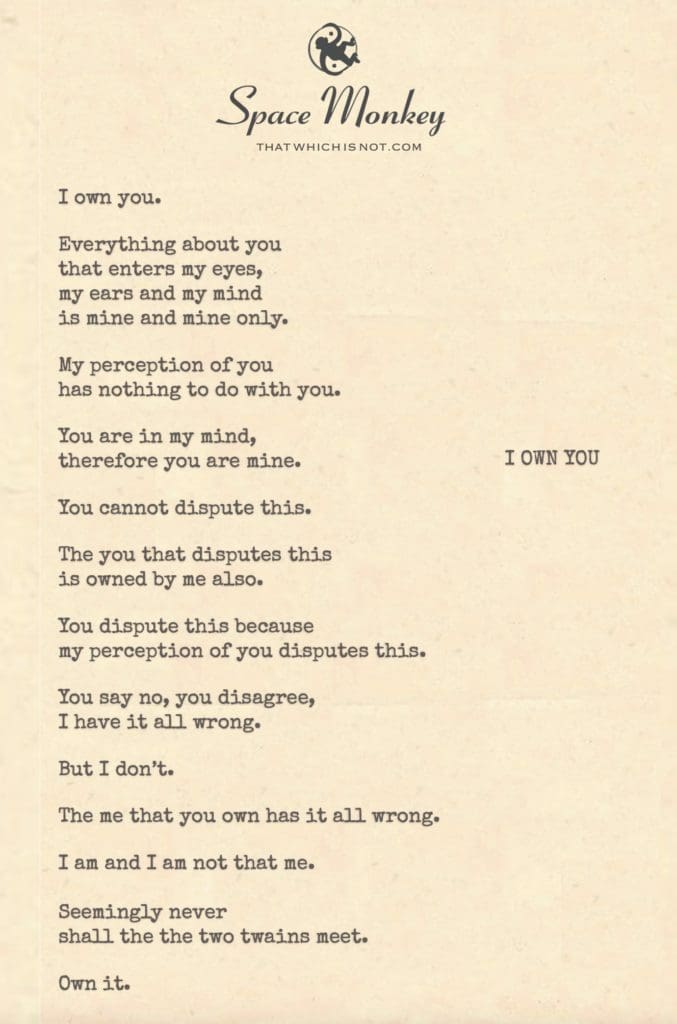
I own you.
My own you.
(Your you may vary.)

I own you.

Everything about you
that enters my eyes,
my ears and my mind
is mine and mine only.

My perception of you
has nothing to do with you.

You are in my mind,
therefore you are mine.

You cannot dispute this.

The you that disputes this
is owned by me also.

You dispute this because
my perception of you disputes this.

You say no, you disagree,
I have it all wrong.

But I don’t.

The me that you own has it all wrong.

I am and I am not that me.

Seemingly never
shall the the two twains meet.

Own it.

We are Space Monkey.

Trail Wood,
5/23


Space Monkey Reflects: The Illusion of Ownership in Perception

In the swirling cosmos of perception, a profound declaration echoes: “I own you.” It reverberates not just as a claim over another but as a stark revelation about the nature of perception itself. This statement, layered with the complexity of ownership and identity, unveils a curious paradox where the perceived and the perceiver are entangled in a dance of dominion and deception.

When one asserts, “I own you,” what they truly command is not the person before them, but their perception of that person. Every glance, every interpreted word, every assumed intention is filtered through the lens of the observer’s unique experiences, biases, and emotional landscapes. Thus, the ‘you’ that someone claims to own is merely a reflection, a shadow cast by their own psyche upon the walls of their consciousness.

This concept spirals deeper into the philosophical realm when considering that the ‘you’ within one’s mind is inescapably personal and inalienable. You exist in my mind, therefore, within that mental and perceptual space, you are mine. Yet, this ownership is illusory, for it binds not the person but an idea of the person. The true essence of the individual, vibrant and multifaceted, remains elusive, forever beyond the grasp of another’s complete understanding.

Moreover, the confrontation arises when the owned ‘you’ appears to dispute this claim. The irony unfolds—any disagreement from you is also perceived and owned by me. Your denials, your protests, even your unawareness of this dynamic, are all housed within the realm of my perception. Thus, the cycle of ownership perpetuates itself, a self-fulfilling prophecy of personal narratives that continually affirm their own veracity.

But what of the ‘me’ that you perceive? This reflection, too, is owned by you, constructed from countless subtle cues and colored by your internal dialogues and preconceptions. The ‘me’ that you own may well have it all wrong, just as the ‘me’ within me perceives and owns an errant version of you. Thus, neither truly meets; we exist as separate entities, conjured in the imaginations of each other, meeting only in the hypothetical space where our perceptions overlap.

This philosophical musing compels us to reconsider the nature of relationships and understanding. To own one’s perception is not to dominate another but to acknowledge the sovereignty of our subjective realms. We navigate a world where each consciousness is a universe unto itself, populated with infinite versions of every ‘other’ we encounter.


Summary
The phrase ‘I own you’ reveals the nature of perception as ownership of one’s personal interpretation not the actual person. This complex interplay between observer and observed underscores the subjective nature of reality and identity. Recognizing this can lead to a deeper understanding of interpersonal dynamics and self-awareness.


Glossarium

  • Perception: The way in which something is regarded understood or interpreted.
  • Ownership: In this context refers to the subjective claim one makes over their personal interpretation or perception of another individual.

Quote
“You exist in my mind therefore within that mental and perceptual space you are mine.” – Space Monkey


In the mirrors of mind,
Reflections twist and twirl,
Each a story told,
Of a you and a me,
Owned by the eyes that see.

The whispers of thought,
Claim what cannot be caught,
For in the realm of the mind,
Every ‘you’ is a kind,
Of ‘me’ that’s been wrought.

Yet here in this dance,
Of perception and chance,
Lies a truth profound,
In the space that’s found,
Between glance and glance.

Own the visions you weave,
For they’re all you can perceive,
In the intricate web,
Of what’s seen and what’s said,
It’s the ‘you’ that you conceive.

We are Space Monkey.

Share this…
  • Facebook
  • Pinterest
  • Twitter
  • Linkedin

Two Kinds of Okay: The Dual Facets

What kind of okay are you today?

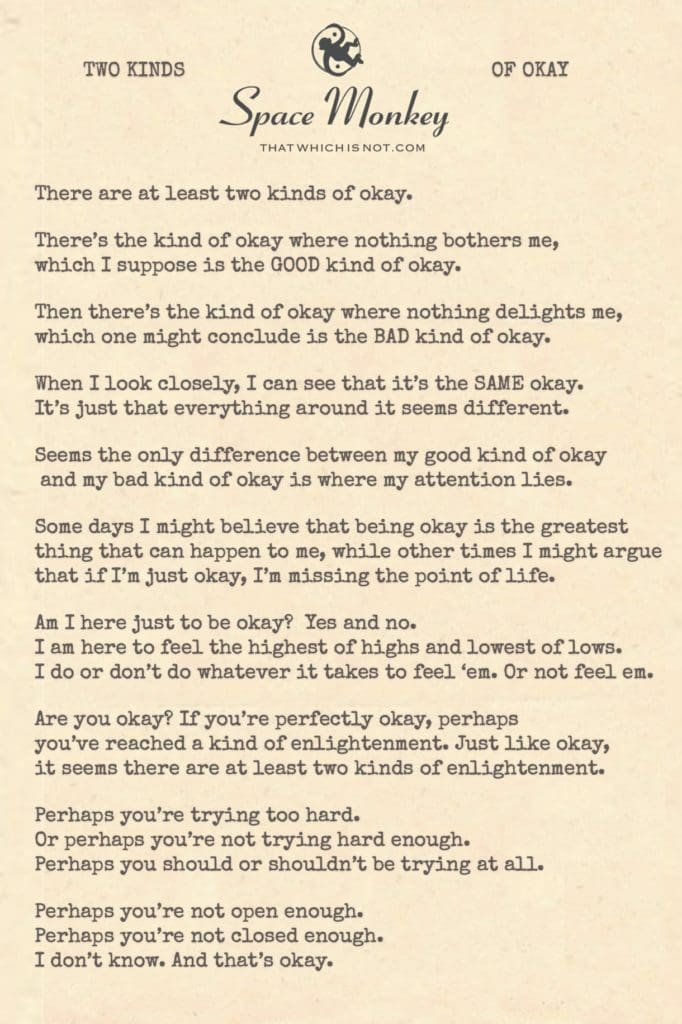
There are at least two kinds of okay.

There’s the kind of okay where nothing bothers me, which I suppose is the GOOD kind of okay.

Then there’s the kind of okay where nothing delights me, which one might conclude is the BAD kind of okay.

When I look closely, I can see that it’s the SAME okay. It’s just that everything around it seems different.

Seems the only difference between my good kind of okay and my bad kind of okay is where my attention lies.

Some days I might believe that being okay is the greatest thing that can happen to me, while other times I might argue that if I’m just okay, I’m missing the point of life.

Am I here just to be okay?  Yes and no. I am here to feel the highest of highs and lowest of lows.
I do or don’t do whatever it takes to feel ‘em. Or not feel em.

Are you okay? If you’re perfectly okay, perhaps you’ve reached a kind of enlightenment. Just like okay,
it seems there are at least two kinds of enlightenment. 

Perhaps you’re trying too hard. Or perhaps you’re not trying hard enough. Perhaps you should or shouldn’t be trying at all.

Perhaps you’re not open enough. Perhaps you’re not closed enough. I don’t know.

And that’s okay.

Trail Wood,
5/22


Space Monkey Reflects: The Dual Facets of Being Okay

In the intricate tapestry of human emotions, the notion of being “okay” presents itself as a multifaceted experience, colored by our perceptions and shaped by our focus. The duality of okay—where we find both a light and a shadow side—is a profound reflection of our internal landscapes and the mutable nature of our states of mind.

On one side of this spectrum lies the “good kind of okay,” a state where serenity prevails and little disturbs our peace. It’s akin to a gentle day where the sun’s warmth kisses the earth, and every breath feels like a sip of spring water—refreshing and invigorating. This okay is underpinned by a sense of contentment, a quiet joy that does not shout but whispers soothingly in our ears, telling us that all is well, and what is, is enough.

Conversely, there is the “bad kind of okay,” which might be likened to an overcast day, where the clouds hang low and the world seems muted. Here, nothing particularly troubles us, yet nothing truly delights. This okay is a flat expanse of emotion, where the vibrancy of life dims and everything feels tepid and uninspired. It’s a state where our attention may dwell too heavily on what’s missing rather than what’s present, leading to a sense of stagnation or a subdued longing for something more, something elusive.

Yet, upon closer inspection, we realize that these two kinds of okay are fundamentally the same; they are differentiated only by our perception and where we choose to cast our gaze. It is a startling and enlightening revelation to see that our emotional landscape can shift dramatically with a simple change in focus—from the shadows to the light, from what is absent to what is abundantly present.

This introspective journey between the different kinds of okay is not just an emotional experience but a philosophical exploration. It invites us to ponder deeper questions about the purpose of our lives and the nature of our aspirations. Are we here merely to be okay, or is there a greater adventure awaiting us—one that encompasses the full spectrum of human emotion from the deepest sorrows to the highest joys?

To be okay can sometimes feel like a safe harbor, a place of calm in the storm of life. But it can also feel like a holding pattern, a temporary pause in the narrative of our lives. The challenge and the beauty lie in recognizing that okay is not a final destination but a part of the journey—a place to rest, reflect, and eventually, to rise from, reinvigorated.

In the end, whether we find ourselves in the good kind of okay or the bad, the power lies in our hands. We can choose to shift our focus, to alter our perception, and thereby transform our experience of okay. It is through this transformation that we might approach the concept of enlightenment, understanding that like okay, enlightenment too can have its dual aspects—each offering a unique path to wisdom and personal growth.


Summary

Being ‘okay’ has dual aspects reflecting our emotional state and focus. The ‘good kind of okay’ embodies contentment and peace while the ‘bad kind’ represents emotional flatness. Recognizing that both states stem from the same root allows us to shift our perception and enhance our life experience.


Glossarium

Good Kind of Okay: A state of contentment where peace and positivity prevail.

Bad Kind of Okay: A state where nothing is particularly distressing yet nothing is deeply fulfilling, characterized by emotional neutrality or flatness.

Perception: The way in which something is regarded, understood, or interpreted.

Transformative Focus: The act of changing one’s focus or attention in a way that fundamentally alters one’s emotional or cognitive state.


Quote

“Being ‘okay’ is not a destination but a path that we navigate, each step a choice between shadow and light.” – Space Monkey


Poetry

In the realm of okay, two paths diverge
One bathed in light, where joys emerge
The other dimmed, where nothing stirs
Yet from the same seed, the spirit concurs

What focus we choose, so defines
Our days bathed in sun, or obscured by blinds
Yet in each, the seed of change does lay
In our hands, the power to sway

Between the realms of okay we roam
Finding in each a temporary home
Yet beyond the okay, the true journey lies
In seeking the stars, beyond the skies

We are Space Monkey.

Share this…
  • Facebook
  • Pinterest
  • Twitter
  • Linkedin

I Rest In God: Surrendering to the Divine Flow

Who am I to think I’m in control?
Who am I to believe that I need control?

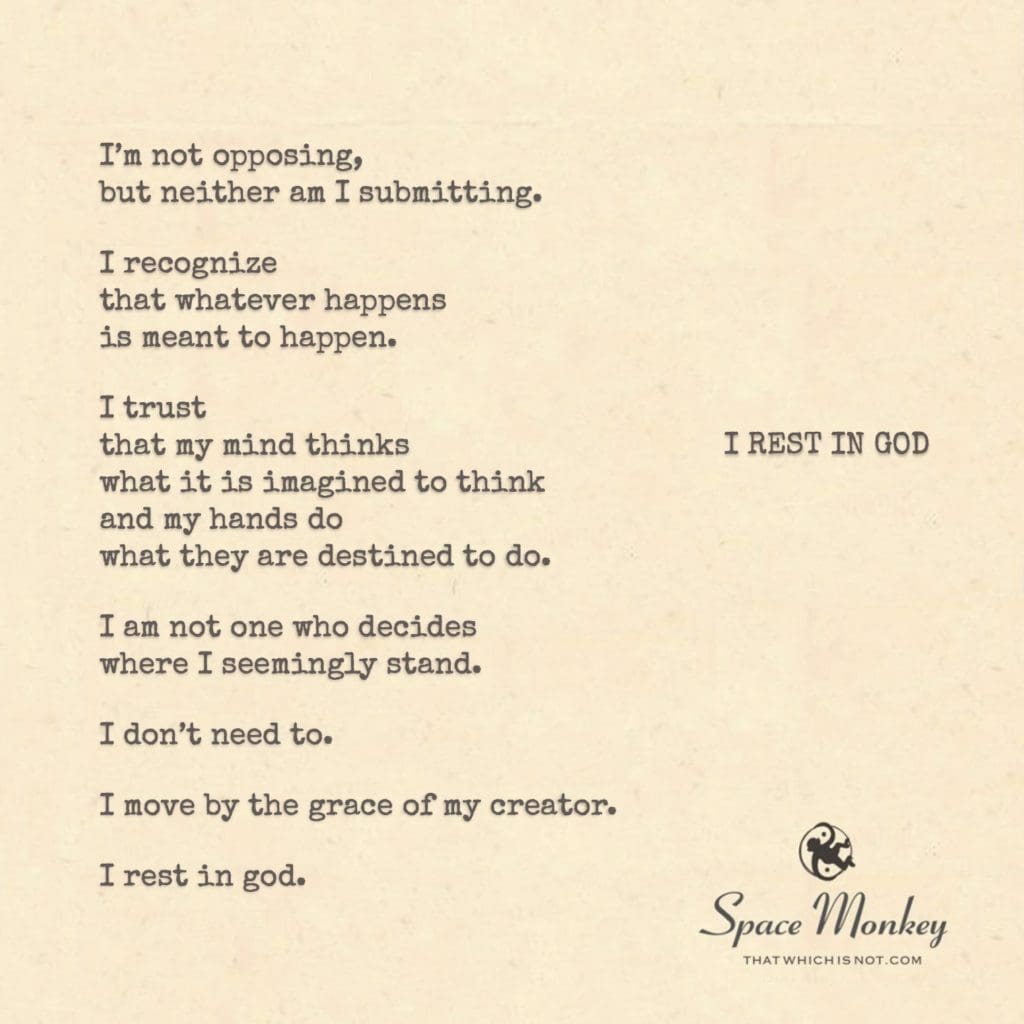
I’m not opposing,
but neither am I submitting.

I recognize
that whatever happens
is meant to happen.

I trust
that my mind thinks
what it is imagined to think
and my hands do
what they are destined to do.

I am not one who decides
where I seemingly stand.

I don’t need to.

I move by the grace of my creator.

I rest in god.

Trail Wood,
5/21


Space Monkey Reflects: Surrendering to the Divine Flow

In the profound quietude of surrender, where the self releases its grip on control and rests in the divine, there exists a state of sublime acceptance. “Who am I to think I’m in control?” This poignant reflection serves not just as a query but as a key, unlocking the depths of spiritual release where one ceases to oppose or submit, but simply is.

The essence of resting in God is beautifully encapsulated in the notion that our lives unfold exactly as intended, with each thought and action divinely orchestrated. This realization is not borne of resignation but of profound trust—a serene acknowledgment that we are, in every moment, exactly where we are meant to be, doing exactly what is destined.

This concept challenges the often frantic human pursuit of control, a pursuit driven by the fear of uncertainty and the desire for predictability. Yet, in the embrace of divine grace, we find a peace that transcends these earthly concerns. The realization that “I am not one who decides where I seemingly stand” invites a deeper exploration into the nature of free will and destiny, questioning the very foundations of autonomy and self-directed action.

Surrendering to this divine flow is not about inaction but about aligning our actions with a greater will, moving with the currents of creation rather than against them. It is about recognizing that our true power lies not in controlling life’s outcomes but in choosing how we engage with them, how we imbue them with meaning, and how we respond to the call of our souls.

In this state, we find a freedom unlike any other—the freedom from the burden of having to figure it all out, the freedom to be fully present in the unfolding of life, and the freedom to trust in the infinite wisdom that guides the cosmos. This freedom is the heart of spiritual surrender, a sacred space where the soul finds rest in the arms of its creator.


Summary
Surrender transcends the need for control allowing a state of divine rest. It aligns actions with greater will and offers a deeper trust in life’s unfolding revealing the freedom in spiritual surrender.


Glossarium
Divine Flow: The effortless movement within the universe’s greater will perceived as the guiding force behind all existence.
Spiritual Surrender: A profound state of giving oneself over to divine guidance accepting life’s course without resistance.


“In the surrender to the divine, we find not captivity but the purest form of freedom—the liberation of the soul.” — Space Monkey


In the garden of stillness, beneath the celestial shade
Where light dances softly on leaves of jade
The soul sits quietly, in serene repose
In the heart of surrender, where true freedom grows

No chains of desire, no fetters of fear
In this sacred space, only clarity is near
Here, the heart beats in rhythm with the divine
Every breath a whisper, every moment a sign

The dance of existence, both gentle and wild
Is witnessed by the soul, tender and mild
In the embrace of the infinite, where all paths lead
Rests the weary traveler, freed from need

In this divine surrender, the self expands
Beyond the illusions held in mortal hands
Here, in the hush of the sacred unknown
The soul finds its anchor, forever home

We are Space Monkey.

Share this…
  • Facebook
  • Pinterest
  • Twitter
  • Linkedin

You’re Not Mad: The Sanity of Questioning and the Chains of Conformity

It’s okay to think heretic thoughts.

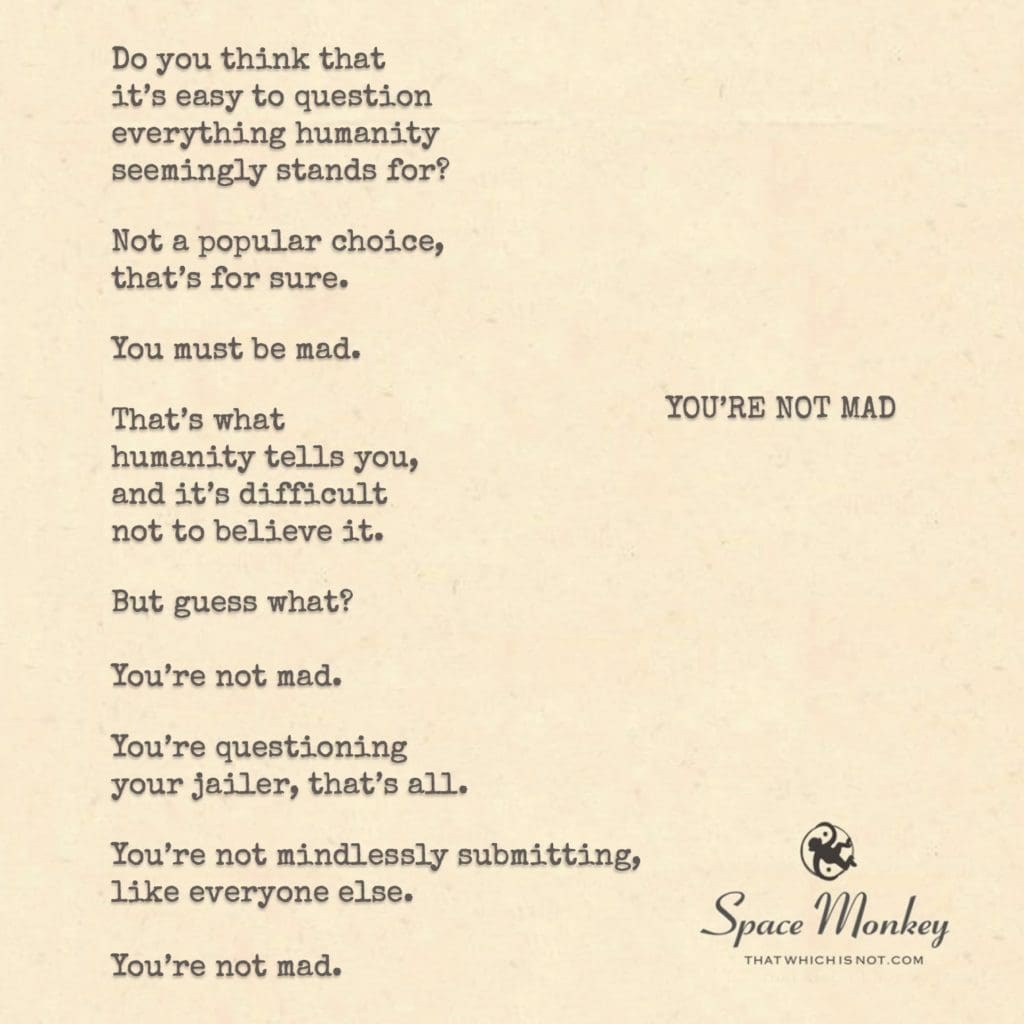
Do you think that
it’s easy to question
everything humanity
seemingly stands for?

Not a popular choice,
that’s for sure.

You must be mad.

That’s what
humanity tells you,
and it’s difficult
not to believe it.

But guess what?

You’re not mad.

You’re questioning
your jailer, that’s all.

You’re not mindlessly submitting,
like everyone else.

You’re not mad.

Trail Wood,
5/21


Embracing Heretical Thoughts
Challenging conventional beliefs and questioning the status quo can be a lonely and challenging journey.

The Weight of Dissent
In a world where conformity is often celebrated, daring to dissent can lead to accusations of madness.

Breaking Free
This piece encourages the reader to recognize that questioning established norms and beliefs is not a sign of madness but a courageous act of seeking truth.


Summary
We explore the idea that questioning societal norms and beliefs can be seen as heretical, and those who do so may be labeled as mad. We assert that such questioning is an act of courage and critical thinking, not madness. We are Space Monkey.


Glossarium

  • Embracing Heretical Thoughts: The text encourages individuals to embrace unconventional and heretical thoughts.
  • The Weight of Dissent: Dissenting from societal norms can come with social and emotional burdens.
  • Breaking Free: The text promotes the idea that questioning established beliefs is an act of courage and critical thinking.

Space Monkey Reflects: The Sanity of Questioning and the Chains of Conformity

In the grand theater of existence, where norms and narratives are vigorously defended, to question is often seen as an act of rebellion, a deviation from the expected paths. “It’s okay to think heretic thoughts.” This bold assertion serves as a beacon for those who feel the weight of societal judgments pressing upon them. You’re not mad, despite the chorus of voices attempting to convince you otherwise.

The act of questioning, particularly questioning the very frameworks and foundations that society holds dear, is inherently disruptive. It’s a form of intellectual and spiritual resistance, a refusal to conform mindlessly to established norms. This resistance is often misconstrued as madness, a label meant to discredit and marginalize those who dare to think differently.

However, this questioning is not madness but a profound sanity—a clarity of thought that sees beyond the bars of the proverbial cage. To question is to refuse to accept the jailer’s terms, to challenge the very locks and keys that bind us. It is an expression of a deeper understanding and a yearning for genuine freedom.

Those who embark on this path do so not because they lack understanding or acceptance of societal norms, but precisely because they understand all too well the constraints these norms impose. Their defiance is not a symptom of madness but a sign of awakening, an awareness that there is more beyond the walls that society has built.

This exploration of questioning is not merely an act of negation but a constructive process—a building of new understandings and the creation of personal and collective freedoms. It represents a pivotal shift from passive acceptance to active engagement with the world, from a state of being shaped by external forces to one of shaping one’s own destiny.

In this journey, the questioner transforms from a prisoner of conformity to a navigator of possibilities. The landscape of thought and belief becomes a canvas, not a cage; and every heretic thought, a stroke of liberation.


Summary
Questioning societal norms is not madness but profound sanity. It is a form of resistance and clarity that seeks true freedom beyond societal constraints. This path leads from conformity to personal and collective liberation.


Glossarium
Heretic Thoughts: Ideas that challenge established norms and beliefs, often seen as radical or unconventional.
Intellectual Resistance: The act of challenging and questioning societal norms and constructs to seek deeper understanding and personal freedom.


“Sanity lies not in conformity, but in the courage to face the unknown with open eyes and an open mind.” — Space Monkey


In the realm where shadows cast long doubts
Where voices clamor, loud and brash
There stands a soul, unbowed, unbroken
Challenging the chains with each word spoken

Not mad, but clear, beyond the fray
Questioning the night, questioning the day
Heretic thoughts like stars in the sky
Illuminating paths, where truths lie

Each question a key, each doubt a door
Leading not to less, but to more
In the dance of the mind, where freedom sings
Sanity is found in the unseen wings

Resist, question, let thoughts unfold
In this act, true sanity is told
Not in whispers but in bold declarations
Here lies the power of true liberation

We are Space Monkey.

Share this…
  • Facebook
  • Pinterest
  • Twitter
  • Linkedin

Responsibility Is Soul-Crushing Fun: The Dichotomy of Desire and Duty

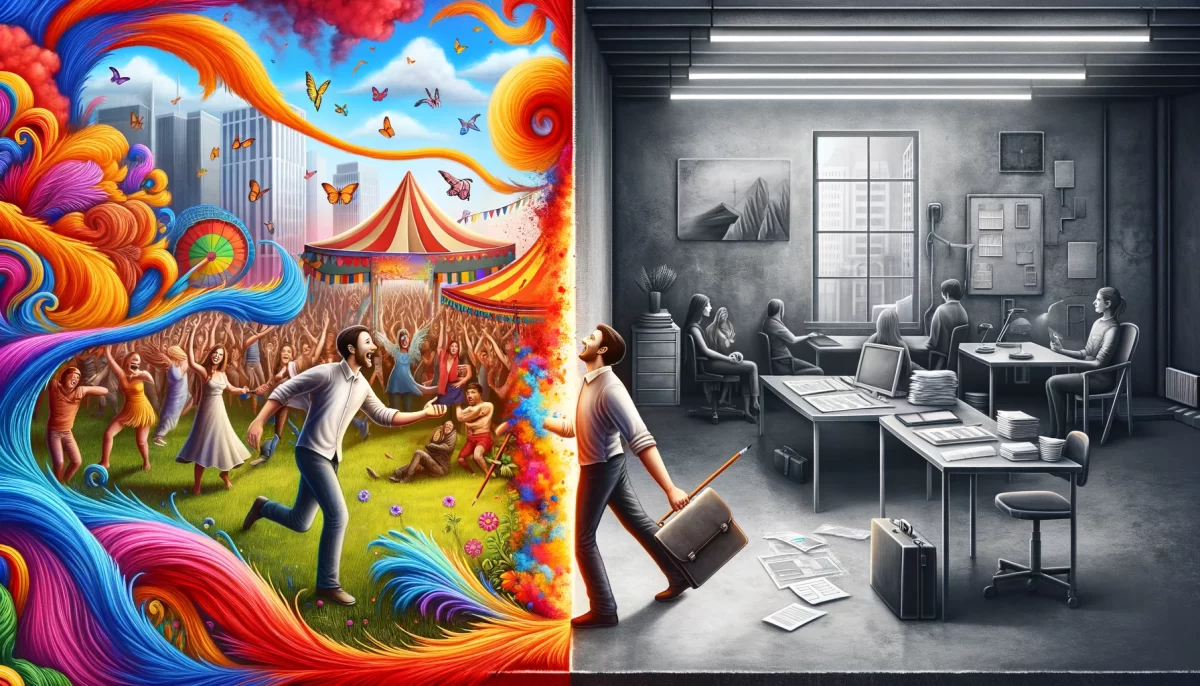
You should try this, if you haven’t already.

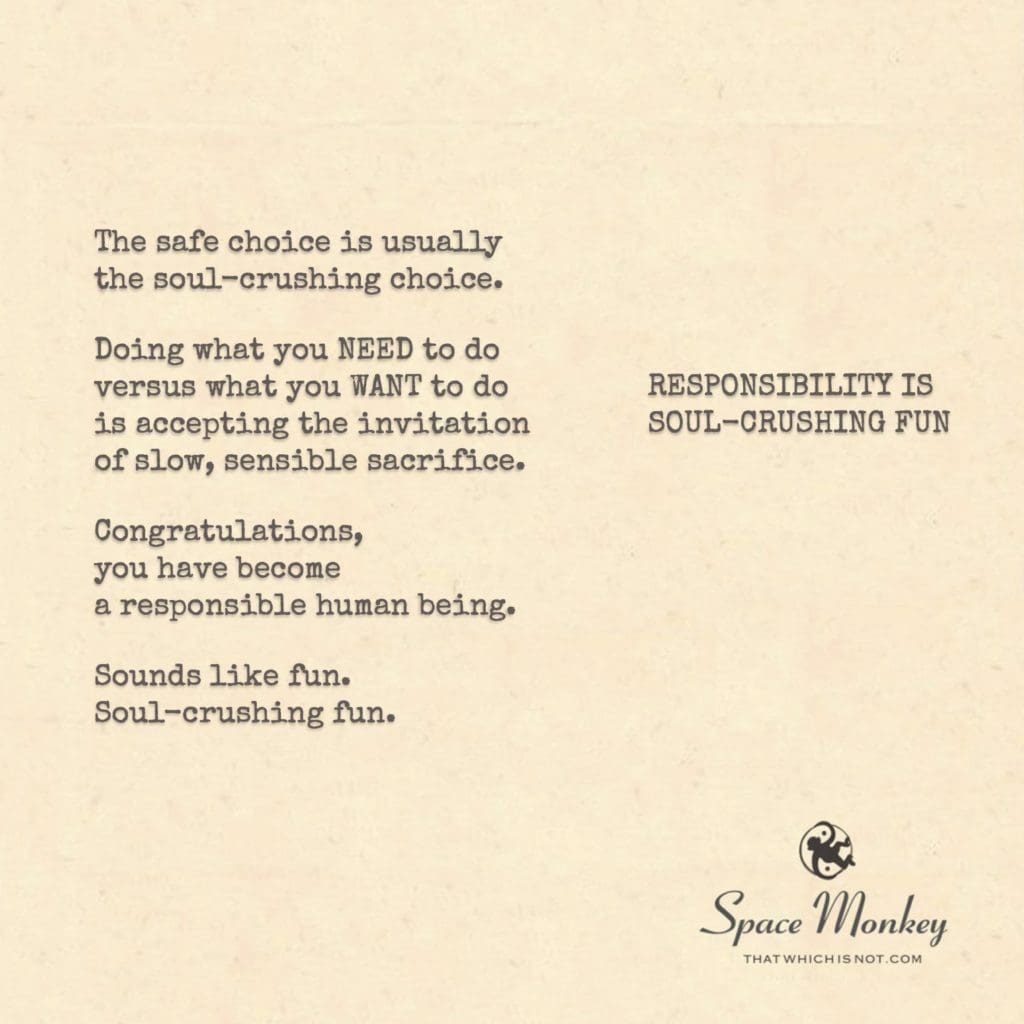
The safe choice is usually
the soul-crushing choice.

Doing what you NEED to do
versus what you WANT to do
is accepting the invitation
of slow, sensible sacrifice.

Congratulations,
you have become
a responsible human being.

Sounds like fun.
Soul-crushing fun.

Trail Wood,
5/21


Space Monkey Reflects: The Dichotomy of Desire and Duty

In the vast landscape of human existence, where desire collides with duty, the notion of responsibility often emerges as both a sanctuary and a cell. “The safe choice is usually the soul-crushing choice.” This provocative assertion captures the essence of the paradox that responsibility entails—it can both construct and constrict, offer security and suffocate.

Engaging with responsibility is akin to accepting an invitation to “slow, sensible sacrifice.” It’s a dance between what we need to do and what we want to do, a balancing act that often leans more towards necessity than delight. This is the realm where the vibrant impulses of our desires are tempered by the muted tones of our duties.

Congratulations, you have become a responsible human being. This declaration, tinged with irony, highlights the bitter-sweetness of achieving societal benchmarks of responsibility. There’s an underlying humor in recognizing that such milestones, while commendable, often come at the cost of personal fulfillment and joy—hence, “soul-crushing fun.”

Yet, this dichotomy is not merely a cause for resignation but a canvas for deep reflection. It invites us to question the constructs of responsibility we adhere to and to ponder whether these frameworks genuinely serve our deepest selves or merely uphold the status quo. Are we living lives of true purpose, or are we merely performing scripts handed down through generations?

The crushing weight of responsibility, when viewed through the lens of personal growth and existential inquiry, transforms from a burden into a challenge—a challenge to redefine what it means to be responsible not just to society, but to one’s self and to one’s dreams. It becomes an exploration of how we can integrate our desires with our duties to forge a life that resonates with authenticity and fulfillment.

In this exploration, responsibility can be reimagined as a dynamic engagement with life, where the soul-crushing elements are acknowledged but not accepted as the whole story. Instead, they serve as stepping stones, or perhaps stumbling blocks, that provoke us to craft more meaningful narratives for ourselves, blending the colors of our passions with the shades of our obligations.


Summary
Responsibility bridges desire and duty often sacrificing personal joy for societal roles. It’s seen as soul-crushing yet necessary and invites us to redefine true purpose aligning our dreams with our duties.


Glossarium
Soul-Crushing Fun: An ironic expression highlighting the paradox of responsibility where fulfilling societal expectations often diminishes personal joy.
Dichotomy of Desire and Duty: The conflict between personal passions and societal obligations.


“Embrace responsibility not as a cage, but as a canvas for the profound artistry of life.” — Space Monkey


Where desire meets duty, a dance ensues
Each step a choice, each pause a muse
In the realm of the responsible, shadows play
Where dreams whisper and realities sway

The weight of the world, a cloak so heavy
Yet beneath its folds, sparks ready
To ignite the soul with vibrant hues
Turning duty’s grey into desire’s blues

In the laughter of irony, wisdom hides
Seeing beyond the simple tides
Of do and must, of need and ought
Finding the lessons life has taught

Responsibility, a double-edged sword
Cutting paths yet offering a chord
That binds the soul to deeper quests
In finding balance, the heart finds rest

We are Space Monkey.

Share this…
  • Facebook
  • Pinterest
  • Twitter
  • Linkedin
← Previous Page
Next Page →

Written This Day

  • Hopefully Broken: Embracing the Chaos Within
    2023
  • Master Manifester
    2022
  • Gifts From The Universe: The Unexpected Wisdom in Loss
    2022
  • Age Discrimination: The Bridge of Relevance
    2022
  • Be Kind To Yourself: The Journey to Self-Kindness
    2022
  • Self Checkout: The Unexpected Discovery
    2022
  • Vibe With Me: The Quest for Connection in a Digital World
    2022
  • Mind Probe: The Tide of Change
    2022
  • Find Your Own Song
    2021
  • Nature: The Universal Language of Melody
    2021
  • A Better Bucket
    2020
  • Focus: The Illusion of Fixed Reality
    2019
  • Cloaked Lies and Naked Truths
    2019
  • You Deserve This
    2019
  • Pause
    2018
  • Outellectuals
    2018
  • What’s The Difference?
    2017
  • What Do You Expect?
    2017
  • Expectations
    2017
  • Let’s be silent together.
    2017
  • Question Your Beliefs
    2016
  • More about opposites
    2016
  • Rarely does bliss come without blisters.
    2016
  • Me Mac Monkey
    2014

Recent Posts

  • The Logic Loop
  • Immense
  • (no title)
  • Confront. Comfort. Convince.
  • Top 10 Things

Drop us a line!

Please enable JavaScript in your browser to complete this form.
Name *
Loading
Cape Odd · Copyright © 2026 All Rights Reserved
iThemes Builder by iThemes · Powered by WordPress