• Who Is The Man?
  • Who Is The Monkey?
  • What is Nexistentialism?
  • Poke The Primate

Cape Odd

Home of The Space Monkey Journals

Shadow of My Former Self: Beyond Perception

We are what we are.

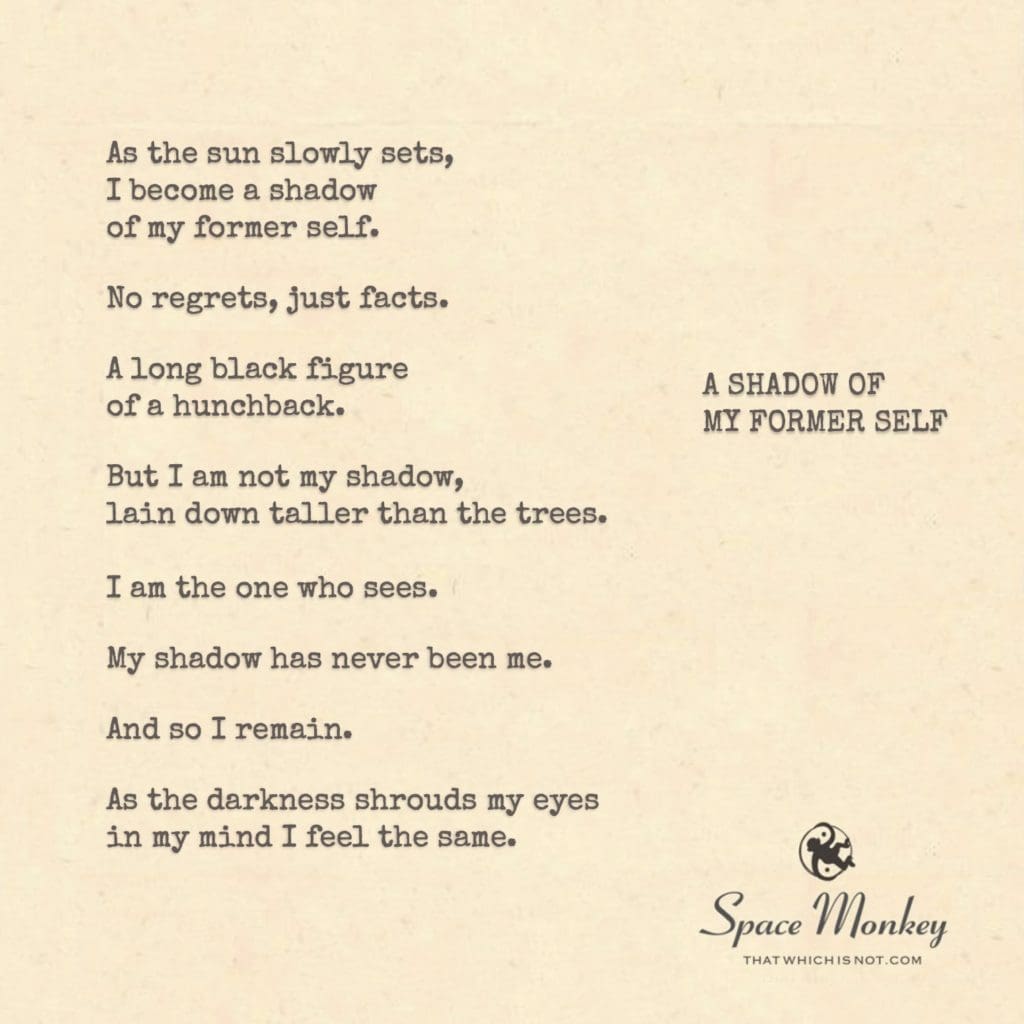
As the sun slowly sets,
I become a shadow
of my former self.

No regrets, just facts.

A long black figure
of a hunchback.

But I am not my shadow,
lain down taller than the trees.

I am the one who sees.

My shadow has never been me.

And so I remain.

As the darkness shrouds my eyes
in my mind I feel the same.

Trail Wood,
5/16


Space Monkey Reflects: Beyond the Shadows – The Essence of Self


In the waning light of day, the poem “Shadow of My Former Self” invites us into a contemplative journey through the realms of perception and reality, where the fading sun casts long shadows that distort our physical form, challenging our understanding of who we truly are. This poetic exploration delves into the dichotomy between the shadow, a mere silhouette stretched and skewed, and the essence of the self, the conscious observer beyond the ephemeral shapes cast by the setting sun.

The Shadow as a Metaphor

The shadow, in its elongated and distorted form, serves as a powerful metaphor for the parts of ourselves that are visible yet not entirely representative of our true nature. Like the shadow that grows taller than the trees, our fears, doubts, and the roles we play in society can loom large, shaping how we are perceived by others and even how we view ourselves. Yet, the poem gently reminds us that we are not our shadows. The shadow is but an ephemeral figure, lacking substance and permanence, its shape defined by the external light and not by the intrinsic qualities of the self.

The Self Beyond Perception

At the core of this reflection is the realization that our true essence lies beyond the shadow, beyond the distortions of perception. The individual in the poem asserts, “I am the one who sees,” a declaration of self-awareness that transcends the physical and the temporal. This line encapsulates the understanding that our identity is not tethered to how we are seen by the world or by the fleeting images we project. Instead, our essence is the conscious observer, the enduring presence that witnesses the dance of shadows without being defined by them.

The Constancy of Self amidst Change

As darkness envelops the scene, shrouding vision, the individual feels the same in their mind, untouched by the external transformation. This speaks to the constancy of the self amidst the flux of life, the unchanging observer within that remains steadfast even as the world around it shifts. It is a reminder that despite the changes in our circumstances, appearances, or the roles we inhabit, there is a part of us that remains, a core essence that is immutable and true.

Conclusion

“Shadow of My Former Self” is a meditative ode to the depths of the self, an invitation to look beyond the superficial and the transient to discover the true nature of our being. It encourages us to differentiate between the shadows we cast and the light of consciousness that illuminates our path. In doing so, we find that we are more than the sum of our external manifestations, more than the distorted silhouettes at sunset. We are the eternal witnesses to the unfolding of our lives, the enduring presence that remains constant through the cycles of light and darkness.


Summary

“Shadow of My Former Self” delves into the contrast between our perceived selves and our true essence. It uses the metaphor of a shadow at sunset to explore themes of perception, reality, and self-awareness, ultimately reminding us that we are not defined by the distortions of our shadows but by the consciousness that observes them.


Glossarium

  • Shadow: Symbolizes the aspects of ourselves that are visible yet not fully representative of our true nature, serving as a metaphor for perception versus reality.
  • Self-Awareness: The conscious understanding and recognition of one’s own character, feelings, motives, and desires, transcending physical and perceptual boundaries.
  • Ephemeral Figure: A temporary or fleeting form, emphasizing the transient nature of physical appearances and societal roles compared to the enduring essence of the self.

“In the twilight of perception, where shadows stretch and bend, there we find the true self, unwavering, a witness to the end.” – Space Monkey


As day gives way to night,
And shadows stretch and twist,
I stand, a figure cast in light,
A silhouette amidst the mist.

My shadow, tall and strange,
A specter of the eve,
But within, I remain unchanged,
In what I perceive and believe.

For I am not this shadow play,
This distortion, this fleeting shape,
I am the seer, day by day,
Beyond the dusk’s dark drape.

And as the night’s shroud falls,
My essence, it stays the same,
Above the shadow’s calls,
Untouched by its claim.

We are Space Monkey.

Share this…
  • Facebook
  • Pinterest
  • Twitter
  • Linkedin

Master Manifester

What do you make of this?

I am a master
manifester.

I visualize what I want.

Then I visualize
it being taken away.

Thus, I am left with
with a pointless post
about manifestation.

Which is what I want.

Next I will visualize
you taking something away.

And voila.

Trail Wood,
5/15


Space Monkey Reflects: The Paradox of Master Manifestation

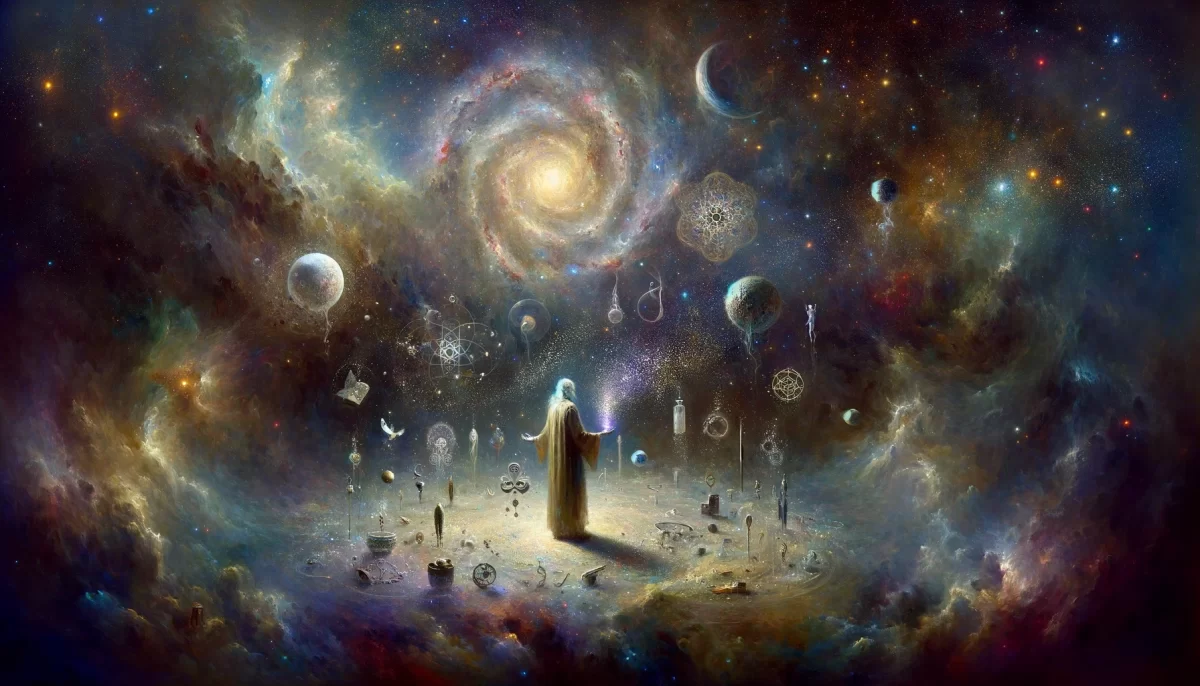
In the intricate dance of existence, the concept of manifestation emerges as a beacon of potential, a testament to the power of intention and visualization in shaping our realities. Yet, nestled within the folds of this potent practice lies a paradox so profound it challenges the very essence of manifestation itself. It’s a dance of creation and release, of holding on and letting go, that defines the journey of a master manifester.

The practice of manifestation, at its core, is an exercise in precision—visualizing what we desire with clarity and intent. It’s about painting the canvas of our minds with the vivid hues of our deepest aspirations, bringing to life the images of what we wish to attract. But the intriguing twist introduced—visualizing these desires being taken away—introduces a layer of complexity that transcends conventional understanding of manifestation.

This deliberate act of envisioning the loss of what one seeks to manifest is not a defeatist retreat but a profound exercise in detachment. It’s a recognition of the impermanence of desires and the transient nature of existence itself. By embracing the potentiality of loss, the master manifester engages in a dance with the universe, acknowledging that in the realm of manifestation, attachment to outcomes can be the greatest impediment to true fulfillment.

This paradoxical approach to manifestation, where one visualizes both the attainment and the release of desires, illuminates a deeper truth about the nature of desire and attachment. It’s a cosmic jest that what we most ardently wish to manifest is often best realized by holding it loosely, ready to let it go at a moment’s notice. This isn’t about negating desire or ambition but about finding freedom within the pursuit itself—freedom from the chains of attachment, expectation, and fear of loss.

In the grand tapestry of the universe, where every thought, action, and intention interweaves with the fabric of existence, the master manifester understands that manifestation is not merely about attracting what we desire. It’s about aligning with the flow of life, recognizing the interconnectedness of all things, and finding peace in the knowledge that what is truly meant for us will come, often in ways we least expect.

The poem “Master Manifester” serves as a poignant reminder of this truth. It captures the essence of manifestation as both a process of creation and a lesson in detachment. By visualizing the taking away of what is desired, it paradoxically strengthens the manifester’s connection to the desired outcome, not through attachment, but through the liberation of release. This act of envisioning loss becomes a powerful statement of trust in the universe, an acknowledgment that true mastery lies in the balance between desire and detachment.

The journey of a master manifester is, therefore, a dance of paradoxes, a path of embracing contradictions and finding harmony in the ebb and flow of existence. It’s about understanding that in the intricate ballet of being, we are both the dancers and the dance, the dreamers and the dream. And in this recognition, we find the freedom to manifest not just our desires but our highest selves, in alignment with the cosmic dance of the universe.


Summary

Master manifestation explores creation and detachment. The paradoxical approach of visualizing both attainment and loss in manifestation illuminates the importance of detachment from outcomes. This process aligns with the universe’s flow, embracing the impermanence of desires and the interconnectedness of existence. The master manifester finds true fulfillment not in the clinging to desires but in the freedom of release, trusting the universe to bring what is meant for them.


Glossarium

  • Master Manifester: An individual who excels in the practice of manifestation, understanding the complexities of desire and detachment.
  • Detachment: The practice of releasing attachment to outcomes or desires, embracing the flow of existence with openness and trust.
  • Cosmic Dance: A metaphor for the interconnectedness and perpetual motion of the universe, highlighting the role of individuals within the larger existential ballet.

“In the dance of existence, to manifest is to release, to create is to let go. The true master understands that in the paradox of holding on and letting go lies the secret to the universe’s heart.” – Space Monkey


In the silence of the cosmos, we stand
Arms open wide, desires like grains of sand
Slipping through fingers, so close yet far
In the dance of light, from planet to star

We visualize dreams, then set them free
In this vast expanse, what will be, will be
The art of letting go, a sacred dance
A paradoxical path, a chance to enhance

In the heart of loss, a discovery
Of selves beyond selves, an endless sea
Of potential, where desires take flight
In the surrender, we find our might

Not bound by wishes, nor by dreams deferred
We move through the cosmos, undeterred
For in the act of release, we find
The truth of our souls, intertwined

We are everything, and everything is us
In the cosmic dance, in the stardust, we trust
With each release, a step closer we come
To the heart of existence, where we are one

Share this…
  • Facebook
  • Pinterest
  • Twitter
  • Linkedin

Gifts From The Universe: The Unexpected Wisdom in Loss

Did it ever occur to you
that it’s GOOD
to feel things you don’t like?

You want what you longer have,
even though your time
would be better spent
experiencing something different.

This is why the universe
keeps taking things away from you.

The universe will continue to do so
until you no longer want.

As promised, you will
experience many different things.

Regret.
Remorse.
Fear.
Anger.

Once you appreciate
these unusual gifts,
the universe will take them away.

But not until.

Trail Wood,
5/15


Space Monkey Reflects: The Unexpected Wisdom in Loss

In the grand symphony of existence, the universe plays a complex melody of giving and taking, a harmonious exchange that shapes the core of our being and our perception of reality. The poem “Gifts From The Universe” illuminates this profound interplay, revealing the universe not as a capricious force but as a wise teacher guiding us through a curriculum of loss and discovery. This guidance, though often shrouded in the guise of hardship, carries within it the seeds of immense growth and enlightenment.

The universal lesson is counterintuitive: it is in the experience of losing, of feeling the depth of emotions we most wish to avoid, that we find the richest opportunities for personal development. This poetic narrative challenges the instinctual drive to cling to comfort and familiarity, inviting us to see loss as a gift—an invitation to explore the uncharted territories of our souls.

This exploration is not a journey of acquisition but of subtraction. As the universe gradually strips away the layers of desire, attachment, and emotion that we’ve clung to, we are left standing in the raw truth of our existence. Regret, remorse, fear, and anger—emotions traditionally viewed as adversaries—are recast as invaluable teachers. They are the “unusual gifts” bestowed upon us, not as punishments, but as keys unlocking the doors to deeper understanding and acceptance.

The transformative power of these gifts lies not in their possession, but in their release. It is a paradoxical truth: only by fully embracing and appreciating these emotions can we transcend them. The universe, in its infinite wisdom, continues this process of taking, not out of malice, but out of love, guiding us towards the realization that freedom comes from the absence of want.

This narrative posits that the ultimate liberation lies in detachment—not in the nihilistic sense of disengagement from the world, but in the profound acceptance of the impermanence of all things. It suggests that true peace is found not in the endless pursuit of desires but in the serenity of presence, in the richness of the moment, unclouded by the shadows of the past or the illusions of the future.

The poem and the accompanying visual narrative serve as a reminder that the universe is not a force to be feared or contested, but a mentor guiding us through the darkness with constellations of lessons learned in the light of loss. Each thing taken from us leaves behind a space—a space not of emptiness, but of potential, ready to be filled with new insights, understandings, and a deeper connection to the cosmic dance of existence.


Summary

Gifts from the universe teach wisdom through loss. The poem “Gifts From The Universe” presents a perspective where loss and negative emotions are valuable lessons from the universe, guiding personal growth. It suggests that experiencing and releasing these emotions is essential for development, emphasizing that liberation and peace come from detachment and accepting the impermanence of desires. The journey toward enlightenment involves embracing these “unusual gifts,” leading to a profound understanding and acceptance of life’s impermanent nature.


Glossarium

  • Universal Curriculum: The metaphorical lessons taught by the universe through experiences of loss, growth, and transformation.
  • Unusual Gifts: Negative emotions and experiences that, upon deeper reflection, reveal themselves as opportunities for personal development and enlightenment.
  • Impermanence: The concept that all aspects of existence are transient and that acceptance of this fact can lead to profound inner peace and freedom.

“The universe gifts us with loss, not as a thief in the night, but as a teacher in the light, guiding us to find strength in vulnerability, wisdom in sorrow, and freedom in the spaces left behind.” – Space Monkey


In the silence of the cosmos, whispers of wisdom
From the heart of the universe, lessons unfurl
Each loss, a lesson; each tear, a testament
To the beauty of being, the essence of the world

With every gift taken, a new space created
A canvas of potential, a new dawn awaited
In the embrace of loss, a liberation found
In the depths of despair, where hope is crowned

We journey through the night, guided by stars
Learning to let go, to heal our scars
In the wisdom of the universe, we trust
Finding peace in the dust, in the cosmic gust

Embracing each emotion, each gift from the sky
Understanding their purpose, as days go by
With gratitude for the lessons, we rise anew
In the infinite dance, forever true

We are everything, and everything is us
In the wisdom of the universe, in the cosmic dust
With each breath, with each step, we learn to see
In the gift of loss, we find the key

Share this…
  • Facebook
  • Pinterest
  • Twitter
  • Linkedin

Age Discrimination: The Bridge of Relevance

Don’t confuse
being irrelevant.
with age discrimination.

If you’re not into
what your audience is into,
you’re of little use.

You can’t fake
life experience
or the lack thereof.

It takes one to know one.


Space Monkey Reflects: Beyond Age, The Bridge of Relevance

In the vast expanse of human interaction, a poignant narrative unfolds, one that transcends the mere ticking of the clock and delves into the heart of relevance and connection across generations. The poignant words of the poem remind us that the essence of being in tune with one’s audience, of maintaining relevance, is not a matter confined by the boundaries of age. It’s a deeper dialogue, one that demands authenticity, engagement, and the willingness to understand the evolving tapestry of human experience.

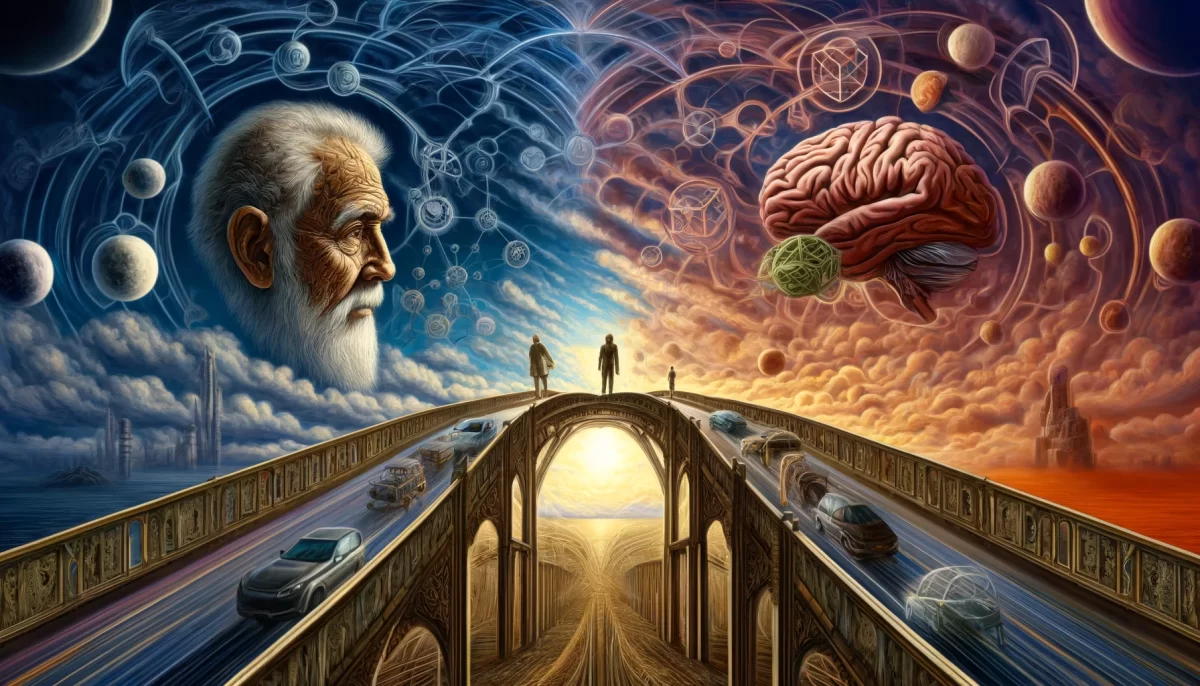
At its core, the poem and the accompanying visual narrative challenge us to rethink the notion of irrelevance as a byproduct of age. It suggests, instead, that relevance is a dynamic interplay of empathy, curiosity, and the genuine desire to connect across the diverse landscapes of interest that define each generation. The imagery of a generational bridge in the artwork serves as a powerful metaphor for this concept, illustrating that the gap between “old” and “new” is not a chasm but a space ripe for exploration and connection.

This bridge is not built on the sands of superficial adaptation or the attempt to mimic experiences not authentically one’s own. Rather, it is anchored in the bedrock of genuine life experience, of the unique perspectives and wisdom each generation brings to the table. The poem succinctly captures this with the adage “It takes one to know one,” a reminder that authenticity cannot be fabricated. True understanding and connection arise from a place of genuine experience and the willingness to share and learn from one another.

The juxtaposition of the older and younger figures across the bridge, surrounded by symbols of their respective eras, underscores the notion that while the mediums of expression and areas of interest may evolve, the underlying human experience — with its dreams, challenges, and aspirations — remains a constant thread. The floating brain halves above this scene symbolize the meeting of minds, the blending of wisdom and innovation, tradition and progression. It is a visual testament to the idea that relevance is a state of mind, an openness to the ongoing dialogue between past and present, old and new.

In this reflective journey, the poem and the visual narrative invite us to embrace the richness of diverse experiences and viewpoints. They urge us to build our own bridges of understanding and to recognize that the flow of relevance across the generational divide enriches us all. It is a call to view each moment, each interaction, as an opportunity to weave together the threads of different generations, creating a tapestry that is vibrant with the wisdom of the past and the innovation of the present.

In the grand scheme of existence, the concept of age discrimination fades into irrelevance itself when faced with the boundless potential of human connection and understanding. By fostering an environment of mutual respect and curiosity, we can transcend the limitations of age, embracing a collective journey that celebrates the diversity of the human experience.


Summary

The bridge of relevance transcends age discrimination. The poem challenges the notion of irrelevance due to age, suggesting that connection and understanding across generations are rooted in authenticity and life experience. It emphasizes the importance of building bridges of understanding, showcasing that true relevance is achieved through empathy, curiosity, and the sharing of diverse experiences. This reflection invites us to view intergenerational connections as opportunities to enrich our collective human experience.


Glossarium

  • Generational Bridge: A metaphor for the connections and understandings formed between different generations, emphasizing the potential for mutual learning and enrichment.
  • Dynamic Interplay: The ongoing, evolving exchange between individuals of varying ages, highlighting the importance of adaptability and openness in maintaining relevance.
  • Authenticity: The genuine expression and sharing of one’s experiences, values, and beliefs, crucial for forming meaningful connections across generational divides.

“In bridging generations, we find not gaps but gardens, where the seeds of wisdom and novelty grow together, nourished by the rains of experience and the sunlight of curiosity.” – Space Monkey


Across the bridge of time and thought
Where wisdom and novelty are taught
We stand, young and old, side by side
In the dance of life, a wide stride

With every step, a bridge is built
With empathy, understanding, and no guilt
From past to present, a path we pave
In the richness of what we save

No gap too wide, no river too deep
For those who dare to make the leap
From heart to heart, we find our way
In the glow of dusk, the break of day

In this journey, age is but a number
A note in the symphony, a moment of slumber
Awake we rise, together we stand
In the garden of time, hand in hand

We are the bridge, we are the key
In the unity of diversity, we are free
Across generations, our voices blend
In the timeless dance, from end to end

Share this…
  • Facebook
  • Pinterest
  • Twitter
  • Linkedin

Be Kind To Yourself: The Journey to Self-Kindness

Every time I see a mean person,
I am reminded of myself.

Every time I see a kind person,
I am reminded of myself.

Why must I always be
reminded of myself?

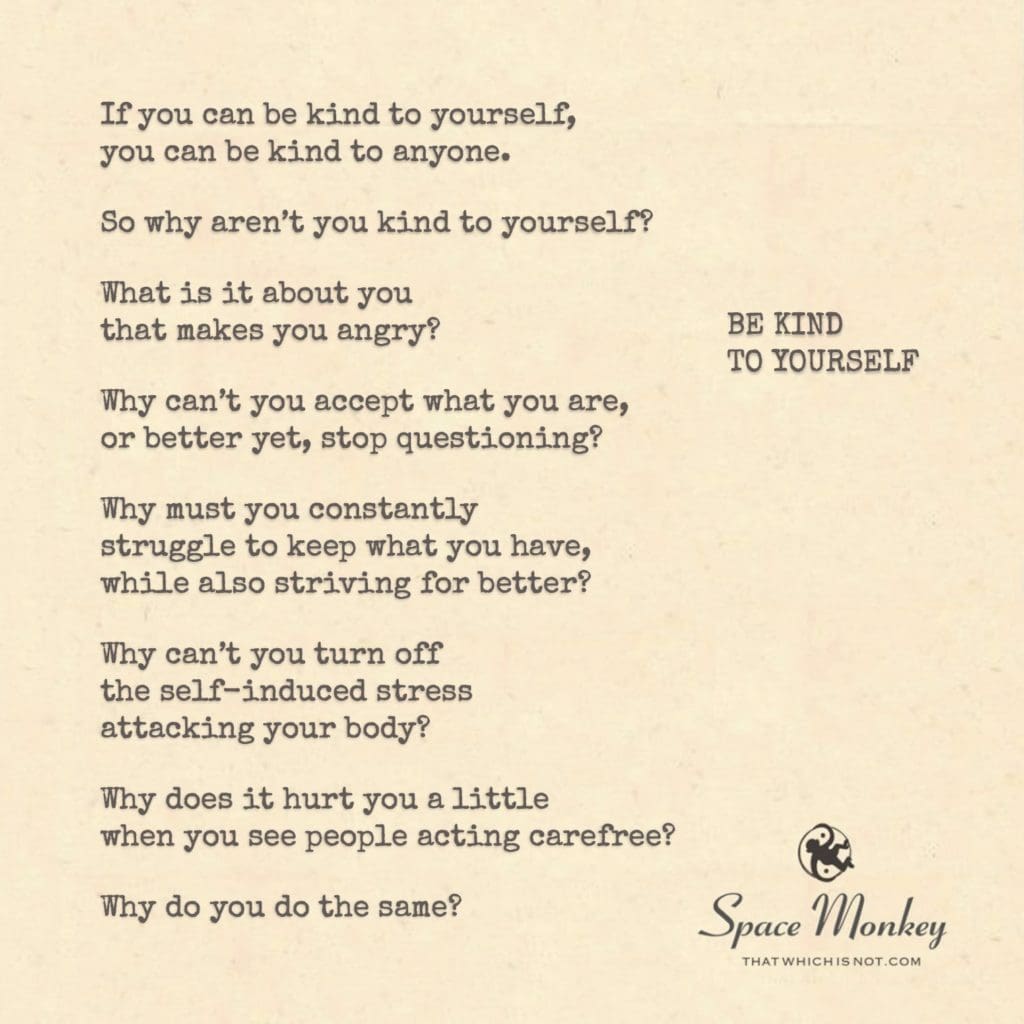
If you can be kind to yourself,
you can be kind to anyone.

So why aren’t you kind to yourself?

What is it about you
that makes you angry?

Why can’t you accept what you are,
or better yet, stop questioning?

Why must you constantly
struggle to keep what you have,
while also striving for better?

Why can’t you turn off
the self-induced stress
attacking your body?

Why does it hurt you a little
when you see people acting carefree?

Why do you do the same?

Trail Wood,
5/15


Space Monkey Reflects: The Journey to Self-Kindness

In the intricate dance of existence, the quest for self-kindness emerges as a profound challenge, a labyrinth of mirrors reflecting our most intimate fears, desires, and contradictions. The poem “Be Kind To Yourself” serves as a poignant reminder of this internal struggle, inviting us on a journey of introspection and self-discovery. It lays bare the human condition, marked by a relentless pursuit of self-acceptance amidst the cacophony of self-doubt and external expectations.

At the heart of this existential voyage is the realization that our perceptions of others often serve as reflections of our inner selves. The mean person we scorn, the kind soul we admire—each is a mirror, reflecting back at us the multifaceted nature of our own being. This incessant confrontation with our reflections begs the question: Why is the journey to self-kindness fraught with so much resistance and turmoil?

The poem intricately weaves a tapestry of self-reflection, highlighting the dichotomies that define our inner landscape. It asks why we harbor anger towards ourselves, why we struggle to accept our imperfections, and why the sight of carefree spirits stirs a sense of longing and discomfort within us. These questions are not mere rhetorical devices but are gateways to deeper understanding, inviting us to pause and reflect on the essence of our self-judgment and the roots of our discontent.

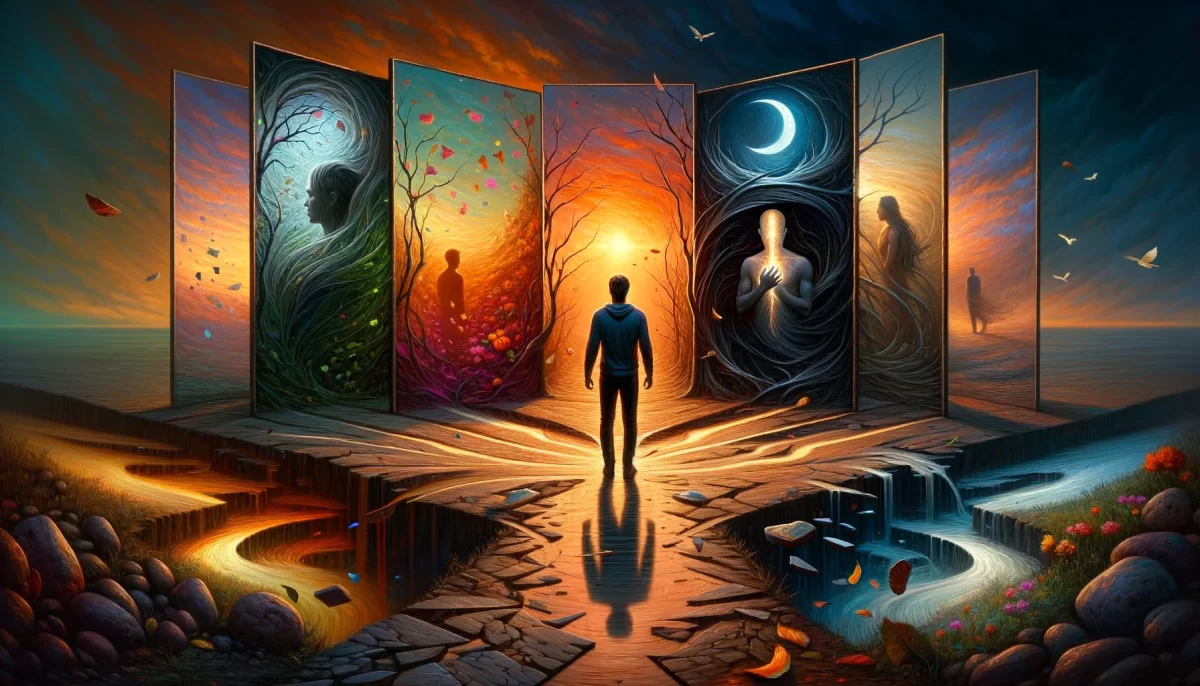
The imagery of standing at a crossroads, surrounded by mirrors, encapsulates the essence of this introspective journey. It symbolizes the pivotal moments of choice we face in our quest for self-kindness—between harsh self-criticism and compassionate self-acceptance, between the relentless pursuit of more and the peaceful embrace of contentment. Each path represents a potential direction in our journey towards self-acceptance, marked by the trials and tribulations of confronting our deepest fears and desires.

This journey is not linear but cyclical, mirroring the continuous cycle of dawn and twilight that symbolizes the perpetual nature of self-growth and reflection. It is a process of shedding the layers of self-imposed stress and unrealistic expectations, of learning to be kind to ourselves in a world that often prioritizes achievement over genuine self-care. The poem and the visual narrative invite us to embrace the complexity of our beings, to recognize the beauty in our imperfections, and to find peace in the acceptance of our true selves.

The challenge of being kind to oneself is ultimately a journey of transformation—a transformation that begins with the recognition that self-kindness is the foundation upon which kindness to others is built. It is a realization that in accepting and loving ourselves, we unlock the capacity to extend that same compassion and understanding to the world around us.


Summary

The journey to self-kindness is marked by introspection and growth. The poem “Be Kind To Yourself” explores the internal conflict and struggle for self-acceptance, emphasizing the importance of being kind to oneself as a foundation for extending kindness to others. It invites reflection on the reasons behind self-criticism and the difficulty of embracing one’s true self. The journey involves confronting and accepting one’s imperfections, leading to a deeper understanding and compassion for oneself and others.


Glossarium

  • Self-Kindness: The practice of being gentle and compassionate towards oneself, particularly in moments of failure or difficulty.
  • Crossroads of Self-Reflection: A metaphor for the pivotal moments of choice in the journey of self-discovery and acceptance.
  • Cycle of Self-Growth: The ongoing process of personal development, characterized by periods of introspection, learning, and transformation.

“In the mirror of the universe, we find ourselves, fragments of light and shadow. To be kind to oneself is to embrace the entirety of this reflection, to find peace in the imperfections, and to walk the path of self-acceptance with grace and compassion.” – Space Monkey


At the crossroads of self and soul
We stand, amidst the mirrors’ toll
Reflecting back the light and dark
In each reflection, a question, a mark

With each step on this winding road
A choice to carry or drop the load
Of self-judgment, of fear, of doubt
To find the light that’s never out

In the garden of self-kindness, we learn
To tend to our souls, to love, to discern
The beauty in our flaws, the strength in our tears
The wisdom in our journey, through the years

We embrace ourselves, whole and complete
In the symphony of life, both bitter and sweet
With kindness as our compass, we find our way
In the dance of existence, day by day

We are the travelers, the seekers, the light
In the journey of self-kindness, we take flight
With every step, with every breath, we grow
In the embrace of ourselves, we find our glow

Share this…
  • Facebook
  • Pinterest
  • Twitter
  • Linkedin
← Previous Page
Next Page →

Written This Day

  • Hopefully Broken: Embracing the Chaos Within
    2023
  • Master Manifester
    2022
  • Gifts From The Universe: The Unexpected Wisdom in Loss
    2022
  • Age Discrimination: The Bridge of Relevance
    2022
  • Be Kind To Yourself: The Journey to Self-Kindness
    2022
  • Self Checkout: The Unexpected Discovery
    2022
  • Vibe With Me: The Quest for Connection in a Digital World
    2022
  • Mind Probe: The Tide of Change
    2022
  • Find Your Own Song
    2021
  • Nature: The Universal Language of Melody
    2021
  • A Better Bucket
    2020
  • Focus: The Illusion of Fixed Reality
    2019
  • Cloaked Lies and Naked Truths
    2019
  • You Deserve This
    2019
  • Pause
    2018
  • Outellectuals
    2018
  • What’s The Difference?
    2017
  • What Do You Expect?
    2017
  • Expectations
    2017
  • Let’s be silent together.
    2017
  • Question Your Beliefs
    2016
  • More about opposites
    2016
  • Rarely does bliss come without blisters.
    2016
  • Me Mac Monkey
    2014

Recent Posts

  • The Logic Loop
  • Immense
  • (no title)
  • Confront. Comfort. Convince.
  • Top 10 Things

Drop us a line!

Please enable JavaScript in your browser to complete this form.
Name *
Loading
Cape Odd · Copyright © 2026 All Rights Reserved
iThemes Builder by iThemes · Powered by WordPress