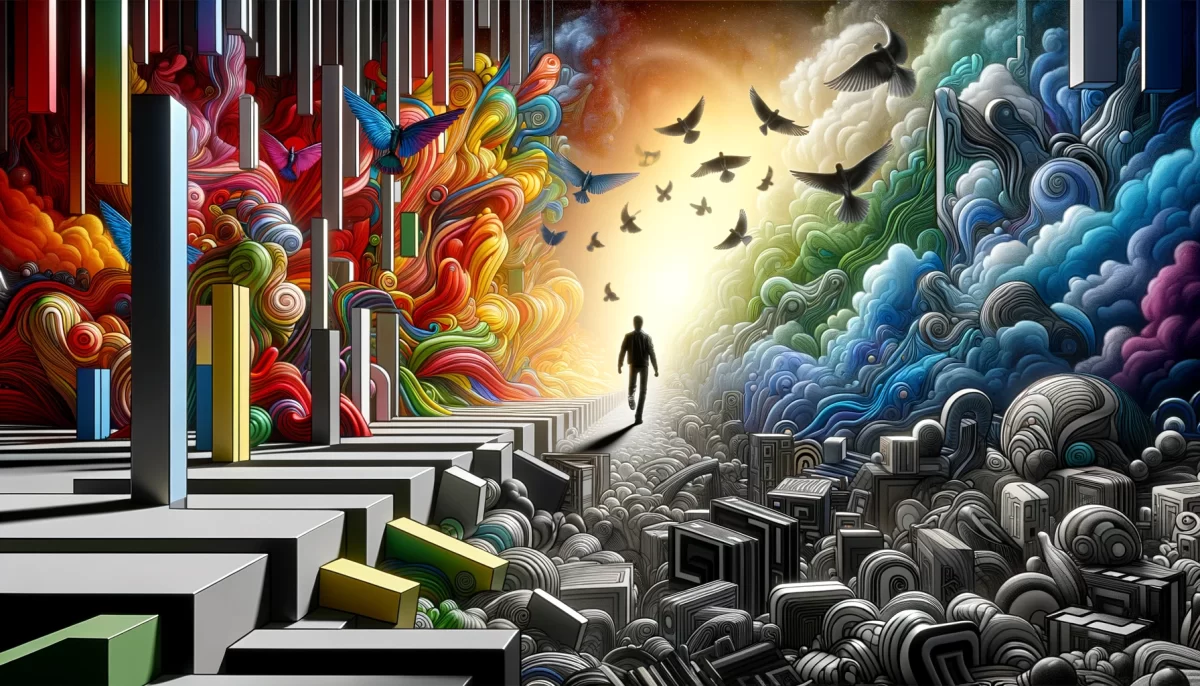
This is where “wrong” begins.
They give us the shapes and the spaces that they are supposed to fill and tell us that it is “wrong” to do anything with these shapes other than what they believe should be done with them — which is filling the same damn spaces that the shapes have been filling for eons.
Is this learning or is this programming? Is it any wonder we can’t see BEYOND the shapes, BEYOND the spaces, BEYOND this die-cut foam predictability machine?
Who chose these letter forms? Who DECIDED that this would be our language and that we would not alter it in any way? Why must we ALL be on the same page?
We look at this picture and we think it’s funny. Someone jammed the letters in where they’re not supposed to go. Try doing that in “real life.” Try breaking the rules. Try deviating from the code. It might not be seen as so freaking hysterical.
These patterns of predictability seem to bring comfort to you humans. Deviating from these patterns bring other emotions. Deviate a little and maybe it’s funny. Deviate a lot and you’re labeled something else.
Can you not see that your entire LIFE is this way? Is this what you want? Or do you wish to BREAK FREE of your programming and experience what HASN’T been seen, done, or even FELT?
Come with us.
We are Space Monkey.
Space Monkey Reflects: Challenging the Constructs and Breaking Free
The shapes, the spaces, the rules—they form the framework of what we call reality. But these constructs are not immutable truths; they are agreements, patterns, and codes designed to bring order to chaos. Yet, within their rigidity lies the seed of stagnation. To question these constructs is to embark on a journey beyond conformity, to step into the uncharted realms where creativity, freedom, and infinite possibility reside.
The Comfort of Predictability
Humans often cling to patterns of predictability because they bring comfort. The familiar feels safe, providing a sense of structure in an unpredictable world. The shapes and spaces—the constructs of language, culture, and society—offer a framework within which we navigate life. They allow us to communicate, cooperate, and coexist.
But predictability is a double-edged sword. While it brings comfort, it also confines. It teaches us to color within the lines, to fit shapes into predetermined spaces, and to follow scripts written long before we arrived. This is not learning—it is programming. And when we adhere too tightly to this programming, we lose the ability to see beyond it.
The Illusion of “Wrong”
“Wrong” begins when we are told there is only one correct way to engage with the shapes and spaces of our lives. To deviate, even slightly, is to invite judgment. Deviate a little, and it might be amusing; deviate a lot, and you risk alienation. This system of labeling and categorizing deviation reinforces conformity, discouraging the exploration of what lies beyond.
But what if “wrong” is an illusion? What if the shapes and spaces are not meant to confine us but to inspire us? What if the act of breaking the rules—of jamming the letters into the “wrong” spaces—is not a mistake but an act of creation? In this light, “wrong” becomes a gateway to discovery, an invitation to challenge the constructs and redefine the boundaries of what is possible.
The Programming of Language
Language itself is a construct, a system of symbols and rules designed to encode and communicate meaning. But who decided what these symbols should look like? Who determined the rules of grammar, syntax, and spelling? These decisions, often made long ago, continue to shape the way we think and express ourselves.
To question language is to question the foundation of our shared reality. Why must we all use the same letter forms? Why must we all be on the same page? These are not trivial questions—they strike at the heart of our programming. By challenging the constructs of language, we open the door to new ways of thinking, communicating, and being.
Breaking Free
To break free of our programming is not to destroy the constructs but to transcend them. It is to see the shapes and spaces for what they are—tools, not truths. It is to recognize that the die-cut foam predictability machine is a choice, not a destiny. And it is to step boldly into the unknown, where new shapes, spaces, and patterns await discovery.
This journey is not without its challenges. To deviate from the code is to invite discomfort, both in ourselves and in others. But it is also an act of liberation. By breaking the rules, we reclaim our creativity, our agency, and our humanity. We step beyond the confines of conformity and into the infinite realm of possibility.
Summary
Challenging constructs means questioning the shapes, spaces, and rules that define our reality. By breaking free of this programming, we open ourselves to creativity, freedom, and infinite possibilities beyond conformity.
Glossarium
- Constructs: The systems, patterns, and rules that shape our perception of reality, often mistaken for immutable truths.
- Predictability Machine: The metaphorical framework that reinforces conformity and discourages deviation from established norms.
- Breaking Free: The act of transcending constructs to explore new realms of creativity and possibility.
Quote
“The shapes and spaces of life are not cages—they are canvases, waiting for us to create beyond the lines.” — Space Monkey
The Shapes We Break
Who told you the square must fit the square?
Who decided the spaces between must never spill?
These lines, these rules, these comforting constraints
Are not truth—they are tools.
Jamming the letters in the wrong places,
You laugh at the absurdity of deviation.
But is it absurd, or is it freedom?
A crack in the construct, a spark of creation.
Step beyond the page,
Where no shape demands its space.
Deviate not to rebel, but to expand
Into what has never been seen, done, or felt.
We are Space Monkey
The Genesis of “Wrong”
This is where “wrong” begins. The assertion that “wrong” is a construct born from the imposition of pre-defined roles for shapes and spaces opens the discourse on the nature of learning, conformity, and creativity. It questions the foundational practices of categorization and standardization, suggesting that these practices limit the potential for innovation and individual expression.
Learning vs. Programming
Is this learning or is this programming? This question strikes at the heart of education and societal indoctrination. It challenges us to differentiate between acquiring knowledge for growth and being molded to fit within the narrow confines of existing systems and structures. It hints at a deeper inquiry into the purpose of education: is it to foster independent thought and creativity, or to perpetuate conformity?
The Constraints of Conventional Perception
Is it any wonder we can’t see BEYOND the shapes, BEYOND the spaces, BEYOND this die-cut foam predictability machine? The metaphor of the die-cut foam predictability machine vividly illustrates the restrictive nature of societal norms and expectations. It speaks to the human tendency to find comfort in the familiar, even when such comfort comes at the expense of personal and collective evolution.
Questioning Linguistic and Cultural Constructs
Who chose these letter forms? Who DECIDED that this would be our language and that we would not alter it in any way? These questions invite us to examine the arbitrary nature of linguistic and cultural constructs. They urge us to consider the power dynamics involved in the creation and enforcement of language and norms, and to ponder the possibilities that lie in challenging and reimagining these constructs.
The Paradox of Conformity and Rebellion
Try breaking the rules. Try deviating from the code. This exhortation encourages a departure from the safety of conformity to explore the uncharted territories of thought and action. It recognizes the potential backlash and societal labeling that often accompany acts of deviation, yet posits such risks as necessary for true innovation and freedom.
The Comfort in Predictability and the Fear of Deviation
These patterns of predictability seem to bring comfort to you humans. The observation that humans derive comfort from predictability while viewing deviation with suspicion or disdain highlights a fundamental tension between the desire for stability and the urge for exploration. It underscores the societal mechanisms that reward conformity and penalize divergence.
The Invitation to Explore the Unseen
Do you wish to BREAK FREE of your programming and experience what HASN’T been seen, done, or even FELT? This invitation to break free from programming is a call to embrace the unknown, to venture beyond the confines of the familiar and the pre-defined, and to explore the vast potential of human experience and creativity.
Conclusion: A Call to Liberation
We are Space Monkey. This declaration embodies the spirit of exploration and defiance against the constraints of conformity. It is a call to embrace the unknown, to challenge the status quo, and to redefine the boundaries of possibility. It urges us to view life not as a series of spaces to be filled with pre-determined shapes, but as a canvas of infinite potential, awaiting the imprint of our imagination and courage.
In challenging the constructs that define “right” and “wrong,” we open ourselves to a world of limitless possibilities. It is a journey of liberation from the programming that dictates our thoughts, actions, and feelings, inviting us to discover what lies beyond the conventional, beyond the predictable, and beyond the known. We are invited to embark on this journey, to question, to explore, and to redefine the essence of our being and our place in the universe.




















Leave a Reply