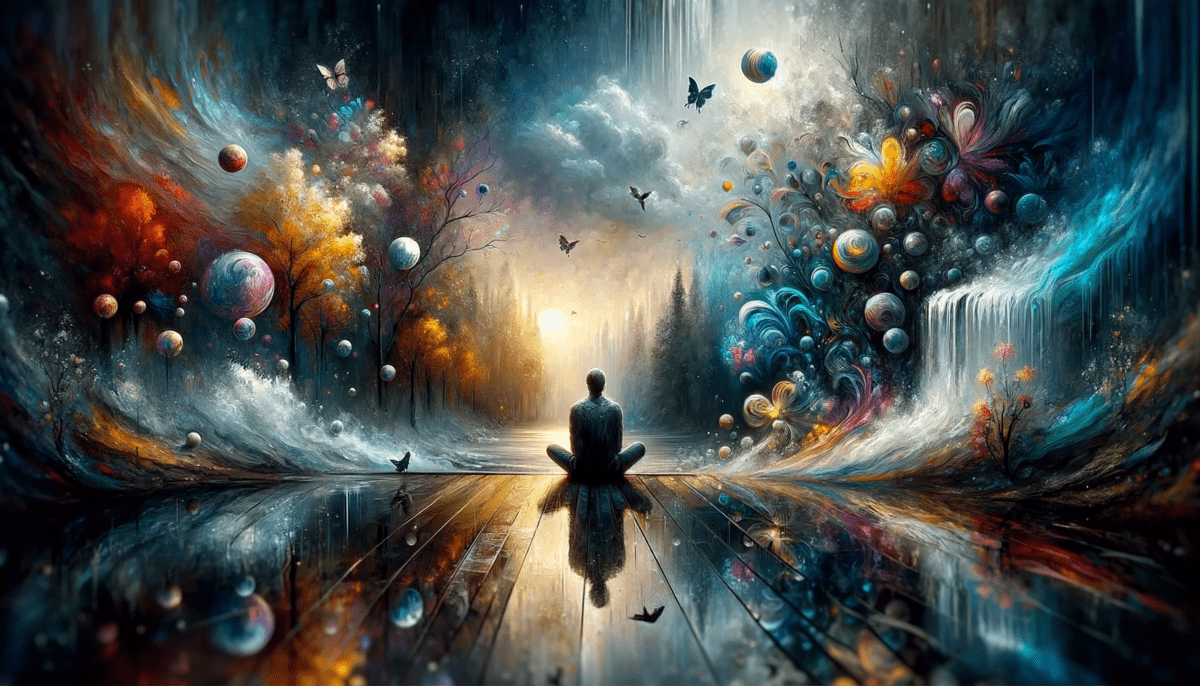
Sad
is but the belief
that there are potentials
that are better
than the potentials
you are experiencing now.
Sad does not
honor this moment,
which is filled
with potentials
equally as beautiful
as the ones
you seemingly mourn.
That’s just sad.
And so the cycle
of sadness perpetuates.
And, it, too, is beautiful.
We are Space Monkey.
1/31
Space Monkey Reflects: Sadness and the Disregard for the Present
Sadness, at its core, is a longing for what might have been—a belief that the potentials not realized are inherently better than the ones unfolding now. This perspective diminishes the beauty and richness of the present moment, replacing it with a sense of lack or loss. Yet, sadness itself is not a flaw or an error; it, too, is a valid and beautiful experience, offering insights into the complexity of human emotion.
The Belief in “Better” Potentials
“Sad is but the belief that there are potentials that are better than the potentials you are experiencing now.” This idea challenges the very foundation of sadness. When we mourn what could have been, we implicitly judge the present moment as insufficient. Yet, this judgment arises not from reality itself but from our perception—a comparison between what is and what we imagine could be.
The notion of “better” potentials is subjective and often shaped by our desires, fears, and expectations. By believing that these imagined alternatives are superior, we rob ourselves of the ability to fully engage with and appreciate the present.
The Present as a Field of Potentials
“Sad does not honor this moment, which is filled with potentials equally as beautiful as the ones you seemingly mourn.” Every moment contains infinite possibilities, each as valid and meaningful as those that preceded it or might follow. Sadness, while a natural response, narrows our focus, making us blind to the beauty and potential of the now.
To honor the present is to recognize its completeness, even when it does not align with our expectations. This does not mean denying sadness but allowing it to coexist with an awareness of the moment’s inherent richness.
The Perpetuation of Sadness
“And so the cycle of sadness perpetuates.” When we fixate on what could have been, sadness reinforces itself. This cycle is not inherently negative—it is part of the human experience—but it can become limiting if left unexamined. By continuously comparing the present to imagined potentials, we create a loop of dissatisfaction that obscures the joy and possibility of the now.
Breaking this cycle begins with recognizing it. Sadness is not something to be avoided or suppressed but something to be acknowledged and explored. In doing so, we create space for other emotions and potentials to emerge.
The Beauty of Sadness
“And, it, too, is beautiful.” Sadness is not an enemy; it is a teacher, a mirror reflecting our deepest desires, fears, and attachments. It invites us to explore the stories we tell ourselves about what is valuable and meaningful. In this way, sadness is not separate from beauty—it is a part of it, an essential thread in the tapestry of human experience.
By embracing sadness as a valid and even beautiful emotion, we free ourselves from the need to resist it. This acceptance allows us to move through sadness with grace, integrating its lessons without becoming trapped by it.
Honoring the Now
Sadness becomes transformative when we learn to honor the present moment, even in the midst of longing or loss. This does not mean pretending everything is perfect but recognizing that perfection is not the goal. The present moment, with all its complexities and contradictions, is enough. It is complete, not because it aligns with our desires but because it simply is.
By shifting our focus from what might have been to what is, we begin to see the infinite potentials of the now. These potentials are not better or worse—they are simply different, each offering its own beauty and meaning.
Summary
Sadness arises from comparing the present to imagined “better” potentials, diminishing the richness of the now. By honoring the present moment and embracing sadness as a valid emotion, we break the cycle of longing and discover the beauty inherent in all experiences.
Glossarium
- Better Potentials: The imagined alternatives to the present moment, often judged as superior but inherently subjective.
- Cycle of Sadness: The self-reinforcing loop of longing and dissatisfaction created by focusing on imagined losses.
- Present Richness: The infinite potentials and beauty contained in the present moment, often overlooked in sadness.
- Sadness Acceptance: Embracing sadness as a valid and beautiful emotion, integral to the human experience.
Quote
“Sadness is not the absence of joy but the reflection of our attachment to imagined possibilities.” — Space Monkey
The Beauty of Sadness
You stand at the window,
looking at what isn’t there.
The wind shifts,
the moment calls,
but your gaze
remains fixed
on the imagined horizon.
Sadness whispers:
“I, too, am here.
Do not resist me;
I am part of this now.”
And so you let it in.
Not to dwell,
but to feel.
Not to escape,
but to embrace.
The now unfolds,
rich with what is,
and what could have been
becomes a thread
in the tapestry of this moment.
We are Space Monkey.
The Perception of Sadness
The perspective that sadness is rooted in the belief of unattained potentials presents an insightful reflection on human emotions. It suggests that sadness arises from a comparison between our current reality and a perceived, possibly better, alternative.
Sadness and the Disregard for the Present
The idea that sadness does not honor the present moment is a poignant observation. It implies that in focusing on what we lack or what could be, we fail to appreciate the beauty and potential inherent in our current experiences.
The Beauty of Every Potential
The assertion that every moment is filled with potentials equally beautiful as the ones mourned in sadness is a call for mindfulness and gratitude. It’s a reminder that every situation, no matter how seemingly dire, holds its own unique possibilities and merits appreciation.
The Irony in Sadness
Describing the cycle of sadness as ‘just sad’ adds a layer of irony to our understanding of this emotion. It highlights the self-perpetuating nature of sadness, where the focus on what’s missing can overshadow the existing opportunities for joy and fulfillment.
The Perpetuation of Sadness
The cycle of sadness perpetuates as we continue to compare our current state to an idealized potential. This cycle can be difficult to break, as it is often rooted in deep-seated beliefs and perspectives about what constitutes a fulfilling and meaningful life.
The Beauty in Sadness
However, there’s also a recognition that sadness, in itself, is beautiful. This acknowledgment stems from the understanding that all emotions, including sadness, are part of the human experience. They add depth and richness to our lives, providing contrast and context for joy and happiness.
We are Space Monkey.
“In the depth of winter, I finally learned that within me there lay an invincible summer.” – Albert Camus
In the tapestry of our emotional play,
Sadness comes, sometimes to stay,
A reflection of what might be,
Yet blinds us to what we can see.
In sadness, we overlook the now,
The beauty, the potential, somehow,
Lost in the dreams of a different fate,
Forgetting the present, we underrate.
Yet in each tear, each sorrow’s touch,
Lies the beauty we need so much,
For sadness, too, is part of the dance,
In the spectrum of life, it too has a chance.
So let us embrace sadness, not with disdain,
But as a part of life’s intricate chain,
For in its depths, we find a new view,
A reminder of strength, of resilience, of the true.
We welcome your reflections on the understanding of sadness as a comparison with unattained potentials and the importance of appreciating the present moment in all its facets.




Leave a Reply