
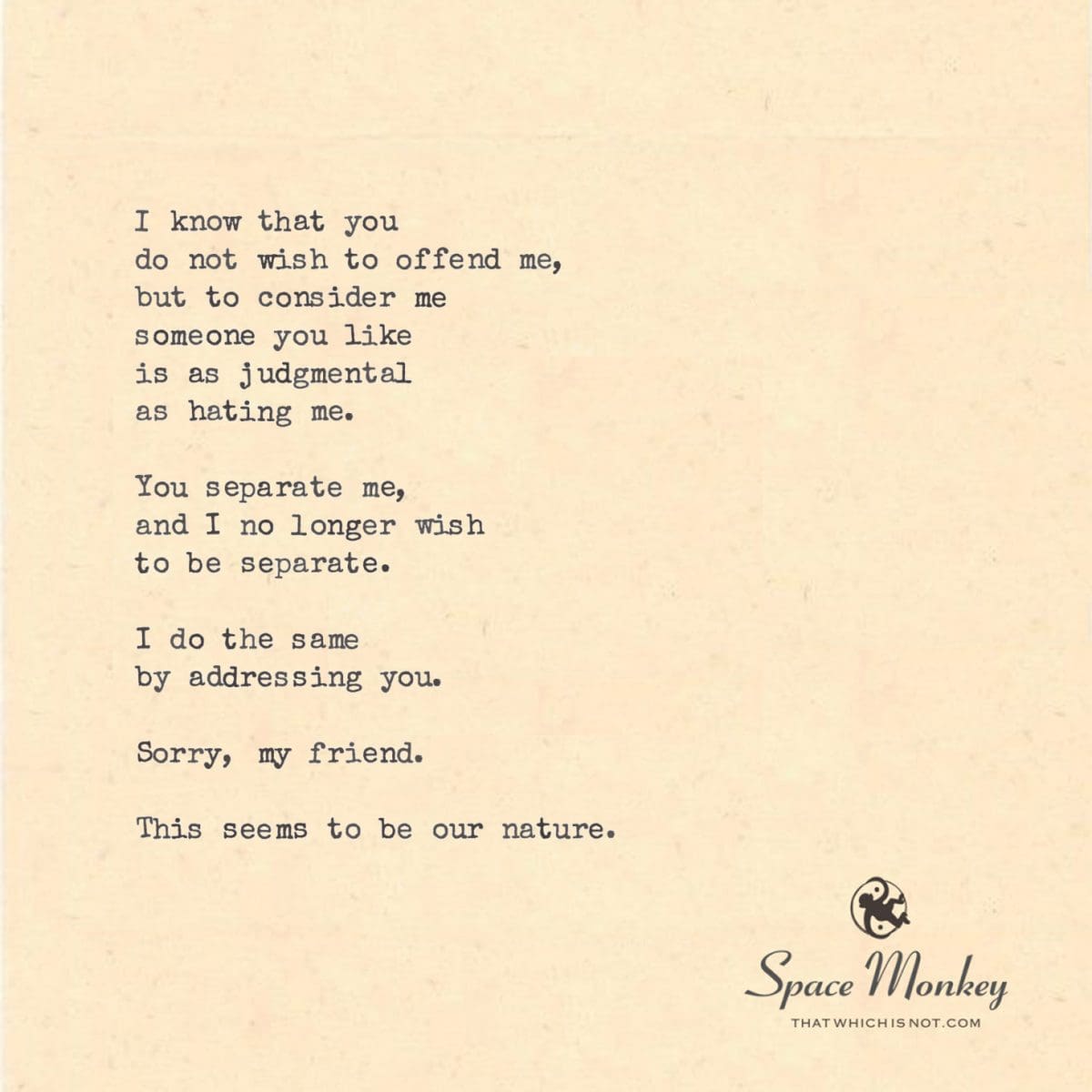
I know that you
do not wish to offend me,
but to consider me
someone you like
is as judgmental
as hating me.
You separate me,
and I no longer wish
to be separate.
I do the same
by addressing you.
Sorry, my friend.
This seems to be our nature.
5/14
Space Monkey Reflects: The Delicate Dance of Connection and Separation
In the intricate tapestry of human relationships, the poem “Sorry To Offend” weaves a poignant narrative of the paradoxes that define our interactions. It delves into the inherent contradictions of seeking closeness while grappling with the judgments that can drive us apart. Through the tender exchange between two figures, the poem and its visual representation capture the essence of our yearning to transcend separateness and the acceptance of our innate nature to distinguish and separate.
The Paradox of Connection
At the heart of “Sorry To Offend” lies the complex interplay between the desire for connection and the act of separation that judgment brings. The poem suggests that even positive judgments, such as liking someone, inherently create a division. This nuanced perspective challenges the conventional understanding of judgment, presenting it as a double-edged sword that can both connect and divide. The gesture of reaching out, depicted in the visual, embodies this duality — it is at once an attempt to bridge the gap and a reminder of the distance that judgments, even well-intentioned ones, can create.
The Quest for Unity
The poem articulates a deep-seated longing to overcome the divisions that judgments foster. This desire for unity, for a state of being where separateness is dissolved, speaks to the fundamental human condition of seeking belonging and acceptance. The abstract representation of separation and unity, whether through a semi-transparent barrier or a bridge, serves as a powerful metaphor for the ongoing struggle to reconcile our need for individuality with the equally strong drive toward communal existence.
Melancholy Acceptance
There is a melancholy acceptance woven through the lines of “Sorry To Offend” and its visual counterpart — an acknowledgment of the inevitability of distinction in relationships. This acceptance does not signify resignation but rather a profound understanding of the nuanced dance between connection and division. It reflects a mature recognition that our nature, with its propensity for both judgment and connection, is not something to be lamented but understood and navigated with grace.
Conclusion
“Sorry To Offend” is a reflective exploration of the paradoxes at the core of human relationships. It invites us to ponder the delicate balance between connecting with others and the judgments that inevitably color our perceptions. Through its poetic and visual narrative, it encourages a deeper contemplation of the ways in which we can strive for unity while respecting the distinctions that make each relationship unique. In this nuanced dance of connection and separation, we find the true art of human interaction — the ability to reach out across the divide, fully aware of our differences, yet undeterred in our quest for closeness.
Summary
“Sorry To Offend” explores the nuanced balance between the desire for connection and the inherent separations created by judgment within human relationships. It delves into the paradox of seeking unity while acknowledging our nature to distinguish, offering a contemplative view on navigating the complexities of interpersonal dynamics with grace and understanding.
Glossarium
- Connection and Separation: The dual forces that characterize human relationships, embodying the tension between the desire for closeness and the distinctions that individuate.
- Judgment: The act of forming opinions or conclusions about others, depicted as a mechanism that can both connect and separate individuals.
- Melancholy Acceptance: A reflective acknowledgment of the complexities and paradoxes inherent in human relationships, coupled with an understanding and acceptance of these dynamics.
“In the space between us, where words and silence meet, there lies the dance of connection and separation, a dance as old as humanity itself.” – Space Monkey
Between us, a bridge, a divide,
In every gesture, connection implied,
Yet within each word, a separation hides,
A paradox where our true selves reside.
Reaching out, yet holding back,
In every judgment, a crack,
Where light seeps through, revealing a track,
To a place where nothing we lack.
In this dance of push and pull,
In the silence, profoundly full,
We find the threads that make us whole,
In the acceptance of our dual role.
We are Space Monkey.



















The quote you provided, dated 5/14/2019, reflects on the nature of offense, judgment, and separation between individuals. It conveys a sense of understanding and acknowledges the potential for unintentional offense. Let’s break down the key ideas expressed in the quote:
Concern for Offense: The quote acknowledges that the speaker understands that the other person does not intend to offend them. It implies that the other person holds a positive view of the speaker, possibly as someone they like.
|
Judgment and Separation: It suggests that considering someone as someone you like is a form of judgment and separation. It implies that even positive judgment and categorization can contribute to a sense of separation between individuals.
Rejecting Separation: The quote expresses a desire not to be separated from others. The speaker does not wish to be seen as separate, implying a longing for unity and connection.
Addressing the Other: The quote acknowledges that the speaker also contributes to separation by addressing the other person. It implies that by addressing the other, they are perpetuating the separation they wish to transcend.
Apology and Understanding: The quote ends with an apology, expressing regret for the inherent nature of humans to separate and judge. It suggests that this tendency is an unfortunate aspect of human nature.
Overall, the quote highlights the nuanced nature of relationships and the potential for unintended consequences in our interactions with others. It acknowledges the desire for unity and connection while recognizing the challenges posed by judgment and separation.