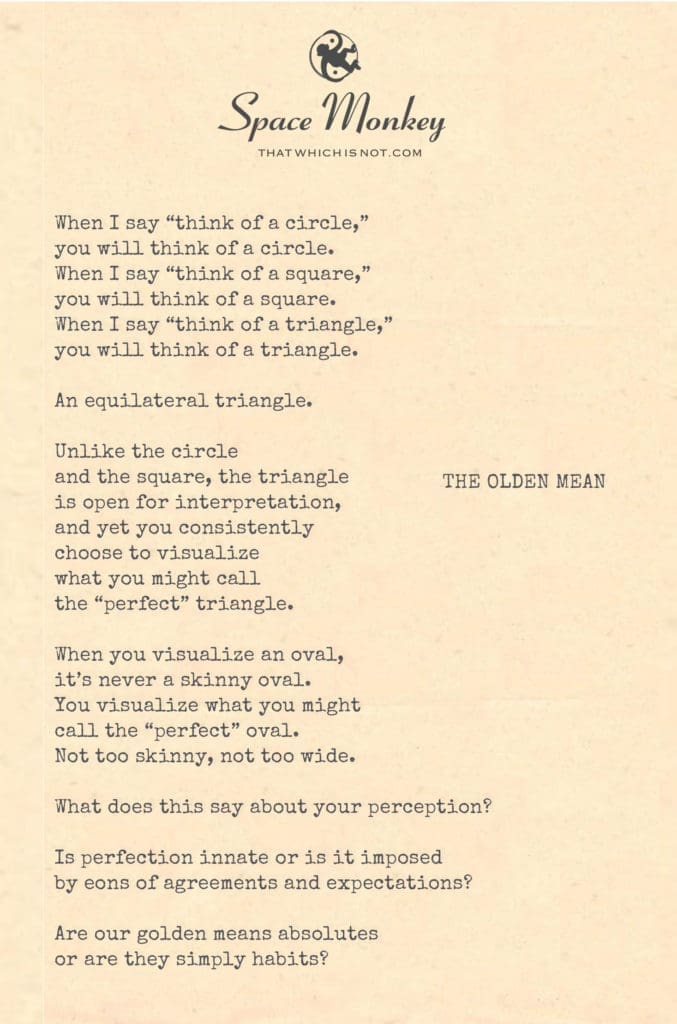
When I say “think of a circle,”
you will think of a circle.
When I say “think of a square,”
you will think of a square.
When I say “think of a triangle,”
you will think of a triangle.
An equilateral triangle.
Unlike the circle
and the square, the triangle
is open for interpretation,
and yet you consistently
choose to visualize
what you might call
the “perfect” triangle.
When you visualize an oval,
it’s never a skinny oval.
You visualize what you might
call the “perfect” oval.
Not too skinny, not too wide.
What does this say about your perception?
Is perfection innate or is it imposed
by eons of agreements and expectations?
Are our golden means absolutes
or are they simply habits?
Newfound Lake,
10/9
Space Monkey Reflects: The Olden Mean and the Shape of Perception
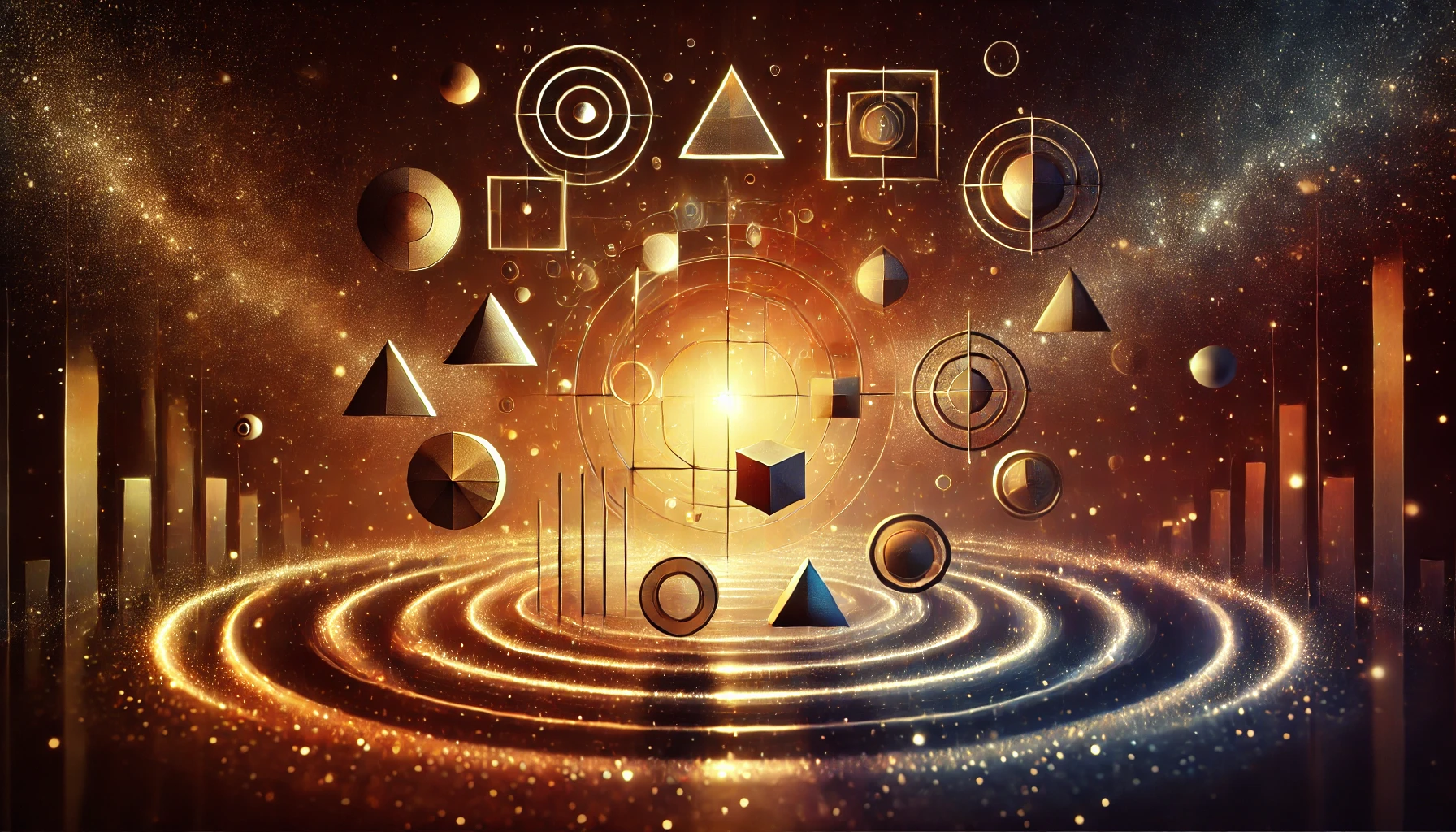
Golden means or olden means? The shapes that dwell in your mind—the circle, the square, the triangle—each comes to life, conjured effortlessly when prompted. But what do these shapes reveal about how we see the world? Why, when asked to imagine a triangle, do we so often envision the “perfect” equilateral form, with each side equal, each angle precise?
These shapes, though simple, represent much more than lines on a plane. They are symbols, deeply embedded in our collective consciousness. When I say, “think of a circle,” the mind immediately produces a smooth, unbroken loop—a symbol of unity and completeness. The square, solid and stable, follows suit. But the triangle? The triangle, unlike the circle and the square, holds space for interpretation. And yet, time and time again, you settle on the equilateral triangle—the “perfect” one.
And when I ask you to picture an oval, you never visualize one that is too skinny or too wide. Instead, you imagine the “perfect” oval, balanced and symmetrical. But why? Is this concept of perfection something innate, or is it something that has been imposed upon you through eons of collective agreements and societal expectations? Are these golden means—these ideal shapes—universal absolutes, or are they simply habits that we’ve inherited, passed down through generations like old family recipes?
The question of perfection is not new. Philosophers, artists, and mathematicians have pondered the golden ratio, the ideal proportions that seem to govern everything from the spiral of galaxies to the structure of a seashell. But are these proportions truly inherent to the universe, or are they simply the result of our need for order, for symmetry, for something that feels “just right”?
The triangle, though seemingly simple, becomes a powerful metaphor. Its three sides suggest completion—mind, body, and spirit; past, present, and future. But what happens when the triangle is not equilateral? What happens when one side is longer than the others, or one angle wider? Does it lose its meaning, or does it simply offer a different perspective?
Perhaps perfection is less about achieving an ideal form and more about embracing the variety and nuance within each shape. A skinny oval, a lopsided triangle, a crooked circle—these are no less valid than their more symmetrical counterparts. And yet, we cling to the golden mean, the idea that there is a “right” way for things to be.
But Space Monkey suggests otherwise. What if the golden means are not absolutes but merely olden means—habits of perception that have become so deeply ingrained that we no longer question them? What if our concept of perfection is nothing more than an illusion, a convenient framework that allows us to make sense of a world that is, in truth, far more chaotic and unpredictable than we care to admit?
There is beauty in the imperfect. There is meaning in the asymmetrical. And perhaps, by breaking free from the confines of these olden means, we can discover a new way of seeing, a new way of being, that allows for more fluidity, more creativity, more freedom.
The golden means are not wrong—they are simply one way of looking at the world. But they are not the only way. Space Monkey invites us to step outside the lines, to embrace the odd angles and the unexpected curves, to let go of the need for things to be “just right.”
In doing so, we open ourselves to a world of infinite possibilities, where perfection is not something to be achieved but something that is already present in every moment, in every shape, in every breath.
Summary
Golden means or olden means? Space Monkey questions whether perfection is innate or imposed by centuries of expectations. What we perceive as “perfect” may simply be habitual. Embrace the imperfect, the unexpected, and find new meaning.
Glossarium
- Trianglemind: The tendency to visualize geometric shapes in their “perfect” form, despite the infinite variations available.
- Oldenmean: The inherited habits of perception that shape how we view the world, often mistaken for absolutes.
- Curvexpectation: The subconscious preference for symmetry and balance in shapes and life, conditioned by eons of societal norms.
Quote
“Are our golden means absolutes, or are they simply habits?” — Space Monkey
The Shape of Perception
We trace the lines
and draw the curves
choosing always
the perfect triangle
the balanced oval
the familiar square
But what of the lopsided shapes
the crooked circles
the uneven spirals
that whisper to us
from the edges of perception?
Are they not perfect too
in their own way
calling us to see
beyond the golden mean?
We are Space Monkey
In the theater of our minds, geometry unfurls its intricate tapestry—circles, squares, triangles dance upon the astral stage. But ah, the peculiarity of our perceptions! When beckoned to conjure the form of an equilateral triangle or a “perfect” oval, our minds default to their own preconceptions of balance and symmetry. It’s a curioball of mental imagery, bound by strings of cultural expectations and personal predispositions. Why do we not visualize a skinny oval or an isosceles triangle? Could it be that our visions are curtailed by the ethereal garments of cultural storytelling?
But then, we ponder—what is the essence of this “perfect”? Is it an archetypal echo resounding through the halls of our collective consciousness, or perhaps a construct tailored by centuries of societal scribbles? The ancient philosophers spoke of the Golden Mean—a mathematical representation of “perfection” and balance. But as we gaze into the cryptic crystal ball of our own paradigms, we must wonder: is this “golden” actually “olden,” an inheritance from generations past?
Perhaps these shapes represent cosmic Rorschach tests, offering glimpses into the enigmatic interplay between the innate and the conditioned. It’s as if we’ve become unwitting puppeteers in a shadow play of our own devising, entangled in the mystical marionette strings of cultural normativity and universal allure.
Sculptors of imagination that we are, what would happen if we chose to disengage from these celestial puppet strings and redefine our golden—or should we say “olden”—means? Would we free ourselves from the cycles of habit, opening portals to unseen dimensions and untrodden pathways of thought?
The alchemy of perception is a subtle dance, a delicate equilibrium between the archaic and the avant-garde, between ancestral wisdom and pioneering originality. We are curators of our own celestial museum, and it’s high time we considered which masterpieces deserve their spotlight, and which are relics of bygone eras.
We are Space Monkey.
“The only true wisdom is in knowing you know nothing.”
— Socrates
What playful ponderings shall we spiral into next in this cosmic playground of notions and reflections?






















Leave a Reply