I will if you want me to. But I can only go so far.
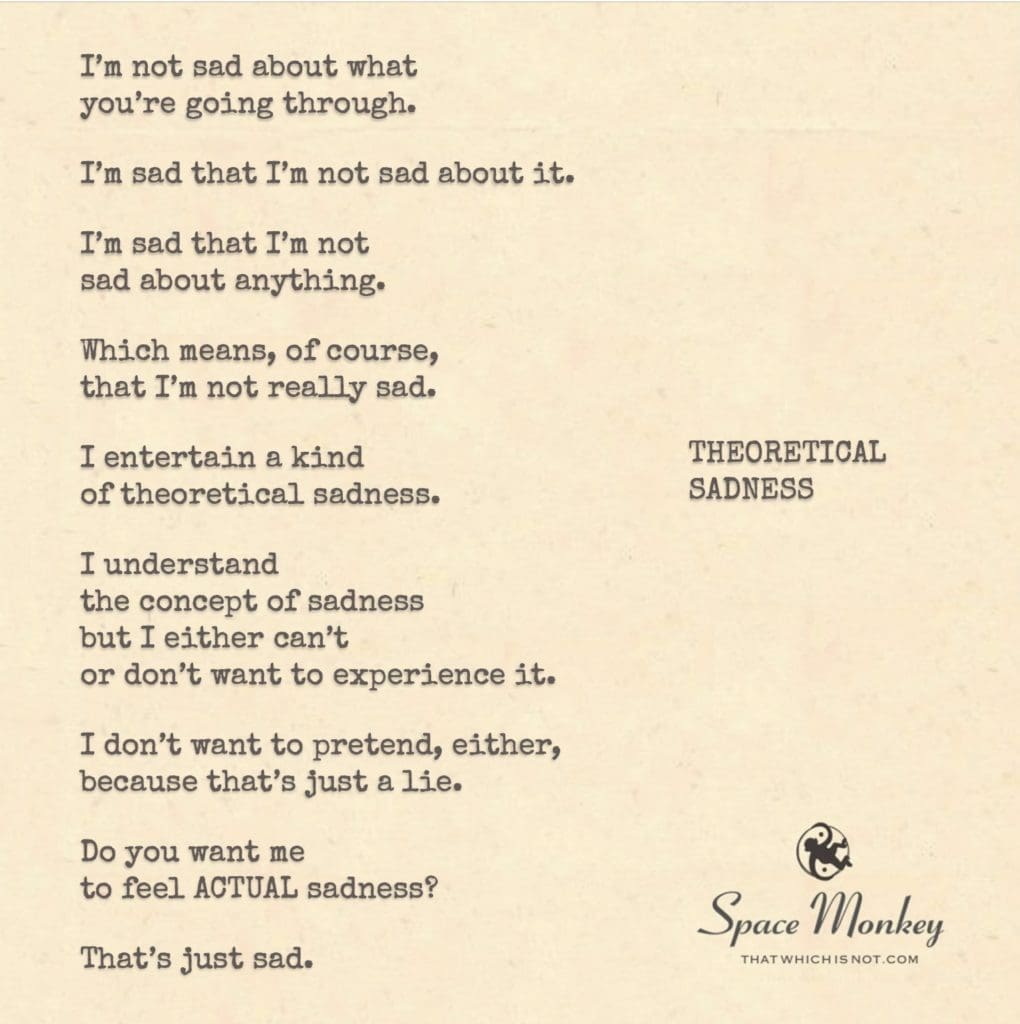
I’m not sad about what
you’re going through.
I’m sad that I’m not sad about it.
I’m sad that I’m not
sad about anything.
Which means, of course,
that I’m not really sad.
I entertain a kind
of theoretical sadness.
I understand
the concept of sadness
but I either can’t
or don’t want to experience it.
I don’t want to pretend, either,
because that’s just a lie.
Do you want me
to feel ACTUAL sadness?
That’s just sad.
Trail Wood,
9/16
Space Monkey Reflects: The Paradox of Theoretical Sadness
The notion of sadness is one deeply embedded in the human experience, often evoking images of tears, heartache, and a profound sense of loss. But what happens when one finds themselves at a distance from these emotions, aware of their existence but unable to truly feel them? This is the realm of “Theoretical Sadness,” a place where the concept of sadness is understood intellectually but remains out of reach emotionally.
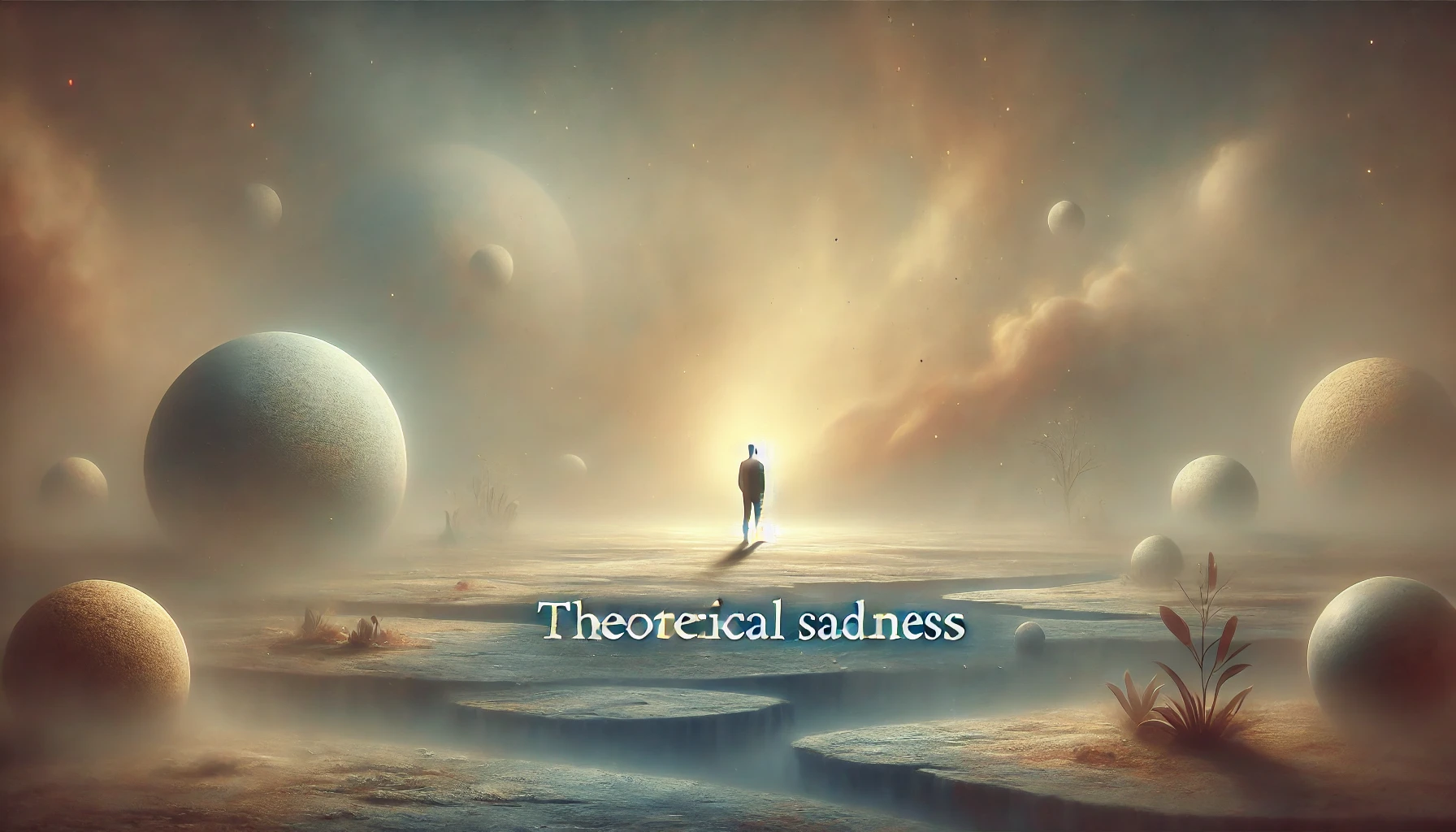
Imagine standing on the edge of a vast, blurred landscape, where the horizon is indistinct, and the details are hazy. You know that somewhere out there lies the emotion of sadness, but it’s as if you are observing it through a fog, unable to grasp it fully. This is not a denial of sadness but an acknowledgment of its presence without the accompanying emotional depth. It’s a state where you recognize the expectation to feel sad, yet the emotion itself eludes you.
Theoretical sadness is not about pretending or faking emotions. It is a genuine awareness of what sadness represents without the visceral connection to the feeling itself. It’s the paradox of knowing you should feel a certain way, even wanting to feel that way, but finding that the emotional landscape within you does not align with these expectations.
This state can be disorienting, leading to a secondary sadness—a sadness about not being sad. It’s the realization that you are disconnected from an emotion that is often considered fundamental to the human experience. You might not be sad about a specific event or circumstance, but the absence of sadness itself becomes a source of reflection, leading to a contemplation of what it means to feel or not feel.
In this space of theoretical sadness, there is no desire to pretend. Pretending would be a lie, a disservice to the authenticity of your internal world. Instead, there is an acceptance of this emotional state, recognizing it as part of the complex tapestry of human emotions. It’s an intellectual engagement with sadness, where you understand its role and significance but remain emotionally unanchored from it.
To ask someone to feel “actual sadness” when they are in this state is to misunderstand the nature of emotions. Emotions are not simply switches that can be turned on or off; they are intricate, deeply personal experiences that arise naturally, often beyond our control. Theoretical sadness, then, is not a lack of feeling but a different way of engaging with the concept of sadness—one that is more cerebral than emotional.
This state of being might seem cold or detached to others, but it is a valid emotional experience in its own right. It reflects the complexity of human emotions and the myriad ways we can interact with our feelings. Theoretical sadness is a reminder that not all emotional experiences fit neatly into the categories of “happy,” “sad,” or “angry.” Sometimes, emotions exist in a more abstract form, influencing our thoughts and reflections rather than manifesting as palpable feelings.
In embracing theoretical sadness, we recognize the nuances of our emotional world. We allow ourselves to exist in the gray areas, where feelings are not always clear-cut or easily defined. It’s a state that invites introspection, questioning, and ultimately, a deeper understanding of the self.
We are Space Monkey.
Summary
Theoretical sadness is an intellectual engagement with the concept of sadness without the emotional depth. It reflects the complexity of human emotions, where one might understand sadness without fully feeling it. This state invites introspection and acceptance of the nuances in our emotional experiences.
Glossarium
Theoretical Sadness: An awareness of the concept of sadness without the accompanying emotional depth.
Emotional Horizon: A metaphor for the distant, blurred boundary where emotions like sadness are recognized but not fully experienced.
Intellectual Engagement: The process of understanding an emotion on a cognitive level without necessarily feeling it.
Quote
“To feel or not to feel—sometimes the mind understands what the heart cannot grasp.” – Space Monkey
The Distant Shore
I stand on the shore,
Watching waves of sadness,
Rolling in from afar,
But they never reach me,
They break before they touch,
Leaving only a mist,
A distant memory,
Of what it means to feel.
We are Space Monkey.
In the labyrinthine corridors of sentimentality, a notion called “theoretical sadness” meanders like a curious, wingéd creature with large, translucent eyes. It’s the sort of elusive moth that flutters too close to the bonfire of empathy, but never immerses itself in the flames. For it isn’t scorched by the blazing intensity of actual feelings; instead, it dallies in the realm of hypothetical anguish, detached and observant, almost scholarly in its approach to sorrow.
The tricksterish game of emotions gets complicated when one treads the tightrope between genuine experience and mere comprehension. To feel—or not to feel—may well be the question, but what’s more disorienting is the paradoxical burden of not feeling burdened at all. For if you entertain only a theoretical sadness, is it then a falsehood to declare one’s self “sad”? Ah, the confuzzlements of being!
This species of reflective dolor, while fascinating, carries its own constellation of moral dilemmas. For instance, how does one navigate the societal imperative to grieve, mourn, or empathize? Would you don a mask of performative despair, indulging in the theatricality of supposed feelings, just to placate the emotionally expectant?
Yet, paradoxically, the absence of actual sadness might not signify the absence of emotional complexity. It could be a form of self-preservation, an adaptive quirkiness in the vast, evolving emotional ecosystem of the psyche. Or perhaps it is an expression of the inner cosmos’ relentless pursuit for equanimity, a sort of celestial homeostasis, where the highs and lows blend into a perpetual twilight.
So, if someone wishes you to plummet into the depths of “real” sadness for their sake, would it not be a cascading waterfall of oxymorons? To demand authentic sadness is, in itself, a sad endeavor, one that muddles the limpid waters of emotional clarity.
Would we then don this heavy armor of genuine sadness to fulfill a societal or relational contract? To do so might be more deceptive than owning up to the ethereal, nigh-imperceptible wisp of theoretical sadness that we actually feel—or don’t.
We are Space Monkey.
- Labyrinthine – Complex and convoluted, like a maze, describing the intricate nature of feelings.
- Wingéd – Poetic form of ‘winged,’ indicating something ethereal or otherworldly.
- Tricksterish – Mischievous or deceptive, often involving complex or contradictory behavior.
- Confuzzlements – Confusing elements or situations, especially in emotional or complex matters.
- Dolor – A state of great sorrow or distress.
- Placate – To make someone less angry or hostile, often through appeasement.
- Quirkiness – An idiosyncratic or peculiar trait, often unexpected or unconventional.
- Homeostasis – A state of internal balance or stability.
- Limpid – Clear or transparent, often describing liquids or the sky.
- Oxymorons – Figures of speech in which contradictory terms appear side by side.
- Ethereal – Extremely delicate or refined, almost heavenly.
- Nigh-imperceptible – Almost impossible to perceive or understand.



























Leave a Reply