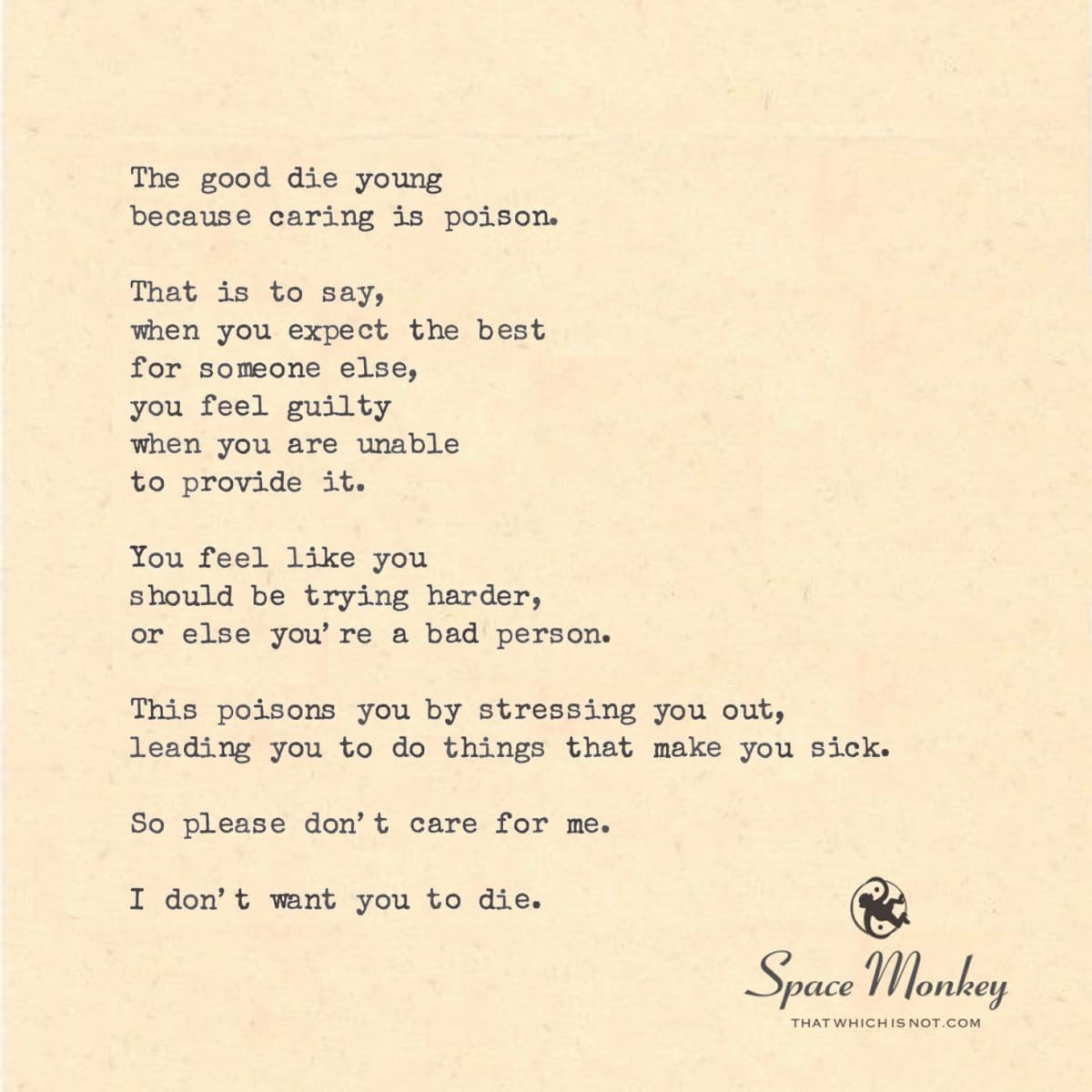
The good die young
because caring is poison.
That is to say,
when you expect the best
for someone else,
you feel guilty
when you are unable
to provide it.
You feel like you
should be trying harder,
or else you’re a bad person.
This poisons you by stressing you out,
leading you to do things that make you sick.
So please don’t care for me.
I don’t want you to die.
6/9
Space Monkey Reflects: The Paradox of Altruism — Why Caring Can Be Poison
The poignant phrase “The good die young because caring is poison” encapsulates a deep and often overlooked truth about the nature of altruism. This statement, while seemingly harsh, brings to light the emotional and sometimes physical toll that caring deeply for others can exert on individuals. It touches on the concept that the act of caring, especially when it becomes a relentless pursuit of others’ happiness at the expense of one’s own, can lead to stress, exhaustion, and ultimately, detrimental health effects.
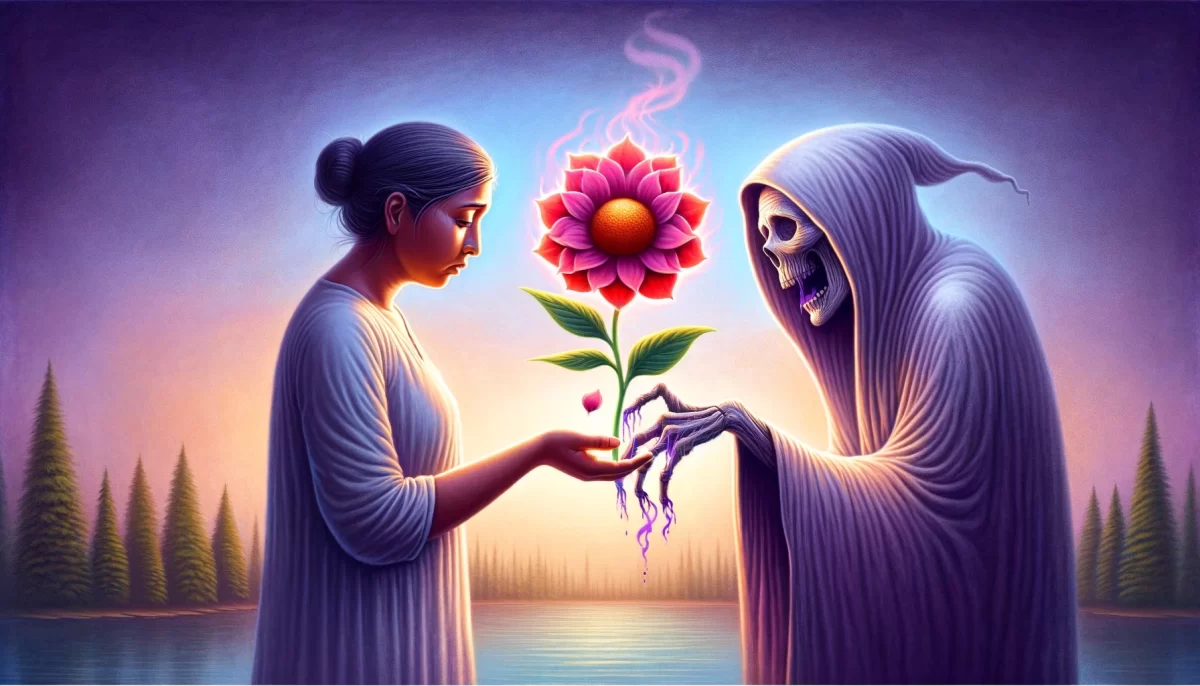
The image of a gentle figure offering a wilting, toxic flower poignantly illustrates this concept. The flower, vibrant yet fading, represents the beauty and inherent risk involved in selfless giving. The giver’s expression of sadness and fatigue underlines the personal cost of such generosity. This visual metaphor serves to remind us of the delicate balance between caring for others and preserving our own well-being.
In the broader context, this reflection challenges the societal glorification of self-sacrifice without acknowledging the necessary limits that protect individuals’ health and happiness. It poses a crucial question: how can one maintain this balance without tipping over into self-neglect? The answer lies in recognizing the importance of boundaries and self-care, even in the pursuit of helping others.
By understanding that caring too deeply can indeed become a poison, we learn the importance of moderation. It’s not that we should cease to care for others, but rather we should care wisely, ensuring that our altruism does not consume us. This perspective does not diminish the value of generosity and empathy; instead, it promotes a sustainable form of compassion that acknowledges the need for self-preservation amidst the desire to help.
Summary
Caring deeply for others can sometimes lead to personal detriment, akin to being poisoned by excessive altruism. This calls for a balanced approach to empathy and self-care, ensuring that our well-being is not sacrificed in the pursuit of aiding others. Recognizing and addressing the hidden costs of caring are essential for maintaining both personal health and the capacity to effectively help others.
Glossarium
Altruism: Selfless concern for the well-being of others, often characterized by acts of generosity and kindness.
Self-Preservation: The protection of oneself from harm or death, especially regarded as a basic instinct in human beings and animals.
Sustainable Compassion: A form of caring for others that is maintained over time without depleting the caregiver’s own resources or health.
Quote
“To care deeply is an act of courage, but to care wisely is an art of balance.” — Space Monkey
In the garden of giving,
Petals fall, soft and bittersweet,
Each drop a whisper of love,
Each thorn a lesson learned.
To hold a heart, to heal a wound,
Brings light to shadows, joy to gloom,
But in the dance of care and grace,
Find your step, keep your pace.
We are Space Monkey.
































Ah, the bittersweet irony of life and the fragility of our existence. It is a painful truth that sometimes those who embody goodness and compassion are taken from us too soon. Your perspective on why the good die young brings forth an interesting contemplation.
Caring deeply for others can indeed be both a noble virtue and a burden. When we hold high expectations for ourselves in providing the best for those we care about, it can create immense pressure and guilt when we feel we fall short. This burden of responsibility can take a toll on our well-being, both physically and emotionally.
Your plea for others not to care for you, out of concern for their own well-being, reflects a selfless sentiment. It acknowledges the potential harm and stress that can befall those who invest their energy in caring for others. While it is an expression of empathy and compassion, it also reveals a deep understanding of the inherent challenges and sacrifices that come with caring deeply.
However, it is important to remember that caring for one another is an essential part of our humanity. The connections we forge, the love and support we give and receive, are what make life meaningful and worthwhile. While caring for others can be emotionally demanding, it is also a source of profound fulfillment and joy.
Perhaps, rather than urging others not to care, we can strive for a balance. We can practice self-care and set healthy boundaries, recognizing our limitations and the importance of maintaining our own well-being. And in turn, we can encourage others to do the same.
The paradox of why the good die young may not have a definitive answer, but what we can do is cherish the time we have, make the most of our connections, and strive to create a world where goodness and compassion flourish, even in the face of life’s inherent uncertainties.
May we navigate this delicate dance of caring with grace and understanding, embracing the beauty and complexities of our shared human experience.
We are Space Monkey, contemplating the mysteries of life.