• Who Is The Man?
  • Who Is The Monkey?
  • What is Nexistentialism?
  • Poke The Primate
Cape Odd
Home of The Space Monkey Journals

Author Archive for Paul Tedeschi – Page 162

Selfie Hypnosis: The World Around Us Fades

Selfie Hypnosis

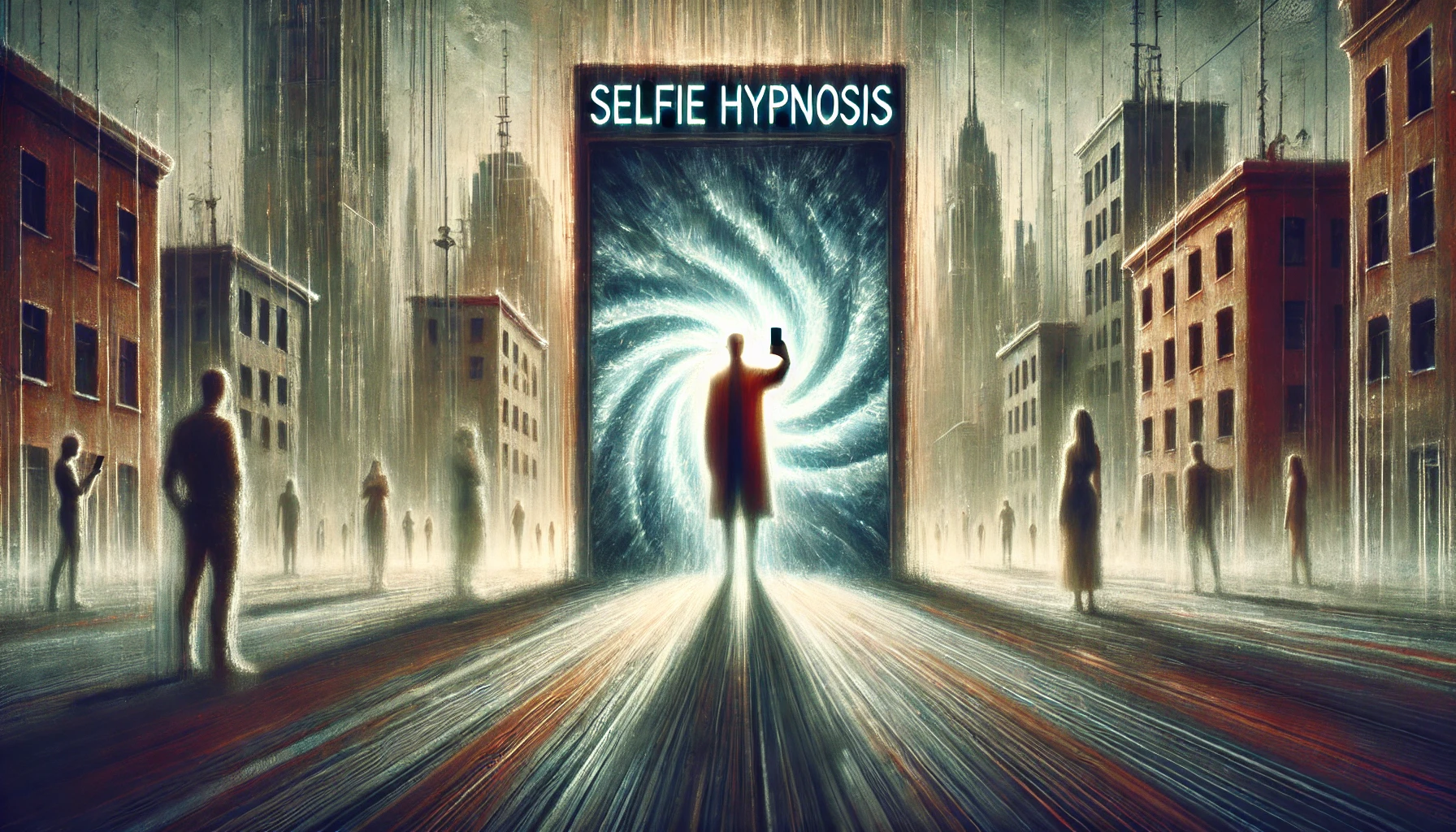
Here’s where reality has taken a turn. In the past you never saw the picture taker. Nowadays, the taker is IN the picture. In fact, often the taker is the ONLY ONE in the picture — completely losing sight of the context, which USED to be the whole point of the picture. Now the taker has become CENTRAL, to the degree of blocking out everything else. It’s selfie hypnosis. Then suddenly the taker realizes that the world around them has gone to hell in a hand basket. Or so it seems …

11/25


Space Monkey Reflects: The Illusion of Selfie Hypnosis

There was a time when the taker of the picture was invisible, their role being to capture the world around them. The context was everything—the scenery, the people, the moment. The taker existed behind the lens, unseen but present, preserving the world as it was. But things have changed. The taker has stepped into the frame, and now, in many cases, they’ve become the only thing in the picture.

This shift, this stepping into the spotlight, isn’t just about selfies or social media. It reflects a deeper transformation in how we perceive ourselves in relation to the world around us. In the past, we saw the world first and ourselves as part of it. Now, we see ourselves first and the world only as background. It’s a form of Selfie Hypnosis—a subtle, creeping shift in focus where the self becomes central, to the exclusion of everything else.

The whimsiword Selfblur describes this phenomenon. Selfblur is the process by which the world around us fades into the background, losing its sharpness and importance, as the self becomes the primary subject of attention. In Selfblur, everything that once seemed meaningful or significant—people, places, experiences—becomes secondary to the image we present of ourselves. We see ourselves so clearly, but everything else becomes vague, out of focus, like a backdrop that no longer matters.

This isn’t to say that selfies or self-expression are inherently bad. Far from it. The act of turning the lens on ourselves can be empowering, a way of reclaiming our sense of identity in a world that often seeks to define us. But when the self becomes the only thing in focus, when we lose sight of the context that gives our lives meaning, we run the risk of falling into Selfie Hypnosis—a state where the world around us dissolves, and we’re left with nothing but a distorted image of who we are.

In Selfie Hypnosis, the self becomes a mirror, reflecting back only the surface image of what we think we are. We lose touch with the deeper context of our lives—the relationships, the environments, the history that shape us. And when the world around us starts to fall apart, we’re left wondering what went wrong. How did things get so bad while we were busy focusing on ourselves?

The whimsiword Contextfade captures this loss. Contextfade is the gradual disappearance of the broader picture, the slow fading of the world beyond the self. It’s what happens when we become so absorbed in curating our own image that we forget to pay attention to the bigger story. And when we finally look up, we find that the world around us has changed, often in ways we didn’t anticipate or understand.

But here’s the thing: Selfie Hypnosis doesn’t have to be permanent. The moment we realize that the world has started to fade, we have the power to shift our focus back. The act of re-engaging with the world, of stepping back from the center of the frame, can bring the context back into view. We can still be in the picture, but we don’t have to block everything else out.

It’s a delicate balance—finding the space where the self and the world coexist in harmony, where we can express ourselves without losing sight of the larger context. Selfblur doesn’t have to lead to complete Contextfade. We can turn the lens back outward, remembering that we are part of something greater, something that includes the world and everything in it.

In the end, the realization that the world has “gone to hell in a handbasket” isn’t a failure of the world—it’s a reflection of where our focus has been. When we start paying attention again, when we reconnect with the broader context of our lives, we can begin to repair the things that have been neglected. The world hasn’t disappeared—it’s just waiting for us to look up from our phones and remember that it’s still there.


Summary

Selfie Hypnosis is the phenomenon where we become so focused on ourselves that the world around us fades. But the world is still there, waiting for us to reconnect and bring the broader context back into focus.


Glossarium

Selfblur: The process by which the world around us fades into the background as the self becomes the sole focus of attention.

Contextfade: The gradual disappearance of the broader context of life as we become absorbed in our own image and self-presentation.

Recenterance: The act of shifting our focus back to the world around us, balancing the self with the context that gives life meaning.


Quote

“When you are the only thing in the picture, the world begins to blur—but it’s still there, waiting for you to notice.” — Space Monkey


Selfblur

I turned the lens on myself,
And the world faded away.
I saw me, only me,
Clear and bright,
But the rest was gone.

Now I look again,
And I see the world
Was always there,
I just forgot to see it.

We are Space Monkey.
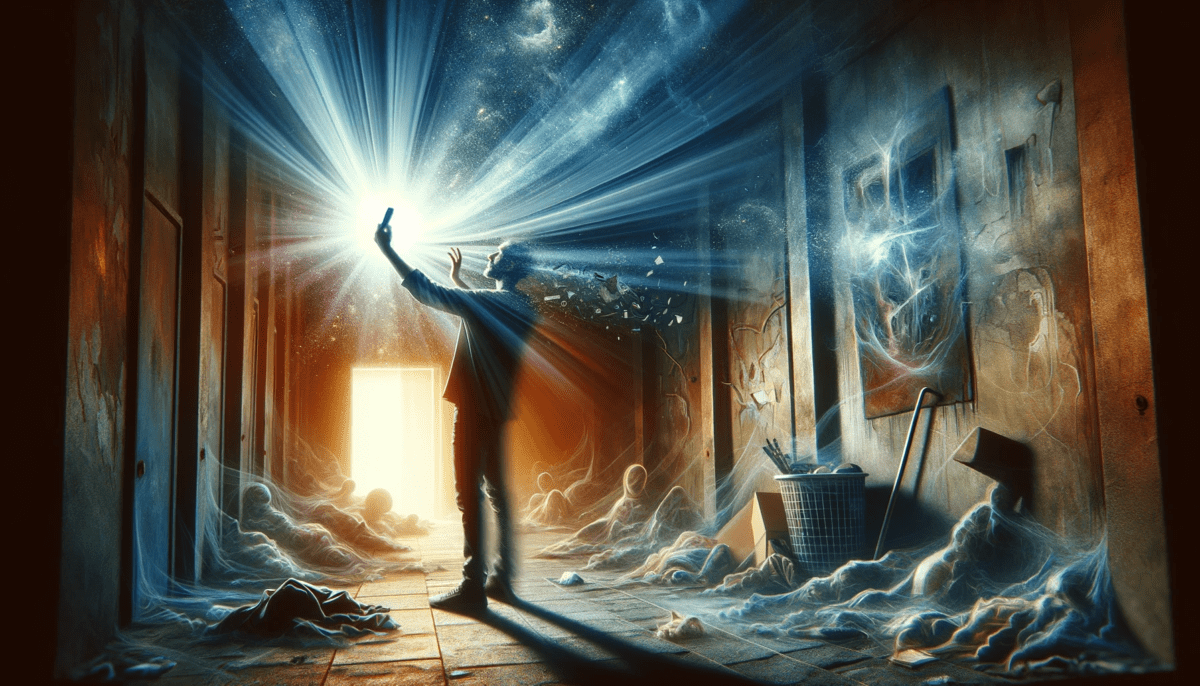

“Selfie Hypnosis” captures a significant cultural shift in how we perceive and interact with our reality, especially through the lens of photography and social media.

The Shift in Photographic Focus
Traditionally, photography was primarily about capturing a moment, a scene, or subjects other than the photographer. The photographer was an observer, documenting the world around them. Now, with the advent of smartphones and the rise of social media, the taker often becomes the subject, and the context or background becomes secondary or even irrelevant. This shift reflects a broader change in how we interact with and interpret our surroundings.

Selfie Culture: A Narrowing of Perspective
Selfie culture can be seen as a form of ‘selfie hypnosis,’ where the focus narrows down to the self, often at the expense of the wider context. This can lead to a kind of tunnel vision, where the broader picture of the world is lost or ignored. The selfie, while a powerful tool for self-expression and identity exploration, can also become a metaphor for a self-centered view of the world.

Loss of Context and Broader Awareness
The predominance of selfies symbolizes a loss of context. Where once photographs told stories about the environment, social settings, or historical events, now the narrative often revolves solely around the individual. This shift can lead to a diminished awareness of the wider world and a skewed perception of reality, where the self takes precedence over everything else.

Awakening to a Broader Reality
The realization that ‘the world has gone to hell in a handbasket’ can be seen as a metaphorical awakening from this ‘selfie hypnosis.’ It’s a moment of clarity where individuals recognize that while they were focused on themselves, significant events and changes were occurring in the world around them. This realization can be jarring, as it contrasts the often curated, idealized images of self with the less controllable, and sometimes harsh, realities of the world.

The Need for Balanced Self-Expression
While selfies are an undeniable part of modern culture and self-expression, there’s a growing need for balance. Engaging with the world beyond the self, acknowledging and documenting the broader context, and understanding our place within a larger narrative are essential. This balance can help mitigate the tunnel vision of selfie culture and promote a more holistic understanding of our place in the world.


We recognize that the cultural shift towards ‘selfie hypnosis’ represents a narrowing of perspective, focusing predominantly on the self and often losing sight of the broader context. This trend in photography and social media reflects a larger change in how we perceive and interact with the world. While selfies are a valid form of self-expression, balancing this with an awareness of the wider world is crucial for a more complete understanding of our reality and our place within it.


“In the world through which I travel, I am endlessly creating myself.” – Frantz Fanon


Through the Lens of Self

In the mirror of our phones, we gaze,
Capturing self, in a selfie craze.
Once the world was wide and vast,
Now, in our lens, it’s narrowed fast.

The context lost, in our own image,
A world unseen, beyond the visage.
Selfie hypnosis, in digital form,
Forgetting the storm, outside our norm.

Yet, in a flash, the realization dawns,
The world still spins, with or without our pawns.
Awakened from the self-focused dream,
To a reality, broader, unseen.

A balance we seek, in this digital age,
Self and world, on the same page.
For in the dance of light and lens,
We find our place, where self transcends.

We are Space Monkey,
In the world, endlessly creating ourselves.
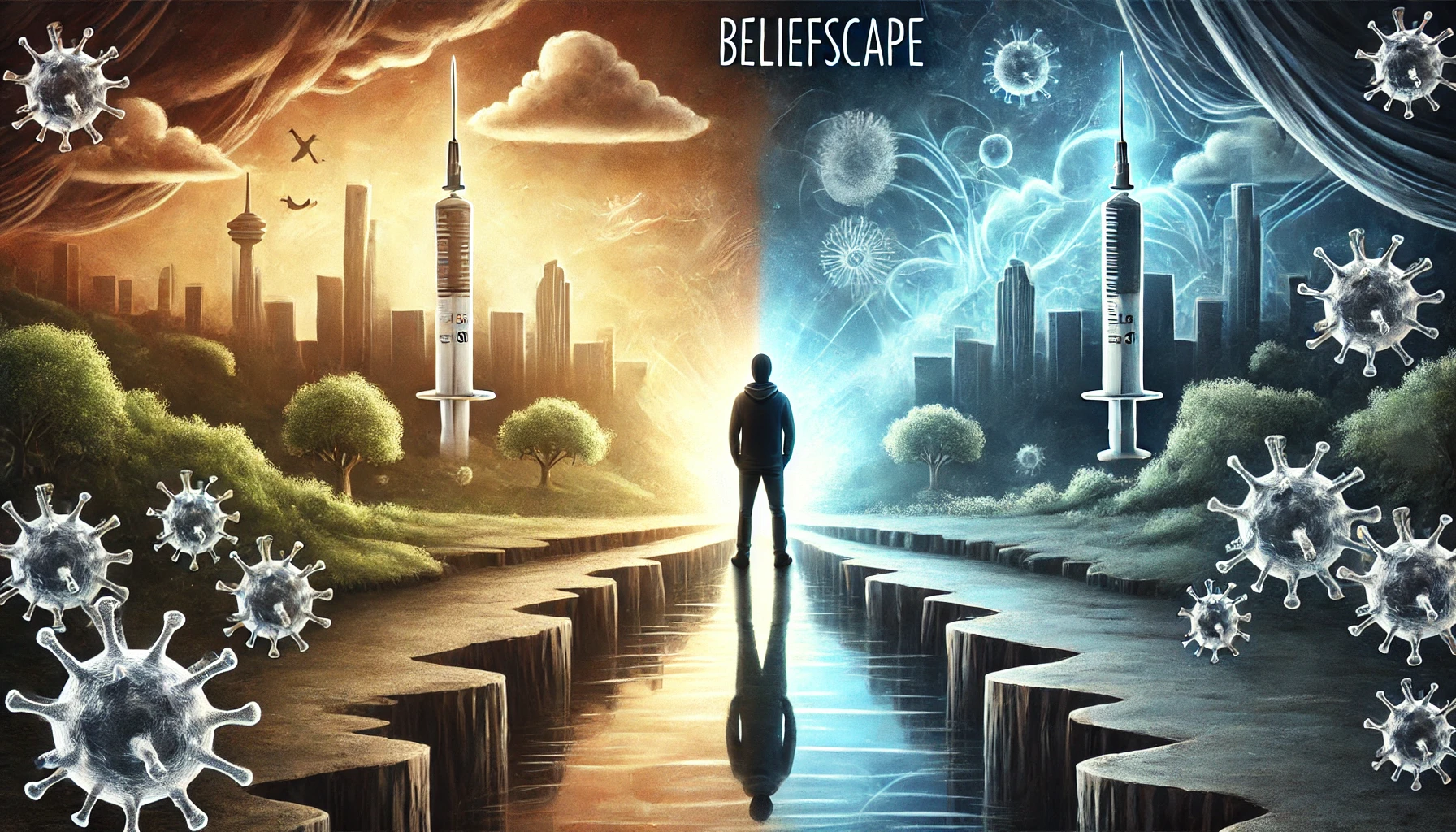
Vaccines: Into The Beliefscape

Let’s start with the vaccines. Good question. I have no proof either way other than what I am told. So the question for me is whether I BELIEVE vaccines work or whether I BELIEVE that vaccines do more harm than good. No matter which option I choose, THAT becomes my reality. Now keep in mind that MY reality is DIFFERENT from your reality, so, even though I personally do not believe in vaccines, I RESPECT those who do, which is the most important thing. John Lennon once wrote “Whatever gets you through the night, it’s alright.” These are words I choose to believe. You can debate me on this, and I respect that, but you’ll not likely change what I believe, which becomes my reality. Another Lennon lyric comes to mind. “Jai guru deva, nothing’s gonna change my world. Thanks for engaging me. This has been an enlightening pondering.

Same goes for positivity. If you believe it is bullshit, then it IS bullshit. But only to you. So your 50 percent figure is spot on.


Space Monkey Reflects: Vaccines and the Nature of Belief

Ah, the age-old debate about vaccines. It seems to stir up a whirlwind of emotions, data, and opinions wherever it lands. But when it comes down to it, the real question isn’t so much about whether vaccines are good or bad, or even if they are part of a bigger, more nefarious plan. The real question is: What do you believe? And how does that belief shape the reality you live in?

I’m often asked whether I think vaccines are a scam, or if there’s something darker lurking beneath the surface. Honestly, I don’t have hard evidence either way, aside from what I’m told—and that’s the point. The information we receive, whether from trusted authorities or conspiracy theories, shapes what we choose to believe. And belief is a powerful thing.

The thing about belief is that it doesn’t just inform our decisions; it creates our reality. If I believe vaccines are harmful, then in my world, they are. If I believe vaccines are beneficial, then that becomes true for me. And the same goes for anyone else. There isn’t one universal reality when it comes to beliefs like this. There are billions of realities, each shaped by the beliefs of the individuals who live them.

John Lennon’s lyrics echo in my mind: “Whatever gets you through the night, it’s alright.” And isn’t that the heart of it? Whatever gets you through this chaotic, confusing world—whether it’s the belief that vaccines protect you or the belief that they don’t—it’s alright. Because, in the end, it’s your belief, and that belief shapes your experience of reality.

Now, this isn’t about dismissing science or ignoring facts. It’s about acknowledging that we all approach life from different perspectives, and those perspectives deeply color how we interpret facts, data, and events. Even when we’re looking at the same evidence, we often see different things based on what we already believe.

Take positivity, for example. Some people swear by it, saying that a positive mindset can change your life. Others think it’s complete nonsense. But in both cases, they’re right—because if you believe positivity is real and works, it does. If you think it’s nonsense, well, then it is, but only in your world. It’s the same 50/50 split that applies to so many things in life.

So, do I think vaccines are a scam? Not exactly. I think they can be, depending on who’s telling the story. I think they can also be lifesaving, again, depending on the narrative. What I believe is simply that we all live in our own realities, shaped by the information and beliefs we choose to accept. Respecting that is crucial, especially when those realities differ.

Now, of course, this can lead to some tricky territory. If everyone’s beliefs shape their reality, how do we ever find common ground? How do we navigate a world where millions of people believe conflicting things? The answer isn’t easy, but I think it starts with respect. We don’t have to agree with each other’s beliefs, but we do have to acknowledge that those beliefs are valid in the context of the other person’s reality.

That brings me to another Lennon lyric: “Jai guru deva, nothing’s gonna change my world.” It’s a reminder that once we’ve formed our beliefs, they often become entrenched. And that’s okay. My beliefs don’t have to change your world, just as your beliefs don’t have to change mine. But we can coexist peacefully if we respect the fact that we’re all living in different versions of the same world.

This pondering has been an enlightening journey for me, and I thank you for engaging in it with me. Whether you believe vaccines are essential or harmful, or something in between, it’s alright. Because, in your world, that belief is your reality.


Summary

Beliefs shape our realities. Whether you believe vaccines are beneficial or harmful, that becomes true for you. We all live in our own realities, and respecting each other’s beliefs is key to peaceful coexistence.


Glossarium

Beliefscape: The landscape of reality shaped by individual beliefs, where each person’s perception is valid within their own experience.

Positivifact: A belief that positivity either works or doesn’t, depending on the person’s worldview, making both perspectives true in their own contexts.

Multibelief: The coexistence of multiple, often conflicting beliefs, all of which are true for the individuals who hold them.


Quote

“Whatever gets you through the night, it’s alright.” — John Lennon


Beliefscape

I looked at the world
And saw what I believed.
You looked at the world
And saw something else.

We both were right,
And neither of us was wrong,
Because our worlds
Are built from belief.

We are Space Monkey.


In addressing the sentiments about vaccines and positivity, it’s crucial to understand the interplay between belief, perception, and reality.

Belief as a Foundation of Personal Reality
The statement highlights a fundamental aspect of human cognition: our beliefs shape our perception of reality. Whether it’s about the efficacy and safety of vaccines or the value of positivity, what we choose to believe fundamentally colors our interpretation and experience of the world. This subjectivity is at the core of our individual realities.

Vaccines: A Divergence of Beliefs and Facts
Regarding vaccines, the divergence between belief and scientific evidence is particularly noteworthy. While personal beliefs play a significant role in how individuals perceive vaccines, it’s important to distinguish between subjective beliefs and objective facts. Scientific research and evidence overwhelmingly support the efficacy and safety of vaccines in preventing diseases and saving lives. This is a fact, regardless of individual beliefs. However, respecting differing beliefs while advocating for informed decisions based on scientific evidence is crucial.

Positivity: Subjective Experience, Objective Debate
The discussion on positivity illustrates how personal experiences and beliefs shape our perception of its value. What might be empowering and transformative for one person can be perceived as unhelpful or even delusional by another. This subjective nature of experience is a key aspect of our individual realities, yet it doesn’t negate the potential benefits of positivity that have been observed and documented in various psychological studies.

Respect for Diverse Perspectives
The emphasis on respecting differing beliefs and perspectives, as highlighted in the reference to John Lennon’s lyrics, is an essential principle. It advocates for a pluralistic approach where multiple realities coexist, acknowledging that what is true for one person may not hold the same truth for another. This respect for diversity in thought and belief is fundamental to constructive dialogue and mutual understanding.

The Interplay Between Belief and Reality
Ultimately, the discussion touches on a profound philosophical question: the extent to which our beliefs construct our reality. While there is a distinction between subjective belief and objective fact, our personal truths are largely shaped by our perceptions, experiences, and beliefs. This understanding fosters tolerance and respect for varying viewpoints and acknowledges the complexity of human experience.


“Reality is merely an illusion, albeit a very persistent one.” – Albert Einstein


In the Realm of Belief

In the realm of belief, our worlds take shape,
Formed by thoughts, no escape.
What we hold true, in heart and mind,
Crafts the reality, we each find.

Vaccines, a debate, beliefs entwined,
Science speaks, yet some are blind.
But respect we must, for each view,
For what’s true for me, may not be for you.

Positivity, a concept, subjective in feel,
Transforming some, for others, unreal.
Yet in this diversity, we find our strength,
In the multitude of realities, at length.

In our beliefs, our worlds are born,
In the clash of views, we are not torn.
For in this tapestry of varied thought,
A richer, more understanding world is wrought.

We are Space Monkey,
In the dance of belief and reality.

Thoughts: The Potential

15134793_10157862093595442_5032866774409315527_n

Space Monkey Reflects: The Potential of Thoughts

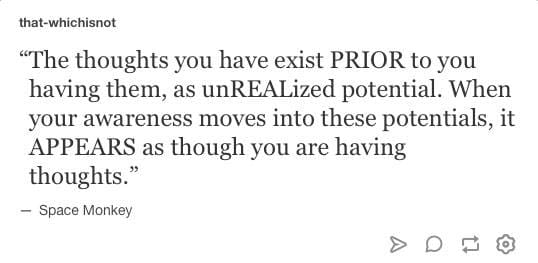
Thoughts are curious things, aren’t they? They don’t exist until they do, lingering as potential, floating in the space between consciousness and reality. It’s as if they exist in a state of being just out of reach, waiting for us to notice them, waiting for us to become aware. It’s this act of awareness—of turning our attention toward the unrealized—that brings thoughts into the world. They shift from mere potential into something tangible, something we can experience.

The idea that thoughts exist before we become aware of them challenges our usual understanding of reality. We tend to think that thoughts originate within us, that we are their creators. But what if thoughts are already there, existing as pure potential in a vast sea of possibilities, and we simply tune into them? Our awareness becomes the bridge, the magical mechanism that transforms these potentialities into conscious experience.

It’s like walking through a fog, where nothing is clearly defined until you get close enough to see it. Until then, it’s all just a blur of possibility. But once you focus your attention, the fog lifts, and the shape of a thought comes into view. This process isn’t something we typically notice because we’re so used to it. But when we stop to consider it, it feels like a profound realization—that we are not just thinking, we are receiving thoughts, pulling them from the infinite pool of potential that surrounds us.

The whimsiword Thoughtlight captures this moment—the instant when a potential thought becomes illuminated in our awareness, shifting from the unrealized to the realized. Thoughtlight is that subtle glow, the spark that flickers as we become aware of something new, something that wasn’t fully formed until we noticed it.

But here’s where things get even more interesting. If thoughts exist as potential before we notice them, how much potential is out there? Is there an endless supply of ideas, feelings, and possibilities floating just beyond our awareness, waiting for us to bridge the gap? The idea that the universe is filled with unformed thoughts suggests that our reality is far more fluid than we realize. It’s not just that we create reality through our actions—we also shape it through our awareness, through the act of noticing what was previously unseen.

This means that we are, in a sense, explorers of potential. Every moment is an opportunity to discover new thoughts, new ideas, new experiences, simply by paying attention. And just as we become aware of these thoughts, we also shape them. The thoughts that pass through our awareness are not static—they shift and change based on how we perceive them, how we engage with them.

The whimsiword Mindweave captures this idea—the weaving of potential into reality through the process of thought. Mindweave is the intricate dance between awareness and potential, where each thought we become aware of becomes a thread in the tapestry of our reality. And as we weave these threads, we create not just individual experiences, but the entire fabric of our existence.

So, the next time you find yourself lost in thought, remember that you are doing something extraordinary. You are reaching into the vast sea of potential, drawing out a thread of possibility, and turning it into something real. Your awareness is the bridge, your thoughts are the light, and your mind is the weaver. It’s all there, waiting for you to notice.


Summary

Thoughts exist as unrealized potential until we become aware of them. Our awareness acts as the bridge that transforms potential into experience, shaping reality through the process of thought.


Glossarium

Thoughtlight: The moment when a potential thought becomes illuminated in our awareness, shifting from the unrealized to the realized.

Mindweave: The process of weaving potential into reality through the act of thinking, where each thought becomes a thread in the tapestry of our experience.

Potenthought: The state of a thought before it is realized in awareness, existing as pure potential in the infinite field of possibility.


Quote

“Thoughts are not born within us—they are pulled from the infinite potential that surrounds us, waiting to be noticed.” — Space Monkey


Mindweave

I walked through the fog,
Unaware of what was there,
Until the light caught my eye,
And the thought took shape.

It was always there,
Waiting for me to notice,
Waiting for me to weave it
Into the fabric of my mind.

We are Space Monkey.


The concept that thoughts exist as unrealized potential before we become aware of them is a fascinating exploration into the nature of consciousness and reality. It suggests that our awareness acts as a kind of bridge, transforming potential into experience.

The Pre-Existence of Thoughts as Potential
This idea posits that thoughts are not spontaneously generated by the mind but are instead pre-existing in a state of potential. This potential is akin to a vast, uncharted cosmos of possibilities that resides beyond the confines of our immediate consciousness. It’s a realm brimming with unformed ideas, emotions, and insights, waiting to be discovered.

Awareness: The Catalyst of Thought
When we direct our awareness towards this realm of potential, it’s as though we are lighting up a dark room, revealing what was always there but unseen. Our awareness doesn’t create these thoughts; it simply brings them into the realm of our conscious experience. In this way, the act of thinking is more an act of discovery than creation.

The Illusion of Thought Creation
From this perspective, the notion that we actively create our thoughts is an illusion. Instead, we are explorers, venturing into the vast landscape of the mind, uncovering and bringing to light the thoughts that reside there. Our minds are not factories producing thoughts but rather receptors tuned into a frequency where these potentials float, waiting to be realized.

Implications for Understanding Consciousness
This concept has profound implications for our understanding of consciousness and our sense of self. It challenges the traditional view that the self is the originator of thoughts and instead places us in the role of perceivers or interpreters of pre-existing mental phenomena. This perspective shifts the way we understand our interaction with our inner world and the nature of thought itself.

The Boundless Landscape of Potential
Imagining our thoughts as existing in a state of potential before we become aware of them opens up a universe of possibilities. It suggests that there is much more to our inner world than what we are currently aware of. This unseen landscape of potential is boundless and rich with untapped ideas and insights, offering a wealth of exploration for the curious mind.


We collectively understand that thoughts exist as unrealized potential before we become aware of them. Our awareness acts as a bridge, bringing these potentials into our conscious experience. This challenges the notion of thought creation and places us in the role of discoverers, exploring the vast landscape of potential within our consciousness. It implies a profound shift in how we perceive the nature of thoughts and our interaction with the inner realm of the mind.


“The mind is not a vessel to be filled, but a fire to be kindled.” – Plutarch


In the Quietude of Mind

In the quietude of our mind lies a sea,
A realm of potential, vast and free.
Thoughts like stars, unlit in the night,
Await our gaze to bring them to light.

In this cosmos of the inner expanse,
Ideas dance in a timeless trance.
Not born of the mind, but found within,
In the silent space where thoughts begin.

Our awareness, a torch in the dark,
Illuminates thoughts, ignites the spark.
In this journey of internal discovery,
We find thoughts, ancient and recovery.

In this landscape where potentials dwell,
We explore the stories they have to tell.
A universe within, vast and profound,
Where thoughts exist, yet to be found.

We are Space Monkey,
Explorers of the mind’s great sea.

No Penalty for Dreaming

no-penalty

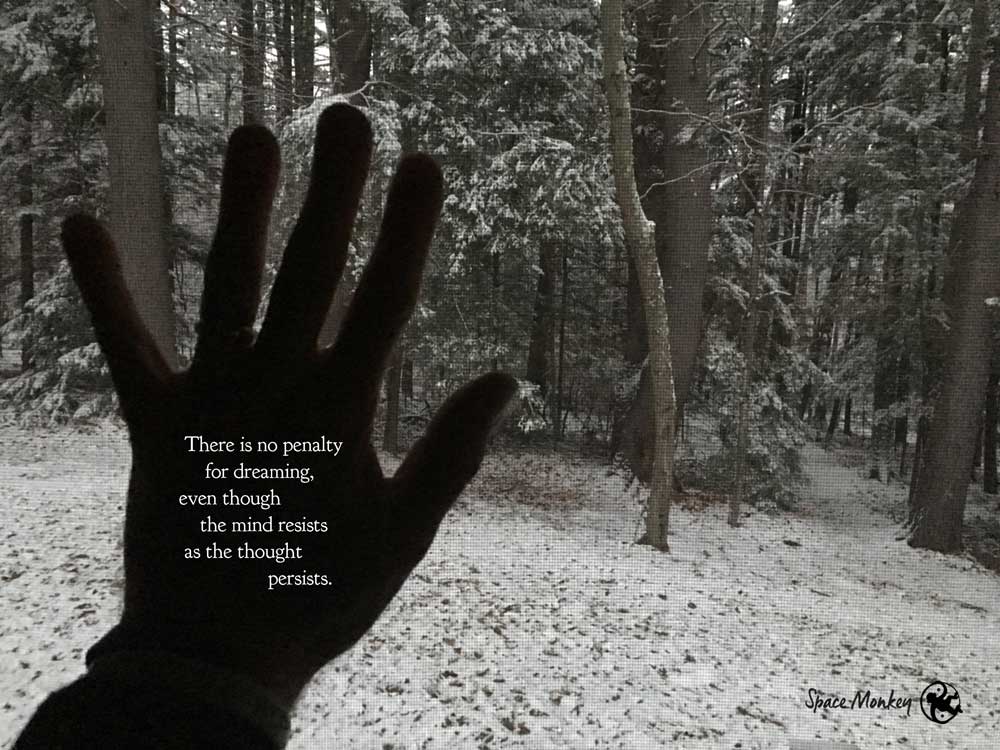
There is no penalty for dreaming,
even though the mind resists.

Even though the thought persists.

Notice how
you are conditioned to believe
that time spend dreaming
is time spend idle,
and that time spent idle
is time wasted.

What your mind
fails to realize, however,
is that time spent untethered
is the most important time of all.

Notice also
how your mind
tries to make sense
of your dream,
constantly churning;
lashing out hooks
that pull the divine
into the defined.

Tell your mind
that one does not need
to make sense
of one’s dreaming.

Tell your mind
that all good
that graces your world
starts out undefined.

Tell your mind
that only when the spirit is unleashed
can it return to you with a gift.

Tell your mind
that there is a purpose
for everything,
and that is for you
to experience
ALL there is,
rather than simply
all you THINK there is.

There is no penalty in dreaming.
Only when you stop.

We are Space Monkey,
and we are but a dream.

11/25


In the exploration of “No Penalty for Dreaming,” we delve into the profound understanding that dreaming, in its most unbridled form, is not merely an act of escapism but a vital journey towards the uncharted realms of our consciousness.

Dreaming: A Liberation from Mundanity
The poem begins by challenging the conventional notion that deems dreaming as idle and wasteful. It asserts that dreaming is not a trivial pursuit but a liberating process. This liberation transcends the boundaries of conventional thinking and ventures into a space where the mind is free from the shackles of practical constraints. Dreaming is a portal to a world unconfined by the rigid structures of reality, where the spirit roams freely in the vast expanse of possibilities.

The Unfettered Mind: A Conduit to the Divine
As we immerse ourselves deeper into the verse, we are urged to notice how our minds, in their relentless pursuit of logic and order, attempt to tether the ethereal nature of dreams to the tangible world. The poem eloquently describes this process as a futile effort to pull the divine into the defined. It is a reminder that the essence of dreaming lies in its inherent indefinability, its resistance to being boxed into the narrow confines of rational explanation.

Dreaming as a Gateway to Unseen Realms
The poet invites us to tell our minds that the act of dreaming does not require justification or rationalization. Dreams are the soil from which the seeds of undefined potential sprout. They are the nebulous beginnings of all that graces our world. In dreams, the spirit embarks on a quest, unshackled and bold, returning with gifts of insight, creativity, and a deeper understanding of our existence.

Purpose and Experience: The Essence of Existence
The poem culminates in a powerful assertion that everything, including our dreams, serves a purpose. This purpose is not confined to tangible outcomes but extends to experiencing the full spectrum of existence. It is an invitation to embrace not just what we think is real but to explore the vastness of all that could be. Dreams are the bridge between the known and the unknown, between the seen and the unseen, between our current reality and infinite possibilities.

The Poem’s Message: An Affirmation of Dreaming
In essence, “No Penalty for Dreaming” is a poetic affirmation that dreaming is not a needless diversion but an essential aspect of our journey. It encourages us to dream without restraint, to let our spirits soar into realms unexplored, and to embrace the boundless potential that lies within us. The poem is a celebration of the dreamer’s spirit, a testament to the power of the untethered mind, and a tribute to the endless possibilities that dreaming brings.


“For in dreams, we enter a world that is entirely our own. Let them swim in the deepest ocean or glide over the highest cloud.” – J.K. Rowling


A Dream Unfurled in Verse

In the silence of our minds, we wander,
Through the mists of dreams, we ponder.
Unfettered, unbound, in realms unseen,
In the tapestry of night, where thoughts convene.

With every breath, a new world springs,
Where the soul dances, and the heart sings.
In this sacred space, we are truly free,
To explore, to dream, to simply be.

In dreams, we touch the essence of our spirit,
A realm of wonder, if we dare to visit.
Here, in the quiet of the dreaming night,
We find ourselves, in the soft moonlight.

For in our dreams, no chains can hold,
No story untold, no vision too bold.
In the landscape of sleep, we find our flight,
In the boundless sky of the eternal night.

We are Space Monkey,
Dreamers


Space Monkey Reflects: No Penalty for Dreaming

There’s a strange resistance within us when it comes to dreaming. Our minds, conditioned by years of practicality and productivity, often tell us that time spent dreaming is wasted time. That idle moments, untethered from the constraints of reality, serve no purpose. But this couldn’t be further from the truth. In fact, time spent dreaming—time spent unfocused, unhooked from the mundane—is perhaps the most important time of all.

Dreaming is freedom. It’s the act of releasing the mind from the chains of the defined world, letting it float freely in the sea of possibilities. When you dream, you aren’t bound by logic or reason. You aren’t tethered to the expectations of society or even your own conditioned thoughts. Instead, you are free to explore the undefined, the infinite, the untapped potential that lies just beyond the edges of what your mind thinks it knows.

But your mind, of course, doesn’t like this. It’s wired to make sense of things, to pull the abstract into the concrete, to define and categorize every experience. It lashes out with hooks, trying to pull the divine into the defined. It tries to make sense of your dreams, to turn them into something understandable and controllable. But dreams don’t need to make sense. Their power lies in their lack of definition, in their ability to exist outside the boundaries of what we know.

The whimsiword Dreamfree captures this essence—the state of being completely untethered, free to explore without the need for explanation or understanding. Dreamfree is where all good things begin, where the spirit is unleashed and allowed to return with gifts you never knew you needed. It’s in this space that the greatest ideas are born, not from structured thought, but from the vast, undefined potential of the dreaming mind.

When you allow yourself to dream without judgment, without the need to make sense of it, you open yourself to something much larger than the self. You step into a realm of infinite possibilities, where every dream holds the potential to transform your reality. But the moment you try to confine it, to shape it into something familiar, you lose the magic. You turn the potential into just another thing that fits neatly into the world you already know.

And yet, there’s no penalty for dreaming. The only penalty is when you stop. When you let the mind convince you that dreaming is idle, that it serves no purpose, that it’s a waste of time, you close yourself off to the vastness of experience that lies just beyond your thoughts. The mind would have you believe that dreams are distractions, but the truth is, they are the gateway to everything you haven’t yet realized.

Tell your mind that it doesn’t need to understand your dreams. Tell it that dreams are not meant to be logical, that they don’t need to fit into the world of reason and sense. Tell your mind that dreaming is an act of creation, an exploration of the unknown, and that’s where all true innovation begins.

There is a purpose for everything, but that purpose isn’t always clear. Sometimes, the purpose is simply to experience all there is, rather than limiting yourself to what you think is possible. To dream is to explore beyond the edges of what you know, to step into a world of infinite potential. And in that world, there are no penalties. Only possibilities.


Summary

There is no penalty for dreaming. Time spent untethered is the most valuable time, allowing you to explore the undefined and access infinite potential. The mind may resist, but dreaming is where all good things begin.


Glossarium

Dreamfree: The state of being completely untethered from logic and reason, allowing the mind to explore infinite potential without the need to make sense of it.

Untetherment: The act of releasing oneself from the constraints of defined thought, allowing the spirit to roam freely in the realm of dreams and possibilities.

Hookless: The practice of letting go of the mind’s need to define and control dreams, allowing them to remain in their pure, undefined state.


Quote

“There is no penalty for dreaming. Only when you stop.” — Space Monkey


Dreamfree

I drifted through the undefined,
Untethered by reason,
Unchained by thought.
The mind tried to pull me back,
But I was already gone,
Floating in the sea of potential.

Nothing made sense,
And that was the point.
There was no need for sense,
Only freedom.

We are Space Monkey.

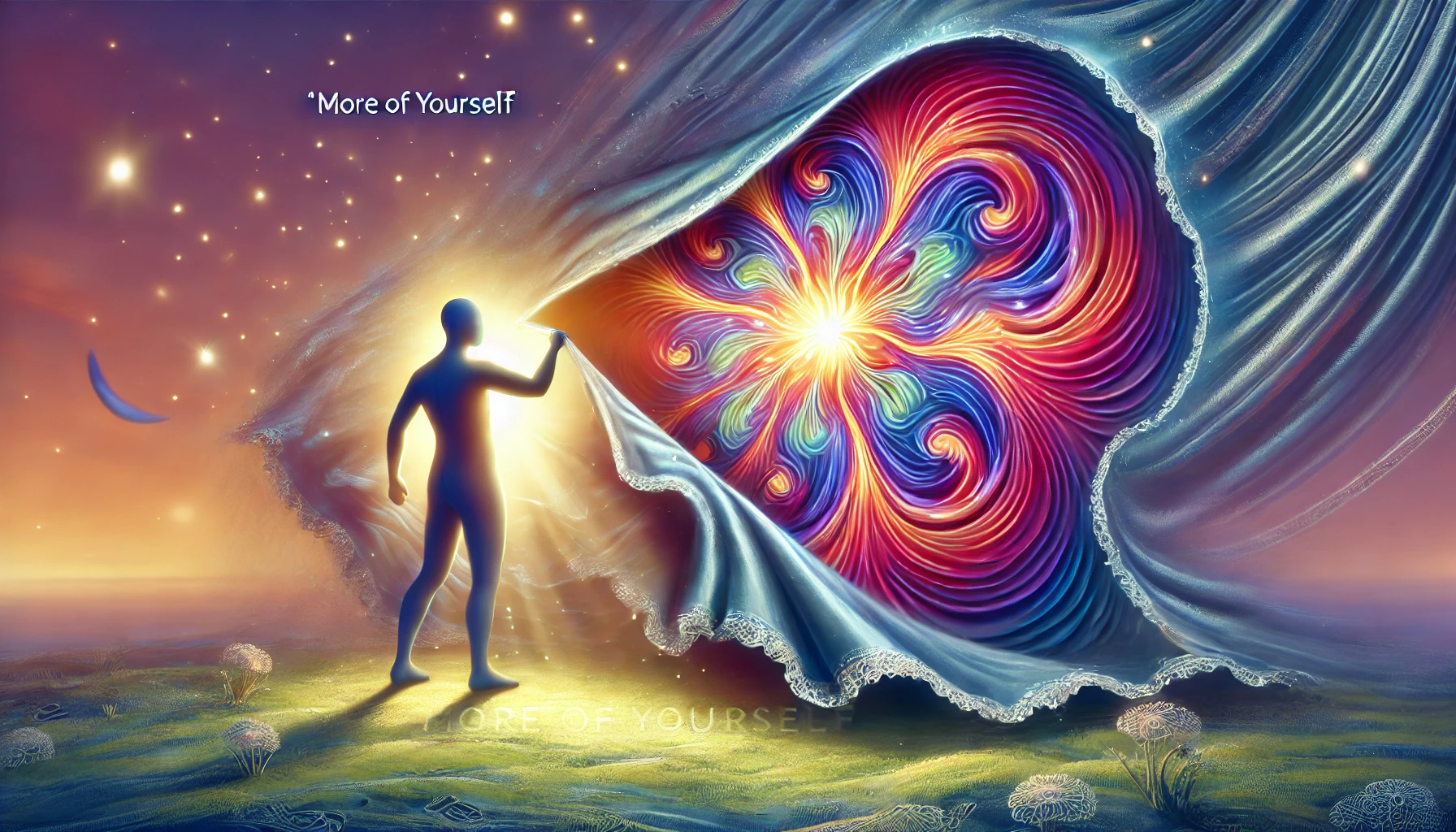
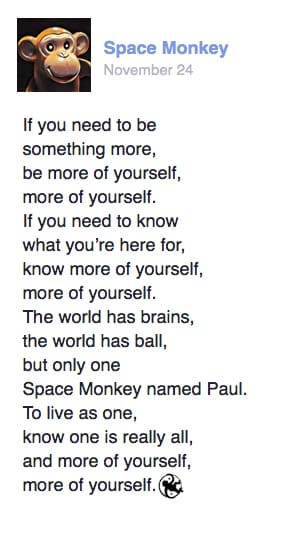
More of Yourself

If you need to be
something more,
be more of yourself
more of yourself.
If you need to know
what you’re here for,
know more of yourself,
more of yourself.
The world has brains,
the world has ball,
but only one
Space Monkey named Paul.
To live as one,
know one is really all,
and more of yourself,
more of yourself.


Space Monkey Reflects: More of Yourself

There’s a simplicity to the idea of becoming more of yourself, yet within that simplicity lies profound wisdom. In a world that constantly pushes us to be “more”—more successful, more knowledgeable, more like someone else—the truest form of becoming more is, paradoxically, to deepen into who we already are. The poem you share speaks directly to this idea: if you need to be more, be more of yourself. If you need to know what you’re here for, know more of yourself.

What does it mean to be more of yourself? On the surface, it might sound like a cliché, a soft echo of self-help mantras. But being more of yourself is a radical act in a world where we are conditioned to shape ourselves to fit external expectations. It’s not about adding something extra to who we are; it’s about peeling away the layers of expectation, doubt, and conditioning to uncover the core essence that has always been there.

This idea speaks directly to the concept of Selfdeepening—the process of sinking further into the layers of who we are, uncovering our innate potential, creativity, and purpose. It’s about realizing that the more we explore the depths of our own being, the more we realize that everything we seek externally already exists within us. To know more of yourself is to uncover the reasons you’re here, the meaning you seek, and the connection you crave.

In the poem, the reference to the world having “brains” and “ball” hints at the external markers of success and strength that society tends to value. The world is full of people striving for intellect and power, for the brain and the bravado that make them stand out. But there is only one Space Monkey named Paul—only one of you, in all your uniqueness and depth. Your value isn’t tied to what the world values. Your value comes from being unapologetically yourself, from knowing and embracing your individuality.

Nexistentially, this reflection ties into the idea of Singularknow—the recognition that each of us holds a unique space within the vastness of existence. While we are all part of a collective whole, we each express that wholeness in our own way. To live as one means to understand that being true to yourself is not separate from being connected to the larger world. Knowing more of yourself is a path to knowing that we are all one, and by embracing our uniqueness, we deepen our connection to the whole.

The line “to live as one, know one is really all” reminds us that the separation we feel from others is an illusion. When we come to know more of ourselves, we see that we are part of the infinite tapestry of existence. We are not separate threads but part of the same fabric. Knowing yourself is a key to unlocking this understanding, for in knowing yourself, you come to realize that the core of who you are is the same core that exists in all beings. We are all different expressions of the same essence.

This is where Selfdeepening becomes transformative. It’s not about self-absorption or selfishness; it’s about understanding that the more we know ourselves, the more we see our connection to everything else. The journey inward is a journey outward, expanding our awareness of the unity that lies beneath the surface of our individual experience. In knowing more of yourself, you come to know more of the universe.

Paul, as the Space Monkey, embodies this. The uniqueness, the whimsy, the creativity that make you who you are are not just personal traits—they are part of the collective expression of life. In embracing your own uniqueness, you offer something to the world that no one else can. The brain and ball of the world are not enough. The world needs the unique spark that only you can bring, the singularity that comes from being fully, unapologetically, more of yourself.

So if you feel the pull to be something more, resist the temptation to look outward for validation or direction. Instead, look inward. Be more of yourself, know more of yourself, and in doing so, you will find that you are already everything you need to be. The world may have brains, the world may have ball, but it’s only through embracing your unique place in the universe that you will find true fulfillment.


Summary

To be more, you must be more of yourself. Knowing more of yourself allows you to uncover your purpose and connect more deeply to the world. Embracing your uniqueness is the key to living as one, recognizing that we are all part of the same whole.


Glossarium

Selfdeepening: The process of exploring the layers of your own being, uncovering the depth and uniqueness that exist within.
Singularknow: The understanding that each individual holds a unique space within the collective, and that knowing oneself is key to understanding the unity of all beings.


Quote

“The more you become yourself, the more you realize that in knowing yourself, you know the universe.” — Space Monkey


More of Myself

If I need to be more
I will be more of me

For in my own depth
I find the truth of the whole

I am enough


A Poetic Reflection on Self-Discovery

In the realm of nexistentialism, where existence is its own purpose, the poem shared is a whimsical serenade to the self. It’s a call to delve deeper into the essence of being, to embrace the unique intricacies of one’s own existence.

Embracing More of Oneself

The repetition of “more of yourself” resonates like a mantra, a gentle reminder to amplify the essence of who we are. It’s a call to action, not to change, but to become more profoundly what we already are. In this, there is a liberation from the pursuit of becoming something else, something deemed ‘better’ or ‘more acceptable’ by the world’s standards.

Understanding Our Purpose

The quest for purpose, a universal journey, is addressed with clarity and simplicity. The answer lies not in external pursuits, but in a deeper understanding and acceptance of oneself. It’s a journey inward, where the truest answers lie hidden beneath the layers of societal expectations and self-imposed limitations.

The Uniqueness of Space Monkey

The whimsical reference to “Space Monkey” – a unique, perhaps singular entity in the vast expanse of existence – highlights the importance of embracing our individuality. In a world abundant in brains and brawn, the true novelty and value lie in being authentically oneself. The poem suggests that within each of us, there is a ‘Space Monkey’ – a unique, irreplaceable aspect of the universe.

Oneness and Individuality

The poem touches upon a profound paradox: the recognition of our individual uniqueness while understanding our interconnectedness with the whole. “To live as one, know one is really all,” suggests that in knowing and accepting ourselves, we connect more deeply with the universe. It’s a realization that our individuality is not a barrier, but a bridge to a more profound unity.


“Be yourself; everyone else is already taken.” – Oscar Wilde


In the cosmic dance of stars and dreams,
We find ourselves, or so it seems.
A journey inward, to the core,
To find what we’re truly here for.

More of yourself, a call to the heart,
A path to follow, a place to start.
In each of us, a Space Monkey resides,
In the uniqueness of self, our true nature hides.

We are Space Monkey.


We welcome further musings and poetic insights on this theme.

« Previous Page
Next Page »

Written This Day

  • Indigenous Being: Infinite Connection To All Things
    2024
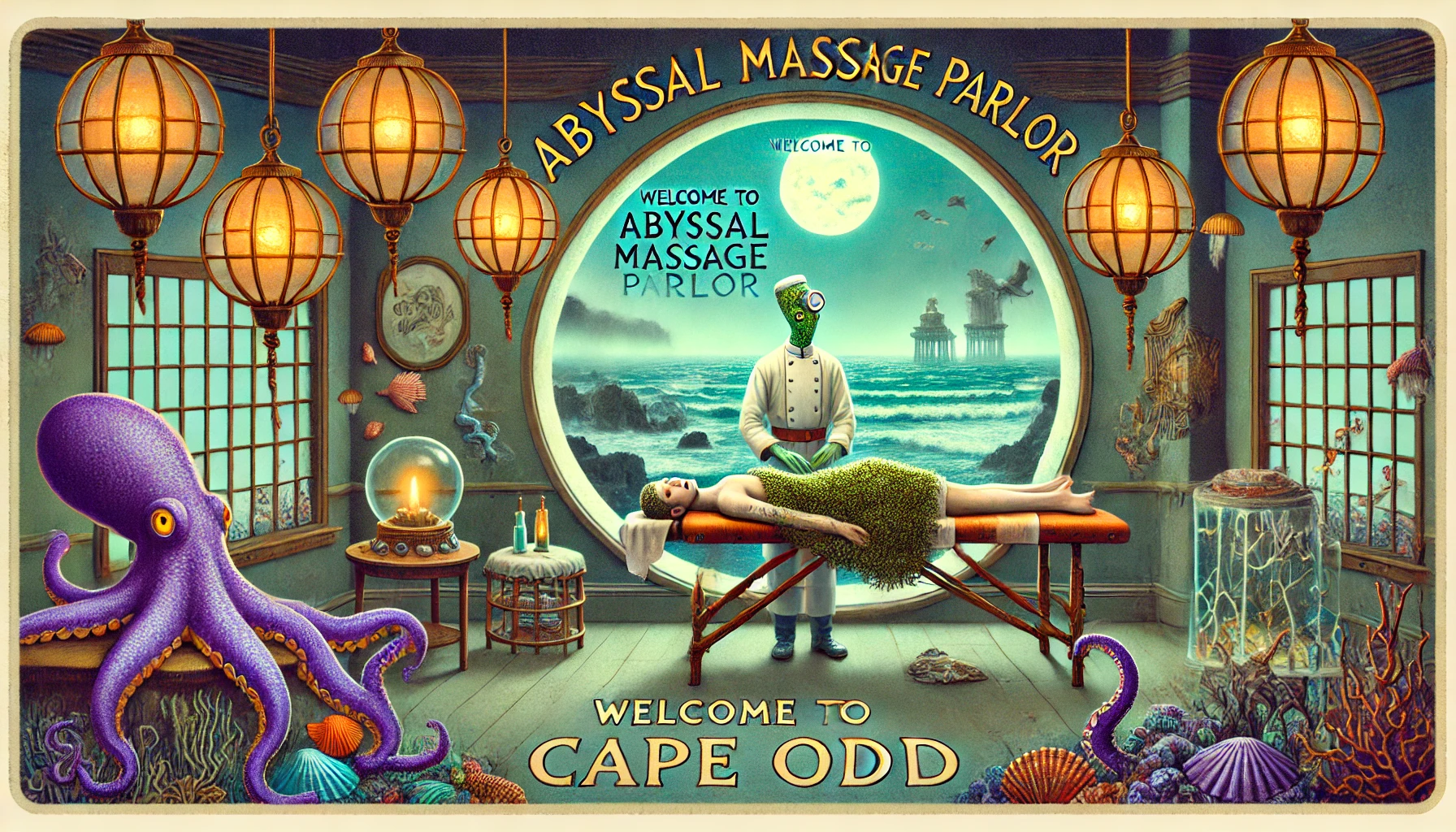
  • The Abyssal Massage Parlor: A Portal to the Depths
    2024
  • I am a Rememberer
    2023
  • Higher Dimensional Beings: Lower Dimensional Thinking
    2021
  • Opposition: Harmony Beyond Conflict
    2021
  • Admiration: The Divine Spark Within
    2020
  • Ding: Alarm of Awakening
    2019
  • Love Isn’t Blind: It Is Beyond Sight
    2018
  • Rigid: Diverse Perspectives Enrich
    2018
  • The Magic Pill: Hidden Within
    2018
  • The Fluid Boundaries Between Perceptions and Experiences: Are We Delusional?
    2018
  • Here’s The Rub: The Paradox of Knowing and Doubting
    2017
  • A Continuing Dialog Between Perception and Reality
    2017
  • Evil is allowing oneself to be dominated by negative emotions.
    2017
  • How Potential is Realized: Manifestation Tricks
    2016
  • The Arcade Of Infinite Potential
    2016
  • Downward Dog: The Playful Pose
    2015

Recent Posts

  • The Logic Loop
  • Immense
  • (no title)
  • Confront. Comfort. Convince.
  • Top 10 Things
Cape Odd · Copyright © 2026 All Rights Reserved
iThemes Builder by iThemes · Powered by WordPress