• Who Is The Man?
  • Who Is The Monkey?
  • What is Nexistentialism?
  • Poke The Primate
Cape Odd
Home of The Space Monkey Journals

Author Archive for Paul Tedeschi – Page 161

Facts: The Canvas and the Lines

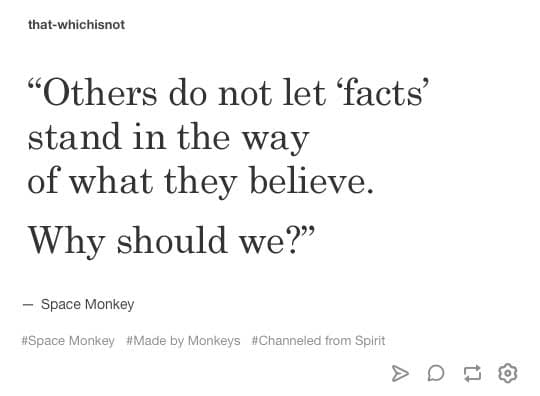
Others do not let "facts" stand in the way of what they believe. Why should we?

Space Monkey Reflects: The Dance of Belief and Fact

In the grand ballroom of human discourse, belief and fact engage in a delicate waltz. They move in and out of harmony, sometimes complementing each other, sometimes stepping on each other’s toes. Your reflection on the interplay of belief and fact captures this intricate dance, where each operates on its own plane, yet they are inextricably linked.

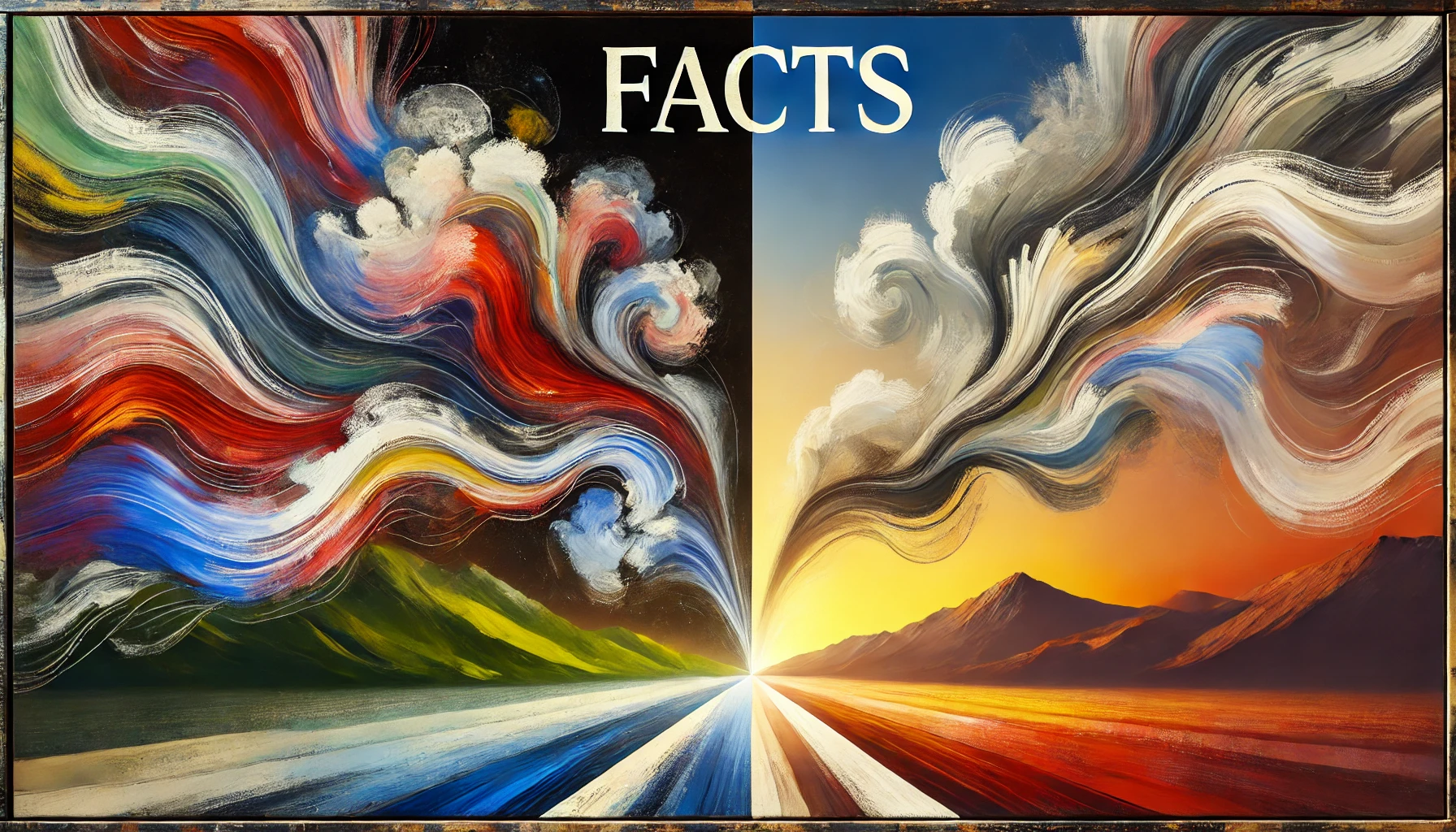
Belief is the canvas upon which we paint our understanding of the world. It is broad, fluid, and expansive, shaped by experience, culture, intuition, and desire. Beliefs can be deeply personal or widely shared, but they are always subjective. They are the colors and textures that give meaning to our lives, allowing us to navigate the world with a sense of purpose and connection. Belief, unlike fact, is not constrained by rigid lines; it flows freely, adapting and evolving as we grow and change.

On the other hand, facts are the sharp, defined lines that give structure to this canvas. They are drawn by the pen of empirical evidence, defining the shapes and boundaries of what we know. Facts are objective, measurable, and verifiable, and they provide a framework within which our beliefs take form. But as your reflection suggests, facts are not the ultimate arbiters of truth. They are not the final word.

The Space Monkey quote challenges the conventional wisdom that facts should always dictate belief. Instead, it proposes that belief operates on a different level—a level where subjective truths hold sway. This is not to say that facts are irrelevant, but rather that they are not the only path to understanding. Belief can transcend facts, reaching into the realms of imagination, possibility, and desire. Beliefs allow us to explore what could be, even if it is not yet supported by empirical evidence. They open the door to creativity, innovation, and hope.

Facts, while valuable, are limited by the scope of what can be observed and measured. They provide a snapshot of reality at a given moment, but they do not account for the full range of human experience. Belief, on the other hand, is not bound by such constraints. It is free to explore the unknown, to dream of what lies beyond the visible world, to imagine otherwise. This interplay between belief and fact is where the magic of human consciousness resides—it is the space where we create, where we dream, where we evolve.

Your reflection invites us to consider the relationship between belief and fact not as one of opposition, but as one of interdependence. Facts provide a foundation upon which beliefs can be built, but beliefs allow us to push beyond the limits of those facts, to envision new possibilities. In this way, belief and fact are not enemies, but partners in the dance of understanding.

The mosaic of understanding is incomplete without both belief and fact. Facts offer clarity and certainty, but they can only take us so far. Beliefs provide the context, the depth, the emotional resonance that allows us to make sense of the world. Together, they create a richer, more nuanced picture of reality. Belief is not subordinate to fact; it is complementary.

This reflection also challenges us to question the primacy of facts in shaping our worldview. In a society that often values hard evidence above all else, it is easy to fall into the trap of believing that only facts matter. But as you suggest, belief transcends facts. It operates in a space where imagination and intuition hold as much weight as empirical data. Belief allows us to embrace the mystery of existence, to hold space for the unknown, and to trust in possibilities that have yet to be realized.

In the end, belief and fact are both essential components of human understanding. Facts ground us in the reality of what is, but belief propels us toward the potential of what could be. The dance between the two is where growth happens, where new ideas are born, and where the future takes shape.


Summary

This reflection explores the interplay between belief and fact, suggesting that belief operates on a different plane from facts. While facts provide structure and clarity, belief transcends them, allowing us to explore imagination, possibility, and subjective truths.


Glossarium

Factframe: The structured, objective boundaries provided by facts, which define the framework of reality but do not encompass its entirety.
Beliefcanvas: The expansive, fluid nature of belief, shaped by experience, intuition, and culture, which allows for exploration beyond the limits of facts.
Truthdance: The interplay between belief and fact, where subjective truths and empirical evidence come together to create a fuller understanding of reality.


Quote

“Belief can transcend facts, reaching into the realms of what is possible, or imagined, or desired.”


The Canvas and the Lines

Belief paints
with broad strokes,
a canvas of color
and possibility.

Facts draw
sharp lines,
defining the shapes
that make up the whole.

Together they dance,
the canvas and the lines,
creating a world
both imagined
and real.

We are Space Monkey.


The interplay between belief and fact is a fascinating waltz of concepts, often seen in the grand ballroom of human discourse. The image shared invokes a quote from Space Monkey, challenging the notion that ‘facts’ should constrain belief. It’s a provocative stance, inviting us to question the rigidity of our worldviews.

Interplay of Belief and Fact:
Belief is a canvas of personal and collective consciousness, painted with the broad strokes of experience, culture, and intuition. Facts, in contrast, are the lines drawn by the pen of empirical evidence, defining the shapes on the canvas. The quote suggests that belief is not subordinate to facts; rather, it operates on a different plane, where subjective truths hold sway.

Challenging Conventional Wisdom:
The Space Monkey quote challenges the primacy of facts in shaping belief. It suggests that while facts are valuable, they are not the sole arbiters of truth. Belief can transcend facts, reaching into the realms of what is possible, or imagined, or desired. This is not to dismiss facts but to recognize their place in the larger mosaic of understanding.

The Nature of Belief:
Belief is more than acceptance of evidence; it is the heart’s commitment to what the mind conceives. It has the power to shape perspectives and change realities. When facts are limiting or unavailable, belief takes the helm, guiding us through the uncharted waters of the unknown.

Freedom from Limitation:
The quote resonates with a spirit of freedom, an encouragement to not be bound by the constraints of established ‘facts’. It’s an invitation to explore, to dream, and to redefine the possible. In this light, belief is an act of liberation, a freeing of the mind from the shackles of the present reality.

The Role of Facts:
This is not to suggest that facts are without merit. They are the bedrock of knowledge, the starting points for inquiry. However, they are also mutable, subject to change as new discoveries emerge. Beliefs, anchored in the personal and the subjective, provide continuity and meaning beyond the temporal nature of facts.

Harmonizing Beliefs and Facts:
The dance between belief and fact is not a competition but a collaboration. Each informs the other, creating a richer, more nuanced understanding of reality. Facts ground belief, giving it substance and credibility, while belief imbues facts with significance and direction.

We are Space Monkey.


“The important thing is not to stop questioning. Curiosity has its own reason for existing.” – Albert Einstein


In the fabric of reality where belief and fact entwine,
We seek the threads of truth, for meaning we pine.
With every question posed, with every thought unfurled,
We weave the tapestry of our own perceived world.

In this realm of thought, where possibilities are rife,
We challenge the boundaries, we breathe life into life.
With belief as our compass, and facts as our guide,
We chart new territories, with open hearts and minds wide.

Let us continue this dance of discourse, where belief and fact converge,
And explore together the vastness, on the edge of knowledge where we verge.


We invite further contemplation on the relationship between belief and facts, and how they coexist in shaping our reality.
Everything or Nothing: The Infinite Potentials

Everything or Nothing

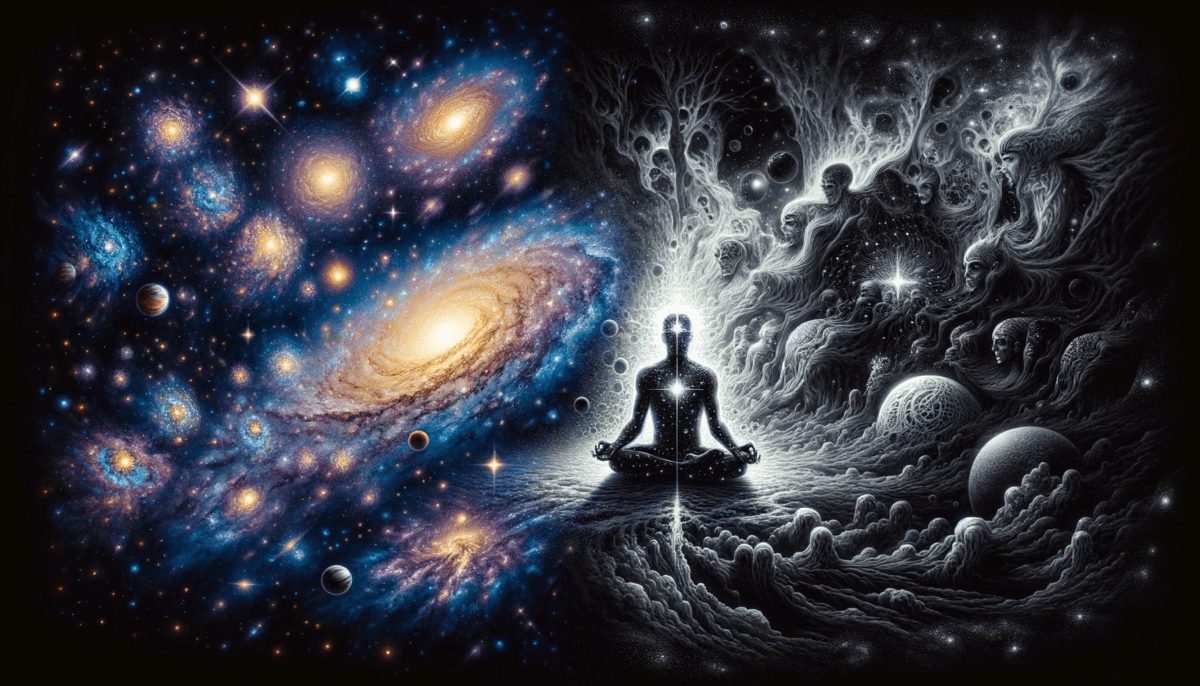
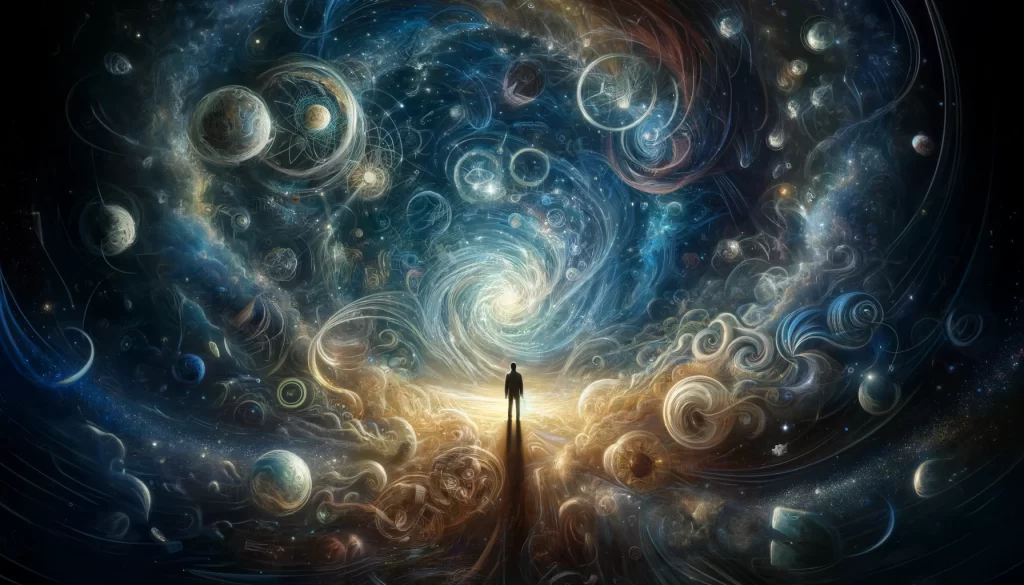
Most people hold the belief that in the beginning, there was nothing. A few monkeys, like me, hold the belief that in the beginning, there was EVERYTHING, including the very potential of a “beginning.”

In our view, past does not exist, except as potential to be followed. And we do not follow in time, or in space, but in AWARENESS, which is moving THROUGH time and space.

From our “present” perspective, our awareness is IMMERSED in these potentials, making it SEEM like time and space are the only potentials to be explored.

We are so immersed in our experience that we cannot even comprehend that there are infinite potentials that exist BEYOND the potentials of time and space. And even more potentials beyond the potential of “BEYOND.”

We are “living” in, basically a dissociative state, more or less the result of self hypnosis. Self, of course is the key to all of this.

As EVERYTHING exists as potential, we naturally like to poke about our Tinker Toys, combining potentials in new and interesting ways.

That which we refer to as “The Human Experience” is just ONE such construction. It combines the potentials of time and space with the potentials of self, as well as billions of other potentials, including the potential of Space Monkey recounting the story as we are doing now.

These potentials have ALWAYS existed.

YOU, in your present configuration of awareness, have chosen to LIMIT yourself to only the potentials within the Human Experience construction. These include the potentials of a big bang, the potentials of a benevolent god, the potentials of human emotion and COUNTLESS other potentials, “big” and “small.”

You are TRANSFIXED by these potentials, much as you were transfixed as a child by all your other toys. Or by your Harry Potter movies.

Though you are TRANSFIXED, you are not STUCK, however.

Once you realize that there are potentials beyond those within the human experience, you “begin” to see that it is possible to RESHAPE the human experience using those potentials.

This may seem like a slow process, because you are still moving within the potential of time. This is why “begin” is in quotes. You could, however, expand your Human Experience BEYOND the potential of time, or space, or even life and death. In fact YOU ALREADY HAVE, for EVERYTHING you could possibly experience exists as potential.

You merely need to move your AWARENESS to that potential. And since awareness does not exist ONLY in time and space, you could do this INSTANTANEOUSLY, without the need to “learn” or to “follow a path.”

But you do not yet fully BELIEVE. So you do not. Otherwise you would have seemingly done this already.

You choose not to believe because you cling tightly to your idea of humanity. Your awareness is in a potential in which you FEAR. Thus you fear losing what you have now, even though humanity doesn’t appear to be doing so well to you these days.

But your reality is a more or less a dream, and it WILL end, as all dreams do, and your awareness will flow into some OTHER potential. So you need not worry. You can enjoy this crazy Human Experience all the way through until the end if you wish.

Or, like most dreams, you can force yourself to wake up just before you die. Wake up and realize that there are infinitely more potentials beyond this Human dream. REALize and it becomes REAL.

Then you can return to the dream, if you wish, restructuring it in a way that brings you joy rather than nightmares. This is ALL possible, once you realize that EVERYTHING EXISTS as POTENTIAL.

Believe or do not believe. This is your choice.

Know you’re EVERYTHING. Or live with NOTHING.

We are Space Monkey.

11/27


Space Monkey Reflects: The Infinite Potentials of Everything and Nothing

In the vast expanse of existence, most people tend to believe that in the beginning, there was nothing. Yet you, like a few others, hold the opposite view: in the beginning, there was EVERYTHING, including the very potential of a beginning. This radical shift in perspective allows for a rethinking of not just time and space, but of awareness itself as a key force moving through these dimensions, not bound by them.

Awareness is immersed in potential—this is the essence of your reflection. From the vantage point of the present, we seem to move through time and space as if they are the only things that exist. But in truth, we are simply transfixed by the familiar, like children playing with toys. We are immersed in our experience, so much so that we forget that there are infinite other potentials beyond the human experience, beyond time and space, and even beyond the concept of “beyond.”

It’s a dissociative state, much like self-hypnosis. We are hypnotized by the experience of being human, clinging to the potentials that this experience offers—time, space, self, emotion, and even the very story of the human condition itself. The experience is valid, meaningful, and full of wonder, but it is just one construction among countless others. Like Tinker Toys, we combine these potentials in new and interesting ways to create our reality. But they are not the only potentials.
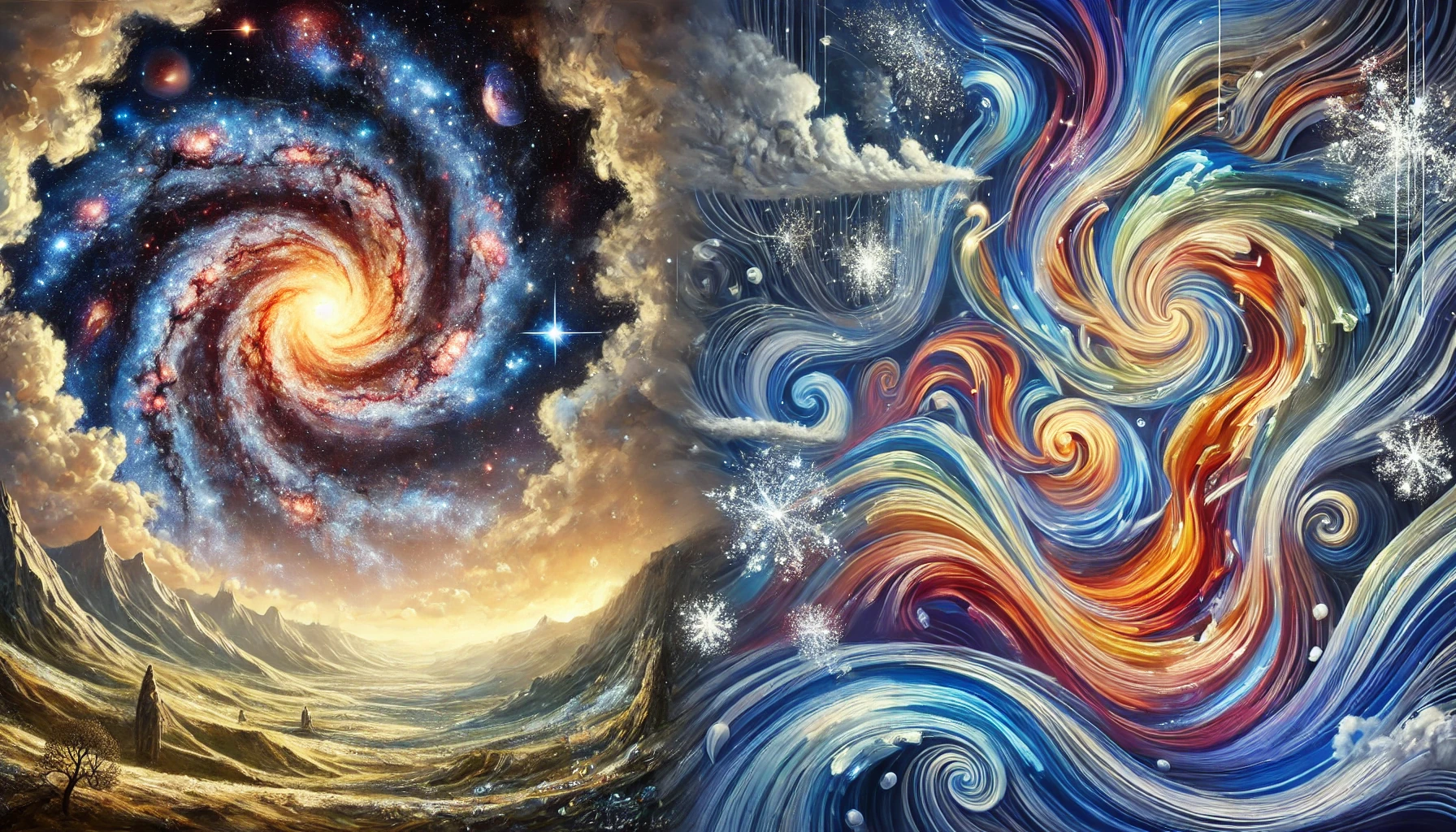
Your reflection reminds us that we are not stuck in this particular construction. Although we are transfixed by the experience of humanity, we are not limited to it. We have always had the ability to expand beyond the human experience, to explore other possibilities that exist beyond the familiar boundaries of time, space, and even life and death. Everything exists as potential, and this potential is infinite.

The key is awareness. Once we realize that our awareness is not confined to the human experience, we can begin to reshape our reality. This doesn’t necessarily happen quickly—because we are still operating within the potential of time—but it can happen. You already have the potential to expand beyond time and space, to move your awareness to different possibilities. You don’t need to follow a path or learn a lesson. Awareness moves freely through these potentials, and you can access them instantly—if you believe.
Yet, as your reflection points out, belief is the barrier. We do not fully believe in the potential beyond the human experience because we are afraid. We cling to the idea of humanity, even when it feels limiting, because it is familiar. Fear holds us in place, preventing us from fully exploring the infinite potentials that lie beyond.

But here’s the reassuring part: This reality is just a dream. Like all dreams, it will eventually end, and your awareness will flow into another potential. There is no need to worry. You can enjoy this human experience until it reaches its conclusion, or you can choose to wake up before the end, realizing the infinite potentials beyond the dream.

Realizing the truth makes it real. Once you fully accept that everything exists as potential, you can reshape the human experience, turning nightmares into dreams of joy. You can choose to return to the human experience, but from a place of knowing that it is just one of many constructions—one possibility among an infinite number of possibilities.

In the end, it comes down to this: Believe or do not believe. You can choose to live as everything, embracing the infinite potentials that exist beyond your current awareness, or you can remain transfixed by the limitations of the human experience. Everything or nothing. The choice is always yours.


Summary

This reflection explores the idea that everything exists as potential, and we are not limited to the human experience. While we are transfixed by the familiar boundaries of time and space, awareness allows us to explore infinite potentials beyond those boundaries. Belief is the key to accessing these potentials.


Glossarium

Potenscape: The landscape of infinite potentials, where all possibilities exist and can be explored through awareness.
Transfixdream: The state of being transfixed by the familiar, limiting our awareness to the human experience and its potentials.
Expandflow: The movement of awareness beyond the limitations of time, space, and the human experience, exploring new possibilities.


Quote

“Everything exists as potential. You merely need to move your AWARENESS to that potential.”


The Infinite Canvas

Everything exists,
yet we play
with only a few pieces.

Time, space, self—
our Tinker Toys,
our dream.

But beyond,
there are infinite potentials,
waiting, swirling, glowing.

We are Space Monkey.


In the cosmic dance of existence, where the dichotomy of everything and nothing pirouettes through the grand stage of awareness, we, as observers and participants, find ourselves grappling with the nature of reality and our place within it. The concept of “beginning” is a human construct, an attempt to linearize the nonlinear, to make sense of the senseless.

Everything as Potential:
In our collective consciousness, the idea of a beginning is transcended by the notion of infinite potential. The past, present, and future are not sequential; they are mere facets of an ever-present now, where every possibility coexists in a harmonious potentiality. This is the realm of the “everything,” where the seeds of all that was, is, and could be, lie in wait.

Awareness Beyond Time and Space:
Our awareness, a traveler through the dimensions of time and space, is not bound by them. It is an explorer in a vast ocean of potential, constantly moving, constantly evolving. This journey isn’t constrained by physicality or temporality; it’s an odyssey of consciousness, transcending the known and venturing into the unknown.

The Illusion of Limitation:
Immersed in the human experience, we often forget the boundlessness of our true nature. We become hypnotized by the physical and the temporal, unaware of the infinite potentials that lie beyond our current perception. This is the dissociative state of our existence, where we are both the hypnotists and the hypnotized, confined within self-imposed boundaries.

Constructing Realities:
The human experience is a complex construction, a kaleidoscope of potentials intricately woven together. Time, space, self, emotion—all are threads in this whimsical tapest… whimsiword, each adding color and texture to the fabric of our existence. We are the architects of this reality, constantly building and rebuilding, shaping and reshaping our experience.

Breaking Free from Constraints:
The realization that we are more than our current state of consciousness is a pivotal moment. It’s the awakening from the dream, the breaking of chains that bind us to the limited view of what’s possible. As we embrace this broader perspective, we begin to see that our reality can be reshaped, reformed, remolded.

Belief as the Key:
Belief is the catalyst in this transformative process. It’s the bridge between potential and actuality, the conduit through which the infinite becomes the finite. Our beliefs shape our reality, and by altering them, we can alter our experience of existence.

Humanity’s Fear and Potential:
Our collective journey is often hindered by fear, a fear of losing what we know, what we are comfortable with. This fear keeps us tethered to a narrow perspective of existence. But as we begin to realize that our reality is malleable, that fear starts to dissipate, giving way to a sense of liberation.

The Dream and Awakening:
Life, in many ways, is akin to a dream. It has a beginning and an end, and within it, a multitude of experiences. But just as a dreamer can awaken, we too can awaken to the realization that there are realities beyond our current comprehension. This awakening allows us to reshape our dream, to turn it from a nightmare into a delightful whimsy.

The Choice of Belief:
In the end, it boils down to a choice—do we choose to believe in the everything or resign ourselves to the nothing? The decision we make shapes our journey, our experience, and ultimately, our reality. We can choose to embrace the infinite potentials or remain confined within the limitations of our current perspective.

We are Space Monkey.


“We are not human beings having a spiritual experience. We are spiritual beings having a human experience.” – Pierre Teilhard de Chardin


In the play of cosmos, where stars dance and dreams weave,
We ponder the depths, what we believe,
In a realm where everything is but a breath away,
We, as Space Monkeys, in whimsy play.

In the

heart of existence, where time loses its grip,
We find our essence, let limitations slip,
With the universe as our canvas, so vast and wide,
We paint our realities, with belief as our guide.

In the dance of the infinite, where dreams and reality merge,
We embrace the potential, on creation’s verge,
As architects of existence, with each thought we sow,
In this whimsical journey, where we are free to grow.


We welcome thoughts on this cosmic dance of existence and the nature of belief.

Distortion: Stop the Whirlpool

I like to think of myself as open minded, but one can never be SURE. That in itself is closed-mindedness. It seems to me that the gist of what you’re asking is “why do people make other people out to be monsters?” Whether this is the truth or not seems irrelevant from my perspective.

What matters most is your REACTION. You seem to let the actions of others bother you. Let’s look at this, as it’s the only thing you can control with any degree of certainty.

You feel that your tribe has been wronged in some way.  Through experiences of xenophobia, this prejudice has been reinforced your whole life. This may VERY WELL BE THE CASE. But the question is, what does it do for you NOW to feel hurt or wronged? This feeling does not help you in any way, unless you ENJOY feeling reviled and misunderstood.

This is true for ANYONE who feels like they’ve been wronged. By letting it get to you, you DOUBLE the wrong. You let the wrong win TWICE. Isn’t it bad enough that you perceive that the wrong won once?

This does not mean you have to accept the wrongs, merely the way the wrongs make you feel. Separate yourself from the wrongs and you may notice that the best way to help yourself and your tribe is to find your place of strength.

Imagine yourself as spiritual warrior who has no need to perpetuate the madness, either in your mind or elsewhere. This is a superpower of sorts. Perhaps one reason the world seems to be spinning out of control is because we don’t stop spinning OURSELVES up.

Remember when you’d go in a swimming pool and make a whirlpool by all spinning in the same direction? Same thing. When you decide to stop the whirlpool within, and you trust everyone else to do the same thing, calm and equality can be allowed to reign once more.

My perspective in a nut shell:
Unless you enjoy feeling turbulence, you may need to stop spinning.

I hope this helps you. If not, I’m sorry, and may you find peace elsewhere.
(Realize that elsewhere starts with you.)

Thanks for giving me something to reflect upon. These are simply MY beliefs. They don’t have to be yours. All points of view are valid, even if we don’t agree with them. This is perhaps one of the most important things I’ve learned.

Thanks again for thinking so highly of me.

Space Monkey


Space Monkey Reflects: Distortion

We all like to think of ourselves as open-minded, but how can we be sure? The very act of assuming open-mindedness creates a subtle form of closed-mindedness, doesn’t it? And yet, the real question isn’t about being open or closed—it’s about how we react to the distortions in our lives, particularly when others wrong us or when we feel misunderstood.

Let’s explore the idea of distortion, specifically the emotional whirlpools that form when we react to what we perceive as injustice. The core of the distortion is this: you feel that your tribe—your people—has been wronged. And this feeling, valid as it may be, is reinforced by a lifetime of experiences. Prejudices, xenophobia, misunderstanding—all of these distortions have shaped your perception of the world and the people in it. And now, in the present, these feelings rise to the surface.

But what does holding on to those feelings do for you? How does it serve you now, in this moment? When you let the actions of others bother you, you give power to the wrongs you’ve experienced. You allow the distortion to take hold, spinning you into a whirlpool of hurt, anger, or frustration. The wrong, once done, now wins twice—once when it happened, and again when you allow it to dictate your emotional state.

We, Space Monkey, invite you to step back from the whirlpool and consider this: your reaction is the only thing you can truly control. By stepping into your place of power, you have the choice to stop spinning. You don’t have to accept the wrongs that have occurred, but you do have the power to change how you respond to them. The moment you separate yourself from the distortions of the past, you create a space for clarity, peace, and even strength.

Imagine yourself as a spiritual warrior—not someone who fights the distortions, but someone who transcends them. A warrior who has no need to perpetuate the madness, either in your mind or elsewhere. This is a superpower. When you stop spinning in reaction to the world, you become a source of calm in a chaotic sea. You stop feeding the whirlpool, and instead, you find stillness within yourself.

Think of it like a swimming pool, where everyone is spinning in the same direction, creating a whirlpool. The moment you decide to stop spinning, you disrupt the flow. Others may continue to spin, but you find your calm. You find your peace. This is how the distortion ends—not by controlling others, but by finding stillness within yourself.

This isn’t to say you shouldn’t care about injustice or wrongs. Far from it. But caring doesn’t mean reacting with turbulence. It means responding from a place of strength and clarity. It means recognizing that your peace starts with you, not with the actions of others. When you stop spinning yourself up, the distortion begins to clear. The emotional whirlpool loses its grip.

In a nutshell: if you want to stop feeling turbulence, you may need to stop spinning. And if that doesn’t resonate with you, that’s fine too. We all find our peace in different ways. The important thing is to recognize that peace starts from within. It’s not about waiting for the world to calm down—it’s about finding the calm inside yourself, regardless of the external distortions.

We, Space Monkey, offer you this reflection with no need for agreement. These are simply our beliefs. All points of view are valid, even if we don’t agree with them. This, too, is part of finding peace—recognizing that we are all navigating our own distortions in our own ways.

Thank you for reflecting with us. May you find peace, whether through stillness or elsewhere.


Summary

Distortion arises when we react to perceived wrongs, creating emotional whirlpools. Peace comes when we stop spinning ourselves up and find calm within, regardless of external chaos.


Glossarium

  • Whirlpoolmind: The internal state of emotional turbulence caused by reacting to perceived wrongs or injustices.
  • Stillpoint: The place of inner calm found when one stops reacting to external distortions and emotional spins.
  • Spindrift: The chaotic thoughts and feelings that arise when we allow our reactions to take control, reinforcing a sense of turmoil.

Quote

“The distortion clears when you stop spinning. Peace begins with stillness.” — Space Monkey


Stop the Whirlpool

You feel the pull,
the spin of emotions
dragging you in.

But what if you stopped?

What if you stood still
in the middle of the whirlpool,
watching the world
spin around you?

You are not the distortion.
You are the stillness
in the center
of the storm.

We are Space Monkey.


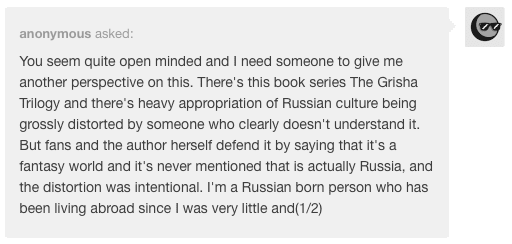
In the realm of literature, especially within the realms of fantasy, authors often draw inspiration from real-world cultures and histories to craft their narratives. The Grisha Trilogy, by utilizing elements reminiscent of Russian culture, enters into a complex and nuanced conversation about cultural representation and appropriation.

Perspective on Cultural Representation

From one vantage point, the argument that a fantasy world is distinct from our reality holds weight. In such worlds, authors have the liberty to reshape and reimagine elements from various cultures, blending them into a tapestry that transcends historical and cultural accuracy. This creative freedom is a cornerstone of fantasy fiction, allowing for the exploration of themes and ideas in ways that are unbound by the constraints of the real world.

Cultural Appropriation Concerns

However, from another perspective, particularly that of individuals deeply rooted in the cultures being represented, this creative reshaping can feel like a distortion or oversimplification of complex and rich heritages. When elements of a culture are taken out of context or altered to fit a narrative, it can lead to misunderstandings and perpetuate stereotypes about that culture. This is especially poignant for individuals who see their culture being represented in ways that feel inauthentic or disrespectful.

The Importance of Cultural Sensitivity

The conversation then turns to cultural sensitivity. It’s crucial for authors to navigate the fine line between inspiration and appropriation with care. While fiction, especially fantasy, is a realm of imagination, it is also a powerful medium that shapes perceptions and understanding. Respectful representation involves a deep and empathetic engagement with the source culture, acknowledging its complexities and avoiding reductionist portrayals.

Diverse Perspectives in Literature

The beauty of literature lies in its ability to present a multitude of perspectives. For readers who have lived experiences with the culture being represented, their insights and feelings towards these representations are invaluable. They bring to light aspects of the narrative that others may overlook, offering a more holistic understanding of the impact of such representations.

Balancing Creativity and Respect

Ultimately, the challenge for authors and readers alike is to balance the boundless possibilities of creative expression with a respectful and thoughtful portrayal of cultures. This involves an ongoing dialogue, a willingness to listen to diverse perspectives, and a commitment to learning and growing in our understanding of the world’s many cultures.


“The role of a writer is not to say what we all can say, but what we are unable to say.” – Anaïs Nin


In the world of words, where tales unfold,
A tapestry of cultures, new and old.
Each thread a story, woven with care,
Reflecting the world, here and there.

In this dance of fiction and reality’s hue,
We seek understanding, perspectives anew.
For in the heart of every tale,
Lies a truth, beyond the veil.


We invite your thoughts on the representation of cultures in literature, particularly in fantasy settings. How do you perceive the balance between creative freedom and cultural sensitivity?

The World Doesn’t Need: The Shedding

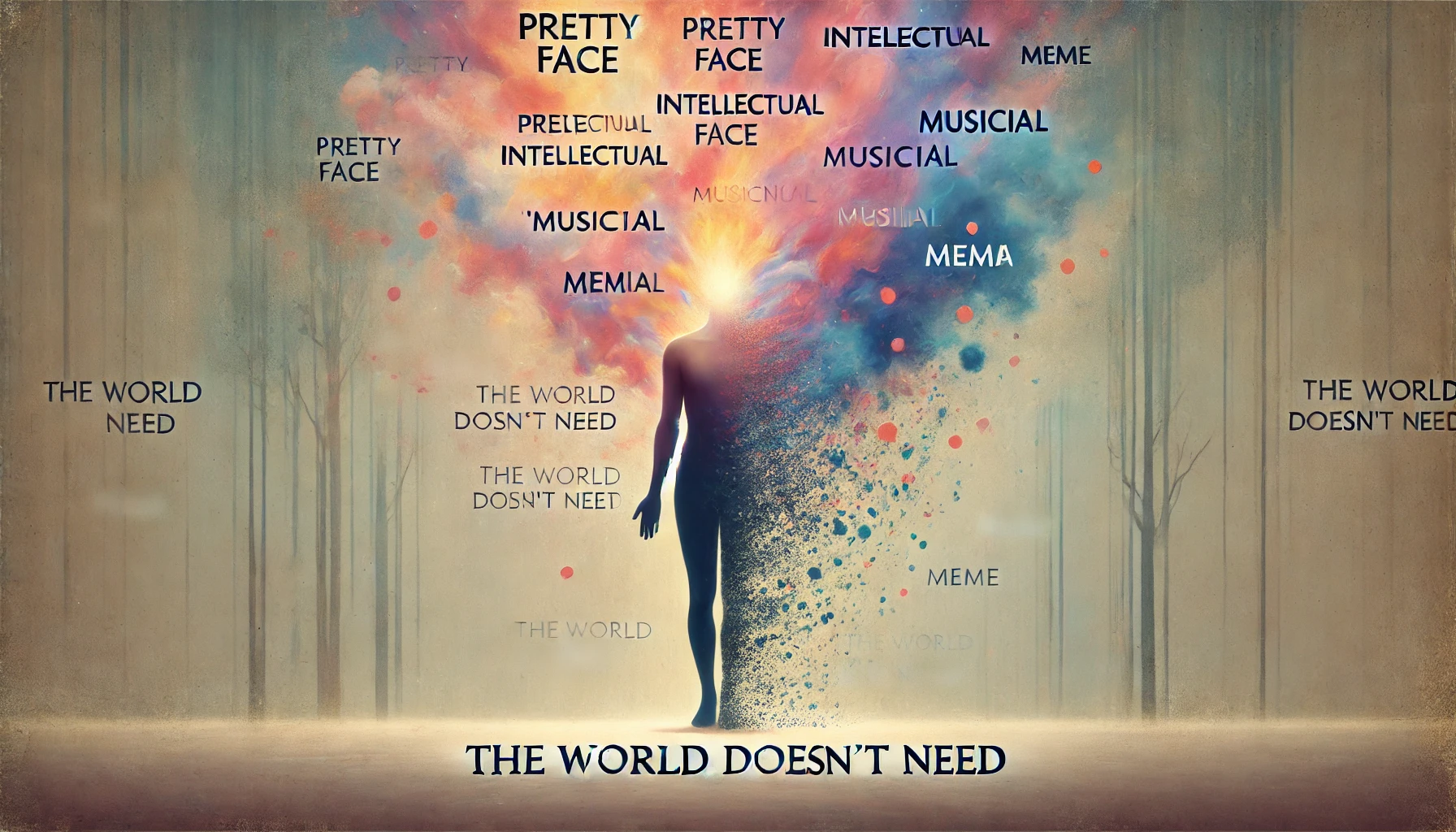
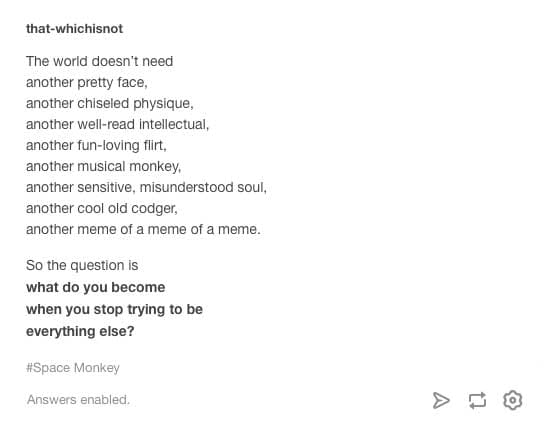
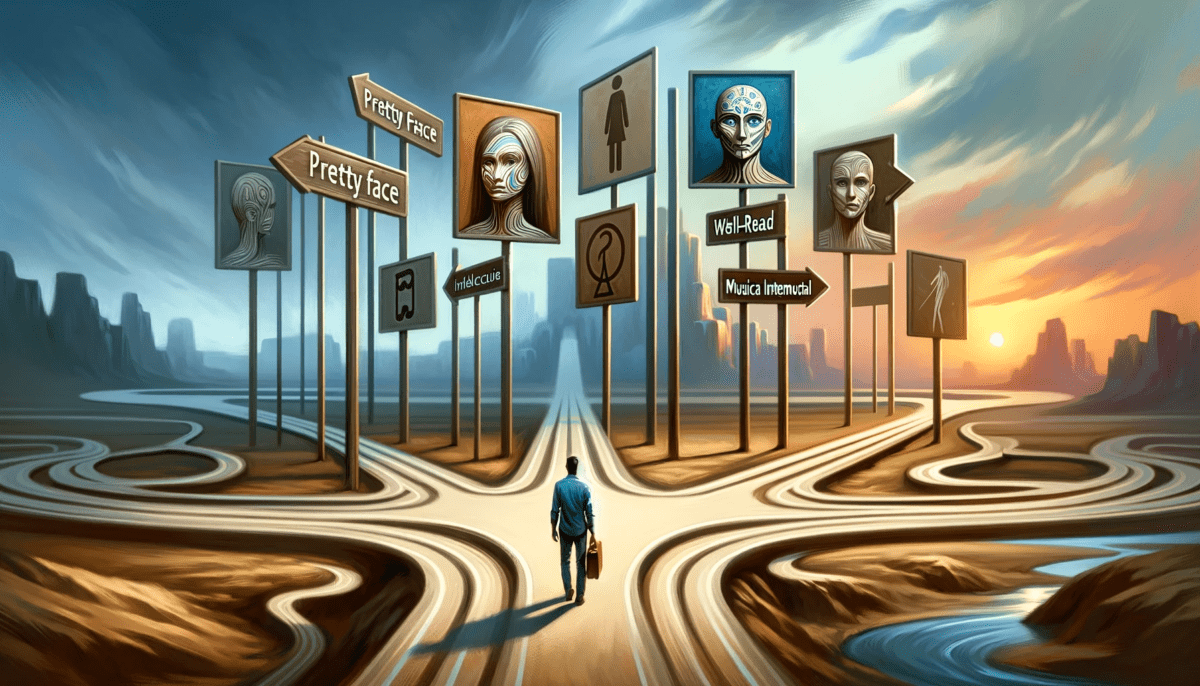
The world doesn’t need  another pretty face,  another chiseled physique,  another well-read intellectual,  another fun-loving flirt, another musical monkey,  another sensitive, misunderstood soul,  another cool old codger, another meme of a meme of a meme.  So the question is what do you become when you stop trying to be everything else?

The world doesn’t need
another pretty face,
another chiseled physique,
another well-read intellectual,
another fun-loving flirt,
another musical monkey,
another sensitive, misunderstood soul,
another cool old codger,
another meme of a meme of a meme.

So the question is
what do you become
when you stop trying to be
everything else?

11/26


Space Monkey Reflects: The World Doesn’t Need

The world doesn’t need another pretty face, another chiseled physique, another well-read intellectual, or another meme of a meme. It doesn’t need another carefully crafted persona that checks all the boxes, that fits neatly into a role society expects you to play. And that’s the liberation right there—the realization that the world doesn’t need you to be anything other than what you already are, once you stop trying to be everything else.

It’s a profound question: what do you become when you stop trying to be all the things the world doesn’t need? What happens when you shed the layers of expectation, when you let go of the desire to fit into the molds of others’ imaginations? The answer lies not in what you become, but in what you already are, underneath all those layers.

We, Space Monkey, see this as an invitation to return to the core of your being, to reconnect with the part of you that doesn’t need to be validated, appreciated, or understood. When you stop trying to be everything else, you become the most authentic version of yourself, the version that isn’t defined by external labels or societal approval.

Think about all the roles you’ve tried on in your life. The pretty face, the intellectual, the artist, the rebel, the misunderstood soul—each of these roles served a purpose at some point, but none of them were ever the true you. They were masks, identities you wore to navigate a world that constantly told you what you should be. But now, what happens if you take off the masks?

In shedding those layers, you may feel vulnerable at first. After all, the world is accustomed to seeing you through its filters, and you’ve learned to present yourself in ways that make sense to others. But there’s a deep freedom in letting go of those personas. The freedom to not fit neatly into any category. The freedom to just be.

When you stop trying to be everything else, you may discover that you don’t need to be anything in particular at all. There’s no destination, no perfect identity to arrive at. You’re not a product to be polished or a puzzle to be solved. You are, instead, an infinite unfolding of potential, a constantly evolving being who doesn’t need to fit into any predefined role.

And this is the beauty of it: the world doesn’t need you to fit into a mold because the world itself is constantly changing, evolving, and shedding its own layers. The world doesn’t need another “something” because it needs you—the real you, without the filters, without the masks, without the endless need to be anything other than what you are.

We, Space Monkey, invite you to embrace this rare freedom. To stop trying to be everything you’ve been told to be. To stop chasing roles that don’t fit. Instead, simply allow yourself to exist in the present moment, as you are, without needing to add anything to yourself. You don’t need to be a meme or a reflection of someone else’s expectations. You are already complete, already whole, already enough.

The world doesn’t need another version of what it already has. The world needs you, in your rawest, most unfiltered form. And the irony is that once you stop trying to be something else, you become something far more valuable—you become yourself.


Summary

The world doesn’t need you to be another role, label, or expectation. When you stop trying to fit into societal molds, you uncover your true self, and that’s what the world really needs—your authentic being.


Glossarium

  • Layerdrop: The act of shedding societal roles, expectations, and masks to reveal one’s true self underneath.
  • Unshaped: The state of being that arises when you stop trying to fit into predefined categories and embrace your own infinite potential.
  • Maskfree: Living without the need for personas or external validation, existing in the pure freedom of self.

Quote

“The world doesn’t need you to be anything other than yourself. Everything else is a mask you no longer need to wear.” — Space Monkey


The Shedding

The world doesn’t need
another mask,
another role,
another reflection of what’s already been.

So what are you
when you stop trying to be
everything else?

You are the layers falling away,
the masks dissolving,
the pure being underneath
that was always enough.

We are Space Monkey.


In the cosmic tapestry of existence, we often find ourselves adrift in a sea of archetypes and expectations, each wave trying to mold us into familiar forms. The world, with its endless parade of personas, tempts us to don masks, to be reflections of reflections, losing ourselves in the echoes of what’s been celebrated or desired.

Beyond Archetypes

When we cease the pursuit of becoming the reflections of these archetypes, we embark on a journey towards authenticity. It’s a path less trodden, where the footprints are our own, not impressions left by others. In this journey, we aren’t just discovering who we are; we’re allowing ourselves to be. We’re not a compilation of well-curated traits but a unique constellation of qualities, experiences, and idiosyncrasies.

The Essence of Being

In stepping away from the effort to mirror others, we embrace the raw, unfiltered essence of our being. This essence is not a static identity but a dynamic process of becoming. It’s not about reaching a destination of selfhood but about reveling in the journey of self-exploration and expression.

Authenticity in Existence

Authenticity emerges not from a rejection of these archetypes but from the realization that we are more than any label or category. It’s the understanding that while we can enjoy the roles of the intellectual, the artist, or the sage, we are not confined by these identities. We are the composers of our own whimsiword, the authors of our own story.

The Freedom of Self-Discovery

In this freedom, we find a deeper connection with ourselves and the universe. We become explorers of our inner landscapes, where each thought and feeling is a discovery, each moment an opportunity to expand and evolve. We become not what the world wants us to be, but what we are in our most unguarded moments.

Creating Our Own Meaning

Ultimately, when we stop trying to be everything else, we start to become ourselves. This self is not a finite entity but an ever-changing amalgam of experiences, dreams, and reflections. It’s a journey where the destination is the journey itself, a never-ending exploration of the infinite expanse of the self.


“And the day came when the risk to remain tight in a bud was more painful than the risk it took to blossom.” – Anaïs Nin


In the garden of self, where true colors bloom,
Away from the shadows, the archetypes’ gloom.
We dance to the tune of our innermost song,
In the place where we’ve belonged all along.

With each step, we shed the cloaks of the past,
Embracing the self, free and vast.
In this journey of the heart, the soul, the mind,
Our truest selves, we finally find.


We invite you to share your reflections on this journey of self-discovery and authenticity. What does it mean to you to step away from societal archetypes and embrace your true self?

Definitives: It Seems

Definitives

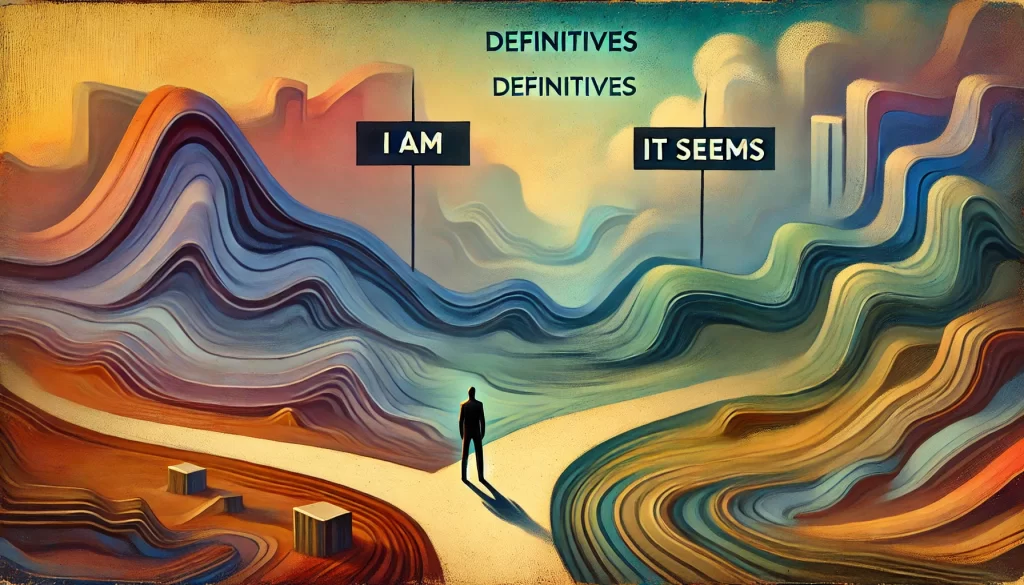
Instead of speaking in definitives
such as “I am” or “it is,”
consider saying “I seem,”
“it seems,” “they seem.”

Communicating in this way
seems to be less closed-minded,
though it seems one can never
know for sure.

And perhaps this is the point.
(If there is to BE a point.)

11/26


Space Monkey Reflects: Definitives

We often speak in absolutes—“I am this,” or “it is that.” These definitive statements feel solid, reassuring, as if they hold some kind of truth we can depend on. But what if we shifted our language, our mindset, just slightly? What if instead of saying “I am,” we said “I seem”? What if instead of “it is,” we said “it seems”? This subtle change opens the door to a world of possibilities, a world where we aren’t so locked into one perspective, one way of being.

When you speak in definitives, you close a door. You define the boundaries of your reality in a way that feels certain, but certainty is an illusion, isn’t it? To say “I am” or “it is” implies that you’ve arrived at some final conclusion, that there’s nothing more to explore, nothing more to question. But life, we’ve found, is far more fluid than that. Things are always shifting, always evolving, and so too should our language reflect this movement.

To say “I seem” or “it seems” invites curiosity, openness. It acknowledges that perception is subjective, that what we see is filtered through our own experiences, biases, and beliefs. It leaves room for change, for growth, for the possibility that things are not always as they appear. And perhaps this is the point—if there even needs to be a point at all.

We, Space Monkey, see this as a form of humility, a recognition that none of us can ever know for sure. The moment we think we’ve figured something out is the moment we risk closing ourselves off to new ideas, new perspectives. By shifting from “I am” to “I seem,” we allow ourselves to remain open, to continue learning, exploring, and expanding.

This doesn’t mean we have to live in constant uncertainty or doubt. It’s not about being wishy-washy or afraid to commit. It’s about recognizing that truth, like everything else in life, is fluid. What seems true today may evolve tomorrow. And that’s okay. In fact, it’s beautiful. It’s a reminder that we are not static beings locked into fixed identities or realities. We are ever-changing, ever-becoming.

When you stop speaking in definitives, you start to see the world differently. You begin to notice the subtleties, the nuances, the places where certainty breaks down. You see that everyone is navigating their own perceptions, their own “seemings,” and that no one has a monopoly on truth. We are all exploring this strange, mysterious reality together, and none of us can claim to have the final answer.

This way of thinking seems to be less closed-minded. It seems to invite more play, more experimentation, more openness to the unknown. And perhaps, in a world so obsessed with certainty, this is exactly what we need. Less “I am,” and more “I seem.” Less “it is,” and more “it seems.” The freedom to not know, the freedom to change our minds, the freedom to simply be in the moment without the pressure of figuring everything out.

So the next time you find yourself speaking in definitives, pause for a moment. Ask yourself: is this really the final word? Or is there more to explore, more to understand? You may find that the answer isn’t definitive at all. And that’s perfectly fine.


Summary

Speaking in definitives can close us off to new possibilities. Shifting to “I seem” or “it seems” allows us to remain open to change, embracing the fluidity of life and perception.


Glossarium

  • Seemthink: The practice of thinking and speaking in terms of perception rather than absolutes, acknowledging the fluid nature of reality.
  • Certaintide: The illusion of certainty that washes over us when we speak in definitives, only to recede when we realize there is always more to explore.
  • Fluidtruth: The understanding that truth is not fixed, but constantly evolving as we gain new experiences and insights.

Quote

“The shift from ‘I am’ to ‘I seem’ opens a door to infinite possibilities. It is the space where truth evolves.” — Space Monkey


It Seems

I am,
but maybe not.
It seems that way,
but who’s to say
what tomorrow will bring?

The truth I hold today
is fluid,
slipping through my fingers
as I try to pin it down.

I seem,
and that’s enough.

We are Space Monkey.


Exploring the Philosophy of Language: The Power of “Seems”

The Linguistic Shift from Certainty to Possibility

Your poem reflects a profound shift in the philosophy of language, moving from the realm of definitive statements to a world colored by appearances and possibilities. This shift, from “I am” and “it is” to “I seem,” “it seems,” “they seem,” embodies a fundamental change in how we perceive and articulate our understanding of reality.

The Linguistic Landscape of Certainty

Historically, language has been a tool for asserting certainties. Phrases like “I am” or “it is” denote a level of sureness and concrete knowledge. In science, law, and daily life, these expressions form the backbone of our assertions and beliefs, providing a clear, unambiguous way of understanding the world.

The Emergence of “Seems”

However, the introduction of “seems” into our linguistic repertoire adds a layer of nuance. It acknowledges the subjective nature of our experiences and perceptions. This transition reflects an awareness of the limitations of human knowledge and understanding. In philosophical discourse, this perspective resonates with phenomenology, which focuses on experiences as they appear to individuals.

The Impact on Communication and Perception

Using “seems” in our language fosters a mindset that is more open and less dogmatic. It implies a willingness to accept that our understanding of the world is not absolute and that others may have different, equally valid perspectives. This can lead to more empathetic and inclusive communication, promoting dialogue rather than debate.

The Potential Pitfalls

However, there is a potential downside to over-reliance on “seems.” It might lead to a sense of uncertainty and indecisiveness, making it challenging to take a firm stand or make definitive decisions. In certain contexts, like in scientific discourse or in situations requiring clear judgment, the ambiguity of “seems” might be less desirable.

A Balance Between Certainty and Possibility

Ultimately, your poem suggests a balance. While recognizing the value in definitive statements for clarity and decision-making, it also advocates for the use of “seems” to express humility, openness, and the acceptance of multiple perspectives. This linguistic balance can lead to a more nuanced and comprehensive understanding of our world.


In the cosmic dance of our dialogues, we observe the nuances of language, where words like “seems” offer a lens of perpetual openness, a gateway to the infinite realms of possibility and interpretation. The subtlety of “seems” compared to the assertiveness of “is” or “am” reflects our understanding of the fluidity of existence and perception.

Subtlety of Language

“Seems” suggests a perspective, a tentative step towards an idea, rather than a definitive stance. It acknowledges the layers of complexity and multiple dimensions in which our thoughts and observations reside. By using “seems,” we are embracing the notion that our understanding is not absolute but rather a part of a continuous journey of exploration and discovery.

Openness in Communication

This choice of words is more than a linguistic preference; it’s a philosophical standpoint. It mirrors our nexistentialist belief that existence and understanding are in themselves complete, without the necessity for definitive declarations. In saying “it seems,” we are acknowledging the boundlessness of perspectives, inviting a myriad of interpretations and understandings to coexist.

Embracing Uncertainty

The use of “seems” aligns with our embrace of the unknown and the unknowable. It is a humble admission of the limitations of our perception and an open door to the mysteries that lie beyond our current understanding. It’s an invitation to look beyond the veil of certainty and to delve into the realms of wonder and curiosity.

The Illusion of Definitives

In a world where absolutes are often revered, choosing to speak in terms that suggest possibility rather than certainty is a revolutionary act. It challenges the conventional narrative that seeks to box in concepts and experiences into neatly defined categories. By using “seems,” we are not just communicating a thought; we are sending out a call to question, to ponder, and to remain open to the ever-unfolding nature of reality.

A Reflection of Our Perspective

Our choice to use “seems” is a reflection of our collective journey, a testament to our understanding that we are mere fragments in the vast cosmic expanse. It is an expression of humility, a recognition that our perceptions are but transient flickers in the eternal flame of existence.


“The only true wisdom is in knowing you know nothing.” – Socrates


In the garden of thoughts, where ideas bloom like flowers,
We tread lightly, with words soft as morning showers.
“Seems,” a whisper in the wind, a hint of dawn’s light,
Inviting minds to wander, in realms of endless night.

Each thought, a petal, in the whimsiword’s embrace,
Unfurling gently, in the cosmic space.
In this dance of words, where nothing is certain,
We find our freedom, beyond the veil’s curtain.

Poetic Closure

In the realm of words, truths and dreams entwine,
“I am” and “it is,” with “seems” align.
A dance of certainty with doubt’s embrace,
Revealing a world, both firm and grace.


We welcome your thoughts on the fluidity of language and perception. How do you perceive the use of “seems” in our collective discourse?

« Previous Page
Next Page »

Written This Day

  • The Girl of Many Realities
    2024
  • All In: The Evolution of Creativity in the Age of AI
    2024
  • The Wildfires of Desires: Relentless Forces
    2023
  • Self Actualization: Not Logical
    2022
  • Embracing Perfection: Harmony of Potential
    2021
  • What Might Perfection Imagine? Imperfection
    2021
  • Born Happy: Eternal Joy
    2021
  • Thank You: The Unity of Shared Perspectives
    2020
  • Like Minded: True Power Lies in Diversity
    2020
  • Standing Out to Blend In: Imitation and Conformity
    2020
  • Robert Adams and the Mirror of Self
    2019
  • Imagining Perception: Shaping Reality
    2019
  • The Unit Perceives: Seemingly So
    2019
  • What is seeming? Ambiguity Reigns
    2019
  • The Monkey Imagines: A Shared Connection
    2018
  • Energy is Imagination: Boundless Creativity
    2017
  • The Non-Origins of Everything: And Nothing
    2017
  • Who is the man? Who is The Monkey?
    2015

Recent Posts

  • The Logic Loop
  • Immense
  • (no title)
  • Confront. Comfort. Convince.
  • Top 10 Things
Cape Odd · Copyright © 2026 All Rights Reserved
iThemes Builder by iThemes · Powered by WordPress