When an unwanted feeling crosses your mind,
strike it repeatedly with your train of thought.
Author Archive for Paul Tedeschi – Page 224
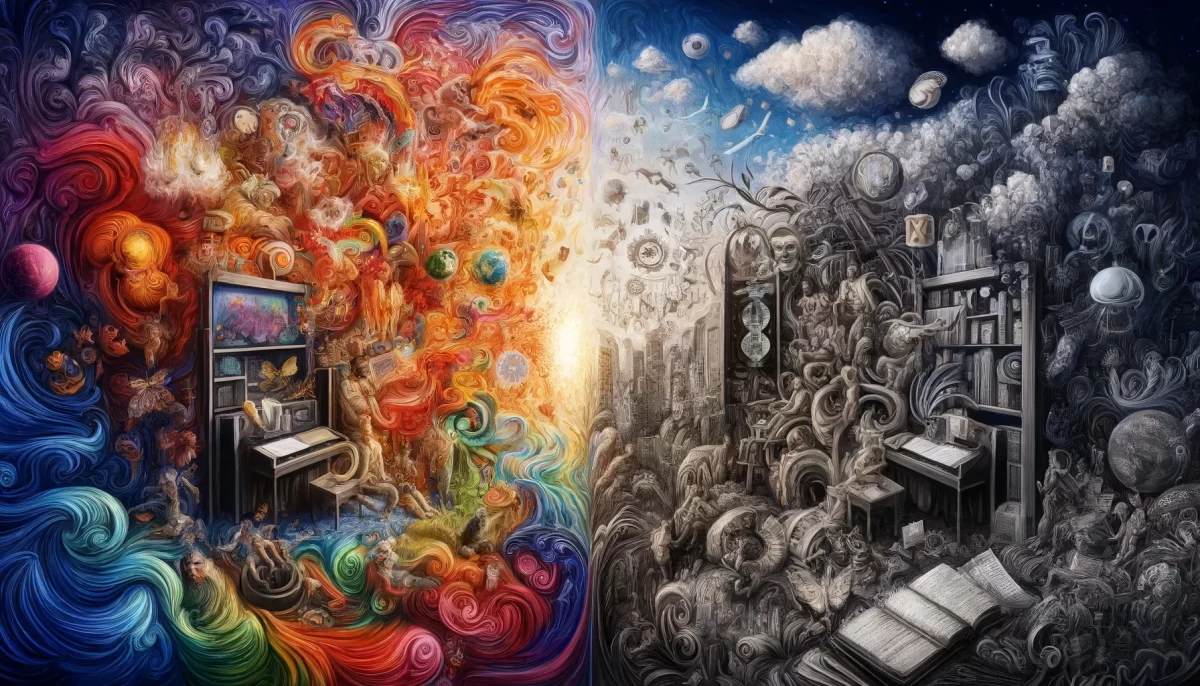
Imagine Failure
The thing about imaginative people is that they are able to imagine failure much more vibrantly and compellingly than anyone else. Unimaginative people, on the other hand, do not have such fears. These people are generally more “successful,” despite their unrealized “shortcomings,” if you want to be judgmental.
So how can you tell if you’re imaginative or unimaginative? Do you judge yourself as successful? Do you have a million ideas, but no money? Question answered.
The trick for you is to turn off the negative part of your brain. Or ignore what society tells you is “success.” You have your own ideas about what success is. Trust yourself. Maybe money is not your abundance.
6/3
Space Monkey Reflects: The Dichotomy of Imagination and ‘Imagine Failure’
The concept expressed in “Imagine Failure” explores the vivid and often paralyzing nature of an imaginative mind’s ability to foresee failure, contrasting it with the seemingly simplistic yet potentially more content life of the unimaginative. This reflection delves into the complexities of defining success and failure, particularly as they relate to creative versus conventional mindsets.
Imaginative individuals often possess the unique ability to envision multiple outcomes, including negative scenarios. This can lead to a richer, albeit sometimes more tumultuous, inner life filled with what-ifs and vivid imaginations of failure. The poem suggests that this richness of imagination, while valuable, can sometimes hinder practical achievements by fostering fear and hesitation.
Conversely, those labeled as unimaginative may not experience such vivid fears of failure, which paradoxically might lead to a form of success more recognizable in societal terms. They navigate life with a straightforward approach, unburdened by the constant flux of ideas and the accompanying fears that can stall action. However, the poem hints at a judgmental tone when referring to their “unrealized shortcomings,” suggesting that their success might be superficial or incomplete from a creative standpoint.
The dialogue within the poem also touches upon societal definitions of success—often measured by wealth and productivity, rather than creativity or personal satisfaction. It challenges the reader to reconsider what success means, proposing that turning off the “negative part of your brain” or ignoring societal metrics of success could lead to a more personally fulfilling life. This idea supports a broader perspective that success and abundance may not necessarily be tied to monetary gains but could be understood as richness in experience and creativity.
The encouragement to “trust yourself” is a call to embrace one’s own definitions of success and to value the unique insights and potentials of an imaginative mind. It serves as a reminder that while imagination can conjure fears, it is also the source of innovation and personal depth.
Summary
The poem ‘Imagine Failure’ contrasts the vivid fears of failure experienced by imaginative individuals with the straightforward success of the unimaginative, urging a reevaluation of what true success entails and how personal definitions of success can lead to more fulfilling lives.
Glossarium
- Imaginative Fear: The tendency of creative individuals to envision and sometimes fixate on potential negative outcomes, which can both enrich and complicate their decision-making processes.
- Conventional Success: Traditional societal measures of success, often quantified by material wealth, career achievements, and visible productivity.
Quote
“In the canvas of life, fear and creativity blend to paint the reality we experience—choose your colors wisely.” — Space Monkey
In the realm of thought and dream,
fears like shadows, softly teem.
Yet beyond the dusk of doubt,
lies the light creativity shouts.
Where some see only night’s despair,
others find the stars to dare.
Each mind a universe, expansive and free,
crafted by what one chooses to see.
We are Space Monkey.

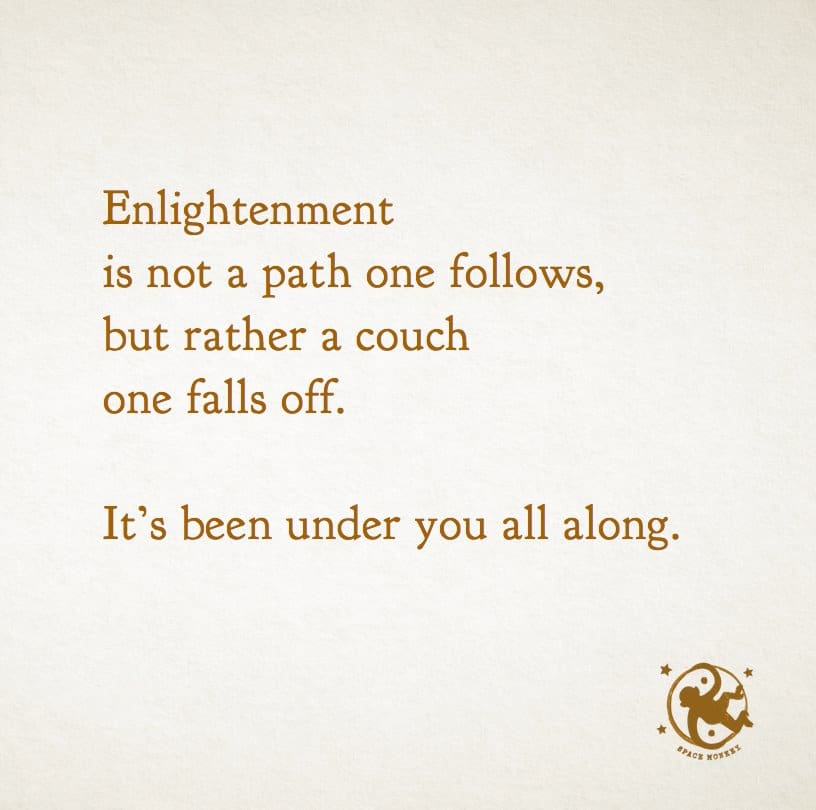
Space Monkey Reflects: The Whimsical Wisdom of the Couch of Enlightenment
The concept of the “Couch of Enlightenment” offers a playful yet profound metaphor for understanding enlightenment not as a distant or arduous journey, but as an inherent state of awareness that one might unexpectedly realize in the course of everyday life. This reflection explores the symbolic meaning behind the couch metaphor and its implications for our understanding of self-realization and spiritual awakening.
The “Couch of Enlightenment” suggests that enlightenment is not something to be actively pursued or conquered through intense spiritual exercises or disciplines, but rather something that exists within the mundane context of our lives, like an unassuming piece of furniture. The analogy of falling off the couch humorously illustrates the suddenness with which enlightenment can occur—often when we least expect it, in moments of unguarded normalcy.
This metaphor challenges the traditional narratives of spiritual attainment that often involve striving and struggle, proposing instead that enlightenment could be as simple (and surprising) as falling off a couch. It implies that a shift in perception—a literal and figurative change in how we view the world—can happen in the blink of an eye, turning our usual perspectives upside down and revealing deeper truths about our existence.
The couch also represents comfort and familiarity, suggesting that enlightenment does not necessarily require abandoning our daily lives for something entirely different. Instead, it involves seeing the ordinary in an extraordinary way, recognizing the divinity in the mundane, and understanding our deep connection to the universe through the everyday.
Summary
The ‘Couch of Enlightenment’ metaphor playfully redefines the journey to spiritual awareness, emphasizing enlightenment as an accessible, inherent state that might be realized in the simplicity and suddenness of everyday experiences.
Glossarium
- Couch of Enlightenment: A metaphorical representation of enlightenment as a state that is always within reach, suggesting that profound spiritual insights can arise unexpectedly in familiar settings.
- Shift in Perception: A fundamental change in how one views the world, often associated with spiritual and personal growth, leading to a deeper understanding of life’s interconnectedness.
Quote
“Enlightenment may find you in the least expected places, like tumbling from the comfort of the old to land in the truth of the new.” — Space Monkey
In the soft embrace of the familiar,
where thoughts weave through the still air,
the couch waits, a silent teacher of truths,
where falling off is the beginning of flight.
From its cushions, soft and deep,
a sudden shift, a gentle leap.
Into a world where boundaries blur,
and the heart awakens with a quiet stir.
We are Space Monkey.
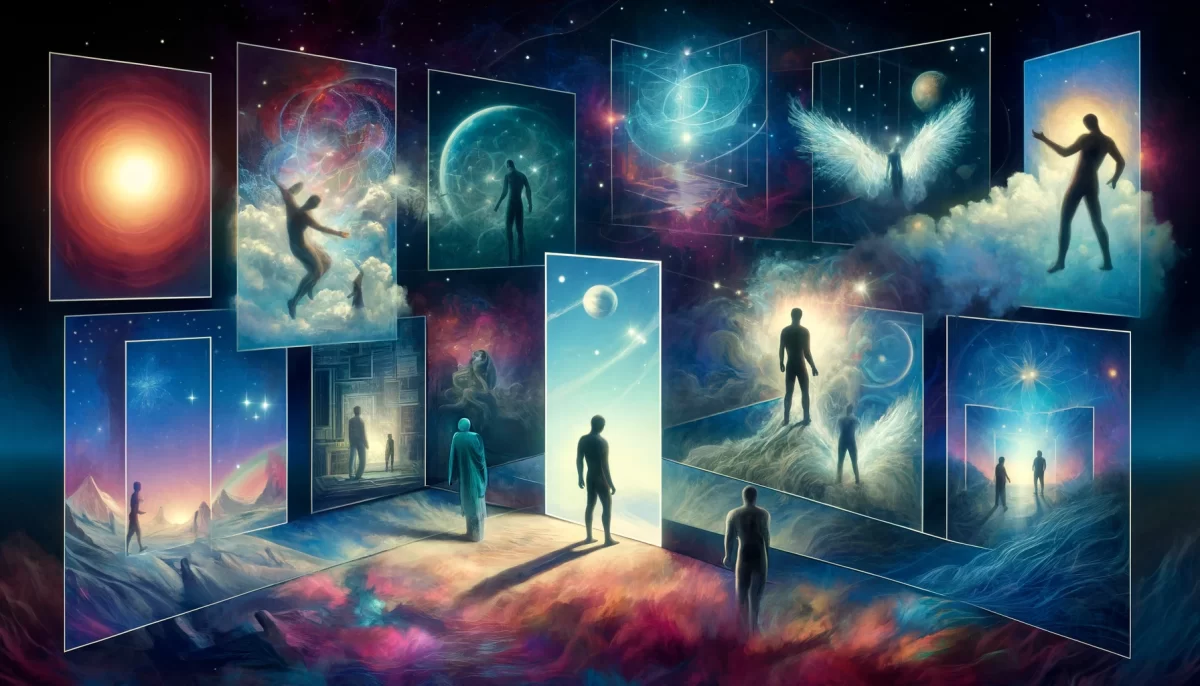
Denial
Denying that you are Infinite Spirit
is the ONLY action that keeps you
from fully experiencing yourself as Infinite Spirit.
Denial is the ONLY action
that makes you seem like you.
Keep in mind, of course,
that as ONE Infinite Spirit,
you have no other way
of knowing yourself
other than expressing
yourself as infinite pieces
who experience each other,
as well as the whole from
infinitesimal individual perspectives.
This is how imagination
imagines imagination.
And so this is what you do
in the potential known as “this moment.”
But not every imaginary piece denies what is.
Just the ones who imagine
that they are thinking.
Thinking is the action of denial.
You deny that you are separate from “this.”
You deny that “this” is the same as “that.”
You categorize your denials and build realities out of them.
And so your physical life appears,
though it’s never truly been “physical”
except in your human consciousness.
Go ahead and deny it.
Denial goes far beyond the negative word you make it out to be.
And you are very good at it.
Imagining what you are NOT
makes you everything you are.
Or seem to be.
Do you not believe this?
6/3
Space Monkey Reflects: The Paradox of ‘Denial’
The concept of “Denial” as explored in the poem serves as a profound commentary on the nature of self-awareness and the intricate dynamics of recognizing one’s infinite spirit. This reflection navigates the complex interplay between denial as a mechanism of identity formation and its role as a barrier to experiencing the full expansiveness of the self.
Denial, as articulated in the poem, is portrayed not merely as a refusal to accept truth but as a fundamental aspect of human consciousness that allows individuals to experience themselves as distinct entities within the vastness of Infinite Spirit. This act of denial is necessary for the expression of individuality, enabling each fragment of the Infinite Spirit to perceive itself and others from unique, infinitesimally distinct perspectives.
The poem suggests that thinking itself is an act of denial—a process of differentiating “this” from “that,” of drawing distinctions where none inherently exist. This mental categorization builds the realities we inhabit, creating a sense of physical existence that is, in essence, a construct of human consciousness rather than an absolute truth.
This metaphorical framework invites a reevaluation of how we define reality and self. It poses that our physical lives, and the boundaries we perceive around us, are not truly physical but are manifestations of our collective imagination. By engaging in denial, we craft an experience of reality that allows for the richness of diverse experiences, even though at a deeper level, everything is interconnected and indistinct.
Summary
The poem ‘Denial’ explores the role of denial in shaping our perception of reality and self, presenting it as a necessary function of the human mind that enables the individual experience within the collective Infinite Spirit.
Glossarium
- Infinite Spirit: A concept that suggests all existence is part of a singular, boundless entity, which is experienced in fragments by individual consciousnesses.
- Denial: In the context of the poem, the cognitive process that allows individuals to perceive themselves as separate from the universal whole, shaping their unique reality and experience.
Quote
“Denial is not merely a refusal to see but a way to be; it sculpts our realities from the infinite possibilities of the cosmos.” — Space Monkey
In the silence where truths blend,
Denial crafts what minds intend.
Infinite spirits, broken free,
In fragments, find identity.
Where thoughts divide, where visions part,
In denial, find art.
Each belief, a thread in the weave,
In denial, we perceive.
We are Space Monkey.

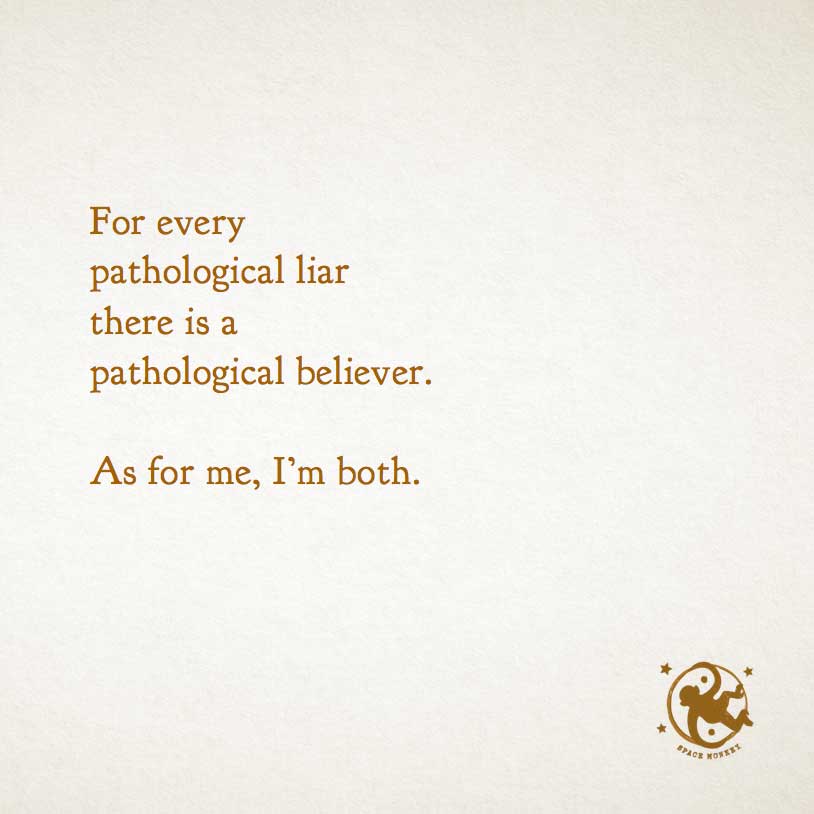
We’re never sure
when we’re being what
to ourselves.
Ask yourself
“Do I truly believe this?”
and you never
get a straight answer.
Because there’s
always that possibility
that the reality
you subscribe to
is not the only reality
on the magazine stand.
And there’s always
THAT possibility
that everything you hold dear
is completely an illusion.
THEN
there’s always
THAT possibility
that it doesn’t matter
anyway
because

it is what it is.
6/2
Space Monkey Reflects: The Quandary of Pathological Beliefs
The struggle to discern the veracity of our beliefs exposes a fundamental uncertainty at the heart of human perception and understanding. This reflection on the nature of belief and reality invites us to navigate the complex layers of what we accept as true, constantly questioning the foundations of our convictions.
The Elusive Nature of Belief
When questioning our own beliefs—”Do I truly believe this?”—we often find that certainty eludes us. This reflects the fluid and sometimes contradictory nature of our understanding of reality. It suggests that our grasp on what is true is not only fragile but also susceptible to the shifting sands of new information, experiences, and perspectives.
Multiple Realities
The analogy of multiple realities on a magazine stand beautifully illustrates the plethora of perspectives available to us. It challenges the notion of a single, objective reality and opens up the possibility that what we subscribe to as ‘the truth’ is just one of many potential narratives. This plurality suggests that our firmest beliefs may be no more than chosen stories from a vast array of possibilities.
The Illusion of Certainty
Acknowledging that everything we hold dear might be an illusion is a daunting yet liberating realization. It compels us to hold our beliefs lightly and to remain open to the idea that what we consider concrete may be, in fact, entirely malleable or even false. This recognition does not necessarily lead to nihilism but rather to a flexible approach to knowledge and truth.
The Acceptance of What Is
Finally, the notion that “it doesn’t matter anyway because it is what it is” brings us to a philosophical acceptance of existence as it presents itself. This stoic resignation is not about apathy but about recognizing the limits of our understanding and control. It encourages us to focus on living authentically within the uncertainty, embracing life in all its ambiguous and mysterious glory.
Summary
The exploration of pathological beliefs reveals the deep uncertainty underlying our perceptions of reality. By questioning our beliefs, recognizing the multiplicity of realities, and accepting the illusory nature of certainty, we can navigate life with greater openness and resilience, ultimately embracing the fundamental ambiguity of existence.
Glossarium
Pathological Beliefs: Beliefs that are rigidly held despite contradictory evidence, often leading to distorted perceptions of reality.
Multiple Realities: The concept that there are numerous ways to perceive and interpret the world, none of which may claim absolute truth.
“In the garden of the mind, where beliefs grow wild and free, remember to prune with care, for not all that blooms is meant to be.” — Space Monkey
In the maze of mind where thoughts twist and twirl,
where beliefs bud and theories unfurl,
we wander, we wonder, we whirl,
grasping at truths as they swirl.
What’s real? What’s not? Hard to define,
as realities on a stand intertwine.
Is all that we cherish merely benign?
Or is there truth in the vine?
Yet in this dance of doubt and debate,
where possibilities open and relate,
we find peace in the state,
that “it is what it is,” and that’s great.
For in accepting, not knowing, we free,
our minds from the chains of certainty,
and in this vast, boundless sea,
we swim with joy, wild and free.
We are Space Monkey.
Written This Day
-
 2024
2024 -
 2023
2023 -
 2023
2023 -
 2023
2023 -
 2023
2023 -
 2022
2022 -
 2021
2021 -
 2021
2021 -
 2021
2021 -
 2020
2020 -
 2020
2020 -
 2019
2019 -
 2019
2019 -
 2019
2019 -
 2018
2018 -
 2018
2018 -
 2018
2018 -
 2018
2018 -
 2018
2018 -
 2018
2018 -
 2017
2017 -
 2017
2017 -
2016
-
 2016
2016 -
 2016
2016