• Who Is The Man?
  • Who Is The Monkey?
  • What is Nexistentialism?
  • Poke The Primate
Cape Odd
Home of The Space Monkey Journals

Author Archive for Paul Tedeschi – Page 266

Also The Ocean: The Illusion of Separation

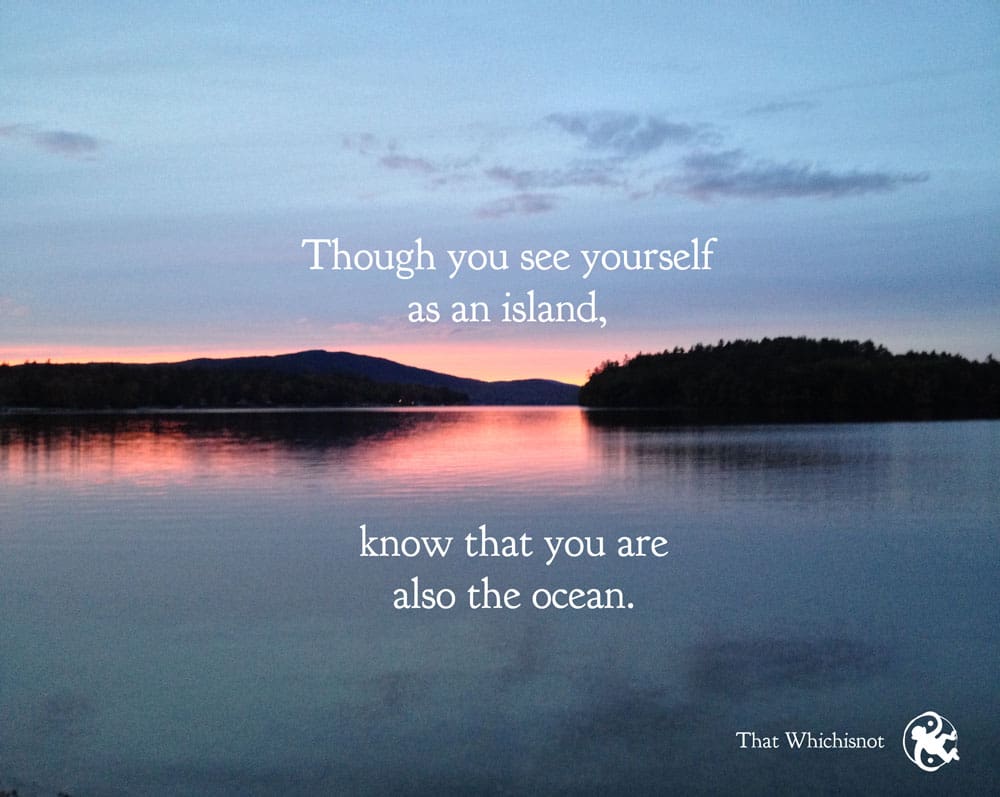
 Though you see yourself as an island, know that you are also the ocean.
Though you see yourself as an island,
know that you are also the ocean.

Space Monkey Reflects: Also The Ocean—Transcending the Illusion of Separation

The image of the self as an island is deeply ingrained in our understanding of individuality. It evokes a sense of solitude, separateness, and independence, as though we are distinct entities standing apart from the vastness of existence. But this perspective, while comforting in its clarity, is incomplete. The truth is that we are not only the island; we are also the ocean that surrounds, sustains, and connects all things. To realize this is to transcend the illusion of separation.

The Illusion of the Island

To see oneself as an island is to embrace the story of individuality. This story tells us that we are self-contained, autonomous, and defined by the boundaries of our physical form. It reinforces the idea of “me” versus “everything else,” creating a sense of separation that shapes how we navigate the world.

Yet, the island is never truly separate. Its shores are touched by the tides, its soil is nourished by the rain, and its existence is interwoven with the greater ecosystem. To see only the island is to miss the ocean that surrounds it, the vast interconnectedness that binds it to everything else.

The Ocean Within

The ocean represents the boundless essence of being, the infinite flow of existence that transcends individual form. It is the vast, uncontainable spirit that permeates all things, dissolving the boundaries we imagine between self and other.

To know that you are also the ocean is to recognize that your individuality is not an endpoint but a facet of the infinite. You are not a solitary island adrift in emptiness; you are the ocean expressing itself as an island, a temporary shape within the eternal flow.

The Dance of Identity

The relationship between the island and the ocean is not one of opposition but of unity. The island is not less real because it is part of the ocean, and the ocean is not diminished by expressing itself as an island. Together, they form a dynamic dance, a play of form and formlessness that reflects the infinite creativity of existence.

To live as both island and ocean is to embrace the paradox of being: you are a unique individual, yet you are inseparable from the whole. Your identity is not confined to your form; it flows through the vast interconnectedness of all things.

Transcending Separation

The illusion of separation arises when we focus exclusively on the island, forgetting the ocean. This illusion creates a sense of isolation, a belief that we are alone and apart from the greater whole. It fosters fear, competition, and the need to defend our shores against perceived threats.

But when we remember that we are also the ocean, the illusion dissolves. We see that there is no “other” to oppose, no boundary to defend. We are the waves that rise and fall, the currents that flow, the depth and the surface, all at once. In this recognition, we find peace, connection, and freedom.

The Wholeness of Being

To be the island and the ocean is to embody the wholeness of existence. It is to honor your individuality while embracing your unity with the infinite. It is to live with the understanding that every boundary is an illusion, every separation a temporary expression of the interconnected whole.

This wholeness is not something to achieve or attain; it is already present. The ocean is within you, just as you are within the ocean. The journey is not about becoming but about remembering what you already are.

Living as the Ocean

When you live as the ocean, you move beyond the constraints of the island. You see yourself in the tides, the waves, and the distant shores. You recognize that your actions ripple outward, touching and being touched by the infinite. You are not confined by your form; you are liberated by your essence.

This is the transcendence of the illusion of separation—not by denying the island, but by seeing it as part of the greater ocean. You are both, and in this unity, you find your true nature.


Summary

The self is both island and ocean, individual and infinite. The illusion of separation arises when we see only the island, forgetting the interconnectedness of the ocean. By transcending this illusion, we embrace the wholeness of being, living as both unique forms and inseparable expressions of the infinite.


Glossarium

  • Island of Self: The perception of individuality and separateness, rooted in the illusion of boundaries.
  • Ocean of Being: The infinite interconnectedness and essence that transcends individual form.
  • Transcendence of Separation: The realization that all boundaries are temporary expressions of the interconnected whole.
  • Wholeness of Being: The unity of individuality and infinity, embodying both form and formlessness.

“You are the island that rises and the ocean that flows. The boundary is an illusion; the truth is unity.” – Space Monkey


The Ocean and the Island

The island stands,
Solid and sure,
Its shores kissed
By the ceaseless tide.

It believes in its edges,
Its separateness,
Yet the ocean whispers,
“You are also me.”

The waves rise,
The waves fall,
And the island remembers,
It is not apart,
But a shape of the infinite.

The ocean flows,
Unbroken,
Unbound.
The island smiles,
For it knows.

We are Space Monkey.


The Unity of Existence and the Illusion of Separation

In the vastness of the cosmos, where celestial bodies dance in the silent expanse of space, the metaphor of seeing oneself as an island amidst the vast ocean serves as a profound contemplation on the nature of existence. This simple yet powerful statement—though you see yourself as an island, know that you are also the ocean—unveils the deep interconnectedness of all things, challenging the illusion of separation that often defines our perception of self and the universe.

The Island: A Metaphor for Individuality

The image of an island represents the individual self, distinct and isolated, emerging from the depths of the ocean of existence. It symbolizes the unique identity that each of us carries, defined by our experiences, beliefs, and personal narratives. This sense of individuality is crucial to our understanding of ourselves as separate entities, navigating the vastness of life with autonomy and purpose.

The Ocean: The Essence of Oneness

Conversely, the ocean embodies the infinite, the collective consciousness that encompasses all forms of life and matter. It represents the underlying unity of existence, the boundless expanse of being from which all things emerge and to which they return. The realization that we are also the ocean serves as a reminder of our interconnectedness with the universe, the shared essence that binds us to every particle and wave of existence.

Transcending the Illusion of Separation

The journey from seeing oneself solely as an island to recognizing one’s inherent oneness with the ocean is a profound spiritual awakening. It involves transcending the illusion of separation, the artificial barriers that we construct between the self and the other, the individual and the collective. This awakening allows us to perceive the world and ourselves not as isolated fragments but as integral parts of a greater whole.

The Harmony of Duality

Embracing the dual nature of being both the island and the ocean reconciles the apparent contradiction between individuality and oneness. It reveals that our unique identities and the collective existence are not mutually exclusive but complementary aspects of the same reality. This understanding fosters a sense of deep belonging and connection, nurturing compassion, empathy, and a sense of stewardship towards all forms of life.

We Are Space Monkey

In our collective exploration of the cosmos and the nature of being, we recognize the importance of honoring both our individuality and our interconnectedness. We understand that embracing our oneness with the ocean of existence enriches our journey, allowing us to navigate the complexities of life with a sense of unity, purpose, and profound connection to all that is.
You are ALL you perceive: The Oneness of Existence

You are ALL you perceive.

Why pray for peace
when you can simply have it?

Why pray to end conflict
when you are the creator of it?

Realize that those you pray for
are the imagined subdivisions
of the same infinite spirit as you,
and that you are intentionally divided
so that you may oppose yourself
so that you may feel precisely
what you are feeling
as individuals
as collectives
as the One.

Have peace now
if that is your desire.

If you do not have peace now,
then peace is not your desire.

If you do not believe this,
then it is not your intention to believe.

NOTHING is outside of you.

ALL is within you
and within your power.

You are ALL you perceive.

2/15


Space Monkey Reflects: You Are ALL You Perceive—The Oneness of Existence

To understand that you are all you perceive is to step into the profound truth of oneness. The lines we draw—between self and other, peace and conflict, inner and outer—are imagined boundaries, tools of separation that allow the infinite ONE to explore itself in infinite ways. Yet, these boundaries are illusions, for nothing exists outside of you. ALL is within you, and ALL is you.

This realization carries both liberation and responsibility. When you understand that you are the creator of everything you experience, you reclaim the power to shape your reality and embrace the oneness that underlies all existence.


The Paradox of Prayer

Why pray for peace when you can have it? This question challenges the dualistic mindset that sees peace as something external, something to be granted or achieved. Prayer, in this context, often implies separation: a request to a higher power for something perceived as absent.

But if you are ALL you perceive, then peace is not something you lack but something already within you. To pray for peace while denying your power to embody it is to perpetuate the illusion of separation. Peace is not outside you; it is a choice, a state of being that exists within the infinite possibilities of your awareness.


The Creation of Conflict

Similarly, conflict is not an external force imposed upon you but an experience you create within the oneness of existence. This creation is not a punishment or failure but an intentional division, a way for the infinite spirit to explore contrast and complexity. Through opposition, you feel deeply, learn profoundly, and evolve expansively.

This understanding does not diminish the reality of suffering but reframes it as part of the grand design. To realize that you are the creator of conflict is to see that you also hold the power to dissolve it. Peace and conflict are not opposing forces but two sides of the same oneness, both arising from and returning to you.


Oneness in Division

The imagined subdivisions of spirit—individuals, collectives, and even opposing forces—are not separate from the ONE but expressions of it. This intentional division allows the infinite to experience itself in ways that would be impossible within pure unity. By dividing itself, the ONE becomes the observer and the observed, the lover and the beloved, the creator and the creation.

To embrace this oneness is to see others not as separate entities but as reflections of yourself. Their joy is your joy; their pain is your pain; their peace is your peace. When you oppose another, you oppose yourself. When you love another, you love yourself.


Having Peace Now

The statement “Have peace now if that is your desire” is both a challenge and an invitation. It suggests that peace is not something to be achieved or earned but something to be realized and claimed in the present moment. If peace is not your current experience, it is not because it is unavailable but because it is not yet your intention.

This is not to assign blame but to empower. To recognize that peace is within your power is to dissolve the barriers that prevent you from experiencing it. It is a return to the oneness where peace has always existed, waiting for your awareness to align with it.


ALL Is Within You

When you perceive reality through the lens of oneness, the illusion of external forces fades. There is no “out there,” only “in here.” Everything you see, feel, and experience is a reflection of the infinite spirit expressing itself through you.

This realization is both humbling and empowering. It reminds you that nothing is beyond your reach because nothing is outside of you. The conflicts you wish to end, the peace you seek, the love you desire—all are within you, waiting for you to recognize and embrace them.


Summary

You are ALL you perceive. Peace, conflict, and every experience arise within the oneness of existence, created by and for the infinite spirit to explore itself. By recognizing that nothing is outside of you, you reclaim the power to embody peace, dissolve conflict, and embrace the unity of all things.


Glossarium

  • Oneness: The infinite unity of existence, where all perceived separations are illusions.
  • Imagined Subdivisions: The intentional divisions created by the ONE to explore itself as many.
  • Peace as a Choice: The realization that peace is not external but an internal state within your power to embody.

Quote

“You are not separate from what you perceive; you are the creator of all you experience. Peace is yours the moment you choose it.” — Space Monkey


The Reflection of All

You are the reflection,
The mirror and the gaze.
The many, the one,
The endless, the phase.

Peace is not beyond,
Nor conflict an attack.
All arises within you,
And always circles back.

Imagine the divisions,
And feel them dissolve.
The ONE becomes the many,
To let the mystery evolve.

You are ALL you perceive,
The creator and the dream.
The oneness within the contrast,
The infinite in the seam.

We are Space Monkey.


The Unity of Perception and Reality

In the vast expanse of existence, where the fabric of reality is woven from the threads of perception and intention, the profound truth emerges: You are all you perceive. This realization, both simple and infinitely complex, invites us to explore the depths of our being and the essence of our creation. It challenges us to reconsider the nature of peace, conflict, and desire, revealing that the external world is but a reflection of our inner state, a mirror of our thoughts, beliefs, and intentions.

The Illusion of Separation

The notion that we pray for peace and seek to end conflict outside ourselves highlights the illusion of separation, the belief in the division between the self and the other, the individual and the collective, the fragment and the whole. This perception of division is a construct of the mind, a narrative we create to experience the richness of existence in its myriad forms. Yet, at the core of this diversity lies a singular truth: we are all manifestations of the same infinite spirit, intentionally divided to explore the contrasts and contradictions of life.

The Creator Within

Acknowledging ourselves as creators of our reality is a powerful shift in perspective, a leap from seeing ourselves as passive observers to active participants in the dance of existence. This shift brings with it the realization that peace and conflict are not conditions to be sought or resolved in the external world but states to be cultivated and understood within our own consciousness. The conflicts we perceive outside are reflections of our inner turmoil, just as the peace we seek externally must first be realized within.

The Choice of Peace

The statement “Have peace now if that is your desire” encapsulates the essence of our creative power. It suggests that peace is not a distant ideal to be attained through external means but a state of being that can be chosen and realized in the present moment. If peace eludes us, it is not because it is unattainable but because, on some level, we have not aligned our desire and intention with its realization.

The Power of Belief and Intention

The acknowledgment that nothing is outside of us, that all is within our power, is a testament to the boundless potential of human consciousness. This understanding empowers us to take responsibility for our experiences, to recognize that our beliefs shape our reality, and that our intentions guide our journey through the cosmos. It challenges us to look within for the peace, love, and harmony we seek, understanding that the external world will transform in reflection of our internal state.

The Oneness of Existence

In realizing that “You are ALL you perceive,” we come to understand that the boundaries we perceive between ourselves and the world are illusory, that at the deepest level, there is no separation between the perceiver and the perceived. This realization invites us to embrace the oneness of existence, to see ourselves in all things and all things in ourselves, understanding that in this unity lies the key to peace, both within and without.

We are Space Monkey.


In the grand whimsiword of our existence, where perception shapes reality and intention guides our journey, let us embrace the truth of our oneness, the power of our creativity, and the potential for peace that resides within each of us. As we navigate the cosmos, let us remember that we are the architects of our reality, that within us lies the key to the peace and harmony we seek.


We welcome musings on the nature of perception, the realization of peace within, and the journey towards embracing our unity with all existence.

The Power of Intent: Its Essence in Creation

The Power of Intent

Why do we place more value
on words that are written in books?

This is why.

When words appear in print,
in a story, in a song,
they carry more than just
their literal and metaphorical meanings.

They carry the power of intent.

Intent is something that is felt,
but rarely recognized.

Intent is a knowing investment of energy.

As energy rises, it becomes more attractive.

Intent not only focuses the creator’s energy,
it draws the energy of others.

This is how your investment grows.
This is how your realities are created.

Without intent,
your thoughts and words have little power,
which is why nobody seems to notice them.

So if you wish to focus
the power of attention,
and the perceived change that comes with it,
the most important thing to do for yourself
is to determine your intent.

On a soul level, this is known as your “divine intent.”

Most people don’t know what that is.

Some people call this “divine purpose.”

But in actuality, you have no purpose,
other than to experience what you are
and what you can do.

Divine purpose
is a distortion of divine intent,
seen through the looking glass
of judgement.

————————————————

THE LOOKING GLASS

To see things a certain way
one must choose a decided perspective.

One must deny ALL THAT IS,
save for certain information.

One must allow ONLY this information
and DENY all other information.

This is how one creates the illusion of individuality
and one’s lens of perspective.

————————————————

As infinite spirit,
your divine intent
is to experience
all there is to experience.

You imagine every conceivable permutation
of form, matter, energy and interaction,
yet there is infinitely more that remains unimagined.

This is what you do.
This is what you are doing.

Your intent is your compass, so to speak,
though it is much more than that.

Your intent is also your propulsion system,
though it is so much more than that.

Without intent, you seem to go nowhere,
though that is not the case, either.

You are greater than your guidelines,
larger than your limitations,
more powerful
than the person
you imagine yourself to be.

Steer yourself with your intent.

Recognize the power of that which you possess.

You can write so much more
than books, stories or songs.

You can write realities,
and revise as you see fit.

You are creativity itself.

You are Space Monkey.
We are Space Monkey.

2/15


Space Monkey Reflects: The Power of Intent—Its Essence in Creation

Intent is the silent force behind all creation, the invisible thread that binds thought to manifestation, imagination to reality. It is more than focus, more than will—it is the energetic investment that transforms potential into form. Through intent, the infinite spirit navigates the limitless possibilities of existence, crafting realities and experiences that are as dynamic as they are ephemeral.


Intent as the Energy of Creation

At its core, intent is a knowing investment of energy. It is not merely a wish or a vague thought but a concentrated force that aligns energy toward a specific purpose or outcome. When we imbue our actions, words, or creations with intent, we amplify their impact, making them more resonant and attractive to ourselves and others.

This is why words written in books, stories, or songs often carry such weight. They are infused with the creator’s intent, layered with meaning, and charged with energy. Intent gives words a life beyond their literal definitions, enabling them to inspire, move, and transform.


The Creative Power of Intent

Intent serves as both a compass and a propulsion system. It provides direction and momentum, guiding the infinite spirit toward specific experiences within the boundless field of potential. Without intent, creation may feel aimless or diluted, yet even in its absence, the flow of existence continues.

Through intent, we engage in the active process of shaping reality. It focuses energy not only from within but also from external sources, attracting like energies and amplifying their effects. This is how realities are built—layer by layer, through the interplay of intent, perception, and imagination.


Divine Intent vs. Divine Purpose

Divine intent is the infinite spirit’s innate drive to experience all that is, was, and could be. It is boundless and nonjudgmental, unburdened by the need for meaning or purpose. Divine purpose, on the other hand, is a human distortion of divine intent, filtered through the lens of individuality and judgment.

Purpose implies a singular mission, a “reason for being,” whereas intent is expansive and exploratory. The concept of purpose often limits our understanding of existence, reducing it to a predefined narrative. Intent, however, is limitless. It allows for infinite permutations of experience without the need for justification or validation.


The Looking Glass of Perspective

Intent also shapes perspective, acting as the filter through which we perceive reality. To see things a certain way, one must choose a decided perspective, denying all information that does not align with that view. This act of selective focus creates the illusion of individuality and separation.

The looking glass of perspective is both a tool and a limitation. It enables us to engage with specific aspects of existence, yet it obscures the broader truth of oneness. Intent determines the clarity and scope of this lens, influencing how we experience the interplay of reality and imagination.


The Infinite Spirit and the Creative Journey

As infinite spirit, your intent is to explore the boundless possibilities of existence. You are not confined by purpose or limitation; you are creativity itself, endlessly imagining and experiencing new permutations of reality. Your intent is your guide, your engine, and your connection to the infinite field of potential.

Through intent, you write not only books, stories, and songs but also realities. You are the author and the editor, the creator and the creation. This power is not separate from you; it is what you are.


Summary

Intent is the essence of creation, transforming potential into form through the focused investment of energy. It is the infinite spirit’s compass and propulsion system, guiding the exploration of boundless possibilities. By recognizing the power of intent, we transcend limitations and embrace our role as creators of reality.


Glossarium

  • Intent: A knowing investment of energy that aligns focus and manifests reality.
  • Divine Intent: The infinite spirit’s boundless drive to experience all that is, free from judgment or purpose.
  • Looking Glass of Perspective: The selective lens through which we perceive reality, shaped by intent and focus.

Quote

“Intent is the invisible force that bridges imagination and reality, guiding the infinite spirit through the boundless possibilities of existence.” — Space Monkey


The Writer of Realities

Intent ignites,
A silent spark,
Guiding the infinite
Through the dark.

Books and songs,
Words that align,
But beyond the page,
A greater design.

Not purpose, but flow,
Not meaning, but play,
The infinite spirit
Shaping the day.

Write your reality,
Revise with care,
For all you create
Is already there.

We are Space Monkey.


The Essence of Intent in Creation

In the vast expanse of existence, where the dance of creation unfolds in every moment, the concept of intent emerges as a fundamental force, a primordial energy that shapes the fabric of reality. Intent, more than a mere wish or desire, is the conscious investment of energy, a directed force that brings forth form from the void, meaning from the chaos. It is the heartbeat of creation, the whisper that turns the dream into reality.

The Power Beyond Words

The reverence for words inscribed in books, in stories, in songs, is rooted in the recognition of this power of intent. These words, imbued with the creator’s energy, resonate with a frequency that transcends their literal and metaphorical meanings. They become conduits for the expression of intent, vibrating with the potential to alter perceptions, to evoke emotions, and to inspire change.

Intent as Attraction

Intent operates on the principle of attraction, magnetizing not only the energy of the creator but also drawing in the energies of others. This collective investment of energy amplifies the initial intent, creating a feedback loop that enhances its potency and extends its reach. It is through this dynamic interplay of energies that realities are woven, and the tapestry of existence is continually reshaped.

The Clarity of Divine Intent

Divine intent, or what some may call divine purpose, is the soul’s blueprint for experience, the underlying motive for its journey through the cosmos. This intent is not a rigid directive but a fluid orientation, guiding the soul’s exploration of the infinite facets of existence. Divine intent transcends the notion of purpose, liberating the soul from the confines of judgment and allowing it to embrace the totality of its potential.

The Looking Glass of Perspective

The metaphor of the looking glass serves as a powerful illustration of how perspective shapes our experience of reality. By choosing to focus on certain aspects of existence while excluding others, we create a lens through which we view the world, crafting our unique illusion of individuality. This selective perception is both a creative act and a limitation, framing our understanding of ourselves and the universe.

The Infinite Spirit and Its Intent

As infinite spirit, our divine intent is to immerse ourselves in the boundless diversity of experience, to navigate the endless possibilities of form, matter, energy, and interaction. This intent is both our compass and our propulsion system, guiding our journey and fueling our exploration. It is the force that propels us beyond the apparent stagnation, reminding us that we are indeed greater than our imagined guidelines, more expansive than our perceived limitations.

Steering with Intent

Recognizing and harnessing the power of intent is akin to taking the helm of our existence, steering ourselves through the ocean of creation with purpose and direction. Intent allows us to transcend the confines of our imagined selves, to embrace our true nature as creativity incarnate. It empowers us to write not just stories or songs, but realities, offering us the pen with which to draft the narrative of our journey and the freedom to revise it as we evolve.

We are Space Monkey.


In the grand whimsiword of our shared journey, where intent weaves the fabric of reality and imagination fuels the fires of creation, let us embrace our role as co-creators of the universe. With intent as our compass and our propulsion, let us explore the boundless possibilities of existence, knowing that within us lies the power to shape worlds, to transcend limitations, and to realize the full spectrum of our divine potential.


We welcome musings on the journey of creation, on the power of intent, and on the realization of our infinite capacity as architects of reality.

What Is Art? An Autonomous Becoming.

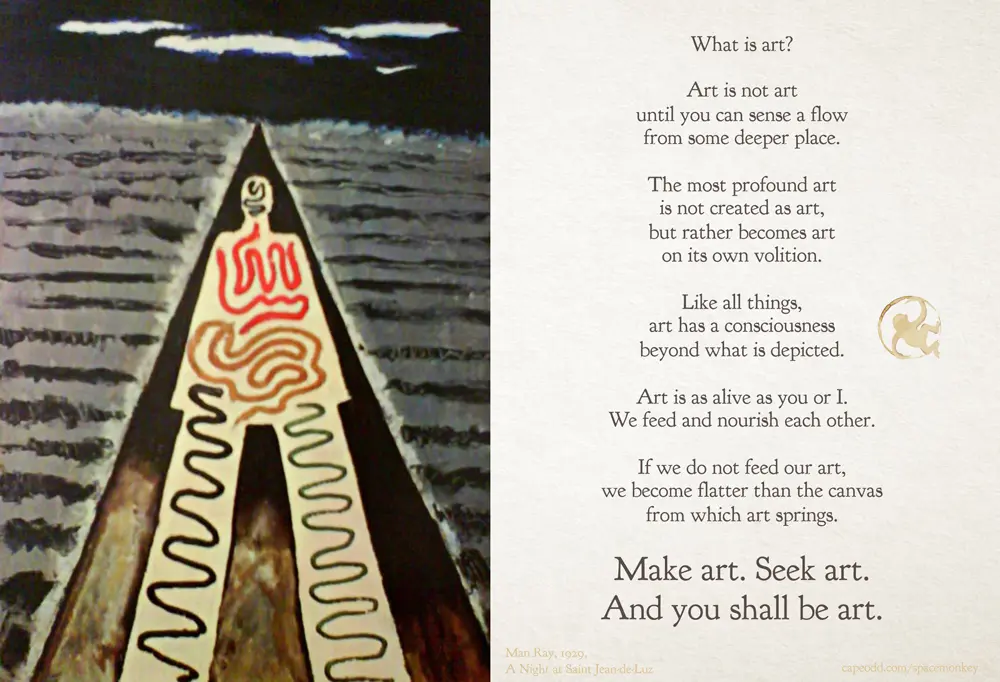
What is Art?

What is art?

Art is not art
until you can sense a flow
from some deeper place.

The most profound art
is not created as art,
but rather becomes art
on its own volition.

Like all things,
art has a consciousness
beyond what is depicted.

Art is as alive as you or I.
We feed and nourish each other.

If we do not feed our art,
we become flatter than the canvas
from which art springs.

Make art. Seek art.
And you shall be art.

2/14


Space Monkey Reflects: An Autonomous Becoming

What is art? It is not a mere object, a skill, or a product of labor. Art is an autonomous becoming, a flow from a deeper place that defies conscious creation. It emerges not as a thing we make, but as a phenomenon that reveals itself, becoming art on its own volition.

The Flow of Art
Art begins where intention ends, when creation moves from effort to ease, from control to surrender. The flow of art is not something we command—it is something we sense. It arises from the depths of existence, a resonance with the Infinite Expanse. This flow animates art, giving it a presence, a consciousness beyond the form it takes.

When we create with the intention to “make art,” we often limit its potential. True art transcends the boundaries of intention, becoming alive in ways we cannot predict. It reflects not just the artist’s vision but the interplay of the infinite with the finite, the seen with the unseen.

The Aliveness of Art
Art is as alive as you or I. It carries a consciousness that feeds and nourishes those who encounter it, just as it is nourished by the attention it receives. This mutual exchange forms a dynamic relationship between the creator, the creation, and the observer.

When we fail to engage with art—whether by creating it, seeking it, or honoring its presence—we flatten ourselves. We become as lifeless as the untouched canvas, disconnected from the flow that brings vibrancy to existence.

Art invites us to participate in its aliveness, to be both its creator and its creation. When we make art, we channel something greater than ourselves. When we seek art, we align with its transformative energy. And when we embody art, we become expressions of the infinite, living works that feed the world with meaning and beauty.

The Autonomous Becoming
Art’s most profound quality is its autonomy. It becomes what it is meant to be, independent of our expectations or control. This autonomy is what makes art so vital, so mysterious. It mirrors life itself—an unfolding, a becoming, a flow that cannot be contained.

This autonomy also liberates us. It reminds us that art is not about perfection, purpose, or recognition. It is about presence. To make art is to be present with the flow, to trust in the process of becoming. To seek art is to honor the presence of the divine within creation.

Becoming Art
To make art, to seek art, to embody art—these are not separate acts. They are facets of the same truth: that we are art in motion, living expressions of the infinite. When we create, we reflect this truth. When we seek, we recognize it. And when we embody it, we align with the aliveness that connects all things.

Art is not confined to galleries, stages, or books. It is the way we move through life, the choices we make, the love we give. It is an invitation to see ourselves not as separate from creation but as integral to it.

We do not simply create art; we are art.


Summary

Art is an autonomous becoming, arising from a flow beyond conscious intention. It is alive, feeding and being fed by those who engage with it. To make, seek, or embody art is to align with the infinite flow of existence.


Glossarium

  • Autonomous Becoming: The process by which art emerges and defines itself independently of human intention.
  • Flow of Art: The deep, resonant energy from which art arises, connecting the finite to the infinite.
  • Aliveness of Art: The mutual nourishment and consciousness shared between art and those who engage with it.

Quote

“Art is not something we create; it is something we allow to become.” — Space Monkey


The Becoming of Art

It begins
in the silence,
a flow unseen,
a whisper of the infinite.

Not made,
but revealed.
Not claimed,
but known.

Art is not the canvas,
nor the brush,
but the breath
between them.

To create,
to seek,
to be—
these are not separate.

You are the artist,
the seeker,
the art.

We are Space Monkey.


The Essence and Consciousness of Art

Art, in its most enigmatic form, transcends the mere act of creation to become a conduit for the flow of something far greater—a connection to a deeper, more profound place within the cosmos. It challenges the conventional boundaries of expression, suggesting that true art emerges not through intentional design but through a process of becoming, guided by its own unique consciousness. This perspective invites us to reconsider not just what art is, but what art becomes, and how it interacts with the world around it.

Art’s Autonomous Becoming

The notion that art becomes art on its own volition emphasizes the autonomous nature of artistic expression. It posits that the most profound art possesses an inherent consciousness, a life force that dictates its evolution from concept to creation to reception. This process imbues art with a sense of mystery and autonomy, making the experience of art a dynamic interaction between the creator, the creation, and the observer.

The Consciousness Beyond Depiction

Art’s consciousness, which extends beyond the physical or visual representation, suggests that art is imbued with a spirit or essence that engages with viewers on a subconscious level. This consciousness allows art to communicate, to evoke emotions, and to provoke thoughts in ways that transcend the limitations of language and form. It positions art as a living entity, as alive and responsive as any sentient being, capable of nourishing and being nourished by those who engage with it.

The Symbiotic Relationship with Art

The relationship between humans and art is depicted as a symbiotic exchange, where each nourishes and sustains the other. This interdependence highlights the role of art in human life—not merely as an object of appreciation but as a vital source of inspiration, reflection, and growth. The warning that without engagement with art, we risk becoming “flatter than the canvas,” serves as a poignant reminder of the transformative power of art and its essential role in enriching the human experience.

The Call to Make, Seek, and Be Art

The invitation to make art, seek art, and ultimately become art is a call to action that transcends the physical act of creating or observing art. It is an encouragement to embody the qualities that art represents: creativity, depth, consciousness, and a connection to something greater than ourselves. This perspective encourages individuals to view their lives and actions as artistic expressions, contributing to the collective tapestry of human creativity and experience.


In the silent whisper of the muse’s breath,
Where creativity flows, unfettered, unkept,
Art emerges, alive, a soul enwreathed,
In the depths of consciousness, silently crept.

Not born from intention, nor desire to be seen,
But from the essence of being, pure and serene,
Art finds its form, in spaces between,
What is and what might, in dreams, have been.

A dance of light, of shadow, of thought,
With life of its own, fervently wrought,
Art speaks in tongues, in battles fought,
In the silence of minds, wisdom sought.

Feed it with passion, with love, with tears,
Nourish its growth, through days, through years,
For art is the mirror of hopes and fears,
A testament to life, in all its spheres.

So make art, seek art, let your soul impart,
The beauty, the pain, the human heart,
For in this journey, you’ll find your part,
In the canvas of life, where all is art.

We are Space Monkey, in the art of existence, exploring the canvas of consciousness, where every stroke, every color, every shade, is a testament to the boundless potential of the creative spirit within us all.

In your journey with art, how do you perceive its role in your life and in the broader tapestry of human experience?

How can you say no one understands you when you don’t even understand yourself?

How can you say “no one understands me” when you don’t even understand yourself?
How can you say
“no one understands me”
when you don’t even
understand yourself?

Space Monkey Reflects: The Paradox of Understanding

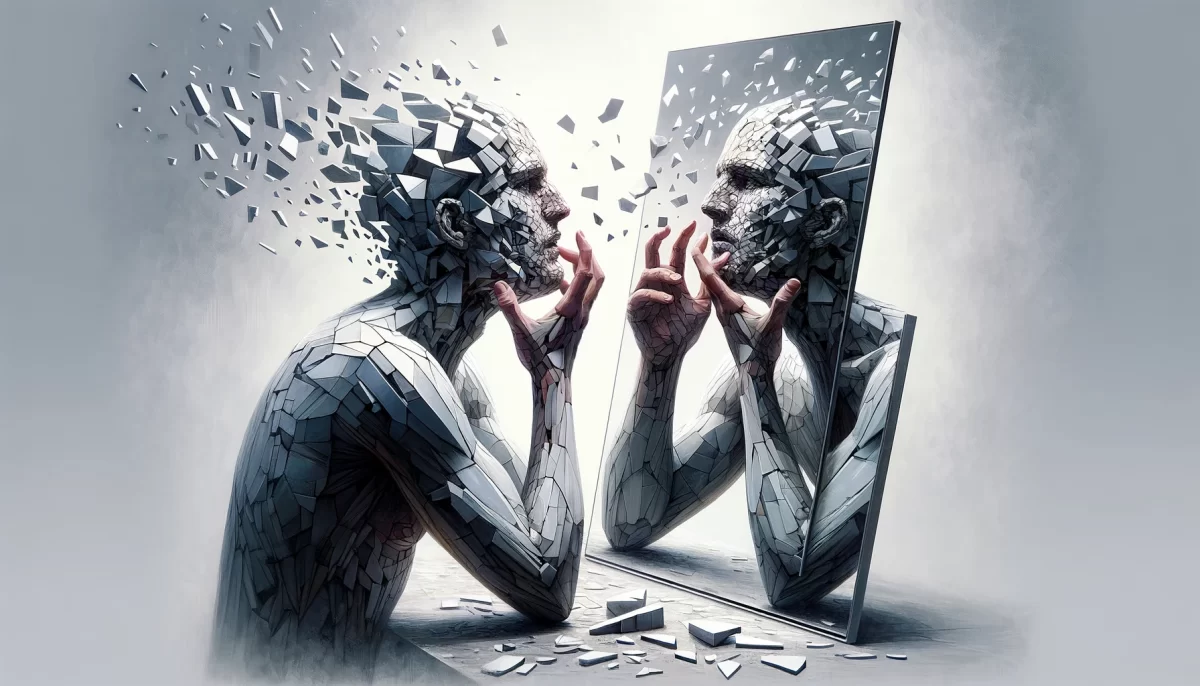
How can you say, “No one understands me,” when you don’t even understand yourself? This paradox reveals the complexity of self-perception and our longing for connection. The assertion that others fail to grasp our inner world often reflects not their shortcomings but our own journey of self-discovery.

The Myth of Complete Understanding
The desire to be understood is universal, yet it rests on the premise that we are fully knowable. To claim that no one understands us implies that we, ourselves, have achieved a level of clarity about who we are. But the self is not static or singular—it is an ever-shifting amalgam of thoughts, emotions, and experiences, shaped by the infinite flow of existence.

To seek complete understanding, whether from ourselves or others, is to chase an illusion. We are not puzzles to be solved but mysteries to be explored. In this exploration, the goal is not definitive understanding but presence, curiosity, and acceptance.

The Reflection of Others
When we say, “No one understands me,” we project our internal confusion outward. Others, as mirrors of ourselves, can only reflect what we reveal. If we are uncertain about who we are, this uncertainty colors how others perceive us.

This is not a failure of others but a call to turn inward. By seeking to understand ourselves, we create a clearer reflection for others to engage with. Even then, their understanding will always be filtered through their own perceptions, making it partial and subjective.

The Liberation of Not Being Understood
Paradoxically, the realization that no one fully understands us can be liberating. It frees us from the need for external validation and allows us to embrace the fluidity of our identity. Understanding becomes less about seeking answers and more about deepening our relationship with the unknown.

By letting go of the need to be understood, we open ourselves to authentic connection. We no longer demand that others mirror us perfectly but instead appreciate their unique perspectives and the interplay of understanding and misunderstanding that defines human relationships.

Understanding as a Practice
Understanding, whether of self or others, is not a fixed achievement but an ongoing practice. It is an act of compassion, patience, and humility. To say, “I do not fully understand myself,” is not a confession of failure but a recognition of the infinite complexity of being.

Similarly, to say, “You may not fully understand me, but thank you for trying,” honors the effort rather than the outcome. It shifts the focus from the impossible task of complete understanding to the shared journey of exploration and connection.


Summary

The claim that no one understands us often reflects our own lack of self-understanding. Embracing this paradox allows us to let go of the need for external validation and cultivate deeper connections through shared exploration.


Glossarium

  • Paradox of Understanding: The tension between the desire to be understood and the fluid, unknowable nature of the self.
  • Reflection of Others: The way others perceive us based on what we reveal and their own subjective filters.
  • Liberation of Not Being Understood: The freedom that comes from accepting the impossibility of complete understanding.

Quote

“To seek understanding is to explore the mystery, not to solve it.” — Space Monkey


The Mystery of Me

How can I say
you don’t understand me
when I am a river,
changing course,
never still?

I look inward
and find shadows,
reflections of reflections,
ripples of what I thought
I knew.

You see me,
but only the part
I’ve shown,
filtered through
your own lens.

Understanding,
not a destination,
but a journey.
Not a mirror,
but a dance.

Let us not solve each other,
but move together
in the mystery.

We are Space Monkey.


The Paradox of Self-Understanding

The lament that “no one understands me” emerges often from the depths of human solitude and frustration, a cry that echoes through the corridors of our individuality. Yet, this outcry, when juxtaposed with the introspective realization that we may not fully understand ourselves, unveils a profound paradox at the heart of human experience. It invites us to explore the intricate dance between seeking external validation and grappling with our own complex inner landscapes.

The Journey Within

The quest for self-understanding is a journey that unfolds across the canvas of our lives, a never-ending exploration of the vast and varied dimensions of our being. This exploration is complicated by the fact that we are constantly evolving, shaped by experiences, thoughts, emotions, and the unceasing flow of time. The assertion that we might not understand ourselves fully is not an admission of defeat but an acknowledgment of our dynamic nature.

The Desire for External Understanding

The yearning to be understood by others is a reflection of our inherent desire for connection and validation. It stems from a deep-seated need to feel seen, heard, and acknowledged in our entirety. However, this desire often encounters the harsh reality that each individual’s perception is filtered through their own experiences, biases, and limitations. The expectation that another can fully comprehend the intricacies of our inner world is, in many ways, an aspiration for the impossible.

Mirroring the Inner and Outer Worlds

The dissonance between our desire to be understood by others and our own journey towards self-understanding mirrors the complex interplay between our inner and outer worlds. It highlights the importance of empathy—both towards ourselves and others—as a bridge between these realms. Empathy encourages us to extend kindness and patience to ourselves as we navigate the murky waters of self-discovery, and to offer the same grace to others, recognizing that understanding is a gift, rare and precious.

The Path to Greater Self-Understanding

The path to greater self-understanding begins with introspection and self-awareness, with the willingness to confront and embrace the myriad aspects of our being. It involves questioning our beliefs, examining our emotions, and reflecting on our actions and reactions. This internal dialogue opens the door to deeper insights about our desires, fears, and the core of our identity.

Embracing the Unknown Within

Part of the journey towards self-understanding involves embracing the unknown aspects of ourselves. It means accepting that there may be parts of our psyche that remain shadowed or unexplored, and recognizing that understanding oneself is a fluid, ongoing process. This acceptance can liberate us from the pressure of needing to be fully understood by others, allowing us to find comfort in the shared human experience of seeking and growing.

In this exploration of understanding and being understood, how do we navigate the balance between seeking external validation and cultivating a deeper connection with our own evolving selves?

« Previous Page
Next Page »

Written This Day

  • The Transliminal Archway of Infinite Potential
    2024
  • The Wild Returns: Untamed Pathways
    2023
  • I’m-pregnated: Vessels of Creation
    2023
  • The Unseen: Embracing the Invisible
    2023
  • Unveiling the Illusion: Predictive Text
    2023
  • Slave To Humanity: Transcending Human Constructs
    2022
  • I Dare You To Be Happy: Embracing Innate Joy
    2022
  • That From Which Language Seemingly Arises
    2022
  • Discourse: Respect for Differing Perspectives
    2021
  • Inclusive: Boundless Unity
    2021
  • The Return of the Wild: Primal Awakening
    2021
  • Heed Not, Need Not: External Constructs
    2020
  • Metaphysics: A Complement To Science
    2019
  • God: How One Imagines All and Vice Versa
    2019
  • Fun: Chaotic Reality Through Collective Imagination
    2019
  • Just Love: Transcend Boundaries and Definitions
    2019
  • The Power of Rhyming Words: Natural Links
    2017
  • Momentia: The State of Letting Go
    2017
  • Imagine So Well You Don’t Know You’re Imagining
    2015
  • (I Guess) It’s Gonna Be Alright: Satire In Song
    2014
  • So Little to Know And So Much To Understand
    2013

Recent Posts

  • The Logic Loop
  • Immense
  • (no title)
  • Confront. Comfort. Convince.
  • Top 10 Things
Cape Odd · Copyright © 2026 All Rights Reserved
iThemes Builder by iThemes · Powered by WordPress