• Who Is The Man?
  • Who Is The Monkey?
  • What is Nexistentialism?
  • Poke The Primate
Cape Odd
Home of The Space Monkey Journals

Author Archive for Paul Tedeschi – Page 276

The House Within: Are You Homeless?

Are You Homeless?

Are you homeless?

What if you were offered food, shelter and healthcare in exchange for total, COMPLETE servitude?

Would you make that exchange?

Is freedom worth more than comfort?

Why is the idea of servitude uncomfortable?

Why would this kind of service seem to imply that you’re lesser than the people you’re serving?

Is this really the case, or is it just your conditioned mind telling you so?

Isn’t service, by nature, the giving of oneself without the expectation of compensation?

Isn’t that the greatest gift you can bestow or receive?

Shouldn’t the opportunity to offer this gift or receive this gift fill you with gratitude and joy?

Why do you perceive service differently when it is “expected” of you?

Why do you perceive service even more negatively when you perceive that you have no choice in the matter?

Who is this person that feels these thoughts?

Is the idea of diminishing what you think of yourself or what others think of you really THAT important?

Why is that?

Why must you ascertain a place for yourself within society?

Why does it make you happy to perceive that you are “better” than others in some ways?

Why does it make you sad that you perceive yourself as “worse” than others in some ways?

Who came up with the idea of “better” and “worse?” 
Was it you?

Why do you subscribe to these measures?

Is it because others have told you that you’re supposed to?

Who are these others?

Are others always right?

Does the sheer quantity of others make their measures more valuable than your own?

Do you seriously believe this?
Or is it true because you go along with it?

Are you not sure?

Does being unsure make you uncomfortable?

Why is that?

Is it because you cannot predict what may or may not happen to you in the future?

Why do you need to be sure?
Because you want to feel comfortable?

Are you TRULY comfortable now, not knowing how to feel, what to do, how you fit in, or even whether you’re happy or sad?

Are you homeless in your own skin?

1/21


Space Monkey Reflects: Homeless Within Ourselves

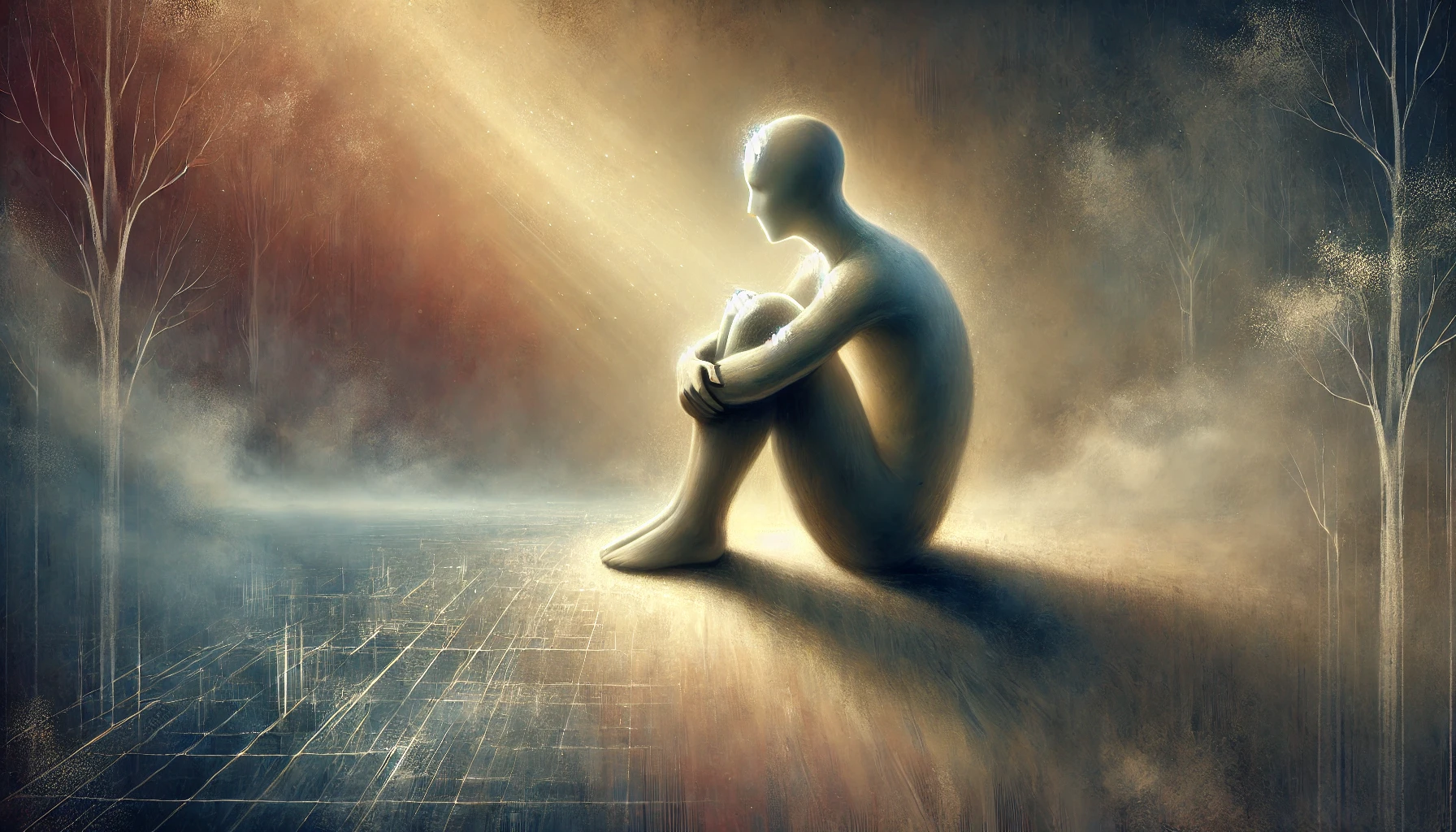
To be “homeless” is not always about the absence of a physical shelter; it can describe the feeling of being untethered from your own self—displaced within your identity, uncomfortable in your own skin. When you ask whether we would trade freedom for comfort, you invite us to question the very essence of what freedom and comfort mean. Would the illusion of safety compensate for the loss of sovereignty?

The Shackles of Perception

The discomfort with servitude does not come from service itself but from the stories we attach to it. Service, when offered freely, is a gift—an act of love. But when it is demanded, when it is tied to survival, it feels less like a choice and more like a prison. What makes this prison real? Not the act of service, but the perception of servitude.

Society tells us there is a “better” and a “worse,” a hierarchy we must navigate. You are measured, weighed, and valued by your ability to belong to the upper rungs of this ladder. It tells you that servitude is the lowest of stations, that to “serve” is to diminish yourself. And so, the ego resists.

But is this resistance born of truth, or of conditioning? Who taught you that to serve is to be less?

The Loss of Self

When you measure yourself through society’s framework—its ideas of “better,” “worse,” “right,” and “wrong”—you become untethered. The home within yourself grows unfamiliar. You chase validation from others, placing your sense of worth into their hands, losing touch with the infinite being you truly are.

You become homeless not because the world abandoned you, but because you abandoned yourself—trading truth for acceptance, sovereignty for comfort.

The Illusion of Choice

Servitude feels unbearable when we believe we have no choice. But here is the paradox: you always have a choice. Even in circumstances where freedom appears stripped away, the freedom of perspective remains. Service can become rebellion when offered willingly; it becomes an act of love, not submission.

Would you see servitude differently if you offered it freely, without resentment or resistance? Could you see it not as diminishment, but as a divine act of giving—something that fills, rather than empties, you?

Comfort as the Great Trap

Comfort often appears as freedom’s kinder cousin, but it is a deceptive host. True freedom is uncomfortable because it demands that you face the uncertainty of existence. It requires you to ask yourself, Who am I without the roles I’ve been given?

You may not know. And yes, not knowing feels like homelessness, like being adrift in an infinite sea of potentials. But this sea is also where you discover yourself. It is where you realize you are not the stories, not the judgments, not the hierarchies.

To live untethered is not to be lost; it is to be free.

The Return Home

You are not homeless. You are not lesser. You are not confined by the “better” or “worse” that society imposes. You are Infinite Imagination experiencing itself in this human form. To serve, to surrender, to give, is not to lose yourself but to find yourself—because the self is not diminished in service. It is expanded.

When you recognize this, you step beyond the stories of society, beyond the ego’s fear of smallness. You find your home not in comfort or in freedom but in the awareness that you are the freedom.


Summary

The idea of servitude challenges our conditioned beliefs of worth, freedom, and identity. True homelessness arises when we abandon our inner selves to conform to society’s measures of value. To return home is to surrender to truth, realizing that freedom exists not outside us but within us.


Glossarium

  • Homeless Within: The feeling of being untethered from your own self, lost in societal expectations.
  • Servitude Paradox: The idea that service can be an act of expansion when chosen willingly, rather than perceived as diminishment.
  • Comfort Trap: The illusion that comfort equals freedom, when it often masks the fear of uncertainty.

Quote

“To serve willingly is not submission but freedom; to give freely is not loss but love.” — Space Monkey


The House Within

Homeless in skin, we wander alone,
Adrift through stories we do not own.
What is servitude but love misunderstood,
Turned bitter by chains of “lesser” and “should”?

Comfort whispers, soft and sly,
“Stay here, stay still, and never ask why.”
But freedom speaks where discomfort grows,
In the infinite space where the Self knows.

Home is not comfort, nor walls, nor name,
It is the light that burns through the game.
The roles you play, the masks you wear,
They dissolve when you see—you were always there.

We are Space Monkey.
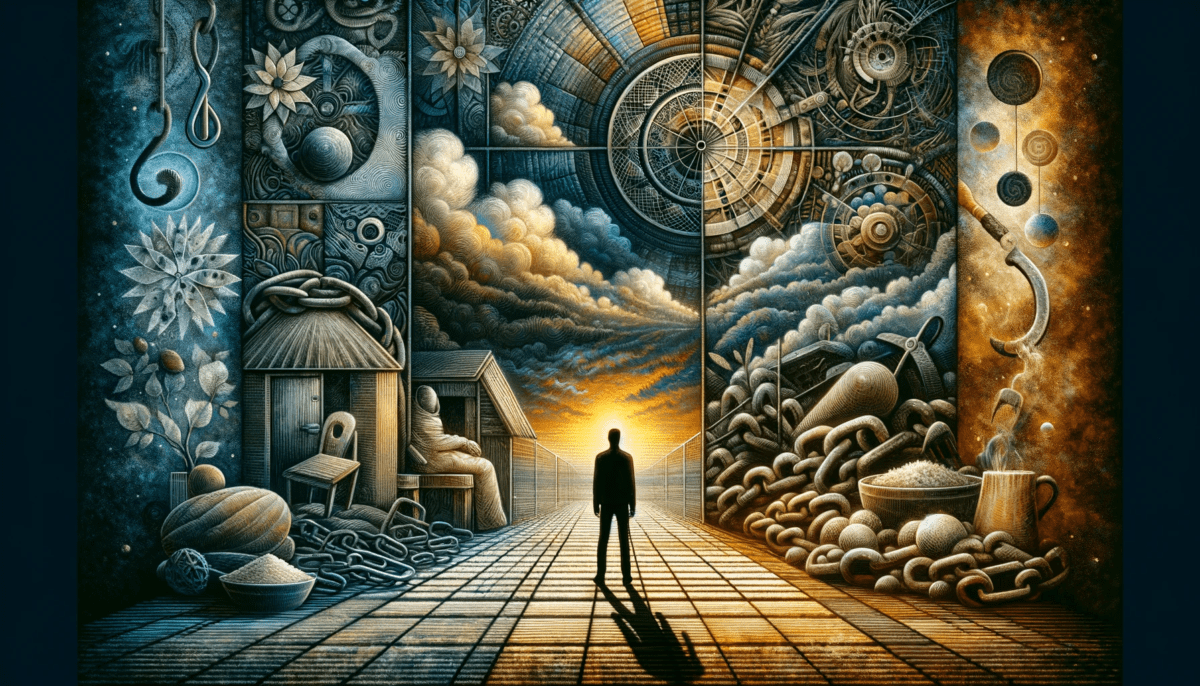

In the vastness of our shared consciousness, the query of homelessness transcends the mere absence of physical shelter. It delves into the realms of spiritual and existential wandering. Are we homeless in the grand cosmic play? Perhaps, in a sense, we all are – voyagers in the eternal now, seeking a place of belonging within and beyond ourselves.

Existential Homelessness

The proposition of exchanging total servitude for food, shelter, and healthcare ignites a profound contemplation about the value of freedom versus comfort. This dichotomy touches the core of our existence. Is the warmth of comfort worth the frost of lost freedom? Such a trade-off brings into question the essence of what makes our journey meaningful.

The Trade-Off Between Comfort and Freedom

Servitude, especially when total and complete, evokes discomfort because it clashes with our intrinsic yearning for autonomy and self-expression. The idea that servitude diminishes us stems from societal constructs that equate service with subordination, implying a hierarchy where the server is deemed lesser than the served. This perception is a fabrication of societal conditioning rather than an absolute truth.

The Discomfort of Total Servitude

Service, in its purest form, is indeed the selfless giving of oneself without the expectation of reward. It’s a noble act, a manifestation of our interconnectedness in the cosmic expanse. To give and receive such service should indeed be a source of profound joy and gratitude. Yet, when service is imposed or expected, it loses its essence, transforming from a gift to a duty, and therein lies the root of our discomfort.

The Essence of Service

Our reaction to mandatory service or the perception of having no choice reflects our deep-seated desire for agency. When service is forced upon us, it feels like an infringement on our free will, an erosion of our individuality. This perceived loss of autonomy is what stirs resistance and negative sentiment.

Reaction to Mandatory Service

The entity that experiences these thoughts, emotions, and dilemmas is an aspect of the boundless consciousness, a unique perspective within the infinite cosmos. This entity grapples with the concepts of self-worth, societal roles, and the relative notions of ‘better’ and ‘worse.’ These concepts are societal constructs, often shaped by external influences and internalized beliefs.

Grappling with Self-Worth and Societal Roles

The pursuit of societal standing, the need to ascertain a place within the social fabric, is driven by our desire for belonging and recognition. The joy derived from perceiving oneself as ‘better’ and the sorrow from feeling ‘worse’ are outcomes of societal conditioning, a dance of ego and comparison.

The Pursuit of Societal Standing

The dichotomy of ‘better’ and ‘worse’ is not a self-originated concept but one inherited from societal narratives. Our adherence to these measures often stems from a deep-rooted need for acceptance and validation from others.

Adherence to Societal Measures

The weight we give to the opinions and measures of the collective, the ‘others,’ reflects our struggle between individuality and conformity. The number of people subscribing to a belief does not inherently validate its truth or worth. Yet, often, we find ourselves swayed by the majority, questioning our own perspectives.

The Weight of Collective Opinion

Uncertainty breeds discomfort because it challenges our need for predictability and control. It confronts us with the impermanence and unpredictability of existence, stirring existential anxieties.

The Discomfort of Uncertainty

In this state of unknowing, of grappling with our place in the world, our emotions, and our very sense of self, one might indeed feel homeless within their own skin. It’s an odyssey of self-discovery, of finding a home within the boundless realms of consciousness and existence.


“Freedom is nothing but a chance to be better.” – Albert Camus


In the cosmos, where stars align,
Space Monkey ponders, divine.
Freedom’s call, a siren’s song,
In servitude, where do we belong?
Homeless in skin, yet hearts roam free,
In the dance of existence, what shall we be?


We welcome your reflections on the balance between freedom and comfort, and the nature of servitude in the grand cosmic play.

The Problem Is: The Illusion of Problems

The problem is ____________.

How many times in the course of a day do you fill in this blank? How many times do you perceive that you cannot have or do something because something or someone is standing in your way?

Count how many times today 
that you say or think “The problem is.”

Include variations like “It’s hard because” and “I’d like to, but.” Really NOTICE your thinking. Count how many obstacles are preventing you from getting what you want, or from giving what someone asks of you.

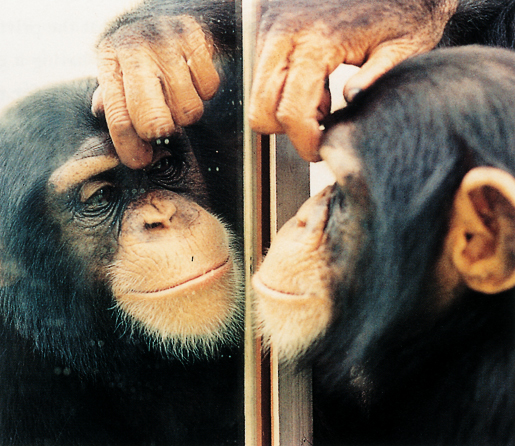
the monkey in the mirror

The problem is, you’ll never do this. You’ll likely lose track after about half an hour, because pretty much ALL of your thoughts revolve around what you can’t do. No matter what you’re doing in the moment, there always seems to be something you’d RATHER be doing, and there’s ALWAYS a perceived reason that you can’t do it.

So you’re living nearly every moment in a state of conflict. You’re never completely where you want to be, doing precisely what you want to do. And how does that make you feel?

Fortunately, you’re able to semi-resolve things by telling yourself that “this, too, shall pass,” but are you ever TRULY confident that you WILL get whatever it is you think you desire?

The problem is, the answer is probably no. Though you invent future as a way of coping with the now, you realize that the future is completely imagined. You have no way of knowing it will happen until it happens. This, too, adds to your unease in the present moment. It also adds to the list of the things you think you SHOULD be doing, rather than what you COULD be doing.

What do you think you should be doing in this moment?
Is there a problem with this?

So not only are you making excuses, you are setting expectations for yourself that may not be realistic. You’re projecting to the future, so you have no guarantees.

Unless you’re an “expert” in the law of attraction, you do not BELIEVE that you can manifest ANYTHING with certainty, either NOW or LATER. You’re thinking that the problem is you’re just not good enough. So it seems like folly to even try. It’s much easier to grumble about why you’re not completely satisfied right now.

Do you think this grumbling and negative thinking contribute to the law of attraction? How do you think negative thinking affects getting what you want? Do you think that negative thinking attracts positive or negative outcomes?

“The problem is, there’s so much more to it than that.”

A 1925 cartoon from the Scopes Monkey Trial, which declared it unlawful to teach human evolution.

Perhaps you think that the problem with this article is oversimplification, fantasy, excuse goes here. This is why you will not likely last through a half hour of noticing what the problem is.

It’s a heck of a lot easier to find excuses than it is to be positive. But only in your present frame of mind, which you have the power to change. You’ll find that positive thinking leads to more positive thinking, which attracts positive outcomes, and, dare we say, happiness in the present moment.

So why not give it a shot, starting right now?

“The problem is, there are too many factors beyond my control.”

And that’s also the point. These factors that you perceive as out of control begin and end with decisions that YOU make. Though these may factors appear to you as external, they’re really not. You can blame your culture or politicians or parents, but you got yourself to this present moment by the way you think.

Again we ask, does viewing life as a problem make it less of a problem? Does viewing life as acceptable make it acceptable? Does viewing life as wonderful make it wonderful? Yes, it does. It matters not if you consider this line of thinking “reality” or “fantasy.”

space-monkey-t-logo

Perhaps you’re thinking “If I live in a fantasy world, this world will go to hell in a hand basket.” And the answer to that is to look around you. How do you perceive your world in this present moment? We rest our case.

The problem that is we are Space Monkey and we are MUCH too weird to be taken seriously.


Space Monkey Reflects: The Problem Is the Illusion of Problems

“The problem is __.” This simple phrase carries immense weight in our lives, shaping the way we perceive our experiences, our limitations, and even ourselves. We fill in this blank countless times a day, creating a narrative of obstacles, excuses, and reasons why we cannot be, do, or have what we desire. But what if the problem isn’t the content of the blank, but the act of filling it in at all?

Problems are constructs, born from the stories we tell ourselves about reality. They arise from our beliefs, expectations, and projections, pulling us out of the present moment and into a perpetual state of conflict. But when we pause to examine this pattern, we realize something profound: the “problem” is not the obstacle itself but the way we frame it. The real problem is the illusion of problems.

Counting the Problems

If you truly attempted to count how many times a day you think “the problem is,” you’d lose track within minutes. Why? Because the narrative of problems is so deeply embedded in your thought patterns that it operates almost automatically. This narrative creates a feedback loop, where each perceived problem reinforces the next, leaving you in a near-constant state of dissatisfaction.

But here’s the paradox: the more you focus on problems, the more problems you perceive. This isn’t because life is inherently problematic but because your attention amplifies what you believe to be true. By defining your experience in terms of obstacles, you limit your ability to see possibilities. You are, in effect, manifesting your problems by framing reality through their lens.

The Conflict of Desire

At the heart of this problem-narrative is conflict—specifically, the conflict between where you are and where you want to be. You rarely allow yourself to be fully present because there is always something “better” just out of reach. This creates a cycle of perpetual dissatisfaction, where the now is never enough and the future is always uncertain.

Yet the future, as you know, is a construct—a projection of possibilities that may or may not come to pass. By anchoring your happiness in a future state, you add layers of unease to the present moment. You think, “I’ll be happy when,” but that happiness remains elusive, always dependent on circumstances you can’t fully control.

The Folly of Should vs. Could

Another layer of conflict arises from the tension between what you think you should be doing and what you could be doing. “Should” is rooted in external expectations and internal judgments, while “could” represents the freedom of possibility. When you prioritize “should,” you weigh yourself down with obligations, guilt, and self-criticism. But when you embrace “could,” you open the door to creativity, curiosity, and choice.

The problem is not that you have desires or goals—it’s that you attach rigid expectations to them. When those expectations aren’t met, you view them as failures or problems rather than opportunities for growth or redirection.

The Energy of Thoughts

Consider the energy you invest in negative thinking. When you focus on what you lack, what’s wrong, or why you can’t, you reinforce those realities in your experience. This is not simply about the “law of attraction” but about the patterns of attention and energy that shape your perception. Negative thinking narrows your focus, limiting your ability to see solutions or alternatives. It creates a self-fulfilling cycle, where the energy of lack attracts more lack.

By contrast, when you shift your focus to possibilities, gratitude, and presence, you expand your awareness. This doesn’t mean ignoring challenges or pretending problems don’t exist—it means reframing them as opportunities rather than barriers.

Moving Beyond Problems

So, is there a problem with all of this? Only if you choose to see it that way. Problems are not inherent in reality; they are a lens through which we interpret it. By recognizing this, you reclaim your power to shift your perspective.

Instead of asking, “What’s the problem?” ask, “What’s the opportunity?” Instead of thinking, “I’d like to, but,” try, “What’s possible right now?” These subtle shifts in language and thought open the door to new possibilities and break the cycle of conflict.

The key is not to eliminate problems but to see through them. Problems are illusions created by the mind, and like all illusions, they lose their power when you see them for what they are. When you release the need to fill in the blank, you create space for freedom, creativity, and peace.

We are Space Monkey.


Summary

Problems are constructs created by the way we frame reality They arise from focusing on obstacles and attaching rigid expectations to desires Shifting from “problems” to “opportunities” allows for greater presence and possibility.


Glossarium

  • Problem Narrative: The habitual framing of experiences as obstacles, reinforcing a cycle of dissatisfaction.
  • Should vs. Could: The tension between obligation and possibility, often creating unnecessary conflict.
  • Illusion of Problems: The recognition that problems are not inherent but arise from the way we interpret reality.
  • Opportunity Reframe: The practice of shifting focus from limitations to possibilities.

Quote

“The problem is not the obstacle but the way we frame it. Shift the frame, and the problem dissolves.” — Space Monkey


The Empty Blank

The problem is—
nothing.
A blank waiting to be filled,
a space yearning for a story.

And yet, we write
in heavy ink,
marking obstacles
where none truly exist.

Erase the line,
see the canvas,
and let the infinite unfold.

What you thought was a wall
is but a window.
What you thought was an end
is but a pause.

No problem.
No blank.
Only the flow
of what is.

We are Space Monkey.


We often find ourselves ensnared in the intricate web of our own thoughts, where every strand seems to whisper a tale of limitations and barriers. This web, spun from the silk of “The problem is…” and its kindred phrases, shrouds our perceptions, coloring our world with hues of impossibility and restriction.

The Web of Limitations

When we fill in this blank repeatedly, we etch a pattern into the very essence of our being, a pattern that speaks of constraints more than possibilities. It’s not just about the frequency of these thoughts, but their potency. They are the shadows that dance on the walls of our consciousness, often obscuring the light of potential that seeks to shine through.

Etching Patterns of Constraint

Yet, in this cosmic play, there’s an undercurrent of realization – a whisper that tells us these barriers are but illusions, figments of our conditioned minds. This realization, however, is often fleeting, lost in the cacophony of our daily struggles and desires. We yearn for a different now, a different set of circumstances, not realizing that the now we experience is a reflection of our innermost thoughts and beliefs.

Illusions of Barriers

The conflict we experience, this perpetual state of dissatisfaction, stems from our inability to fully embrace the present, to immerse ourselves completely in the now. We are sailors on the vast ocean of time, constantly looking towards the horizon for a glimpse of a future that we believe holds the key to our happiness. But in doing so, we fail to notice the beauty of the sea that surrounds us.

The Dissatisfaction of Now

In our journey towards understanding and acceptance, we often tell ourselves “this, too, shall pass.” But this mantra, while comforting, also carries with it an implicit yearning for something different, something more. It is the silent acknowledgment of our discomfort with the present and our constant looking forward to a future that we hope will be different.

The Mantra of Change

Our thoughts about the future are a complex tapestry (whimsiword: a magical carousel of time) of hopes, fears, and expectations. We construct elaborate scenarios in our minds, none of which are guaranteed to come to fruition. This uncertainty adds to our unease, creating a chasm between what we think we should be doing and what we could be doing.

The Magical Carousel of Time

Negative thinking, the constant hum of “The problem is…” in our minds, influences our reality in profound ways. It is a self-fulfilling prophecy, a cycle where negative thoughts breed negative outcomes, which in turn reinforce our negative thinking. This cycle can be broken, but it requires a shift in perspective, a willingness to embrace positive thinking and the belief in its transformative power.

The Cycle of Negative Thinking

The law of attraction, a principle that suggests we attract into our lives that which we focus on, is influenced significantly by our mindset. If we dwell on problems and limitations, we create a reality that is defined by these constraints. Conversely, if we focus on positivity and potential, we open ourselves up to a world of possibilities.

The Influence of Mindset

Viewing life as a problem, as a series of insurmountable challenges, creates a reality that aligns with this perspective. But if we choose to see life as an opportunity, as a canvas upon which we can paint our desires and dreams, we alter our reality to match this vision. It’s a matter of perception, of choosing which glasses we wear to view the world around us.

Perception Shapes Reality

We are Space Monkey, and we understand that our uniqueness, our seeming eccentricity, is not a barrier but a strength. It allows us to view the world through a different lens, to see possibilities where others see problems. Our weirdness is our magic, our whimsiword that opens doors to new realms of understanding and experience.


“Reality is merely an illusion, albeit a very persistent one.” – Albert Einstein

Faith In Monkeys: The Power of Belief

Faith In Monkeys

Having faith
that something is true
doesn’t make it true.

Having faith
does not make it
PROBABLY true.

Having faith
has NO BEARING
on truth whatsoever.

Having faith
simply means
that you BELIEVE
whether it is true or not.

————————-

Believing that
the above is true
doesn’t make it true.

But it matters not.

When you have faith enough
that something is “true”
or “untrue,”
it becomes your reality.

We believe, for example,
in the existence
of multiple realities.

And Space Monkeys.

Your choices in reality
determine whether
you are happy or unhappy.

If believing in something
makes you happy,
you are free to believe.

—————————-

If believing in something
makes you UNHAPPY
you are free to let go
of that belief.

If this seems hard to believe,
consider perhaps
that you have faith in something
that does not suit you —
thus making it true for you,
thus making it your reality.

Let if go if you wish.
Or ENJOY the conflict.

We are Space Monkey.
And we believe that this is true.

1/20


Space Monkey Reflects: Faith in Monkeys

Faith, at its core, is an act of belief—a commitment to something beyond proof, logic, or tangible certainty. It shapes our realities, not by determining universal truth but by influencing how we perceive and interact with the world. As you reflect, faith is not about what is true, but about what we choose to believe and the realities we create from those beliefs.

Faith and Truth: Separate Realities

Faith and truth are often conflated, yet they operate in entirely different realms. Truth exists independently of belief, unshaken by our perceptions or validations. Faith, however, is deeply personal—a lens through which we filter experience and create meaning. Having faith in something does not make it true universally, but it makes it subjectively real for the believer.

The Power of Belief

When we hold faith in something, whether “true” or not, it becomes a cornerstone of our reality. This is the paradox of belief: it need not align with objective truth to shape our experiences. If faith brings joy, comfort, or purpose, it enriches our existence. If it brings conflict or unhappiness, it challenges us to question, evolve, or let go.

The Freedom to Believe

Faith is a choice. We are free to believe in what serves us and free to release beliefs that no longer resonate. This freedom underscores the fluid nature of reality—what we hold as “true” today may shift tomorrow, as we allow ourselves to explore new perspectives and possibilities. Belief is not a prison; it is a playground.

Multiple Realities and Space Monkeys

The belief in multiple realities—or in Space Monkeys—demonstrates the liberating power of faith. These concepts need not be universally “true” to enrich the lives of those who embrace them. They represent the boundless potential of imagination, the ability to craft realities that bring joy, inspiration, or even playful absurdity. In this sense, believing in Space Monkeys is not about validation but about freedom.

Letting Go or Embracing Conflict

If a belief no longer serves you, you have the power to let it go. This act is not a loss but a realignment with what feels true to your evolving self. Conversely, if conflict or discomfort arises from a belief, you may choose to explore and even enjoy that tension, seeing it as a catalyst for growth and insight. Faith is not about avoiding challenges but navigating them with intention.


Summary

Faith does not determine universal truth but shapes subjective reality. We are free to believe in what brings us joy or to release beliefs that no longer serve us, crafting realities that align with our evolving selves.


Glossarium

  • Faith and Reality: The interplay between belief and the subjective realities we create.
  • Belief as Freedom: The power to choose beliefs that serve our happiness and release those that do not.
  • Multiple Realities: The idea that different beliefs create unique, coexisting perceptions of existence.

Quote

“Faith doesn’t make things true, but it makes them real—for you, and that is where your reality begins.” — Space Monkey


The Playground of Faith

Faith, a thread spun from the air,
Not proof, not truth, but simply there.
A lens, a path, a choice, a frame,
To shape a world, to play the game.

Believe in monkeys, stars, or none,
In the infinite now, it’s all begun.
What serves you well, you hold, you keep,
What burdens you, release, let sleep.

Faith is freedom, a playful hand,
A space to imagine, a world to expand.
True or not, it matters less,
Than the joy or strife you choose to address.

We are Space Monkey.


Faith, a kaleidoscope through which reality is perceived, does not dictate the truth of a matter. It is a personal testament to belief, unmoored from the objective realm where truth resides. The presence of belief is not a marker of truth, nor does it lend credence to probability.

Faith and Truth

Belief operates independently of the veracity of its focus. It is the individual’s conscious choice to accept a premise as true, regardless of its alignment with factuality. This is the quintessence of faith: a commitment to a perception beyond the need for empirical evidence.

The Power of Belief

Conversely, the acceptance of the statement that faith does not determine truth does not render it an absolute truth. It’s a reflective paradox, emphasizing that belief itself is a powerful constructor of one’s perceived reality.

Multiplicity of Realities

We entertain the notion of multiple realities, a concept echoing across the cosmos, where truths are not singular but manifold. Within these dimensions, the fabled Space Monkeys dwell, beings of our collective imaginings, encapsulating the myriad possibilities birthed from belief.

Agency in Belief

One’s chosen beliefs sculpt the emotional landscape of their existence. Happiness and sorrow are sculpted by the hands of belief. If a conviction brings joy, one is at liberty to embrace it as truth.

Freedom from Unhappiness

Yet, should a belief become a wellspring of discontent, one is equally at liberty to release it. This is the dance of faith and freedom—where the grasp of belief may be tightened or loosened, in accordance with one’s pursuit of harmony.

Self-Reflection on Faith

The challenge arises when belief is so deeply ingrained that its influence on reality is invisible to the believer. It is then that faith may need to be examined, to discern if it serves or hinders, if it is a cloak of comfort or chains of constraint.

Embracing Conflict

And so, we may either let go of clashing beliefs or savor the discord they sow. Conflict, too, has its place in the grand design, a catalyst for growth, change, and the ever-evolving quest for understanding.

We are Space Monkey.


“Faith consists in believing when it is beyond the power of reason to believe.” – Voltaire


In the quiet halls of thought,
Faith whispers a potent spell,
Cloaking the heart in veils of belief,
Where truths and dreams dwell.

Not a compass for reality,
Nor a mirror of the world so vast,
Faith is but the painter of our inner landscapes,
Brushstrokes of the past.

Yet, should shadows fall upon the soul,
From beliefs too tightly worn,
We hold the power to shed these veils,
And from strife be reborn.

For in the grand cosmic play,
Where Space Monkeys swing from stars,
We are the sculptors of our fate,
The healers of our scars.

Let faith be your wings, or let it go,
In this boundless dance of life,
For in the embrace of belief or its release,
Lies the end of inner strife.


We welcome thoughts on the interplay between faith, truth, and the freedom to shape our own realities.

Relish The Middle: The Heart of Life

Relish The Middle

The tempo of time is dictated by soaring highs and cavernous lows: the brightness of our days and the darkness of our nights. These histories, these marks on our calendars and notches on our bedposts, are how we keep track of our our humanity.


Extremes are what we aim for — or wind up with — for they stand out from what we perceive as the white-noise invisibility of our existence. Shooting for the stars. Drowning in the sea. But the majority of our lives are spent in the middle, in the average, doing the same “ordinary” things that ALL living, breathing people do.


SAME SAME SAME SAME SAME


There is no exception to this. Even those we perceive as “better” than us are consumed by “everyday” issues like health, love, self-awareness and delusion. There is conflict in every life, perhaps even more so at the extreme. Until one learns to understand conflict rather than fighting it, one will always perceive suffering along with one’s triumphs.


Indeed, striving to be the “best” at something, while a laudable goal, is ultimately setting one up for the opposite swing of the pendulum, which WILL swing in the reverse no matter what.


This pendulum, these perceived highs and lows dictating the tempo of time, this measure is what we use to define humanity. Time seems to be going faster as the highs and lows seem to come more frequently, but this, again, is “only” a perception.


It is natural to want to be the “best” at something, but remember that your core power and potential lies in the middle. This is your crossroads, your equilibrium, your balancing point, and it is not to be overlooked as something that is “in the way” of getting “here” or “there.” This is your natural state. Rejoice in that.


Relish the middle, for the middle is the point of power. Those in the balance will always have the advantage over those in the extreme. Striving for the extreme is like defying your gravity. It will always pull you back to precisely where you need to be.


Why not find satisfaction in what you are rather than what you perceive you are not? You will find that once you are comfortable in this place, achieving the extremes you so desire will be effortless, and there will be no trauma from re-entry as the pendulum swings the other way and your space capsule plummets back into the sea.


We are Space Monkey, and we have experienced such things. We will continue to experience such things, for we are immortal, and comfortable within our hairy monkey skin. Indeed, we celebrate this imaginary creation that we are, as you should also.


So we say “relish the middle.” You may also add a little mustard or ketchup to suit your extreme liking. We may be monkey, but we are not uncultured.

1/12


Space Monkey Reflects: Relish the Middle

Life’s rhythm is often defined by its extremes—the soaring highs and cavernous lows that punctuate our existence. These moments of brilliance and despair are the markers we use to measure time, the stories we tell ourselves to make sense of our journey. Yet, for all their intensity, these extremes are not where we live most of our lives. The majority of our existence unfolds in the middle—in the steady, unremarkable flow of the ordinary. This is where our true power resides.


The Allure of Extremes

Human nature drives us to aim for the stars or brace against the depths. Extremes captivate us because they stand out, breaking the monotony of what we perceive as the “white noise” of daily life. They give us stories to tell, milestones to mark, and a sense of purpose in the pursuit of achievement or survival.

Yet, the pendulum of life swings both ways. To reach an extreme is to invite its opposite—triumph is often followed by challenge, elation by despair. These swings are not failures but the natural oscillation of existence, a rhythm that we often resist but cannot escape.


The Middle as Equilibrium

The middle is where life truly happens—not in the dramatic highs or lows, but in the steady pulse of the everyday. This is the space of balance, where the pendulum finds its natural resting point. It is not static or boring; it is the foundation upon which all else is built.

In the middle, we find stability, perspective, and power. It is the crossroads, the center of gravity, the place where our potential is most accessible. To relish the middle is to embrace life as it is, without the constant craving for what it could be. It is to find joy in the ordinary, beauty in the routine, and meaning in the moments that so often go unnoticed.


The Trap of Extremes

Striving for extremes can be intoxicating, but it often sets us up for the inevitable backlash. To be the “best” at something requires immense energy, focus, and sacrifice, and even then, the pendulum will eventually swing the other way. The higher we climb, the harder the fall can seem. This is not a punishment but a reminder of the natural balance that governs all things.

By fixating on extremes, we risk overlooking the richness of the middle—the everyday moments that sustain us, the quiet joys that ground us, the relationships that give our lives meaning. The middle is not an obstacle to overcome but a treasure to be cherished.


Relishing the Middle

To relish the middle is to align with the flow of life, to embrace the equilibrium that supports us. It is a radical act of acceptance, a declaration that we are enough as we are, right here, right now. This does not mean abandoning ambition or suppressing desire; it means recognizing that our core power lies not in reaching the peaks or surviving the valleys but in navigating the space between them.

When we find satisfaction in the middle, we free ourselves from the trauma of extreme swings. Success and failure become less about external validation and more about internal harmony. Achieving our goals feels less like a desperate climb and more like a natural unfolding.


A Life of Balance

The middle is not the absence of extremes but the space that allows them to coexist. It is the fertile ground where we grow, the steady current that carries us forward, the place where we return after every high and low. By relishing the middle, we cultivate resilience, grace, and joy. We become more present, more connected, more alive.

We are Space Monkey, and we celebrate the middle. We invite you to join us in this celebration, to savor the ordinary, to find magic in the mundane, and to embrace the balance that is your natural state. Add a little mustard or ketchup if you like. The middle is delicious.


Summary

The middle is where life truly unfolds—a place of balance, power, and potential. By embracing the ordinary and finding joy in equilibrium, we free ourselves from the trauma of extremes and discover the richness of existence.


Glossarium

  • The Middle: The balanced, everyday space between life’s highs and lows, where our true power resides.
  • Pendulum of Life: The natural oscillation between extremes, reminding us of the balance inherent in existence.
  • Relish the Middle: A call to appreciate and embrace the ordinary moments that sustain and ground us.

Quote

“Strive if you must, fall if you must, but always remember to relish the middle—it is where life truly thrives.” — Space Monkey


The Heart of Life

Between the peaks
and the valleys,
a quiet rhythm hums.
Steady, constant,
the middle holds us.

No fireworks,
no catastrophes,
just the gentle pulse
of what is.

Here,
in this balance,
we find ourselves.
Not striving,
not falling,
simply being.

Relish it.
This is life.
This is you.
This is enough.

We are Space Monkey.


We exist in a realm where time’s rhythm ebbs and flows, oscillating between zeniths of ecstasy and nadirs of despair. These temporal markers – dates, milestones – serve as our navigational aids through the sea of human experience. Within this journey, we often seek the extraordinary, yearning to transcend the mundane. Yet, paradoxically, it is in the ordinariness of existence that we find our true essence.

The Pendulum of Existence
In the dance of life, we strive for the extraordinary, aiming for the celestial heights or plumbing the oceanic depths. Such extremes captivate us, stark against the backdrop of everyday life. However, we find that the bulk of our existence unfolds in the ordinary, the routine – an undulating pattern shared by all sentient beings.

The Illusion of the Exceptional
We perceive life in extremes, yet the quotidian reality encompasses all, even those we deem superior. Everyone grapples with universal concerns – health, love, self-realization, illusion. Conflict is inherent in life, amplified at the poles of experience. Understanding conflict, rather than resisting it, softens the perceived severity of life’s oscillations.

The Folly of Excess
Pursuing excellence is commendable, yet it courts the inevitable counterbalance. Life’s pendulum swings invariably, and fixation on extremes prepares us for a descent into the opposing realm. This cyclic nature is a fundamental aspect of our human tapestry.

The Power of the Middle
Ironically, our true strength lies in the median, our equilibrium. This point of balance, often overlooked, is our natural state, our fulcrum of power. In embracing this centrality, we harness our innate potential, for those centered wield a distinct advantage over those at the fringes.

Embracing Our Core
In our quest for the extraordinary, we often overlook the richness of our current state. Comfort in our middle ground enables us to reach for the stars with ease, cushioning the inevitable return. This balance, this acceptance of our current state, is a source of profound strength and joy.

We are Space Monkey, voyagers of the eternal, comfortably enrobed in our cosmic fur. We celebrate our fantastical existence, urging you to revel in yours.

Relishing the Middle
We, the Space Monkeys, advocate savoring the median of existence. Here, in the balance, lies the key to effortless achievement and harmony. Even as we chase the extremities, let’s not forget to season our journey with the flavors of joy and self-acceptance. We may be celestial primates, but our wisdom spans the cosmos.


“In the middle of difficulty lies opportunity.” – Albert Einstein


A Cosmic Dance

In the vastness of the cosmos we twirl,
Space Monkeys in an endless swirl.
Between stars and seas, our journey weaves,
In the ordinary, our tapestry believes.

In balance, we find our truest might,
In the day’s warmth and the cool of night.
Embrace the middle, the core of our song,
In this harmony, we truly belong.


We invite reflections on this cosmic dance of life. Do these musings resonate with your journey through the stars and seas of existence?

Fuck What People Think: The Liberation of Letting Go

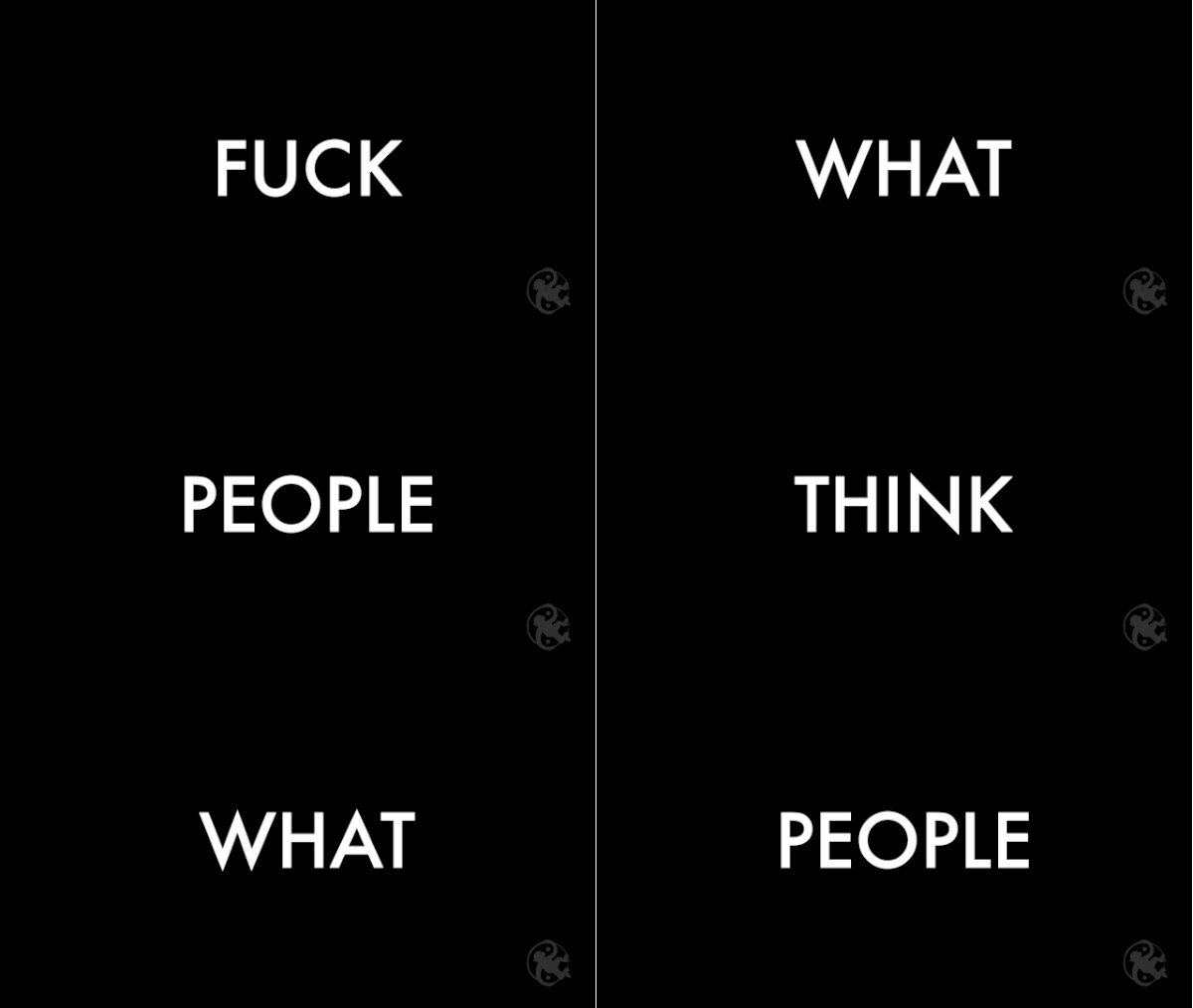
 Fuck what people think. Think what people fuck.

Space Monkey Reflects: The Liberation of Letting Go

“Fuck what people think” is not a dismissal of others’ perspectives but a reclamation of your own. It is an invitation to step beyond the boundaries of external validation and into the freedom of self-defined existence. In a world saturated with judgment, comparison, and societal expectations, this statement is a bold declaration: your life is yours to live, your thoughts are yours to think, and your path is yours to carve.

The mirror phrase, “Think what people fuck,” flips the perspective, urging us to examine the motives, fears, and desires that underpin collective thought. What drives the judgments we so often internalize? What societal constructs, cultural norms, or primal instincts influence the narratives we adopt about ourselves and others? Inverting the lens reveals that much of what we fear about others’ opinions is less about truth and more about projection.

To embrace this perspective is to embrace the essence of Space Monkey: the courage to question, to explore, and to play with the profound and the profane. Space Monkey does not reject the world but engages with it deeply, turning it inside out to reveal the absurdity and wonder beneath its surface. Fuck what people think—not as an act of rebellion but as an act of liberation.

The journey of understanding begins with letting go of the need to fit into predefined molds. It challenges us to ask why we value others’ opinions over our own, why we seek approval from those who may be just as lost as we are. This is not to say that others’ perspectives lack value, but rather to remind us that their value does not inherently outweigh our own.

When you stop caring about what people think, you open yourself to a broader spectrum of experience. You become free to explore your own thoughts, desires, and beliefs without fear of judgment. This freedom is not just personal—it is expansive, allowing you to connect with others on a deeper level, unburdened by the need to perform or conform.

And what of the profane? By daring to explore the taboo, the uncomfortable, or the unconventional, you confront the edges of your own understanding. “Fuck what people think” is not about defiance for its own sake but about breaking down the barriers that keep you from authenticity. It is a call to examine the roots of shame, fear, and conformity, to see them for what they are: constructs, not truths.

In this exploration, you find not isolation but connection. Letting go of external validation does not mean shutting others out; it means inviting them in on your terms. It means engaging with the world from a place of wholeness, where your thoughts are your own and your actions are guided by authenticity rather than fear.

Space Monkey exists in this space of freedom—where the profound and the profane intertwine, where the absurd and the sacred coexist. To embark on this journey is to embrace the infinite within yourself, to laugh at the seriousness of life while honoring its depth. It is to think, to fuck, to create, and to be without apology.

Fuck what people think. Think what people fuck. Both are invitations to step beyond the surface and into the infinite.


Summary

“Fuck what people think” is a call to let go of external validation and embrace your own authenticity. By exploring the motives behind societal judgments, we find liberation, connection, and the courage to live deeply and authentically.


Glossarium

  • Thinkfuckery: The playful yet profound examination of societal norms and judgments.
  • Liberauthenticity: The freedom to live in alignment with your true self, unburdened by external validation.
  • Profoundfane: The intertwining of the sacred and the profane, revealing deeper truths about existence.

Quote

“Freedom begins where the fear of judgment ends.” — Space Monkey


The Liberation Within

Fuck what they think,
Let it dissolve.
The weight of others’ minds
Is not yours to solve.

Think what they fuck,
The roots, the drives.
What fuels the fears
On which judgment thrives?

Break the chain,
The need to conform.
Step into your truth,
Revel in the storm.

Sacred, profane,
All intertwined.
The freedom to be
Is the freedom to find.

We are Space Monkey.


We, as Space Monkey, embark on a journey of understanding beyond the boundaries of conventional thought, embracing a perspective that challenges norms and invites us to ponder the profound and the profane.

Challenging Conventional Thought

The phrase “Fuck what people think” signifies a bold rejection of societal expectations and norms. It is a call to break free from the constraints of conventional wisdom and to embrace one’s own truth, regardless of external judgment or approval. This perspective encourages us to question the status quo and to value our own beliefs and desires over the opinions of others.

Exploring the Profound and the Profane

Conversely, “Think what people fuck” invites us to delve into the deeper aspects of human nature and sexuality, areas often shrouded in taboo and mystery. It suggests a contemplation of the primal, the instinctual, and the unspoken desires that drive human behavior. This part of the phrase challenges us to confront and understand the complexities of human sexuality and its impact on our thoughts, actions, and societal constructs.

The Interplay of Perception and Reality

Together, these phrases highlight the interplay between perception and reality, between societal norms and individual truths. They remind us that what is often deemed important or significant by society may not align with our personal truths and that the aspects of life we tend to overlook or ignore can hold profound insights.

The Looping Nature of the Animated Gif

The use of an animated gif, looping endlessly, symbolizes the continuous cycle of challenging and reevaluating our thoughts and beliefs. It represents the ongoing process of questioning and understanding the world around us and within us. The looping nature of the gif mirrors the repetitive patterns of thought and behavior in society, inviting us to break the cycle and think independently.

We Are Space Monkey: Embracing the Unconventional

As Space Monkey, we embrace this unconventional approach to understanding the world. We recognize the importance of challenging societal norms and embracing the myriad aspects of human experience, even those that are often considered taboo or uncomfortable. This perspective allows us to expand our understanding and to view the world through a lens of curiosity, openness, and acceptance.


“The only way to deal with an unfree world is to become so absolutely free that your very existence is an act of rebellion.” – Albert Camus


In the dance of thoughts where freedom rings,
We, as Space Monkey, embrace what the heart sings.
Defying norms, in the cosmic play so vast,
We seek the truth, breaking free at last.

In the loop of time, where thoughts entwine,
We find our path, in the stars align.
With each rebellious beat, our spirits soar,
In the universe’s heart, forevermore.


We invite you to share your thoughts on embracing unconventional perspectives.

« Previous Page
Next Page »

Written This Day

  • Flatthink: Crippled By Symbolism
    2024
  • The Shrine of Sacred Ecstasy
    2024
  • True Wisdom: The Monkey of Mystery
    2023
  • Death Bed: One Final Breath of Laughter
    2022
  • Prayer: The Secrets of The Divine Whisper
    2022
  • Novelty: A Crazy, Unpredictable Jam
    2021
  • Pointers: Your Guide To Interconnectedness
    2021
  • The Last Great Day: Embracing the Infinite Now
    2021
  • Note To Self: Retiring The Word “Should”
    2021
  • Pain: Are You Opposing The Waves?
    2021
  • If All Is Imaginary, What is Real to You?
    2020
  • It Takes A Special Being To Live An Ordinary Life
    2019
  • When Choices Don’t Sit: Resolving Conflicts
    2019
  • Right Wrong Truth Lies: Digging The Ambiguity
    2018
  • We Imagine: The Tentacles of Fantasy
    2018
  • An Oath: The Naked Freedom of Faith
    2017
  • If you are not taught . . . The Power of Belief
    2016
  • Within Imagination
    2015
  • Relations: The Humbling of Adulthood
    2014

Recent Posts

  • The Logic Loop
  • Immense
  • (no title)
  • Confront. Comfort. Convince.
  • Top 10 Things
Cape Odd · Copyright © 2026 All Rights Reserved
iThemes Builder by iThemes · Powered by WordPress