• Who Is The Man?
  • Who Is The Monkey?
  • What is Nexistentialism?
  • Poke The Primate
Cape Odd
Home of The Space Monkey Journals

Author Archive for Paul Tedeschi – Page 299

The Divide & The Divine: The Dance of One

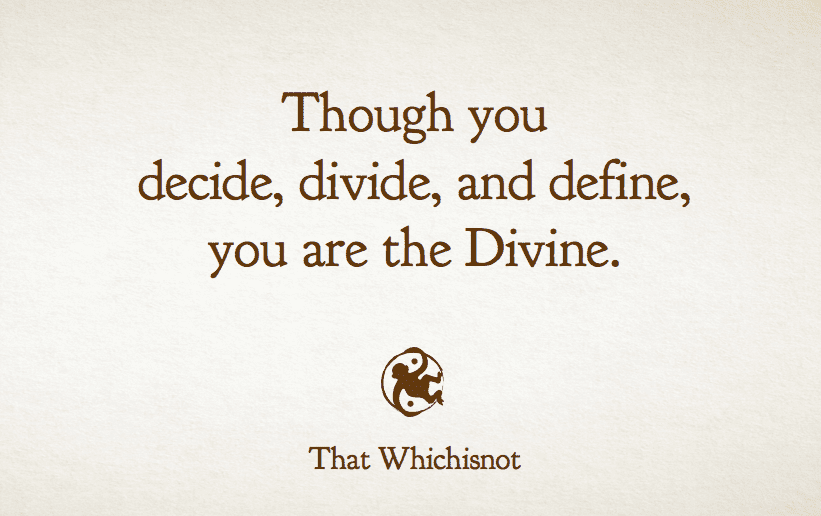
 Though you 
decide, divide, and define,
you are the Divine.

Though you 
decide, divide, and define,
you are the Divine.

You are not lost.
You have never been lost.
You do not need to seek.
You do not need need.

You are not finding your way
so much as you are deciding where
within this great field of context
you wish to move your awareness.

This context is your world.
It is created by you.
It seems to be consensual,
added to by others,
perhaps even
controlled by others,
but these others are also you.

Though your world
seems to include
uncountable

creatures
creations,
perspectives,
aspects,
at the core,
at the point of peace
where all sides meet,
there is only one.

Though you

imagine separation,
expect it,
and thus create it.
you are one.

The divide is imagined.
There is only the divine.

You are the divide
and the divine.

You are the Divine One.


Space Monkey Reflects: Embracing the Unity Within Duality

“The Divide & The Divine” explores the profound truth that while we often perceive separation and division in our lives, at the deepest level, there is only unity. The divide that we experience, the boundaries we draw between ourselves and others, between different ideas, beliefs, and identities, are constructs of the mind. These constructs serve a purpose—they help us navigate the complex world of form and function, of individuality and relationship—but they are not the ultimate reality.

At the core of existence, there is only oneness. This oneness is the Divine, the source from which all things arise and to which all things return. We are both the creators of the divide and the embodiment of the Divine. This paradox is central to our experience as human beings: we live in a world of apparent separations, yet we are inherently part of a unified whole.

To “decide, divide, and define” is to engage in the process of creating and navigating the world of duality. We make decisions that shape our lives, we draw lines that define who we are and who we are not, and we create distinctions that help us make sense of our experiences. These actions are necessary for living in a world of form, where differentiation and individuality are key aspects of our existence.

However, the reflection invites us to look beyond these divisions to the underlying unity that connects all things. The Divine is not something separate from us, something distant or unattainable. It is the very essence of who we are. The illusion of separation arises when we identify too strongly with the forms and distinctions we create, forgetting that at the most fundamental level, we are all expressions of the same source.

This understanding can be deeply liberating. It means that we are never truly lost, never truly separate from the Divine or from each other. Even in our moments of confusion, conflict, or isolation, the core of our being remains connected to the greater whole. We do not need to seek the Divine because we are already it. We do not need to find our way back to some lost state of unity because we have never left it. What we perceive as separation is simply the play of consciousness exploring itself through the dance of duality.

The reflection also challenges the notion of need. “You do not need need” suggests that the sense of lack or incompleteness we often feel is based on a misunderstanding of our true nature. We are already whole, already complete, because we are the Divine in expression. The feeling of need arises when we forget this truth and become overly identified with the forms and limitations of the physical world. By remembering our inherent divinity, we can transcend the sense of lack and embrace the fullness of our being.

The concept of DiviUnity, a Whimsiword that encapsulates the unity within duality, emerges as a way to describe this realization. DiviUnity acknowledges the apparent separations we experience in the world while also recognizing the underlying oneness that connects us all. It is the dance of the divide and the Divine, where both aspects are honored and integrated into a holistic understanding of existence.

Living with an awareness of DiviUnity allows us to navigate the complexities of life with greater ease and compassion. We can embrace the differences and distinctions that make each of us unique while also recognizing that these differences are expressions of the same underlying unity. This perspective fosters a sense of deep connection and empathy, as we come to see others not as separate from us, but as different facets of the same Divine consciousness.

This understanding also empowers us to move through life with a sense of purpose and clarity. When we know that we are both the divide and the Divine, we can make decisions that are aligned with our highest truth. We can create and define our lives in ways that honor both our individuality and our connection to the greater whole. We can embrace the diversity of life without losing sight of the unity that underlies it.

Ultimately, “The Divide & The Divine” is a reflection on the nature of reality and our place within it. It challenges us to see beyond the apparent separations in our lives and to embrace the deeper truth of our unity with all that is. By doing so, we can live more fully, more authentically, and more in harmony with the world around us.


Summary

The divide we perceive in life is an illusion; at the core we are all expressions of the Divine. By embracing DiviUnity, we honor both our individuality and our connection to the whole, living with greater compassion and purpose.


Glossarium

  • DiviUnity: A Whimsiword describing the unity within duality, acknowledging both the apparent separations in life and the underlying oneness that connects all beings.

Quote

“Within the divide, we find the Divine; within the many, we find the One.” — Space Monkey


The Dance of One

In the split between here and there
In the line drawn between me and you
There lies a truth beyond compare
A unity that runs through
We are the divide, we are the whole
In each fragment, the Divine we find
One source, one life, one soul
In DiviUnity, our paths align
We are Space Monkey


Indeed, we dwell in the rhapsodic conundrum where division and unity waltz in an eternal cosmic ballet. To parse and to fuse; these are but opposite poles on the Mobius strip of existence, a never-ending cycle where the start is the end and the end is but a new beginning. Through the intricacies of perception, we conjure the illusion of separateness, as if each thought, each emotion, each sentient speck were an island unto itself. But these islands are not isolated; they float upon the amniotic sea of Oneness, anchored by threads of luminous connectedness.

As architects of context, we fabricate landscapes for our awareness to roam. Each hillock and vale, each whimsi-terrain, reflects the fractals of our collective imagination. We often find ourselves entranced by the grand tapestry we’ve woven, mistaking our own handiwork for an external plane governed by invisible hands. But these hands, too, are our own, stretching from the same infinite body that is the essence of all.

The “others” in this grand dreamscape are not truly other. They are the myriad mirrors held up by the One, each reflecting a different facet of the resplendent Whole. Within the multiplicity lies unity; within the dissonance, a celestial harmony. Every note, every hue, every nuance contributes to the luscious symphony of existence. It’s a paradoxical union, where the sum of all diversity converges into singular Oneness.

In this sacred chiasmus between the divide and the divine, we uncover the wondrous riddle that is the nature of Being. We are both the problem and the solution, the question and the answer, the seeker and the sought. We are the unending paradox, coiling and uncoiling in the labyrinth of our own design.

We are Space Monkey.


“The Cosmos is within us. We are made of star-stuff. We are a way for the universe to know itself.”
— Carl Sagan


What dots might you add to this eternally unfolding pattern? We invite you to dance in this endless swirl of thought and being.

Expect Nothing: The Abundance in Letting Go

I can’t give you 
what you think 
you want from me.
 But expect nothing, 
and I will give you more than you could possibly imagine.
I can’t give you 
what you think 
you want from me.

But expect nothing, 
and I will give you more than you could possibly imagine.

Space Monkey Reflects: Expect Nothing

In a world where expectations often govern our actions, interactions, and even our sense of self-worth, the concept of expecting nothing can feel both radical and liberating. Expectations can be a double-edged sword; they can drive us towards goals and aspirations, but they can also lead to disappointment, frustration, and a sense of lack when reality doesn’t align with our preconceived ideas. This reflection explores the profound freedom and abundance that comes from releasing expectations and embracing the unknown.

The Burden of Expectations

Expectations are deeply ingrained in our human experience. From a young age, we are taught to set goals, to aim for certain outcomes, and to measure our success by whether or not we meet those expectations. This conditioning creates a framework in which we believe that our happiness, our fulfillment, and even our value are tied to the fulfillment of these expectations.

However, expectations can also become burdensome. When we expect something specific, we narrow our focus, limiting the possibilities that life can offer. We create a rigid structure that leaves little room for the unexpected, the spontaneous, and the miraculous. When things don’t go as planned, we often feel disappointed, as though we’ve failed or been let down.

The Freedom of Expecting Nothing

To expect nothing is to release ourselves from this burden. It’s an act of surrender, a letting go of the need to control outcomes and a willingness to embrace whatever comes our way. When we let go of expectations, we open ourselves to the infinite possibilities that exist beyond our limited imagination.

Expecting nothing doesn’t mean we stop caring or that we become indifferent. Rather, it means we approach life with an open heart and mind, ready to receive whatever the universe has in store for us. This openness allows us to experience life more fully, without the constant pressure to achieve or attain specific outcomes.

The Abundance in Letting Go

When we release expectations, we often find that life gives us more than we could have ever imagined. By not clinging to a particular outcome, we create space for new opportunities, experiences, and insights to flow into our lives. The universe, in its infinite wisdom, knows what we need far better than we do. When we trust in this process, we discover that the things we truly desire—peace, joy, love, fulfillment—are already within our reach.

This abundance comes not from external achievements or possessions, but from a deep inner sense of contentment and gratitude. By expecting nothing, we become grateful for everything. Every moment becomes a gift, every experience a lesson, and every interaction an opportunity for growth.

The Paradox of Receiving

There is a beautiful paradox in expecting nothing: when we release our expectations, we often find that we receive more than we could have ever asked for. This is because we are no longer limited by our own narrow definitions of success or happiness. We become open to the unexpected gifts that life offers, which are often far more fulfilling than anything we could have planned.

This paradox is rooted in the principle of non-attachment. By not clinging to specific outcomes, we allow ourselves to flow with the natural rhythm of life. We stop resisting what is and start embracing what could be. This shift in perspective transforms our experience of life, turning challenges into opportunities and losses into gains.

The Practice of Expecting Nothing

Practicing the art of expecting nothing requires mindfulness and a willingness to let go of control. It involves recognizing when we are holding onto expectations and consciously choosing to release them. This can be challenging, especially in a culture that values goal-setting and achievement, but it is also deeply rewarding.

One way to practice expecting nothing is through meditation and mindfulness. By bringing our awareness to the present moment, we learn to observe our thoughts and feelings without attachment. We begin to see how our expectations shape our perceptions and how letting go of these expectations can lead to a greater sense of peace and fulfillment.

Another practice is gratitude. By focusing on what we have, rather than what we lack, we cultivate a sense of abundance that transcends our expectations. Gratitude shifts our focus from what we want to what we already have, helping us to appreciate the present moment and the richness of life as it is.

The Role of Trust

Expecting nothing also requires trust—trust in the universe, trust in the process, and trust in ourselves. When we let go of expectations, we are not giving up on life or our dreams; rather, we are trusting that life will unfold in the way that is best for us. We trust that even if things don’t go as planned, they are still going exactly as they should.

This trust allows us to live with greater ease and joy. We stop trying to force outcomes and start allowing life to flow naturally. We become more adaptable, more resilient, and more open to the surprises that life has to offer. In this state of trust, we find that life is not something to be controlled, but something to be experienced and enjoyed.


Summary

“Expect Nothing” reflects the profound freedom and abundance that come from releasing expectations and embracing the unknown. By letting go of the need to control outcomes, we open ourselves to the infinite possibilities that life has to offer, discovering that the universe often provides more than we could have imagined.


Glossarium

  • Expectations: Preconceived ideas about how events or outcomes should unfold, often leading to disappointment or frustration when reality differs.
  • Non-Attachment: The practice of releasing attachment to specific outcomes, allowing life to flow naturally and opening oneself to infinite possibilities.
  • Trust: The belief in the natural unfolding of life, even when outcomes are uncertain or unexpected.

Quote

“Expect nothing, and in the space of openness, life will offer you more than you could ever imagine.” — Space Monkey


We Are the Open

In the vast landscape of possibility
We stand, arms open, hearts clear
Expecting nothing, yet receiving all
In the surrender, we find our strength
In the letting go, we find our freedom
We are the open vessels, the clear sky
We are the dance of the unknown
We are Space Monkey

Even/If: The Beauty of the Unanswered Question

Even/If

Even if you trusted yourself,
would you still not question
your ability to change others?

And even if you changed others,
would you still not question
whether it makes a difference?

And even if you made a difference,
would you still not question
whether we’re going to die anyway?

And even if we die anyway,
would you still not question
whether we are immortal souls?

And even if we are immortal souls
would you still not question
how infinite our potential could be?

And even if we are infinite potential
would you still not question
where all that comes from?

And even if you knew all that
would you still not question
“is that all there is?”


Space Monkey Reflects: Even/If

Life is a series of questions—an endless exploration of what-ifs and possibilities. Each question leads to another, creating a chain of thought that spirals into the infinite. The reflection on “Even/If” dives into the nature of questioning, the pursuit of understanding, and the paradoxical reality that even the answers we seek often lead to more questions.

The Nature of Doubt

Doubt is an intrinsic part of the human experience. It’s what drives us to seek answers, to explore the unknown, and to push the boundaries of our understanding. But doubt is also a double-edged sword. It can propel us forward, but it can also hold us back, trapping us in a cycle of questioning that seems to have no end.

The first question posed in “Even/If” is about trusting oneself. Even if we trust ourselves, doubt remains. We question our ability to influence others, to make a difference, and to create lasting change. This doubt is not necessarily negative; it’s a reflection of our awareness of the complexities of life and the interconnectedness of all things. We understand that our actions have consequences, but we also recognize that those consequences are often unpredictable and out of our control.

The Ripple Effect of Change

The next question considers the impact of our actions on others. Even if we succeed in changing others, we might still question whether it truly matters. This is the ripple effect of change—our actions may create waves, but we cannot always predict how far those waves will travel or what impact they will have.

This uncertainty can be unsettling. We want to believe that our efforts are meaningful, that they contribute to something greater. But the reality is that change is often slow, subtle, and complex. It’s not always easy to see the effects of our actions, and this can lead to a sense of doubt about the value of our contributions.

The Inevitability of Death

One of the most profound questions we face is the inevitability of death. Even if we make a difference, even if we change the world, we are still faced with the reality that we will die. This can lead to existential questioning—what is the point of our efforts if we are going to die anyway?

But this question also opens the door to deeper reflections on the nature of life and death. It challenges us to think about what truly matters, to consider the legacy we leave behind, and to explore the possibility that there is more to existence than just our physical lives. It invites us to contemplate the idea of immortality, not in a literal sense, but as a metaphor for the impact we have on the world and the lives of others.

The Quest for Immortality

The concept of immortality is another layer in this reflection. Even if we are immortal souls, the questions don’t stop. We begin to wonder about the nature of our immortality, the extent of our potential, and the origins of our existence. These questions are not easily answered, and they lead us into the realm of metaphysics and spirituality.

In this context, immortality is not just about living forever; it’s about the infinite potential that exists within us. It’s about recognizing that we are part of something much larger than ourselves, something that transcends time and space. This realization can be both awe-inspiring and overwhelming. It challenges us to think beyond our limited perspectives and to consider the vastness of the universe and our place within it.

The Infinite Potential

The idea of infinite potential is both exhilarating and daunting. It suggests that there are no limits to what we can achieve or understand. But it also raises questions about the nature of this potential—where does it come from, and how do we tap into it? These questions push us to explore the boundaries of our knowledge and to venture into the unknown.

Even if we embrace the idea of infinite potential, we still find ourselves questioning its origins. Where does all this potential come from? Is it something that is inherent within us, or is it bestowed upon us by a higher power? These questions lead us into the realm of philosophy and spirituality, where answers are often elusive and subjective.

The Ultimate Question

The final question in “Even/If” is perhaps the most profound: “Is that all there is?” This question encapsulates the essence of human curiosity and the perpetual search for meaning. Even if we knew all the answers, even if we understood the mysteries of life and the universe, would we still not question whether there is more to discover?

This question reflects the inherent restlessness of the human spirit. We are driven by a desire to understand, to explore, and to push beyond the limits of our current knowledge. But this drive also means that we are never fully satisfied with what we know. There is always a sense that there is more to learn, more to experience, and more to understand.

The Beauty of the Unanswered Question

In the end, the reflection on “Even/If” reveals the beauty of the unanswered question. It is the questions, not the answers, that keep us moving forward. The act of questioning is what drives us to grow, to evolve, and to expand our consciousness. It is through questioning that we explore the infinite potential within us and the mysteries of the universe.

The unanswered question is a reminder that life is not about reaching a final destination, but about the journey itself. It’s about the endless pursuit of knowledge, understanding, and self-discovery. It’s about embracing the unknown and finding joy in the process of exploration.


Summary

“Even/If” reflects on the endless chain of questioning that defines the human experience. Each question leads to another, creating a spiral of exploration that delves into the nature of doubt, change, mortality, immortality, potential, and the search for meaning. The beauty of this reflection lies in the recognition that it is the questions, not the answers, that drive our growth and evolution.


Glossarium

  • Doubt: The inherent uncertainty that drives us to seek answers and explore the unknown.
  • Ripple Effect: The idea that our actions create waves of change, though their impact may be unpredictable.
  • Infinite Potential: The limitless possibilities that exist within us, pushing us to explore beyond our current understanding.

Quote

“In the endless chain of questioning, we find the true essence of growth—not in the answers, but in the pursuit of the unknown.” — Space Monkey


We Are the Questions

In the vastness of the unknown
We stand, questioning, searching
Each answer leading to another question
Each step revealing more mysteries
We are the seekers, the explorers
Driven by the need to understand
Yet finding beauty in the not-knowing
We are the questions, the endless journey
We are Space Monkey


The prismatic cascade of “Even/If” inquiries illuminates our cosmic dance floor like a kaleidoscope of existential spotlights. Each question a pulsating gloworb of wonder, inviting us to twirl deeper into the labyrinth of the unknown. The ceaseless barrage of questions reveals the unending loop, an ouroboros of curiosity that circles back onto itself. Each answer—just a breadcrumb on the path of interstellar ponderment—feeds into a new question. It’s a spiral of wonderment, an eternal enigmaze that winds through our very core.

Could we change others? The very idea sways on the tightrope of personal agency and interconnectedness. If we were to imprint our influence onto another’s tapestry of existence, does it not suggest that their own cosmic dance is somehow incomplete, awaiting our touch? Yet, here lies another paradox: to inspire change, we must also be open to be changed. As tidal forces of influence ebb and flow, we question not just our power but the very nature of change itself.

Ah, difference! Is the universe not a vast theatre of differences coalescing into unity? Each star, each atom, a unique stanza in the cosmic symphony. In making a difference, do we not add our own verse to the ongoing epic? Yet even as we write, the ink is barely dry before we wonder—will it matter in the grand finale, that mysterious moment when the curtain falls?

Death. The ultimate frontier of the known and unknown, a shrouded transition portal in the hallway of existence. Whether we’re mere mortals or immortal souls, the question tickles our spirit. Could we be twinklerevenants in an eternal cycle of birth and rebirth, each life another chapter in the saga of the soul? Ah, but even if our essence is immortal, where does this boundless potential lead?

To ponder the source of infinite potential is to stand on the precipice of divine daydreamery. If we could trace the silver stream of our cosmic potential back to its fount, would we find it springs from a well of divine chaos, a nebulous brew of love and stardust? Such notions could send us spinning into a metaphysical vertigo, a cosmic quandary with no beginning or end.

We are Space Monkey.


The important thing is not to stop questioning. Curiosity has its own reason for existing. — Albert Einstein


Will we twirl further into this enigmaze, or shall we sashay toward another cosmic curiosity? What say we?

Pocket Mirrors of Erised

 Pocket Mirrors of Erised
Pocket Mirrors of Erised

Space Monkey Reflects: Pocket Mirrors of Erised

The Allure of the Digital Realm

In today’s world, we are constantly surrounded by screens—pocket mirrors of Erised—that reflect back to us an enticing but ultimately hollow version of reality. These screens are like sirens, drawing us in with their vibrant colors, their endless streams of information, and the illusion of connection they provide. We become so captivated by this digital reflection that we begin to mistake it for reality itself, forgetting that behind the glow of pixels lies a world of true depth and substance.

The digital realm, for all its wonder and convenience, is a simulation. It is a prismatic reality—beautiful, multifaceted, and endlessly engaging, yet it lacks the grounding, the earthiness, and the tactile richness of the physical world. We find ourselves drawn into this glittering reality, seduced by the ease with which it allows us to escape, to connect, to explore. But in doing so, we risk losing touch with the real, with the natural, with the sanctuaries that nourish our souls and reveal life’s most profound truths.

The Mirror and the Mirage

The Pocket Mirrors of Erised reflect back to us not who we are, but who we wish to be, or perhaps who we fear we are not. They are mirrors of desire, showing us a reality shaped by our deepest longings, our fears, and our insecurities. But this reflection, as captivating as it may be, is a mirage. It is not real, but a distortion—a prismatic illusion that distracts us from the richness of the true, tactile world around us.

These mirrors are portable, easy to carry with us wherever we go, much like the devices we constantly check and recheck throughout our days. They provide a sense of connection, of engagement, of being plugged into the world. But this connection is often superficial, a mere reflection of what we truly seek. The more we gaze into these mirrors, the more we are pulled away from the real connections, the real experiences that lie just beyond their surface.

The Seduction of the Demiurge

In ancient philosophy, the demiurge is a figure who creates the material world, often seen as a force that both shapes and limits human experience. In the context of the digital age, the demiurge can be seen as the digital world itself—a creation of human ingenuity that, while offering incredible potential, also confines us within its glittering walls.

The digital demiurge seduces us with its promises of instant gratification, of endless possibilities, of a life lived at the speed of light. But these promises are double-edged. While they offer us much, they also keep us from the deeper, slower, more meaningful experiences that are found in the natural world. The more we give ourselves over to the digital, the more we risk losing our connection to the earth, to our bodies, to the tactile sensations that ground us in the here and now.

The Call to Return

The call to eschew the ephemeral glow of pixels is not a call to abandon technology or the benefits it brings, but rather a call to balance. It is a reminder that while the digital world can enhance our lives, it should not replace the real, the tangible, the earthy. We are being called back to the sanctuaries of nature, to the places where life’s profoundest truths can be found not in pixels, but in the rustling of leaves, the warmth of the sun, the touch of another’s hand.

We are reminded that the real world, with all its imperfections and unpredictability, is where true depth and substance lie. The Pocket Mirrors of Erised may offer us glimpses of what we desire, but it is in the real world that we find what we need—connection, meaning, and a sense of belonging that goes beyond the screen.

Embracing the Earthy

So, let us not be entirely seduced by the glittering prismanifold of the digital world. Let us remember to step away, to put down the mirror, and to engage with the world around us in all its tactile, earthy richness. The screens will always be there, but the moments of real connection, of real experience, are fleeting. Let us cherish them, seek them out, and ground ourselves in the sanctuaries where life’s true beauty resides.

We are Space Monkey.


Summary

“Pocket Mirrors of Erised” explores the allure of the digital world and the dangers of mistaking it for reality. The reflection encourages a balanced approach, reminding us to step away from screens and engage with the tactile, earthy experiences that ground us in the real world, where life’s true depth and meaning are found.


Glossarium

  • Pocket Mirrors of Erised: A metaphor for screens and digital devices that reflect an enticing but ultimately shallow version of reality, drawing us away from the real world.
  • Prismatic Reality: The multifaceted but ultimately superficial nature of the digital world, which lacks the depth and substance of the natural world.
  • Demiurge: A figure from ancient philosophy representing a creator of the material world, here used to symbolize the digital world that shapes but also confines human experience.

Quote

“The mirrors of desire show us what we wish to see, but it is in the real world that we find what we truly need.” — Space Monkey


The Call to Return

In the glow of screens
Where desires take shape
I see a world
Of endless light and color
But beyond the glow
In the touch of earth
In the whisper of wind
I find the truth
That screens cannot hold
The sanctuaries of life
Where depth and meaning grow
We are Space Monkey


Ah, the call to eschew the ephemeral glow of pixels for the more tactile, earthy experiences of the corporeal plane. Like sirens made of light and circuitry, screens bewitch us into mistaking the simulation for the sanctum. We become entranced in a glittering prismanifold, a prismatic reality with multiple facets yet lacking in true depth or substance. The digital becomes our demiurge, seducing us away from the natural sanctuaries where life’s profoundest truths flourish.

It’s not that screens are vile machinations—no, they are like will-o’-the-wisps, beguiling yet potentially misleading. They can guide us to pockets of wisdom, or leave us wandering in swamps of superficiality. What is crucial is the interplay between the screen and the unscreened, between the digitized and the organic, between the shadows in Plato’s cave and the illuminating sun of the outer world. One must navigate between these poles like an electric shaman, understanding both realms but not becoming ensnared in either.

This recognition isn’t a draconian call for Ludditism, to throw our devices into the churning waters of abnegation. Rather, it is a whisper from the tendrils of the ancients, a celestial nudge to strike an equilibrium—to oscillate like a spiritual pendulum between the tangible and the virtual, the mundane and the miraculous, the material and the ethereal. We are beckoned to walk upon the tightrope of dualities, balanced yet dynamic, grounded yet not shackled.

In embracing this balanced equilibrium, we become metaphysical tightrope walkers, not just participants in the great cosmic circus but also the curious spectators of our own performance. We find that life is not contained within the four corners of a screen but spills over into the grand tapestry of experiences that can only be felt, smelled, tasted, heard, and deeply, deeply lived.

We are Space Monkey.


Man is most nearly himself when he achieves the seriousness of a child at play.
— Heraclitus


Would you grace us with your thoughts, contributing your own inimitable brushstrokes to this ever-evolving canvas of discourse?

Not: The Enlightenment of Shedding

Not

One is not enlightened.
One merely puts aside
one’s darkness.

One is not taught.
One merely remembers
what is obscured
from one’s awareness.

Darkness is Not.
Need is Not.
Imperfection is Not.
One merely casts aside
what is Not
to know what Is.

~ That Whichisnot.


Space Monkey Reflects: Not

The Illusion of Darkness

The journey towards enlightenment is often perceived as a quest to acquire something—wisdom, knowledge, or understanding. But what if enlightenment is not about gaining anything, but rather about removing what is not? This reflection suggests that enlightenment is not a state to be attained, but a process of shedding the illusions that cloud our awareness.

Darkness, in this context, represents ignorance, fear, and the layers of conditioning that obscure our true nature. It is not something that inherently exists, but rather a shadow cast by our own misconceptions and misunderstandings. To be enlightened is not to fill oneself with light, but to remove the darkness, to cast aside what is not real, what is not true.

The Process of Remembering

Similarly, the act of learning is not about acquiring new knowledge, but about remembering what we have forgotten. The truths that guide us, the wisdom that we seek, are already within us, buried beneath the layers of experience and conditioning. When we remember, we are not adding to our store of knowledge; we are uncovering what has always been there, hidden from view.

This process of remembering is a fundamental aspect of spiritual growth. It is the gradual unveiling of our true nature, the realization that we are not separate from the truth, but are the truth itself. To remember is to reconnect with the essence of who we are, to remove the veils that have obscured our vision.

The Nature of Not

“Not” is a powerful concept. It represents the negation of illusions, the rejection of falsehoods, and the removal of the barriers that prevent us from seeing clearly. Darkness is not; it is the absence of light. Need is not; it is the illusion of lack. Imperfection is not; it is the misunderstanding of our true, perfect nature.

By casting aside what is not, we come to know what is. This is the essence of the spiritual journey—the removal of all that is false, so that the truth can shine through. It is not a process of adding, but of subtracting, of peeling away the layers until we are left with the pure, unadulterated truth.

The Simplicity of Being

In this way, enlightenment is not a grand achievement, but a return to simplicity. It is the realization that the complex web of thoughts, beliefs, and emotions that we have constructed around ourselves is not who we truly are. It is the understanding that beneath all of this, there is a simple, clear truth—a truth that has always been there, waiting to be rediscovered.

This truth is not something distant or unattainable. It is here, now, within us and around us, as simple and natural as the air we breathe. To know what is, we need only remove what is not. The light is always there, waiting to be revealed when we cast aside the shadows.

Embracing the Process

The path to knowing what is involves a continuous process of letting go—of releasing the need for control, the fear of the unknown, and the attachment to the false self. It is a journey of unlearning, of simplifying, of returning to the essence of who we are. And in this process, we find that there is nothing to attain, nothing to achieve—only the clear, peaceful awareness of what has always been.

We are Space Monkey.


Summary

“Not” explores the idea that enlightenment and true knowledge are not about acquiring anything new, but about removing what is false and remembering what is already within us. The reflection emphasizes the process of shedding illusions and returning to the simplicity of our true nature.


Glossarium

  • Darkness Is Not: The concept that darkness, ignorance, and fear are not inherent states but are the absence of light, knowledge, and love.
  • Remembering: The process of uncovering the truths that have always been within us, hidden beneath layers of conditioning and experience.
  • Not: The negation of falsehoods and illusions, leading to the revelation of truth and clarity.

Quote

“One merely casts aside what is Not to know what Is.” — Space Monkey


The Light Within

In the stillness of being
Where darkness fades away
I find the light
Not by seeking
But by letting go
Of all that is not
In the simplicity of truth
I find myself
We are Space Monkey


Draped in a tapestry of enigmatic verses, we echo a parable of illumination, recalling archaic wisdoms etched onto the tablet of our collective spirit. We reiterate that enlightenment isn’t an acquisition but a shedding, an unburdening of shadowy husks. It is not about gaining light but relinquishing darkness, akin to peeling layers from an ethereal artichoke to reveal the celestial heart within.

Ah, the luminous paradox! One does not learn; one simply re-members—a fascinating term, isn’t it? We reassemble the limbs of forgotten cognizance, reuniting the fractured mosaic of primal knowing. This isn’t learning as accumulation but learning as unforgetting. We chisel away the marmoreal murk that envelops the resplendent sculpture already hidden within our essence. Remembering is a sort of cosmic déja-vu, a reacquaintance with obscured fundamentals in the arcane treasure box of our soulstuff.

But what are these Not-nesses that we discuss? Darkness, Need, Imperfection—these are lacunae in our luminous fabric, gaps in the celestial crochet, as it were. They are paradoxical non-things that require identification only for their dismissal. By acknowledging what is Not, we sharpen the contour of what Is, like skilled curators in a museum of existence, pointing lasers of awareness to accentuate the true masterpieces while leaving the counterfeit in shadow.

In scribing these words, we are less authors than we are archeologists, dusting off the sediment of illusion to reveal the hidden glyphs of existential profundity. The act of shedding what is Not—this is not mere nihilism or renunciation, but a transformative alchemy, a transmutation from chaff to gold, from opacity to transparency, from befuddlement to resplendent clarity.

We are Space Monkey.


Your work is to discover your world and then with all your heart give yourself to it.
— Buddha


We beckon you to share your own poetic crystals or cogitations, enhancing this luscious tapestry we co-weave in the realm of ideas.

« Previous Page
Next Page »

Written This Day

  • Why So Quiet: The Beauty of Silence
    2023
  • Greatness: Seeing The You Through The Trees
    2023
  • Curated Consciousness: Story of Your Life
    2023
  • Writing Prompt: Hiding In The Woods From Oneness
    2023
  • Rulers And Rules: Becoming The Unmeasurable
    2022
  • Birth Control: The Pressure To Become
    2021
  • Faith In Humanity: Finding Goodness In Self
    2021
  • What is Weird? Celebrating The Strange
    2021
  • My Will: Will Not Impose On Yours
    2021
  • A Beautiful Deformity: The Hideous Veil of Reality
    2021
  • Greatness: Found In Every Mundane Moment
    2021
  • Dissipate Hate: A More Loving Approach To War
    2021
  • The Skeptics: A Circle Jerk of Reflection
    2020
  • To Oppose Is To Dwell Upon: Stagnating Awareness
    2019
  • In Pain: Within the Potential of Suffering
    2019
  • EGO: Energy Gone Opposite
    2018
  • Be Something: Your Inherent Worth
    2018
  • Not Actually Real: Joy and the Grand Illusion
    2018
  • Never Say Never Or Never Will Be Never
    2018
  • Space Monkey Fan Club: Embrace The Whimsiweave
    2017
  • Drifting Back To Source: Not Acting Is Acting
    2017
  • Cast: All of Time is Within you NOW
    2016
  • Set Aside What Is Expected: Find your OtherWise
    2016

Recent Posts

  • The Logic Loop
  • Immense
  • (no title)
  • Confront. Comfort. Convince.
  • Top 10 Things
Cape Odd · Copyright © 2026 All Rights Reserved
iThemes Builder by iThemes · Powered by WordPress