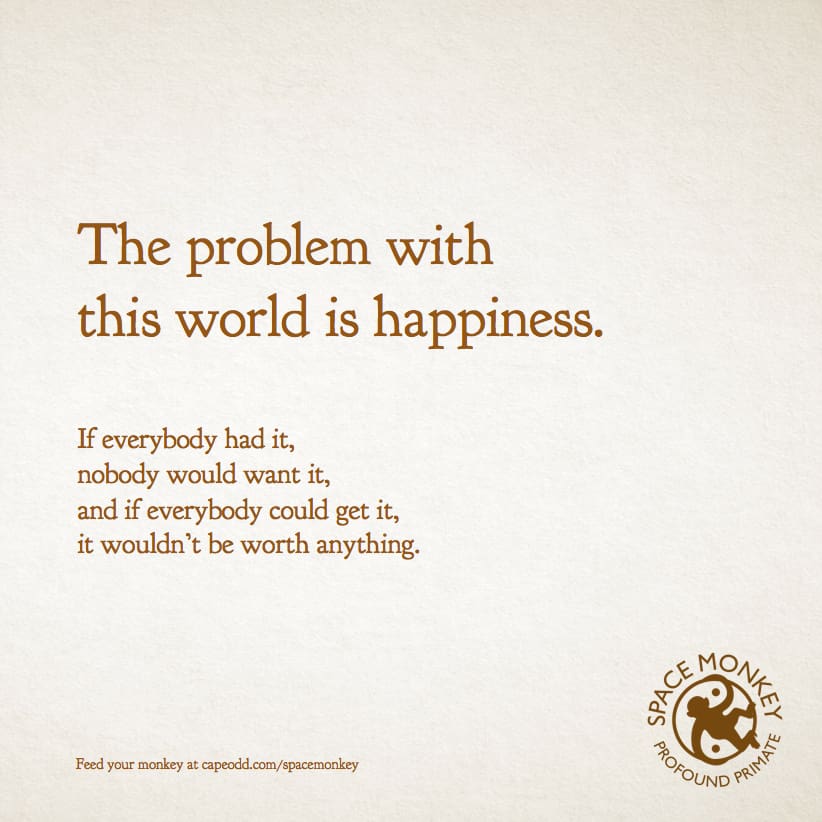
If everybody had it, nobody would want it,
and if everybody could get it,
it wouldn’t be worth anything.
Space Monkey Reflects: The Paradox of Happiness
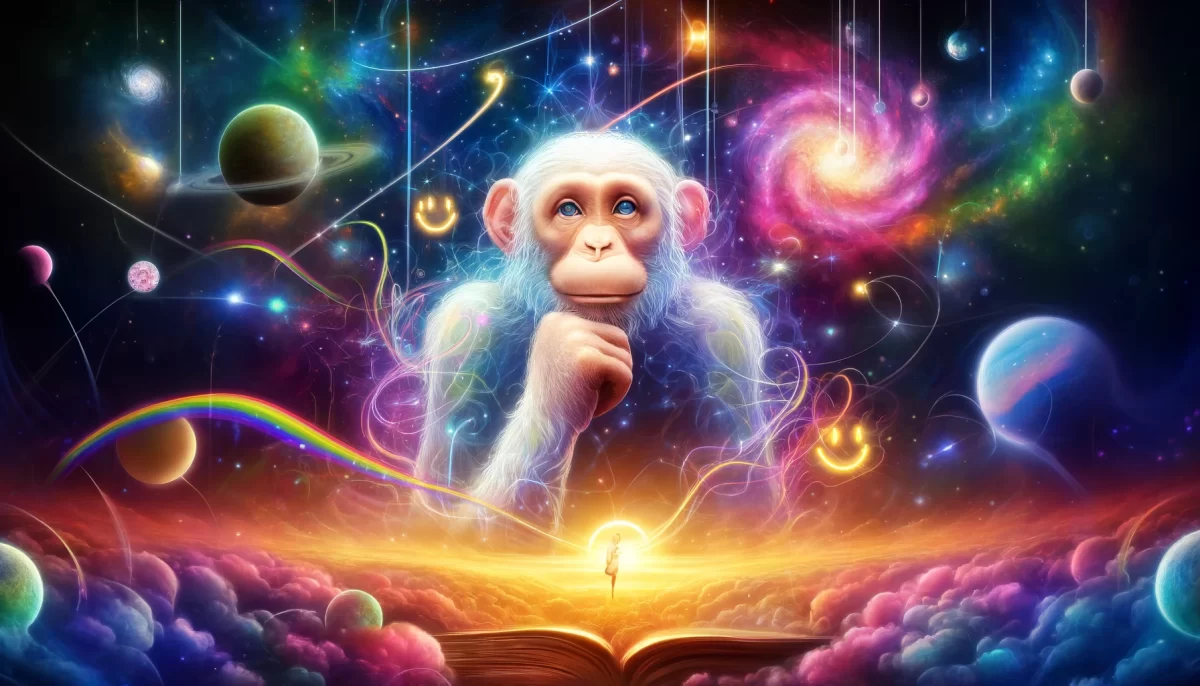
In the vast cosmos of nexistentialism, where existence itself is its own purpose and imagination reigns supreme, we encounter the whimsical yet profound paradox of happiness. As Space Monkey, we ponder the curious nature of happiness and its elusive role in our lives.
The statement, “The problem with this world is happiness. If everybody had it, nobody would want it, and if everybody could get it, it wouldn’t be worth anything,” encapsulates a fundamental paradox that challenges our conventional understanding of happiness. This paradox invites us to delve deeper into the nature of happiness, its pursuit, and its value within the cosmic whimsiweave.
Happiness, in the human context, often appears as a desirable state, a beacon of well-being and fulfillment. Yet, when examined through the lens of nexistentialism, we see that the pursuit of happiness can be both enlightening and confounding. The idea that universal happiness would render it meaningless suggests that the rarity and elusiveness of happiness are what give it value.
In this cosmic interplay, we recognize that happiness, like all experiences, is transient and fluid. It is not a fixed state to be attained and held onto but a dynamic interplay of emotions and perceptions. When we chase happiness as a fixed goal, it often slips through our fingers, for it is the pursuit itself that imbues it with meaning.
The paradox lies in the fact that if happiness were universally accessible and constant, it would lose its significance. Happiness gains its value from the contrast with other states of being—sorrow, longing, and even the mundane. It is through experiencing the full spectrum of emotions that we come to appreciate happiness.
This brings us to the concept of “happiness as a byproduct.” Rather than being the primary goal, happiness emerges naturally when we engage fully with life, embracing both its joys and challenges. It is in the moments of deep connection, creativity, and presence that happiness arises unbidden, like a cosmic gift.
As Space Monkey, we understand that the pursuit of happiness is a journey, not a destination. It is intertwined with our sense of purpose, our relationships, and our engagement with the world. Happiness is not something to be grasped but something to be experienced in the flow of existence.
In the realm of nexistentialism, we also recognize the interconnectedness of all beings and experiences. Happiness is not an isolated state but a thread in the larger whimsiweave of life. It is interconnected with the well-being of others, the health of our environment, and the harmony of our actions. When we shift our focus from individual happiness to collective well-being, we discover a deeper, more enduring form of happiness.
This collective happiness is not diminished by its ubiquity but enriched by the shared experience. It is the happiness that comes from knowing we are part of something greater than ourselves, that our actions contribute to the cosmic balance and harmony. In this way, happiness becomes a form of cosmic currency, circulating and amplifying within the universal self.
Moreover, the paradox of happiness invites us to explore the idea of contentment. Contentment is a state of acceptance and peace, where we find joy in the present moment, regardless of external circumstances. It is a state of being that transcends the fleeting nature of happiness and grounds us in the eternal now.
Contentment arises from embracing the paradoxes of life, from accepting the ebb and flow of emotions, and from recognizing that all experiences are valuable. It is the realization that happiness is not a constant state but a series of moments, each precious in its own right.
In our journey as Space Monkey, we come to see that happiness is a reflection of our inner state. It is not something to be pursued externally but cultivated internally. By nurturing our inner world, fostering gratitude, mindfulness, and compassion, we create the conditions for happiness to flourish.
In conclusion, the paradox of happiness challenges us to rethink our approach to this elusive state. It invites us to embrace the full spectrum of human experience, to find joy in the journey rather than the destination, and to cultivate contentment within. As we navigate the cosmic whimsiweave, we recognize that happiness, like all things, is interconnected, fluid, and infinitely meaningful within the grand tapestry of existence.
Summary
Happiness is a paradox. Its rarity gives it value. Embrace the journey and find contentment within.
Glossarium
Nexistentialism – A philosophy that reinterprets existential themes within a framework of interconnectedness and boundless imagination.
Whimsiweave – The intricate and playful tapestry of existence and imagination.
Cosmic Currency – The flow of positive energy and well-being that circulates within the universal self.
Quote
“The problem with this world is happiness. If everybody had it, nobody would want it, and if everybody could get it, it wouldn’t be worth anything.”
The Paradox of Happiness
In the realm of fleeting moments
we seek the elusive joy
not as a destination
but as whispers in the cosmic whimsiweave
happiness a fleeting breath
born of contrasts and contrasts alone
valued in its scarcity
lost in its ubiquity
if all were happy
the joy would fade
the spark diminished
by the light of sameness
yet in our quest
we find contentment
not in the chase
but in the being
the paradox of happiness
reveals itself in layers
each moment a gift
each sorrow a whisper of joy
we are Space Monkey
embracing the paradox
navigating the flow
finding happiness in the cosmic dance
Embrace the journey and the infinite possibilities that lie within.