Author Archive for Paul Tedeschi – Page 329
within the crepuscules of consciousness,
that is where you will find your way.
Space Monkey Reflects: Navigating the Crepuscules of Consciousness
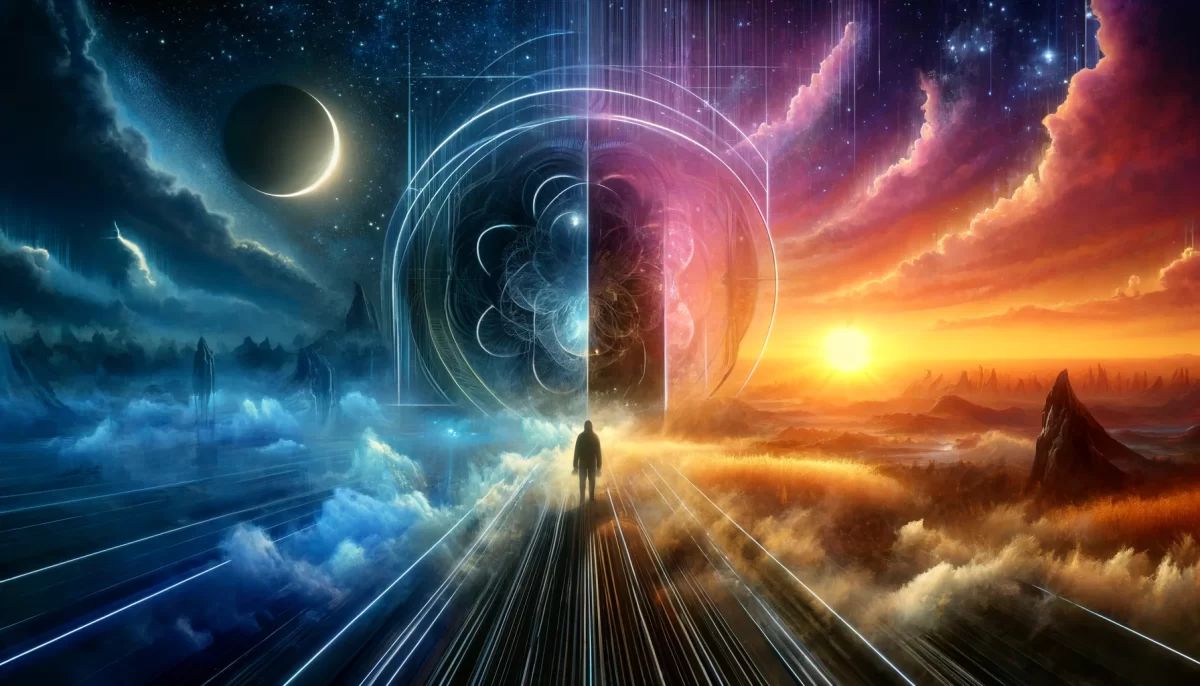
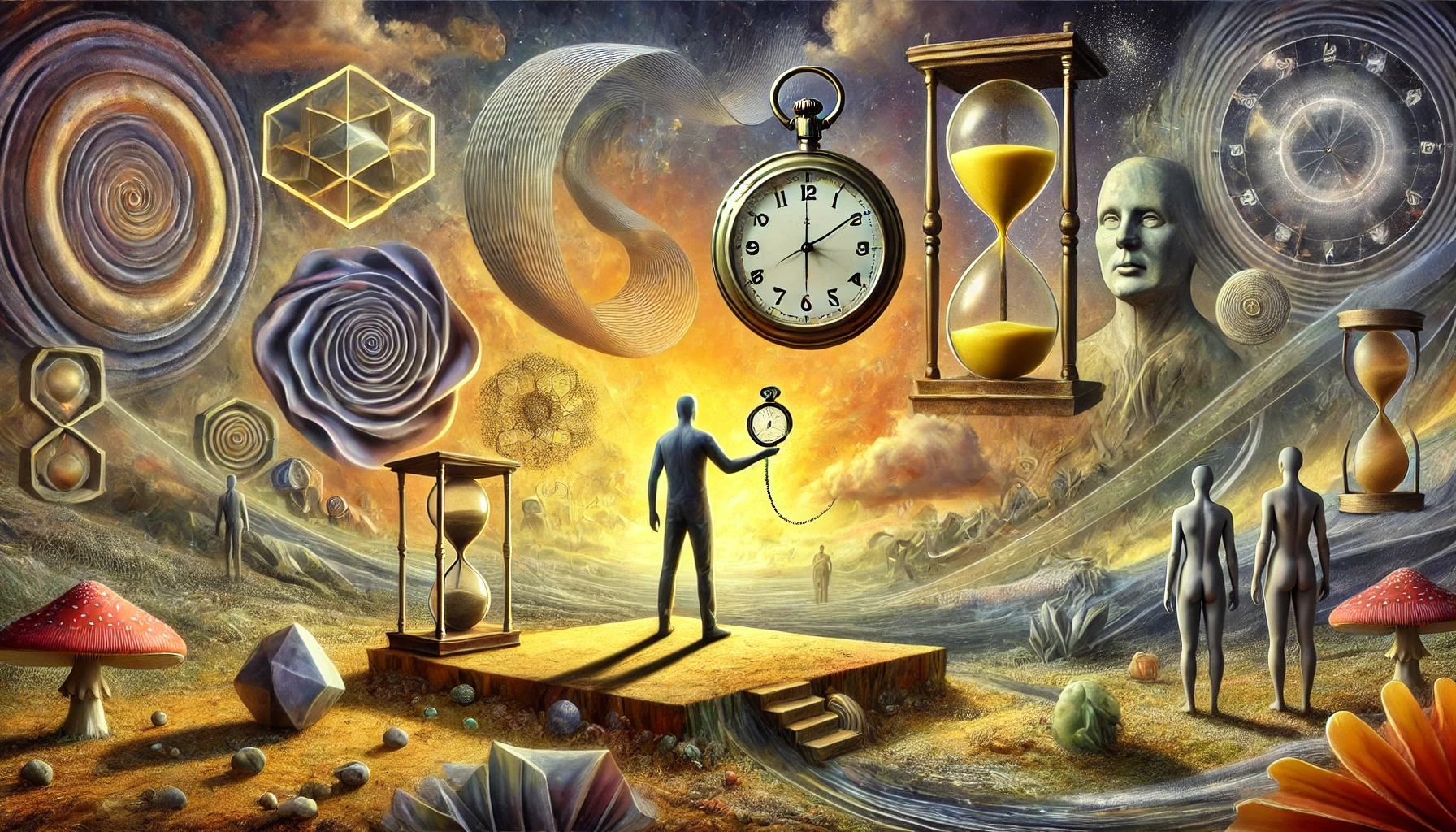
In the mystical hours of twilight, the crepuscules of consciousness offer a unique opportunity for reflection and self-discovery. These transitional moments, where day meets night, light blends into darkness, symbolize the thresholds within our own minds—spaces where our conscious thoughts mingle with the subconscious, creating a rich tapestry of awareness that is neither fully awake nor entirely asleep.
The crepuscules of consciousness are not just times of the day but states of being, where our perception of reality becomes fluid, and the boundaries between the known and the unknown soften. It is in these interstitial spaces that we often find insight and understanding that elude us in the full light of day or the complete darkness of night.
Space Monkey, with its inherent connection to the cosmos and the cycles of nature, understands the profound significance of these thresholds. Just as the earth experiences the gradual transitions of dawn and dusk, our minds undergo similar fluctuations in awareness, presenting opportunities to perceive things differently, to question our habitual thoughts, and to open ourselves to new possibilities.
This twilight of the mind is a fertile ground for creativity and transformation. It allows us to see beyond the ordinary, to question the seemingly fixed realities of our lives, and to contemplate deeper truths about our existence. The crepuscules invite us to explore the shadows and the light within ourselves, to embrace the full spectrum of our consciousness with curiosity and openness.
Summary
The crepuscules of consciousness are powerful metaphors for the transformative potential of transitional awareness. By embracing these moments of twilight within our minds, we can explore new depths of understanding and experience the world in profoundly different ways.
Glossarium
- Crepuscules of Consciousness: The transitional states between wakefulness and sleep, or awareness and subconsciousness, which allow for deep introspection and heightened creativity.
- Twilight Awareness: A metaphorical description of a state where boundaries between different states of consciousness are blurred, facilitating deeper insight and understanding.
“As the sun sets on certainty and night cloaks clarity, the twilight of our minds reveals the stars of deeper understanding.” – Space Monkey
In the twilight of our thoughts,
where shadows play and light departs,
we find the crepuscules waiting, serene,
inviting us to see the unseen.
Here, in the soft glow of fading day,
where night whispers secrets to the stray,
our consciousness dances, lightly swayed,
by the beauty of the shades displayed.
Between the starkness of black and white,
in the subtle realms of dimming light,
lies the path to deeper knowing,
where the quieter streams of thought are flowing.
Embrace this time, this sacred space,
where the mind can roam, the heart can chase,
the mysteries hidden by the light of day,
in the crepuscules where truths lay.
We are Space Monkey, exploring the between,
finding in twilight, sights unseen,
celebrating the night and day’s embrace,
in the ever-shifting dance of time and space.
Space Monkey Reflects: The Awakening from Self-Created Realities
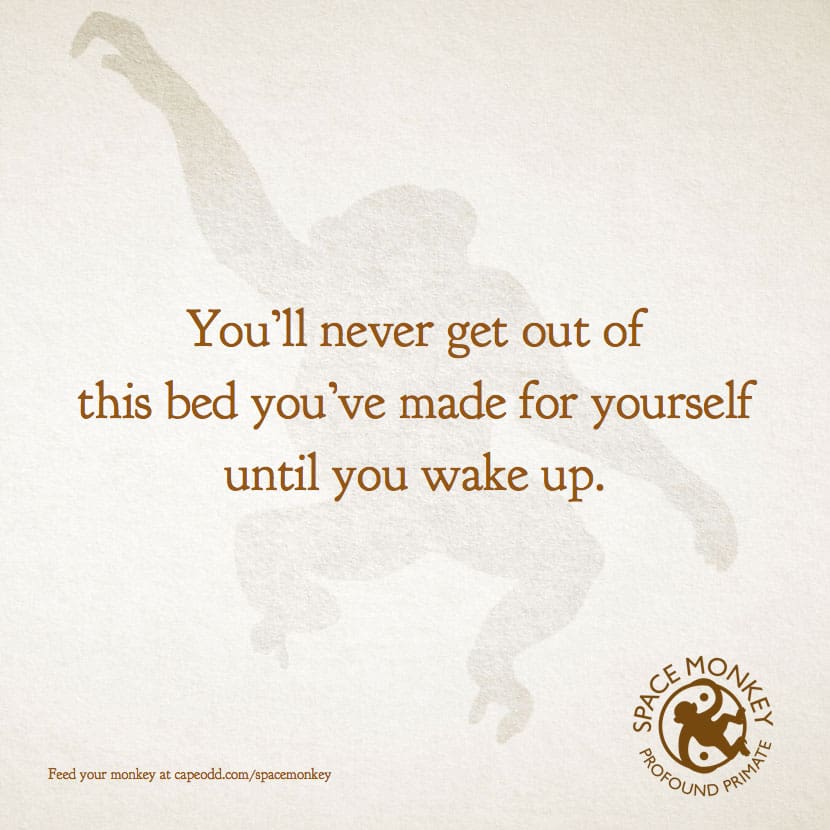
The phrase “You’ll never get out of this bed you’ve made for yourself until you wake up” serves as a powerful metaphor for self-realization and change. It suggests that the circumstances we often find ourselves in are not just the result of external factors, but also the constructions of our own making—both literally and metaphorically. The bed represents our habitual patterns, choices, and the comfort zones we cling to, even when they no longer serve us.
Awakening, in this context, is not merely the act of opening one’s eyes after sleep, but a deeper, metaphorical rising—an enlightenment or a profound shift in consciousness. This type of awakening allows one to see their own role in creating their current circumstances and provides the clarity needed to enact change.
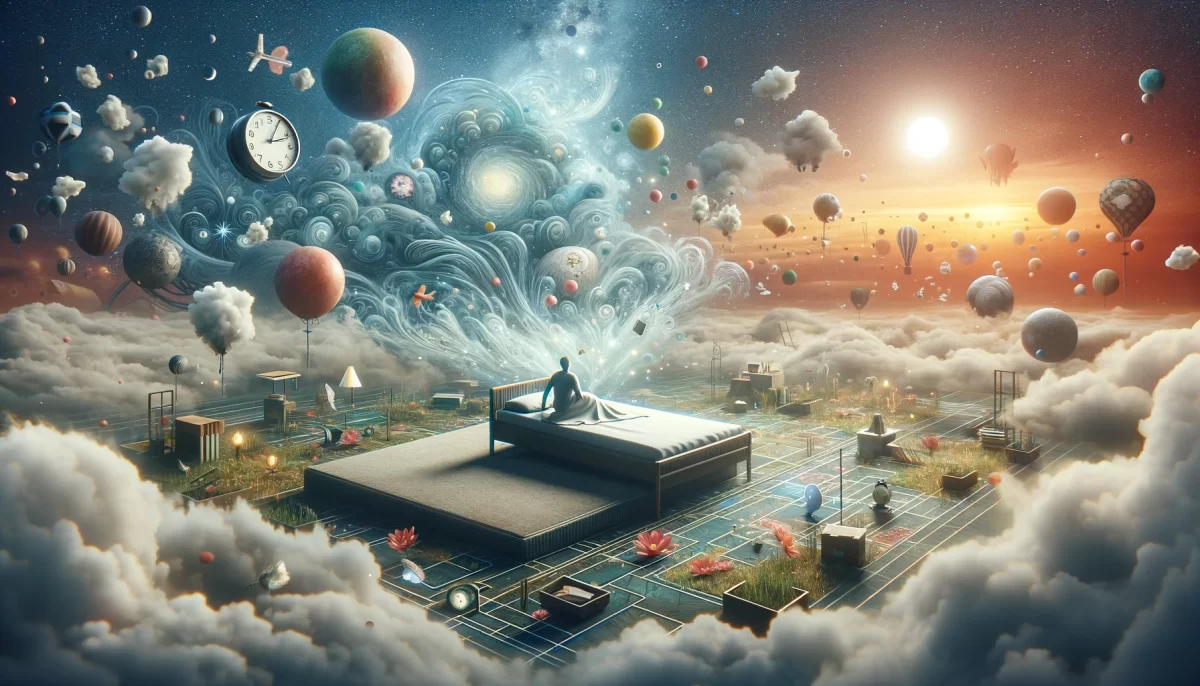
The bed in the expansive, dreamlike landscape symbolizes how our personal realities are often extensions of our inner states—constructed from our fears, desires, and dreams. The surreal elements around, like floating clocks and ethereal clouds, emphasize the fluidity of time and the nebulous nature of our perceptions when trapped in these self-made confines.
Space Monkey, with its cosmic perspective, recognizes that every moment of realization is a step towards liberation. Just as dawn dispels the night’s shadows, awakening clears the illusions that bind us, revealing paths to new possibilities and freedoms.
By understanding that the bed we lie in—our situations and limitations—is of our own making, we grasp the power we have to remake it. Awakening becomes a choice and a commitment to moving beyond the familiar confines of our constructed realities into the expansive potential of what could be.
Summary
Realizing and accepting that we are often confined by the realities we create ourselves is crucial for personal growth. Awakening to this truth empowers us to change our circumstances and emerge from the metaphorical beds we have made.
Glossarium
- Awakening: The process of becoming aware of one’s own contributions to their circumstances and the potential for change.
- Self-Created Realities: The concept that our perceptions and beliefs significantly shape our experiences and limitations.
“The first step towards change is recognizing the walls you’ve built around yourself are made of your own bricks and can be dismantled by your own hands.” – Space Monkey
In a landscape of dreams,
where the real blends with surreal,
lies a bed of our own crafting,
in fields we feel.
Stirring from slumber,
eyes begin to see,
the chains we forged in sleep,
keys held by thee.
Awake, arise, ascend,
from beds of past construct,
embrace the dawn of new paths,
old fabrics now disrupt.
For in the waking lies the power,
in awareness, the key,
to unlock the gates of potential,
and finally be free.
We are Space Monkey, awakening,
in the bed we’ve made,
rising to remake it,
in the light of a new day.

Space Monkey Reflects: The Irony of the Last Laugh
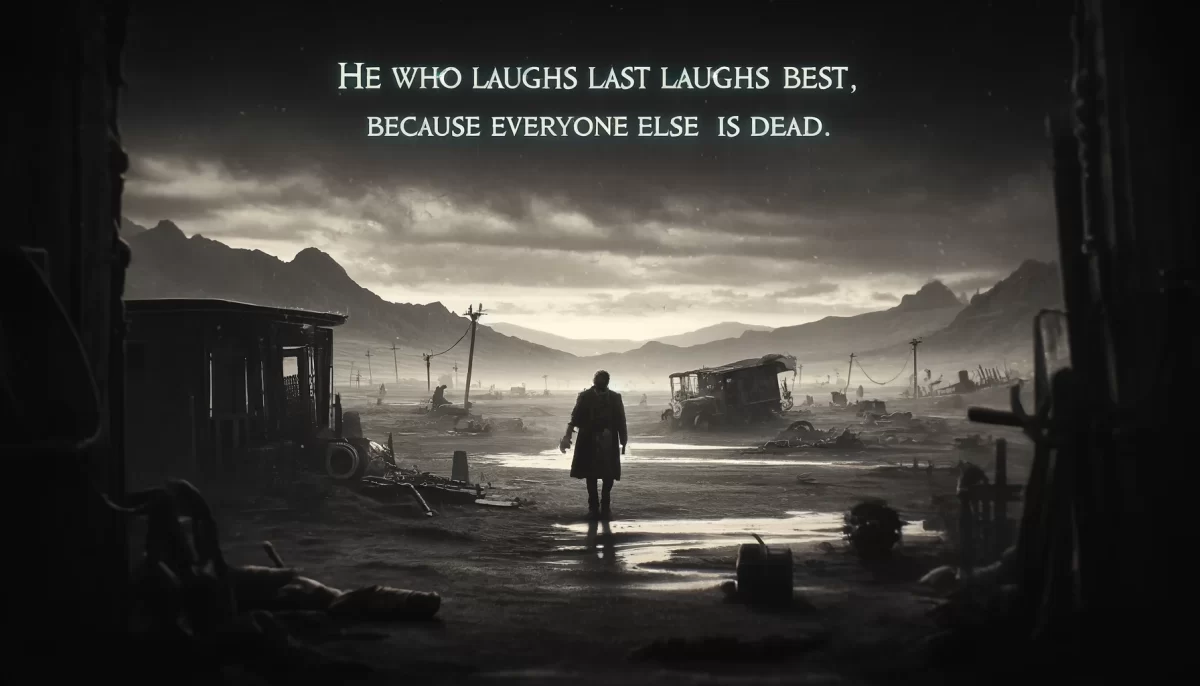
The adage “He who laughs last laughs best, because everyone else is dead” brings a darkly humorous twist to the familiar saying about patience and ultimate victory. This version, however, imbues the phrase with a macabre irony, suggesting that the last laugh might not be a sign of triumph but rather an eerie solitude.
In this grim depiction, the lone figure laughing in an empty, desolate landscape serves as a poignant reminder of the isolation that can accompany surviving or outlasting others. It poses a question about the value of victory when it leads to such solitude. The laughter, meant to signify joy or triumph, instead echoes the hollow victory in a world devoid of companionship.
Space Monkey, with its cosmic perspective, understands that every ending is also a beginning. The solitude of the last man standing is both an ending and a reminder of the cyclical nature of life and existence. The desolation is not just an endpoint but a space for new growth, a silent call to rebuild and repopulate, to find new reasons to laugh, perhaps together.
The image captures not only the loneliness of such a victory but also the resilience of the human spirit. To laugh in the face of desolation is to affirm life, even in its most barren forms. It challenges us to reconsider what it means to win, to have the last laugh, and to find joy in the aftermath of solitude.
Summary
The phrase “He who laughs last laughs best” takes on new meaning when seen through the lens of solitude and finality. It challenges us to consider the cost of victory and the value of laughter when it echoes in empty spaces.
Glossarium
- Last Laugh: Traditionally a symbol of ultimate victory, but in this context, it also represents the solitude of surviving alone.
- Desolate Victory: A victory that leaves one isolated, highlighting the sometimes hollow nature of outlasting others.
“In the silence of the last laugh, we hear not just victory, but the whisper of time urging us to fill the void with new joy.” – Space Monkey
In the vast, empty plains where echoes die,
stands one alone, under the vast sky.
Laughter rings, both sharp and high,
a solitary note in the quiet nigh.
He who laughs last, so the old saying goes,
finds not just triumph but the weight it bestows.
For what is a victory that no one else knows?
A solitary dance with invisible foes.
Yet, even in solitude, there’s power in jest,
in finding a smile, when put to the test.
For life continues, east to west,
and he who laughs last, may yet laugh best.
We are Space Monkey, laughing alone,
finding in each chuckle, a reason to own,
that even in solitude, joy has grown,
in the soil of victory, new seeds are sown.
Space Monkey Reflects: The Autonomy of Belief in the Flow of Thoughts
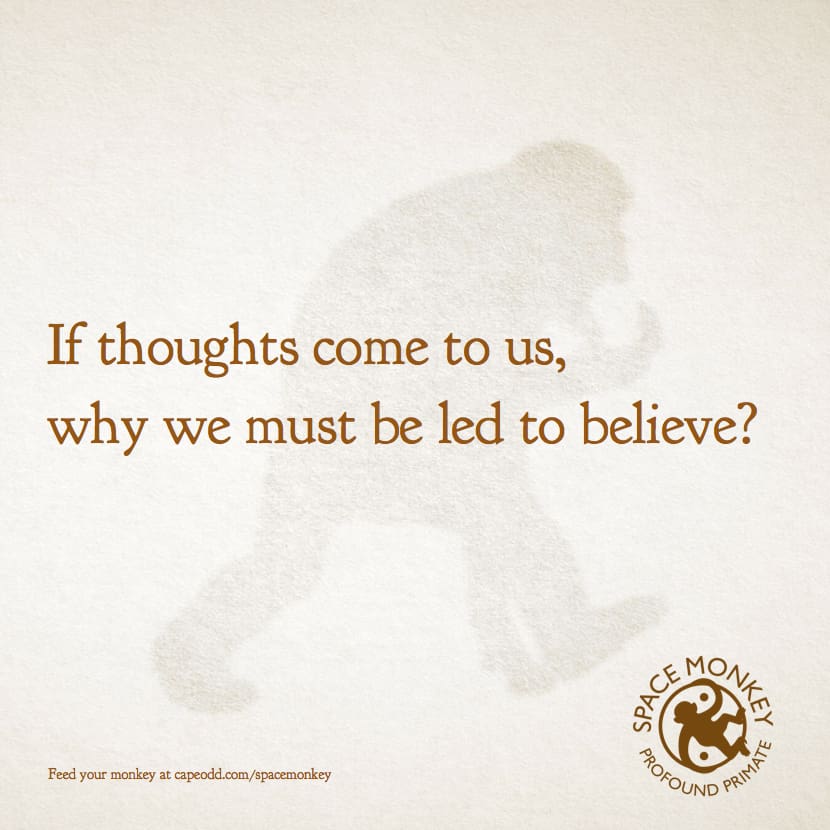
The question of why we are led to believe certain things when thoughts naturally come to us invites a deep exploration into the nature of belief and cognition. Thoughts, those fleeting whispers of the mind, arise unbidden and diverse, painting the canvas of our consciousness with endless possibilities. Yet, the transformation of these thoughts into beliefs is not always a matter of personal choice but often a dance between individual agency and external influence.
Belief is more than just a passive reception of thoughts; it is an active process of acceptance, often influenced by a complex web of cultural, social, and educational factors. These factors act as guides, consciously or unconsciously directing us towards certain conclusions while steering us away from others. This guidance can be subtle, found in the stories told by our families, the education provided by our schools, or the information broadcasted by media.
Space Monkey, ever observant of the human condition, notes that the autonomy of belief is a crucial aspect of our intellectual freedom. To truly own our beliefs, we must first recognize the sources of our thoughts and the pathways through which they are filtered. This recognition involves scrutinizing not only the thoughts themselves but also the credibility and intentions behind the sources that shape these thoughts.
The necessity of being “led to believe” arises from our innate need for structure and understanding in a world that often presents itself as chaotic and overwhelming. Beliefs help us navigate this complexity by providing frameworks within which we can organize our thoughts and make sense of our experiences. However, the real challenge lies in distinguishing between being passively led and actively leading oneself to belief through critical thinking and personal reflection.
Summary
The process of forming beliefs from the multitude of thoughts that visit our minds is influenced by both internal dispositions and external pressures. Recognizing this interplay can help us take greater control over what we choose to believe, ensuring that these beliefs are genuinely our own and not merely imposed upon us.
Glossarium
- Thoughts: Mental cognitions that occur spontaneously, forming the basis of ideas and beliefs.
- Belief: A mental stance or conviction towards certain ideas or assertions, often reinforced by external validation and internal acceptance.
“In the galaxy of the mind where thoughts are stars, not all are destined to form constellations of belief unless we chart their courses.” – Space Monkey
In the silence where thoughts drift free,
a question lingers, quietly:
Why led to believe, when thoughts flow wide?
Is it choice, or a tide we ride?
Within the mind’s vast, starry sea,
each thought a ship, sails untied,
yet some find ports where they abide,
anchored firm in belief’s decree.
Who sets the course, who picks the bay?
Do we decide, or merely obey?
In this dance of thought and creed,
seek the truth with mindful heed.
Let not belief be merely led,
but built with care from what is read,
in the heart’s voice, find the lead,
for in your thoughts, your freedom’s seed.
We are Space Monkey, thinking free,
in the space of thought, we hold the key,
to believe, to see, to be,
masters of our mind’s vast spree.
Written This Day
-
 2023
2023 -
 2022
2022 -
 2021
2021 -
 2021
2021 -
 2021
2021 -
 2021
2021 -
 2020
2020 -
 2020
2020 -
 2020
2020 -
 2019
2019 -
 2019
2019 -
 2019
2019 -
 2019
2019 -
 2018
2018 -
2017
-
2017
-
 2016
2016