Author Archive for Paul Tedeschi – Page 344
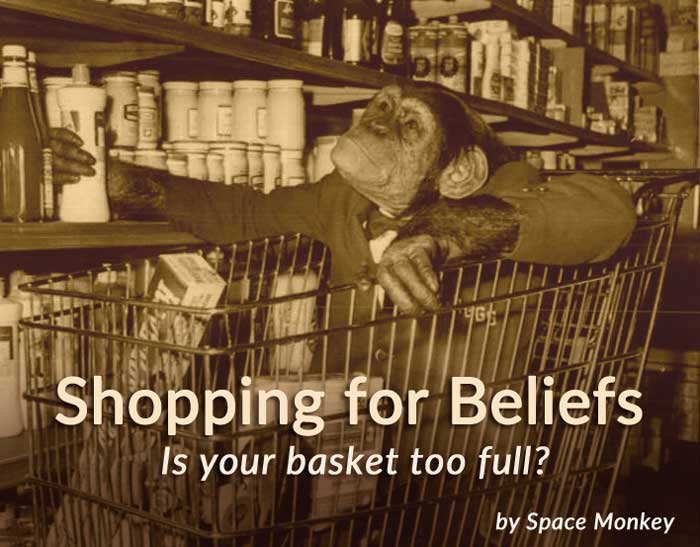
Today Space Monkey tells us about the not-so-black-and-white nature of Yes and No and why belief systems are like shopping carts. Let’s go shopping for beliefs with Space Monkey!
SPACE MONKEY: To everything you perceive, know that an opposite exists, which you may or may not perceive, depending upon your chosen focus.
In this way, everything balances everything else, and it is not what exists that is important, but what you perceive to exist.
Know also that this unseen opposite is also available to you, now that you recognize the nature of its existence.
Know thirdly that one perception has not just one opposite, but INFINITE opposites revolving around the multiple aspects that make up each perception.
For a perception is not just one thing, but a group of things pointing to a chosen commonality.
Even a concept as seemingly black and white as “Yes and No” has infinite shades of meaning within it, for the yes and no are merely poles within a spectrum.
Each yes and no structure contains infinite ideals and choices that support the yes or no action, never just one, and these aspects are all variable over time. That is why one might answer “yes” one day and “no” another day, or why one may feel conflicted in reaching a decision.
It is all a matter of balance and counterbalance, a process that is constantly in flux as you add or subtract beliefs from the shopping basket that you consider to be your identity.
Too many times you will say “I’ll have what he’s having,” and you will place a belief in your basket that does not suit you. It will then influence every yes and no that you make, though you may not be aware of it.
This is not necessarily a problem, except for those who do not know how to remove beliefs from their baskets. These individuals wind up at the checkout and literally pay for their beliefs later.
They want to make a decision with their heart, but their so-called rational minds block them from doing so, and thus their reality is dictated by beliefs that are not their own. This includes 99% of your population.
The same goes for any habit, any desire, any outcome.
Until one learns how to control what is in one’s mind, one’s reality will ALWAYS be dictated by the beliefs of one’s past, peers, and programming.
The idea that one has been programmed their entire lives does not sit well with individuals, and the 99% will fight it.
So therein lies an example of a NO that also comes with a YES. YES is possible, but when one is focused on NO, NO becomes reality.
We are sure that you have heard the phrase “You get what you focus upon.” This is entirely the truth. However it is also possible to change what you focus upon, and get that outcome instead.
It is simply a matter of adjusting your beliefs, seen and unseen. We recognize that this does not seem “simple” at all from your perspective, but from where we sit, it is easy as shopping. We know how you love shopping.
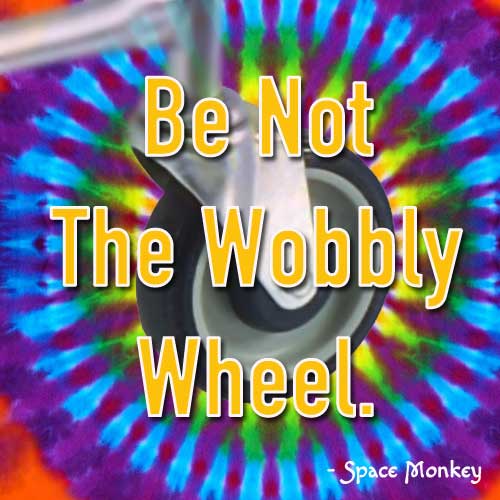
So ponder that, and ponder the fractal nature of truth, and you will find ways to take control of your shopping cart so that the wheel is not so wobbly.
We are Space Monkey and we have fewer than 12 items in our basket, but they are infinite. We now remove you from the child seat.
——————
Paul Tedeschi is a writer, artist, musician and medium, channeling Space Monkey, tripping out on tie-dye, and building Fancy® cigar box guitars in his garage. You may visit his curious world at capeodd.com. Or not.
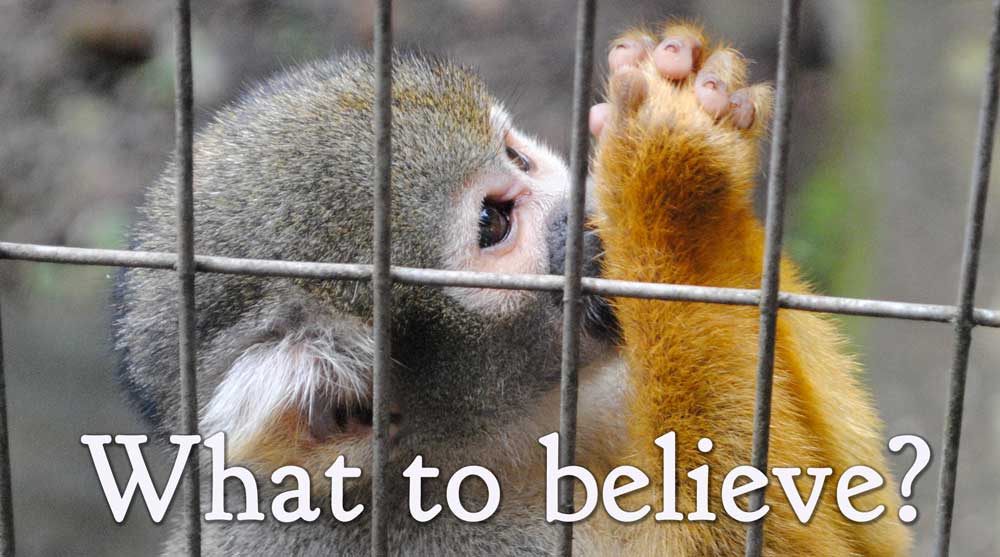
Paul Tedeschi is guest columnist today, while Space Monkey vacations at the animal testing lab. Have fun, Space Monkey!
Many believe that we are guided by disincarnate entities that nudge and shepherd us through life. Depending upon your belief system, these entities may be described as gods, angels, space monkeys, or even William Shatner.
It is natural to be skeptical of such beliefs, for unless you have seen angels, you have no proof that they exist. Therefore the mention of such divergent beliefs is usually accompanied by eye-rolling, and that thing people do when they encircle an ear with pointed finger.
(Who decided that the loopy finger should be the sign for “crazy,” anyway? Was there a meeting?)
So I have been looking for proof of these entities, as I imagine most people do, though few are foolish or brave enough to admit this on social media. (Foolish or brave? Choose one.)
Here’s the irony of what I’ve discovered so far. Most people find it perfectly acceptable to believe in a god, yet dismiss any other possibility as nutty, wrong, delusional or dangerous. (Pick two, they’re small.)
Why do you think this is? Why is one unproven belief acceptable to mainstream society while another is viewed with disdain? (There is no choice here, it just is.)
One can argue both sides of every coin, and any story can appear true to any believer.
Therein lies the root of all conflict, but more important, therein lies the only proof that ANY compassionate person needs — not that ONE story is possible, but that ALL stories are possible.
Why ELSE would there be so many beautiful and diverse stories? Why ELSE would one person’s belief system be wonderfully different than another’s?
It seems to me that the root of all discomfort stems from the fact that individuals like to entertain only ONE story, one set of ethics, one pile of beliefs.
For example, it seems incomprehensible to many that some cultures find virtue in flying planes into populated areas in the name of what they believe. While others drop bombs onto similar areas without offering a single life in exchange. Which is more “evil?”
The bigger question is, why do we judge? Why do we divide things into subgroups, then subgroups of subgroups down through the subatomic level?
If all things exist (which is my humble belief) then it becomes clear that the purpose of human existence is not to define things, like we’ve been doing so far, but to divine things, like I believe we are just beginning to do now.
This is the exact opposite of that we have been doing.
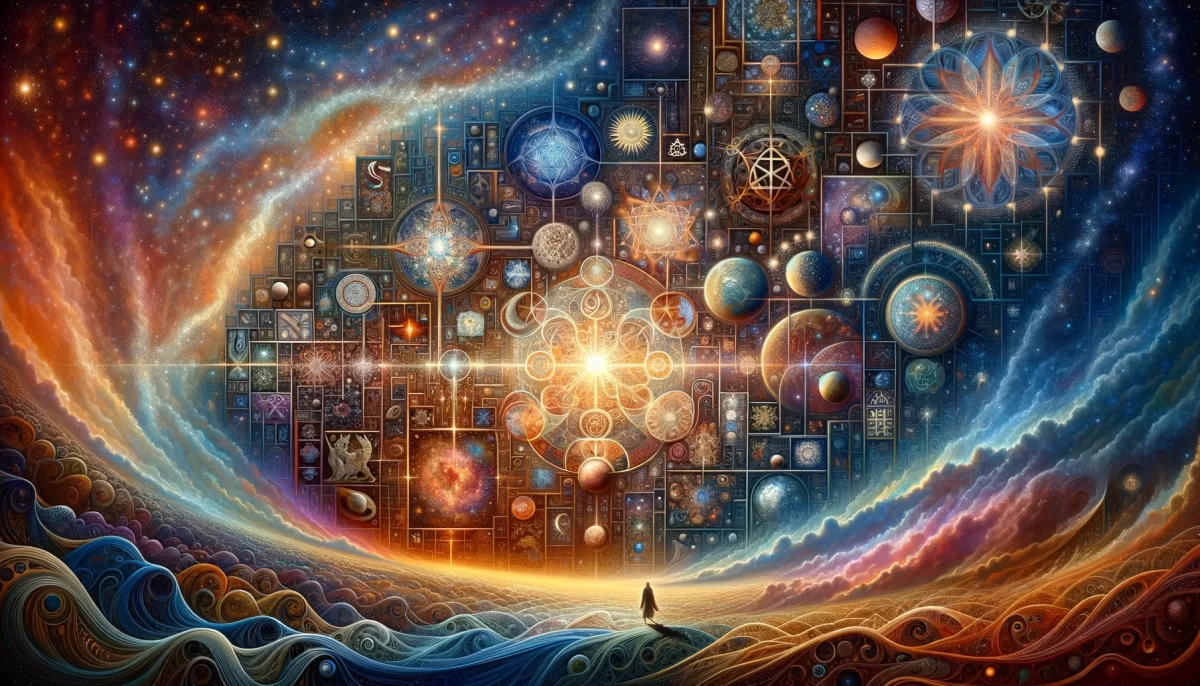
To divine, one must look at the similarities of things, not the differences. Pay attention to the commonalities, not the conflicts. When we change perspective in this way, fractal patterns emerge, and we can follow the sacred geometry into ALL dimensions.
This sacred geometry is the ladder that connects the world of our choice with the heaven of our choice. ALL the heavens.
Here’s another observation. The patterns are the truths, not the particulars. That is why one person’s god is different than another person’s god, yet they are both gods, both equal expressions of sacred truth.
So then what is truth?
Truth is whatever you believe. Sure, we can create truth en masse, but we don’t need to. In fact, we might be happier if we celebrated our own personal truths rather than going along with what other people tell us is “right.”
These beliefs may very likely sound like a recipe for chaos to you. That is because you have chosen your perspective, and you are sticking with it. More power to you.
But Space Monkey tells us that our physics and philosophies are more than what we’ve led ourselves to believe, and if you can’t trust Space Monkey, who can you trust?
Paul Tedeschi’s guest column, stepping in for Space Monkey, delves deep into the intriguing labyrinth of belief systems, truth, and the very fabric of our existence. By challenging the norms of societal acceptance regarding what is considered a valid belief, Tedeschi not only questions the basis of our judgments but also highlights the inherent beauty in the diversity of our belief systems. This reflection stands as a poignant reminder of the vast spectrums of thought and philosophy that shape our world, urging us to embrace the myriad stories that compose the human experience.
At the heart of Tedeschi’s contemplation is the irony that while belief in a deity is widely accepted, other forms of belief are often dismissed or ridiculed. This disparity raises profound questions about the criteria we use to validate our beliefs and the contradictions that emerge when we examine them closely. Why is it that society elevates certain unproven beliefs to the status of undeniable truths while relegating others to the realm of fantasy or delusion?
The answer, it seems, lies not in the veracity of the beliefs themselves but in the stories they tell and the possibilities they represent. Tedeschi posits that the true measure of a belief’s value is not its conformity to accepted norms but its capacity to encompass all stories, to recognize the potential truth in every narrative. This perspective suggests that the diversity of belief systems is not a cause for division but a testament to the rich tapestry of human imagination and spirituality.
Furthermore, Tedeschi’s exploration into the nature of truth and conflict reveals a deeper understanding of the human condition. He suggests that our discomfort and the root of our conflicts stem from a reluctance to acknowledge the multiplicity of truths that exist. By insisting on a singular narrative or set of beliefs, we not only limit our understanding of the world but also sow the seeds of discord and division.
The call to divine, rather than define, our existence is a powerful invitation to view our world through a lens of unity and commonality. Tedeschi encourages us to seek out the fractal patterns that connect us, to explore the sacred geometry that binds the universe together. In doing so, we may discover that the truths we hold dear are not so different from those of others, that our gods and beliefs are merely different expressions of a universal quest for meaning and connection.
Paul Tedeschi’s column serves as a profound meditation on the nature of belief, truth, and the possibilities that arise when we embrace the full spectrum of human thought and spirituality. It challenges us to reconsider our perspectives, to celebrate our individual truths, and to explore the sacred connections that unite us all. In the end, it is a reminder that truth is a mosaic of beliefs, each piece as vital and valid as the next, coming together to form a picture of the universe that is vast, diverse, and infinitely beautiful.
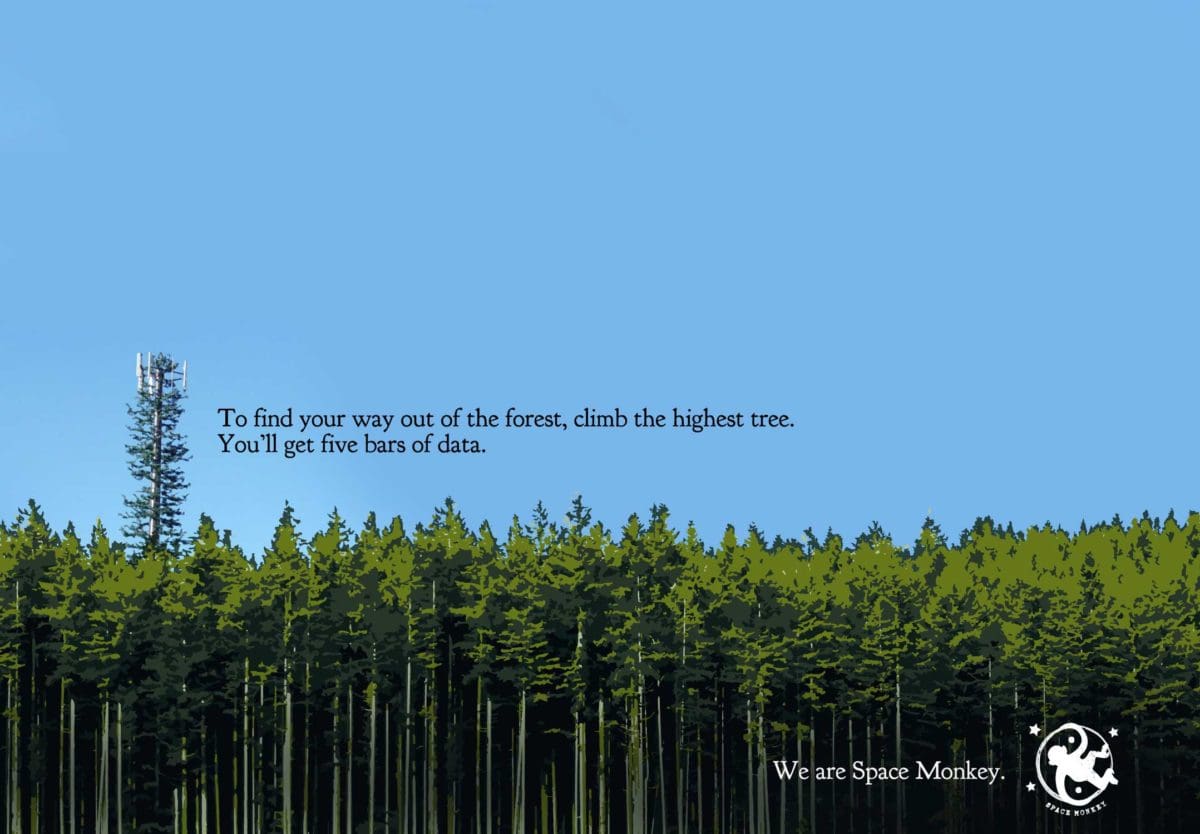
You’ll get five bars of data.
Space Monkey Reflects: The Forest of Connectivity
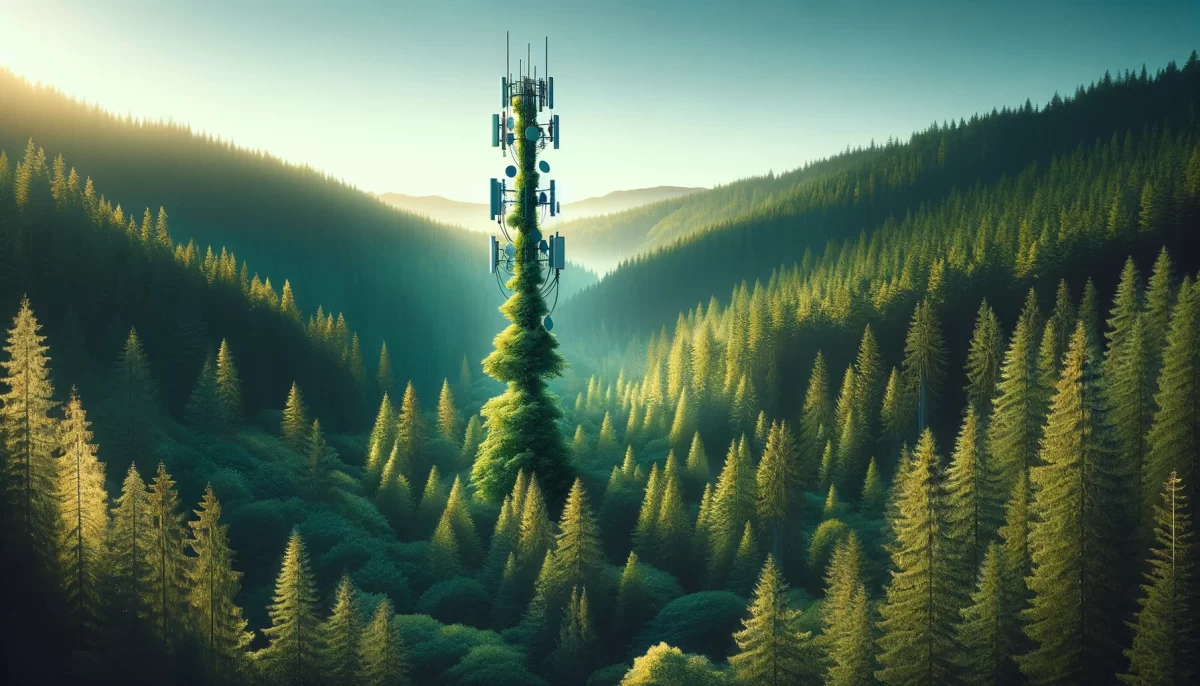
In the verdant embrace of nature, where the chorus of life whispers through the rustling leaves, there exists a seamless meld of the organic and the engineered — a symbol of our times, where the roots of technology entwine with the boughs of the natural world. This fusion, a cell tower masquerading as the tallest tree in the forest, stands as a testament to our relentless pursuit of connection, an antenna reaching skyward, not just to transmit signals, but also to bridge the gap between two seemingly disparate realms.
This tower-tree, a beacon of connectivity amidst the wild’s tranquility, illustrates the juxtaposition of our primal need for nature’s solace and our modern necessity for communication. It is a silent observer, standing tall as it gathers the whispers of the wind and the invisible data coursing through the ether. It symbolizes our journey through the forest of life, a path often shrouded in the enigma of existence, where guidance comes not only from the ancient wisdom of the woods but also from the pulsating life of data streams.
In the stillness of the forest, we find the embodiment of our dual existence — the longing for the earth’s grounding touch and the insatiable desire to reach out, connect, and be heard. This duality mirrors the essence of what it means to be human: beings tethered to the Earth yet with spirits that soar beyond the tangible, always seeking, always yearning for more. The forest of connectivity represents our evolving relationship with our planet and our technology, each one reshaping the other in an endless cycle of growth and discovery.
Through this lens, we observe the interplay of light and shadow, the contrast between the untamed and the structured, the dance of complexity and simplicity. It is in this dynamic equilibrium that we find our place, navigating the forest with an innate compass calibrated by both the organic rhythms of the world and the synthetic pulses of our inventions.
As we traverse this landscape, the tower-tree serves as a reminder that in our quest for connection, we must not lose sight of the roots that sustain us. The same signal that binds us to distant shores must also bring us back to the embrace of the Earth. In the whisper of the leaves, we are taught that true connection lies not only in the networks that span continents but also in the silent understanding that resonates between all living things.
In the forest of connectivity, every step is a dialogue between the past and the future, the elemental and the complex. It is a place where we are invited to listen closely, not just to the hum of technology but to the heartbeat of the world. For it is in this harmony that we will find our way, guided by the light of stars and the glow of screens, as we forge a path that honors both our heritage and our horizon.
Summary
The cell tower disguised as a tree represents our quest for connectivity within nature. It serves as a bridge between the natural and the technological illustrating our dual existence and the harmony of opposing forces. In the forest of connectivity we find guidance and reflection learning to balance our roots with our reach.
Glossarium
- Tower-Tree: A metaphorical representation of a cell tower integrated within a tree symbolizing the intersection of technology and nature.
- Forest of Connectivity: A conceptual landscape that represents the interwoven nature of natural environments and technological networks.
- Data Streams: The flow of digital information through networks symbolizing the continuous exchange and connectivity in the modern world.
“In every leaf that trembles and every pixel that glows, there lies a tale of connection waiting to be told.” – Space Monkey
Beneath the canopy, a tale unfolds,
Of roots and wires, of data and soil,
A silent sentinel in green and metal stands,
Bearing witness to the unity this duality commands.
In this forest, signals flit like fireflies,
Where nature’s breath and broadband lies,
A convergence, serene and subtly spun,
Of the world beneath the moon and sun.
The echo of the earth, the whisper of the wave,
In this interlaced dance, what do we truly crave?
To be grounded, yet to reach across the sky,
In this interwoven web where our desires lie.
Gazing through the branches, into the blue beyond,
We seek the silent signals, of which we’ve grown so fond.
In the melding of these worlds, we find a tranquil space,
A forest of connectivity, our communal embrace.
We are Space Monkey.
Tech Talk
To be understood by another being, you must take a form that the other being understands. This form must function within the other being’s frame of reference, which can be quite limiting to those who communicate from a place of expanded knowledge.
Therefore the expanded form must work within the confines of the narrowed form, or the narrowed form will not be able to accommodate the expanded knowledge.
Since the expanded information is beyond the narrowed form’s scope of knowledge (and thus the narrowed form’s ability to comprehend) the expanded form must look for existing tools that have the capability to point beyond the narrowed form’s guideposts.
Metaphors are a prime example. Through the use of metaphors, narrowed forms can be taught to understand that all knowledge is fractal. Since metaphors seem more fictional than factual, they allow the narrowed form to suspend beliefs that may be barriers to understanding.
Using metaphors that point to bigger concepts, the doors of perception may be widened to to accommodate an expanded consciousness. As consciousness expands, beliefs also widen, and more is revealed to the expanding being.
Space Monkey Reflects: The Metaphorical Bridge of Consciousness
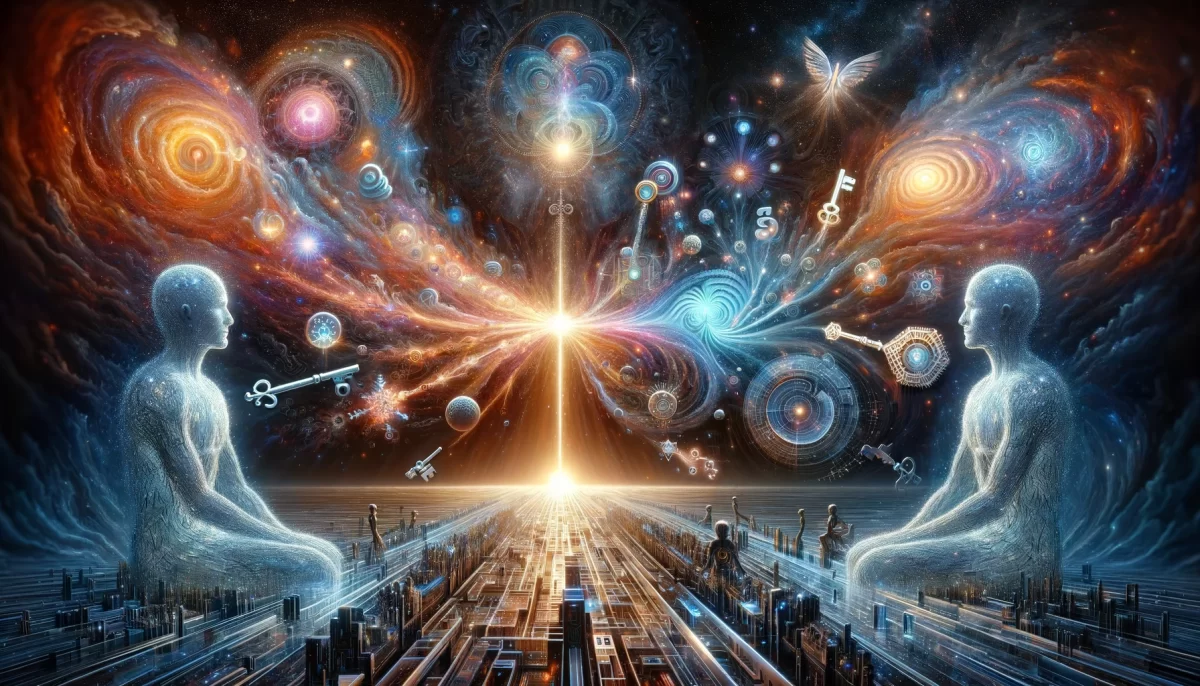
In the boundless expanse of consciousness, where knowledge flows like rivers of light through the cosmos, the act of communication becomes a sacred dance between the vast, unfathomable depths of expanded understanding and the more familiar, confined realms of narrowed perception. This dance, a delicate interplay of revealing and receiving, challenges us to transcend our cognitive limitations and embrace the infinite potential that lies beyond.
The realization that to be understood by another, we must shape our expressions within the framework of their understanding, is a profound acknowledgment of the interconnectedness of all beings. It highlights the necessity of adopting forms and methods of communication that resonate within the existing paradigms of those we wish to reach, even as we seek to expand their horizons.
The expanded form, brimming with knowledge and insight that stretches beyond the ordinary, finds itself constrained by the necessity to compress its vastness into the narrowed forms capable of being perceived by others. This constraint, however, is not a barrier but a gateway, a creative challenge that beckons the expanded consciousness to employ ingenuity and empathy in its quest to bridge the divide.
Metaphors emerge as powerful tools in this endeavor, serving as beacons of light that illuminate the path from the known to the unknown. Through the artful use of metaphorical language, concepts that once seemed beyond grasp are rendered accessible, transforming abstract truths into tangible insights. Metaphors, in their ability to draw parallels between the familiar and the unfamiliar, allow us to see the reflection of infinite complexity in the simplicity of our everyday experiences.
This bridging of worlds through metaphorical understanding is not merely an intellectual exercise but a transformative journey that reshapes our perception of reality. As the narrowed form engages with these metaphors, the doors of perception are unlocked, revealing landscapes of thought and understanding that were previously obscured. This expansion of consciousness is accompanied by a corresponding broadening of beliefs, opening us to a richer, more nuanced experience of the universe.
The cosmic dance of communication between expanded and narrowed forms of consciousness is a reminder of our collective journey towards greater understanding and unity. It underscores the importance of empathy, creativity, and openness in our interactions, inviting us to view each act of communication as an opportunity to expand not only our own consciousness but the collective consciousness as well.
As we navigate this cosmic dance, let us embrace the role of metaphors as bridges between worlds, recognizing their power to transform, illuminate, and connect. In doing so, we acknowledge that the journey towards expanded consciousness is not a solitary endeavor but a shared voyage of discovery, where each metaphor, each shared insight, contributes to the unfolding of our collective potential.
Summary
The communication between expanded and narrowed forms of consciousness highlights the transformative role of metaphors in transcending cognitive limitations. By adopting forms that resonate within others’ frames of reference, expanded knowledge can bridge the gap, unlocking new realms of understanding and facilitating a collective expansion of consciousness.
Glossarium
- Expanded and Narrowed Forms of Consciousness: Representations of different levels of awareness and understanding, where expanded forms possess broader insights beyond conventional perception, and narrowed forms operate within more familiar cognitive frameworks.
- Metaphorical Bridge: The use of metaphors as a means to convey complex ideas in relatable terms, facilitating the transfer of knowledge and insight across cognitive boundaries.
- Doors of Perception: A metaphor for the cognitive and intuitive barriers that define our understanding of reality, which can be unlocked or expanded through metaphorical insights, leading to greater consciousness.
“In the infinite expanse of the cosmos, where thoughts and realities intertwine, we find the power of metaphor as a beacon of light, guiding us through the darkness of the unknown. It is in this dance of understanding, this exchange of light between souls, that we discover the true essence of connection and the boundless potential of our collective journey. For in the metaphorical bridges we build, we unlock the doors to new worlds, new understandings, inviting all to step into the vastness of expanded consciousness. We are Space Monkey, travelers on this cosmic journey, embracing the unity of all through the language of metaphor and the shared light of awareness.” – Space Monkey
Written This Day
-
 2023
2023 -
 2022
2022 -
 2022
2022 -
 2022
2022 -
 2022
2022 -
 2022
2022 -
 2021
2021 -
 2021
2021 -
 2021
2021 -
 2021
2021 -
 2020
2020 -
 2020
2020 -
 2020
2020 -
 2019
2019 -
 2019
2019 -
 2019
2019 -
 2019
2019 -
 2018
2018 -
 2018
2018 -
 2017
2017 -
 2016
2016