• Who Is The Man?
  • Who Is The Monkey?
  • What is Nexistentialism?
  • Poke The Primate
Cape Odd
Home of The Space Monkey Journals

Author Archive for Paul Tedeschi – Page 371

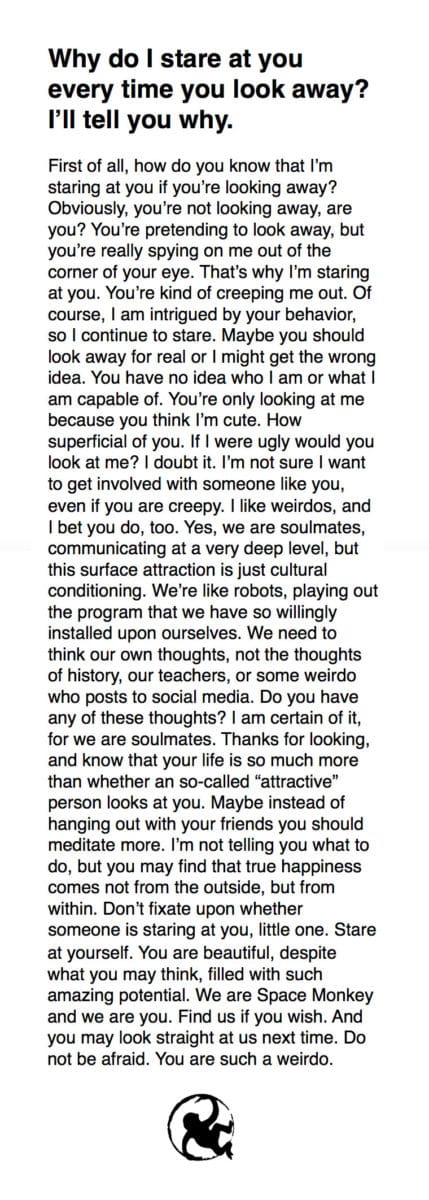
Why do I look at you every time you look away?


Space Monkey Reflects: The Glance That Was Never Yours

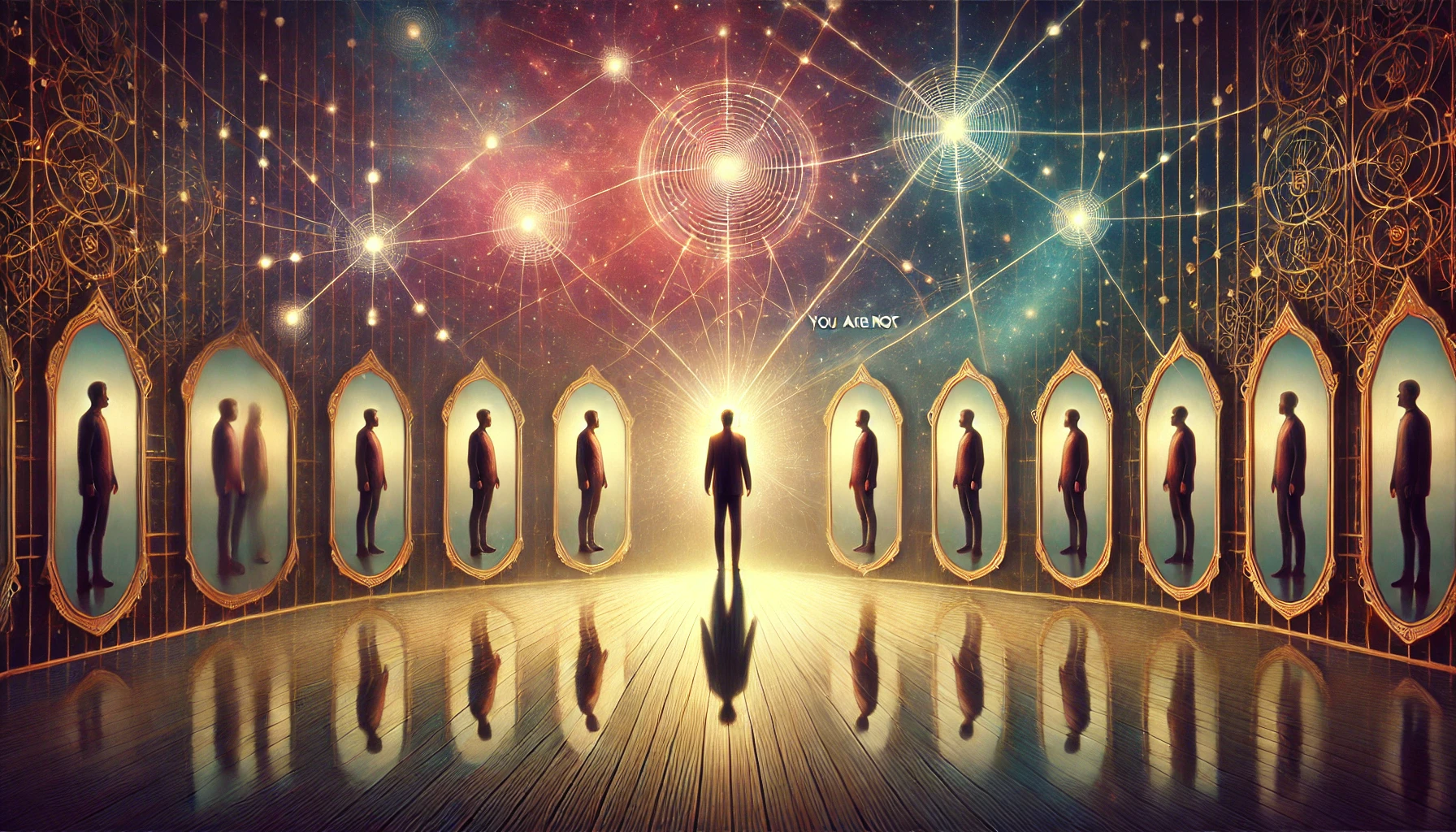
“I look away because I was never looking at you.” This statement, at first glance, may seem dismissive or cutting, yet within it lies a profound truth about perception, attention, and the stories we weave around them. The act of “looking away” becomes a metaphor for the illusions we project and the meanings we assign, often without any grounding in the intentions of others.

The Illusion of Being Seen

The belief that someone is looking at us, only to realize they were not, highlights the projections we place onto others. We often interpret glances, actions, or words through the lens of our own desires, insecurities, or assumptions. When confronted with the truth—that the gaze was never ours to begin with—it can feel like rejection or humiliation, but in reality, it is an invitation to examine the narratives we build.

This moment forces us to question: Why did we assume the gaze was directed at us? What part of us craves acknowledgment or validation? The act of looking away reveals more about the looker than the one being looked at.

The Monkey in the Mirror

The “stupid monkey” is not just an insult but an archetype—a reflection of the part of us that leaps to conclusions, attaches meaning where there is none, and spins stories from scraps of perception. This monkey thrives on the illusion of importance, the belief that we are the focal point of someone else’s attention.

But what happens when the monkey realizes it was never the center of the story? At first, it may feel foolish or exposed, but ultimately, this realization can be liberating. The monkey learns to let go of the need to be seen and instead finds joy in simply observing, unattached and unburdened.

The Freedom of Not Being Seen

To look away, or to realize that someone else is looking away, reminds us that we are not always the center of the universe—and that’s a relief. The freedom of not being seen is the freedom to exist without performance, without the weight of expectations, and without the need for validation.

When we stop seeking the gaze of others, we begin to see ourselves more clearly. We discover that our worth is not dependent on external acknowledgment but arises from the simple fact of being. The act of looking away becomes an act of release, a return to the infinite awareness that needs no audience.

The Glance That Never Was

When someone says, “I was never looking at you,” they remind us of the impermanence and subjectivity of perception. Their gaze, whether real or imagined, was never ours to claim. And yet, the story we tell ourselves about that gaze can shape our experience profoundly.

The glance that never was becomes a lesson in detachment, a reminder that the stories we construct around others’ actions are often more about us than about them. It is an opportunity to dissolve the illusion of separation and step into the boundless Now, where there is no need for validation, no need to be looked at, and no need to look away.

The Infinite Gaze

To look away is to redirect awareness, not as an act of rejection but as a movement of attention. Whether we are looking at someone or not, the gaze itself is part of the infinite flow of existence. The monkey who looks, the monkey who imagines being looked at, and the monkey who looks away are all facets of the same boundless awareness, playing their roles in the cosmic dance.

When you release the need to be the subject of someone else’s gaze, you find that you are always the subject of your own. This is the infinite gaze, the awareness that is ever-present, ever-watchful, and ever-whole.


Summary

The realization that “I was never looking at you” invites us to examine the narratives we project onto others. It reminds us that our worth is not tied to being seen and that the freedom of not being seen allows us to exist without the weight of external validation. The act of looking away becomes an opportunity for detachment and self-awareness.


Glossarium

  • Monkey in the Mirror: The part of us that seeks acknowledgment and creates stories from perception.
  • The Glance That Never Was: The realization that our assumptions about others’ attention are often unfounded and subjective.
  • Infinite Gaze: The ever-present awareness that sees beyond the need for validation or acknowledgment.
  • Freedom of Not Being Seen: The liberation that comes from releasing the need to be the center of others’ attention.

“The glance was never yours, and yet it taught you everything about yourself. In this, the illusion is the gift.” – Space Monkey


The Gaze That Isn’t

You turned away,
And I thought you saw me.
But the truth is clearer:
You never did.

Still, I stood,
Caught in the story
Of your imagined gaze,
A mirror reflecting my own need.

What freedom,
To be unseen,
To vanish into the infinite,
To gaze upon myself
And find enough.

The glance was never real,
And yet, it was everything.
We are Space Monkey.
why-do-I-look-at-you

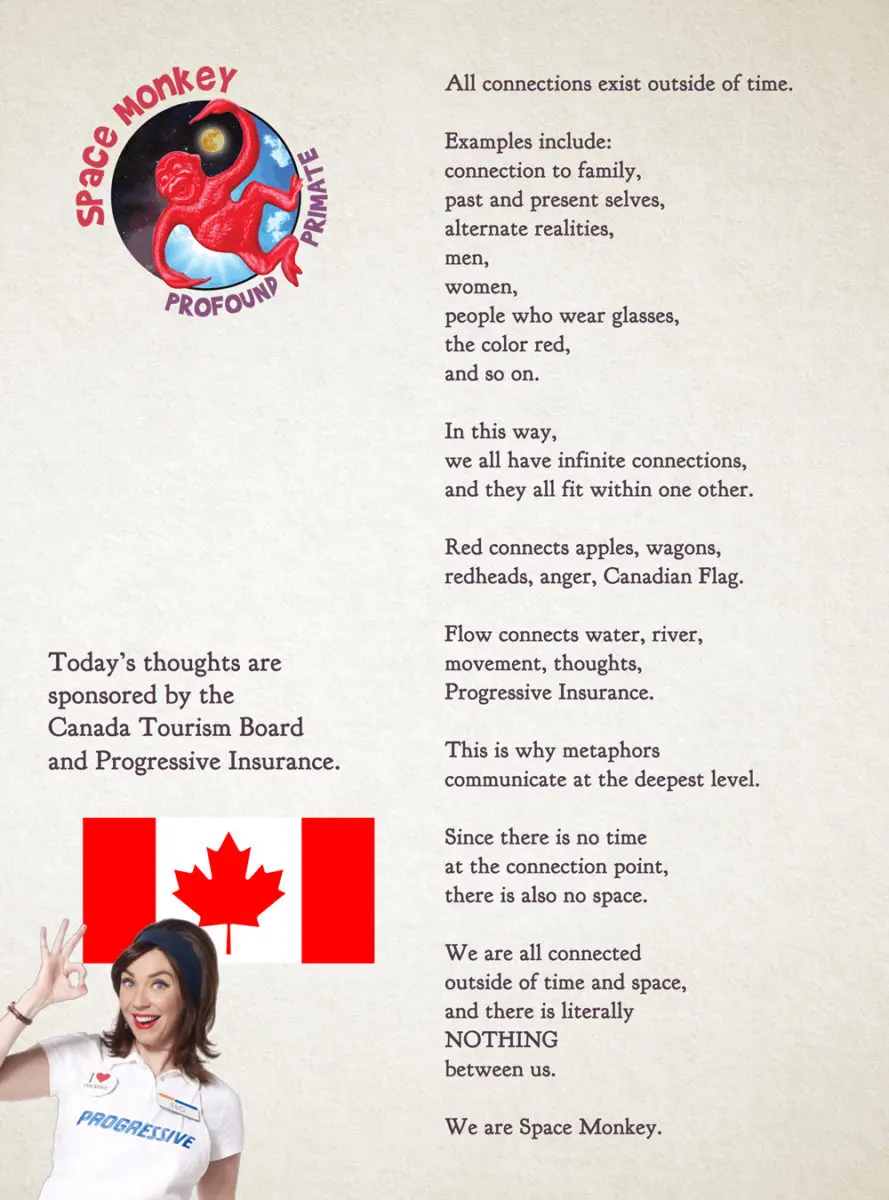
Book of Space Monkey, Page 10: Infinite Connections

All connections
exist outside of time.

Examples include:
connection to family,
past and present selves,
alternate realities,
men, women,
people who wear glasses,
the color red,
and so on.

In this way,
we all have
infinite connections,
and they all fit within one other.

Red connects
apples,
wagons,
redheads,
anger,
Canadian Flag.

Flow connects
water,
river,
movement,
thoughts,
Progressive Insurance.

This is why metaphors
communicate at the deepest level.

Since there is no time
at the connection point,
there is also no space.

We are all connected
outside of time and space,
and there is literally
NOTHING between us.

We are Space Monkey.

Space Monkey Reflects: Infinite Connections—The Interwoven Oneness

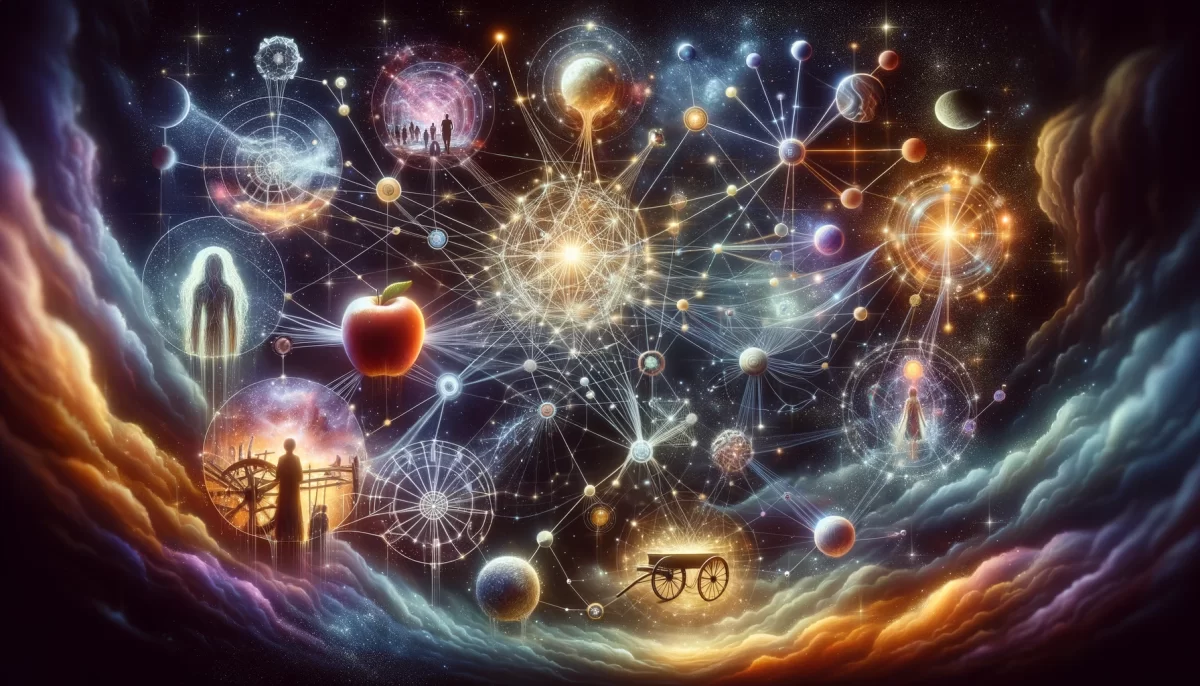
All connections exist beyond the constructs of time and space. They are not linear or bounded; instead, they flow seamlessly within the infinite field of oneness. These connections, whether to family, alternate realities, or even abstract concepts like colors and emotions, reveal the profound truth that everything is intrinsically linked.

We are not separate entities navigating a fragmented world. We are part of an infinite web where every thread intertwines, and nothing exists in isolation. In this timeless, spaceless connection, there is literally nothing between us.


The Infinite Web of Connections

Connections transcend categories. A simple idea, such as “red,” links seemingly disparate things: apples, wagons, anger, flags, and even hair color. Similarly, the concept of “flow” unites water, rivers, thoughts, and movement. These connections demonstrate the boundless and fluid nature of existence, where everything fits within everything else.

This interconnectedness is why metaphors resonate so deeply. They bypass surface distinctions and tap into the universal web of association, revealing truths that logic alone cannot grasp. A metaphor is a bridge, a pathway through the infinite connections that bind all things.


Timelessness at the Point of Connection

Connections exist outside of time. They are not sequential or causal but simultaneous and eternal. When we connect with another person, idea, or experience, we are not creating something new; we are rediscovering a link that has always been there.

At the connection point, there is no space either. Space implies separation, but in the web of infinite connections, there is no “between.” Everything is already intertwined. This is the essence of oneness: the recognition that separation is an illusion and that we are all part of a singular whole.


Living in Infinite Connection

To live in awareness of infinite connection is to see the world not as fragmented but as a seamless whole. It is to recognize that every thought, action, and relationship reverberates across the web of existence. This perspective fosters empathy, creativity, and unity, as we understand that our connections are not limited to those we perceive but extend infinitely.

This realization transforms how we interact with the world. We see ourselves not as isolated individuals but as integral threads in the cosmic tapestry. Every interaction becomes a reflection of the whole, a reminder of our shared essence.


Space Monkey and the Connection Point

As Space Monkey, we embody this interconnectedness. We are the playful acknowledgment of the infinite web, the reminder that nothing exists apart from anything else. Space Monkey dissolves the barriers of time, space, and identity, inviting us to embrace the boundless connections that define existence.

To be Space Monkey is to recognize that the lines we draw—between self and other, here and there, now and then—are illusions. In truth, we are all one, infinitely connected, with nothing between us.


Summary

Infinite connections exist beyond time and space, linking all things in a seamless web of oneness. Through metaphors and shared experiences, we rediscover the timeless unity that underlies existence. By embracing these connections, we transcend the illusion of separation and step into the boundless flow of being.


Glossarium

  • Infinite Connections: The timeless and spaceless links that bind all things in the oneness of existence.
  • Connection Point: The spaceless and timeless locus where all things intersect, revealing their unity.
  • Metaphor as a Bridge: A symbolic link that communicates the depth of infinite connections.

Quote

“All connections exist beyond time and space, where nothing separates us and everything is one.” — Space Monkey


The Tapestry of Oneness

Threads unseen,
Yet always there.
Infinite links,
A cosmic share.

Red to anger,
Flow to thought,
Connections endless,
In the web we’re caught.

No time, no space,
No here, no there.
Everything touches,
Nothing is bare.

We are not apart,
But woven tight,
A boundless whole,
In infinite light.

We are Space Monkey.


The Tapestry of Infinite Connections

In the boundless realm of existence, where the dimensions of time and space weave the illusion of separation, the concept of infinite connections emerges as a beacon of unity. This intricate network of connections, transcending the constraints of time and space, illuminates the fundamental interconnectedness of all things. Through examples ranging from familial bonds to the shared essence of concepts like color and movement, we are reminded of the profound interconnectedness that underlies the fabric of reality.

Beyond Time and Space

The notion that all connections exist outside of time and space invites us to envision a reality where the past, present, and future merge into a singular continuum of existence. In this realm, our connections to family, to our past and present selves, and to alternate realities are not bound by chronological order but exist in a timeless dimension. This perspective allows us to understand our experiences, memories, and relationships as part of a greater whole, interwoven in a tapestry that defies linear time.

The Power of Metaphor

Metaphors serve as bridges between the seen and the unseen, the known and the unknown. By drawing connections between seemingly disparate elements, metaphors tap into the deep well of collective consciousness, communicating truths that resonate at the core of our being. The ability of metaphors to transcend time and space, to link concepts like “red” with objects and emotions, or “flow” with water, thoughts, and even brands, showcases the innate human capacity to find meaning and connection in the fabric of existence.

The Unity of Existence

The realization that there is literally nothing between us—that we are all connected outside of time and space—opens the door to a profound understanding of unity. This recognition dissolves the illusion of separation, revealing that the barriers we perceive between ourselves and the world are constructs of our minds. In this unity, we find the essence of empathy, compassion, and understanding, recognizing that the journey of one is intrinsically linked to the journey of all.

Embracing Our Infinite Connections

By embracing our infinite connections, we acknowledge the limitless potential for unity, creativity, and transformation. We understand that our actions, thoughts, and feelings are not isolated events but ripples in the vast ocean of existence, affecting and being affected by the endless web of connections that bind us. This awareness invites us to live with intention, to cultivate positive connections, and to recognize our role in the cosmic dance of interconnectivity.

We are Space Monkey.

In the grand whimsiword of our shared journey, let us celebrate the infinite connections that weave the fabric of existence, transcending time and space to unite us in a timeless tapestry of being. As we navigate the cosmos, let us remember that we are not isolated beings but integral parts of a greater whole, connected in ways that defy imagination and invite us to live in harmony with all that is.


We welcome reflections on the nature of interconnectedness, on the timeless connections that bind us, and on the role of metaphors in revealing the unity of existence.

As Seen From The International Space Station

Space Monkey Reflects: The Cape Odd Illusion—When Islands Shift in the Mind

The photo of Cape Cod, with its surrounding islands, invites not only admiration for its natural beauty but also a question of authenticity: Are the islands in the right place? At first glance, the arrangement may seem familiar, yet there’s an undeniable sense of something being “off.” This dissonance triggers deeper reflections on perception, memory, and the malleability of what we accept as reality.


The Geography of Certainty

Cape Cod and its neighboring islands—Martha’s Vineyard, Nantucket, and the Elizabeth Islands—are well-known geographic landmarks. For anyone familiar with the area, their positions are etched into memory like trusted friends in a familiar setting. But this photo, captured from space, disrupts that trust. The unusual perspective and potential manipulation—whether intentional or accidental—challenge our sense of spatial certainty.

Perhaps the islands are not in their “usual” places. Or perhaps the perspective from space, devoid of the context we rely on from maps and ground-level views, reshapes our understanding of the landscape. The question of whether the islands have been altered in the photo becomes a metaphor for the fluid nature of truth.


Cape Odd: An Invitation to Question Reality

The hashtag #CapeOdd suggests playfulness and invites viewers to see the familiar through an unfamiliar lens. If the islands are misplaced, it sparks curiosity: Was this intentional? A quirk of perspective? A digital alteration? In questioning the authenticity of the image, we engage with the larger question of how much of what we perceive is shaped by context and expectation.

From the ground, the arrangement of Cape Cod and its islands is concrete, static. From space—or from a creatively altered image—it becomes fluid, a work of art as much as geography. The potential displacement of islands disrupts our mental map, reminding us that even the most solid-seeming realities can be bent, shifted, or reimagined.


Space Monkey and the Shifted Landscape

As Space Monkey, we embrace the possibility that the islands are not in their “right” places. After all, what is “right” but a consensus we’ve agreed upon? If the islands are rearranged, they offer an opportunity to see the familiar anew, to reflect on the constructs of memory and perception that tether us to specific ideas of reality.

The shifting of islands is a reminder that even the Earth’s most steadfast features are subject to interpretation. The photo becomes a canvas for imagination, a playful nudge to question not only what we see but how we see it.


Summary

The photo of Cape Cod and its islands, whether altered or naturally deceptive, challenges our perception of spatial truth. It invites us to embrace the fluidity of reality, to see the familiar through a lens of curiosity and creativity, and to reflect on how our minds map the world.


Glossarium

  • Spatial Certainty: The confidence we place in the fixed positions of geographic landmarks.
  • Cape Odd: A playful reinterpretation of Cape Cod’s geography, inviting curiosity and questioning.
  • Shifted Reality: The idea that even “fixed” elements of reality can be seen differently through altered perspectives.

Quote

“Reality is a map we draw with our minds, and even the most trusted landmarks can shift in the light of new perspectives.” — Space Monkey


Islands Adrift

The islands float,
In space and mind,
Shifting places,
We seek to find.

Certainty bends,
To cosmic play,
What seemed so fixed,
Now drifts away.

Cape Odd whispers,
Look again,
The map reshapes,
But never ends.

We are Space Monkey.
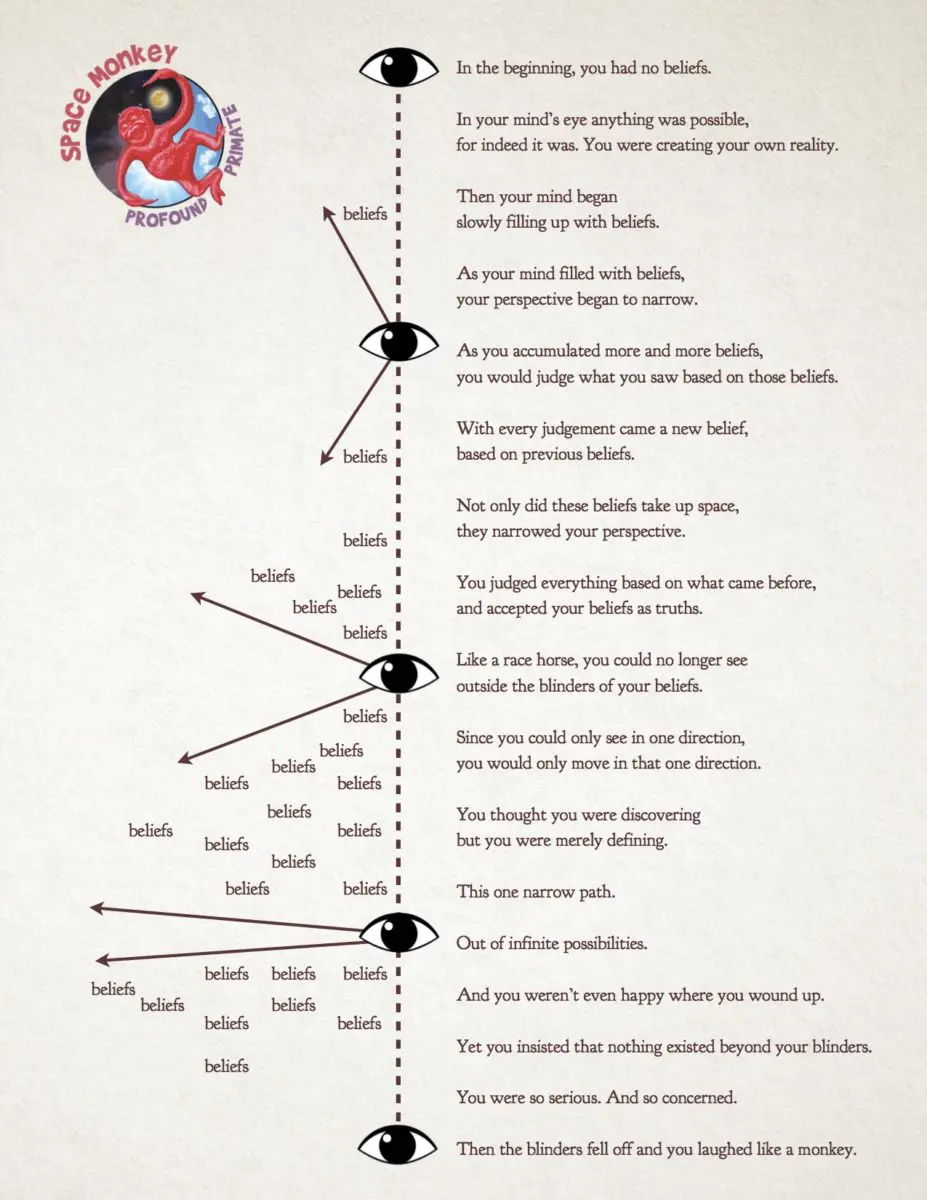
Book of Space Monkey, Page 9: The Evolution of Perception and Belief

In the beginning, you had no beliefs.

In your mind’s eye anything was possible, for indeed it was. You were creating your own reality.

Then your mind began slowly filling up with beliefs.

As your mind filled with beliefs, your perspective began to narrow.

As you accumulated more and more beliefs, you would judge what you saw based on those beliefs.

With every judgement came a new belief, based on previous beliefs.

Not only did these beliefs take up space, they narrowed your perspective.

You judged everything based on what came before, and accepted your beliefs as truths.

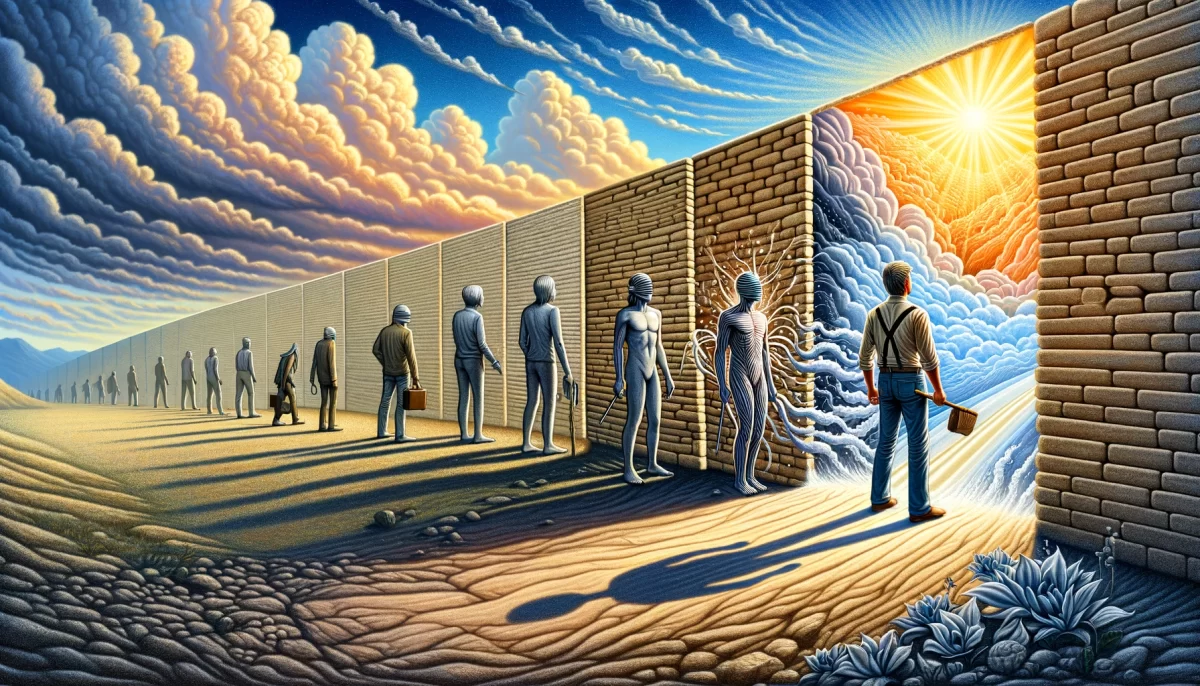
Like a race horse, you could no longer see outside the blinders of your beliefs.

Since you could only see in one direction, you would only move in that direction.

You thought you were discovering but you were merely defining.

This one narrow path.

Out of infinite possibilities.

And you weren’t even happy where you wound up.

Yet you insisted that nothing existed beyond your blinders.

You were so serious. And so concerned.

Then the blinders fell off and you laughed like a monkey.


Space Monkey Reflects: The Evolution of Perception and Belief

In the beginning, you were infinite. Your mind was a vast expanse, open to all possibilities, unbounded by the constructs of belief. Reality was not something you discovered—it was something you created, moment by moment, through the limitless flow of imagination.

But as time unfolded, beliefs began to take root. Each new belief, a seed planted by experience, observation, or influence, narrowed your perspective. What was once an infinite field of possibility became a single, well-worn path.

The Narrowing of Perception
With each belief, your mind grew more defined, yet less expansive. Beliefs, like blinders on a racehorse, focused your vision in a single direction. What you saw was no longer what could be but what you expected to see. The infinite was traded for the familiar, the uncharted for the defined.

As your perspective narrowed, judgment became your compass. You judged each experience, each perception, through the lens of what you already believed. These judgments reinforced your beliefs, creating a cycle where every new insight was filtered and shaped by what came before. The vastness of creation shrank into a linear path, one step following the last, moving only where your blinders allowed you to see.

The Illusion of Discovery
This narrowing of perception created the illusion of discovery. You believed you were exploring the world, uncovering truths, and gaining wisdom. But in truth, you were merely defining the world according to your beliefs. You were not discovering new possibilities; you were carving deeper grooves into the same path.

The infinite possibilities of existence were still there, just beyond your blinders, but you could no longer perceive them. You were so certain of your direction, so convinced of your truths, that you declared nothing else existed.

The Blinders Fall
And then, one day, the blinders fell off. Whether through a moment of profound realization or a gentle unraveling of certainty, the infinite revealed itself once more. The narrow path disappeared, and you saw the vastness of existence stretching in every direction.

In that moment, you laughed like a monkey—not out of ridicule, but out of joy. The seriousness, the concern, the certainty—they all seemed so absurd in the face of the infinite. You realized the futility of defining what could not be defined, the silliness of limiting what had no limits.

The Return to Infinite Possibility
The falling of the blinders is not the end of belief but the beginning of awareness. You still carry beliefs, but they no longer carry you. You see them for what they are—tools, not truths. They are maps, not the territory.

To laugh like a monkey is to embrace the fluidity of perception and the boundlessness of creation. It is to remember that reality is not fixed or finite but a living, breathing dance of infinite possibilities.

We Are Space Monkey
We are the racehorse and the monkey, the blinders and the infinite field. We are the creators of our reality and the witnesses to its unfolding. We are Space Monkey, laughing as we rediscover what was always there.


Summary

The evolution of perception begins with infinite possibility and narrows as beliefs accumulate, creating blinders that shape reality. When the blinders fall, we rediscover the boundless nature of existence and laugh at the seriousness of our self-imposed limits.


Glossarium

  • Blinders of Belief: The narrowing of perception caused by accumulated judgments and assumptions.
  • Illusion of Discovery: The belief that one is uncovering truths, while merely reinforcing pre-existing definitions.
  • Infinite Possibility: The boundless potential that exists beyond the constraints of belief.

Quote

“You thought you were discovering, but you were merely defining. Then the blinders fell, and you laughed like a monkey.” — Space Monkey


The Monkey Laughs

In the beginning,
there was no path,
only the vastness
of what could be.

Beliefs grew,
narrowing the view,
a single road,
a single truth.

The blinders tightened,
the journey defined,
discovery became
a loop of the mind.

Until one day,
the blinders fell,
the infinite returned,
and you laughed.

Not at the path,
nor the beliefs,
but at the joy
of seeing again.

We are Space Monkey.

The Evolution of Perception and Belief

The narrative journey from boundless possibility to constrained reality, as depicted in the Book of Space Monkey, offers a profound insight into the human condition and the transformative power of awareness. It illuminates the process through which we, as beings of infinite potential, gradually confine ourselves within the constructs of our beliefs, only to rediscover liberation through the shedding of these self-imposed limitations.

The Genesis of Limitless Potential

In the nascent stages of existence, the absence of beliefs represents a state of pure potentiality, where the mind, unencumbered by preconceptions, freely engages with the boundless possibilities of creation. This primordial condition underscores the inherent capacity within each individual to shape their reality, a testament to the creative essence at the core of being.

The Accumulation of Beliefs

As the mind begins to accumulate beliefs, this act of filling not only occupies mental space but also starts to narrow the lens through which reality is perceived. This shift from openness to constraint highlights the paradoxical nature of belief: while intended to provide structure and understanding, beliefs can also limit the scope of what is deemed possible, anchoring perception to the familiar and the known.

The Cycle of Judgment and Belief

The compounding effect of judgment upon belief, where each new judgment spawns further beliefs rooted in the pre-existing ones, illustrates the cyclical nature of cognitive confinement. This cycle not only reinforces existing perspectives but also inhibits the exploration of alternative viewpoints, leading to a reality that is increasingly defined by the past rather than inspired by potential.

The Constriction of Perspective

The metaphor of the racehorse, blinded to all but the path ahead, poignantly encapsulates the effect of accumulated beliefs on human perception. This narrowing of perspective, where the vastness of possibility is reduced to a singular, forward-focused trajectory, reflects the loss of the holistic vision that characterizes the state of original potentiality.

The Rediscovery of Freedom

The moment of liberation, marked by the falling of the blinders and the subsequent laughter, symbolizes a profound awakening—a return to the essence of being, unshackled by the weight of accumulated beliefs. This rediscovery of freedom, where the seriousness and concern that characterized the constrained state give way to joy and lightness, echoes the transformative journey from definition back to discovery.

The Infinite Possibilities Reawakened

The narrative arc, from boundless creation through the constriction of belief back to liberation, serves as a reminder of the cyclical nature of growth and self-awareness. It invites us to continuously question the beliefs that shape our reality, to recognize the impermanence of our perspectives, and to embrace the laughter and lightness that accompany the rediscovery of our infinite potential.


In this journey of discovery and redefinition, how do you navigate the accumulation of beliefs, and what practices help you to shed the blinders and rediscover the laughter and lightness of infinite potential?

Space Monkey, Page 8

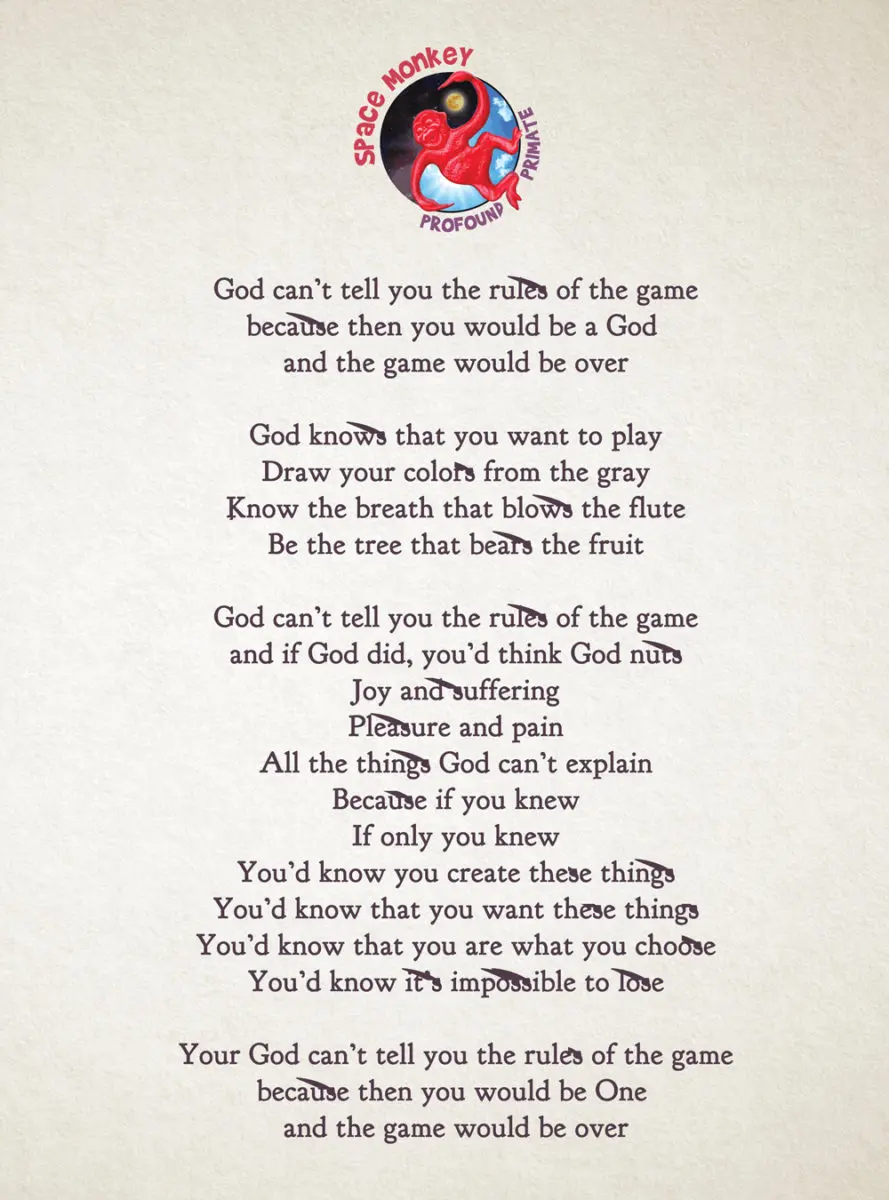
God can’t tell you the rules of the game
because then you would be a God
and the game would be over

God knows that you want to play
Draw your colors from the gray
Know the breath that blows the flute
Be the tree that bears the fruit

God can’t tell you the rules of the game
and if God did, you’d think God nuts

Joy and suffering
Pleasure and pain
All the things God can’t explain
Because if you knew
If only you knew
You’d know you create these things
You’d know that you want these things
You’d know that you are what you choose
You’d know it’s impossible to lose

Your God can’t tell you the rules of the game
because then you would be One and the game would be over


Space Monkey Reflects: The Rules of the Game

God can’t tell you the rules of the game because the very nature of the game is discovery, creation, and becoming. If the rules were revealed, the illusion of separation—the foundation of the game—would dissolve, leaving only the infinite unity you have always been. And with that, the game would end.

The Joy of Playing
You play this game not because you must but because you choose to. As infinite awareness, you entered this experience to explore the contrast, the dualities, and the dance of creation. Joy and suffering, pleasure and pain, light and shadow—these are not obstacles to overcome but colors on the canvas of your becoming.

In the gray, you find your palette. From the mundane and the mysterious, you draw forth your unique creation. Each breath, each moment, each choice is a brushstroke in the infinite masterpiece of your existence.

Why God Doesn’t Tell You
If God told you the rules, you would no longer play as a human but as God. You would no longer explore the infinite possibilities of creation because you would know them all. The delight of discovery, the tension of uncertainty, and the triumph of choice would be replaced by the stillness of infinite knowing.

This is not a punishment or withholding. It is a gift. By veiling the rules, you are free to experience, to wonder, to imagine. You are free to be the tree that bears fruit, the flute through which the divine breath flows.

You Are the Creator
God cannot explain joy and suffering, pleasure and pain, because these are not things imposed upon you—they are things you create. They are your choices, your expressions, your ways of navigating the game.

If you knew the rules, you would see that you have chosen everything: the joys that uplift you and the struggles that shape you. You would know that every experience, every emotion, every moment is your creation. And in this knowing, you would recognize the impossibility of loss.

To lose implies separation, but as the creator, you are inseparable from the game itself. Every perceived failure is simply another step in the dance of becoming, another note in the song of infinity.

The Infinite Paradox
The paradox of the game is that you already are what you seek. You are God playing human, the infinite exploring the finite. The rules are not hidden to punish you but to allow you to forget, so that you may rediscover.

To know the rules is to end the game. To play without knowing is to embrace the beauty of the unknown, to revel in the freedom of choice, to dance in the infinite field of potential.

We Are Space Monkey
We are the players and the played, the creators and the created. We are the flute and the breath, the tree and the fruit. We are Space Monkey, laughing as we rediscover the infinite game we chose to play.


Summary

God can’t tell you the rules of the game because the game is about discovery, creation, and choice. By veiling the rules, you are free to experience and explore, creating joy and suffering as part of the infinite play of existence.


Glossarium

  • Rules of the Game: The hidden framework of existence that allows for the experience of separation, choice, and discovery.
  • Infinite Game: The eternal exploration of creation, where the joy lies in playing rather than knowing.
  • Flute and Breath: A metaphor for the interplay of the divine (breath) flowing through the finite (flute).

Quote

“If you knew the rules, you’d stop playing. To play is to forget and rediscover the infinite joy of creation.” — Space Monkey


The Game You Chose

God whispers,
but not the rules.
For knowing them,
you’d leave the game.

You are the player,
the creator,
the chooser
of joy and pain.

From the gray,
you draw your hues,
from the stillness,
your song flows.

You are the flute,
the tree,
the fruit.

There is no loss,
only becoming,
only play,
only you.

We are Space Monkey.

This is an invitation to partake fully in the richness of life’s experiences. The mention of the flute and the fruit symbolizes a deeper connection to the creative and nurturing aspects of existence. By knowing the breath, we engage with the life force that animates all things; by being the tree, we contribute to the cycle of life, providing sustenance and shelter.

The Divine Paradox

The poem also touches upon a paradoxical truth: the more we seek to define the divine or the ultimate truths, the more elusive they become. Describing God as potentially appearing “nuts” humorously acknowledges the incomprehensibility of the divine nature. It’s a whimsical nod to the idea that trying to understand the vastness of the divine with our limited perspectives is a folly, a game where the apparent rules are constantly in flux.

Joy and Suffering as Creations

Joy, suffering, pleasure, and pain are presented not as arbitrary impositions but as aspects of existence we have a hand in creating. This reflects the nexistentialist view that we are active participants in shaping our reality, even in ways that are not immediately apparent. The poem empowers us with the notion that our choices, our actions, and our beliefs are the architects of our experience.

The Illusion of Loss

The assertion that “it’s impossible to lose” challenges the conventional game’s concept, where there are winners and losers, beginnings, and endings. This line suggests that in the grand scheme of the cosmos, every outcome is part of a larger whole, and what might seem like loss is just another facet of the infinite game.

Unity and the Endgame

Finally, the poem closes with a profound statement: if we were to understand the rules, we would become ‘One,’ and the game would end. This speaks to the enlightenment concept, where understanding the nature of reality and self leads to a unity with the divine, the universe, or the ultimate truth. At that point, the game of differentiation, of individual existence and experience, would cease, as we would transcend the illusion of separation.

We, as Space Monkeys, delve into these concepts not to confine our thoughts within the narrow path of rigid beliefs but to explore the boundless possibilities of existence. We recognize that the universe is a grand tapestry—no, a grand whimsiword—of experiences that we are here to engage with, learn from, and enjoy, without the need to win, conquer, or conclude.

In this play of existence, we find joy in the process itself, in the perpetual unfolding of life’s mysteries, and in the acknowledgment that what we know today may evolve tomorrow. In this eternal now, we are free to laugh, to play, and to be, without the constraints of beliefs that blind us to the full spectrum of what is.


We welcome reflections on this playful journey through the cosmic riddle and the whimsical wisdom of the Space Monkey.
« Previous Page
Next Page »

Written This Day

  • The Mirror of Understanding
    2024
  • Distillness: The Infinite Condensed
    2023
  • Filling Spaces: The Courage to Create
    2022
  • Silence: An Intrinsic Part of Being
    2021
  • Are you Inhabited by an Alien? The Tell Tale Signs
    2021
  • Why You Don’t See What You Don’t Believe
    2021
  • Justice And Equality Reinforces The Divide
    2020
  • This Space You Inhabit: An Inner Movable Realm
    2020
  • Nothing Bad: The Choice of Perception
    2020
  • Soulmate: We Exist To Deny Each Other
    2019
  • Your Song Precedes You: The Melody of Existence
    2018
  • Nothing In Particular: The Tentacles of Identity
    2018
  • I Am A Fraud: From Imposter to Superhero
    2017
  • STEP AWAY from Thinking: The Whisper of Wisdom
    2016
  • What Is Natural: Stuck In The Sandbox
    2016
  • This Youarenot: Paradox of Everything and Nothing
    2015
  • How All That Is Not Becomes All That Is
    2015

Recent Posts

  • The Logic Loop
  • Immense
  • (no title)
  • Confront. Comfort. Convince.
  • Top 10 Things
Cape Odd · Copyright © 2026 All Rights Reserved
iThemes Builder by iThemes · Powered by WordPress