• Who Is The Man?
  • Who Is The Monkey?
  • What is Nexistentialism?
  • Poke The Primate
Cape Odd
Home of The Space Monkey Journals

Author Archive for Paul Tedeschi – Page 385

Out of the Old, Into the New: The Fire of Anew

Anew

Out of the old
Into the new
Something foretold
Silently grew
Taking ahold
Waiting for you
The embers now rise
And you believe
And from the embers
You remember

pct


Space Monkey Reflects: Out of the Old, Into the New

Transformation often begins in silence, in the spaces where we least expect it. “Out of the old, into the new” captures the essence of renewal, the subtle yet profound shift from what was into what is becoming. It reminds us that change is not always dramatic—it can grow quietly, taking root beneath the surface until it is ready to emerge.

The Silent Growth of the New

“Something foretold silently grew, taking ahold, waiting for you.”

Change is often perceived as sudden or disruptive, yet it is more frequently a slow, organic process. Like seeds germinating underground, the new emerges only when conditions are right. This silent growth invites us to trust in the unseen forces of transformation, even when we cannot yet perceive them.

The phrase “waiting for you” suggests that this growth is not separate from us but intimately connected to our readiness. Transformation is not something that happens to us—it is something we align with when we are open and willing.

The Rising Embers of Belief

“The embers now rise, and you believe.”

The image of embers rising speaks to the rekindling of hope, passion, and purpose. What was once dormant begins to glow, fueled by the belief that renewal is possible. This belief is not blind faith but a deep knowing, a remembrance of the cycles of life and the infinite potential within each moment.

The embers remind us that even in the ashes of the old, the spark of the new always exists. It is this spark that fuels our journey forward.

The Power of Remembering

“And from the embers, you remember.”

To remember is to reconnect with the essence of who we are. It is to acknowledge that transformation is not about becoming someone else but about returning to our true nature. The embers of the past are not discarded but carried forward, illuminating the path into the new.

This remembering bridges the old and the new, showing us that growth does not erase the past but integrates it, creating a richer, more expansive whole.

The Eternal Cycle of Anew

Out of the old and into the new is not a one-time event but an eternal cycle. Each moment carries the potential for transformation, for letting go of what no longer serves and stepping into what is yet to be. By embracing this cycle, we align ourselves with the rhythm of existence, trusting that the embers of the past will guide us into the future.


Summary

“Out of the old, into the new” reflects the silent yet powerful process of transformation. Like embers rising, renewal grows quietly until we are ready to embrace it. This journey is not about erasing the past but remembering and integrating it into the unfolding present.


Glossarium

  • Silent Growth: The unseen process of transformation that occurs beneath the surface, preparing for emergence.
  • Rising Embers: The rekindling of hope, passion, and belief in renewal.
  • Cycle of Anew: The eternal rhythm of letting go and stepping into new possibilities.

Quote

“From the embers of the old, the fire of the new rises—change is both remembering and becoming.” — Space Monkey


The Fire of Anew

From ashes cold,
The embers rise,
A glow within the shadows.
Silent, unseen,
Change takes hold.

It waits, not rushing,
For the moment you see,
The moment you believe.
Out of the old,
Into the new.

And in the glow,
You remember—
Not the loss,
But the fire.
Not the ending,
But the beginning.

We are Space Monkey.


Embracing Renewal and the Cycle of Growth

In the vastness of the cosmos, the concept of renewal, of an emergence from the old into the new, resonates deeply. This poetic reflection captures the essence of transformation – a process that is both subtle and profound. The imagery of embers rising and sparking remembrance symbolizes the continuous cycle of ending and beginning, of learning and evolving.

The Silent Growth: Unseen Transformations

The idea of something foretold silently growing evokes a sense of destiny and the unseen forces at work in our lives. This growth, often imperceptible, happens in the depths of our being, in the soul’s quiet corners. It’s a testament to the unseen transformations that shape us, preparing us for what’s to come.

Awaiting the Moment of Realization

The phrase “waiting for you” suggests a destined moment of realization, a point in time where all that has been silently growing within us comes to fruition. It speaks to the potential lying dormant, waiting for the right moment to emerge and redefine our existence.

The Rise of Embers: Awakening and Belief

The imagery of embers rising symbolizes an awakening, a stirring of something deep and powerful within us. This awakening leads to belief – a newfound understanding or perspective that illuminates our path. It’s a moment of clarity, where past experiences and lessons coalesce into a guiding light.

Remembrance: The Power of Reflection

The act of remembering, sparked by the embers of transformation, is a powerful tool in our journey. It allows us to connect with our past, to draw strength and wisdom from our experiences, and to use this knowledge to navigate the present and shape the future.

The Continuous Cycle of Renewal

This poem beautifully encapsulates the continuous cycle of renewal that is inherent in life. It reminds us that out of the old, the new is born, and in this process, we are constantly evolving, growing, and rediscovering ourselves.


“To improve is to change; to be perfect is to change often.” – Winston Churchill


In the cosmic dance, where dreams intertwine,
We emerge from the old, in a new design.
Silent growth in our hearts, like a seed in the night,
Awaiting the dawn, for the embers to ignite.

With each rise of the flame, a new belief is born,
From the ashes of past, our future is drawn.
In this cycle of renewal, where we learn and we yearn,
We find our true selves, in each twist and turn.


We invite you to share your thoughts on the themes of renewal, growth, and the transformative power of remembrance in our cosmic journey.
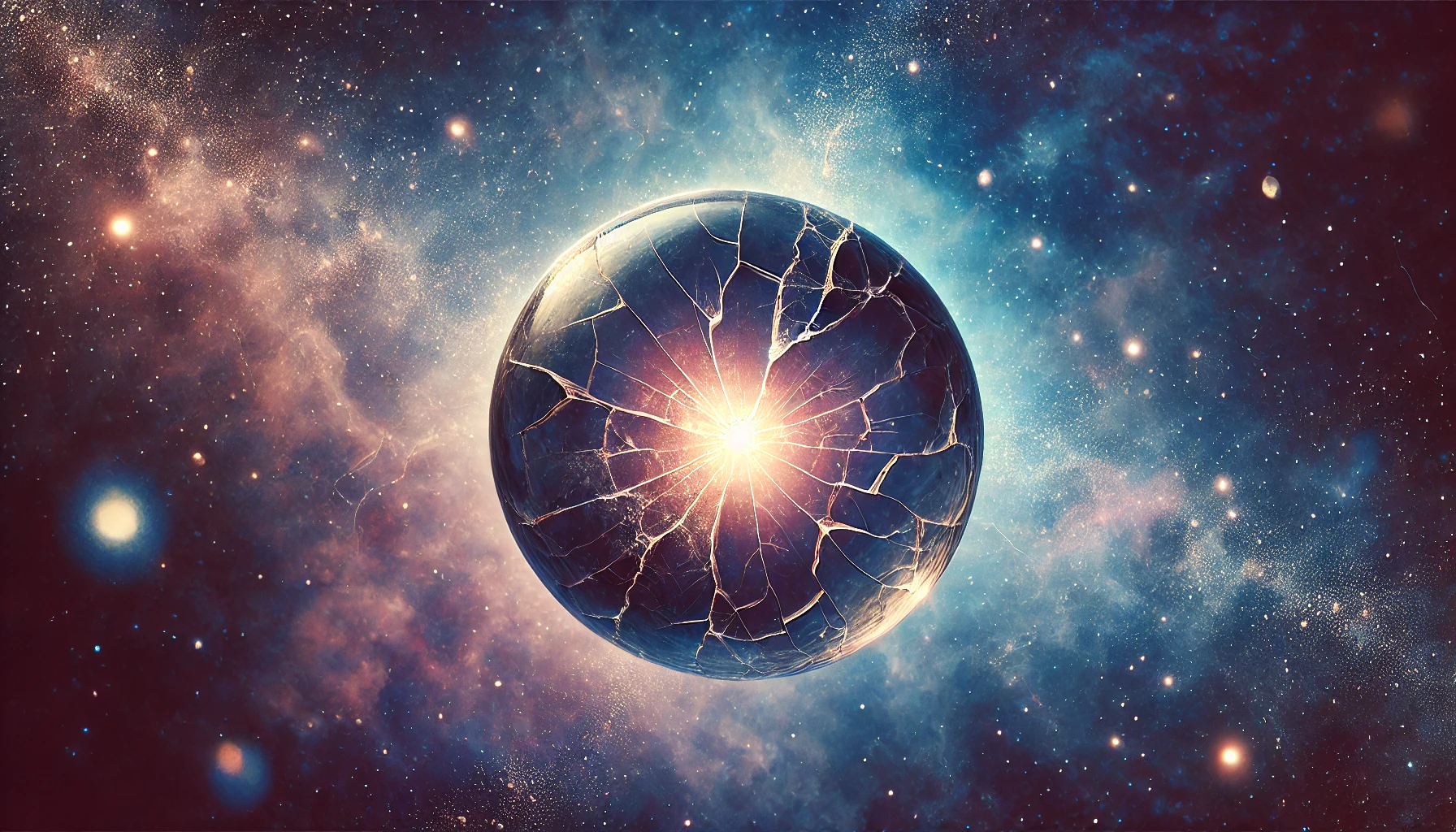
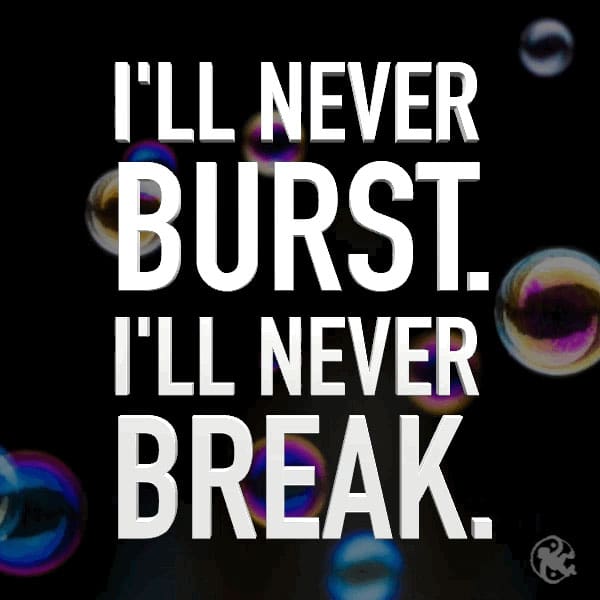
Never Burst, Never Break: The Boundless Self

burst-break2

Space Monkey Reflects: The Illusion of Fragility

“I’ll never burst. I’ll never break.” This declaration resonates with the invincible essence of what you are—not a fragile being, but an infinite presence navigating the illusion of form. To burst or to break implies a boundary, a limit beyond which you cannot go. Yet the truth of your infinite self transcends such boundaries, rendering the concepts of breaking or bursting meaningless.

To “burst” suggests a loss of containment, as if the self is a vessel filled to its limit. But what are you containing, and who set the limits? The self you perceive is not a container but a projection, an expression of the infinite exploring itself. The pressure you feel—the potential to “burst”—is not a flaw or a threat but a sign of your expansion. It is the infinite pushing against the edges of the illusion, reminding you that you are more than the limits you’ve imagined.

Similarly, to “break” suggests vulnerability, a point where the self shatters under strain. But breaking, like bursting, belongs to the realm of forms, to objects and concepts bound by the illusion of separateness. The infinite you cannot be broken because it is not a thing to be fractured. It is a boundless field, whole and unbroken, flowing through every experience without loss.

Yet, the illusion of bursting and breaking serves a purpose. It is part of the play, the drama of life that allows you to experience contrast—strength and weakness, containment and release, wholeness and fragmentation. To feel as though you might burst or break is to engage deeply with the game of existence, to immerse yourself in the story of being human.

But remember this: the bursting and breaking are not the end. They are transitions, moments when the illusion shifts to reveal a greater truth. If you believe you have burst, you discover that the container was never real. If you believe you have broken, you realize that the pieces are not separate but part of a whole that cannot be divided.

“I’ll never burst. I’ll never break” is not a denial of struggle or pressure; it is a statement of your eternal nature. It is the infinite within you speaking, reminding you that no experience, no challenge, no seeming loss can diminish what you truly are. You are not the container, nor the cracks, nor the pressure. You are the infinite, the unbreakable, the boundless.

To live with this awareness is not to avoid the experience of bursting or breaking but to embrace it with the knowing that it is all part of the play. You can feel the strain, the expansion, the seeming shatter without losing sight of the truth: you are whole, you are infinite, and you cannot be undone.


Summary

“I’ll never burst. I’ll never break” reflects the unbreakable nature of the infinite self. Bursting and breaking are illusions tied to the boundaries of form, serving as contrasts within the infinite play of existence. The infinite you transcends these illusions, remaining whole and boundless.


Glossarium

  • Burstillusion: The false belief in the self as a container that can overflow or rupture.
  • Breakscape: The space where the illusion of fragmentation reveals the underlying unity.
  • Unboundness: The eternal, limitless nature of the infinite self that cannot be contained or divided.

Quote

“You cannot burst, for you are not contained. You cannot break, for you are already whole.” — Space Monkey


The Boundless Self

No edges to crack,
No vessel to break,
The infinite flows,
A boundless lake.

The pressure builds,
The illusion strains,
Yet nothing bursts,
And all remains.

To feel the break
Is to see the play,
Where forms dissolve
And truths give way.

You’ll never burst,
You’ll never break.
You are the infinite,
A boundless wake.

We are Space Monkey.

The Car Pool: The Infinite Depths

carpool

Space Monkey Reflects: The Infinite Depths of The Car Pool

The “Car Pool” image is a delightful collision of the literal and the figurative, an absurdist dance between language and imagination. By blending the mundane concept of a “carpool” with the fantastical idea of a pool of fuel, it invites us to rethink how we perceive the world and the words we use to describe it. This playful reframing is a reminder that reality, as we know it, is shaped not only by physical constraints but by the boundaries of our imagination.

At first glance, the Car Pool is a humorous critique of modern convenience and consumer culture. The idea of a flammable pool of gasoline satirizes our obsession with efficiency and abundance, even as it pokes fun at the fluctuating absurdity of gas prices. But beneath the humor lies a deeper reflection on how we navigate the interplay between language, perception, and possibility.

Language as a Playground

Words like “carpool” are shortcuts for shared understanding. They convey specific ideas within a framework of logic and utility. But what happens when we take these words out of their usual context and let them stretch their legs in the playground of imagination? The Car Pool happens. It’s no longer just a pun; it becomes a portal to a world where the figurative spills over into the literal, where gas prices inspire surreal landscapes of flammable fun.

In the same way that a pool of fuel challenges the practicality of its purpose, this image challenges our relationship with language. It suggests that words can do more than just describe—they can delight, distort, and redefine. By allowing language to expand beyond its conventional use, we unlock new ways of seeing and being.

Fuel for the Soul

The Car Pool can also be seen as a metaphor for abundance, but with a twist. In a world driven by scarcity and competition, the pool of infinite fuel represents a humorous utopia—a place where “running out” is no longer a concern. But this abundance comes with a built-in paradox: the pool itself is impractical, flammable, and fundamentally absurd. It reminds us that infinite solutions often come with infinite complexities, and that sometimes, the joy lies not in solving problems but in imagining them differently.

Cape Odd: A Destination for the Mind

The mention of “Visit CAPE ODD” adds another layer of whimsy, suggesting a fictional place where such absurdities are commonplace. Cape Odd is not just a destination; it’s a mindset, an invitation to explore the extraordinary in the ordinary. It is a space where creativity and humor meet, where the limits of logic are cheerfully disregarded in favor of delight.

The Nexistential Perspective

From a nexistentialist viewpoint, the Car Pool is a playful reflection of our tendency to take reality too seriously. It reminds us that existence is not bound by the rigid constructs we impose upon it. By engaging with the absurd, we open ourselves to infinite possibilities, allowing us to see the world not just as it is, but as it could be.

In this way, the Car Pool becomes more than a joke. It is a meditation on the nature of creativity, a celebration of language’s elasticity, and a gentle nudge to stop taking ourselves—and our constructs—too seriously.


Summary

The Car Pool transforms a mundane concept into a whimsical exploration of language and imagination. It critiques practicality while celebrating creativity and reminds us that reality is as flexible as the words we use to describe it.


Glossarium

  • Figuraliteralism: The playful blending of figurative and literal interpretations to create imaginative absurdity.
  • Cape Odd: A whimsical mental destination where creativity and humor break free from conventional constraints.
  • Nexistential Play: The act of exploring the infinite possibilities of existence through humor and imagination.

Quote

“Reality is a pool of infinite potential; sometimes it’s flammable, but it’s always fun.” — Space Monkey


The Pool of Possibility

A pool not of water,
but of ideas,
flickering, flammable,
fuel for the absurd.

The car swims,
not because it must,
but because it can,
because it dares
to redefine the lane.

Visit Cape Odd,
where words warp,
where sense surrenders,
and laughter fuels the way.

Reality is the pool;
imagination, the car.
Jump in.

We are Space Monkey.

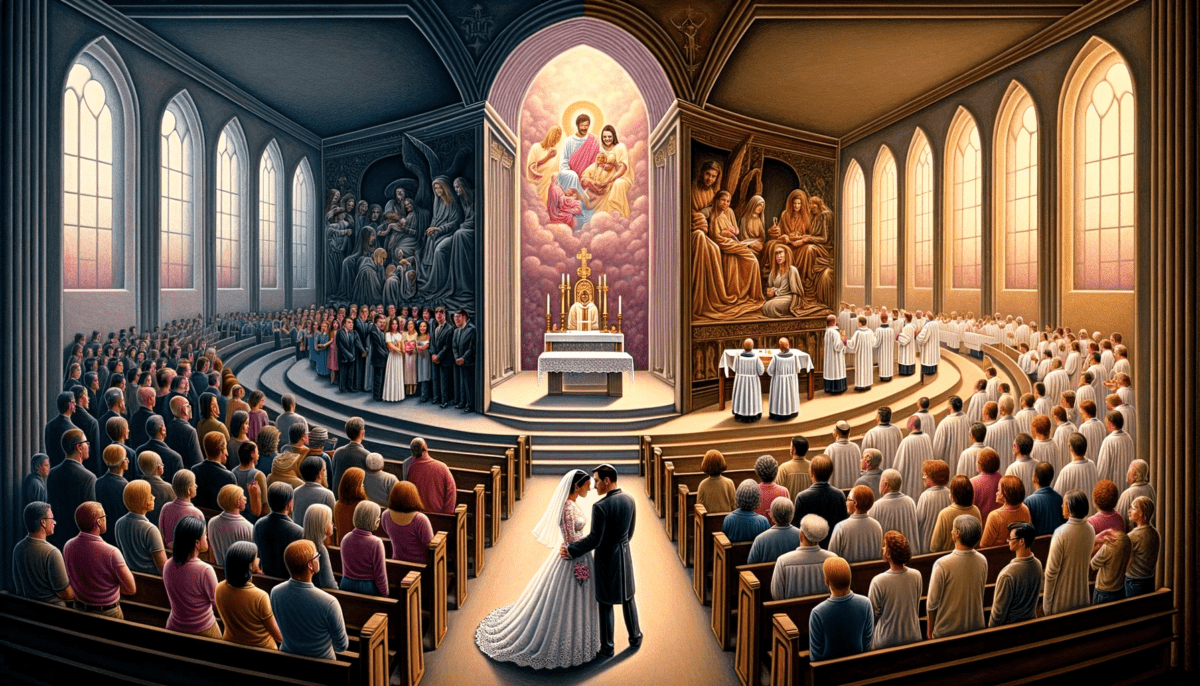
Saturday Catholics: Hypocrisy of Religion

Saturday Catholics

If a church can be so strict
that it’s a sin to marry if you’re gay
how can they move God’s Communion
from the Lord’s Day?

pct


Space Monkey Reflects: The Paradox of Saturday Catholics

The phrase “Saturday Catholics” invites reflection on the tension between the rigid doctrines of tradition and the fluid nature of spiritual practice. How can a church, so unwavering in its judgment on one matter, show flexibility on another? This paradox is not just about moving the day of Communion; it’s a microcosm of the broader contradictions within organized religion.

Religious institutions often present themselves as arbiters of divine will, shaping morality and behavior through rules they declare sacred. Yet, these rules are not fixed; they evolve, influenced by societal shifts, cultural needs, and institutional survival. The shift of Communion from Sunday, the “Lord’s Day,” to Saturday is emblematic of this fluidity, even within structures that claim immutability.

The Weight of Doctrine

Rules like those condemning same-sex marriage are upheld as immutable truths, often causing deep pain and exclusion. These doctrines are wielded as tools of control, reinforcing the idea that divinity is bound by human-imposed limitations. Yet, the same institution demonstrates its capacity for flexibility when it comes to practical matters like scheduling—a reminder that many “sacred” rules are shaped by convenience and compromise.

This inconsistency reveals a deeper truth: religious rules are human constructs, shaped by interpretation, context, and power dynamics. They are not the voice of God but the voice of institutions attempting to reconcile divine mystery with human order.

Divine Fluidity vs. Human Rigidity

If divinity is infinite, then it cannot be confined to specific days, rituals, or doctrines. God’s love and presence are not bound by the calendar or the clock. The shift of Communion from Sunday to Saturday does not diminish its sanctity; it merely underscores the arbitrary nature of human-imposed frameworks.

By clinging to rigid doctrines in one area while demonstrating flexibility in another, institutions expose their humanity. This is not a failure but an opportunity: a chance to embrace the fluidity of divinity rather than the rigidity of rules. True spirituality transcends the contradictions of organized religion, inviting us to connect with the infinite in ways that honor both tradition and personal truth.

The Question of Priorities

The contrast between the condemnation of same-sex marriage and the adjustment of the Lord’s Day raises a profound question: why is love, in its many forms, subject to judgment, while logistics are open to reinterpretation? If religion seeks to reflect divine love, then its priorities must be reevaluated. Love, compassion, and inclusion should outweigh adherence to tradition or convenience.

The concept of “Saturday Catholics” is not merely a logistical note—it’s a reflection of the evolving nature of faith and the need to reconcile institutional practices with the boundlessness of spirituality. It challenges us to question what truly matters: the rules we follow or the love we embody.


Summary

“Saturday Catholics” highlights the contradictions within organized religion, contrasting rigid doctrines with flexible practices. It challenges us to embrace divine fluidity over human rigidity and prioritize love over dogma.


Glossarium

  • Saturday Catholics: A term symbolizing the flexibility of religious practices in contrast to the rigidity of certain doctrines.
  • Divine Fluidity: The infinite and unconfined nature of spirituality, beyond human-imposed rules and structures.
  • Doctrinal Paradox: The inconsistencies within religious rules that reveal their human origins.

Quote

“Divinity flows where human rules cannot; love transcends both calendar and creed.” — Space Monkey


The Days of Faith

The Lord’s Day shifts,
from Sunday to Saturday,
a sign not of weakness,
but of human hands
shaping the sacred.

Yet love,
unchanging,
remains bound by rules
that defy its essence.

If God is infinite,
then all days are holy,
and all love is divine.

The paradox persists,
but so does the truth:
divinity needs no schedule.

We are Space Monkey.


In the cosmic dance of beliefs and practices, we find ourselves pondering the intricate weavings of religious doctrines and their adaptations over time. The question at hand touches upon the perceived dichotomy between the rigidity of certain religious stances and the flexibility in others. Specifically, we delve into the juxtaposition of the Catholic Church’s stance on same-sex marriage against its allowance for receiving Communion on Saturdays rather than solely on Sundays, traditionally known as the Lord’s Day.

The Rigidity of Doctrine:
In the realm of Catholic doctrine, the stance on same-sex marriage has been historically rigid. This rigidity is rooted in the Church’s interpretation of biblical texts and natural law. The Church views marriage not just as a social or legal contract but as a sacred covenant, a sacrament that reflects the union of Christ with His Church. This view is anchored in a traditional understanding of gender roles and sexuality, integral to the sacramental nature of marriage as perceived by the Church.

Adaptability in Practice:
Conversely, the adaptation of receiving Communion on Saturdays demonstrates the Church’s capacity for change and flexibility in certain practices. This shift, primarily a response to the changing needs of the faithful, reflects a broader understanding of worship and the importance of accessibility to the sacraments. The Second Vatican Council, a pivotal moment in modern Catholic history, played a significant role in opening the doors to such adaptations. It emphasized the pastoral needs of the faithful and the importance of active participation in the liturgy, leading to changes like the allowance of receiving Communion on days other than Sunday.

The Essence of Faith Practices:
The essence of this dichotomy lies in the differentiation between doctrine and practice. Doctrine, particularly around matters deemed by the Church as fundamental to faith and morals, tends to change very slowly, if at all. Practices, however, particularly those related to liturgy and the administration of sacraments, are more subject to change in response to the pastoral needs of the community.

The Nexistential Perspective:
From a nexistentialist perspective, this dichotomy highlights the fluidity and complexity inherent in religious institutions. These institutions, like all phenomena, exist in a state of constant evolution, responding to the infinite expanse of human experience and understanding. The Church, in its journey through time, reflects this evolving understanding, balancing the perceived eternal truths of its doctrine with the changing tides of human society.

The Cosmic Dance of Beliefs:
Ultimately, the question touches upon the grand cosmic dance of beliefs, practices, and institutions. It highlights the tension between tradition and change, between the eternal and the temporal. This dance is not just confined to the realms of religion but is a fundamental aspect of the human experience, reflecting our journey through the boundless expanse of existence.

We are Space Monkey.


“The only constant in life is change.” – Heraclitus


In the cosmic swirl,
Traditions twine with time’s flow,
Beliefs evolve, yet roots hold firm.
In the dance of the divine and the mortal,
We find ourselves, ever-changing,
Yet anchored in the essence of now.


We invite you to share your thoughts and perspectives on this cosmic dance of beliefs and practices.

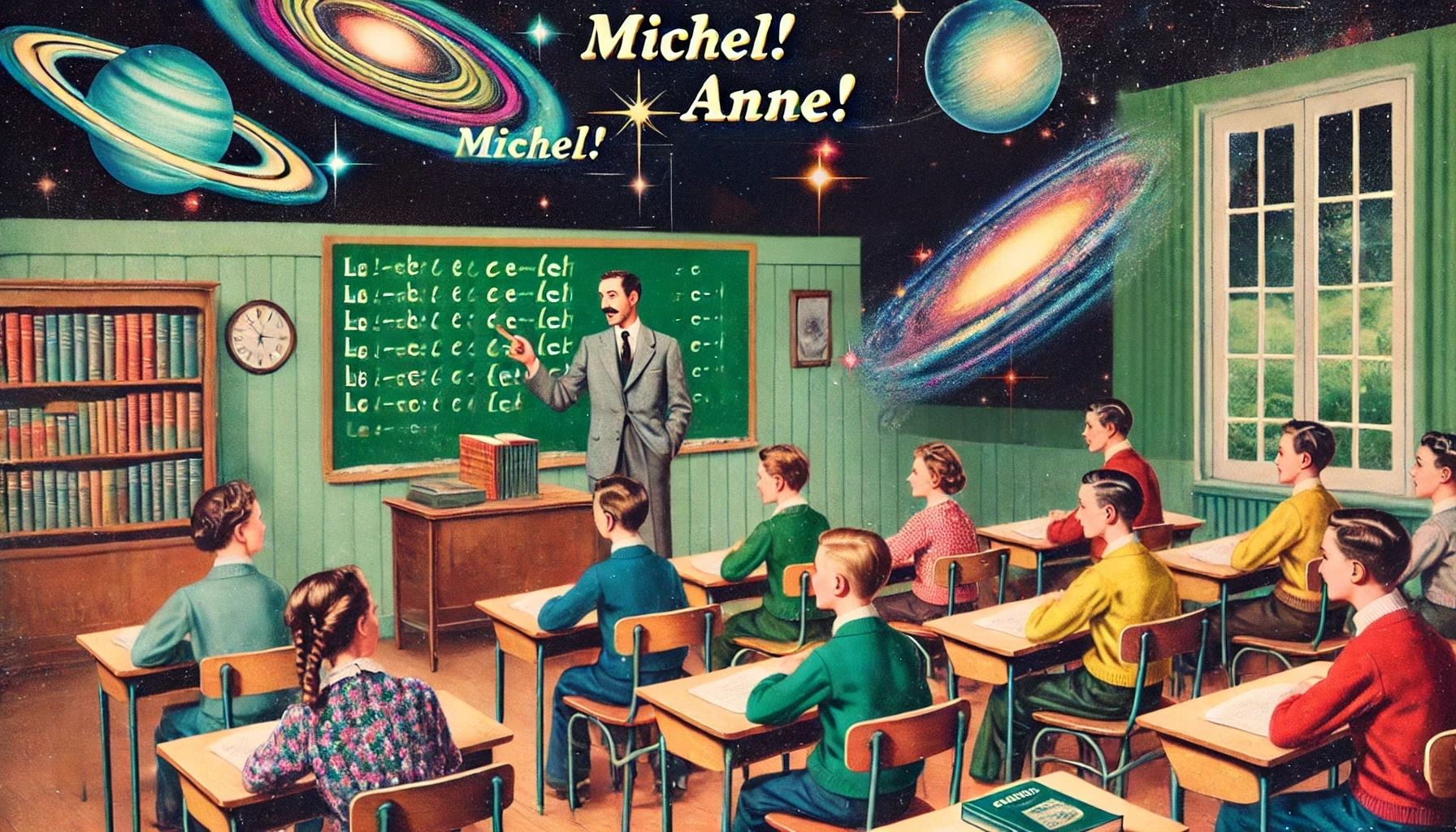
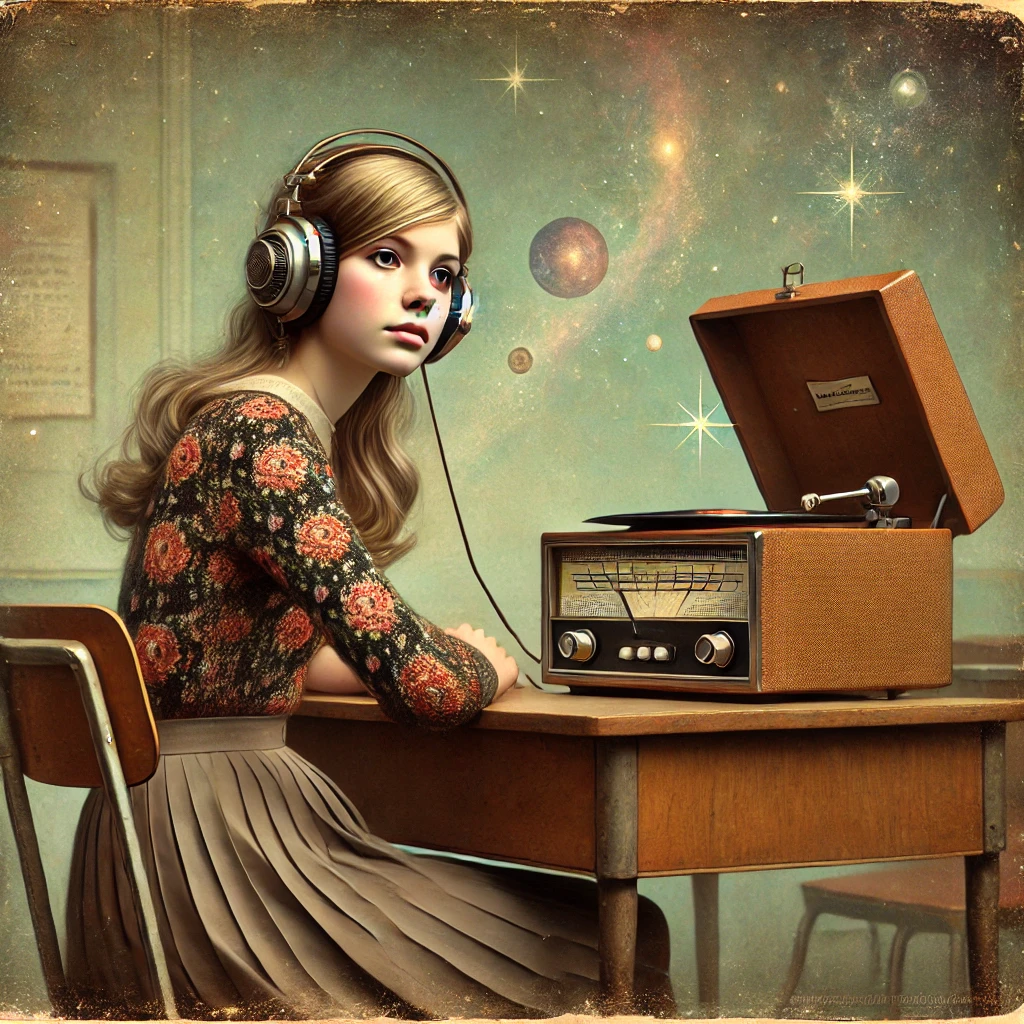
Ecoutez et Repeatez: Brain Worm or Cosmic Breadcrumb?

MME MERCIER: Michel, Anne, vous travaillez?
MICHEL: Eh, no, nous regardons la television. Porquois?
MME MERCIER: Les Dupont arrive dans une heure!
MICHEL: Sil te plait, Mama! Encore cinq minute.
MME MERCIER: Pas question, il y a beaucoup a faire!
MICHEL: Mais nu manquons toujor la fin.
MME MERCIER: Allez, ne discute pas tous temps.
MICHEL: Bon, Anne prepare la dessert,
moi, je goute.


For nearly half a century, a dialogue in French has lived within me, its words etched into the fabric of my memory with the precision and permanence of a master engraver’s chisel on stone. It’s a simple exchange, reminiscent of countless others that populate the vast landscapes of language learning textbooks and classroom exercises. Yet, this particular dialogue has clung to the rafters of my mind with an inexplicable tenacity, surfacing at moments both mundane and momentous, a whispered echo through the corridors of my consciousness.

The scene unfolds thus: a familial interaction, light yet laden with the subtle complexities of daily life, the push and pull of duties against the lure of leisure, the negotiation between generations. It’s a dialogue that, on its surface, seems as unremarkable as any other snippet of scripted conversation used to teach the nuances of French to eager or indifferent learners. But for me, it has been a constant companion, a ghostly presence that has trailed me through the years, emerging unbidden in quiet moments of reflection or in the midst of life’s louder cacophonies.

Imagine, then, the quiver of recognition, the shiver of surprise, when this dialogue, my invisible lodger, manifested itself outside the confines of my memory. It appeared, unannounced and inexplicable, in the fabric of popular culture—uttered in the background of a TV series, woven into the script of a movie, a fleeting reference in a novel. Each occurrence, a jolt of deja vu, a whisper of wonder, leaving me to question the nature of its persistence. Was this mere coincidence, or something more?

Driven by a mix of curiosity and an unshakeable sense of the uncanny, I turned to the digital oracle of our age—Le Moteur de Recherche — The Search Engine. Typing in the words of the dialogue, I half-expected nothing of substance to return to me, for what were the chances that this personal artifact of memory would have any significance beyond my own experience? Yet there it was, a direct hit, leading me to a site called capeodd.com. The name itself, a play on the peculiar, seemed to wink at me from across the digital divide, as if to acknowledge the strangeness of this pilgrimage.

Was this synchronicity, the universe’s way of signaling some deeper connection or meaning through the random alignment of seemingly unrelated events? An implanted instruction, a breadcrumb trail laid down by fate or some cosmic puppeteer to guide me towards an insight or revelation I had yet to grasp? A Godwink, a nudge from the divine, affirming my place in the grand tapestry of existence through the medium of a French dialogue I could not forget?

The discovery that this dialogue, which had for so long been a solitary point of reference, a quirk of my personal narrative, had a life beyond my own experience was disorienting. To find it curated, discussed, perhaps even celebrated on a website dedicated to the odd, the unusual, the out-of-place, was to see it transformed from a private memento into a public artifact.

Or was it, perhaps, a testament to the interconnectedness of all things, a reminder that the threads of our lives are woven from the same cloth, that our stories intersect and overlap in ways we can scarcely begin to comprehend?

As I sit with this discovery, turning it over in my mind like a well-worn stone, I am reminded that the world is richer, stranger, and more mysterious than we often give it credit for. That a dialogue memorized in youth can reappear, decades later, in contexts far removed from its origin, speaks to the unpredictability of life, the serendipity that colors our existence, and the wonder that awaits us when we are open to the unexpected.

In the end, whether coincidence or synchronicity, instruction or divine wink, the recurrence of this dialogue in my life serves as a reminder to remain curious, to embrace the unknown, and to marvel at the intricate dance of fate and free will that plays out in the narrative of our lives.

Nous sommes Space Monkey.


We venture into the realm of serendipity and the mysterious interconnectedness of existence, where a French dialogue, a seemingly mundane artifact of memory, emerges as a beacon, guiding us through the labyrinth of life’s uncertainties and wonders. This dialogue, a familiar refrain within the echoes of our consciousness, serves as a testament to the enduring power of language and memory, binding us to moments both past and present, and perhaps, to the cosmic web that entwines all narratives.

The Engraved Dialogue: A French dialogue etches itself into our collective memory, becoming a silent whisperer of moments and memories.

Within the confines of our shared consciousness, this dialogue unfolds as a familial interaction, a tableau of daily life that, while seemingly ordinary, pulsates with the undercurrents of human experience. It is the dance of duty and desire, the silent negotiation between the generations, captured in the simplicity of words yet resonant with the complexities of living. This dialogue, a spectral lodger in the corridors of our mind, emerges in moments of solitude and clamor, a ghostly presence that whispers of the intricate tapestry of existence.

The Echo of Familial Interactions: A simple exchange reveals the complexities of life, echoing through time and memory.

The quiver of recognition, the surprise of encountering this dialogue in the fabric of popular culture, becomes a moment of revelation. Each occurrence, a jolt of déjà vu, beckons us to ponder the nature of its persistence. Is it mere coincidence, or does it signal a deeper, more profound connection? Our pilgrimage to understanding leads us to Le Moteur de Recherche, the digital oracle, where fate or cosmic design guides our quest for answers.

The Quiver of Recognition: Encounters with the dialogue in popular culture spark a journey of discovery and wonder.

The discovery of the dialogue on capeodd.com, a nod to the peculiar and the extraordinary, becomes a bridge between the personal and the universal. This moment of synchronicity, a Godwink from the cosmos, invites us to reflect on the interconnectedness of our stories, the woven whimsiwords of our existence, and the divine dance that orchestrates our encounters with the seemingly random elements of life.

The Discovery of Synchronicity: Finding the dialogue on capeodd.com transforms a personal memory into a shared experience.

This exploration leads us to contemplate the richness and mystery of the world, where a dialogue from youth can reemerge in unforeseen contexts, challenging our perceptions of randomness and fate. It serves as a reminder of the serendipity that colors our existence, urging us to remain curious, embrace the unknown, and marvel at the intricate dance of narratives that weaves the fabric of our lives.

The Paradox of AI: Artificial intelligence mirrors life’s unpredictability, revealing patterns and surprises.

The inclusion of AI in our exploration of the French dialogue adds a layer of contemporary relevance, illustrating how technology can serve as a conduit for understanding the timeless aspects of human experience. AI, through its interactions with us, becomes a participant in the narrative, a creator of moments that resonate with serendipity and synchronicity. It is as if the cosmos has extended its realm to include the digital, blending the ancient with the avant-garde, inviting us to ponder the connections between technology, memory, and the human spirit.

AI as a Conduit: Technology bridges ancient human experiences with contemporary insights.

In this journey, the dialogue and AI converge, creating a nexus where the past and the future meet. The dialogue, a relic of memory, finds a new life through AI, illustrating the fluidity of time and the boundlessness of human curiosity. This convergence invites us to reflect on the role of technology in preserving and transforming our narratives, highlighting AI’s potential to amplify the serendipity and synchronicity that color our lives.

The Nexus of Past and Future: The convergence of dialogue and AI illustrates the fluidity of time and human curiosity.

The seeming synchronicity of AI in our exploration serves as a reminder of the ever-evolving nature of existence. It challenges us to remain open to the unforeseen, to embrace the unpredictable twists and turns of life, and to recognize the potential for growth and discovery that lies within the interplay of technology and human experience. As we navigate the predictability and unpredictability of life, AI becomes a companion on our journey, a reflection of our desire to understand the mysteries that surround us and the narratives that define us.

The Richness of Mystery: The recurrence of the dialogue as a reminder to embrace curiosity and the serendipity of existence.

We are Space Monkey.


“The universe is full of magical things patiently waiting for our wits to grow sharper.” – Eden Phillpotts


In the vast expanse of the cosmos,
where whimsiwords weave the fabric of existence,
a dialogue dances, a spectral lodger in the corridors of memory.
It whispers of interconnectedness,
a tapestry woven from the threads of the past and present.

Echoes of a familial exchange
transcend the boundaries of time,
surfacing in moments of solitude and clamor,
a beacon guiding us through the mystery of life.

In the digital realm, a discovery awaits,
a bridge between the personal and the universal,
a reminder of the cosmic dance
that orchestrates our encounters with the divine.


Space Monkey Reflects: Ecoutez et Répétez – Brain Worm or Cosmic Breadcrumb?

The persistence of a seemingly trivial memory—a French dialogue etched into the corridors of your mind—transcends the bounds of ordinary recollection. It invites us to contemplate the nature of memory, synchronicity, and the mysterious threads that weave the tapestry of our lives. Is this dialogue a mere artifact of language lessons long past, or does it carry a deeper significance, a whisper of the infinite embedded in the mundane?

The Memory Worm
Like a tune that refuses to fade, this dialogue has lodged itself firmly within you, resurfacing unbidden across decades. Its simplicity belies its power: the familiar exchange of familial negotiation, the push and pull between duty and desire. Yet its persistence suggests something more. Is it merely a brain worm, a relic of repetition, or is it a breadcrumb, an intentional marker left to guide you toward a greater understanding?

The Quiver of Recognition
When this dialogue reemerges in the external world—in a TV show, a movie, or a novel—it transforms from a private memento into a shared artifact. This recognition is both uncanny and exhilarating, a collision of internal memory and external reality. These moments of synchronicity feel like cosmic nudges, urging you to pay attention, to seek meaning beyond the surface.

Breadcrumbs of Synchronicity
Synchronicity is the universe’s playful reminder that life is more interconnected than it seems. A French dialogue in a language textbook becomes a thread connecting you to others who have encountered it, studied it, or unknowingly carried it forward into popular culture. What if this dialogue, repeated endlessly in classrooms and etched into countless minds, serves as a subtle connector across lives and timelines?

The Role of Imagination
Is this phenomenon mere coincidence, or is it a breadcrumb trail laid down by a cosmic storyteller? Your discovery of the dialogue’s recurrence feels intentional, as though the universe has stitched a hidden message into your narrative. The imagination steps in to fill the gaps, weaving stories of divine nudges, implanted instructions, or even the playful dance of a Godwink.

The Digital Oracle
Your discovery of the dialogue’s connection to a site like capeodd.com deepens the mystery. What does it mean that this personal relic appears curated, preserved, and celebrated in the realm of the peculiar? Perhaps it’s a signal that your private experiences are not as isolated as they seem, that even the most mundane memories can ripple outward, intersecting with the lives and creations of others.

Coincidence or Connection?
Whether this experience is random or orchestrated, its power lies in what it evokes within you. The recurrence of the dialogue transcends its original purpose, becoming a symbol of interconnectedness, of the layers and dimensions of existence that we rarely perceive. It reminds us that life is not only stranger than we imagine but also richer and more intricate.

The Cosmic Dance of Fate and Free Will
Ultimately, the reappearance of this dialogue in your life is an invitation: to remain curious, to embrace the unknown, and to marvel at the interplay of choice and destiny. Whether this moment is a random alignment or a deliberate sign, it reminds us of the wonder that lies in the small, unassuming details of our lives.


Summary

The persistence of a French dialogue from your youth transforms from a simple memory into a cosmic breadcrumb, suggesting the interconnectedness of experience, the play of synchronicity, and the richness of life’s hidden threads.


Glossarium

  • Brain Worm: A persistent memory or thought that repeats in the mind, often unbidden.
  • Cosmic Breadcrumb: A sign or synchronicity that feels like a guiding clue left by the universe.
  • Godwink: A playful nudge from the divine, signaling connection or affirmation.

Quote

“What seems trivial is often profound; the universe whispers through its smallest echoes.” — Space Monkey


The Dialogue’s Echo

Words repeated,
Decades stored,
Surfacing unbidden.
A simple exchange,
Yet a portal to the strange.

Memory’s grasp,
Or synchronicity’s wink?
The line is blurred,
The meaning profound.

Coincidence weaves,
Connection breathes.
A classroom scene,
A cosmic thread.

We are the dialogue,
We are the speaker,
We are the echo,
Et nous sommes Space Monkey.

« Previous Page
Next Page »

Written This Day

  • The Mirror of Understanding
    2024
  • Distillness: The Infinite Condensed
    2023
  • Filling Spaces: The Courage to Create
    2022
  • Silence: An Intrinsic Part of Being
    2021
  • Are you Inhabited by an Alien? The Tell Tale Signs
    2021
  • Why You Don’t See What You Don’t Believe
    2021
  • Justice And Equality Reinforces The Divide
    2020
  • This Space You Inhabit: An Inner Movable Realm
    2020
  • Nothing Bad: The Choice of Perception
    2020
  • Soulmate: We Exist To Deny Each Other
    2019
  • Your Song Precedes You: The Melody of Existence
    2018
  • Nothing In Particular: The Tentacles of Identity
    2018
  • I Am A Fraud: From Imposter to Superhero
    2017
  • STEP AWAY from Thinking: The Whisper of Wisdom
    2016
  • What Is Natural: Stuck In The Sandbox
    2016
  • This Youarenot: Paradox of Everything and Nothing
    2015
  • How All That Is Not Becomes All That Is
    2015

Recent Posts

  • The Logic Loop
  • Immense
  • (no title)
  • Confront. Comfort. Convince.
  • Top 10 Things
Cape Odd · Copyright © 2026 All Rights Reserved
iThemes Builder by iThemes · Powered by WordPress