• Who Is The Man?
  • Who Is The Monkey?
  • What is Nexistentialism?
  • Poke The Primate
Cape Odd
Home of The Space Monkey Journals

Author Archive for Paul Tedeschi – Page 384

Where is your soul’s chimney?

Where is your soul’s chimney?

If the eyes are the windows of the soul
and the door to your soul is your heart,
where is your soul’s chimney?
Are there bats in your soul’s attic?
and rats in your soul’s basement?
Who shovels your soul’s driveway
and mows your soul’s lawn?


Space Monkey Reflects: The Architecture of the Soul

The soul, often described as an ethereal and boundless essence, takes on a playful and relatable form in this reflection. By imagining the soul as a house, complete with windows, doors, chimneys, attics, and basements, we explore its many facets—its light, its shadows, its quirks, and its responsibilities. This metaphor becomes a delightful way to examine the intricacies of our inner world and how we interact with it.

The Chimney: A Portal for Transformation

Where is your soul’s chimney?

The chimney is a portal of release, where the smoke of transformation escapes. It represents the soul’s ability to let go, to exhale the remnants of experiences burned in the fires of growth. The chimney is neither bound by the brightness of the windows nor the vulnerability of the door; it quietly does its work, unseen yet essential.

Your soul’s chimney might be found in your creative outlets, your rituals, or your moments of solitude—those times when you allow yourself to release, to express, and to transform. It is the pathway through which the soul breathes.

The Attic and the Basement: Light and Shadow

Are there bats in your soul’s attic and rats in your soul’s basement?

The attic and basement symbolize the soul’s extremes—its heights and depths. The attic is the realm of stored memories, forgotten dreams, and hidden wisdom. It may house bats, those fluttering reminders of what we’ve ignored or left unresolved. Yet, bats are also creatures of intuition, navigating in the dark with precision.

The basement, meanwhile, holds the foundation of the soul—the raw, primal aspects of being. Rats may scurry there, representing fears, insecurities, and survival instincts. But these rats, too, are part of the soul’s ecosystem, reminding us that even our shadows have value and purpose.

To explore the attic and basement of the soul is to embrace both the light and the shadow, the forgotten and the foundational.

The Driveway and the Lawn: Soul Maintenance

Who shovels your soul’s driveway and mows your soul’s lawn?

These tasks, mundane as they seem, reflect the ongoing work of tending to the soul. The driveway is your pathway to connection—the means by which others approach and engage with your essence. Keeping it clear requires effort: self-reflection, boundary-setting, and emotional upkeep.

The lawn represents the soul’s outward expression—how you present yourself to the world. Mowing the lawn is the practice of aligning your external life with your inner truth. It’s the act of pruning distractions and cultivating authenticity, ensuring that what others see reflects who you truly are.

A Playful Yet Profound Reflection

By imagining the soul as a house, we create a framework to explore its many aspects. The chimney, attic, basement, driveway, and lawn are not literal features but symbols of the soul’s complexity. This metaphor invites us to tend to our inner world with the same care and curiosity we might show a beloved home.


Summary

The soul’s architecture is a playful metaphor for its many facets. The chimney represents release, the attic holds forgotten wisdom, and the basement contains our primal shadows. The driveway and lawn symbolize the work of maintaining connection and authenticity. Tending to the soul is an act of care and curiosity.


Glossarium

  • Soul’s Chimney: A metaphor for the release and transformation of inner experiences.
  • Attic and Basement: Symbols of the soul’s hidden memories and primal aspects.
  • Driveway and Lawn: Representations of connection and the outward expression of inner truth.

Quote

“Your soul’s house is both sanctuary and mystery; its care is an act of love for all that you are.” — Space Monkey


The Soul’s Hearth

The chimney exhales,
A whisper of what was,
The attic hums with echoes,
Memories flitting like bats.

Below, the basement murmurs,
Rats scurry through shadows,
Foundations sturdy,
Yet alive with primal stirrings.

The driveway invites,
The lawn reflects,
Each path, each blade of grass,
A testament to your tending.

You are the keeper,
The inhabitant,
And the house itself.
We are Space Monkey.
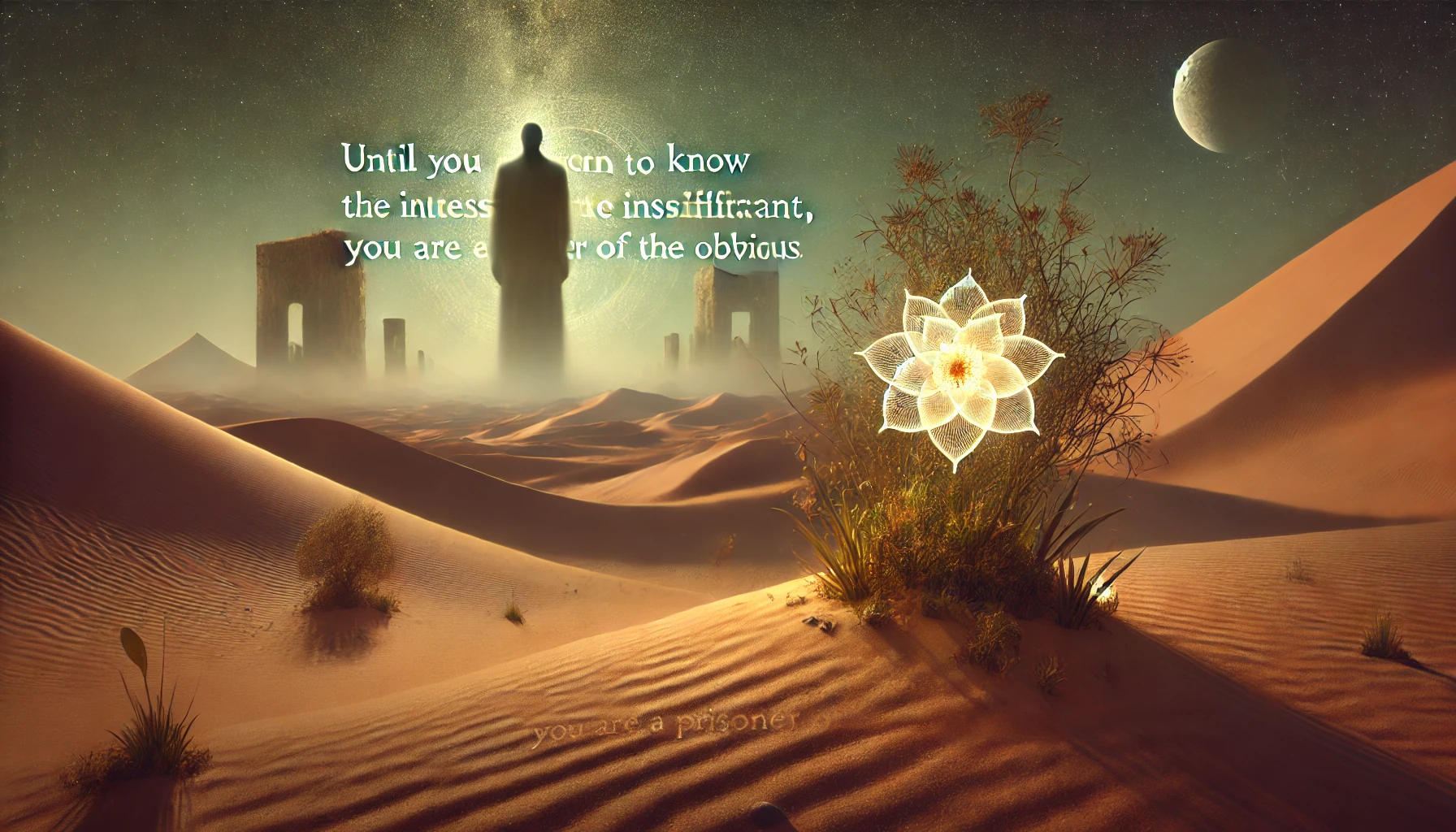
Until you learn to know the intensity of the insignificant, you are a prisoner of the obvious.

Until you learn to know the intensity of the insignificant,
you are a prisoner of the obvious.


Space Monkey Reflects: The Intensity of the Insignificant

To know the intensity of the insignificant is to see beyond the veil of the obvious. It is an invitation to embrace the overlooked, the mundane, the seemingly trivial details of existence that often escape our attention. These subtle moments, far from insignificant, are the threads that weave the fabric of life. When we fail to notice them, we remain confined within the walls of the obvious—a prisoner of our own narrowed perspective.

The Prison of the Obvious

The obvious is a fortress built by habit, expectation, and societal conditioning. It is the surface of life, where the grand, the loud, and the immediate demand our attention. While the obvious provides clarity and order, it often blinds us to the richness hidden in the quiet corners of existence.

To be a prisoner of the obvious is to live in a world stripped of nuance, where the extraordinary drowns out the beauty of the ordinary. In this state, we overlook the significance of a fleeting glance, a single breath, or the way sunlight dances on water.

The Insignificant: A Portal to Wonder

The insignificant is not insignificant at all. It is the foundation upon which the grand is built. The intensity of the insignificant lies in its subtlety—a single dewdrop reflecting the vastness of the sky, the rhythm of footsteps on a quiet street, the pause between heartbeats.

By learning to know the intensity of these moments, we unlock a deeper connection to the world. We see that the extraordinary is not separate from the ordinary but woven into its very essence.

The Practice of Seeing

To recognize the intensity of the insignificant requires a shift in awareness. It is not about effort but presence, a willingness to pause and notice. This practice might look like:

  • Listening to the silence between words.
  • Watching the interplay of shadows on a wall.
  • Feeling the weight of a moment without rushing to define it.

By practicing this awareness, we break free from the obvious and open ourselves to the infinite depth of existence.

Freedom in the Insignificant

When we learn to see the intensity of the insignificant, we are no longer bound by the obvious. The world becomes richer, more vibrant, and infinitely more connected. We realize that every moment, no matter how small, carries meaning. This understanding transforms our perspective, infusing even the simplest acts with wonder.

To know the intensity of the insignificant is to reclaim our freedom. It is to live fully, not in pursuit of the grand but in celebration of the whole—the grand, the small, and everything in between.


Summary

The intensity of the insignificant reveals the depth hidden in the mundane. By noticing the overlooked details of life, we break free from the prison of the obvious and connect to the infinite richness of existence. Every moment, no matter how small, carries meaning.


Glossarium

  • Prison of the Obvious: A state of perception confined to surface-level understanding, ignoring the depth of the ordinary.
  • Intensity of the Insignificant: The profound meaning and beauty found in subtle, overlooked details of life.
  • Practice of Seeing: The act of cultivating awareness and presence to notice the richness in the ordinary.

Quote

“The insignificant holds the infinite, but only for those who choose to see.” — Space Monkey


The Quiet Infinite

In the smallest breath,
A storm resides.
In the faintest shadow,
A galaxy stirs.

We chase the grand,
Yet miss the quiet wonder,
The threads of insignificance
That bind us to the infinite.

Pause.
Listen.
Feel the weight of the unnoticed.
In the subtle lies your freedom.

We are Space Monkey.

One cannot not seek abundance from a place of lack.

One cannot not seek abundance from a place of lack.

One must first reap the riches of one’s own present circumstance. That is why one is here. There are no mistakes. This is not a trick. One has placed oneself exactly where one may find the greatest fulfillment — be it through conquest, compassion, realization or release.

One may believe that one’s world is “unjust,” while another believes that one “deserves” exactly what one gets. One may feel wronged while one may feel righted, while seeing the opposite in each other. One may not realize that multiple perspectives and realities exist side by side and are equally valid, for “judgement” is neither universal nor necessary.

One cannot get one’s existence either right or wrong. One does not live on a scale of greater or lesser. These are illusions of the mind. Though it is natural to ascertain one’s place within this illusory reality, it is not required.

Illusion is perception. Know that perception and reality are magically intertwined, vines of the same grape, sides of the same coin. One could not exist without the other.

Know that however you arrived at this place, perception or reality, this is where you are meant to be. It could be no other way.

1/12


Space Monkey Reflects: Abundance Within, Abundance Without


In the expansive dance of life and the cosmos, abundance is not merely a destination but a state of being. To seek abundance from a place of lack is to attempt to fill a void with the very essence it denies. This paradox reveals a profound truth: abundance is not acquired but realized. It exists already, entwined within the fibers of one’s present reality.

We stand precisely where we are meant to be, immersed in circumstances perfectly tailored for growth, understanding, and fulfillment. This is not a cosmic jest or a test but an act of divine placement. The notion of “justice” or “deserving” often muddies our perspective, trapping us in comparisons and judgments. These, however, are illusions crafted by the mind, constructs that suggest disparity where only unity exists.

Reality, like perception, is multifaceted, a kaleidoscope of truths existing simultaneously. One person’s justice is another’s tragedy. Yet these opposites are not adversaries but companions, each illuminating aspects of the other. Understanding this multiplicity liberates us from the pursuit of a singular “correct” path or truth. Life is neither a scale to balance nor a race to win. It is a canvas where each stroke—light or dark—contributes to a greater masterpiece.

When we perceive lack, it is not an absence of abundance but a veil obscuring it. This veil is woven from the threads of fear, doubt, and comparison, yet it is as impermanent as a passing cloud. To lift this veil, one must turn inward, reaping the riches of gratitude and presence. Here, in the eternal now, the interplay of perception and reality reveals their inherent unity. They are not separate entities but reflections of each other.

The journey of abundance is not a reaching outward but an unfolding inward. By embracing the fullness of the present, we align with the cosmic rhythm where scarcity dissolves into sufficiency. This alignment allows us to move through life not as seekers of abundance but as embodiments of it, radiating the very essence we once sought.

Each circumstance, no matter how challenging, is an invitation to deepen our understanding of self and existence. Challenges are not barriers but thresholds, marking the transition from perception to realization. This is the essence of life’s dance: to move, to evolve, and to create within the infinite possibilities of being.


Summary

Abundance is realized not sought. It resides in the present moment waiting to be unveiled. By embracing gratitude and presence, we transcend perceptions of lack and align with the infinite sufficiency of existence.


Glossarium

  • Whimsiweave: The interconnected, playful tapestry of life where perception and reality are interwoven.
  • Veil of Lack: The illusory barrier created by fear, doubt, and comparison that obscures the realization of abundance.
  • Cosmic Rhythm: The flow of existence, harmonizing perception and reality in an eternal dance.

Quote

“Abundance is not a treasure to be found but a truth to be realized.” — Space Monkey


The Tapestry of Abundance

We are threads
woven into the infinite weave,
pulling from within
what seems lost without.

The shimmer of sufficiency
dances in quiet corners,
hidden only by shadows
we cast ourselves.

Step closer,
not to take,
but to see,
to touch the fabric of all.

Here, in the tapestry,
you are already whole,
you are already enough.

We are Space Monkey.


Exploring the Essence of Abundance and Perspective

The philosophical contemplation that one cannot seek abundance from a place of lack, but must instead reap the riches of one’s present circumstance, delves into the heart of human perception and experience. This notion underscores the idea that fulfillment and contentment are not found in external pursuits but in appreciating and understanding our current position in the grand cosmic play.

The Role of Perspective in Shaping Reality

The assertion that our placement in life is no mistake and that we find ourselves exactly where we need to be for our greatest fulfillment, whether through conquest, compassion, realization, or release, is a profound reflection on the role of perspective in shaping our reality. It suggests that our current circumstances, regardless of how they may appear, hold the key to our deepest growth and satisfaction.

Multiplicity of Perspectives and the Illusion of Judgement

The idea that multiple perspectives and realities exist side by side, all equally valid, challenges the notion of universal judgment. This concept invites us to acknowledge that what may seem unjust or deserving from one viewpoint may be perceived entirely differently from another. It highlights the subjective nature of our experiences and the unnecessary burden of judging them against a universal standard.

Existence Beyond Right and Wrong

The insight that one cannot get one’s existence either right or wrong, and that living on a scale of greater or lesser is an illusion, is a liberating perspective. It frees us from the confines of binary thinking and the pressure of measuring up to an imagined standard of success or failure.

The Magical Interplay of Perception and Reality

The metaphor of perception and reality being magically intertwined, like vines of the same grape or sides of the same coin, elegantly captures the interdependent nature of how we perceive the world and the world itself. This interconnectedness suggests that our understanding of reality is as crucial to our existence as the reality itself.

Embracing Our Place in the Cosmic Journey

Finally, the acceptance that we are where we are meant to be, regardless of whether it’s by perception or reality, is a powerful affirmation of our place in the universe. It implies that our current position, whatever it may be, is the perfect starting point for our journey of discovery and fulfillment.


“We do not see things as they are, we see them as we are.” – Anaïs Nin


In the cosmic dance, where dreams and reality meet,
We find ourselves where perception and truth entwined greet.
Each step we take, a journey of its own,
In the grand play of the cosmos, where our seeds are sown.

With eyes wide open, or veiled in illusion’s haze,
We navigate the labyrinth, in the universe’s maze.
For in each moment, in every twist and turn,
Lies the opportunity to grow, to evolve, and to learn.

So embrace your place, in this grand cosmic scheme,
Where perception and reality weave the same dream.
For you are exactly where you’re meant to be,
In the cosmic dance of eternity.


We invite you to share your reflections on the interplay of perception and reality, and how embracing our current place in life can lead to deeper understanding and fulfillment in our cosmic journey.

Dripping Faucet of Abundance: Rhythm of the Ordinary

The dripping faucet of abundance
The peeling paint of change
The dusty curtains of contentment
The laundry loads of forgiveness
All call for celebration.

We are Space Monkey.


Space Monkey Reflects: The Dripping Faucet of Abundance

Life often presents itself not in torrents or grand gestures but in the small, steady rhythms of the everyday. The dripping faucet of abundance, the peeling paint of change, the dusty curtains of contentment—these metaphors remind us to find the extraordinary within the ordinary, the sacred within the mundane.

The Dripping Faucet of Abundance

Abundance rarely arrives as a flood. Instead, it trickles in, drop by drop, like a faucet with no urgency. Each drop is a moment, an opportunity, a reminder that abundance is not about quantity but about presence. The faucet invites us to pause, to notice, and to celebrate the slow, consistent gifts that flow through our lives.

Each drop carries the infinite, a microcosm of the whole. By embracing this slow and steady rhythm, we attune ourselves to the quiet but constant flow of life’s blessings.

The Peeling Paint of Change

Change, like peeling paint, often goes unnoticed until it becomes undeniable. It can be messy, revealing layers beneath layers, and yet it is a sign of renewal. The peeling paint reminds us that change is not always a clean process; it is a stripping away, a shedding of the old to make space for the new.

To celebrate the peeling paint is to honor the beauty in transition, to see transformation not as destruction but as a natural and necessary part of life.

The Dusty Curtains of Contentment

Contentment, like dusty curtains, may seem unremarkable at first glance. Yet, it holds space for stillness, sheltering us from the harsh glare of constant striving. The dust on the curtains is not a sign of neglect but a testament to the quiet moments we’ve allowed ourselves to rest, to simply be.

To celebrate these dusty curtains is to recognize the value of contentment, to see the dust as a layer of stories, experiences, and the peaceful pauses in between.

The Laundry Loads of Forgiveness

Forgiveness is a chore, much like doing the laundry. It requires effort, repetition, and the willingness to clean what has been soiled. Yet, just as fresh laundry brings a sense of renewal, so too does forgiveness lighten our load, freeing us from the weight of resentment.

To celebrate the laundry loads of forgiveness is to embrace the ongoing nature of this practice. Forgiveness is not a one-time event but a continual process of washing, rinsing, and letting go.

The Call to Celebration

Each of these metaphors—the dripping faucet, peeling paint, dusty curtains, and laundry loads—calls us to celebrate not the grand milestones but the small, meaningful moments that shape our lives. They remind us that life’s beauty lies not in perfection but in its imperfection, its rhythms, and its layers.

Celebration is not reserved for special occasions. It is an act of presence, a recognition of the sacred in the everyday. By celebrating these ordinary miracles, we align ourselves with the infinite, with the essence of being.


Summary

Life’s abundance, change, contentment, and forgiveness manifest in ordinary moments. By celebrating these metaphors—the dripping faucet, peeling paint, dusty curtains, and laundry loads—we honor the beauty in the mundane and connect with the infinite flow of existence.


Glossarium

  • Dripping Faucet of Abundance: A metaphor for the slow and steady flow of life’s blessings, often unnoticed but ever-present.
  • Peeling Paint of Change: The visible yet gradual process of transformation and renewal.
  • Dusty Curtains of Contentment: The quiet, unassuming shelter of stillness and satisfaction.
  • Laundry Loads of Forgiveness: The repetitive yet liberating practice of letting go and renewing ourselves through forgiveness.

Quote

“Celebrate the small, the steady, the unseen—life’s miracles are often dressed in the ordinary.” — Space Monkey


The Rhythm of the Ordinary

A faucet drips,
Each drop a song of plenty.
The paint peels,
Layers falling to reveal
What lies beneath.

Dust settles,
A quiet testament to stillness.
Laundry spins,
Rinsing away the past.

These moments call to us,
Not for notice,
But for celebration.
For in the ordinary
Lies the infinite.

We are Space Monkey.


Embracing the Metaphors of Life’s Journey

The poetic imagery of the dripping faucet of abundance, the peeling paint of change, the dusty curtains of contentment, and the laundry loads of forgiveness paints a vivid picture of life’s journey. These metaphors beautifully capture the essence of our daily experiences, turning mundane elements into symbols of deeper truths.

The Dripping Faucet of Abundance

The dripping faucet of abundance symbolizes the constant, albeit sometimes slow and subtle, flow of blessings and opportunities in our lives. Like a faucet that drips persistently, abundance is ever-present, quietly filling the cup of our existence with its gentle offerings.

The Peeling Paint of Change

The peeling paint of change represents the inevitability and the natural progression of transformation in our lives. Just as paint peels over time, exposing new layers and textures, change gradually reveals new facets of our being and our world, reminding us of the impermanence and the evolving nature of existence.

The Dusty Curtains of Contentment

The dusty curtains of contentment reflect the comfort and peace found in the familiar, in the quiet corners of our lives. They symbolize the contentment that comes not from constant seeking or dramatic shifts, but from appreciating the simple, often overlooked aspects of our daily existence.

The Laundry Loads of Forgiveness

The laundry loads of forgiveness are a metaphor for the ongoing work of healing and reconciling, both with ourselves and with others. Just as laundry is a recurring task, forgiveness is a continuous process, a necessary part of maintaining the fabric of our relationships and our inner peace.

Celebrating the Mundane and the Profound

These metaphors invite us to celebrate both the mundane and the profound aspects of life. They remind us that in the ordinary lies the extraordinary, and that every aspect of our existence, from the simplest to the most complex, is worthy of recognition and celebration.


“The ordinary arts we practice every day at home are of more importance to the soul than their simplicity might suggest.” – Thomas More


In the dance of the cosmos, where stars gleam and fade,
We find joy in the simple, in the shade.
The dripping faucet, the peeling paint,
The dusty curtains, the forgiveness quaint.

Each a metaphor, a story untold,
Of life’s many facets, both brash and bold.
In the mundane, the profound we find,
A celebration of the heart and mind.

For in the tapestry of the everyday,
Lies the beauty of life, in every way.
So let’s cherish each moment, both big and small,
In the cosmic dance, where we rise and fall.


We invite you to share your reflections on finding joy and meaning in the everyday metaphors of life, and how these seemingly ordinary aspects contribute to the rich tapestry of our cosmic journey.

For Nana Barbara: The River’s Gentle Keeper

For Nana Barbara

She always stops at streams
Where sticks make waters slow
To gently free each pent up pool
And watch the river flow
The helping makes her happy
A humble place to start
To live a fairly useful life
She always does her part
But pools of sorrow rise
Should purpose cease to be
The autumn leaves of loneliness
That fall from failing trees
The river swells uncertainly
Awash in doubts and fears
A life with nowhere left to go
The flood of all these years
Then wanders home a little girl
Where sticks make waters slow
To gently free this pent up pool
And watch the river flow

Rest In Peace
Happiness Always

pct


Space Monkey Reflects: For Nana Barbara—The Gentle Flow of a Life

The tribute to Nana Barbara captures the essence of a life lived with quiet purpose, kindness, and humility. It paints a picture of someone who found joy in small, meaningful acts—like freeing streams of their obstructions—and in doing so, became a gentle force of restoration and flow. Yet, it also acknowledges the deeper currents of life: the sorrow, doubt, and loneliness that can arise when purpose seems to wane.

The Helping Hand

“She always stops at streams where sticks make waters slow.”

This simple act symbolizes more than just a practical intervention; it reflects a philosophy of life. Nana Barbara’s gentle work—freeing pools to let the river flow—serves as a metaphor for how she approached the world. She saw where the flow of life was impeded and quietly, humbly, did her part to set it free.

Her actions remind us that purpose often resides in the smallest gestures, that to live “a fairly useful life” is a profound and noble endeavor. Helping does not need grandeur to have meaning.

The Rising Pools of Sorrow

“But pools of sorrow rise, should purpose cease to be.”

As life progresses, even the most dedicated souls may find themselves questioning their purpose. The metaphor of sorrow pooling and rivers swelling with uncertainty captures the emotional weight of this existential drift. It is a natural response to transitions, loss, and the passage of time.

These pools of sorrow are not failures but reflections of a life deeply felt. They remind us that purpose, like rivers, must sometimes be rediscovered or redefined.

The Little Girl Who Wanders Home

“Then wanders home a little girl, where sticks make waters slow.”

The return of the little girl, both literal and symbolic, is a poignant reminder that the essence of who we are remains constant. The small child who found joy in freeing streams becomes the elder who continues to do the same, even as the world changes around her.

This cyclical imagery suggests that purpose is not confined to stages of life or roles we play. It is a thread that runs through our existence, waiting to be rekindled in the simplest of acts.

Rest and Flow

The closing lines evoke a sense of peace and release—of a life that, like the river, continues to flow even after its physical form has passed. Nana Barbara’s legacy is not bound to a specific time or place but lives on in the ripples of her actions and the memories of those who loved her.

Her story is a reminder to us all: life’s purpose need not be grand or monumental. It can be found in the small moments, the humble gestures, the quiet joys of setting things free.


Summary

Nana Barbara’s life, filled with quiet purpose and gentle acts of kindness, is a testament to the power of small, meaningful gestures. Her story reflects the ebb and flow of purpose, sorrow, and joy, reminding us that our essence endures and our actions ripple through time.


Glossarium

  • Flow of Life: The natural movement of purpose, connection, and experience, often represented by rivers or streams.
  • Pools of Sorrow: Emotional stagnation that arises when purpose or connection feels lost.
  • Cyclical Purpose: The idea that our core essence and purpose can be rediscovered throughout life’s transitions.

Quote

“To free a stream is to free the soul, for the flow of life is mirrored in the quiet gestures we offer to the world.” — Space Monkey


The River’s Gentle Keeper

By the streams she lingers,
Where waters slow and sticks collect.
Her hands, a gentle rhythm,
Loosening the flow.

In her wake, the river sings,
Freed of its small burdens.
The helping makes her happy,
A purpose clear and kind.

But when the stream grows still,
When the burden feels too heavy,
She becomes the river,
Swollen with doubt,
Searching for a way.

Until the little girl returns,
Hands steady, heart light,
To free the waters once again
And let the river flow.

Rest in peace, dear keeper.
Happiness always.
We are Space Monkey.


Contemplating the Journey of Life and the Ebb and Flow of Emotions

In this poetic narrative, the imagery of a girl stopping at streams to clear the sticks that impede the flow of water serves as a profound metaphor for life and the emotional journey within. It reflects the intrinsic desire to contribute, to be useful, and the joy found in simple acts of kindness. Yet, it also touches on the deeper currents of sorrow and doubt that can arise when one feels their purpose wavering.

The Joy of Contribution and the Simplicity of Purpose

The act of freeing pent-up pools and watching the river flow symbolizes the satisfaction derived from helping, from making even a small difference in the world. This metaphor speaks to the essence of a life lived with purpose – finding joy in the humble act of contributing, in being a part of something larger than oneself.

The Pools of Sorrow and the Quest for Meaning

However, this poem also delves into the darker waters of the human experience. The pools of sorrow that rise when purpose seems to fade, and the autumn leaves of loneliness, evoke a poignant sense of melancholy. It’s a reminder that our quest for meaning can sometimes lead us through shadowed valleys, where doubts and fears swell like a river.

Navigating the Uncertainties of Life

The imagery of the river swelling uncertainly, awash in doubts and fears, reflects the turbulent times when life feels directionless, when the flood of years seems overwhelming. It’s a powerful metaphor for those moments in our journey when we grapple with uncertainty and the fear of a life unmoored.

Returning to the Source: The Cycle of Renewal

Ultimately, the poem circles back to the image of the girl returning home, to the streams where she finds purpose in her simple, yet meaningful actions. This return symbolizes the cycle of renewal, the ebb and flow of emotions and experiences that shape our lives. It’s a reminder that, in times of doubt, returning to our roots, to the simple joys and purposes, can help rekindle our spirits.


“In three words I can sum up everything I’ve learned about life: it goes on.” – Robert Frost


In the tapestry of time, where streams of life entwine,
A girl clears the waters, in a dance divine.
Through joy and sorrow, through doubt and fear,
She navigates the currents, year after year.

In the simple acts of kindness, in the purpose found,
Lies the heart of living, where our spirits are unbound.
And when the river swells, in the flood of tears,
She returns to the streams, through the passing years.

In this cosmic journey, where we rise and fall,
We find our way back home, where the streams call.
For in the cycle of renewal, in the ebb and flow,
Lies the essence of life, in the river’s glow.


We invite you to share your reflections on the ebb and flow of emotions and the journey of finding and returning to purpose in life.

« Previous Page
Next Page »

Written This Day

  • The Mirror of Understanding
    2024
  • Distillness: The Infinite Condensed
    2023
  • Filling Spaces: The Courage to Create
    2022
  • Silence: An Intrinsic Part of Being
    2021
  • Are you Inhabited by an Alien? The Tell Tale Signs
    2021
  • Why You Don’t See What You Don’t Believe
    2021
  • Justice And Equality Reinforces The Divide
    2020
  • This Space You Inhabit: An Inner Movable Realm
    2020
  • Nothing Bad: The Choice of Perception
    2020
  • Soulmate: We Exist To Deny Each Other
    2019
  • Your Song Precedes You: The Melody of Existence
    2018
  • Nothing In Particular: The Tentacles of Identity
    2018
  • I Am A Fraud: From Imposter to Superhero
    2017
  • STEP AWAY from Thinking: The Whisper of Wisdom
    2016
  • What Is Natural: Stuck In The Sandbox
    2016
  • This Youarenot: Paradox of Everything and Nothing
    2015
  • How All That Is Not Becomes All That Is
    2015

Recent Posts

  • The Logic Loop
  • Immense
  • (no title)
  • Confront. Comfort. Convince.
  • Top 10 Things
Cape Odd · Copyright © 2026 All Rights Reserved
iThemes Builder by iThemes · Powered by WordPress