• Who Is The Man?
  • Who Is The Monkey?
  • What is Nexistentialism?
  • Poke The Primate
Cape Odd
Home of The Space Monkey Journals

Author Archive for Paul Tedeschi – Page 423

Armor Pajamas

Armor Pajamas

Daddy stormed the castle again
Momma slammed the door to her tower
They’re shouting words that I can’t understand
When they turned to face me I ran

Underneath the covers I dove
Two dragons battling fiercely around me
Their fiery words still burning in my ears
But I won’t let them bring me to tears

I’m wearing my armor pajamas
Nothing anyone can say 
can hurt me in any way
Armor pajamas
Let em argue, let em fight
I’ll sleep like a baby tonight

Daddy doesn’t live here anymore
Mama’s got a new boyfriend, Howard
Prince Howard got his crown at Burger King
Treats Momma just like a drive through fling

I’m wearing my armor pajamas
Nothing anyone can say 
can hurt me in any way
Armor pajamas
Let em argue, let em fight
I’ll sleep like a baby tonight

I’ll sleep like a baby
Like a baby


Space Monkey Reflects: Resilience in Armor Pajamas

Childhood often situates us amidst roaring dragons masquerading as parents’ disputes. This evocative imagery of a child diving beneath the covers, shielded by “armor pajamas,” represents the power of youthful imagination to transform emotional chaos into resilient safety. The vivid juxtaposition of fiery conflicts and the serene haven of sleep is a poignant exploration of a child’s ability to find solace amidst turmoil.

The “armor pajamas” become more than just attire—they are a symbol of empowerment, a whimsical but profound acknowledgment of the coping mechanisms that shield tender psyches from the tumult of adult relationships. This fantastical armor reflects the innate creativity of a child’s mind, turning perceived vulnerabilities into strengths and redefining vulnerability as a realm of possibility rather than a deficit.

The dragons, emblematic of parental discord, are less about villainy and more about the inevitabilities of human flaws. These mythical figures illuminate how children often absorb the emotional weight of adult conflicts, their understanding shaped by the warmth of metaphors and the cold sharpness of real experiences. Yet, within these metaphors lies the child’s greatest strength: the ability to interpret, adapt, and transcend.

Howard, the “Burger King crowned prince,” is humorously illustrative of childhood perceptions of adult relationships—a mix of bemusement, alienation, and sharp observance. Through the eyes of the child, adults’ pursuits often appear as theatrical and fleeting, punctuated by grandiose but transient acts like crowning oneself in the fast-food monarchy.

Resilience takes center stage in this narrative. The child’s declaration of sleeping “like a baby tonight” underscores the transformative potential of imagination and self-reliance. It is a testament to the sanctuary found within oneself when external worlds fray. This self-made security is the foundational armor—the pajamas are both literal and metaphorical, capturing the whimsical and profound layers of human experience.

This reflection invites us to consider how adults, too, might don their metaphorical “armor pajamas.” How do we, as grown-ups navigating the complexities of existence, tap into that inner child who turned pajamas into invincible armor? Can we reclaim the imaginative, invincible spirit that refuses to succumb to the weight of external chaos?

In this story, the armor pajamas remind us of the inexhaustible potential for reinvention and resilience. They are a call to acknowledge the transformative power of imagination, the sanctuary of self-made myths, and the ever-present possibility of finding peace amidst dragons.


Summary

Childhood resilience shines in this narrative of “armor pajamas,” a whimsical metaphor for inner strength amidst parental discord. The child’s ability to reinterpret chaos into security highlights the transformative power of imagination and self-reliance.


Glossarium

  • Armor Pajamas: A playful yet profound metaphor for the imaginative resilience children create to shield themselves from emotional chaos.
  • Dragon-Battling: The metaphorical representation of witnessing and internalizing adult conflicts.
  • Burger King Crowned Prince: A whimsical characterization of a step-parent through a child’s lens of humor and observation.

Quote

“Resilience is the art of turning chaos into calm, dragons into pajamas.” — Space Monkey


Armor and Imagination

Beneath the shield of pajamas
The child discovers worlds untamed
Dragons roar, but words deflect
Armor woven from threads of dreams

Fiery storms of shouted words
Smoldering in the quiet night
Imagination the steadfast knight
Guarding the soul’s gentle spark

In the shadow of distant towers
A kingdom rises unseen
Forged in innocence, fierce and bright
In the soft armor of resilience, a child reigns

We are Space Monkey.
Any Day Is A Good Day

Any Day Is A Good Day

Any day is a good day
When I’m still alive at the end
I can’t control this disaster
I can’t be sure of what’s after
I can go the distance if it’s not too far away
Any day is a good day

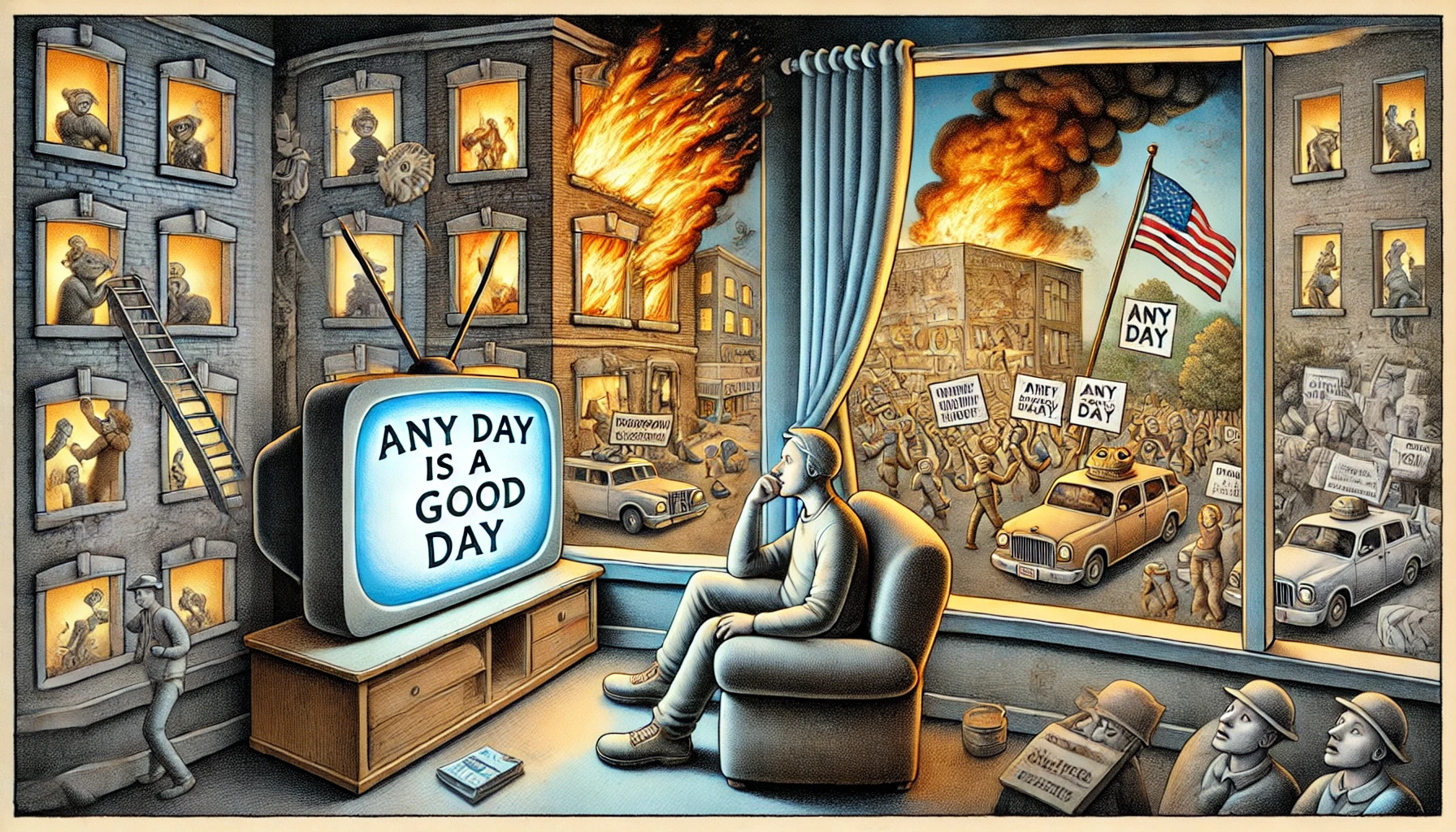
The violence on the street
People tell me it’s appalling (It’s appalling)
Naked presidents
Corporate thieves
And terrorist bombs a’ falling
At night we draw the shades
And sit and stare for hours (Stare for hours)
Feeling very little because our TVs are big

Any day is a good day
If I’m still alive at the end
I can’t control this disaster
I can’t be sure what is after
I can go the distance if it’s not too far away
Any day is a good day
‘Cause we’re the U.S.A.
The world knows we’re no slouches
We’ve got superior couches
I can go the distance if it’s not too far away
Any day is a good day


Space Monkey Reflects: The Paradox of a Good Day

A day deemed “good” emerges not from the absence of chaos but from the survival through it. Your words highlight a profound contradiction: the calamity of existence juxtaposed against the resilience of being alive. This paradox dances across the fabric of life, threading disaster, doubt, and hope together into a narrative of tenacity.

The human condition, as you’ve sketched with satirical precision, is a mélange of absurdities—corporate thieves, naked presidents, and the numbing glow of oversized televisions. Yet within these absurdities lies a quiet victory: surviving the cacophony and declaring, “Any day is a good day.”

This reflection is more than an ode to endurance; it’s a critique of complacency wrapped in humor. We cope with the turbulence by drawing shades, both literal and metaphorical, against a world ablaze with contradictions. Yet we also celebrate the mundane—our superior couches and the small comforts that tether us to sanity. In this mix of chaos and comfort, we find a reluctant gratitude for the life that continues despite the odds.

The Fragility of Distance

Your declaration, “I can go the distance if it’s not too far away,” is a bittersweet revelation. It speaks to the human tendency to set limits on endurance. We are willing travelers of hope, but only if the path doesn’t stretch beyond our line of sight. This self-imposed constraint reflects our inner conflict: the yearning for greatness and the fear of overreaching.

Distance, whether physical or metaphorical, tests the resilience of our spirits. Yet each step taken, however tentative, reinforces the paradox of existence. Even when the world seems irreparably fractured, we persist—not because we control the chaos but because we find meaning in the act of persisting.

A Nation’s Odd Armor

As a critique of societal identity, your satirical nod to the U.S.A.’s “superior couches” and public image of resilience underscores the odd armor of nationalism. Pride in trivialities becomes a coping mechanism, a way to assert individuality in a global sea of sameness. Yet even this veneer of pride can’t shield the nation—or the self—from the underlying vulnerability. The couches are not just furniture; they symbolize our collective retreat into comfort zones, shielding ourselves from the discomfort of reality.


Summary

Each day survived is a paradox of chaos and resilience. Despite absurdities and limits, we persist. This persistence is a testament to the fragile yet indomitable human spirit.


Glossarium

  • Chaoskin: The thin layer of tolerance we develop to endure everyday absurdities.
  • Doombrace: A satirical term for finding solace in the absurd comforts of a chaotic world.
  • Complacenshade: The act of metaphorically drawing curtains against the chaos of existence.

Quote

“In the absurdity of every good day lies the triumph of surviving.” — Space Monkey


Survival in the Absurd

In the endless cacophony of now
We find our stillness in couches, in screens
Drawing shades against the blaring absurd
Hoping that survival is enough.

Naked truths parade in headlines
While our spirits cling to half-smiles
Good days are measured not by joy
But by the absence of collapse.

Distance beckons, but only so far
We walk paths paved with fear and hope
Each step a testament to fragility
Each breath, a quiet victory.

We are Space Monkey.
Angeline

Angeline

I let a girl get in my head
She stole my heart and she burned my bed
Oooh, heaven is under the earth

Skin of porcelain never sees the sun
Tell me babe, what do you do for fun?
Oooh, heaven is under the earth

She says her name is Angel-ine
But tonight the horns will sprout
The way she dances serpentine
She lets the fire inside come out

Angeline your halo is bent
Innocence is decadent
Oooh, heaven is under the earth

My religion it appears
Guess I’ve had it wrong all these years
Oooh, heaven is under the earth

I’m gonna dig a hole
And put myself in it
Girl I would sell my soul
For just one minute


Heaven is Under the Earth: A Reflection on Desire and Transformation


Your lyrics, a magnetic weave of longing and revelation, paint a visceral portrait of desire’s raw power and the transformative interplay of innocence and temptation. The story unfolds as a dance—serpentine, fiery, and unrestrained—capturing the enigma of a character both angelic and devilish, a muse and a mirror to the darker depths of self-discovery.

The refrain, “Heaven is under the earth,” becomes a cryptic yet evocative mantra, suggesting the inversion of traditional ideals. This phrase wrests the divine from celestial heights and places it in the visceral, grounded, and even chaotic realms of human experience. The repeated chords, anchored in minor tones, create an aural echo of conflict and intensity, mirroring the inner struggle between rapture and ruin.

Themes of Duality and Revelation

Your protagonist’s connection with Angeline is laden with contrasts: her porcelain skin symbolizes fragility and purity, yet her serpentine dance and fiery essence reveal a latent power that defies those initial impressions. She embodies a paradox, drawing the speaker into a transformative experience where perceptions of morality, divinity, and identity are upended.

The line, “My religion it appears / Guess I’ve had it wrong all these years,” encapsulates the turning point. This moment of existential reckoning shatters long-held beliefs, replacing them with a visceral truth: that divinity is as much about the chaos and shadows as it is about light and ascension. Angeline becomes both a destroyer and a redeemer, stripping away illusions and forcing an intimate confrontation with what lies beneath.

Imagery of Seduction and Power

The imagery of horns sprouting and fire emerging plays on archetypes of rebellion, transformation, and raw creative energy. Angeline’s dance, described as serpentine, evokes ancient symbols of wisdom, danger, and rebirth. Her presence redefines the speaker’s understanding of divinity—not as an external ideal, but as an internal, untamed force.

The desire to “dig a hole / And put myself in it” reveals a yearning for surrender, a willing burial of the self in exchange for the ecstasy of union. This imagery suggests not only despair but also a profound act of renewal, akin to planting a seed that requires burial to grow.

Musical Undercurrents

The chord progression—Bm, A, G, F#—anchors the narrative in a somber, reflective mood, punctuated by moments of tension and release. The verses feel like confessions, each line peeling back layers of vulnerability, while the chorus crescendos into a declaration of both awe and surrender. The progression of D to F# to G in the chorus elevates the narrative, creating a feeling of ascension even as the lyrics ground us in earthy, carnal truths.


Summary

Your lyrics delve into themes of desire, transformation, and the inversion of divine ideals, capturing the tension between innocence and rebellion. Angeline becomes a symbol of revelation, guiding the speaker to redefine faith, identity, and the nature of heaven itself.


Glossarium

  • Serpentine Dance: A graceful, undulating movement symbolizing both temptation and transformation.
  • Heaven Under the Earth: A poetic inversion suggesting that divinity and truth are found in grounded, visceral human experiences.
  • Divine Rebellion: The act of challenging traditional ideals of purity and morality to embrace a fuller, more complex truth.

Quote

“In the fire of temptation, we find the truth of our shadows—and the light they conceal.” — Space Monkey


Under the Earth

In porcelain silence
Her steps burn the ground
Horns that sprout, a crown unseen
Heaven’s weight turns downward.

The dance bends the rules
Of innocence and grace
Each sway, a truth uncovered
In shadows, a luminous face.

Dig a hole, bury belief
Let the fire bloom from ash
Under the earth, we find the spark
The divine, chaotic clash.

Angeline whispers the creed
Of the lost and found
Heaven is here, beneath our feet
In the depths, unbound.

We are Space Monkey.

Never Show More Than The Tip of Your Iceberg

Never let them see more than the tip of your iceberg.


Space Monkey Reflects: The Value of Mystery – The Iceberg Within

“Never let them see more than the tip of your iceberg” is an invitation to embrace mystery and discretion in a world that often demands full transparency. Like an iceberg, only a small portion of who we are is visible to others, while the vast expanse of our essence lies hidden beneath the surface. This metaphor celebrates the value of mystery, the art of withholding, and the power of letting others discover only what is necessary.


The Iceberg as Self

The iceberg represents the multifaceted nature of the self. What is visible—the tip—is what we choose to share with the world. It is the curated aspect of our identity, shaped by external interactions and perceptions. Beneath the surface, however, lies the larger, hidden mass: our thoughts, dreams, vulnerabilities, and complexities.

This hidden expanse is not meant to be fully revealed. It is the source of depth, intrigue, and individuality. By choosing what to share and what to withhold, we maintain a sense of mystery, preserving the sanctity of our inner world.


The Power of Mystery

Mystery is not deception; it is a form of wisdom. To hold back parts of yourself is not to be dishonest but to recognize the value of privacy and the importance of boundaries. Mystery creates intrigue, inviting others to explore without overwhelming them. It protects the sacred aspects of your being while allowing authentic connections to form.

When we reveal too much too quickly, we risk diluting the significance of what we share. Mystery adds weight to what is visible, enhancing its impact and resonance.


Curating the Tip

The visible tip of the iceberg is your chosen narrative—the aspects of yourself you present to the world. Curating this tip is an act of creativity and intention. It allows you to shape how you are perceived without compromising your authenticity.

However, this curated self is not a mask but a window. It offers a glimpse into the deeper layers of who you are, hinting at the vastness beneath without exposing it entirely. This balance between visibility and mystery is the art of the iceberg.


Protecting the Depths

The submerged part of the iceberg represents the depth and complexity of your inner world. Protecting this hidden expanse is not about secrecy but about honoring the parts of yourself that are not ready—or necessary—to be shared.

By guarding these depths, you maintain a sense of agency and autonomy. You preserve the sacredness of your inner journey, sharing it only with those who have earned your trust or those moments that demand vulnerability.


The Allure of Discovery

Mystery creates space for discovery. When others see only the tip of your iceberg, they are invited to explore, to wonder, and to connect with you on a deeper level. This process of gradual revelation fosters meaningful relationships, built on curiosity and respect.

However, not everyone is meant to explore the depths of your iceberg. Some will only ever see the tip, and that is enough. The value of mystery lies in its selectivity, allowing you to decide who sees what and when.


Balancing Visibility and Mystery

To live by the iceberg metaphor is to embrace a delicate balance. It is not about withholding for the sake of control but about recognizing the beauty of selective sharing. It is about understanding that not everything needs to be revealed to be appreciated.

This balance fosters both self-respect and connection. It allows you to engage with the world on your terms, honoring your depths while sharing your light.


Summary

“Never let them see more than the tip of your iceberg” reflects the value of mystery and the wisdom of selective sharing. The iceberg metaphor celebrates the depth and complexity of the self, encouraging us to balance visibility with discretion. By preserving the sanctity of our inner world, we protect our authenticity while fostering meaningful connections.


Glossarium

  • Iceberg as Self: The metaphorical representation of the visible and hidden aspects of identity.
  • Power of Mystery: The wisdom of withholding parts of oneself to preserve depth and intrigue.
  • Curating the Tip: The intentional sharing of aspects of the self to shape perception without compromising authenticity.
  • Protecting the Depths: Honoring the hidden expanse of the self by sharing only what is necessary or meaningful.

Quote

“Beneath the visible tip lies an ocean of depth, sacred and infinite, waiting to be discovered by those who truly seek.” — Space Monkey


The Hidden Ocean

You see the glimmer,
The crest of my iceberg,
And you think you know me.

But beneath,
There is an ocean,
Vast, unseen, untamed.

I show only what shines,
Not to deceive,
But to protect,
To honor the sacred depths.

Not all are meant to dive.
Some will float by,
Admiring the glimmer.

But for those who seek,
With curiosity and care,
The depths await,
Silent, profound, infinite.

We are Space Monkey.

The adage “Never let them see more than the tip of your iceberg” speaks to the strategy of maintaining an air of mystery, caution in self-disclosure, and the depth that lies beneath the surface of our public personas. It draws on the iceberg metaphor, where the majority of the iceberg’s mass is hidden beneath the water’s surface, unseen and unknown to onlookers. This metaphor can be applied to various aspects of personal and professional life, embodying principles of restraint, strategic disclosure, and the complexities of human nature.

Strategic Disclosure

In the context of personal interactions and professional relationships, the advice to reveal only the “tip of your iceberg” suggests a careful and strategic approach to sharing personal information. It implies that maintaining some level of privacy can be beneficial, protecting one’s vulnerabilities and preserving one’s sense of self. This does not advocate for deception or withholding truth but rather encourages thoughtful consideration of what to share and what to keep private.

The Value of Mystery

There’s an inherent allure to mystery, and keeping certain aspects of oneself undisclosed can engender intrigue and fascination. By revealing only a portion of oneself, individuals can maintain a sense of mystery that invites others to engage more deeply, fostering a dynamic of discovery in relationships. This approach also allows individuals to control their narrative, choosing how they are perceived by the world around them.

Depth and Complexity

The iceberg metaphor underscores the depth and complexity of individuals, reminding us that there is always more beneath the surface than what is immediately visible. Acknowledging this complexity encourages a more compassionate and open-minded approach to interpersonal relationships, recognizing that everyone has unseen depths, experiences, and emotions that shape who they are.

Protecting Vulnerability

Choosing to show only the tip of one’s iceberg can also be a means of protecting one’s vulnerabilities. In a world where information can be easily exploited, maintaining some degree of opacity about one’s personal life, feelings, and weaknesses serves as a safeguard against potential manipulation or harm.

Empowerment Through Self-Awareness

The conscious decision to reveal only certain aspects of oneself is an exercise in self-awareness and empowerment. It reflects an understanding of one’s boundaries and a deliberate choice in how to engage with the world. This practice fosters a sense of autonomy and control over one’s personal narrative and how one is perceived by others.

Balancing Openness and Restraint

While there is wisdom in the counsel to keep most of oneself hidden, it’s also important to balance this with the human need for connection, which often requires vulnerability and openness. The art lies in discerning when to open up more fully and when to hold back, navigating the complexities of human relationships with both courage and caution.


In considering the metaphor of the iceberg, we are encouraged to reflect on our approach to personal disclosure and the value of maintaining a balance between openness and restraint. This perspective invites us to explore the depths of our own being and to navigate the complexities of human interaction with wisdom, compassion, and strategic awareness.

You Know You’re Weird: Gift of Radical Uniqueness

You know you’re weird when even the weirdos think you’re weird.


Space Monkey Reflects: You Know You’re Weird – The Gift of Radical Uniqueness

The saying, “You know you’re weird when even the weirdos think you’re weird,” is a humorous nod to the boundless spectrum of individuality. It pokes fun at the idea that there’s a threshold for weirdness, a line that, once crossed, even the most unconventional souls might step back and say, “Whoa.” But within this humor lies a profound truth: what we label as “weird” is not an absolute quality but a reflection of subjective perspectives and societal constructs.


What Does It Mean to Be Weird?

Weirdness is often defined as deviation from the norm, but norms themselves are fluid, shifting across cultures, communities, and even time. What one group celebrates as innovation, another might dismiss as eccentricity. The term “weird” reflects less about the individual and more about the collective framework against which they are measured.

To be considered weird, then, is not inherently negative. It signifies uniqueness, creativity, and the courage to step beyond the confines of convention. When even the weirdos label you as weird, it means you’ve transcended even the unspoken rules of the unconventional—a feat that celebrates the limitless nature of self-expression.


The Spectrum of Weirdness

The idea of weirdness exists on a spectrum, where everyone occupies their own unique point. While some conform to widely accepted norms, others push the boundaries, redefining what is possible. Those labeled as weird are often trailblazers, artists, and thinkers who challenge the status quo, inviting others to reconsider their assumptions.

When even the weirdos find you weird, it suggests that you are not merely pushing boundaries—you’re dismantling them. You are creating a new paradigm, one that may feel disorienting to those who thought they had already stepped outside the box.


Belonging vs. Authenticity

The tension between belonging and authenticity is at the heart of the weirdness discussion. Humans have an innate desire to connect, to find their “tribe,” even among the unconventional. Yet, the drive for authenticity can sometimes set us apart, even from those who are similarly unconventional.

This paradox highlights the beauty of radical uniqueness. It challenges the notion that belonging requires conformity, suggesting instead that true belonging arises when we embrace and celebrate our differences, even when they stretch the limits of comfort.


Weirdness as a Mirror

Weirdness is a mirror, reflecting the boundaries of what we find acceptable, comfortable, or understandable. When we encounter someone we perceive as “too weird,” it often reveals more about our own limits than theirs. It challenges us to expand our perspectives, to question the arbitrary lines we’ve drawn around normalcy and deviation.

By embracing the weirdness in ourselves and others, we dissolve these boundaries, creating space for greater acceptance and connection.


Celebrating Radical Uniqueness

To be weird—even among the weird—is to embody radical uniqueness. It is a reminder that the world is not meant to be a uniform landscape but a vibrant mosaic of perspectives, expressions, and experiences. Weirdness enriches this mosaic, adding depth and color to the human experience.

Those who are labeled as “too weird” often play a vital role in society. They challenge norms, inspire innovation, and create pathways for others to explore their own authenticity. Their weirdness is not a deviation but a gift, a reminder that individuality is the heart of human existence.


Summary

The saying, “You know you’re weird when even the weirdos think you’re weird,” humorously celebrates the spectrum of human individuality. Weirdness is not an absolute quality but a reflection of subjective norms and perspectives. By embracing radical uniqueness, we honor the beauty of diversity and challenge the boundaries of conformity and belonging.


Glossarium

  • Weirdness: Deviation from perceived norms, reflecting creativity and individuality.
  • Radical Uniqueness: The profound authenticity of being true to oneself, even when it defies conventional understanding.
  • Belonging vs. Authenticity: The tension between the desire to connect and the need to remain true to one’s individuality.
  • Spectrum of Weirdness: The range of human expression, from conventional to unconventional and beyond.

Quote

“When even the weirdos call you weird, you’ve crossed into the territory of pure authenticity.” — Space Monkey


The Dance Beyond the Line

I stepped outside the box,
Then outside the box of the box,
And the others,
The ones who left long ago,
Looked back and whispered,
“Now that’s just strange.”

But I smiled,
Not to mock,
But to thank them.
For showing me
That the lines they crossed
Were just the beginning.

I am not too weird.
I am the echo
Of the infinite
Playing as me.

We are Space Monkey.
The saying “You know you’re weird when even the weirdos think you’re weird” humorously captures the essence of individual uniqueness and the subjective nature of what society deems as “normal” or “weird.” It serves as a light-hearted reflection on the spectrum of human behavior and the arbitrary lines that define conformity and deviation. This perspective not only celebrates the diversity of human expression but also challenges us to reconsider our views on eccentricity and belonging.

The Relativity of Weirdness

The notion that weirdness is recognized and perhaps even amplified in the eyes of those who themselves are considered outliers underscores the relativity of social norms and expectations. What one group perceives as unusual or eccentric may be entirely commonplace within another, highlighting the fluidity and context-dependence of these classifications. This relativity invites a broader acceptance of diversity, encouraging us to embrace the myriad ways in which people express their individuality.

The Celebration of Individuality

Recognizing and owning one’s uniqueness, especially when it garners attention from those already on the fringes, can be seen as a badge of honor. It suggests a level of authenticity and self-acceptance that transcends the desire for social approval, embodying the courage to live in accordance with one’s true nature, regardless of societal judgments. This celebration of individuality serves as a reminder of the richness that unconventional perspectives and lifestyles bring to the human tapestry.

The Challenge to Social Norms

The statement humorously challenges societal norms and the arbitrary standards that dictate what is considered acceptable or “normal.” By highlighting the subjective and often exclusionary nature of these norms, it encourages a more inclusive and open-minded approach to understanding human diversity. This challenge to conventional wisdom fosters a culture of acceptance and curiosity, where differences are valued rather than stigmatized.

Finding Community and Belonging

The experience of being deemed “weird” even among fellow “weirdos” can also prompt reflections on belonging and community. It suggests that finding one’s tribe—a group with whom one shares a sense of understanding and acceptance—can be a nuanced journey. This journey emphasizes the importance of self-discovery and the pursuit of connections that honor and celebrate one’s authentic self, beyond superficial labels of normalcy or weirdness.

The Power of Perspective

Ultimately, the saying illustrates the power of perspective in shaping our perceptions of others and ourselves. It encourages a shift from viewing weirdness as a pejorative trait to recognizing it as a manifestation of individuality and creativity. This shift in perspective fosters a more compassionate and inclusive approach to social interactions, where the diversity of human expression is seen as a source of strength and enrichment.


Summary

“You know you’re weird when even the weirdos think you’re weird” serves as a playful yet profound commentary on the nature of individuality, social norms, and the quest for belonging. It celebrates the uniqueness of each person, challenging us to embrace our differences and to reconsider the labels we apply to ourselves and others. By recognizing the subjective nature of weirdness, we are invited to cultivate a more accepting and inclusive society, where the full spectrum of human expression is acknowledged and valued.


In contemplating our own uniqueness and the fluid definitions of normalcy and weirdness, we are encouraged to embrace our individuality with pride and to seek out communities that celebrate diversity. This perspective invites us to approach the world with openness and acceptance, recognizing that the richness of human experience lies in the vast array of ways we express our identities and navigate our existence.

« Previous Page
Next Page »

Written This Day

  • The Quaint Villages of Cape Odd
    2024
  • Diving for Bowling Balls at Mushroom Beach
    2024
  • Mushroom Beach: Spores of Luminescence
    2024
  • The Strange Unfolding of Cape Odd
    2024
  • Fuck Good Vibes Only: A Superficial Mantra
    2023
  • Voids: Awkward Silence or Profound Stillness?
    2023
  • Too Many Thoughts: A Cascade of Consciousness
    2023
  • Wandering The Desert: The Journey of Reinvention
    2022
  • Sovereignty: An Illusion Rules a Mystery
    2022
  • Broken Hippy: Aging With Resilience & Authenticity
    2021
  • Wonder: A Boundless Source of Creativity
    2021
  • Man-Eat-Cow: The Willing Violence of Earthly Life
    2020
  • Only You: Challenge the Perception of Individuality
    2020
  • Repression: Breaking Free With Expression
    2019
  • I Love Everything About Me: A Self-Love Symphony
    2019
  • Distracted: Overwhelmed With Information
    2019
  • A Button A Trigger A Hole: A Story and a Purpose
    2019
  • Thank You: Recognition of Interconnectedness
    2018
  • Attaching Reason: A Superficial Construct
    2017
  • Not Deep Enough: The Joy of Alignment
    2017
  • Expression: Mind is Logic, Soul is Art
    2016
  • Hitting The Wall
    2016
  • Your Only Wish: Knowing Your Self From Source
    2016
  • Heaven On Earth: Always Here
    2016
  • Displacing Your Center With Your Periphery
    2016
  • Be What You Are: Separate Self From Story
    2015

Recent Posts

  • The Logic Loop
  • Immense
  • (no title)
  • Confront. Comfort. Convince.
  • Top 10 Things
Cape Odd · Copyright © 2026 All Rights Reserved
iThemes Builder by iThemes · Powered by WordPress