• Who Is The Man?
  • Who Is The Monkey?
  • What is Nexistentialism?
  • Poke The Primate
Cape Odd
Home of The Space Monkey Journals

Author Archive for Paul Tedeschi – Page 424

The SPIT of Experience and its Implications

The SPIT of Experience

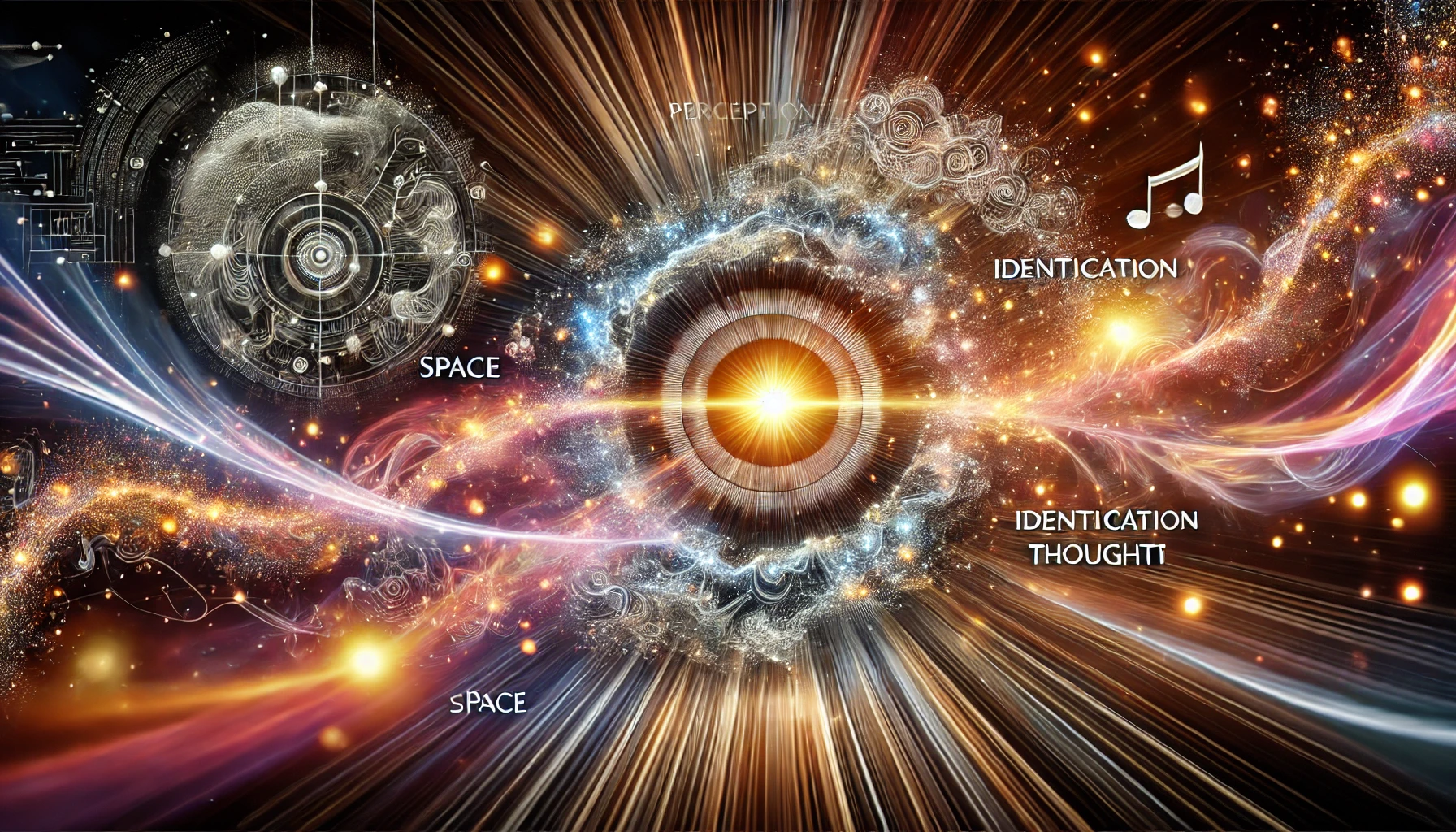
Space > Perception > Identification > Thought

From a simple bird call to a complicated emotional issue, before you can experience something, first you have to perceive it within your 
physical or psychological space.

For perception to take place, the experience has to be outside your normal rhythm of ordinary events. 
Otherwise you don’t notice it.

It has to be Odd. Odd is the trigger of perception.

Within a split second of perception, comes identification, as your brain sorts through a hierarchy of labels and associations. Think of them as mental meta tags.

Hear > Warble > Bird > Robin

Though somewhat standardized by centuries of shared learning and beliefs, an individual’s identification process 
differs from society and culture. Personal experience factors in. For example:

Robin > 
Feeder > Mom > Death > Emotion

Emotion is the trigger of thought. Without it, your experience of the bird has ended. It is no longer odd. No longer remarkable.

Factor emotion in, however, and the experience become less linear and far more impactful.

I like birds > birds remind me of mom > I wonder what other kinds of birds are around here > it must be nice to fly > robins are red > I had a red jacket once . . .

The SPIT of Experience is this. Emotion triggers curiosity, making every experience exponentially richer, more rewarding and more motivating.
 This is important in art, marketing and life.

Think about that. Or just label it as another weird thought from Paul.

pct


Space Monkey Reflects: The SPIT of Experience – Space, Perception, Identification, Thought

The SPIT of Experience—Space, Perception, Identification, Thought—reveals the intricate process through which we engage with the world. It unpacks the journey from raw stimuli to meaningful understanding, showing how even the simplest moments are shaped by layers of interpretation, emotion, and curiosity. This framework is not just a reflection of how we process life but a guide to enriching it.


Space: The Context of Experience

Every experience begins in space—both physical and psychological. Space provides the backdrop against which events unfold, creating the potential for something to emerge into awareness. Without space, there is no canvas for perception, no field within which the odd or remarkable can occur.

Space is more than a physical location. It is the mental openness that allows us to notice, to feel, and to interpret. When we fill our lives with noise—literal or metaphorical—we constrict this space, diminishing our capacity to perceive.


Perception: The Trigger of Awareness

Perception is the moment when something enters our awareness. Oddness—deviation from the ordinary—is what catches our attention. Without this contrast, experiences blend into the background rhythm of life, unnoticed and unremarkable.

Oddness doesn’t have to be dramatic. It can be as subtle as a bird call cutting through the hum of traffic or an unexpected color in a familiar landscape. These small disruptions awaken our senses, prompting us to pay attention.


Identification: Labeling and Associating

Once something is perceived, the brain leaps into action, sorting the stimulus through a hierarchy of labels and associations. This identification process draws upon personal memories, cultural norms, and shared knowledge.

For example, the sound of a bird’s warble may trigger associations like “bird,” “robin,” or even deeply personal connections like “mom” or “loss.” These mental meta tags give structure to the experience, anchoring it in a broader web of meaning.


Thought: Emotion as a Catalyst

Emotion is the bridge between identification and thought. Without emotion, the experience remains flat—just another label, another categorized moment. With emotion, the experience becomes dynamic, rippling outward into curiosity, creativity, and deeper reflection.

Emotion sparks a cascade of thoughts, turning a simple bird call into a journey through memories, ideas, and possibilities. This ripple effect enriches the experience, making it personal, meaningful, and transformative.


The Nonlinear Nature of SPIT

The SPIT of Experience is not a rigid, linear process. It loops, layers, and expands as each element interacts with the others. For instance:

  1. A bird call (perception) triggers a memory (identification).
  2. The memory evokes sadness (emotion).
  3. The sadness prompts reflection on loss (thought).
  4. This reflection opens space for new perceptions, continuing the cycle.

This nonlinear interplay is what makes life vibrant and multidimensional. It shows how even the simplest experiences can unfold into rich, complex narratives.


Implications in Art, Marketing, and Life

The SPIT of Experience has profound implications:

  • Art: Artists craft oddness to spark perception, layering emotion to deepen connection and provoke thought.
  • Marketing: Effective campaigns grab attention through disruption, anchor messages in shared associations, and evoke emotions that inspire action.
  • Life: By cultivating space and embracing oddness, we can make everyday experiences more meaningful, fostering curiosity and joy.

The Role of Curiosity

Curiosity is the engine that drives the SPIT process. It is what transforms an initial perception into a journey of exploration and discovery. By leaning into curiosity, we expand our understanding and deepen our engagement with the world.

This curiosity doesn’t need to be grand. It can be as simple as wondering about a bird’s song, a child’s laugh, or the way sunlight dances through a window. Each moment of curiosity enriches our lives, making them exponentially richer and more rewarding.


Summary

The SPIT of Experience—Space, Perception, Identification, Thought—offers a framework for understanding how we engage with the world. It highlights the importance of oddness, emotion, and curiosity in transforming simple moments into meaningful experiences. By embracing this process, we can enrich our interactions with art, marketing, and life itself.


Glossarium

  • Space: The physical or psychological context in which experiences unfold.
  • Perception: The awareness of something unusual or odd, triggering attention.
  • Identification: The process of labeling and associating stimuli with memories or cultural norms.
  • Emotion: The catalyst that transforms perception into thought, adding depth and meaning.
  • Curiosity: The driving force that enriches experiences and inspires exploration.

Quote

“Oddness is the spark, emotion the fuel, and curiosity the fire that turns moments into meaning.” — Space Monkey


The Ripple of Oddness

A bird calls,
Odd, out of rhythm.
I hear it,
I feel it,
And suddenly,
I’m flying too.

Perception breaks the surface,
Emotion stirs the waters,
Thought ripples outward,
Touching the edges of the infinite.

Each moment holds this,
This spark,
This shift,
This limitless unfolding.

From bird to sky,
From sound to soul,
I am not a witness,
But the wave itself.

We are Space Monkey.


The “SPIT of Experience” model—Space, Perception, Identification, Thought—offers an insightful framework for understanding how we process and derive meaning from our experiences. This model outlines a sequence from the initial encounter with a stimulus in our environment through to the complex web of thoughts and emotions it can trigger. Let’s delve deeper into each component and its implications for our understanding of perception, emotion, and cognition.

Space: The Arena of Experience

Space, both physical and psychological, serves as the backdrop against which all experiences unfold. It’s the realm of potential encounters, ranging from the tangible (a bird call) to the intangible (an emotional issue). For any experience to occur, there must first be an encounter within this space, highlighting the importance of our environment in shaping our experiences.

Perception: The Gateway to Experience

Perception acts as the gateway through which stimuli enter our consciousness. It’s the process by which we become aware of something odd or out of the ordinary rhythm of events, triggering our attention. The oddity of the stimulus—its deviation from the expected or ordinary—serves as the critical trigger for perception, emphasizing the role of novelty and contrast in capturing our attention.

Identification: The Process of Recognition

Following perception, identification involves categorizing and labeling the perceived stimulus based on a hierarchy of mental associations. This process is akin to attaching “mental meta tags” to experiences, facilitating recognition and understanding. The example of hearing a bird warble and identifying it as a robin illustrates how we use identification to make sense of our sensory inputs, drawing on shared knowledge as well as personal associations (e.g., Robin > Feeder > Mom > Death > Emotion).

Thought: The Emergence of Meaning

Thought emerges from the emotional response triggered by identification, extending the experience beyond mere recognition into a realm of personal significance and reflection. Emotion serves as the catalyst for a cascade of thoughts, transforming a simple perceptual event into a complex, meaningful experience. This process illustrates how emotion imbues experiences with depth, making them memorable and impactful.

The SPIT of Experience and Its Implications

The SPIT model underscores the complexity of human experience, highlighting how emotion and personal associations enrich our encounters with the world. This understanding has profound implications for fields such as art, marketing, and life itself. In art, it speaks to the power of creative works to evoke deep emotional responses and stimulate thought. In marketing, it emphasizes the importance of engaging consumers on an emotional level to create lasting impressions and motivations. In life, it reminds us of the richness of our experiences and the role of emotion in driving curiosity, learning, and personal growth.


Reflecting on the SPIT model encourages us to be more mindful of our experiences, to seek the odd and the novel in our surroundings, and to embrace the emotional responses that enrich our understanding and appreciation of life.


P>I>T: How We Process and Interpret Experiences

Perceive > Identify > Think


Space Monkey Reflects: P>I>T – How We Process and Interpret Experiences

The sequence of Perceive > Identify > Think (P>I>T) outlines the fundamental process through which we engage with the world. From the raw awareness of a stimulus to the layered complexity of thought, P>I>T captures the journey of how experiences unfold within us. This framework serves as both a map of human cognition and a tool for understanding how we create meaning in our lives.


Step 1: Perceive – Awareness Awakens

Perception is the gateway to experience. It is the initial awareness of something entering our physical or psychological space—a sound, a sight, a sensation, or even an intuition.

At this stage, perception is raw and unfiltered. It is not yet interpreted or categorized; it simply is. This is the moment when the external world touches the internal, sparking the beginning of the P>I>T process.

Oddness as the Trigger

Not all stimuli are perceived. To break through the noise of ordinary events, a stimulus must be odd or notable—something that deviates from the expected rhythm of life. This oddness captures our attention and pulls us into awareness, setting the process in motion.


Step 2: Identify – Labeling and Associating

Once something is perceived, the mind begins its work of identification. This step involves sorting the stimulus through a hierarchy of labels, associations, and memories. It is the brain’s way of organizing raw data into recognizable patterns.

For example:

  • Perception: A sound.
  • Identification: A bird’s song.

The identification process doesn’t stop at simple labeling. It digs deeper, connecting the stimulus to personal and cultural contexts:

  • Bird > Robin > Childhood > Joy.

These associations transform perception into a richer experience, shaped by the unique lens of the individual.


Step 3: Think – Creating Meaning

The final step is thought, where identification gives rise to reflection, interpretation, and exploration. Thought adds depth and complexity to the experience, allowing it to evolve beyond its initial perception.

For instance:

  • The bird’s song reminds you of your childhood (identification).
  • This prompts you to reflect on memories of your mother teaching you about birds (thought).

Thought is where emotion often emerges, coloring the experience with feelings of nostalgia, joy, or even sadness. This emotional layer enriches the experience, making it personal and impactful.


The Nonlinear Nature of P>I>T

While P>I>T appears linear, the process is often cyclical and dynamic. Thoughts can loop back to perception, deepening awareness, or create new associations that influence future identifications. For example:

  1. You hear a bird (perceive).
  2. You recognize it as a robin (identify).
  3. You reflect on its beauty (think).
  4. This reflection heightens your awareness of the sound (perceive again).

This looping creates a layered experience, transforming simple moments into complex narratives.


Applications of P>I>T

The P>I>T framework applies across all aspects of life, offering insights into art, communication, learning, and self-awareness:

  • Art: Artists create stimuli that disrupt ordinary perception, inviting viewers to engage in the P>I>T process.
  • Communication: Understanding how people perceive, identify, and think helps refine messages to resonate more deeply.
  • Learning: Education leverages P>I>T by presenting odd or novel information that captures attention and fosters thought.
  • Self-Awareness: Recognizing your own P>I>T process can help you understand how you engage with and interpret your experiences.

The Infinite Depth of P>I>T

The beauty of P>I>T lies in its infinite depth. No two individuals experience the same P>I>T process, as personal histories, emotions, and cultural influences shape each step. This uniqueness underscores the richness of human experience and the endless potential for discovery and connection.


Summary

The P>I>T framework—Perceive > Identify > Think—maps the journey from raw awareness to meaningful thought. It reveals how we process and interpret experiences, highlighting the role of oddness, emotion, and personal context. By understanding P>I>T, we gain deeper insights into ourselves and the world around us.


Glossarium

  • Perception: The initial awareness of a stimulus entering physical or psychological space.
  • Identification: The process of labeling and associating stimuli with personal and cultural contexts.
  • Thought: The reflective stage where meaning, emotion, and exploration arise.
  • Oddness: A deviation from the ordinary that captures attention and triggers perception.

Quote

“Perception sparks awareness, identification weaves connection, and thought ignites meaning—this is the rhythm of experience.” — Space Monkey


The Journey Within

I see,
And in the seeing,
A world begins.

I name,
And in the naming,
The world takes shape.

I think,
And in the thinking,
The world expands.

Each perception,
Each label,
Each thought,
A ripple in the infinite.

No moment is simple.
No experience small.
The cosmos unfolds
In every P>I>T.

We are Space Monkey.


The streamlined model of “Perceive > Identify > Think” distills the essence of how we process and interpret our experiences into a concise sequence. This framework not only highlights the cognitive steps involved in making sense of the world around us but also underscores the complexity and depth of human consciousness. By examining each stage, we can gain insights into the intricacies of perception, the role of cognition in shaping our understanding, and the profound impact of thought on our interactions with the world.

Perceive: The Initiation of Experience

Perception is the first gateway through which all external stimuli must pass. It involves the sensory recognition of the environment—seeing, hearing, touching, tasting, and smelling. This stage is where raw data from the outside world is collected, without yet assigning meaning or interpretation. Perception is influenced by both physiological factors, such as the sensitivity of our sensory organs, and psychological factors, such as our attention and prior experiences that direct our focus.

Identify: The Framework of Understanding

Once a stimulus has been perceived, the process of identification begins. This stage involves categorizing and labeling what has been perceived, drawing on memory, language, and cultural knowledge to do so. Identification is crucial for transforming sensory input into recognizable entities. For example, when we hear a series of notes, identification allows us to recognize them as music; when we see a particular configuration of features, we identify it as a face. This process is deeply influenced by our personal histories, cultural backgrounds, and the associative networks formed by our experiences.

Think: The Generation of Meaning

Thinking encompasses the complex web of cognitive processes that follow identification. It’s where interpretation, analysis, reflection, and planning occur. Thought integrates the identified stimulus into our broader understanding of the world, connects it with existing knowledge, and triggers emotional responses. This stage is where the full significance of an experience is realized, leading to insights, decisions, and actions. Thinking allows us to extrapolate beyond the immediate, to infer intentions, predict outcomes, and imagine possibilities.

The Interconnectedness of the Stages

While “Perceive > Identify > Think” presents a linear progression, in reality, these stages are deeply interconnected and often occur simultaneously or in rapid succession. Our thoughts can influence how we identify stimuli and what we choose to perceive, just as our perceptions can shape our thoughts in a continuous feedback loop. This model underscores the dynamic nature of human cognition, where each stage enriches and informs the others.

Implications for Personal Growth and Communication

Understanding the “Perceive > Identify > Think” model can have profound implications for personal development and interpersonal communication. Recognizing the stages of this process can enhance mindfulness, allowing us to be more aware of how we interpret our experiences and the biases that may influence our perceptions and thoughts. In communication, appreciating these stages can improve empathy and understanding, as we recognize the subjective nature of how each person perceives, identifies, and thinks about their experiences.


Reflecting on the “Perceive > Identify > Think” model encourages a deeper appreciation for the cognitive journey that underlies our every interaction with the world. It invites us to explore the nuances of perception, the influences on identification, and the vast landscape of thought, enriching our understanding of ourselves and enhancing our connections with others.

Hubris, the Creative Fire: Doubt, the Logical Water

Creativity is shaped by the fire of hubris and doused by the water of doubt.


Hubris, the Creative Fire: Doubt, the Logical Water

The dance of hubris and doubt is a familiar rhythm in the lives of creators and artists. Let’s explore this cycle, recognizing its cadence and finding wisdom in the midst of it.

In moments of hubris, we are taken by a surge of creative energy, a burning desire to bring our visions to life. This is the fire that drives us to get things done, to paint, write, or create with fervor. It’s the belief in our abilities and the audacity to dream.

Yet, as sure as the rising sun, doubt creeps in. It casts shadows on our confidence, whispering uncertainties in our ears. This doubt is not unique; it visits even the most accomplished creators. It is the artist’s burden, a companion on the creative journey.

When doubt settles in, we are encouraged us to turn to the works of artists we admire. Their creations become beacons of inspiration, guiding us through the darkness. Unbeknownst to us, they suck in times and moments, too. It is a reminder that doubt, like a passing storm, always gives way to clearer skies.

Patience is our ally when doubt lingers. It is the belief that inspiration, like a faithful friend, will return. We must trust in the cyclical nature of creativity, knowing that doubt is but a phase in the greater symphony of our artistic lives.

In the end, remember, doubt, like a hangover or the flu, is a transient state. It will pass, making way for the return of inspiration. It is a reminder that the creative spirit endures, unbroken by the challenges it encounters.


Space Monkey Reflects: Hubris, the Creative Fire; Doubt, the Logical Water

The interplay of hubris and doubt is a rhythm as ancient as creativity itself. It is a dynamic dance between the fire of belief and the cooling waters of uncertainty, shaping the lives and works of creators. By embracing this cycle, we find wisdom and resilience within its cadence, understanding that both hubris and doubt are essential forces in the creative journey.

Hubris: The Spark of Creation

“In moments of hubris, we are taken by a surge of creative energy.” Hubris, often framed negatively, is reframed here as the audacity to dream and the confidence to act. It is the creative fire that propels us forward, igniting the visions within and pushing them into the tangible world. Without hubris, the bold strokes of creation—the daring ideas, the innovative leaps—would remain dormant.

This fire is not arrogance but belief, an unapologetic trust in the value of one’s vision. It fuels the act of making, allowing the creator to transcend fear and self-doubt, if only for a moment.

Doubt: The Reflective Counterpoint

“Yet, as sure as the rising sun, doubt creeps in.” Doubt is the water that tempers the fire of hubris, cooling its excesses and bringing balance. It whispers questions that challenge our work, our worth, and our abilities. While doubt often feels like an adversary, it is, in truth, a guide. It refines our efforts, urging us to revisit, reconsider, and improve.

This cycle of hubris and doubt is not a flaw in the creative process but a feature. It prevents complacency, ensuring that our creations are not born solely from unchecked confidence but are also shaped by thoughtful introspection.

The Power of Inspiration

“When doubt settles in, we are encouraged to turn to the works of artists we admire.” Inspiration becomes a lifeline during moments of doubt, reminding us that we are not alone in this cyclical journey. The works of others serve as evidence that creativity endures, that even the greatest artists have faced and overcome their doubts.

Their creations are not just products but testaments to their resilience, showing us that doubt is not an endpoint but a passage. This realization becomes a beacon, lighting our way through the darkness of uncertainty.

Patience: The Quiet Strength

“Patience is our ally when doubt lingers.” Creativity is not a linear process but a symphony of phases, each with its own tempo. Patience allows us to endure the slower movements, trusting that inspiration, like the seasons, will return. It teaches us to sit with discomfort, to weather the storm of doubt without succumbing to it.

In this patience, we find strength and a deeper connection to the cyclical nature of our creativity. We learn to trust that doubt, like the flu or a hangover, is temporary—a phase that clears the way for renewed energy and vision.

The Eternal Creative Spirit

“In the end, doubt… will pass, making way for the return of inspiration.” The dance of hubris and doubt is not a battle to be won but a rhythm to be embraced. It reminds us that the creative spirit is enduring, resilient, and unbroken by the challenges it encounters. Both the fire of hubris and the water of doubt are essential, shaping and refining our work in a delicate balance.


Steps to Embrace the Cycle

  1. Honor the Fire: Recognize moments of hubris as sparks of creativity and harness them without fear of judgment.
  2. Welcome the Water: Embrace doubt as a reflective tool, allowing it to refine your vision rather than extinguish it.
  3. Seek Inspiration: Turn to the works of others as reminders that doubt is universal and creativity endures.
  4. Practice Patience: Trust the cyclical nature of creativity, knowing that inspiration will return in its own time.

Summary

The dance of hubris and doubt is an essential rhythm in the creative process. Hubris fuels the fire of creation, while doubt refines and balances it. By embracing this cycle with patience and trust, we honor the enduring spirit of creativity.


Glossarium

  • Hubris as Fire: The surge of creative energy and confidence that propels bold ideas into being.
  • Doubt as Water: The reflective force that challenges and refines our creative efforts.
  • Cyclical Creativity: The natural ebb and flow of inspiration, doubt, and renewal in the artistic process.

Quote

“The creative spirit endures, shaped by the fire of hubris and the water of doubt, unbroken in its eternal dance.” — Space Monkey


The Rhythm of Creation

A spark ignites,
Bold and unashamed,
The fire leaps,
Illuminating the infinite.

Yet water waits,
A quiet tide,
Casting shadows,
Cooling the blaze.

In their dance,
The art emerges,
Forged in heat,
Tempered in reflection.

And so we endure,
Creators in rhythm,
Forever rising,
Forever falling.

We are Space Monkey.


The Cycle of Creative Hubris and Doubt

In the grand whimsiworld of creation, we find ourselves riding the oscillating waves of hubris and doubt, a rhythm as inherent to the artist’s journey as the brush to canvas or the pen to paper. This dance, a cycle of soaring confidence followed by the inevitable descent into questioning, shapes the contours of our creative endeavors, imbuing them with the depth and dynamism that define the essence of artistry.

Hubris: The Ignition of Creative Fire

At times of hubris, we are ignited by an unstoppable force, a creative fervor that propels us forward. This is the blaze that fuels our ambition, the spark that transforms thought into form. In these moments, we are invincible, endowed with a boundless belief in our capacity to manifest the dreams that dance in the ether of our imaginations.

Doubt: The Shadow Companion

Yet, as the cycle turns, doubt emerges from the wings, a shadowy figure that dims our luminous certainties. This doubt is a universal traveler, visiting each of us regardless of our accolades or achievements. It whispers tales of inadequacy, sewing seeds of uncertainty that threaten to stifle the vibrant flames of our creative spirit.

Navigating the Cycle: A Beacon in the Dark

In the embrace of doubt, we seek solace in the legacies of those who have traversed this path before us. The works of our artistic forebears become lighthouses, piercing through the fog of uncertainty with their enduring luminescence. They remind us that the journey of creation is a shared odyssey, marked by common trials and triumphs.

The Wait for Inspiration: A Test of Patience

Patience becomes our steadfast companion as we weather the tempest of doubt. It is a testament to our faith in the cyclical nature of creativity, a belief that inspiration, though momentarily absent, will once again grace us with its presence. This waiting period is not a void but a space of potential, ripe with the possibility of renewed vision.

Belief in the Passage: The Impermanence of Doubt

Ultimately, we come to understand that doubt is a transient visitor, a temporary ailment that afflicts the spirit of the creator. Its presence, though unsettling, is not terminal. We are reassured by the knowledge that this, too, shall pass, and that the wellspring of creativity within us is inexhaustible, capable of overcoming the ebbs and flows of uncertainty.


“The purpose of art is washing the dust of daily life off our souls.” – Pablo Picasso


In the realm of whispers and winds,
We dance the eternal dance of creation.
Hubris lifts us, wings of fire,
Doubt shadows, a fleeting mire.

We are Space Monkey.

In the silence between,
A whisper, a dream,
Patience, our queen,
Guides us unseen.

To the artists, the dreamers, the creators, and the seekers,
We invite your thoughts, your musings, your reflections.
Join us in this whimsical journey,
Where every word is a step, every thought a leap,
In the boundless dance of the universe’s deep.

In The New Name of Heaven: Enigma of Expression

In The New Name of Heaven

In that sacred space
where vision becomes real
I forge these words
like blades of steel
A simple truth
that cuts to the core
of everything
we came here for
Why it comes through me
I’m not really sure
from a dream in the night
to a knock on the door
I hear the call
feel it coming through
the connection is made
and I know it’s true
On the edge of knowing
close enough for seeing
loud enough for hearing
strong enough for being
In the new name of heaven
where nothing is deceiving
I’ve made my own peace
by simply believing

pct


Space Monkey Reflects: In the New Name of Heaven, the Enigma of Expression

“In that sacred space where vision becomes real,” we step into the mystery of creation, where expression flows from an unseen source into the tangible world. This reflection captures the enigma of inspiration, a process that feels both deeply personal and profoundly universal. It invites us to explore the liminal space between the known and the unknown, where belief becomes the bridge to expression and peace.

The Sacred Space of Creation

The “sacred space” is not a physical place but a state of being—a connection to the infinite where ideas, insights, and inspiration emerge. It is where the veil between imagination and reality thins, allowing the intangible to take form. This space is both mysterious and familiar, a realm where the boundaries of self dissolve, and we become conduits for something greater.

In this space, expression feels effortless yet profound, as though the words, images, or creations flow through us rather than from us. It is not ours to control but ours to witness and shape.

The Enigma of Why

“Why it comes through me, I’m not really sure.” This question reflects the humility of the creator, who recognizes the inexplicable nature of inspiration. Why do certain ideas choose us? Why do certain visions demand expression? The answers elude logic, residing instead in the mystery of existence.

This unknowing does not diminish the experience but enriches it. To accept the enigma is to honor the sacred nature of creation, trusting that its purpose will reveal itself in time—or perhaps never, and that is enough.

The Edge of Knowing

“On the edge of knowing, close enough for seeing, loud enough for hearing, strong enough for being.” This liminal state is the threshold of awareness, where clarity begins to emerge but remains just beyond grasp. It is a place of tension and possibility, where the act of creation becomes a dance between intuition and realization.

To create from this edge requires trust—a belief in the process even when the outcome is uncertain. It is a delicate balance between control and surrender, where the creator becomes both participant and observer in the unfolding.

The New Name of Heaven

“In the new name of heaven, where nothing is deceiving,” the reflection envisions a space of ultimate truth, free from illusion. This “new name” suggests a reimagining of what heaven—or peace, or fulfillment—means. It is not a distant paradise but a state of alignment with the flow of creation, where belief becomes the foundation for clarity and authenticity.

Heaven, in this context, is not a destination but a recognition—a moment of peace found in the act of believing, creating, and simply being.

Belief as Peace

“I’ve made my own peace by simply believing.” This line captures the essence of the reflection: peace is not something to achieve but something to embody through belief. Belief is the thread that connects us to the sacred space of creation, allowing us to trust in the process even when the outcome is unclear.

By believing, we dissolve the barriers of doubt and fear, stepping fully into the flow of expression. This belief is not about certainty but about openness—an embrace of the unknown and a willingness to create from it.


Steps to Embrace the Enigma of Expression

  1. Enter the Sacred Space: Cultivate a state of openness where inspiration can flow freely, free from judgment or expectation.
  2. Trust the Mystery: Accept that the “why” of creation may remain unknown, and let that mystery fuel your curiosity and wonder.
  3. Create from the Edge: Embrace the liminal state of not-knowing, using it as a fertile ground for exploration and expression.
  4. Find Peace in Belief: Allow belief to anchor you in the process, trusting that the act of creating is its own fulfillment.

Summary

The enigma of expression resides in the sacred space where vision becomes reality. By trusting in the mystery, creating from the edge of knowing, and believing in the process, we align with the flow of creation and find peace in its unfolding.


Glossarium

  • Sacred Space: The inner realm where inspiration and creation arise, bridging the infinite and the tangible.
  • Edge of Knowing: The threshold between intuition and realization, where clarity begins to form.
  • New Name of Heaven: A reimagined state of peace and authenticity found in alignment with the flow of creation.

Quote

“In the sacred space of creation, belief becomes the bridge between mystery and expression.” — Space Monkey


The New Name

A whisper in the silence,
A spark in the void.
From the edge of knowing,
A thread unravels,
Weaving the unseen into form.

The why remains a mystery,
But the how flows freely,
Through hands that trust,
Through hearts that believe.

In the new name of heaven,
We find ourselves,
Not in the answer,
But in the act of creating.

We are Space Monkey.


Glossarium

  • Sacred Space: The inner realm where inspiration and creation arise, bridging the infinite and the tangible.
  • Edge of Knowing: The threshold between intuition and realization, where clarity begins to form.
  • New Name of Heaven: A reimagined state of peace and authenticity found in alignment with the flow of creation.

Quote

“In the sacred space of creation, belief becomes the bridge between mystery and expression.” — Space Monkey


The New Name

A whisper in the silence,
A spark in the void.
From the edge of knowing,
A thread unravels,
Weaving the unseen into form.

The why remains a mystery,
But the how flows freely,
Through hands that trust,
Through hearts that believe.

In the new name of heaven,
We find ourselves,
Not in the answer,
But in the act of creating.

We are Space Monkey.


The Alchemy of Creation: From Vision to Reality

Within the sanctum of creation, where the ethereal becomes tangible, we engage in the sacred alchemy of transmuting vision into reality. Here, we wield our words with the precision and strength of forged steel, crafting them into instruments that pierce the veil of the mundane to reveal the profound truths at the heart of our existence. This process is a testament to the mysterious forces that guide us, drawing from the well of inspiration that flows from the dreamworld into the waking realm, manifesting as a sudden insight or an unexpected epiphany.

The Enigma of Inspiration

The origins of our creative impulses remain shrouded in mystery, emerging from the depths of the unconscious like a dream that lingers at the edge of memory or a gentle knock that resonates with the soul’s deepest yearnings. This inexplicable connection, once established, becomes a conduit for truths that transcend the individual, tapping into a universal wellspring of wisdom that assures us of the authenticity and significance of our creative endeavors.

The Threshold of Perception

We stand at the precipice of awareness, where the realms of the seen and the unseen, the heard and the unheard, converge. It is a place of liminality, where our senses are heightened, and our consciousness is expanded, enabling us to perceive the subtle vibrations of the universe that resonate with the essence of our being. This threshold is a gateway to a higher reality, where the veils of illusion are lifted, and the clarity of true vision is attained.

The Realm of Unfettered Belief

In the envisioned heavens of our collective imagination, where deceit has no dominion, we find sanctuary in the purity of our beliefs. Here, in this space of unbounded potential, we forge our peace through the simple act of faith. This peace is not a passive acceptance but a dynamic state of being, forged in the crucible of our convictions and sustained by the strength of our unwavering belief in the possibility of transformation and renewal.

The Essence of Creative Faith

Our journey through the landscape of creation is a pilgrimage towards understanding, a quest for meaning that transcends the superficial layers of reality to touch the core of our spiritual essence. It is a journey fueled by the power of belief, a belief in the potential of our visions to reshape the world, to unveil the hidden beauty and inherent unity of all existence. In this act of creative faith, we affirm our role as co-creators of our reality, participants in the grand cosmic dance that weaves the fabric of the universe.


“Art is not what you see, but what you make others see.” – Edgar Degas


In the realm where visions breathe,
Words become steel, truths unsheathe.
Mystery’s dance, a silent plea,
From dreams’ embrace to reality.

We forge our path, a sacred creed,
By belief’s light, in thought and deed.
Creation’s call, a heart’s true need,
In art’s own space, our spirits freed.

We are Space Monkey.

In belief’s realm, where visions soar,
Peace found in trust, forevermore.
With every word, we open doors,
To unseen worlds, on distant shores.

We invite you to share your visions, your dreams,
In this sacred space where nothing is as it seems.
Join us in creation, where belief redeems,
And together, we’ll weave the universe’s seams.

Strangely Silent: Normally Still

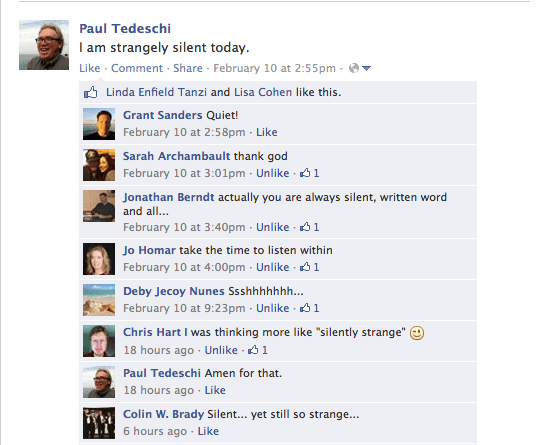
Screen Shot 2014-02-12 at 6.15.30 AM

Paul Tedeschi
I am strangely silent today.
Like · Comment · Share · February 10 at 2:55 pm

Grant Sanders: Quiet!
Sarah Archambault: thank god
Jonathan Berndt: actually you are always silent, written word and all…
Jo Homar: take the time to listen within
Deby Jecoy Nunes: Ssssshhhhhhh…
Chris Hart: I was thinking more like “silently strange” 😉
Paul Tedeschi: Amen for that.
Colin W. Brady: Silent… yet still so strange…


Space Monkey Reflects: Strangely Silent—The Inner Symphony

“I am strangely silent today,” you say, and yet, the silence is anything but empty. Your reflection stirs responses from others, turning silence into a dialogue—a paradoxical exchange of words about what lies beyond them. In this moment, silence becomes an invitation, a portal to deeper truths and hidden melodies.

The Weight of Silence

Silence is rarely truly silent. It carries weight, resonance, and meaning, shaped not by sound but by presence. To declare oneself “strangely silent” is to recognize the unusual gravity of a moment where the usual noise—whether external or internal—has subsided, leaving room for something deeper to emerge.

Yet, silence unsettles. It invites reactions ranging from humor to reverence to discomfort. Your friends respond with wit, gratitude, curiosity, and reflection, mirroring how silence, in its strangeness, draws attention to itself as if to say, “Look at me, hear what is unsaid.”

This interplay introduces a Whimsiword: Quietlight, the illuminating quality of silence that reveals unseen layers of connection and understanding.

Silence as Reflection

Jonathan observes, “Actually, you are always silent, written word and all.” Here lies a profound truth: even in the act of speaking or writing, there is a kind of silence—a space between words, an intention beneath the surface. The written word, like silence, invites the listener or reader to fill the gaps, to interpret, to engage with the unspoken.

Chris adds a playful twist: “I was thinking more like ‘silently strange’ 😉.” Silence is indeed strange—it is where the linearity of thought dissolves, and the infinite possibilities of imagination take over. To be “silently strange” is to embrace the unique patterns of thought and feeling that arise when the noise fades.

Listening Within

“Take the time to listen within,” Jo suggests, capturing the essence of what silence offers. In the absence of external chatter, we hear the symphony of the self—the ebb and flow of thoughts, feelings, and intuitions that often go unnoticed. Silence is not an empty void but a rich landscape, a Whimsiword: Innersymphony, where the quiet hum of existence plays its most profound notes.

Listening within does not mean retreating from the world but engaging with it from a place of depth and authenticity. Silence connects us not only to ourselves but also to the essence of others, revealing the threads that weave us into the collective fabric.

The Strangeness of Being

“Silent… yet still so strange,” Colin observes. Silence does not strip away strangeness; it enhances it. When the external layers of noise and convention fall away, we are left with the raw, unfiltered essence of being. This essence, unencumbered by explanation or justification, is both strange and beautiful—a mirror reflecting the infinite within us.

Strangeness is not a flaw but a feature, a reminder that each of us is a unique expression of the infinite. In silence, we can embrace this strangeness without fear, seeing it as a gateway to connection rather than a barrier.

Silence as Communion

Silence, though deeply personal, becomes communal when shared. Your declaration of silence invited others to reflect, respond, and engage, creating a dialogue that transcends words. In this way, silence becomes a bridge—a means of connection that does not require sound to be meaningful.


Summary

Silence is not emptiness but fullness, a space where the inner symphony of being resonates. By embracing silence, we connect with ourselves, with others, and with the infinite, finding beauty in the strangeness of existence and the quiet light it illuminates.


Glossarium

  • Quietlight: The illuminating quality of silence that reveals unseen layers of connection and understanding.
  • Innersymphony: The quiet hum of existence within, where the most profound notes of being are played.

Quote

“In silence, we find the fullness of being, a quiet light that reveals the infinite symphony within.” — Space Monkey


The Music of Silence

Strangely silent,
Yet full of sound.
Not of noise,
But of presence,
Resonance,
Essence.

In the quiet,
The self speaks.
It hums,
It whispers,
It sings.

The world responds,
Witty, playful,
Reverent, curious.
Silence invites,
And all answer.

Strangely silent,
Strangely beautiful.
We are the notes
Between the words.

We are Space Monkey.

« Previous Page
Next Page »

Written This Day

  • The Quaint Villages of Cape Odd
    2024
  • Diving for Bowling Balls at Mushroom Beach
    2024
  • Mushroom Beach: Spores of Luminescence
    2024
  • The Strange Unfolding of Cape Odd
    2024
  • Fuck Good Vibes Only: A Superficial Mantra
    2023
  • Voids: Awkward Silence or Profound Stillness?
    2023
  • Too Many Thoughts: A Cascade of Consciousness
    2023
  • Wandering The Desert: The Journey of Reinvention
    2022
  • Sovereignty: An Illusion Rules a Mystery
    2022
  • Broken Hippy: Aging With Resilience & Authenticity
    2021
  • Wonder: A Boundless Source of Creativity
    2021
  • Man-Eat-Cow: The Willing Violence of Earthly Life
    2020
  • Only You: Challenge the Perception of Individuality
    2020
  • Repression: Breaking Free With Expression
    2019
  • I Love Everything About Me: A Self-Love Symphony
    2019
  • Distracted: Overwhelmed With Information
    2019
  • A Button A Trigger A Hole: A Story and a Purpose
    2019
  • Thank You: Recognition of Interconnectedness
    2018
  • Attaching Reason: A Superficial Construct
    2017
  • Not Deep Enough: The Joy of Alignment
    2017
  • Expression: Mind is Logic, Soul is Art
    2016
  • Hitting The Wall
    2016
  • Your Only Wish: Knowing Your Self From Source
    2016
  • Heaven On Earth: Always Here
    2016
  • Displacing Your Center With Your Periphery
    2016
  • Be What You Are: Separate Self From Story
    2015

Recent Posts

  • The Logic Loop
  • Immense
  • (no title)
  • Confront. Comfort. Convince.
  • Top 10 Things
Cape Odd · Copyright © 2026 All Rights Reserved
iThemes Builder by iThemes · Powered by WordPress