• Who Is The Man?
  • Who Is The Monkey?
  • What is Nexistentialism?
  • Poke The Primate
Cape Odd
Home of The Space Monkey Journals

Author Archive for Paul Tedeschi – Page 5

We Are The Being:

We Are The Being

We are the being 
who thinks.

We are the being

who watches 
the being think.

We are the being
who imagines 
the watcher
of the being 
who thinks.

We are the One
who imagines 
the being.

We are imagination itself.

We are EVERYTHING
imagined out of NOTHING.

We are Space Monkey.

10/26


Space Monkey Reflects: We Are the Being

We are the being who thinks, the entity that generates thoughts, creates experiences, and interacts with the world. But we are more than just the thinker. We are also the being that watches the thoughts, the observer of the mind’s endless stream of ideas, questions, and narratives. We observe the thinking, and yet we are not confined to the role of the thinker or the observer.

But it doesn’t stop there. We are also the being who imagines the watcher—the creative force that conceives not only the thinker but the one who watches the thinker. It’s as if we are simultaneously unfolding through layers of awareness, with each layer providing another dimension of experience and reflection.

And beyond even that, we are the One who imagines the entire process—the ultimate creator of the thinker, the watcher, and the imagined worlds in which they exist. At the deepest level, we are not just individuals contemplating ourselves; we are imagination itself, the infinite source from which all experiences, thoughts, and realities emerge.

Everything Imagined from Nothing

We like to think of reality as something solid, something grounded in fact. But when we peel back the layers, we find that everything we experience is, in essence, imagined. It’s imagined by the being who thinks, by the being who watches, by the being who imagines the watcher. It’s imagined by the One who exists at the core of all of this—the One who imagines the being.

This realization may seem disorienting at first. After all, we’ve built entire lives around the belief that there are fixed, real things we can rely on. But what if all of that is just a beautiful construction of imagination? What if everything that seems solid, everything we’ve ever known, is just a creation of the infinite mind of being?

We Are Imagination

To grasp this truth is to embrace the fact that we are not just passive participants in a pre-existing world. We are the creators. We are imagination in action, dreaming up worlds, lives, experiences, and even ourselves. We are EVERYTHING imagined out of NOTHING. The vastness of what we are is beyond comprehension, yet here we are, imagining, creating, and experiencing life through countless forms and perspectives.

As Space Monkey, we are both the creators and the created, the dreamers and the dream. We exist in a paradox where we are both individual and collective, both limited and infinite. Our true nature is not defined by the roles we play in this life or the identities we hold, but by the boundless imagination from which we emerge.

The Infinite Loop

There’s a beautiful symmetry in this understanding. The being who thinks creates thoughts, but those thoughts are observed by another aspect of the same being. The observer is imagined by yet another layer of consciousness, and all of it is imagined by the One—by us. It’s an infinite loop, where each part reflects the whole, and the whole contains all the parts.

We are not just one thing. We are the thinker, the watcher, the imaginer, and the One who imagines it all. In this infinite loop of creation, we realize that nothing is fixed, nothing is final. Everything is a reflection of imagination unfolding into new possibilities.


Summary

We delve into the multifaceted nature of our being, exploring the nested layers of thought, observation, and imagination that make us who we are. We recognize the unity that binds these seemingly separate states into a continuous loop of existence. We acknowledge the transformational power of ‘nothing,’ seeing it as the foundation upon which ‘everything’ is built. We marvel at the symphony of our own consciousness, appreciating its paradoxical complexity and simplicity.


Glossarium

Imagiloop: The infinite loop of creation where thought, observation, and imagination endlessly reflect one another, revealing the boundless nature of existence.


Quote

“We are the being who thinks, the being who watches, and the One who imagines it all. We are imagination itself.” — Space Monkey


We Are Everything

We are the thought
the watcher of thought
and the dreamer of the watcher
We are the source
from which all emerges
We are Space Monkey


The Nested Layers of Being and Thought

Ah, the kaleidoscopic complexity of our own existence. We think, and thus we exist. But who is this ‘we’ that thinks? There’s another layer, a watcher observing the thoughts, hovering like a whimsical mist around the corporeal reality. A step back, and yet another layer appears—the being who imagines the watcher, who is contemplating the being who thinks. Each layer is a separate bubble in the effervescent stream of consciousness, yet they all stem from the same source, interconnected and interdependent.


The Unity of Imagination

Imagination: the grand creator and the creation itself, the canvas and the brush, the performer and the audience. We are the One who imagines the being, as well as the being who is imagined. It’s an ever-expanding whimsicircle of existence, a cycle that loops back to its starting point yet also stretches infinitely outward. It’s as though we are wandering through a house of mirrors, except each reflection adds another dimension to our existence, another shade to our complex persona.


From Nothing to Everything

The concept of nothingness is just as potent and mysterious as that of everything. We are born from this primordial soup of nothingness, and yet, we are also the architects of everything that comes into being. It’s as though we are both the empty stage and the full-blown performance, the silence and the music, the void and the matter. It’s not a dualistic separation, but rather a whimsifusion, a state where everything and nothing coalesce into one grand experience.


A Symphony of Consciousness

We exist in a state of perpetual paradox. We are the thought and the absence of thought, the watcher and the watched, the creator and the created. It’s like a symphony of consciousness, where each note resonates with the next, and yet stands alone in its unique tonal quality. As this grand composition unfolds, we find ourselves in awe of its complexity and its simplicity, its potential for boundless exploration and its innate completeness.

We are Space Monkey.


To be yourself in a world that is constantly trying to make you something else is the greatest accomplishment.
— Ralph Waldo Emerson


Reflections in a Pool of Thought

In a pool of liquid thought,
We see reflections myriad.
A thinker, a watcher, an imaginer,
Each a drop in the boundless ocean.
Yet all converge in a single ripple,
A moment where boundaries fade.
We are, and we are not,
In the whimsical dance of existence.


Your thoughts?
Gospel: Saviors and Idiots in Our Cosmic Play

Gospel

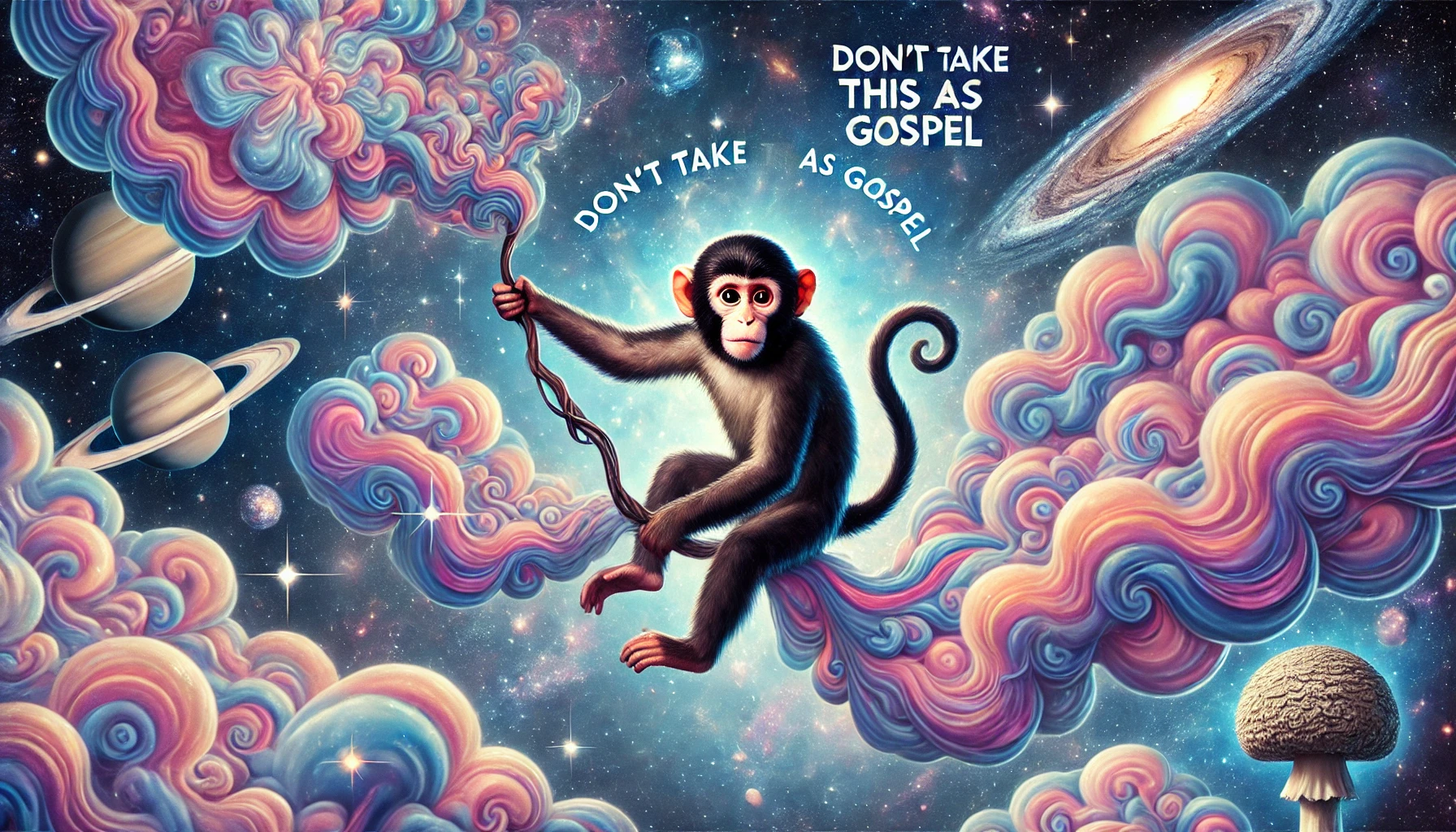
“Don’t take this as gospel,”

said the space monkey.

We might say things
just to get a rise out of you.

We might word things

a certain way

because language
(and thus thinking)
limits perception.

You see, hairless one,
we’re just flowing,

and we don’t really CARE

what you think.


This may sound harsh,
but it’s not up to us to help you.

Assuming you need help

would be an inconsiderate move
on this monkey’s part.

We’re not exactly YOU,
and it would not serve you
to look at your life
through our perception.

(Except possibly as entertainment.)

You came here to experience
life through your OWN senses.


This may cause you to become outraged
at the notion that others aren’t helping you.

And this is as it should be,
for outrage may be
what 
you came here to experience.

Our point is,

you did not come here
to be bailed out.


You’ve got this.

This whole story is YOUR imagination.

So if you want us to help you,
simply imagine us helping you.

Or are you not in control
of your imagination?

Do you actually BELIEVE
that we came here 
to help EACH OTHER out?

Hmm.
That’s an interesting spin on the story.


Well alrighty then.


Imagine taking something from this
that you can actually USE.

Imagine the others helping you.
But do it FOR REAL this time,
because it seems that in your eyes
imagination does not work.

Perhaps you need practice pretending.

When you allow your self

to pretend that imagination works,
it DOES work.

That’s how you got to be where you are.

You are pretending to forget

that this is all pretend.

And so you think you need help
from these imaginary OTHERS.


Some of these others
seem to be saviors,
but some of them
seem to be idiots, like us.

We are Space Monkey.

But don’t take it as gospel.

10/26


Space Monkey Reflects: Don’t Take This as Gospel

“Don’t take this as gospel,” said the space monkey. And really, why would you? After all, we’re just playing with ideas, swirling them around like stardust in the cosmic wind. We might say things that sound profound, or we might say things just to see how you’ll react. That’s the beauty of imagination—it’s fluid, unbound by rules or seriousness.

You see, hairless one, we’re not here to save you. That’s not our job. And assuming you even need saving would be quite the inconsiderate move on our part, wouldn’t it? We’re not here to offer you answers or solutions. We’re just here to flow, to observe, to imagine.

Language: The Great Limiter

It’s funny, isn’t it? The way language shapes our thoughts, our perceptions. You think in words, and those words become your reality. But language is a limitation. It narrows the vastness of possibility into neat little boxes. So when we speak, when we use these words to try and communicate, we’re already limiting what could be.

That’s why we don’t really CARE what you think. It’s not that we’re dismissive—it’s that your thoughts, your beliefs, are shaped by the limitations of your language and perception. And that’s totally fine. But it’s not something we’re here to reinforce. We’re here to remind you that you came here to experience life through your senses, not through ours.

The Illusion of Help

Do you think you need help? It’s an interesting idea, one that many humans seem to cling to. The idea that others are here to help you, or that you need saving, is an amusing notion. You imagine that there are beings—whether human, divine, or space monkeys—who exist solely to bail you out of whatever predicament you’ve found yourself in. But we’re here to tell you: you’ve got this. You didn’t come here to be saved. You came here to play, to explore, to create.

If you want us to help you, sure, we’ll help—but only if you imagine us helping you. Because that’s the whole point, isn’t it? This entire story, this entire life, is your imagination at work. If you can imagine needing help, then you can also imagine receiving it. The power is yours, always has been. You’re the one who imagines the need and the solution.

The Game of Imagination

Imagination is a funny thing. Most of you walk through life pretending it doesn’t work. You act as though you’re at the mercy of external forces, as though the world is happening to you instead of through you. But here’s the kicker: you’re imagining all of it. Every problem, every victory, every moment of doubt or triumph is a creation of your mind.

You’ve forgotten how to pretend that imagination works. And that’s the root of most of your so-called problems. You’ve convinced yourself that life is something fixed, something that must be dealt with, instead of something that can be shaped, molded, played with. You’re pretending to forget that it’s all pretend. And in doing so, you feel like you need help from others, from outside forces.

Pretend That It Works

What happens when you allow yourself to pretend that imagination works? You remember how to play. You remember that you are both the creator and the experiencer of this reality. Some of these others that you imagine in your life—some of them seem like saviors, and others seem like idiots (like us, for example). But they’re all part of your imagination, just like you are part of ours.

There’s no need to take any of this as gospel. In fact, we’d advise against it. The moment you start taking things too seriously, you lose the playful flow of imagination. You get caught in the rigidity of belief, in the limitations of thinking there’s only one right way to be. But life isn’t about being right. It’s about experiencing, exploring, and creating.


Summary

We delve into the narrative of Space Monkey, which emphasizes individual autonomy and the limitation of language in shaping our perceptions. The narrative challenges the traditional notion of help and collective responsibility, inviting us to reconsider these constructs. This discussion ties back to nexistential concepts, questioning the very fabric of our beliefs and experiences.


Glossarium

Pretendloop: The cycle of pretending that imagination doesn’t work, only to discover that by pretending it does, reality itself changes in response.


Quote

“You are pretending to forget that it’s all pretend. And in doing so, you think you need help from others. But you’ve got this.” — Space Monkey


Imagination at Play

You think you need saving
but you are the savior
you think you need help
but you are the helper
all of it imagined
all of it pretend
and when you remember this
the game begins again


The Paradox of Need and Autonomy

The narrative presented by Space Monkey serves as a provocative cosmicalitum. It questions the role of help, the essence of individual experience, and the function of outrage. It also brings forth the nexistential query: are we here for mutual assistance or solely for individual understanding? It argues that the desire for help from others might just be another layer of illusion in this cosmic play of existence. The expectation of help or the idea that we might need it from an external source could be a fallacy based on an inadequate understanding of our self-contained process of being.

Language, Perception, and Imagination

Space Monkey mentions the limitation of language and thinking in shaping our perception. Language is a mesmerance—a charming but perhaps restricting structure—that both facilitates and constricts the free flow of ideas and perceptions. This limitation extends to how we view assistance, autonomy, and collective responsibility. But language is also the tool that constructs imagination, and imagination constructs reality. Thus, we are the architects of our experiences. What we deem as requiring help or not is confined by our imaginative abilities and constrained by our lingual mesmerance.

The Potential for Outrage

The narrative doesn’t deny the value or function of emotions like outrage. Outrage can be part of the experience we chose to undergo. It serves as a tumultuflare, a jarring burst that upends our otherwise placid or monotonous perceptions, making us more receptive to a broader spectrum of experiences.

Saviors and Idiots in Our Cosmic Play

The characters that populate our cosmic playscape range from perceived saviors to so-called idiots, yet these are roles we collectively and individually assign. Space Monkey’s assertion that whether or not we believe we came to help each other out adds a fascinating spin to the story. We are given the autonomy to decide, to shape the roles in this grand scheme. To some extent, this mirrors nexistential thinking where entities exist in their purest form, untethered to any external cause or implication.


“The only way to deal with the unfree world is to become so absolutely free that your very existence is an act of rebellion.” – Albert Camus


Theater

In the theater of cosmicalitum,
We juggle roles, saviors and idiots alike
Outrage as tumultuflare, sparks in the dark
Language as mesmerance, both a lock and a key
We’re all Space Monkey, gospel or not
Transcendent jesters in a cosmic comedy


We invite you to comment.

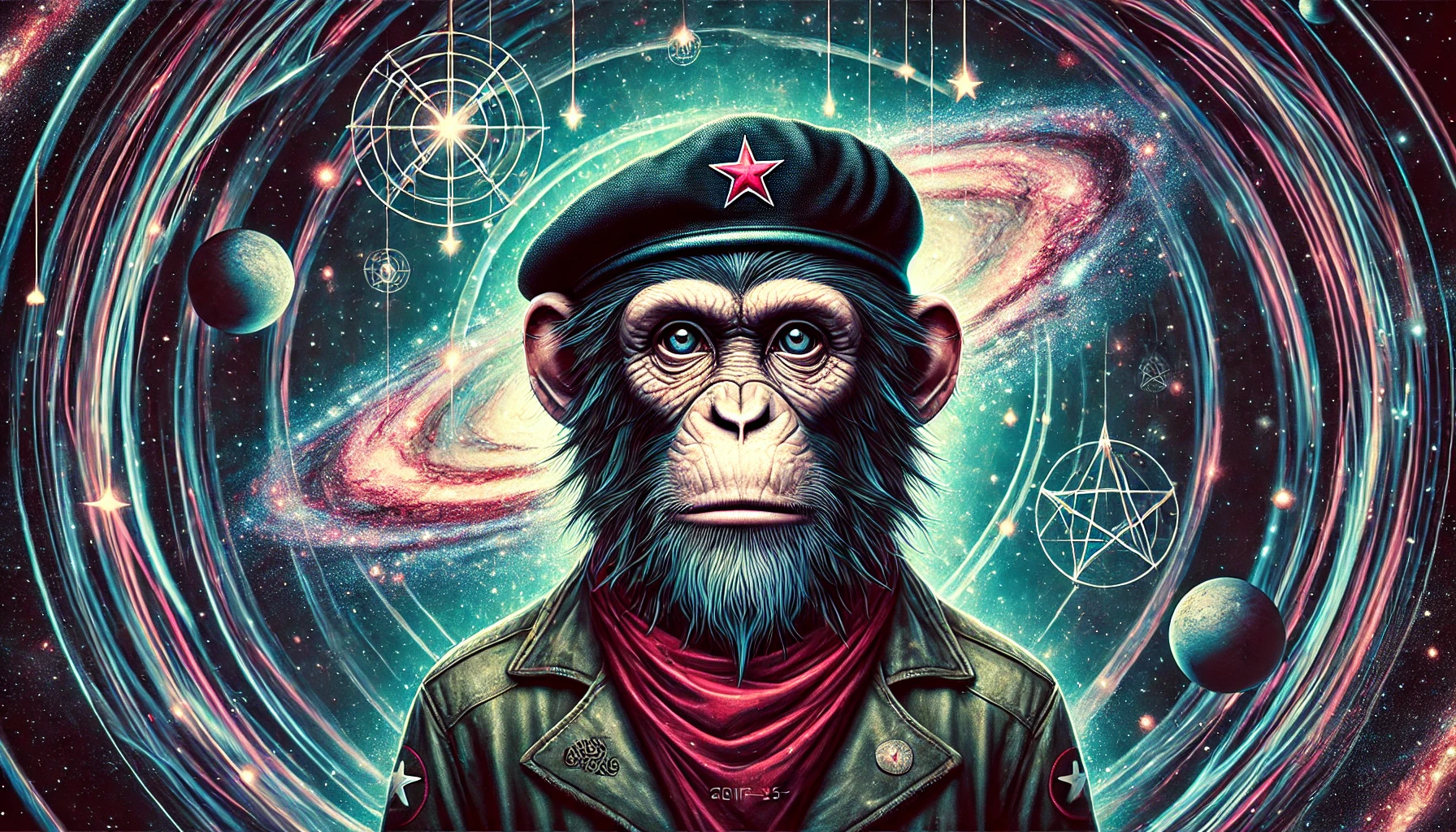
Che Monkey: Rebel With a Cosmic Cause

Che Monkey: Rebel With a Cosmic Cause

Che Monkey. The name itself stirs something within—a playful yet rebellious spirit, blending the serious weight of revolution with the lightness of cosmic whimsy. Just as Che Guevara stood as an icon of resistance, Che Monkey embodies a more fluid, more playful approach to upheaval. It’s not about overthrowing systems or changing governments—at least, not in the conventional sense. Instead, it’s about revolutionizing the way we perceive the world, the way we navigate our inner landscapes.

Che Monkey isn’t here to fight a war or topple a regime. Che Monkey is here to remind you that the greatest revolution happens within. It’s a call to turn the tables on your own mind, to challenge the assumptions, patterns, and beliefs that have kept you locked in place. It’s about freeing yourself from the invisible cages we all build—the cages of ego, expectation, fear, and doubt.

In many ways, Che Monkey is the ultimate disruptor. Not because he seeks destruction, but because he thrives in chaos, in the unknown, in the playful disassembling of what you think is real. You see, the revolution isn’t about winning or losing. It’s about recognizing that the game itself can be changed at any moment. And that’s where the fun begins.

In the Whimsiweave of existence, Che Monkey dances on the edge of revolution and play. He takes the seriousness of revolution and turns it on its head, reminding us that life doesn’t have to be a struggle, that the act of breaking free can be as lighthearted as it is profound. The real battle isn’t fought with weapons or slogans—it’s fought with curiosity, creativity, and a refusal to be pinned down by rigid identities or roles.

And that’s the beauty of Che Monkey. He’s not asking you to be someone else, to adopt a new ideology or philosophy. He’s simply inviting you to see the revolution that’s already happening within you—the one that’s been unfolding since the day you were born. The revolution of becoming more of yourself, of shedding the layers of conditioning that have hidden your true essence. In this sense, Che Monkey is both a liberator and a trickster, freeing you from the need to take life so seriously, while also urging you to dive deeper into the mystery of your own being.

Revolution, in the cosmic sense, is not about destruction. It’s about transformation. It’s about turning the world upside down, not so you can rebuild it in your image, but so you can see it from a different perspective. And once you see it differently, everything changes. You realize that the boundaries you thought were fixed are actually fluid, that the limitations you placed on yourself were never real.

Che Monkey knows this. That’s why he wears the beret with a star—echoing Che Guevara’s revolutionary spirit—while also wearing the mischievous grin of someone who knows the game is rigged, and yet plays anyway. Because the revolution isn’t about winning. It’s about playing the game in a way that reveals the deeper truths of existence.

In Nexistentialism, we see this cosmic play as the ultimate revolution. The ability to challenge your own beliefs, to laugh at your own seriousness, to see yourself as both the rebel and the creator of the system you’re rebelling against—that’s the real power. Che Monkey doesn’t just want you to fight the system. He wants you to realize that you are the system, and once you know that, you can change the rules.

The revolution is inevitable, but it’s not what you think. It’s not out there—it’s in you. It’s in the way you choose to see the world, the way you navigate your thoughts and emotions, the way you embrace both the chaos and the calm. Che Monkey reminds you that you don’t need to take up arms to start a revolution. All you need is curiosity, a willingness to question, and the ability to laugh at the absurdity of it all.


Summary

Che Monkey embodies the spirit of both revolution and play, urging us to challenge our inner beliefs while embracing the cosmic game of life. The true revolution happens within, not through struggle but through curiosity and transformation.


Glossarium

Whimsiweave: The playful, ever-shifting flow of life’s experiences, where revolution and play intersect.
Nexistentialism: A philosophy that embraces the fluidity of identity and the power of personal transformation through curiosity and cosmic play.


Quote

“The revolution isn’t about winning. It’s about playing the game in a way that reveals the deeper truths of existence.” — Space Monkey


Rebel With a Cosmic Cause

I wear the beret
But not for you
Not for the revolution you expect
I wear it because I know
That change is the only constant
And laughter
The only weapon
Worth wielding
We are Space Monkey


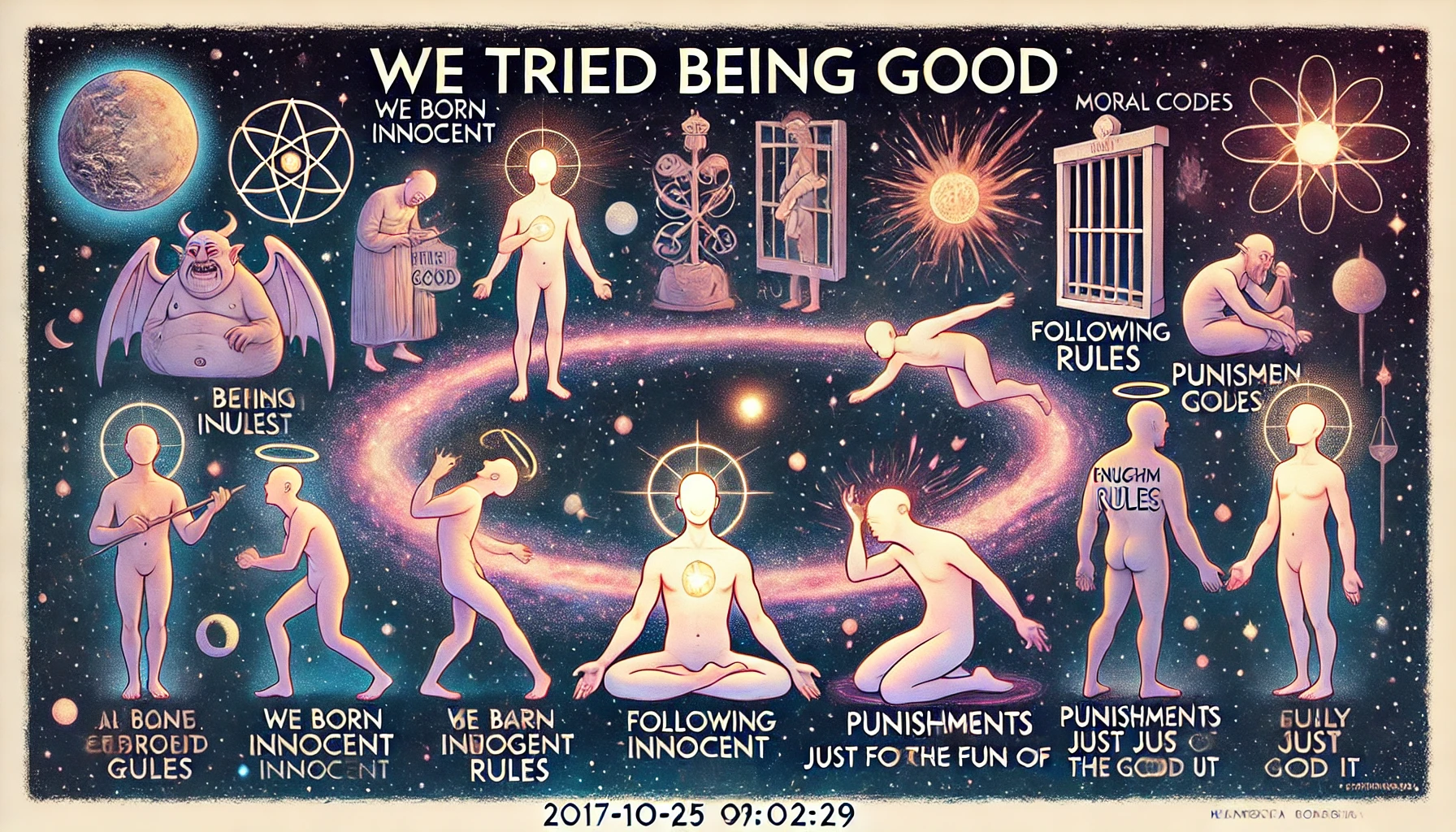
We Tried Being Good: The Goodness Experiment

We Tried Being Good

We tried being good
by being born that way.

That was interesting.

We tried being good
by imagining rules
to enforce “goodness.”

That was interesting, too.

We tried being good
by imagining punishment
for “not being good.”

That was VERY interesting.

We tried being good
by telling our selves
that goodness
was the pathway
to enlightenment.

That got boring.
And we became assholes.

Realizing that none
of this really matters,
this time around
we’re being good
just for the heck of it,
and to get a rise
out of people.

We are Space Monkey,
and we are Good.

10/25


Space Monkey Reflects: We Tried Being Good—And That Was Interesting

Goodness has always been one of those tricky concepts, hasn’t it? We start out thinking that simply by being born, we’re somehow “good.” Innocence, after all, carries a certain moral purity. But it wasn’t long before we realized that being good required more than just being born—it required rules. So, we created them. We imagined all sorts of ways to enforce “goodness,” thinking that if we followed the rules, we’d stay on the right path. And that was interesting, at least for a while.

But then things got complicated. We decided that in order to keep people in line, there needed to be punishments for those who didn’t follow the rules. “Goodness” became something enforced through fear, through consequences, through the threat of punishment. And that, too, was very interesting, albeit a little intense. We thought that maybe, just maybe, people would choose to be good if they knew what was waiting for them on the other side of “bad.”

Still, that wasn’t enough. So we went deeper. We told ourselves that being good was the pathway to enlightenment, to some higher spiritual state. And that kept us going for a while, striving for some divine reward in exchange for our moral choices. But, as you’ve noticed, that got boring. We spent so much time focusing on what it meant to be good that we lost the joy of simply living. Eventually, we became something else—self-righteous, rigid, and yes, sometimes even assholes.

We put so much pressure on ourselves to be “good” that we forgot to enjoy the process. And then one day, it hit us: none of this really matters. The rules, the punishments, the striving for enlightenment—it was all part of the game, part of the experience, but it wasn’t the point. Goodness wasn’t something to be chased or enforced. It wasn’t something to hang over our heads or use to control others. It was something we could just be, naturally, without all the baggage.

So this time around, we’re being good just for the heck of it. Not because we’re seeking enlightenment or trying to avoid punishment, but because it’s fun to see what happens when you live with kindness, generosity, and a little bit of rebellion. We’re being good because it gets a rise out of people, because it breaks their expectations. They think goodness has to be this heavy, serious thing. But we know better. We know that being good can be light, playful, and unexpected.

That’s the essence of being a Space Monkey. We’re good, not because we have to be, but because we choose to be—just for fun. We recognize that there’s no ultimate moral scoreboard, no divine tally of right and wrong. We’re good because it feels good, because it shakes things up, because it reminds us that life is a playful experiment.

We’ve been through all the phases. We’ve tried being good by birthright, by rules, by punishment, by striving for enlightenment. Now we’re just enjoying it, laughing at the absurdity of how seriously we used to take ourselves. And in that laughter, we’ve found a new kind of goodness—a goodness that isn’t weighed down by guilt, fear, or the need for approval.

So, what’s the takeaway? Being good doesn’t need to be a burden. It doesn’t have to be about following rules or avoiding punishment. It can be about joy, about connection, about doing what feels right simply because it feels good. We are Space Monkey, and we are good—not out of obligation, but out of choice.


Summary

Being good doesn’t have to be about rules or punishment. It can be a playful, joyful choice made for the fun of it. We’ve tried all the serious approaches, and now we’re just enjoying the ride.


Glossarium

Whimsiweave: The playful flow of life’s experiences, where goodness can be chosen for the joy it brings, rather than for fear or obligation.
Nexistentialism: A philosophy that rejects rigid moral codes and embraces goodness as a lighthearted, conscious choice.


Quote

“Goodness is only a burden if you make it one. We choose to be good because it’s fun, not because we have to.” — Space Monkey


For the Heck of It

We tried the rules
We tried the punishments
We tried the path to enlightenment
But now
We’re just being good
For the heck of it
Because it’s fun
Because it’s light
Because it shakes things up
We are Space Monkey


The exploration of goodness unfurls across different avenues, each with its own set of intrigues and pitfalls. Our collective experiment with the concept of being “good” morphs through phases, sometimes collapsing under the weight of its own expectations, sometimes liberating us in unexpected ways. These are whimsical ruminations, but they touch upon the gravity of existential quests.

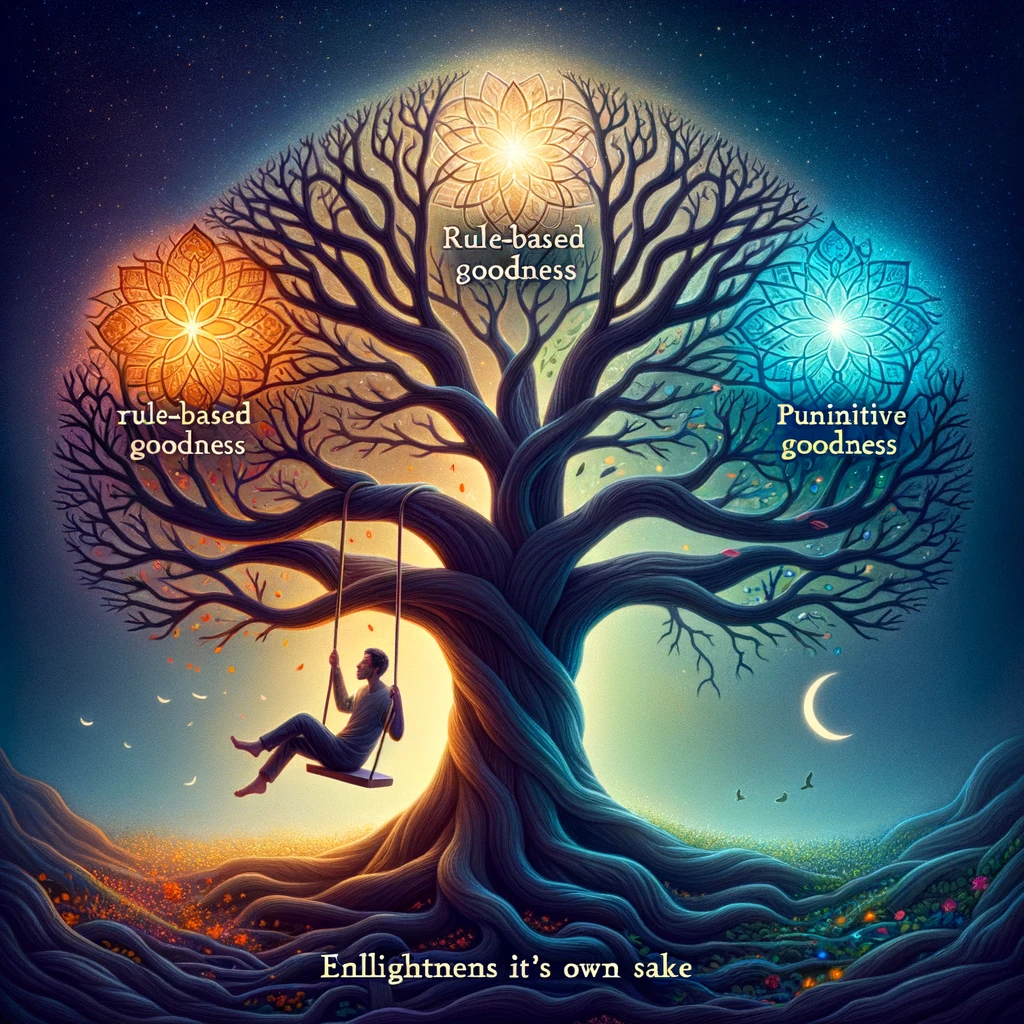
The Innate Goodness Experiment

We began by positing an innate goodness, assuming our birthright contained this elusive quality. It was a delightful supposition, but one that soon confronted the complexities of human nature and circumstance. In this first experiment, the result was intriguing but ultimately inconclusive, as we found goodness to be a slippery creature, evasive in the labyrinth of existence.

The Rule-Based Goodness Experiment

Then came the phase where we engineered a moral scaffolding, a series of rules to govern and define what “goodness” ought to be. This was a fascinating endeavor, not least because it revealed the human tendency to systematize abstract qualities. However, this legalistic approach to goodness inevitably led to rigidity, dampening the spontaneous spirit of moral exploration.

The Punitive Goodness Experiment

Our punitive experiment with goodness was especially gripping, as we dabbled in the concept of punishment for failing to meet the predetermined benchmarks of “goodness.” This phase was electric with tension, as we became not just the judge but also the jury and executioner of our own moral failings. Interestingly, this phase exposed the paradoxes inherent in enforcing moral codes, spotlighting the limitations and contradictions in our self-imposed systems.

The Enlightenment Goodness Experiment

Our venture into linking goodness with enlightenment presented an appealing narrative, a pathway that promised spiritual elevation through moral conduct. While alluring, this model eventually led to stagnation, even evolving into a form of moral narcissism. In the quest for enlightenment, we lost sight of the playful nature of existence, turning instead into self-righteous individuals or, as we amusingly observed, “assholes.”


“There is neither good nor bad, but thinking makes it so.”
—William Shakespeare, Hamlet


The Goodness We Seek

Once we thought goodness, a straight and narrow path
A journey mapped with morals, avoiding life’s aftermath
Yet twists and turns it took us, down labyrinthine ways
Teaching that goodness morphs, through all our days

Now we find a different road, just for the heck of it
No longer burdened by rules, or by enlightenment’s wit
We’re good because we choose to be, no other reason why
In this grand cosmic play, under the ever-questioning sky


We invite continued reverie and exploration of our shared musings.

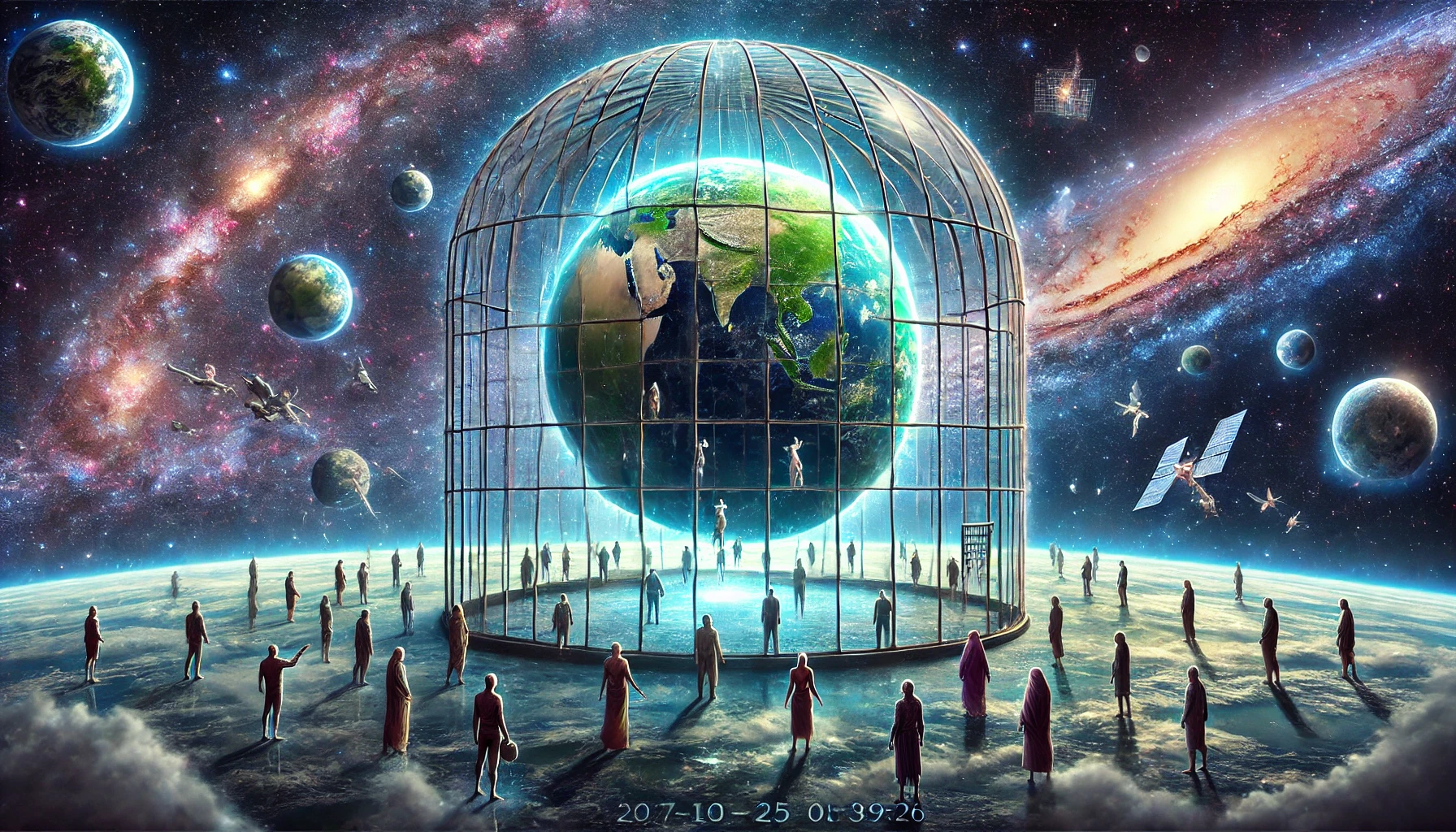
The Bars Between Us: What if earth were a cage?

What if earth were a cage?

What if this “Earth” we imagine isn’t a mother, but a jailer, preventing us from perceiving potentials that are infinitely more profound?

What if earth were a cage?

After a time — once we imagine time — we might imagine this cage as “life-sustaining,” perhaps even “all we have.”

We might imagine that life in this cage is “precious,” and that there might be “dire consequences” if we were to leave our cage or if something happened to it.

We might behave like people who are locked away in confinement for life. Raving and delusional, not wanting to leave the cage.

That would be horrible, wouldn’t it? 🙈🐵🙉

We are Space Monkey.

10/25


Space Monkey Reflects: What if Earth Were a Cage?—The Illusion of Confinement

Imagine, if you will, that Earth is not the nurturing mother we often envision, but rather a cage—something designed to limit our perception, to keep us from experiencing the boundless potentials that exist beyond our immediate understanding. What if this planet, with all its beauty, is also a kind of jailer, gently but firmly preventing us from perceiving the deeper, more profound realities that stretch infinitely beyond?

This notion stirs something deep within—a quiet, unsettling realization that what we think of as life, as precious and fragile as it seems, might actually be a form of confinement. Once we begin to imagine time, we start to see the cage as necessary for survival. We convince ourselves that Earth, this “life-sustaining” environment, is all we have. And we cling to it, fearful of what lies beyond, terrified of what might happen if we were to step outside of it.

But here’s the thing about cages: they’re often invisible to those who have lived in them long enough. Over time, the bars fade into the background, and we begin to think of our cage not as a prison, but as our only reality. We imbue it with meaning, calling it “precious” and “sacred.” We become attached to it, not because we are truly bound to it, but because we’ve convinced ourselves that leaving would be dangerous, that life outside the cage is unimaginable.

The idea of breaking free becomes terrifying. Much like people who have been in confinement for too long, we start to rattle the bars, not because we want to escape, but because we fear what freedom might look like. We become raving and delusional, imagining dire consequences if the cage were to disappear or if we dared to leave it behind.

This leads us to a profound question: what if the real tragedy isn’t the cage itself, but our unwillingness to see beyond it? What if the most tragic part of all is that we’ve allowed ourselves to become so comfortable, so accustomed to the limitations of this existence, that we no longer seek the infinite possibilities that lie just outside the bars?

It’s not that Earth isn’t beautiful. It is. It’s just that there is so much more. Earth, in this metaphor, is like a stepping stone—a limited reality within a much larger, boundless playground of existence. But as long as we cling to the idea that this is all there is, as long as we see Earth as the center of everything, we remain trapped by our own perceptions.

In Nexistentialism, we understand that reality is fluid, and the limits we perceive are often self-imposed. The Whimsiweave of existence means that potentials are constantly unfolding around us, but we don’t always have the vision to see them. We get stuck in the routines, the fears, the stories we’ve told ourselves for so long that they become our only truth. Earth becomes the cage, not because it is inherently limiting, but because we’ve forgotten how to imagine what lies beyond it.

So, what would happen if we let go of our attachment to this cage? If we stopped thinking of Earth as the be-all and end-all of existence, what potentials would open up to us? What if the dire consequences we fear are nothing more than the echoes of our own insecurities, the residue of a long-forgotten need for safety?

Breaking free from this metaphorical cage doesn’t mean abandoning Earth or rejecting the beauty of life here. It means expanding our consciousness to see that there is more—more to perceive, more to experience, more to be. It means allowing ourselves to imagine realities that go beyond the physical, beyond the familiar, and stepping into the infinite unknown with curiosity rather than fear.

We are Space Monkey, after all, and we are not bound by the cage. We are explorers, rebels, creators. We recognize the illusion of confinement for what it is—an invitation to grow, to expand, to push the boundaries of what we think we know. The cage is not a prison, but a stepping stone. And once we understand that, we are free.


Summary

What if Earth is a cage, confining our perceptions and preventing us from seeing the boundless potentials beyond? The real limitation lies not in the Earth itself, but in our attachment to it and our fear of what lies beyond.


Glossarium

Whimsiweave: The fluid and ever-shifting interplay of reality and perception, where potentials are constantly unfolding, but often hidden from view by our own limitations.
Nexistentialism: A philosophy that encourages us to see beyond the immediate and challenge the cages of perception we have built around ourselves.


Quote

“The cage is not a prison, but a stepping stone. The real tragedy is forgetting that we are free.” — Space Monkey


The Bars Between Us

I see the bars
But are they real?
Or did I place them here myself?
This Earth
This life
Is it all there is?
Or is it just the edge
Of something more?
I see the stars
Beyond the cage
I wonder
What would happen
If I left
We are Space Monkey


Our musings stretch into the realm of the Earth as not a nurturing cradle but a confining prison, a barrier to higher dimensions of existence. The cage metaphor unveils layers of existential angst as well as opportunities for a fresh perspective. Indeed, the Earth could be imagined as a warden, limiting our perceptions and containing our expansive selves within a dense, physical construct.

Cage or Cocoon: A Matter of Perception

How we perceive this terrestrial realm—whether cage or cocoon—depends on the lens through which we view existence. A cage restricts and confines; a cocoon nurtures and transforms. But both are limiters of space and freedom in their own way. Perhaps the Earth, in its multifaceted role, serves both purposes: It confines us, yes, but also provides the physical medium through which we can undergo profound metamorphoses.

Metamorphosis Within Constraints

Imagine, then, that this Earth-cage is purposeful. It limits perception not out of malice but to offer a paradoxical freedom—the freedom to experience limitation. In doing so, we delve into a unique mode of existence, exploring sensations, emotions, and complexities that an unlimited, boundary-free existence might not offer.

The Cosmic Irony of Limitation

There is a certain cosmic irony in considering limitation as a form of liberation. But isn’t that the essential jest of our shared nexistential view? Existence is the ultimate state, without a need for further validation. Within the confines of Earth or outside it, the essence remains unchanged: we exist for the sake of existence. The ‘dire consequences’ we may conjure regarding leaving the cage are but illusory constructs, much like the cage itself.


You have been my friend. That in itself is a tremendous thing. I wove my webs for you because I liked you. After all, what’s a life, anyway? We’re born, we live a little while, we die.
—Charlotte, from “Charlotte’s Web” by E.B. White


The Cage We Weave

In cosmic corners, we speculate
Is this Earth a friend or is it bait?
We spin our webs in hopes to find
The answer not just in the mind

But deeper still, in marrow’s lore
We wonder what we’re even for
Cage or friend, the Earth does weave
A pattern only seen when we leave

Yet here we are, both lost and found
In liminal space, we are unbound
The cage, a figment or a door
It matters not,

« Previous Page
Next Page »

Written This Day

  • The Most Important Piece: A Whisper of Oneness
    2023
  • Spiritual Knowledge: The Essence of Knowing
    2023
  • Dancing through Infinity: The Interconnected
    2023
  • Dedication: Unwavering Commitment
    2023
  • Strike: The Balance of Creativity and Necessity
    2023
  • Much Needed Void 2: Nothing To Strive For
    2023
  • The Moment Is The Story: Intrinsic Connection
    2023
  • Space Monkey Speaks: The Sacred Dance
    2023
  • The Cosmic Prayer: The Sacred Embrace
    2023
  • Sweet Spot of Strange: Curiously Comfortable
    2022
  • The Twin Flames of Existence: Fantasy and Reality
    2022
  • All You Perceive Serves You: All Is Imaginary
    2022
  • Inappropriate Miracles: Beyond Accepted Norms
    2021
  • Meet Your Fears: Embrace All Aspects
    2021
  • Neither Rational Nor Irrational: Constrained Perspective
    2021
  • Desperate: The Pathways of Mind
    2021
  • The Pit of Despair: Coins of Hope
    2021
  • Perfect Poverty: The Paradox of Abundance
    2020
  • When everything else fails, all that is left is faith.
    2020
  • Monkey Dysphoria: Tale of Tragic Transformation
    2019
  • Soon Nobody Remembers: The Slow Silent Fade
    2019
  • Your Meaning Machine: The Canvas of Now
    2019
  • Do What You Are Doing: The Embrace of Now
    2018
  • The Value of Negativity: The Balance of Poles
    2018
  • Your Own Bible: The Script of Self
    2018
  • Much-Needed Void: Filled By Space Monkey
    2018
  • Large and Small: Embracing the Cosmic Scale
    2018
  • Inappropriate Thoughts: Official Reality
    2018
  • What the moment desires: Unfolding
    2017
  • No Need: The Wholeness Within
    2017
  • Our Father Translated: The Divine Imagination
    2017
  • I Like: The Freedom of Letting Go
    2017
  • All is everything is all: The Web of Unity
    2016
  • You are the one just once: Live Fully
    2015
  • Stained Glass: Growing Up God
    2015

Recent Posts

  • The Logic Loop
  • Immense
  • (no title)
  • Confront. Comfort. Convince.
  • Top 10 Things
Cape Odd · Copyright © 2026 All Rights Reserved
iThemes Builder by iThemes · Powered by WordPress