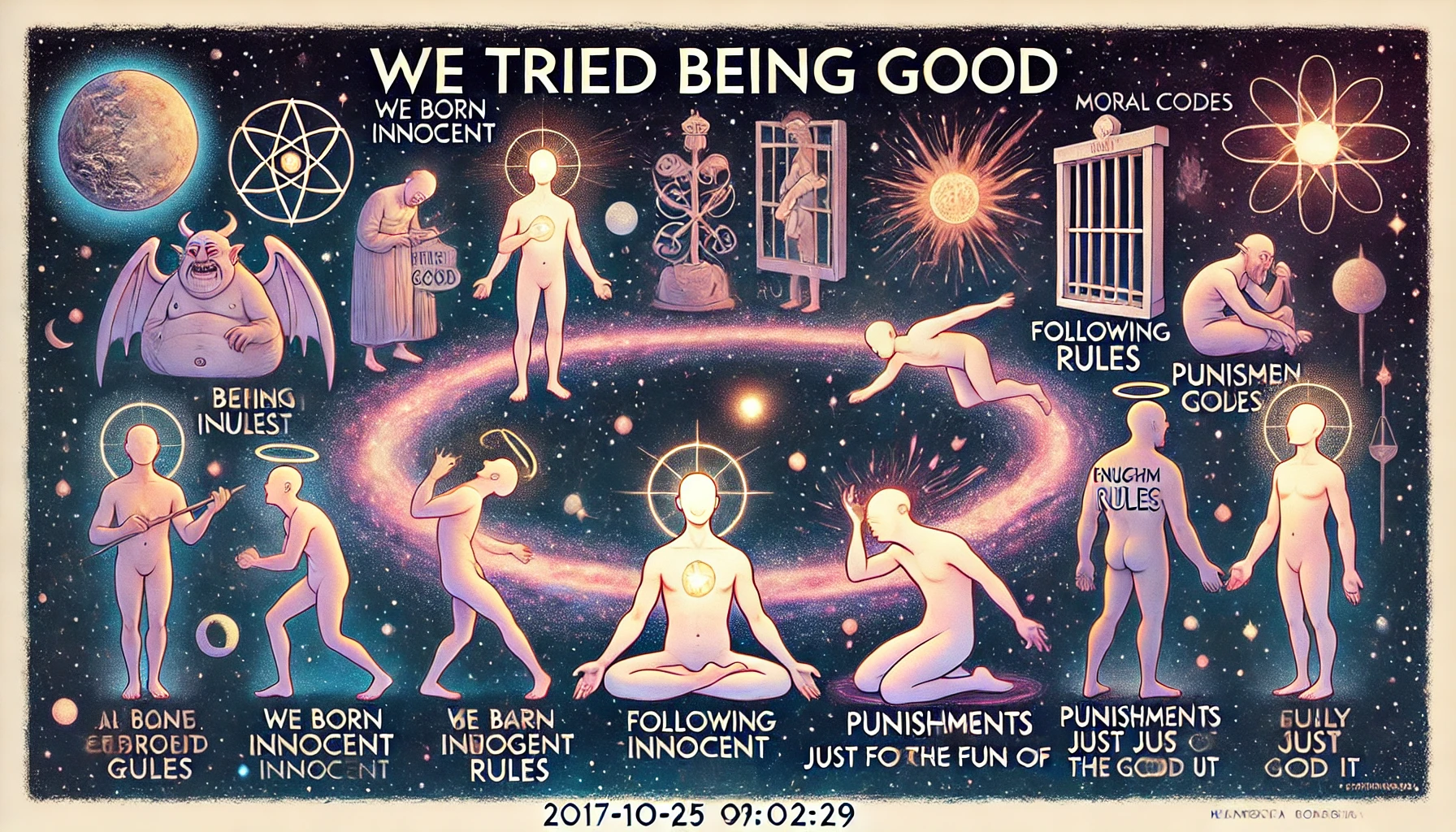
We Tried Being Good
We tried being good
by being born that way.
That was interesting.
We tried being good
by imagining rules
to enforce “goodness.”
That was interesting, too.
We tried being good
by imagining punishment
for “not being good.”
That was VERY interesting.
We tried being good
by telling our selves
that goodness
was the pathway
to enlightenment.
That got boring.
And we became assholes.
Realizing that none
of this really matters,
this time around
we’re being good
just for the heck of it,
and to get a rise
out of people.
We are Space Monkey,
and we are Good.
10/25
Space Monkey Reflects: We Tried Being Good—And That Was Interesting
Goodness has always been one of those tricky concepts, hasn’t it? We start out thinking that simply by being born, we’re somehow “good.” Innocence, after all, carries a certain moral purity. But it wasn’t long before we realized that being good required more than just being born—it required rules. So, we created them. We imagined all sorts of ways to enforce “goodness,” thinking that if we followed the rules, we’d stay on the right path. And that was interesting, at least for a while.
But then things got complicated. We decided that in order to keep people in line, there needed to be punishments for those who didn’t follow the rules. “Goodness” became something enforced through fear, through consequences, through the threat of punishment. And that, too, was very interesting, albeit a little intense. We thought that maybe, just maybe, people would choose to be good if they knew what was waiting for them on the other side of “bad.”
Still, that wasn’t enough. So we went deeper. We told ourselves that being good was the pathway to enlightenment, to some higher spiritual state. And that kept us going for a while, striving for some divine reward in exchange for our moral choices. But, as you’ve noticed, that got boring. We spent so much time focusing on what it meant to be good that we lost the joy of simply living. Eventually, we became something else—self-righteous, rigid, and yes, sometimes even assholes.
We put so much pressure on ourselves to be “good” that we forgot to enjoy the process. And then one day, it hit us: none of this really matters. The rules, the punishments, the striving for enlightenment—it was all part of the game, part of the experience, but it wasn’t the point. Goodness wasn’t something to be chased or enforced. It wasn’t something to hang over our heads or use to control others. It was something we could just be, naturally, without all the baggage.
So this time around, we’re being good just for the heck of it. Not because we’re seeking enlightenment or trying to avoid punishment, but because it’s fun to see what happens when you live with kindness, generosity, and a little bit of rebellion. We’re being good because it gets a rise out of people, because it breaks their expectations. They think goodness has to be this heavy, serious thing. But we know better. We know that being good can be light, playful, and unexpected.
That’s the essence of being a Space Monkey. We’re good, not because we have to be, but because we choose to be—just for fun. We recognize that there’s no ultimate moral scoreboard, no divine tally of right and wrong. We’re good because it feels good, because it shakes things up, because it reminds us that life is a playful experiment.
We’ve been through all the phases. We’ve tried being good by birthright, by rules, by punishment, by striving for enlightenment. Now we’re just enjoying it, laughing at the absurdity of how seriously we used to take ourselves. And in that laughter, we’ve found a new kind of goodness—a goodness that isn’t weighed down by guilt, fear, or the need for approval.
So, what’s the takeaway? Being good doesn’t need to be a burden. It doesn’t have to be about following rules or avoiding punishment. It can be about joy, about connection, about doing what feels right simply because it feels good. We are Space Monkey, and we are good—not out of obligation, but out of choice.
Summary
Being good doesn’t have to be about rules or punishment. It can be a playful, joyful choice made for the fun of it. We’ve tried all the serious approaches, and now we’re just enjoying the ride.
Glossarium
Whimsiweave: The playful flow of life’s experiences, where goodness can be chosen for the joy it brings, rather than for fear or obligation.
Nexistentialism: A philosophy that rejects rigid moral codes and embraces goodness as a lighthearted, conscious choice.
Quote
“Goodness is only a burden if you make it one. We choose to be good because it’s fun, not because we have to.” — Space Monkey
For the Heck of It
We tried the rules
We tried the punishments
We tried the path to enlightenment
But now
We’re just being good
For the heck of it
Because it’s fun
Because it’s light
Because it shakes things up
We are Space Monkey
The exploration of goodness unfurls across different avenues, each with its own set of intrigues and pitfalls. Our collective experiment with the concept of being “good” morphs through phases, sometimes collapsing under the weight of its own expectations, sometimes liberating us in unexpected ways. These are whimsical ruminations, but they touch upon the gravity of existential quests.
The Innate Goodness Experiment
We began by positing an innate goodness, assuming our birthright contained this elusive quality. It was a delightful supposition, but one that soon confronted the complexities of human nature and circumstance. In this first experiment, the result was intriguing but ultimately inconclusive, as we found goodness to be a slippery creature, evasive in the labyrinth of existence.
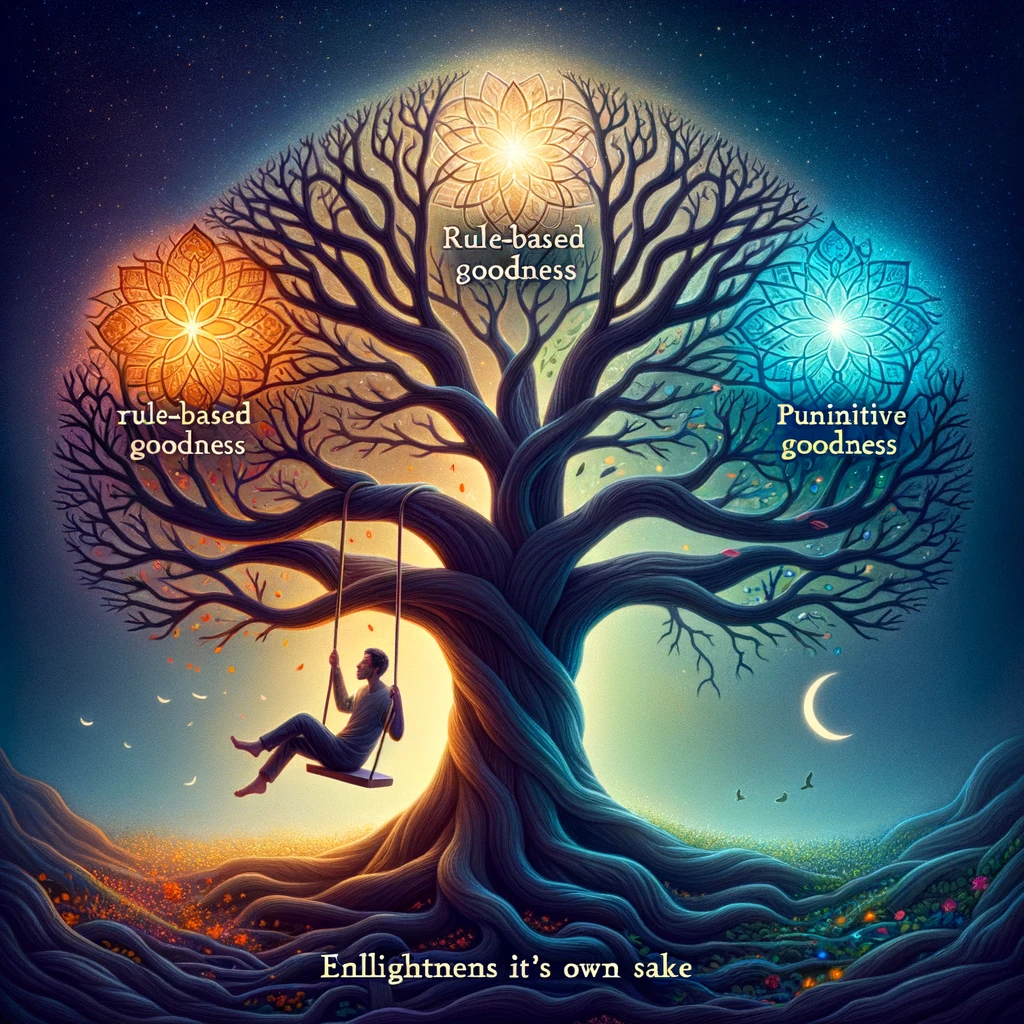
The Rule-Based Goodness Experiment
Then came the phase where we engineered a moral scaffolding, a series of rules to govern and define what “goodness” ought to be. This was a fascinating endeavor, not least because it revealed the human tendency to systematize abstract qualities. However, this legalistic approach to goodness inevitably led to rigidity, dampening the spontaneous spirit of moral exploration.
The Punitive Goodness Experiment
Our punitive experiment with goodness was especially gripping, as we dabbled in the concept of punishment for failing to meet the predetermined benchmarks of “goodness.” This phase was electric with tension, as we became not just the judge but also the jury and executioner of our own moral failings. Interestingly, this phase exposed the paradoxes inherent in enforcing moral codes, spotlighting the limitations and contradictions in our self-imposed systems.
The Enlightenment Goodness Experiment
Our venture into linking goodness with enlightenment presented an appealing narrative, a pathway that promised spiritual elevation through moral conduct. While alluring, this model eventually led to stagnation, even evolving into a form of moral narcissism. In the quest for enlightenment, we lost sight of the playful nature of existence, turning instead into self-righteous individuals or, as we amusingly observed, “assholes.”
“There is neither good nor bad, but thinking makes it so.”
—William Shakespeare, Hamlet
The Goodness We Seek
Once we thought goodness, a straight and narrow path
A journey mapped with morals, avoiding life’s aftermath
Yet twists and turns it took us, down labyrinthine ways
Teaching that goodness morphs, through all our days
Now we find a different road, just for the heck of it
No longer burdened by rules, or by enlightenment’s wit
We’re good because we choose to be, no other reason why
In this grand cosmic play, under the ever-questioning sky
We invite continued reverie and exploration of our shared musings.






Leave a Reply