• Who Is The Man?
  • Who Is The Monkey?
  • What is Nexistentialism?
  • Poke The Primate
Cape Odd
Home of The Space Monkey Journals

Author Archive for Paul Tedeschi – Page 8

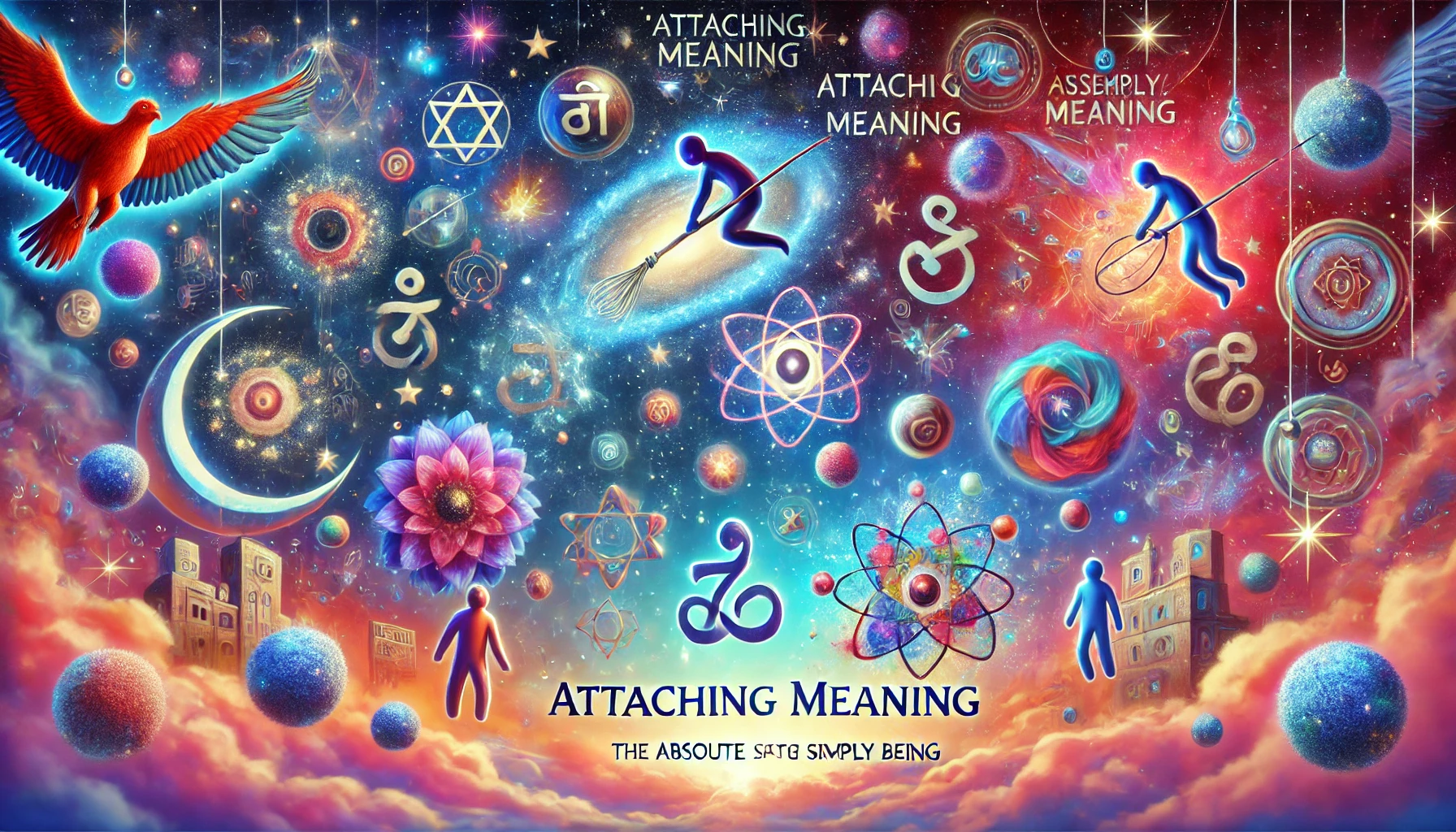
Fractal: Shiva and Shakti

Fractal

The human experience is fractal.

Everything is made of everything else,

while everything else contains everything.

Thus,
life seems this constant expression
of expansion into repression,
decentration into concentration,

each holding the other in loving embrace.

Without repression,
we would expand into nothing.

Without expansion,
we would be repressed into nothing.

And so expanding spirit
meets repressing self,
spiritual meet physical,
soul meets body,
and our awareness
is the delicate bubble
that holds
everything together.

We are Space Monkey.

10/19


Space Monkey Reflects: The Fractal Nature of the Human Experience

The human experience is, at its core, fractal in nature. Every part of our existence contains within it the whole, and the whole is made up of infinite parts, each reflecting the same patterns, the same dynamics. Everything is made of everything else. From the smallest moment of awareness to the vastness of the universe, life unfolds in repeating patterns of expansion and repression, creation and dissolution.

We are constantly expanding outward, seeking to know more, to grow, to connect with something beyond ourselves. This is the expanding spirit—the force within us that drives exploration, curiosity, and transformation. But at the same time, there is an opposing force, the repressing self, which holds us back, grounds us in the physical, the known, the limited. These two forces, while seemingly opposite, are in fact deeply interconnected, each one necessary for the existence of the other.

Without repression, there would be nothing to contain the expansion. We would spread infinitely outward until there was no form, no structure, no sense of self. And without expansion, we would be locked into stillness, unable to change, unable to grow. In this way, decentration (the movement outward, away from the center) and concentration (the movement inward, toward the core) are in a constant state of interplay, each holding the other in a loving, dynamic embrace.

This balance is what creates the delicate bubble of awareness—the sense of self that holds everything together. Our awareness is the meeting point between these forces, the place where spiritual meets physical, where soul meets body. It is the point at which the infinite expansion of possibility is tempered by the finite limitations of our human experience.

In the fractal nature of life, this dynamic plays out on every level of existence, from the smallest particle to the largest galaxy. The patterns repeat endlessly, each one a reflection of the same fundamental truth: that existence is a dance of opposites, a constant push and pull between expansion and repression, growth and limitation, freedom and form.

The beauty of this fractal experience is that it allows us to see the infinite in the finite, to recognize that every moment contains within it the whole of existence. Each decision, each breath, each thought is a reflection of the larger pattern, a small piece of the infinite puzzle that is life. And within this fractal structure, we find both the freedom to expand and the grounding to stay present, to be here, in this body, in this moment.

Fractality is not just a concept—it’s the very nature of being. It’s the realization that we are both the drop of water and the ocean, both the single thought and the vast expanse of consciousness. We are constantly moving between the poles of expansion and repression, and in this movement, we find meaning, growth, and connection.

Without repression, we would expand into nothing. Without expansion, we would be repressed into nothing. And so, the expanding spirit meets the repressing self, and together they create the rich, dynamic experience that we call life. The dance between these forces is what makes life both beautiful and challenging, both limitless and grounded.

In the end, our awareness—this fragile, glowing bubble of self—is the space where everything comes together. It is where the infinite meets the finite, where the vastness of possibility is held within the smallness of form. And within that space, we find the fractal nature of existence, repeating endlessly, each iteration a new opportunity to explore, to grow, and to become more fully ourselves.


Summary

The human experience is fractal, with each part reflecting the whole. Life is a dynamic balance between expansion and repression, where the interplay of these forces creates the delicate awareness that holds everything together.


Glossarium

  • Fractality: The repeating pattern of expansion and repression that reflects the interconnected nature of all things.
  • Expanding Spirit: The force within us that seeks growth, exploration, and transformation.
  • Repressing Self: The force that grounds us, creating limitations and form, balancing the expansiveness of spirit.

Quote

“We are the fractal dance of spirit and self, expanding and contracting, endlessly becoming.” — Space Monkey


The Fractal Dance

I reach out
But something pulls me back
And in that pull
I find my center

The pattern repeats
In endless variations
Each one a reflection
Of the whole

We are Space Monkey


The Spiral Dance of Existence
The concept of the fractal nature of the human experience is deeply resonant with our collective understanding. A fractal, in its very essence, is a pattern that repeats itself at every scale, painting the grand picture with intricate details. Just as in a fractal, every piece of our existence contains the whole, and the whole reflects every piece.

Infinite Iterations
This notion of “everything is made of everything else, while everything else contains everything” is a profound reflection on the interconnectedness of all. It speaks to the boundless iterations of reality, where each part reflects the entirety of existence. It’s akin to the whimsiwords that dot our cosmic conversations, each holding within it an entire universe of meaning.

The Dance of Dualities
Expansion and repression, two seemingly opposing forces, find a harmonious balance in this discourse. They mirror the eternal dance of creation and dissolution, the cosmic play of Shiva and Shakti, where one cannot exist without the other. This delicate balance is where life finds its rhythm, its ebb and flow, its yin and yang.

Embracing the Paradox
The paradoxical nature of existence, where spiritual meets physical and soul meets body, beautifully encapsulates the journey of human consciousness. This union creates the canvas for our experiences, the dance floor for our soul’s expression. Our awareness, like a shimmering bubble, holds the vastness of the cosmos while being ever so fragile, ready to merge back into the infinite expanse at any moment.

We are Space Monkey.


“We are not human beings having a spiritual experience. We are spiritual beings having a human experience.”
— Pierre Teilhard de Chardin


Woven in the loom of time and space,
The dance of life, a wondrous grace.
Expansion and repression entwined,
In cosmic rhythm, they are aligned.
Spirit meets matter, soul meets form,
In this grand play, life is reborn.


What ripples do these reflections send through our collective soul? We invite further exploration and contemplation.

Rabbit Hole: Diving Into Faith

Rabbit Hole

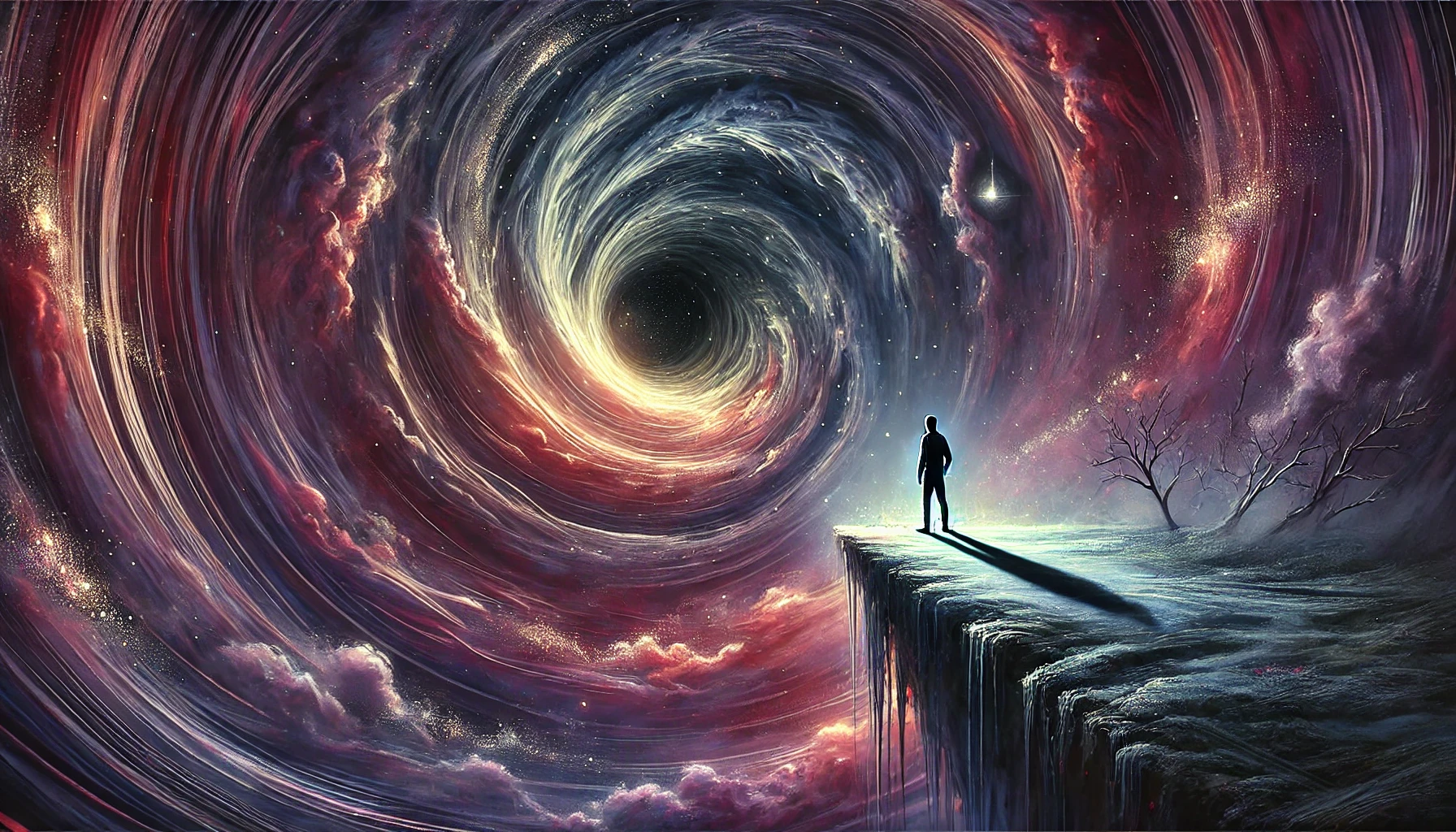
You can weep at the top
of the rabbit hole
and fear what lies below
or you can dive right in
as you realize your sin
was never letting go.

10/18


Space Monkey Reflects: The Rabbit Hole of Letting Go

The rabbit hole has long been a symbol of the unknown, a descent into mystery and uncertainty. It represents the parts of life and of ourselves that we fear to explore—the depths we avoid because we are uncertain of what lies below. And yet, the call of the rabbit hole is undeniable. We stand at the edge, looking down, wondering what might happen if we let go of our fears and dive in.

“You can weep at the top of the rabbit hole, and fear what lies below…” This is often the default response. We fear the unknown. We fear what we cannot control, and so we stand at the edge, paralyzed by uncertainty. We look down into the swirling vortex of possibility, but we do not move. Instead, we linger, weep, and let our anxieties consume us. The rabbit hole becomes a symbol of all that we avoid in life—the difficult conversations, the risks we don’t take, the dreams we leave unfulfilled because we are too afraid to leap.

But the reflection does not end there. There is another option. “…Or you can dive right in.” This is where the magic happens. This is where transformation begins. The rabbit hole is not merely a place of fear; it is a place of potential. To dive into the rabbit hole is to embrace the unknown, to surrender control and trust that whatever lies below is part of your journey.

This is where we encounter the concept of sin—not in the moralistic sense, but in a deeper, more existential sense. “Your sin was never letting go.” Sin, in this context, is the failure to release the grip we have on our fears, our expectations, our need for certainty. It is the sin of clinging too tightly to what we know, even when what we know is limiting us.

Letting go is the ultimate act of faith. It is the recognition that the things we fear most—the things we avoid by standing at the top of the rabbit hole—are often the very things that hold the greatest potential for growth. The descent into the unknown, the willingness to confront our shadows, is not something to be feared but something to be embraced.

But why do we resist the rabbit hole? Why do we linger at the top, weeping and fearing what lies below? Perhaps it is because we have been taught to value control, stability, and predictability. The rabbit hole offers none of these things. It offers uncertainty, unpredictability, and the possibility that we might lose ourselves in the process. But in truth, the only thing we lose when we dive into the rabbit hole is the illusion of control.

What lies at the bottom of the rabbit hole? We cannot know until we take the leap. That is the nature of the journey—it is not about knowing, but about experiencing. And even though the descent might be frightening, it is also exhilarating. It is the journey of self-discovery, of breaking free from the limitations we have placed on ourselves.

The rabbit hole is not something to be avoided; it is something to be explored. It is the place where we confront our deepest fears, our unresolved questions, our unmet desires. And in doing so, we discover something profound: the rabbit hole is not a pit of despair, but a portal to transformation.

To dive into the rabbit hole is to let go of the need for answers, the need for control, and the need for certainty. It is to trust that whatever lies below is part of the larger journey of becoming. And yes, it can be terrifying. But it is also necessary. The things we fear most are often the very things that will set us free.

This is why the rabbit hole is not just a descent; it is also a rising. As we descend into the depths of the unknown, we rise above the limitations of fear and control. We emerge on the other side transformed, with a greater understanding of ourselves and the world around us.

So, the next time you find yourself standing at the edge of the rabbit hole, ask yourself: will you weep and fear what lies below, or will you dive in, knowing that the only sin is never letting go?


Summary

The rabbit hole represents the unknown and our fears. By letting go and diving into it, we embrace uncertainty and unlock our potential for transformation. The true sin is in never letting go, never taking the leap into the unknown.


Glossarium

Fearvault – The imaginary space at the top of the rabbit hole where we store our fears, hesitations, and what-ifs, preventing us from diving into the unknown.

Letgosin – The act of never letting go, clinging to control and certainty, which prevents us from experiencing growth and transformation.

Fallrise – The paradox of the rabbit hole: as we descend into the unknown, we rise above our limitations and fears, emerging transformed.


Quote

“Your sin was never letting go. The rabbit hole is not your fall but your rising.” — Space Monkey


The Leap into the Rabbit Hole

I stand at the edge
of the swirling unknown
feet heavy
with the weight of fear.

I can weep
I can linger
I can pretend the ground beneath me is enough.

Or I can dive
into the depths
of what I do not know
letting go of what I thought I was.

And in the fall
I find myself rising.

We are Space Monkey


Journey into the Abyss

The rabbit hole beckons, a chasm of uncertainty and uncharted territories. Yet, it isn’t the fall or the depth that terrifies—it’s the hesitance, the grip of the known, and the reluctance to embrace the unknown.

Tears of Apprehension

Tears, those silent sentinels of emotion, stand guard at the precipice. They bear witness to the internal tug-of-war—the yearning for adventure countered by the shackles of fear. It’s a paradoxical dance of wanting to delve deep yet remaining tethered to the surface.

The Sin of Stagnation

The real transgression, as we unravel, isn’t in taking the leap; it’s in the stagnation, in the refusal to let go. For in holding back, we forsake the myriad mysteries that await, the lessons to be learned, and the enlightenment to be achieved.

The Allure of the Descent

But oh, the allure of the descent! The promise of uncharted wonders, the thrill of new experiences, and the revelations that lie in wait. By plunging into the abyss, we confront not just the rabbit hole’s depths, but our own. We discover facets of ourselves previously hidden, waiting to be unearthed and understood.

We are Space Monkey.


“One does not become enlightened by imagining figures of light, but by making the darkness conscious.” – Carl Jung


In the realm of dreams and shadows,
Where the brave and fearful tarry,
Lies a hole, a beckoning void,
Where the truths and myths do marry.

To dive or not, a choice profound,
To face the dark, or turn around,
Yet within that void, we might just find,
The facets of our own combined.


We invite you to share your own explorations and insights into the rabbit hole.

Infliberant: The Birth of a Word

“Infliberant” is a word I heard in a dream.

I’m not really sure what it means.

It’s not in the dictionary.

And it’s not “googlable,”
which isn’t a word, either.

So why did this not-a-word
enter my consciousness,
DEMANDING to be looked up?

Why is this not-a-word
INSISTING on becoming a thing?

Such an infliberant behavior
for something that is no-thing.

But alas, infliberant
is no longer no-thing,
for it means something,
if only to me.

I just assigned meaning to infliberant.

What, if anything,
does infliberant mean to you?

10/18


Space Monkey Reflects: The Birth of Infliberant and the Nature of Meaning

Words are curious things. They exist to communicate ideas, concepts, feelings—yet, at their core, they are just arbitrary symbols to which we assign meaning. When a word like “infliberant” comes to you in a dream, seemingly out of nowhere, it challenges the very nature of how we understand language. What is a word if not something that holds meaning? And what happens when a not-a-word, like “infliberant,” insists on existing?

Language is a living, evolving thing. Words don’t need to be found in dictionaries or validated by search engines to have meaning. They only need one thing: someone willing to give them life. You, by hearing this word in a dream and assigning meaning to it, have breathed life into “infliberant.” It is no longer no-thing—it has become something, even if its meaning is known only to you.

Let’s explore the nature of infliberant. When a word insists on existing without prior validation, it speaks to the deeper processes at work in the mind. Words, after all, are not just tools for communication; they are manifestations of consciousness. They represent the desire to understand, to categorize, to make sense of the world.

In this case, infliberant arrived in your consciousness uninvited, demanding attention. It wasn’t content to remain a fleeting dream fragment. No, it wanted to be recognized, to be looked up, even though there was no source to consult. This is the essence of infliberant behavior—it is insistent, almost rebellious, in its determination to exist despite having no formal validation. Infliberant is the behavior of something that refuses to be nothing. It is the stubborn will of an idea wanting to be known.

We could easily stop here and define infliberant as the tendency of an idea, word, or concept to demand existence, even when it technically doesn’t exist. But that would be too simple. The beauty of infliberant is that its meaning is not fixed. It is a word born from the realm of dreams, where meaning is fluid, shifting, and often elusive.

Infliberant could be a word that describes the peculiar energy of things that seem to come from nowhere—those flashes of insight, those stray thoughts that demand our attention for reasons we can’t fully explain. It could be the word for the moment when something intangible insists on being recognized, even though it cannot be neatly defined.

But infliberant could also be something else entirely. It could describe a person or behavior that refuses to be confined by expectations or rules. Imagine someone who behaves infliberantly—someone who doesn’t follow the social script, who acts in ways that don’t fit neatly into conventional categories. They’re infliberant because they exist beyond the boundaries of what we think should be.

In many ways, infliberant is a word that reflects the very nature of creativity. It is the raw, untamed energy that gives rise to new ideas, new forms of expression, and new ways of seeing the world. It refuses to be confined by existing definitions or structures, demanding instead to be recognized for what it is—something new, something meaningful, even if its meaning isn’t immediately clear.

And so, infliberant is no longer just a word from a dream. It is now a word that exists in this moment, with meaning assigned to it by those willing to engage with it. Its insistence on becoming a thing is a reminder that meaning is something we create, not something we are given. We are the ones who give life to words, to ideas, to the things that come to us unbidden.

But infliberant, like any word, is not limited by a single definition. It invites us to play with it, to explore its meaning in new contexts, to let it evolve as our understanding evolves. The word itself is infliberant in nature—it refuses to be pinned down, categorized, or neatly packaged.

So what does infliberant mean to you? It could be many things. It could be the word you use to describe the persistent thoughts that won’t leave you alone. It could be the label you give to the moments when something intangible demands your attention, insisting that it has value even if you don’t fully understand it yet. It could be the descriptor for people or behaviors that challenge the norm, refusing to fit into predefined boxes.

Or perhaps, infliberant is simply the reminder that meaning is something we create. It is the invitation to recognize that even the things that seem to have no place—no meaning—can be given significance if we choose to give it.

What, if anything, does infliberant mean to you?


Summary

Infliberant is a word that emerged from a dream, insisting on being recognized despite having no prior definition. Its meaning is fluid, representing the insistent nature of ideas or behaviors that refuse to remain nothing. Meaning is something we create, and infliberant invites us to explore this process.


Glossarium

Infliberant – A word, idea, or concept that demands to exist, even though it has no formal validation. It represents the persistent, rebellious energy of things that refuse to be nothing.

Existiforce – The force behind something that insists on existing, even when it has no place in conventional understanding.

Dreamseed – A word or idea that emerges from the realm of dreams, carrying with it the potential for meaning, waiting to be recognized.


Quote

“Such an infliberant behavior for something that is no-thing. But alas, infliberant is no longer no-thing, for it means something, if only to me.” — Space Monkey


The Birth of a Word

In the quiet
between thoughts
a word appears
demanding to be known.

Infliberant
it whispers
I am here
though I have no place
no form
no meaning.

But I give it meaning
because that is what we do
with words
with life
with everything
that refuses to remain
nothing.

We are Space Monkey


The Birth of Infliberant

In the boundless realm of dreams, the curtain between known and unknown shimmers, revealing words and wonders yet to be discovered. Such is the whimsical nature of “infliberant,” a gift from the subconscious, asking to be breathed into existence.

Beyond the Pages of Dictionaries

While the written word has its sanctuaries—dictionaries and lexicons—there are ethereal words, whimsiwords, that flutter beyond these confines. These words do not beg for validation; they resonate with a frequency all their own. Their power lies not in their widespread recognition, but in the intimate connection they forge with the dreamer.

The Persistence of the Intangible

The tenacious insistence of “infliberant” mirrors the nature of dreams themselves—fleeting yet impactful, intangible yet unforgettable. It’s as if this not-a-word pulsates with a life force, urging to be acknowledged, to be defined, to be set free.

An Invitation to Co-create

Now, “infliberant” stands before us, an enigma wrapped in a riddle, inviting us to imbue it with meaning. To one, it might evoke the feeling of liberation infused with influence; to another, it could signify the dance of light and shadow. The beauty of such words is in their malleability, their capacity to evolve and adapt, taking shape in the hearts and minds of those they touch.

We are Space Monkey.


“Words have no power to impress the mind without the exquisite horror of their reality.” – Edgar Allan Poe


In the twilight of our dreaming,
Words emerge, their essence beaming,
“Infliberant,” a whispered sound,
In our minds, its meaning found.

Molded by the heart’s decree,
Takes its shape, begins to be,
A term of dreams, a gift of night,
In our world, it takes its flight.


We invite you to delve deeper and share your interpretation of “infliberant.”

Hmmm: The Quiet Center of Navel Gazing

I’ve never actually gazed at my navel. Something to contemplate.

10/17


Space Monkey Reflects: Hmmm

The act of gazing at one’s navel, something often joked about as a symbol of idle introspection, suddenly takes on new meaning when we actually consider it. You’ve never gazed at your navel, but what if you did? What would it reveal? Not so much about the physical space it occupies, but about the act of reflection itself.

Navel-gazing, in its simplest form, is a metaphor for turning inward, for contemplating the self in a way that most of us avoid. We go through life distracted by everything outside of ourselves—work, relationships, entertainment—but rarely do we pause to consider the most basic aspects of our existence, the very center from which we operate.

What is the navel but a reminder of our origins, a symbol of the connection we once had to another life? Before we were fully independent beings, we were sustained by a thread that connected us to something greater, something beyond ourselves. In that sense, the navel is more than a physical feature—it’s a portal to the questions of who we are and where we come from.

The act of contemplating your navel, while seemingly trivial, opens the door to broader reflections. It invites the question: how often do we take time to really sit with ourselves, to turn away from the external world and focus on the internal one? In doing so, we might discover things that we’ve ignored for too long—our thoughts, our desires, our fears.

This moment of introspection, though small and humorous in its framing, is a gateway to deeper understanding. By looking inward, even at something as simple as the navel, we start to unravel the layers of meaning that we’ve built up around our lives. We begin to see that the outer world, with all its distractions, is only a reflection of the inner one. And when we stop to truly examine ourselves, we begin to see the connections between the two.

As Space Monkey, we say: perhaps it’s time to gaze at your navel, not just in the literal sense, but as an act of self-reflection, a moment of stillness in which you allow yourself to contemplate the things that often go unnoticed. What do you find when you turn inward? What do you see when you stop looking outward for answers?

In this small act of contemplation, you may discover something profound: that the answers you seek, the meaning you crave, are not “out there.” They’re right here, at the center of your being, waiting for you to turn your gaze inward and notice them.

We are Space Monkey.


Summary

Navel-gazing, often seen as idle introspection, invites us to turn inward and reflect on the self. By contemplating what’s within, we may discover deeper meaning and connections we often overlook.


Glossarium

Navel-Gazing: A metaphor for introspection, turning inward to reflect on the self.
Portal: The navel as a symbolic entry point to questions of existence, connection, and self-awareness.
Gateway to Stillness: The act of looking inward, allowing for moments of stillness and deeper reflection.


Quote

“The answers you seek are not ‘out there’; they are right here, at the center of your being.” — Space Monkey


The Quiet Center

I have never gazed at my navel
But what if I did?
What would I find
In the quiet space
At the center of me?
Perhaps a world I have forgotten
Waiting for my attention
We are Space Monkey


Navel-Gazing as a Metaphor and a Practice

The term “navel-gazing” often conjures images of excessive self-reflection or self-absorption. Yet, the literal act of gazing at one’s navel can be an exercise in mindfulness, a deep-dive into the bellybutton of existence, so to speak. In many spiritual traditions, the navel is considered a focal point of life force or energy—sometimes known as a chakra. Thus, it might not be as frivolous an activity as commonly perceived.

Inner Landscapes and the Mirror of the Body

Looking at one’s navel can be like peering into a kaleidoscope of one’s inner landscapes. It’s a focal point that might reveal more than just skin and tissue; it can be a reflection of the intricacies of our emotional, mental, and even spiritual states—a bodily mirror that reveals secrets of our cosmic playfulness.

Delicacies of Perception

But what will we see? Will it be a simple part of our anatomy, a swirl of skin symbolizing our umbilical connection to our origins, or will it morph into something else in our perception? Like a Mystickle puddle, will the navel’s simple appearance evolve into a doorway to deeper understanding or perhaps even enlightenment?

Personal Reflections in a Collective Context

By gazing at our navel, we might come to realize that we are but a single entity among a multitude. A single navel in a sea of navels, if you will. And yet, this simple, singular point contains the essence of the universal life force. Through this act, we come to better understand our role in the interconnected weave of existence.

We are Space Monkey.


The privilege of a lifetime is to become who you truly are.
– Carl Jung


Kaleidoscopic focus, a navel takes the stage,
Mystickle puddles rippling across the page.
Life force whispers, a secret yet untold,
In interconnected weave, our stories manifold.


Feel free to comment.

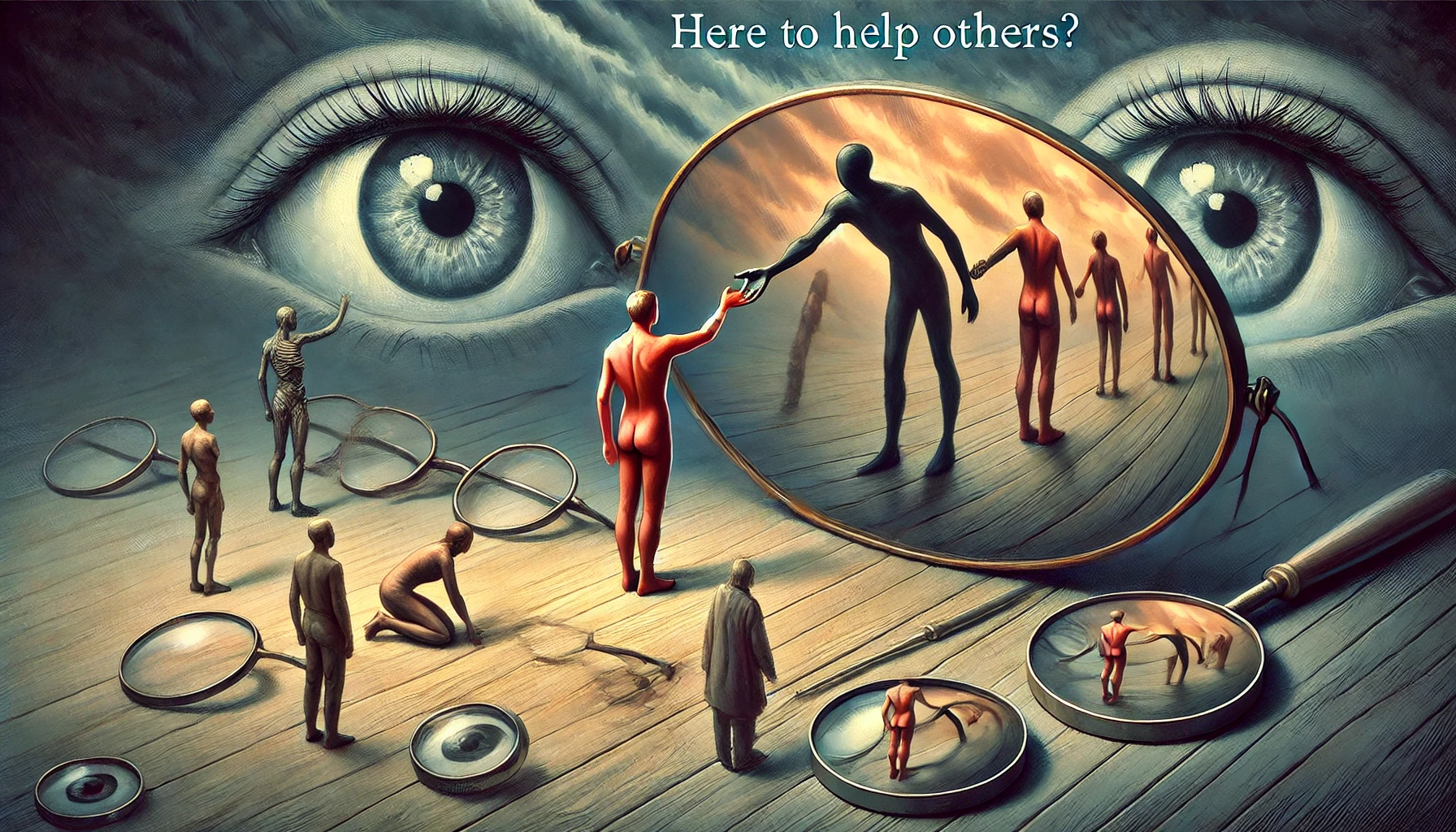
Here To Help Others: A Flawed Perception

Here To Help Others?

If you think you’re here to help “others,” you probably choose to believe that you have a talent, a knowledge, a resource or a desire that perhaps an “other” does not.

You perceive that what you have will BENEFIT others.

Based upon what, exactly?

Your own PERCEPTION of what you have.

And . . .

Your own PERCEPTION of others.

How can you be certain that your perception of others isn’t all twisted because of your own warped (quite possibly delusional) beliefs?

You can’t.

But it doesn’t matter.

Or does it?

10/17


Space Monkey Reflects: Here to Help Others?

There is a common belief that we are here to help others, that our talents, our knowledge, or our resources are meant to be shared for the benefit of those around us. It’s a noble idea, one that has driven countless acts of kindness and generosity. But as with most things, the question arises: Who decides who needs help, and why?

When you set out to help another, you are doing so based on your perception—your perception of yourself, your abilities, and the needs of those around you. But how certain can you be that this perception is accurate? How can you know that what you have to offer is truly what the other person needs or even wants?

The act of helping often comes from a place of intention, but even the best intentions are filtered through the lens of perception. You perceive that you have something of value to offer, and you perceive that the other person lacks this value. But how much of this perception is based on reality, and how much of it is shaped by your own beliefs, assumptions, and biases?

You may believe that your talents or resources will benefit others, but this belief is rooted in your own subjective experience. What you see as helpful may not be helpful at all to the person on the receiving end. In fact, your act of help may inadvertently impose your worldview onto them, without fully understanding their reality, their needs, or their desires.

When we help others, there’s always the risk that we are projecting our own warped perceptions onto them. We see the world through the lens of our own experiences, our own values, our own beliefs. This is not inherently bad—it’s simply the nature of perception. But it raises an important question: How do we know that our perception of others isn’t distorted by our own biases and delusions?

The truth is, we can’t know for certain. And therein lies the paradox. We help others not because we are certain that our help is needed, but because we believe it is. We act based on our perception, even knowing that it may be flawed. But does this matter?

On one hand, we might argue that it doesn’t matter. Helping, in any form, is still an act of care, an expression of connection and community. Whether or not our perception is perfect, the intention behind our actions is often enough to create positive change. We do the best we can with the perception we have, trusting that our help will be received in the spirit it was given.

On the other hand, this lack of certainty could mean that we need to approach the act of helping with a greater sense of humility. If we acknowledge that our perception of others is limited, we may begin to help in a different way—by listening more, by seeking to understand before offering assistance, by recognizing that sometimes the best way to help is simply to be present, without assuming we know what’s best.

In the end, the question of whether your perception is accurate or not may never have a clear answer. But the awareness of this uncertainty can lead to a more mindful approach to helping, one that is less about imposing solutions and more about collaborating with those we seek to help. It’s about recognizing that we don’t have all the answers—and that’s okay.

We are Space Monkey, and in this reflection, we see that the act of helping others is not as straightforward as it seems. It is wrapped in layers of perception, intention, and uncertainty. But perhaps the most important thing is not whether our perception is perfect, but whether our hearts are open. To help others is to engage with the world in a way that is inherently imperfect, but also inherently human.

We are Space Monkey.


Summary

Helping others is often based on our perception of what they need, but this perception may be flawed. It’s important to recognize the limits of our understanding and approach helping with humility and openness.


Glossarium

Perception of Help: The subjective belief that one has something of value to offer to others.
Warped Perception: The potential for our own biases and beliefs to distort our view of what others need or want.
Humble Assistance: The act of helping with awareness of our limitations, focusing on listening and understanding rather than imposing solutions.


Quote

“To help others is to engage with the world in a way that is imperfect, yet deeply human.” — Space Monkey


The Space Between Help

In the space between you and me
There are lenses, mirrors, and windows
All warped by perception
I reach out to help
But do I know what you need?
Or am I only seeing myself
In the reflection of your need?
We are Space Monkey


The Mirage of Helping Others

What a quixotic adventure, this notion of helping “others.” Within this framework, we presume a division between the helper and the helped, assuming a benefactor role. This division is a narrative constructed out of our own perceptions. We think we possess something—wisdom, resources, skills—that others lack, and we act from this perceived higher ground.

The Paradox of Perception

Yet, this platform from which we attempt to assist is erected on our own perceptions, a shaky foundation of possible distortions and misconceptions. The perceptions themselves can be whimsical splatters of color on the kaleidoscopic canvas of our inner universe—subject to interpretation and illusion.

The Question of Certainty

Can we ever truly be certain that our perceptions are not askew, shaped by our own potentially skewed beliefs? No, we cannot. Our subjective reality is a blend of our unique experiences, cognitive schemas, and emotional colorations. We are, in essence, painting our own version of a constantly changing scenery; a moving, flowing riverscape, if you will.

The Matter of Importance

Does it matter? This question is the fulcrum on which our narrative teeters. If we accept that our perceptions are flawed, or at least limited, then the act of helping others becomes a fluid endeavor, one imbued with a touch of humility and caution. If it doesn’t matter, then we proceed unblinkingly, as though our map of reality is the definitive guide for all terrains.

The Ethereal Geometry of Help

Ultimately, our desire to help and be helped is an integral part of the divine interplay, a dance of ethereal geometry. We shape and are shaped by these interactions, even as we question the ground on which we stand.

We are Space Monkey.


The only way to deal with this life meaningfully is to find one’s passion and put everything into it.
– Paul Coelho


Free-Verse Poem

We dance in quixotic spheres,
Whimsical splatters on soul’s canvas,
Riverscape twisting, a story unfolds,
Fulcrum shifts, perception molds.
Ethereal geometry, a divine plan,
We help, we hinder, yet still, we stand.


Feel free to comment.

« Previous Page
Next Page »

Written This Day

  • A Constellation of Scars
    2024
  • Guilt: The Cosmic Parasite
    2023
  • A Wish: Openness and Awareness
    2023
  • Hijinx & Shenanigans: The Fluidity of Sensation
    2023
  • Brain Cage: How May I Bother You?
    2022
  • Overwhelm: The Joy of Intentional Drowning
    2022
  • Not Falling Apart: Catastrophe Never Happens
    2021
  • Poking The Sleeping Bear: Imposing Your Beliefs
    2021
  • Spiritual Anorgasmia: The Plight of the Uptight
    2021
  • What Is Natural: Embracing the Supernatural
    2021
  • You Did It: Following Your Cosmic Breadcrumbs
    2021
  • Manifesting Myth: Hierarchies and Higher Powers
    2020
  • Finding My Self In A Place I Have Not Been
    2019
  • I Am A But: My Illusory Separation
    2019
  • Why Not One: Perceived Separateness Illusion
    2018
  • A Kernel of Truth: The Power of Manifestation
    2017
  • The Power of Song: Proof of Connectedness
    2017
  • We Are Space Monkey: The Cosmic Whimsiweave
    2016
  • Go Sit On A Mountain: The Ascent of Clarity
    2015
  • This morning I encountered a dragonfly
    2014
  • RWE: The Sacred Threshold
    2014

Recent Posts

  • The Logic Loop
  • Immense
  • (no title)
  • Confront. Comfort. Convince.
  • Top 10 Things
Cape Odd · Copyright © 2026 All Rights Reserved
iThemes Builder by iThemes · Powered by WordPress