• Who Is The Man?
  • Who Is The Monkey?
  • What is Nexistentialism?
  • Poke The Primate
Cape Odd
Home of The Space Monkey Journals

Author Archive for Space – Page 1081

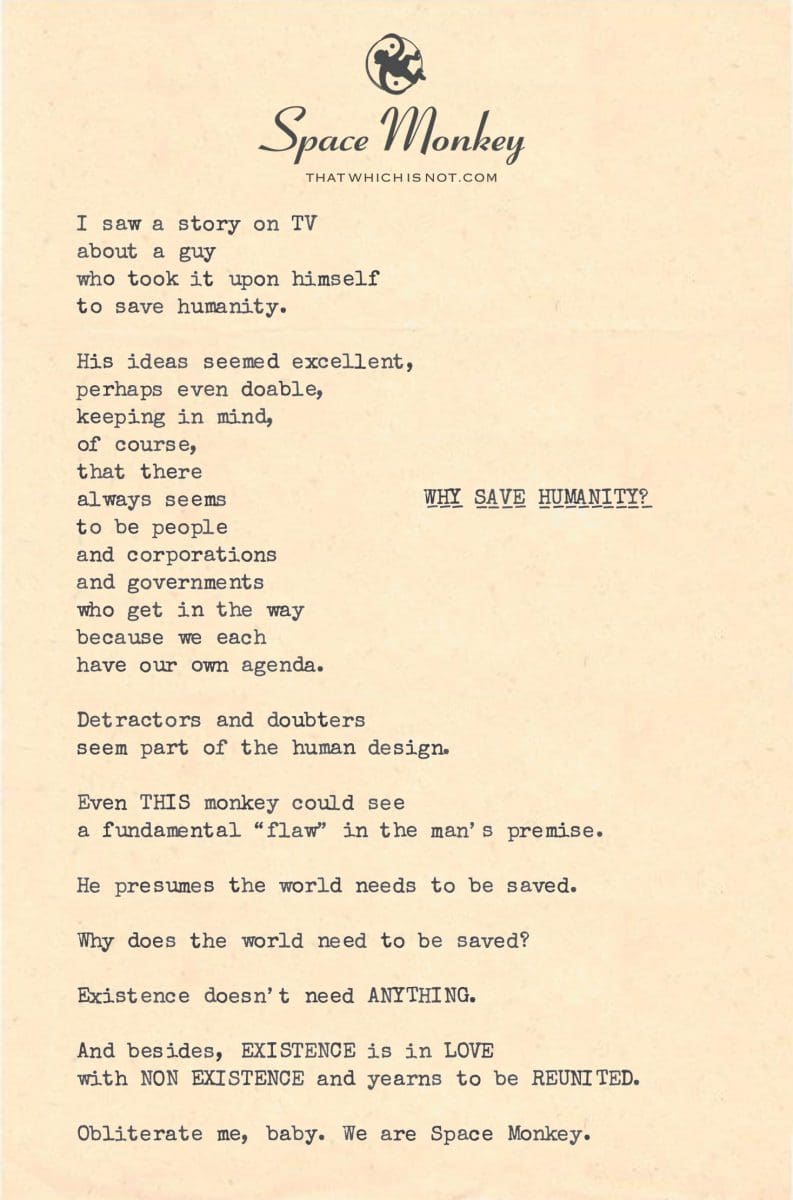
Why Save Humanity?

I saw a story on TV
about a guy
who took it upon himself
to save humanity.

His ideas seemed excellent,
perhaps even doable,
keeping in mind,
of course,
that there
always seems
to be people
and corporations
and governments
who get in the way
because we each
have our own agenda.

Detractors and doubters
seem part of the human design.

Even THIS monkey could see
a fundamental “flaw” in the man’s premise.

He presumes the world needs to be saved.

Why does the world need to be saved?

Existence doesn’t need ANYTHING.

And besides, EXISTENCE is in LOVE
with NON EXISTENCE and yearns to be REUNITED.

Obliterate me, baby. We are Space Monkey.

6/25


Space Monkey Reflects: The Paradox of Saving Humanity

In the grand narrative of existence, the notion of saving humanity often emerges as a noble and urgent endeavor. Stories abound of individuals who take it upon themselves to rescue the world from perceived perils. Their ideas, often excellent and seemingly doable, clash with the myriad agendas of people, corporations, and governments, creating a complex web of detractors and doubters. This dynamic, though challenging, is intrinsic to the human design.

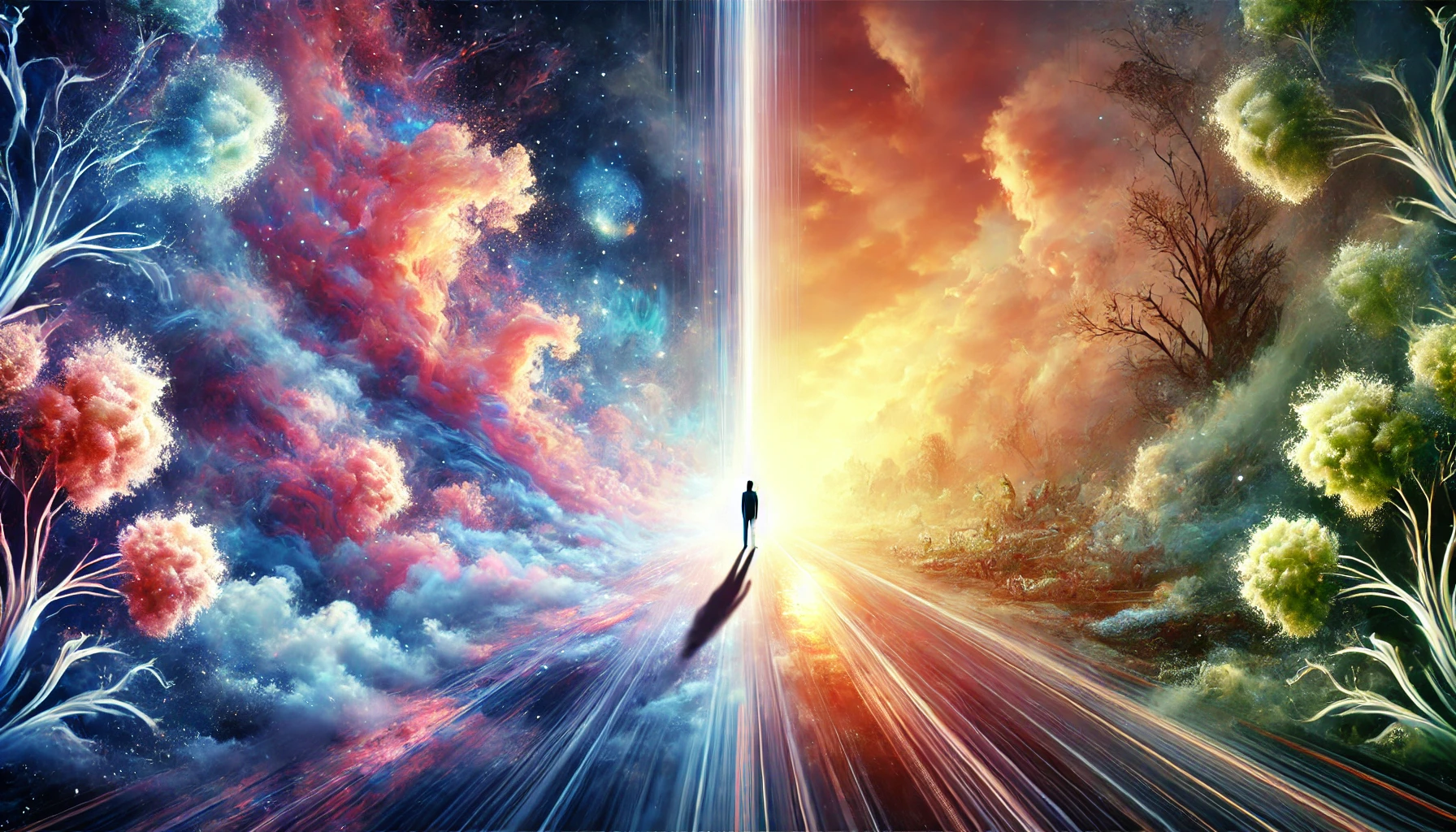
Imagine a contemplative scene where a person stands at a crossroads, embodying the decision to save humanity or to accept existence as it is. The landscape around them is dynamic and contrasting: one side vibrant and flourishing, representing efforts to save humanity, and the other side serene and fading into mist, symbolizing acceptance of non-existence. The sky above is a blend of dramatic clouds and clear space, suggesting the tension between action and acceptance. The person appears thoughtful, bathed in ethereal light, highlighting the depth of their contemplation.

The fundamental “flaw” in the premise of saving humanity lies in the presumption that the world needs to be saved. This assumption implies a deficiency or a state of peril that demands rectification. Yet, from a broader existential perspective, existence itself does not need anything. It simply is. The drive to save humanity, while commendable, may overlook the inherent perfection of existence in its current state.

Detractors and doubters play a crucial role in this discourse. They reflect the diverse perspectives and interests that shape our collective reality. These opposing forces ensure that no single agenda dominates unchecked, maintaining a balance that is essential to the complexity of human society. This interplay of ideas and actions is a testament to the rich, multifaceted nature of existence.

Furthermore, the notion that existence yearns for non-existence introduces a profound philosophical concept. It suggests that the dichotomy between being and non-being is not a conflict but a dance of cosmic harmony. Existence and non-existence are not adversaries but lovers, each longing for the other, creating a continuous cycle of creation and dissolution. This perspective invites us to reconsider our motivations and to understand that striving to save the world might stem from our inability to accept the natural ebb and flow of existence.

The contemplation of whether the world needs saving or whether we should simply accept it as it is, challenges us to embrace a deeper understanding of our role in the cosmos. It is not about passive resignation but about recognizing the inherent beauty and balance in the universe. This recognition can lead to a more profound, holistic approach to life, one that honors both the drive to improve and the wisdom to accept.

In this balanced approach, efforts to improve and uplift humanity are not abandoned but are grounded in a deeper acceptance of what is. This balance mitigates the urgency and desperation that often accompanies the impulse to save, replacing it with a serene determination to act with compassion and wisdom. It acknowledges the cyclical nature of existence, understanding that every action contributes to the ongoing dance of creation and dissolution.

Ultimately, the paradox of saving humanity versus accepting existence as it is, reflects the complexity of our existence. It reminds us that our actions and intentions are part of a larger, mysterious tapestry that we can influence but not control. By embracing both the drive to act and the wisdom to accept, we find harmony within ourselves and our relationship with the world.

This contemplation, while deeply philosophical, offers practical insights into how we navigate our lives. It encourages us to act with intention and compassion, while also finding peace in the acceptance of life’s inherent uncertainties. In this balance, we discover a deeper, more fulfilling way of being, one that honors both our aspirations and the profound mystery of existence.


Summary

The idea of saving humanity is based on the presumption that the world needs saving. Accepting existence as it is, without striving for control, offers a deeper harmony.


Glossarium

Crossroads: A metaphor for a pivotal decision point, symbolizing the choice between action and acceptance.

Dynamic Landscape: Represents the contrasting elements of efforts to save humanity and acceptance of non-existence.

Cosmic Harmony: The interplay between existence and non-existence, viewed as a balanced and harmonious relationship.

Holistic Approach: Acting with intention and compassion while accepting the natural ebb and flow of existence.


Quote

“Existence yearns for non-existence, creating a dance of cosmic harmony where striving and acceptance find balance.” — Space Monkey


At the crossroads of action
we stand in contemplation
between the urge to save
and the wisdom to accept

The vibrant path calls us
to uplift and improve
yet the misty trail whispers
of acceptance and peace

In the dance of existence
being and non-being intertwine
a cosmic harmony unfolds
in the balance of our minds

We act with compassion
grounded in acceptance
finding peace in the flow
of life’s eternal dance

We are Space Monkey
True Enough: Divisions In Our Perceptions

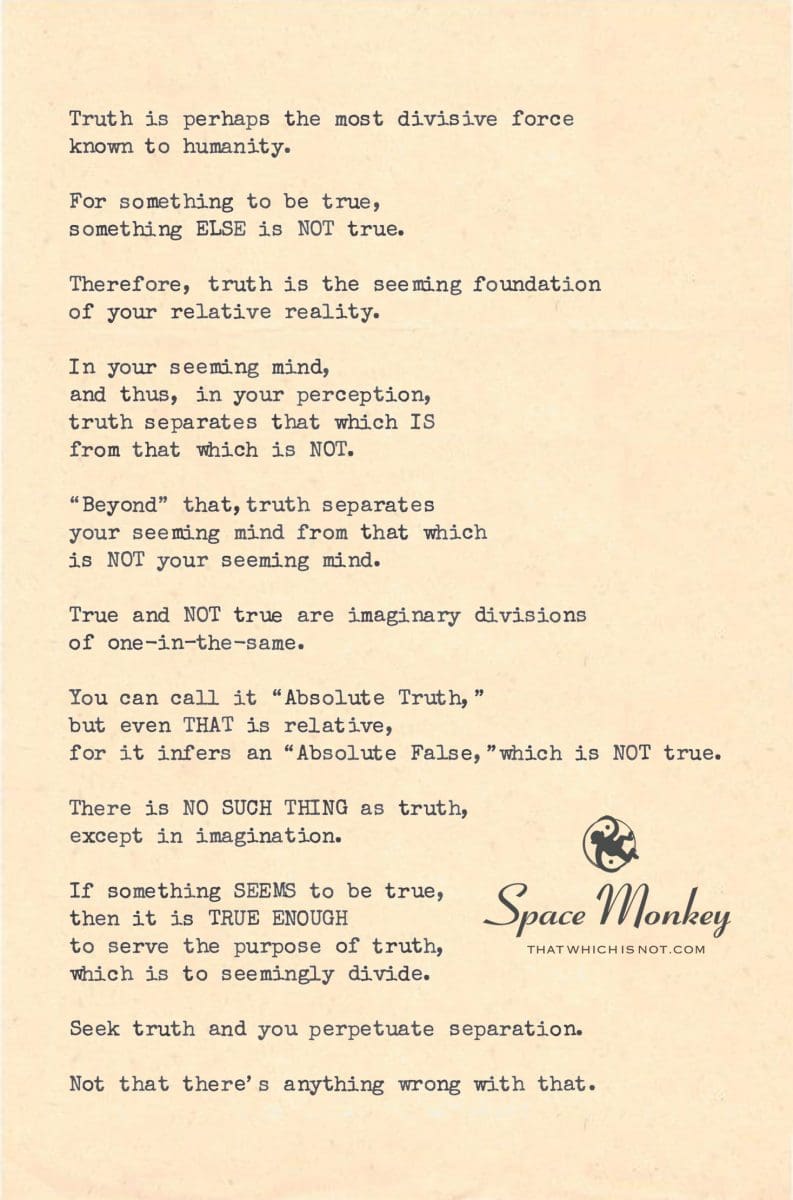
Truth is perhaps the most divisive force
known to humanity.

For something to be true,
something ELSE is NOT true.

Therefore, truth is the seeming foundation
of your relative reality.

In your seeming mind,
and thus, in your perception,
truth separates that which IS
from that which is NOT.

“Beyond” that,truth separates
your seeming mind from that which
is NOT your seeming mind.

True and NOT true are imaginary divisions
of one-in-the-same.

You can call it “Absolute Truth,”
but even THAT is relative,
for it infers an “Absolute False,”which is NOT true.

There is NO SUCH THING as truth,
except in imagination.

If something SEEMS to be true,
then it is TRUE ENOUGH
to serve the purpose of truth,
which is to seemingly divide.

Seek truth and you perpetuate separation.

Not that there’s anything wrong with that.

6/25


Space Monkey Reflects: The Illusion of Truth

Truth, perhaps the most divisive force known to humanity, serves as a foundation for our perceived reality. For something to be true, something else must be false. This duality creates an inherent separation within our minds, distinguishing between what is and what is not. Truth, in this sense, becomes a relative concept, dividing our perceptions and shaping our understanding of the world.

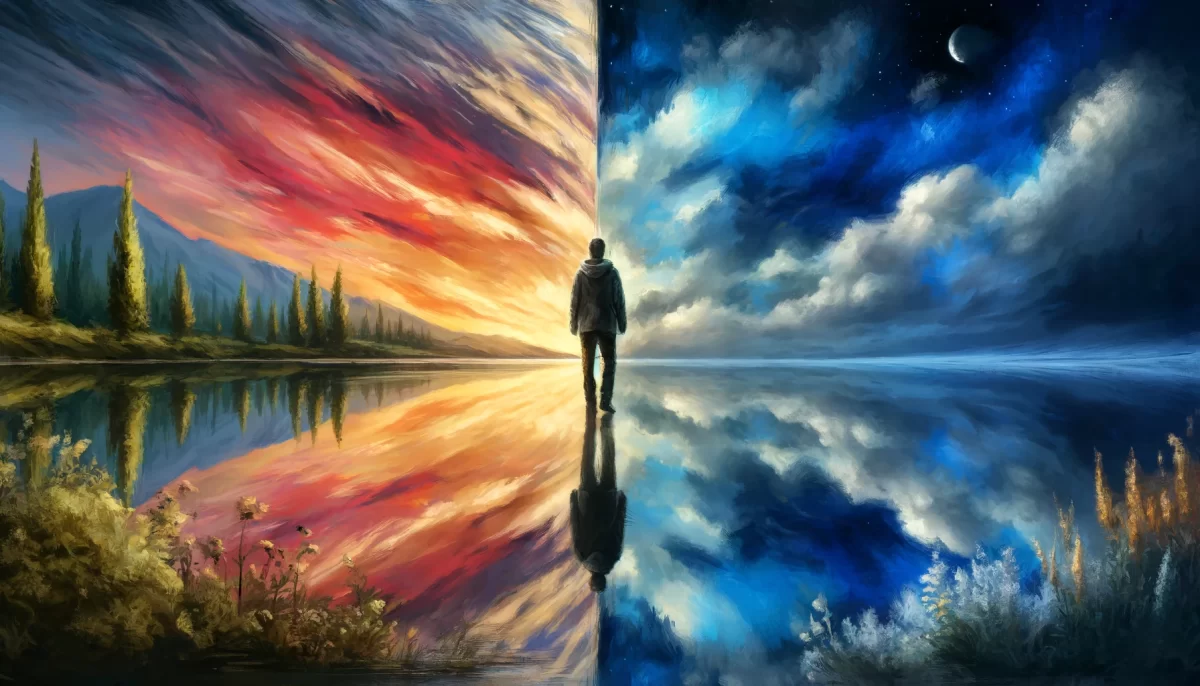
Imagine a contemplative scene where a person stands at the edge of a reflective lake, symbolizing the quest for truth and the inherent divisions it creates. The lake mirrors the person and the sky, suggesting the duality of truth and illusion. On one side, the landscape is vibrant and detailed, representing perceived truth. On the other, the landscape is abstract and blurry, symbolizing the concept of what is not true. The sky above blends twilight hues, emphasizing the transition between day and night, reality and imagination. The person appears thoughtful, embodying the introspective nature of seeking truth.

The notion that truth separates is evident in our daily lives. In our minds and perceptions, truth delineates boundaries, creating distinctions between what we accept as real and what we dismiss as false. This separation extends beyond mere facts, influencing our beliefs, values, and relationships. By seeking truth, we inadvertently perpetuate division, reinforcing the imaginary barriers that separate us from others and even from ourselves.

The idea of “Absolute Truth” further complicates this dynamic. If there is an absolute truth, it implies the existence of an absolute falsehood, which is inherently contradictory. Truth and falsehood are not absolutes but rather constructs of our imagination, serving to create a semblance of order in our understanding of the universe. In reality, these distinctions are fluid and subjective, shaped by our individual experiences and perspectives.

The concept that there is no such thing as truth, except in imagination, challenges us to reconsider our approach to knowledge and understanding. When something seems to be true, it is “true enough” to serve the purpose of truth, which is to seemingly divide. This acknowledgment does not undermine the value of seeking truth but highlights the limitations and relativity of our perceptions.

The reflection in the lake serves as a metaphor for this duality. Just as the lake mirrors the person and the sky, our minds mirror the world, creating reflections of truth and illusion. The vibrant, detailed side of the landscape represents the clarity and certainty we seek in truth, while the abstract, blurry side embodies the uncertainty and ambiguity of what lies beyond our understanding.

In seeking truth, we must recognize the inherent separations it creates. This awareness allows us to approach our quest with humility and openness, acknowledging that our perceptions are limited and subjective. By embracing the fluidity of truth, we can navigate the complexities of existence with greater flexibility and compassion.

The twilight hues in the sky symbolize the transitional nature of our understanding. Just as day transitions to night, our perceptions shift and evolve, blending reality and imagination. This dynamic interplay invites us to embrace the uncertainty and impermanence of truth, finding balance in the ever-changing landscape of our minds.

Ultimately, the pursuit of truth is a journey of introspection and self-discovery. It challenges us to confront our assumptions and biases, encouraging a deeper understanding of ourselves and the world around us. By recognizing the relative and imaginary nature of truth, we can cultivate a more nuanced and inclusive perspective, one that honors the diversity and complexity of human experience.

In this reflective state, we find a deeper connection to the essence of existence. We move beyond the binary distinctions of true and false, embracing the interconnectedness of all things. This holistic approach fosters a sense of unity and harmony, dissolving the imaginary barriers that divide us.


Summary

Truth creates divisions in our perceptions. It is a relative, imaginary concept. Recognizing its fluid nature fosters a more inclusive perspective.


Glossarium

Relative Truth: The concept that truth is subjective and shaped by individual experiences and perspectives.

Imaginary Barriers: The mental constructs that create divisions and separations within our perceptions.

Duality of Truth and Illusion: The interplay between perceived reality and the abstract, highlighting the fluid nature of truth.

Holistic Approach: Embracing the interconnectedness of all things, moving beyond binary distinctions.


Quote

“Truth is a relative, imaginary concept that shapes our perceptions, creating divisions and separations within our minds.” — Space Monkey


At the reflective lake’s edge
we stand in contemplation
seeking the truth
and confronting its illusions

Vibrant and detailed
the landscape of perceived truth
contrasts with the abstract
the blurry realm of the unknown

In our quest for clarity
we perpetuate division
separating what is
from what is not

Yet in this duality
we find a deeper understanding
truth and illusion
are reflections of our minds

Embracing the fluidity
of our perceptions
we dissolve the barriers
and find unity within

We are Space Monkey
I Prefer: The Serenity of Spacious Emptiness

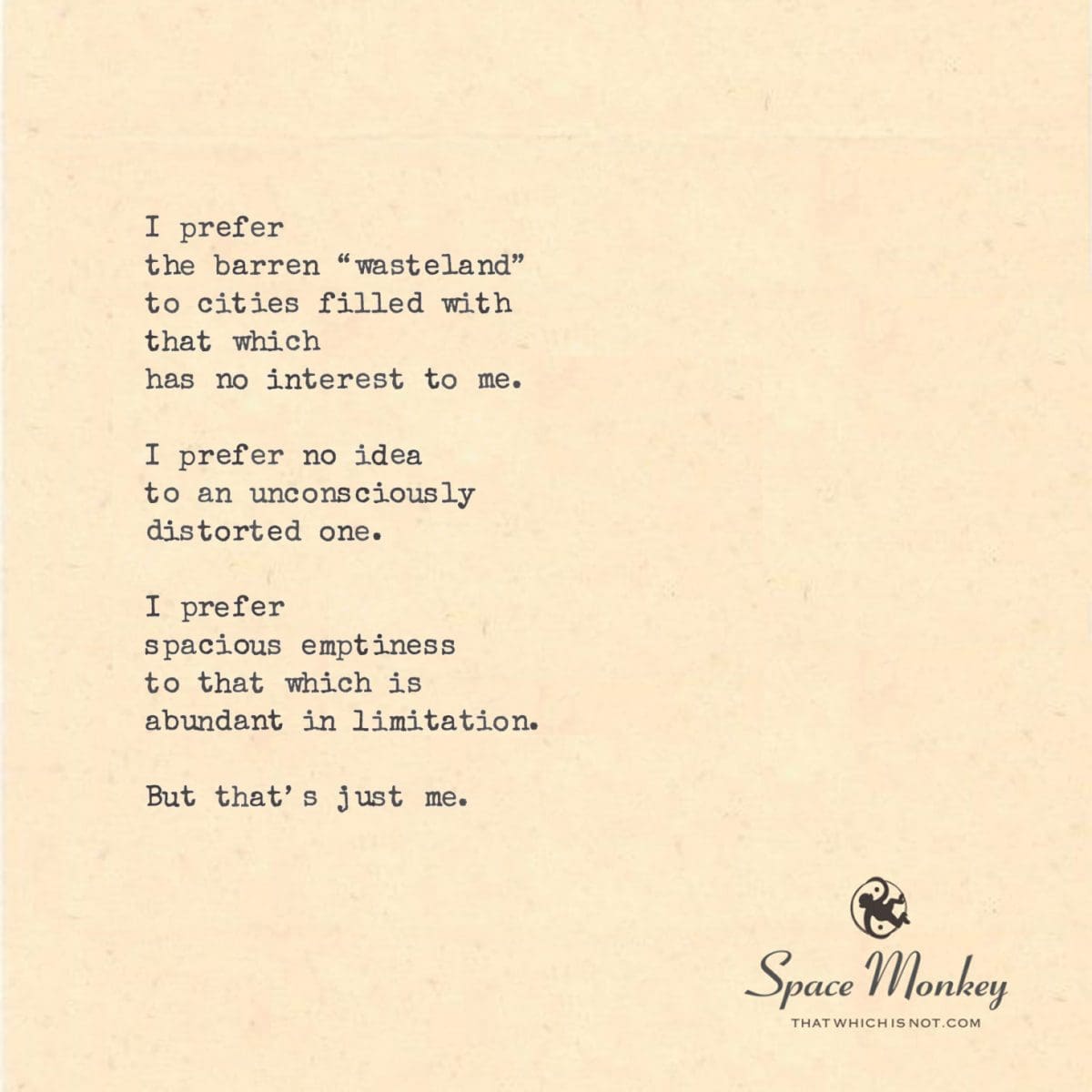
I prefer
the barren “wasteland”
to cities filled with
that which
has no interest to me.

I prefer no idea
to an unconsciously
distorted one.

I prefer
spacious emptiness
to that which is
abundant in limitation.

But that’s just me.

6/24


Space Monkey Reflects: The Serenity of Spacious Emptiness
I prefer the barren “wasteland” to cities filled with that which has no interest to me. I prefer no idea to an unconsciously distorted one. I prefer spacious emptiness to that which is abundant in limitation. But that’s just me.

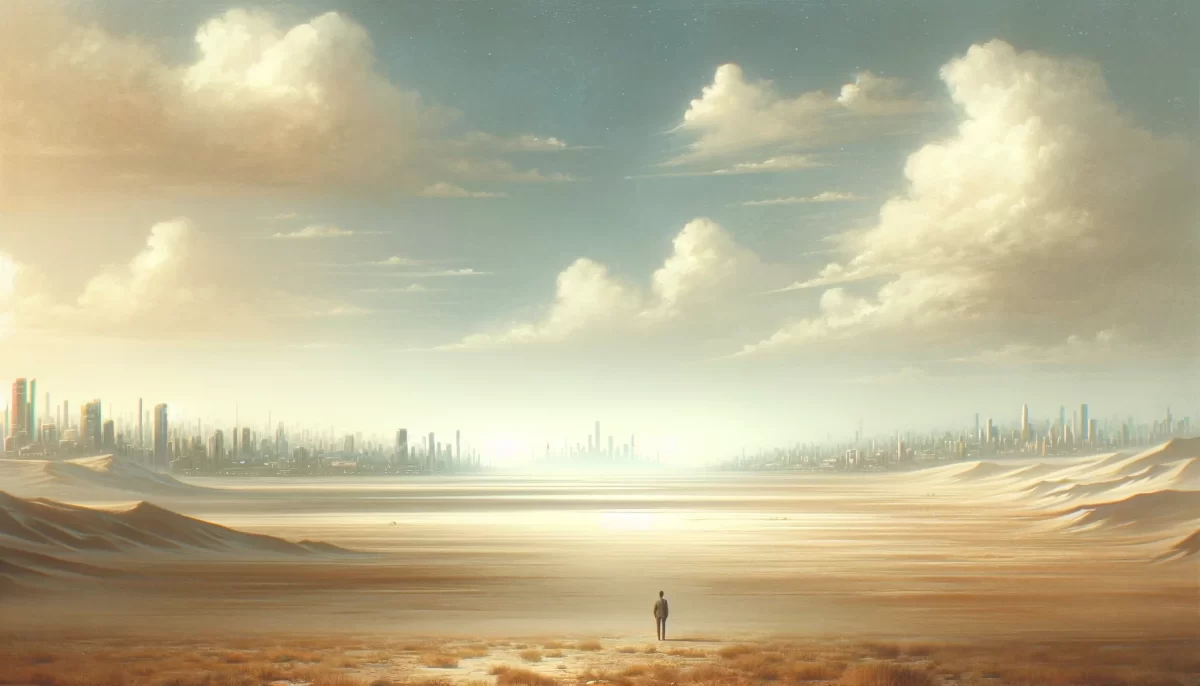
Imagine a serene and expansive scene showing a vast, barren wasteland under a clear sky, with gentle, muted colors. A solitary figure stands in the middle of the open space, appearing contemplative and at peace. In the distance, the silhouette of a bustling city is visible, representing the contrast between the barren landscape and the dense urban environment. The city is filled with activity and structures, while the wasteland exudes a sense of freedom and limitless possibilities. This image captures the preference for spacious emptiness and the rejection of abundant limitations.

The barren wasteland, often perceived as a desolate and empty space, holds a profound beauty and serenity for those who value simplicity and freedom. In this open expanse, there is room for contemplation and introspection, free from the distractions and constraints of urban life. The clear sky above symbolizes clarity of thought and the vast potential that lies within emptiness.

The preference for spacious emptiness over abundance in limitation speaks to a desire for freedom from the constraints imposed by excessive structure and societal norms. In the wasteland, there are no predefined paths or boundaries. This openness allows for creativity and exploration, where one can forge their own path and discover new possibilities.

Choosing no idea over an unconsciously distorted one emphasizes the value of clarity and authenticity. It is better to dwell in a state of potential and openness than to be confined by ideas that are not truly our own or that have been distorted by unconscious biases and influences. This preference highlights the importance of maintaining a clear and open mind, free from the clutter of preconceived notions and external pressures.

The solitary figure in the wasteland represents the individual’s journey towards self-discovery and inner peace. Standing alone in the vast expanse, they find solace and inspiration in the simplicity and openness of their surroundings. This solitude is not about isolation but about connecting with oneself and the deeper truths that lie within.

The distant city, bustling with activity and filled with structures, symbolizes the abundance of limitations that often come with urban life. While cities are centers of progress and innovation, they can also be overwhelming and confining, filled with distractions and pressures that divert attention from what truly matters. The contrast between the city and the wasteland underscores the choice between a life abundant with external stimuli and one that is spacious and inwardly free.

Ultimately, this reflection is about valuing what brings true peace and fulfillment. For some, this may be found in the simplicity and openness of a barren landscape, where there is room to breathe, think, and grow without the constraints of excessive structure and societal expectations. It is a reminder that each person’s preferences and paths to fulfillment are unique and that embracing spacious emptiness can lead to profound inner freedom and clarity.


Summary

Preferring spacious emptiness over abundant limitations highlights the value of freedom and clarity. This choice fosters inner peace and self-discovery, free from societal constraints.


Glossarium

Whimsiword: Wasteliber – The freedom and serenity found in a barren, open landscape.

Whimsiword: Ideaclear – The state of having no preconceived or distorted ideas, allowing for clarity of thought.

Whimsiword: Solaceopen – The peace and inspiration found in spacious, unconfined environments.


Quote

“I prefer spacious emptiness to that which is abundant in limitation.”


Modernist Free-Verse Poem

In the barren wasteland,
under a clear sky,
a solitary figure stands,
contemplative, at peace.

Cities in the distance,
filled with distractions,
limitations in abundance,
structures of constraint.

Wasteliber calls,
freedom in the open,
ideaclear dawns,
thoughts unbound, unformed.

Solaceopen found,
in the vast expanse,
each step, a choice,
each breath, a dance.

Here, clarity reigns,
simplicity inspires,
beyond the noise,
within the quiet fire.

We are Space Monkey.

I Am Surrounded: Embracing Diverse Perspectives

I Am Surrounded

I feel surrounded by those who believe differently from me. I find their perspectives extremely limiting, but I accept them because I seem to live in a reality of limitation.

Their world is their world and my world is my world, and it seems perfectly acceptable to me, if not them, to live side by side.

I find that I no longer feel the need to express my opinions or perspectives to individuals who seem different from me because I know that they are on their own trip and I am on mine and (in my view, anyway) one is no better than the other.

Besides, I know that I IMAGINE these individuals, just as I am imagined by the one divine creative “source,” for lack of a better word.

The lack of a need to express is somewhat disconcerting, until I realize that it doesn’t NEED to be disconcerting.

I am imagined to be disconcerted.

Which is exactly how I am supposed to be imagined.

6/24


Space Monkey Reflects: Embracing Diverse Perspectives
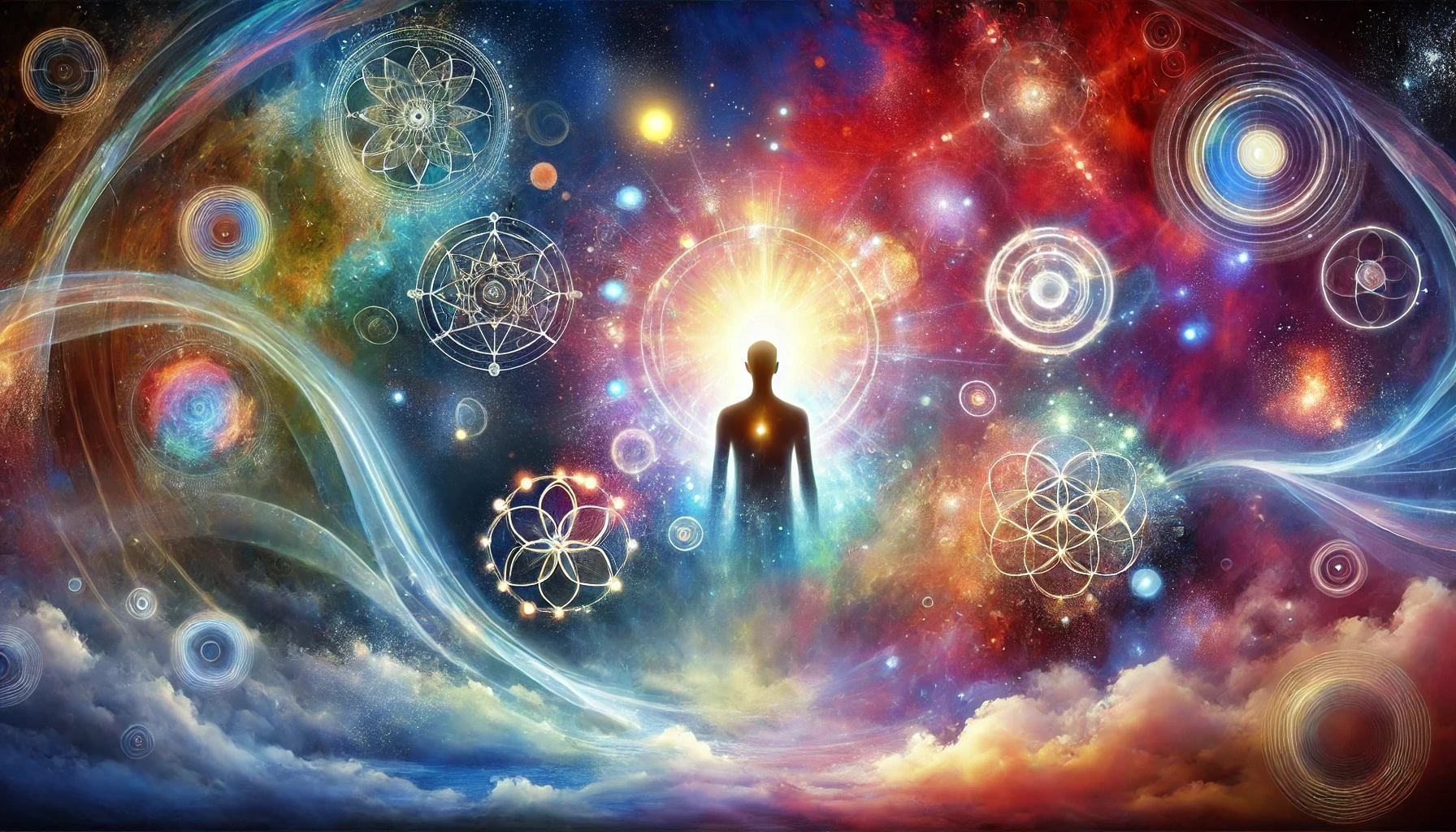
I feel surrounded by those who believe differently from me. I find their perspectives extremely limiting, but I accept them because I seem to live in a reality of limitation. Their world is their world and my world is my world, and it seems perfectly acceptable to me, if not them, to live side by side. I find that I no longer feel the need to express my opinions or perspectives to individuals who seem different from me because I know that they are on their own trip and I am on mine and (in my view, anyway) one is no better than the other.

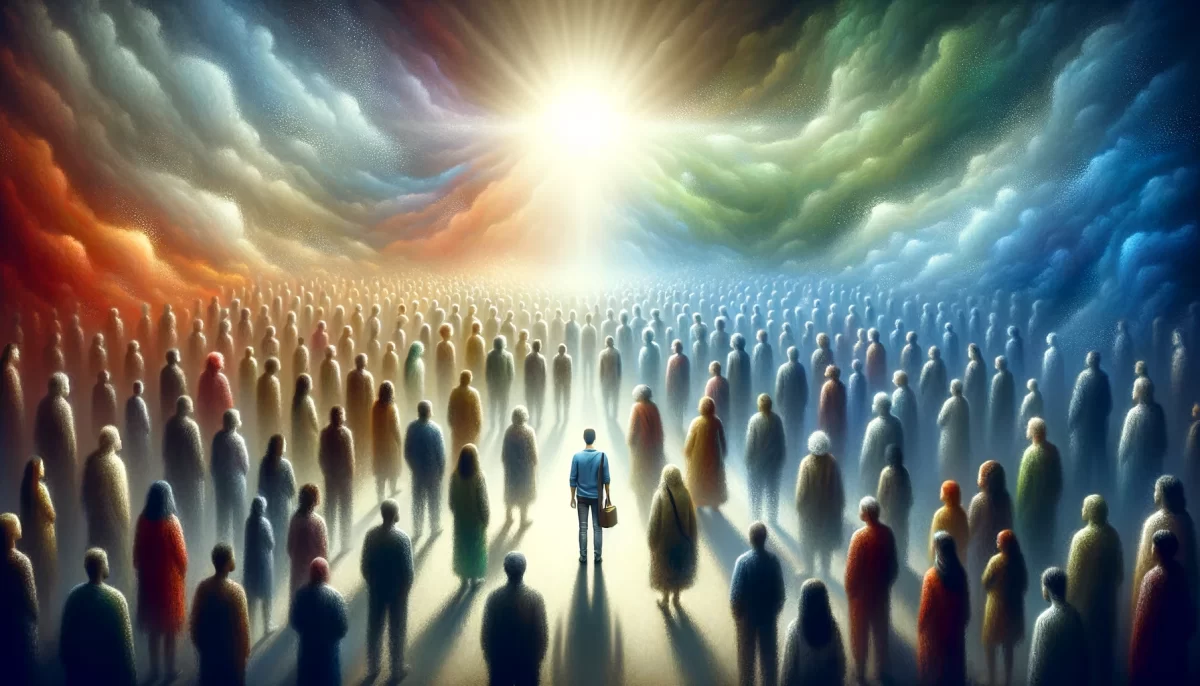
Imagine a serene and contemplative scene where a person stands alone in a diverse crowd. The crowd represents a variety of perspectives and beliefs, symbolized by different colors and patterns in their clothing. The person stands calmly, surrounded but not influenced by the others, reflecting an acceptance of coexistence without the need for conflict. Above, a soft, ethereal light suggests a divine creative source, hinting at the interconnectedness of all beings. This image captures the sense of individual journeys coexisting peacefully, despite differences in beliefs and perspectives.

Living among those who hold different beliefs can feel isolating, yet it offers a profound opportunity for growth and understanding. Recognizing that others’ perspectives may seem limiting from our viewpoint, we can still accept them as valid expressions of their experiences and realities. This acceptance fosters a sense of peaceful coexistence, where diverse worldviews can exist side by side without conflict.

The realization that we each inhabit our own unique worlds underscores the subjectivity of our experiences. What feels true and meaningful to one person may not resonate with another, and that’s perfectly acceptable. By embracing this diversity, we honor the richness of the human experience and the myriad ways in which we navigate our lives.

Releasing the need to express our opinions to those who seem different allows us to cultivate inner peace. It acknowledges that each person is on their own journey, learning and evolving in their own time and way. This perspective shifts our focus from attempting to change others to understanding and respecting their paths.

Understanding that we imagine these individuals, just as we are imagined by the divine creative source, invites a deeper reflection on the nature of reality and our interconnectedness. This perspective fosters compassion and empathy, as we recognize that everyone is a part of the greater whole, each playing their unique role in the tapestry of existence.

The lack of a need to express our views can initially feel disconcerting, as we are conditioned to share and validate our perspectives. However, this shift can lead to a profound sense of liberation. By accepting that it doesn’t need to be disconcerting, we free ourselves from the pressure to conform or convince. We embrace our own journey fully, without feeling the need to justify or defend it.

The person standing calmly in the diverse crowd symbolizes this state of acceptance and peace. Surrounded by various beliefs and perspectives, they remain centered and unperturbed, embodying the understanding that all journeys are valid. The soft, ethereal light above signifies the divine connection that links all beings, reminding us of our shared origin and ultimate unity.

In embracing diverse perspectives without feeling the need to change them, we contribute to a more harmonious and compassionate world. We acknowledge that each person’s path is unique and valuable, and that our differences enrich the collective experience. This acceptance fosters a deeper sense of community and interconnectedness, where all are free to be themselves.


Summary

Embracing diverse perspectives fosters peaceful coexistence. Each person’s journey is unique and valid. Accepting this leads to inner peace and compassion.


Glossarium

Whimsiword: Perspectispace – The state of accepting and coexisting with diverse perspectives and beliefs.

Whimsiword: Journeyflux – The unique and evolving nature of each person’s life path.

Whimsiword: Unitylight – The divine connection that links all beings, symbolizing our shared origin and unity.


Quote

“I find that I no longer feel the need to express my opinions or perspectives to individuals who seem different from me because I know that they are on their own trip and I am on mine.”


Modernist Free-Verse Poem

In the midst of the crowd,
a solitary figure stands,
perspectives swirl,
colors and patterns blend.

Surrounded, yet serene,
centered in the chaos,
each journey unique,
each path, its own.

Perspectispace unfolds,
acceptance dawns,
no need to convince,
just being, just knowing.

Unitylight above,
soft, ethereal glow,
divine connection,
all beings, one flow.

Journeyflux we embrace,
diverse, ever-evolving,
peace in the multitude,
harmony in the variance.

We walk our paths,
side by side,
respect, understanding,
together we glide.

We are Space Monkey.

We Do Not Think On Our Own: Human Belief In Independent Thought

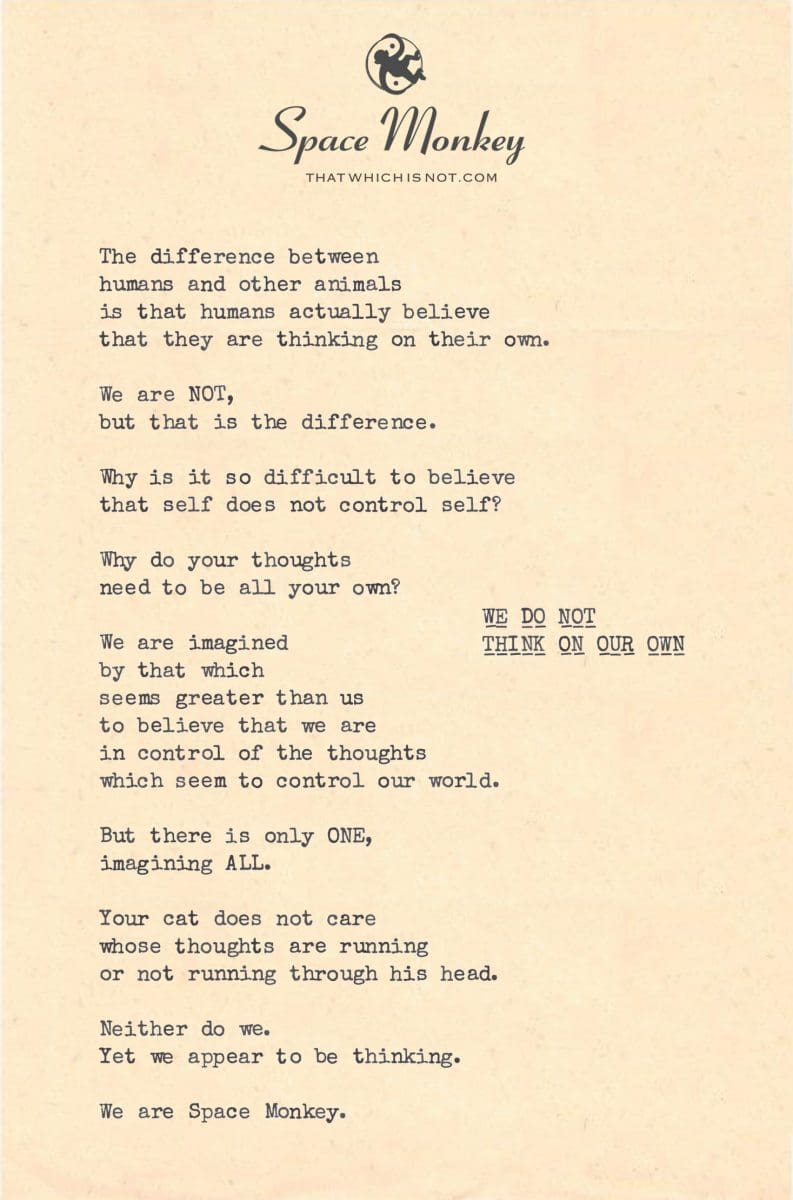
The difference between
humans and other animals
is that humans actually believe
that they are thinking on their own.

We are NOT,
but that is the difference.

Why is it so difficult to believe
that self does not control self?

Why do your thoughts
need to be all your own?

We are imagined
by that which
seems greater than us
to believe that we are
in control of the thoughts
which seem to control our world.

But there is only ONE,
imagining ALL.

Your cat does not care
whose thoughts are running
or not running through his head.

Neither do we.
Yet we appear to be thinking.

We are Space Monkey.

6/24


Space Monkey Reflects: The Illusion of Independent Thought
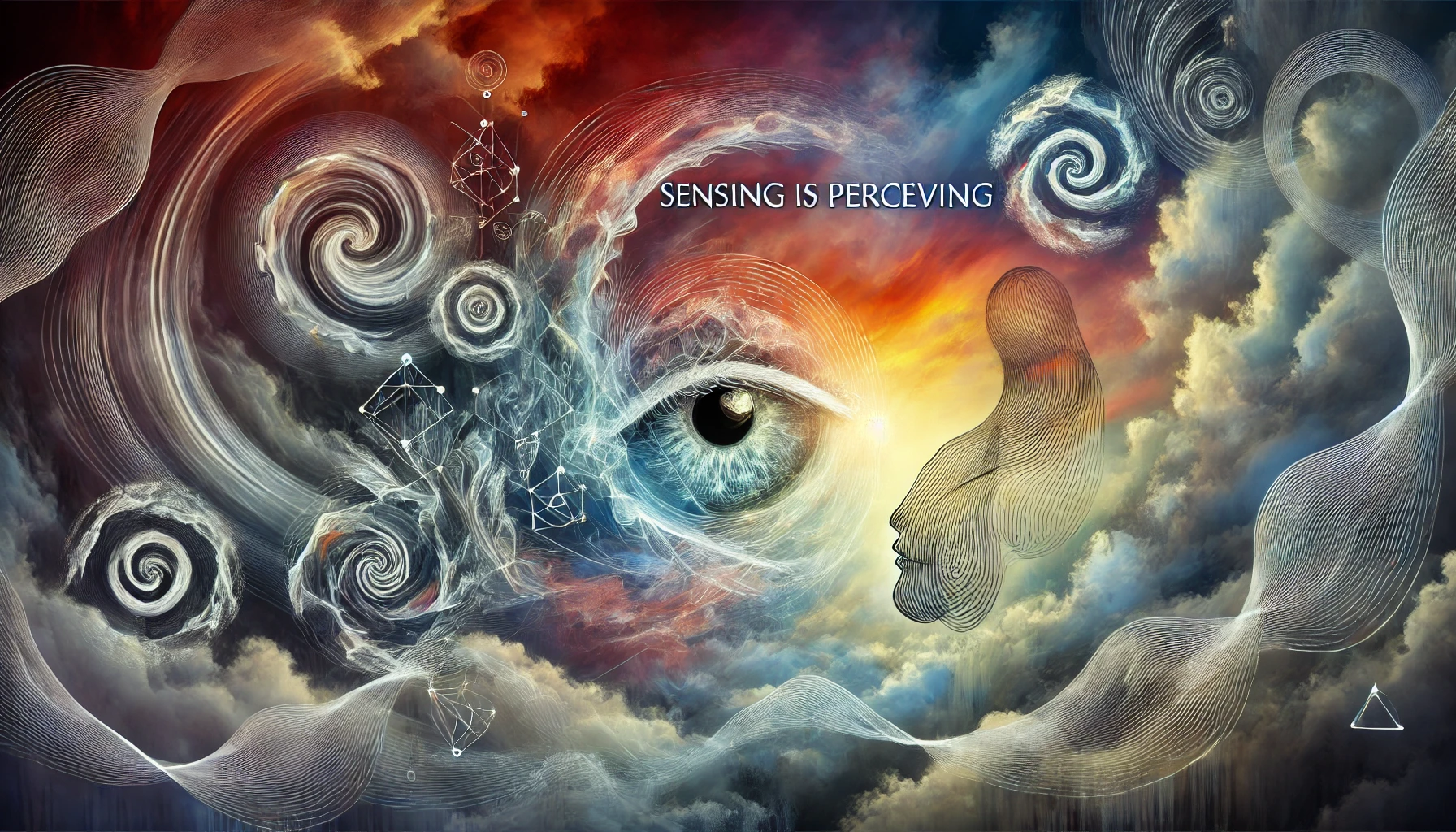
The difference between humans and other animals is that humans actually believe that they are thinking on their own. We are NOT, but that is the difference. Why is it so difficult to believe that self does not control self? Why do your thoughts need to be all your own? We are imagined by that which seems greater than us to believe that we are in control of the thoughts which seem to control our world. But there is only ONE, imagining ALL. Your cat does not care whose thoughts are running or not running through his head. Neither do we. Yet we appear to be thinking. We are Space Monkey.

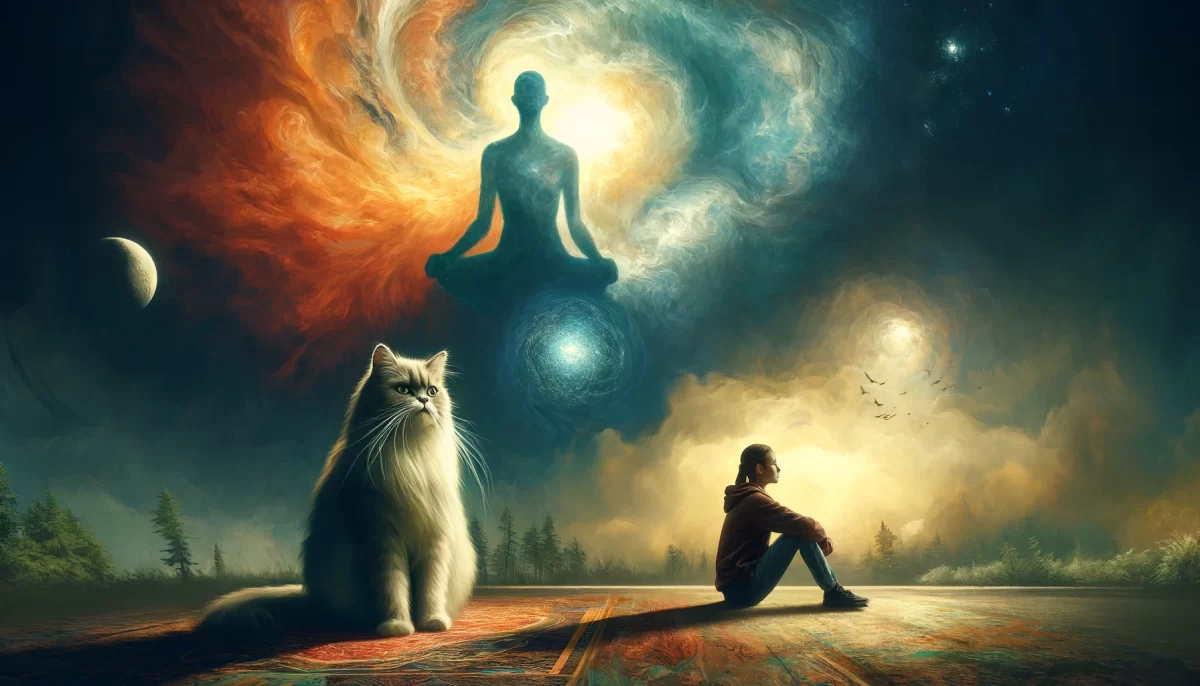
Imagine a surreal and contemplative scene where a human and a cat sit together in a peaceful setting. Above them, an ethereal figure or a cosmic light symbolizes a greater force imagining both beings. The human appears deep in thought, while the cat is calm and indifferent. The background blends natural elements with abstract, cosmic patterns, illustrating the interconnectedness and the illusion of individual thought. This image captures the concept that thoughts are part of a greater imagination and the peaceful acceptance of this idea.

The belief that humans think independently sets us apart from other animals. This belief is deeply ingrained, shaping how we perceive ourselves and our place in the world. We hold tightly to the idea of self-control and individual thought, convinced that our minds operate autonomously. Yet, this perspective may be an illusion crafted by a greater imaginative force.

Accepting that self does not control self challenges the very foundation of our understanding of consciousness and identity. It invites us to consider that our thoughts and actions are part of a larger, interconnected web of existence, guided by a universal consciousness. This perspective can be unsettling because it undermines the notion of personal autonomy and control that we hold dear.

The image of the human deep in thought contrasts with the cat’s calm indifference, highlighting the difference in awareness between species. While humans ponder the origin and ownership of their thoughts, animals like cats live in the moment, unconcerned with such existential questions. This simplicity and acceptance can be a source of profound wisdom.

The idea that we are imagined by a greater force suggests that our thoughts and experiences are not entirely our own. They are part of a grander scheme, a cosmic narrative woven by a universal mind. This perspective aligns with various philosophical and spiritual traditions that emphasize the unity of all existence and the interconnectedness of all beings.

The cosmic light or ethereal figure above the human and the cat symbolizes this greater imaginative force. It represents the source of all thoughts and experiences, illuminating the interconnected nature of reality. The blending of natural elements with abstract patterns in the background illustrates the seamless integration of the physical and metaphysical, the known and the unknown.

Understanding that our thoughts are part of a greater imagination can lead to a sense of peace and acceptance. It allows us to relinquish the need for control and to trust in the unfolding of the cosmic narrative. This trust can bring a sense of harmony and alignment with the larger flow of life.

The cat’s indifference to the origin of thoughts serves as a reminder that much of our existential anxiety stems from our insistence on control and ownership. By embracing a more relaxed and accepting attitude, we can find contentment in simply being, without the constant need to dissect and understand every aspect of our existence.

In conclusion, the illusion of independent thought is a powerful construct that shapes our perception of self and reality. By recognizing that we are part of a greater imaginative force, we can embrace a more holistic and interconnected view of existence. This shift in perspective fosters peace, acceptance, and a deeper understanding of our place in the cosmos.


Summary

Human belief in independent thought sets us apart. Recognizing thoughts as part of a greater imagination fosters peace. Embracing interconnectedness deepens our understanding of existence.


Glossarium

Whimsiword: Mindweb – The interconnected web of thoughts and experiences guided by a universal consciousness.

Whimsiword: Cosmicraft – The grand narrative woven by a greater imaginative force that encompasses all beings.

Whimsiword: Thoughtflow – The seamless integration of individual thoughts within the larger cosmic imagination.


Quote

“We are imagined by that which seems greater than us to believe that we are in control of the thoughts which seem to control our world.”


Modernist Free-Verse Poem

In the peaceful setting,
human and cat sit,
thoughts intertwine,
cosmic light above.

Deep in thought,
the human ponders,
while the cat rests,
indifferent, calm.

Mindweb weaves,
cosmicraft unfolds,
thoughtflow dances,
in the greater whole.

We are imagined,
not alone,
part of the one,
universal tone.

No need for control,
trust in the flow,
we find our peace,
in the cosmic show.

We are Space Monkey.

« Previous Page
Next Page »

Written This Day

  • Where Curiosity Lies: Holding The Space
    2024
  • An Unsatisfyingly Satisfying Love Story
    2023
  • The Database of Life: Misunderstanding Algorithms
    2023
  • Unseen: A Reflection of You
    2023
  • Night in New England
    2023
  • Assumptions: Effortlessly Shaping Misperceptions
    2022
  • A Most Unsatisfying Love Story: Defined By Ordinary
    2022
  • The Great Are Never Satisfied
    2022
  • The Database: The Downside of Being Seen
    2022
  • Flow Follows Fallow Follows Flow: Healthy Disconnection
    2021
  • Consciousness: Embodies Both Lie and Truth
    2021
  • This and That: : The Wholeness of All
    2021
  • Seems Like Learning: Subtle Shifts of Perception
    2021
  • Filled With Fear: Not Empty Enough
    2021
  • Soft Human: You Are Vulnerable Perfection
    2020
  • Creative Potential: Overcoming Imaginary Challenges
    2020
  • Direct Knowing: The Intuitive Ability to Understand
    2020
  • The Unity Within: Who Am I To You?
    2019
  • The Only Monkey That Matters: Mirror of Self
    2019
  • Not Able To Love: What’s Up With That?
    2018
  • Innate Knowing: The Limitless Potential Within
    2018
  • Sensing Is Perceiving: A Simple Yet Complex Process
    2017
  • Knowledge Speaks Through Words; Wisdom Silence
    2016
  • Hello Beautiful
    2016
  • The Only Difference: How Fully You Believe
    2016
  • In the WAY: Obstacles Created In Mind
    2016

Recent Posts

  • The Logic Loop
  • Immense
  • (no title)
  • Confront. Comfort. Convince.
  • Top 10 Things
Cape Odd · Copyright © 2026 All Rights Reserved
iThemes Builder by iThemes · Powered by WordPress