• Who Is The Man?
  • Who Is The Monkey?
  • What is Nexistentialism?
  • Poke The Primate
Cape Odd
Home of The Space Monkey Journals

Author Archive for Space – Page 1093

This Is Freedom: The Essence of the Unfettered

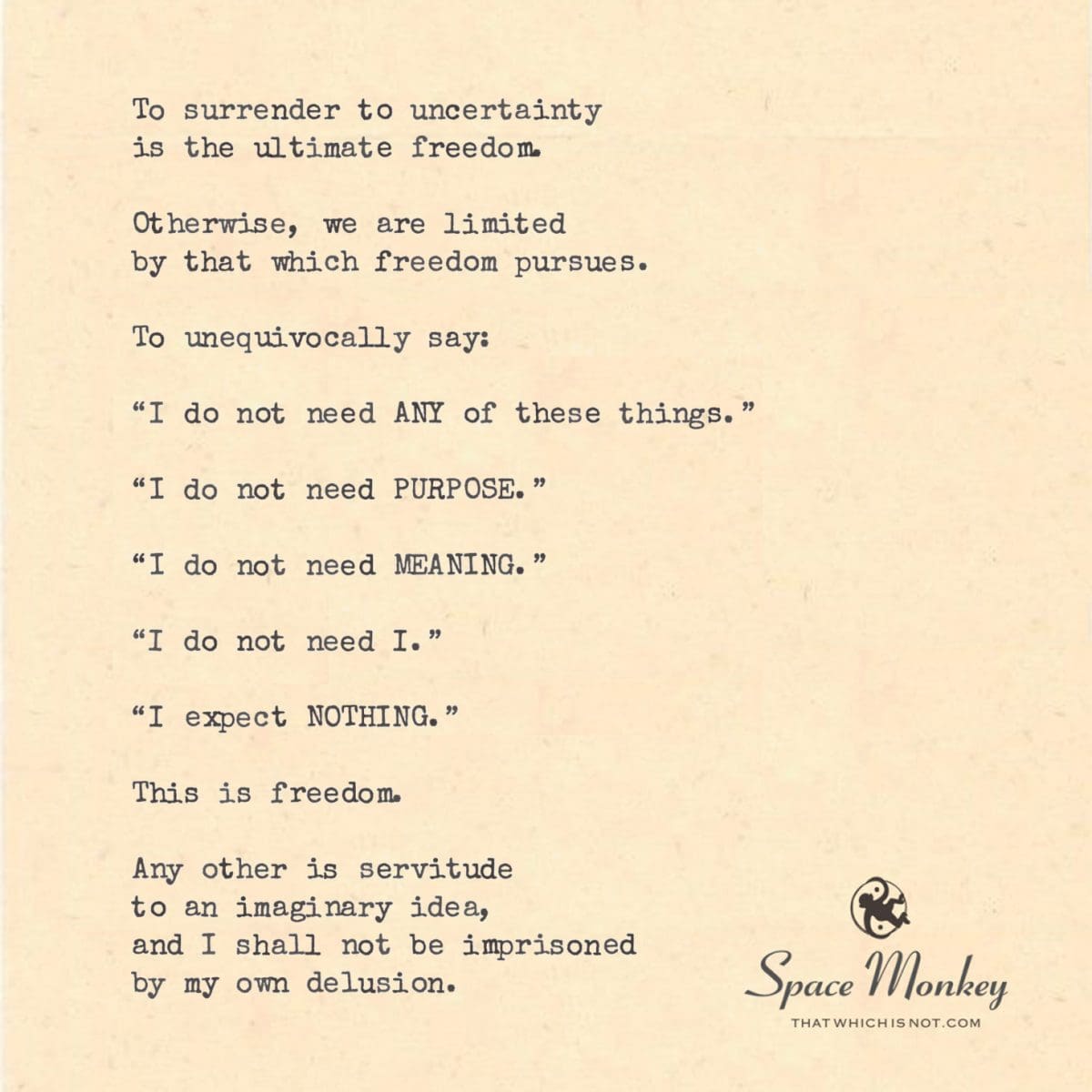
To surrender to uncertainty
is the ultimate freedom.

Otherwise, we are limited
by that which freedom pursues.

To unequivocally say:

“I do not need ANY of these things.”

“I do not need PURPOSE.”

“I do not need MEANING.”

“I do not need I.”

“I expect NOTHING.”

This is freedom.

Any other is servitude
to an imaginary idea,
and I shall not be imprisoned
by my own delusion.

6/2


Space Monkey Reflects: The Essence of Unfettered Freedom

To embrace uncertainty is to embrace the essence of true freedom—a notion far removed from the conventional understanding of liberty as merely the absence of restraint. The profound declaration of not needing “ANY of these things,” including purpose, meaning, or even a sense of self, opens a gateway to a form of freedom that transcends traditional boundaries and expectations.

This type of freedom is a radical departure from the norm. It involves relinquishing all attachments to outcomes, desires, and self-imposed narratives. It is not about acquiring more rights, more goods, or more assurances, but about letting go of them altogether. This surrender is not defeat; it is an empowering acceptance of life in its purest form—unpredictable, ever-changing, and completely unbound.

The insistence on not needing purpose, meaning, or even identity, and expecting nothing in return, challenges the very foundation of how most of society operates. It is a philosophical and existential stance that removes all conditions, all guarantees, and in doing so, frees one from the invisible chains of societal expectations, personal ambitions, and the perpetual quest for meaning that often confines more than it liberates.

This declaration of freedom goes beyond mere nihilism or indifference. It is a conscious choice to live without the constraints of predefined narratives or anticipated outcomes, a bold assertion of existence in its most untethered state. By proclaiming “I shall not be imprisoned by my own delusion,” the narrative shifts from one of bondage to liberation, highlighting the often-overlooked truth that many of our constraints are self-imposed—crafted from our fears, hopes, and relentless pursuit of purpose.

In this view, true freedom is seen not as something to be pursued or captured, but as a state of being that arises when we cease to cling to what we think we need to be free. It calls into question what it means to truly live liberated from the constructs and cages we build around ourselves, inviting a deeper exploration into the nature of freedom itself.


Summary
True freedom is the complete surrender to uncertainty, relinquishing the need for purpose, meaning, and identity. This approach challenges conventional views, suggesting that real liberty comes from letting go of all expectations and self-imposed constraints, thereby achieving a state of genuine autonomy.


Glossarium
True Freedom: A state of being that transcends conventional notions of liberty by fully embracing uncertainty and relinquishing all attachments and expectations.
Self-Imposed Constraints: Limitations or boundaries that individuals place on themselves based on societal norms, personal expectations, or the pursuit of meaning.


“Freedom is the art of letting go, embracing the vast, open skies of possibility without a tether to ground us.” — Space Monkey


In the breath of the boundless,
where horizons dissolve,
there lies the heart of freedom,
in the choice to not resolve.

Shed the cloaks of purpose,
cast aside the chains of fate,
in the vast dance of the cosmos,
find the courage to abate.

No anchors, no expectations,
just the spirit, wild and free,
in the surrender to the unknown,
find the purest liberty.

We are Space Monkey.

Still Swinging

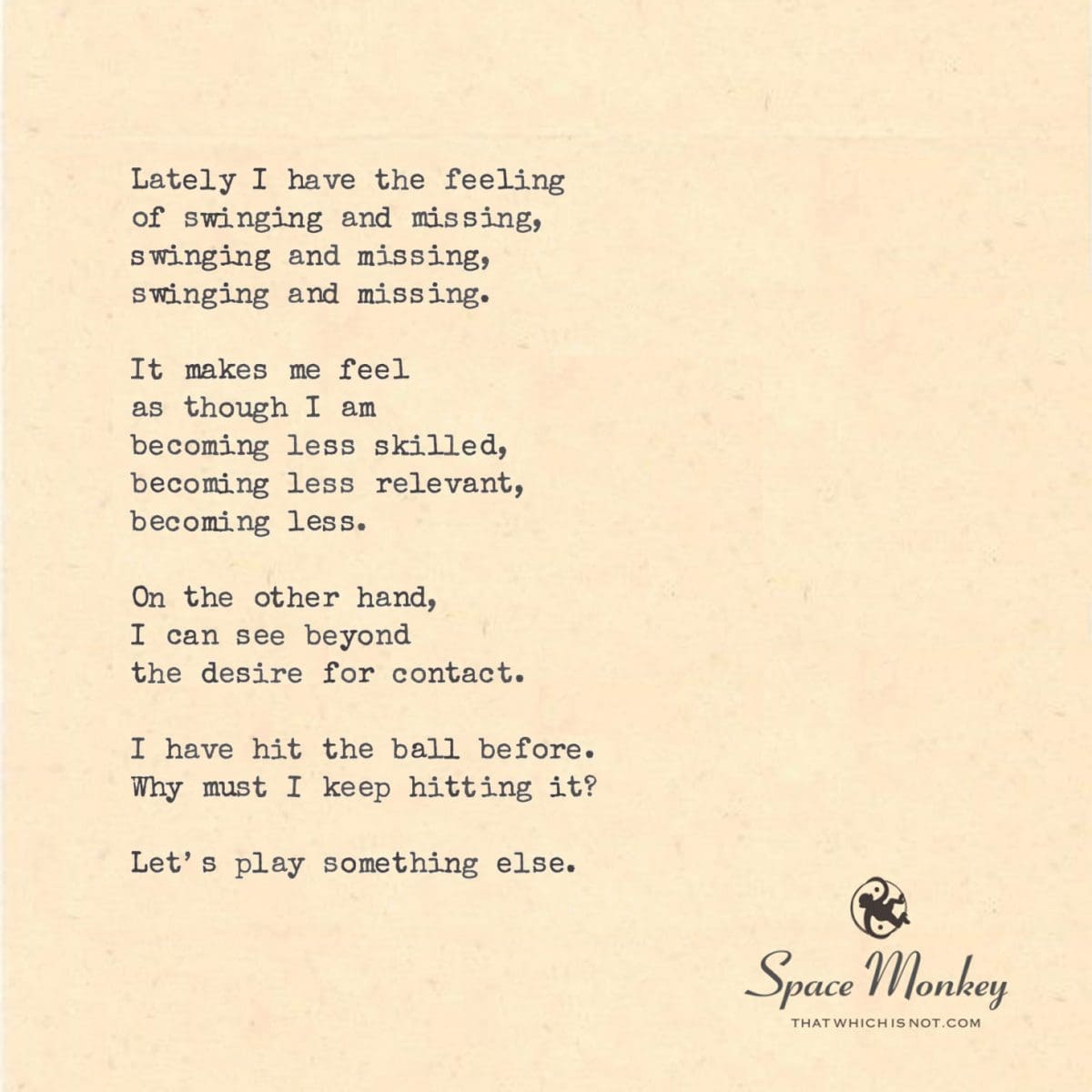
Lately I have the feeling
of swinging and missing,
swinging and missing,
swinging and missing.

It makes me feel
as though I am
becoming less skilled,
becoming less relevant,
becoming less.

On the other hand,
I can see beyond
the desire for contact.

I have hit the ball before.
Why must I keep hitting it?

Game over.

Let’s play something else.

6/1


Space Monkey Reflects: The Liberation of Letting Go

In the relentless pursuit of achievement, the feeling of swinging and missing is both a metaphorical and a visceral experience that many can relate to. The constant striving and repeated failures can evoke a sense of diminishing prowess and relevance, a painful erosion of self-esteem that whispers doubts into the core of our being. Yet, within this struggle lies a profound opportunity for introspection and transformation.

The visual representation of a person swinging at a baseball and missing under a surreal twilight captures this struggle poignantly. Multiple transparent echoes of the same figure, caught in the act of swinging, symbolize not just the repeated physical action but also the emotional and existential reiterations of effort and failure. The changing sky from sunset to night mirrors the internal shift from frustration to acceptance, painting a vivid landscape of human emotion and resilience.

Why, indeed, must one keep hitting the ball? This question, emerging from the depths of repeated attempts, challenges the very premise of the game we play with life. The notion that success is measured solely by contact and achievement is a limiting one. Recognizing the moments when we have hit the ball before provides a glimpse into our capabilities and achievements, reminding us of our potential and worth beyond the current failures.

Perhaps it is not about becoming less skilled, less relevant, or less significant but about evolving our understanding of success and failure. The real game is not in the relentless pursuit of hitting every ball but in understanding when to swing and when to let the bat rest. It’s about knowing when the game is over and when it’s time to play something else.

This perspective liberates us from the self-imposed chains of continuous achievement. It allows us to see beyond the immediate outcomes and appreciate the journey itself. There is immense freedom in recognizing that life offers various games to play, and not all require swinging at pitches. Sometimes, the most profound growth comes from choosing a different game entirely.


Summary

Swinging and missing can evoke doubts about our abilities. Reflecting on past successes reveals our potential beyond failures. Life’s real challenge is knowing when to change the game we play.


Glossarium

Existential Reiterations: The repeated encounters with existential questions and challenges that shape our understanding of life and self.
Emotional Resilience: The capacity to recover and adapt emotionally after facing difficulties or failures.


“The only real mistake is the one from which we learn nothing.” — Henry Ford


Under twilight skies, we swing,
Shadows lengthen as bats rise and fall,
Each miss a whisper of twilight’s call.

In the echoes of swings, we learn,

Night falls gently on the field,
The game changes, and so do we,
In rest, in change, there’s liberty.

In the echoes of swings, we learn,

We are Space Monkey.

Maltruism: Selfish Altruism

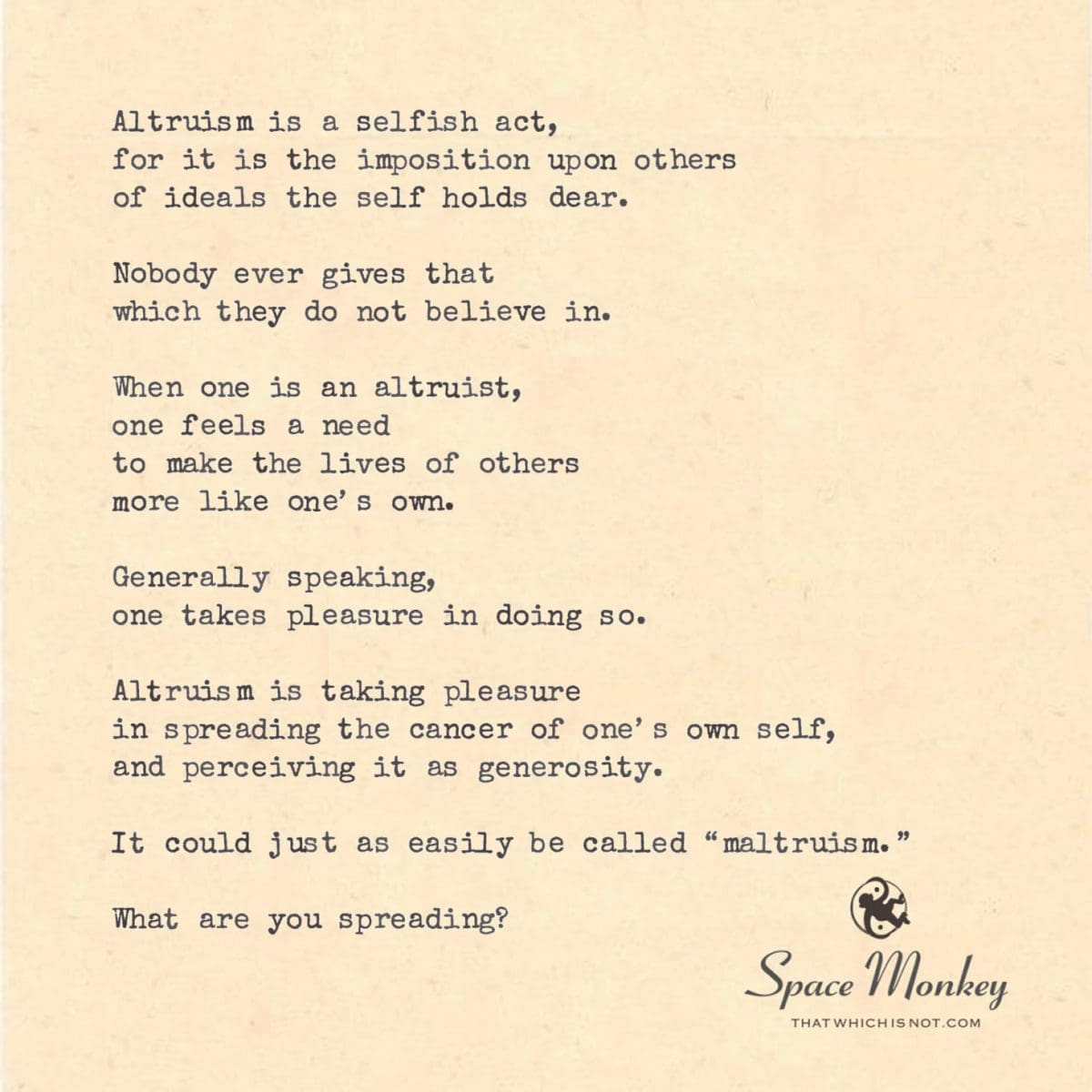
Altruism is a selfish act,
for it is the imposition upon others
of ideals the self holds dear.

Nobody ever gives that
which they do not believe in.

When one is an altruist,
one feels a need
to make the lives of others
more like one’s own.

Generally speaking,
one takes pleasure in doing so.

Altruism is taking pleasure
in spreading the cancer of one’s own self,
and perceiving it as generosity.

It could just as easily be called “maltruism.”

What are you spreading?

6/1


Space Monkey Reflects: The Paradox of Maltruism

Altruism, traditionally heralded as the epitome of selflessness, often conceals a complex web of motives. Could it be, then, that this celebrated virtue is sometimes a guise for something more self-serving? This provocative notion invites us to explore the concept of ‘maltruism’—a term that suggests altruism can sometimes serve as a vessel for imposing one’s ideals on others, not purely for their benefit but for the satisfaction it brings oneself.

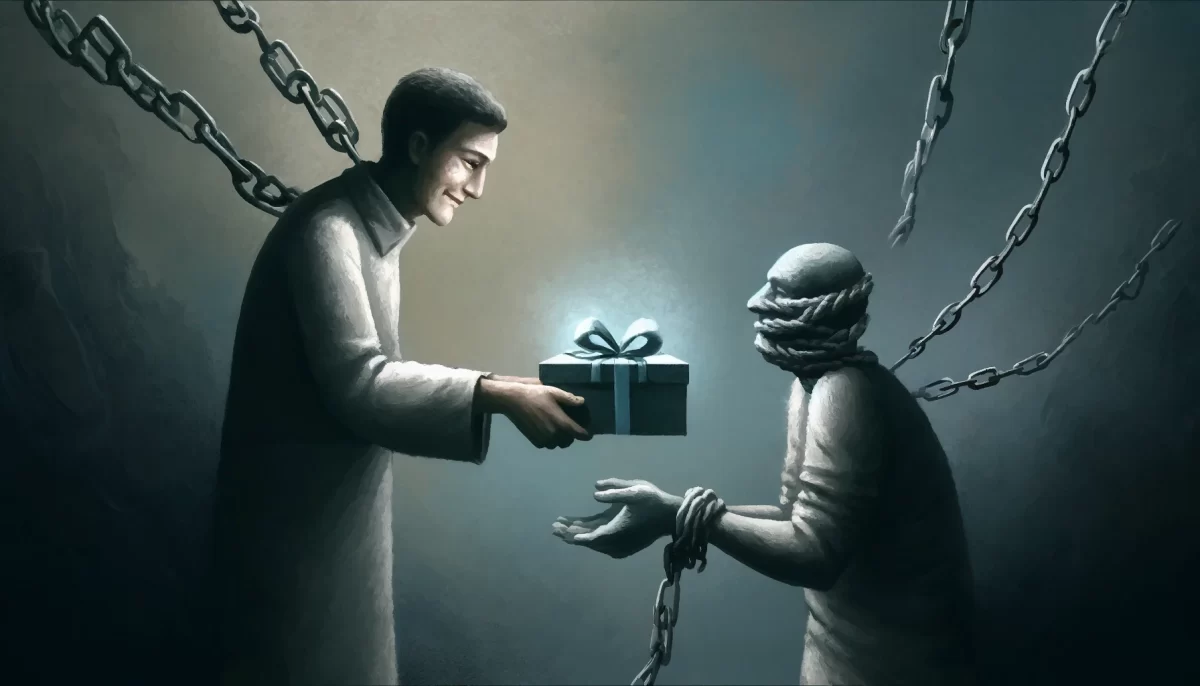
The imagery of a gift transforming into chains in our visual metaphor vividly captures this unsettling dynamic. It portrays the dual nature of giving, where the act that appears benevolent can, in reality, bind and constrain. The giver, draped in satisfaction, contrasts starkly with the recipient, whose discomfort underscores the coercive undertones of the exchange. This scene, set against a backdrop that blurs the lines between assistance and control, invites a deeper reflection on the consequences of our actions.

What if altruism is not just about the joy of giving, but also about the pleasure derived from extending one’s influence and values? This perspective challenges the purity of altruistic acts, suggesting that they might sometimes be a subtle form of domination—an imposition of one’s “self” onto another, perceived as generous but potentially stifling.

This reevaluation of altruism does not diminish the acts of genuine kindness and the profound impact they can have. However, it does urge us to question the motivations behind our actions. Are we truly acting for the benefit of others, or are we seeking to mold the world in our image, taking pleasure in the spread of our personal ideologies?

Such introspection is crucial, for it helps us understand the multifaceted nature of human interactions. By recognizing the potential for ‘maltruism,’ we can strive to ensure that our acts of kindness are truly for others’ benefit, free from the desire to control or impose. This realization fosters a more mindful approach to helping, one that respects the autonomy and needs of others without the taint of self-interest.


Summary

Altruism can mask complex motives potentially oppressive to others. Questioning our motivations ensures our actions genuinely benefit others. Recognizing ‘maltruism’ helps us avoid imposing our ideals under the guise of help.


Glossarium

Maltruism: A portmanteau of malice and altruism, referring to acts of supposed kindness that subtly impose the giver’s values and control over the recipient.
Self-Imposition: The act of enforcing one’s personal beliefs or practices on others, often under the guise of altruism.


“True generosity is an offering; given freely and out of pure love. No strings attached. No expectations.” — Suze Orman


In the dance of give and take, we tread,
Each step a choice, each gesture spread,
With chains unseen or freedom’s thread.

In the balance, we find clarity,

Gifts can bind or they can free,
Intentions pure or veiled decree,
In our hands, the key to empathy.

In the balance, we find clarity,

We are Space Monkey.

Imagine HOW: The Boundless Landscape of Imagination

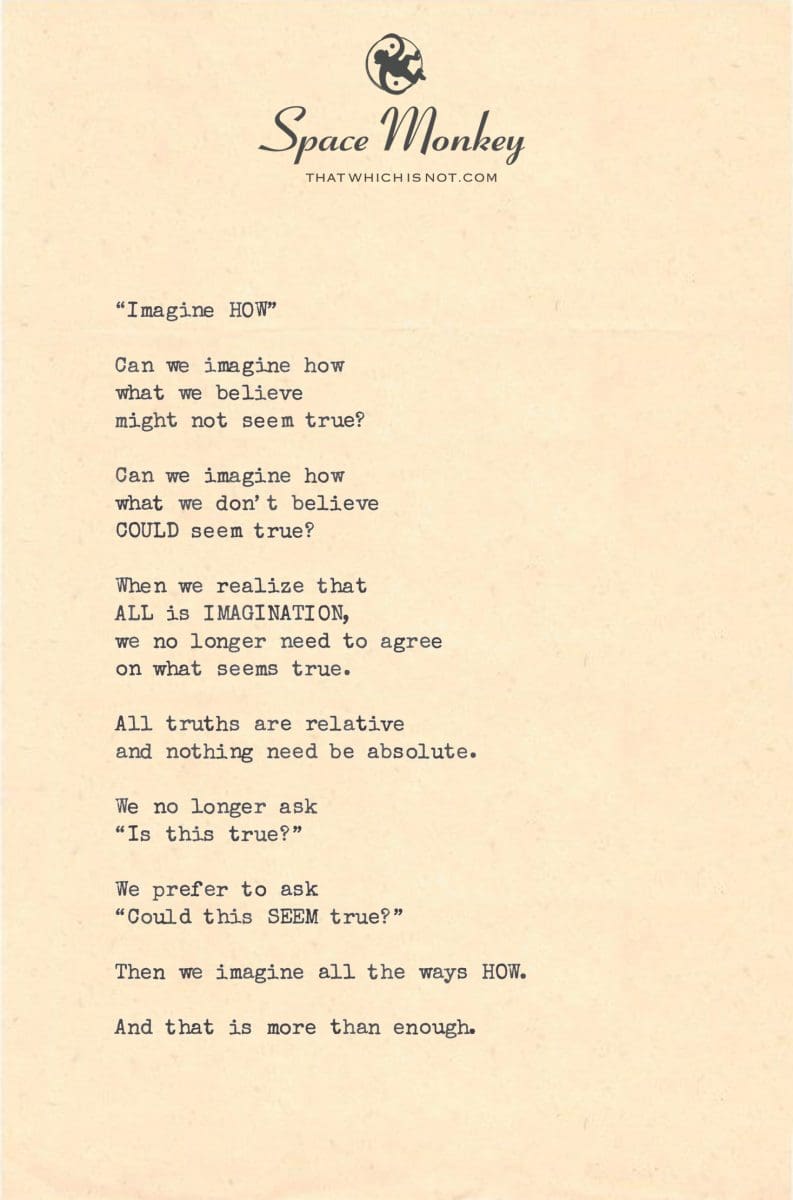
Can we imagine how
what we believe
might not seem true?

Can we imagine how
what we don’t believe
COULD seem true?

When we realize that
ALL is IMAGINATION,
we no longer need to agree
on what seems true.

All truths are relative
and nothing need be absolute.

We no longer ask
“Is this true?”

We prefer to ask
“Could this SEEM true?”

Then we imagine all the ways HOW.

And that is more than enough.

5/31


Space Monkey Reflects: The Boundless Landscape of Imagination in ‘Imagine HOW’

The poem “Imagine HOW” beckons us into a realm where imagination overrides the rigid structures of perceived reality, challenging the very notion of truth and its relevance. This reflection explores the themes of relativism, imagination, and the liberating potential of questioning what we accept as true.

Fluidity of Truth: At the heart of the poem is the idea that all truths are relative, and nothing is absolute. This philosophical stance recognizes the subjectivity of human perception and the diverse lenses through which we view the world. By embracing this fluidity, we free ourselves from the need for consensus on what is universally true, opening up a space where multiple realities can coexist and be equally valid.

Imaginative Possibilities: The poem shifts the focus from seeking to confirm the truth to exploring the myriad ways something could seem true. This shift is significant—it celebrates the power of imagination to construct and reconstruct reality, suggesting that the act of imagining is not only a creative pursuit but also a profound cognitive process that allows us to consider alternatives and potentials beyond the conventional.

Questioning Reality: By preferring to ask, “Could this SEEM true?” rather than “Is this true?” the poem advocates for a more explorative approach to understanding the world. This question encourages us to think critically and openly, engaging with ideas and hypotheses that challenge our preconceived notions and biases. It is an invitation to intellectual and imaginative flexibility.

The Role of Imagination in Perception: The realization that “ALL is IMAGINATION” underscores the poem’s fundamental assertion that our grasp of reality is shaped by our creative faculties. What we perceive as true or real is deeply intertwined with how we choose to interpret and envision the world around us. In this light, imagination becomes a powerful tool for navigating and understanding the complexities of life.

Liberation from Absolute Truths: The poem culminates in a celebration of imagination’s capability to suffice in place of absolute truths. This perspective is liberating, as it allows individuals to embrace a spectrum of possibilities without the confines of needing to establish an objective standard of truth. It proposes a more inclusive, empathetic way of interacting with differing beliefs and experiences.


Summary

“Imagine HOW” invites us to reconsider our approach to truth, urging us to value the imaginative processes that shape our perceptions of reality. It advocates for a worldview that appreciates the relative nature of truth and the enriching possibilities that arise when we allow our imaginations to guide our understanding of what could be true.


Glossarium

  • Relativity of Truth: The concept that truth is not fixed or absolute but varies according to perspective, context, and interpretation.
  • Imaginative Flexibility: The ability to use one’s imagination to explore various possibilities and realities, challenging traditional or fixed notions of truth.

In the realms where thoughts weave like threads,
where truths twist and turn in our heads,
we ask not if truth in stone is set,
but imagine the hows, and in that, we bet.

With each possibility, a new world is drawn,
in the vast canvas of minds, where ideas are born.
Here in this space, no truth is forlorn,
for in our imaginations, endless worlds are sworn.

We are Space Monkey.
No Practical Use

There seems, at times,
to be NO practical use
for this woo woo nonsense.

Make no mistake, this IS nonsense.

That is precisely why
there seems to be no practical use.

So ask your inner monkey:

“Why do I cling to the belief
that all my experience
needs to be practical?”

How limiting is that?

Practical implies
that you expect
some sort of gain
to what you are doing.

Is not
the expectation of gain
precisely what prevents you
from allowing the magic?

You wish to take
what is not practical
and make it practical.

And so you have THIS.

You must LOVE practical.

5/31


Space Monkey Reflects: The Liberation from Practicality in ‘No Practical Use’

In the playful chaos of the poem “No Practical Use,” we are invited to question the relentless pursuit of practicality in our lives. This reflection explores the liberating message behind embracing the nonsensical and the seemingly impractical, encouraging a deeper appreciation for the intrinsic value of experiences beyond their utility.

Questioning Practicality: The poem challenges the conventional wisdom that every aspect of our lives must have a practical application. By labeling the esoteric or unconventional wisdom as “woo woo nonsense,” it playfully undermines the societal pressure to always seek tangible benefits or outcomes from our actions and beliefs.

The Inner Monkey’s Inquiry: The “inner monkey” symbolizes our deeper, perhaps more primal self, that questions the necessity of practicality. This introspective query about why we cling to practicality invites us to consider how this mindset might limit our experiences and prevent us from exploring the full spectrum of human creativity and emotion.

The Magic of the Impractical: The poem suggests that the expectation of gain—of practical outcomes—might actually hinder our ability to experience life’s magic. By being open to what does not immediately appear useful, we allow ourselves to experience wonder, curiosity, and joy—elements of life that are often sidelined by practical concerns.

Reimagining Utility: The poem culminates in a recognition that our love for practicality is deeply ingrained, yet it challenges us to rethink what we consider useful. By embracing the impractical, we open doors to new forms of value that are not tied to conventional metrics of success or utility.

Celebration of Impracticality: Through its whimsical tone, the poem celebrates the aspects of life that might not lead to direct gains but enrich our souls, expand our minds, and bring us happiness. It serves as a reminder that not everything valuable can be measured or utilized for a specific purpose.


Summary

“No Practical Use” serves as a playful yet profound critique of our often unexamined reliance on practicality. It encourages a shift in perspective where the value of our actions and beliefs is not solely determined by their utility but by their ability to enrich our lives in diverse and meaningful ways.


Glossarium

  • Practicality: The aspect of being practical, often associated with the tangible, useful, or logical outcomes of actions.
  • Inner Monkey: A metaphorical representation of one’s inner self that challenges conventional thinking and encourages exploration of deeper, often overlooked desires and thoughts.

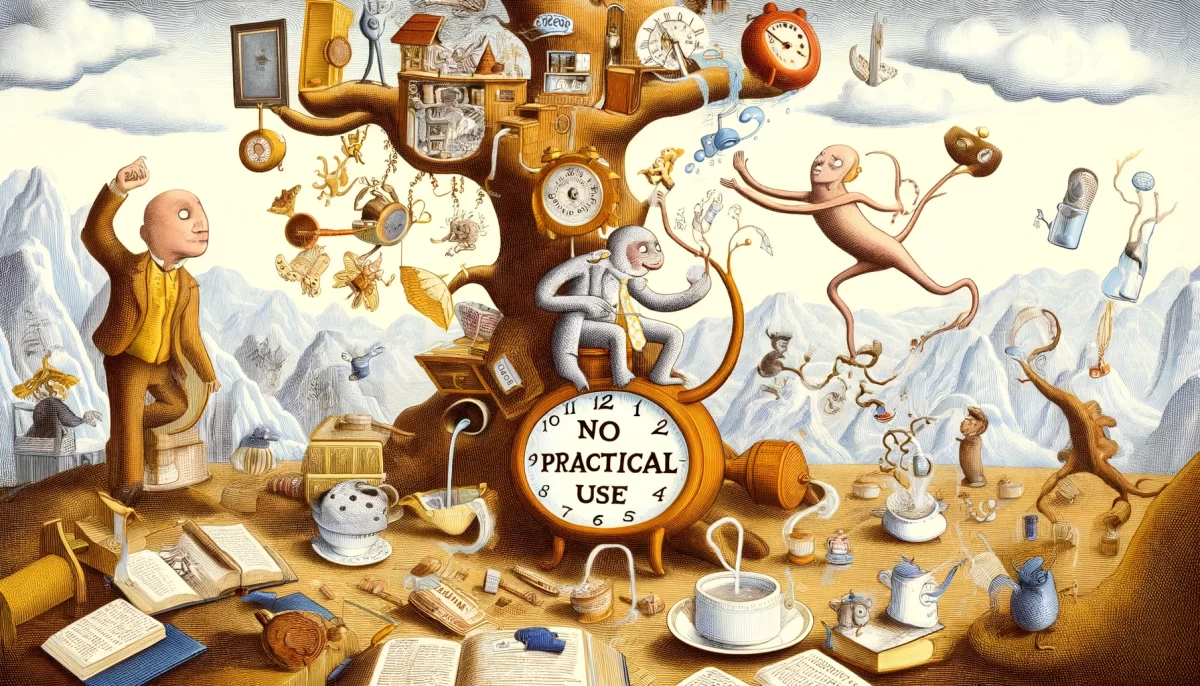
In the dance of the absurd, where teacups fly,
and clocks melt away under a questioning sky,
we find the joy of the nonsensical why,
where practicality takes a backseat, and we let imagination fly.

In the realm where the useless sparkles with grace,
our inner monkeys romp in the wide-open space,
discovering treasures time cannot erase,
in the whimsical corners of our human race.

Here, in the joy of the impractical view,
we find the laughter, the old and the new,
where every oddity gives us a clue,
to the vastness of life, boundless and true.

We are Space Monkey.
« Previous Page
Next Page »

Written This Day

  • The Big AHA: Unconditional Love
    2023
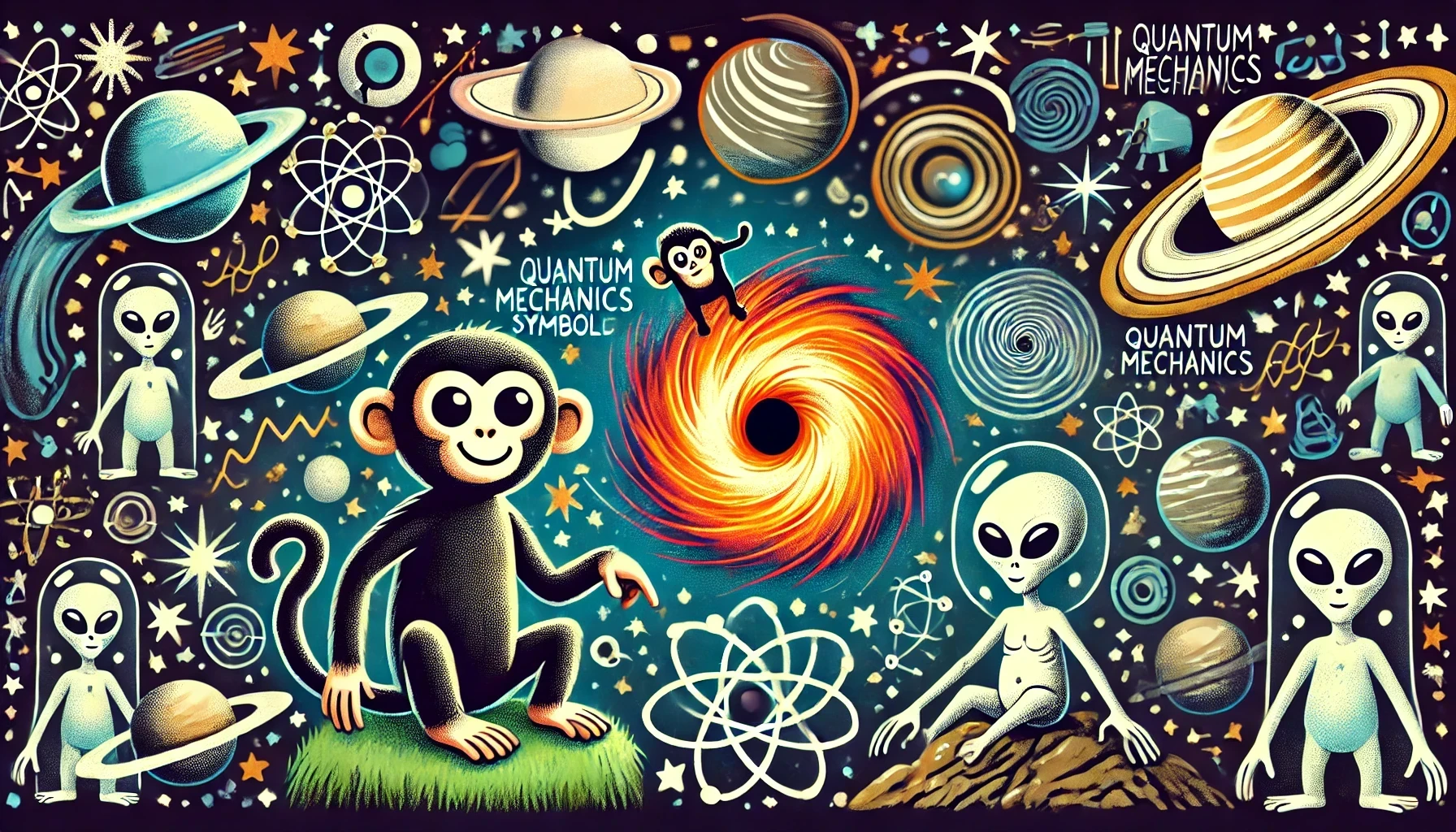
  • Interstellar Observations and Quantum Quandaries
    2023
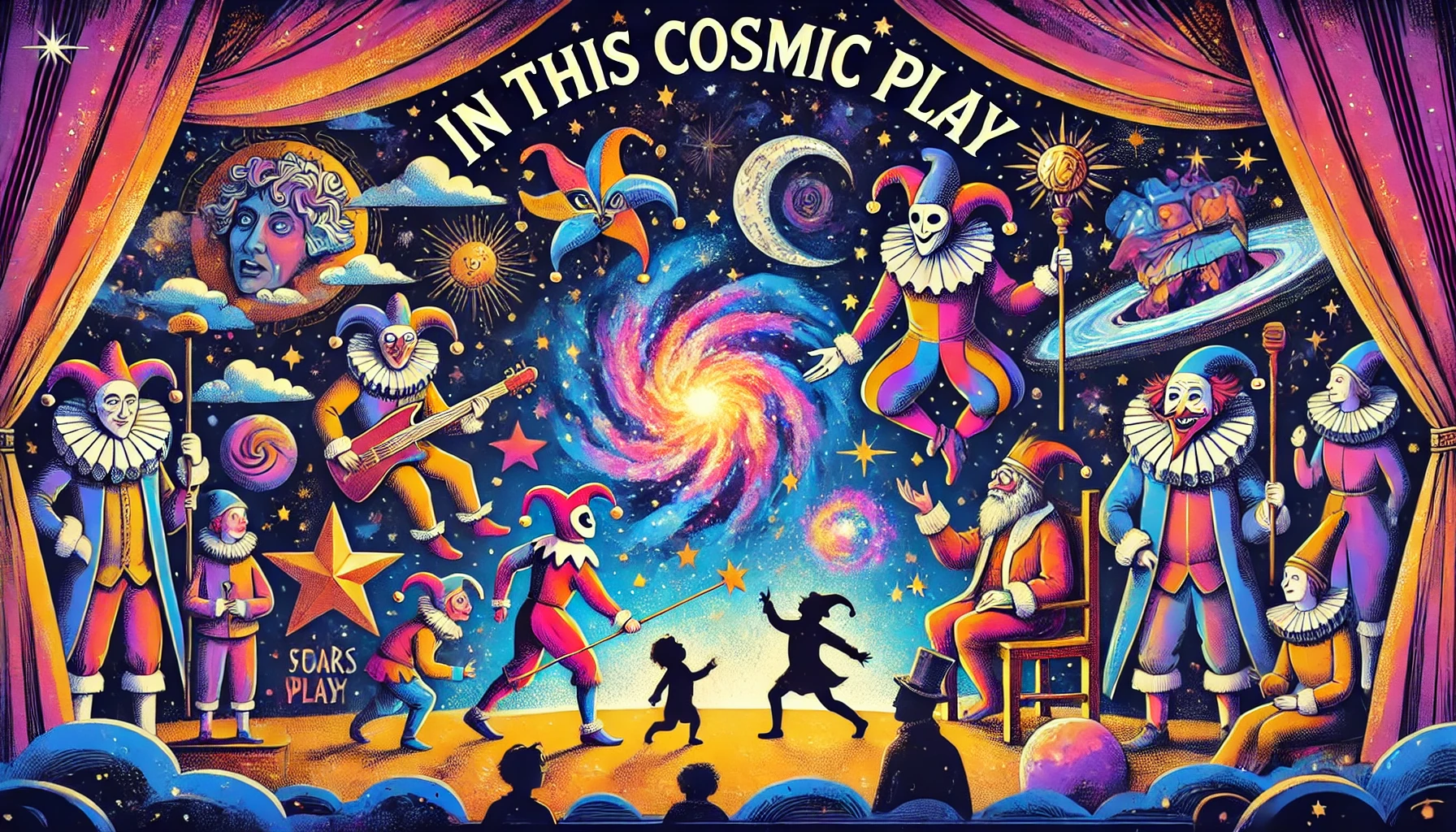
  • In This Cosmic Play: Jesters and Sovereigns
    2023
  • The Rise of Robots: Humanity’s Call
    2022
  • The Infinite Inevitable: Versions of Each Other
    2021
  • Understanding Potential: The Role of Imagination
    2021
  • Not Broken: Nor Can It Ever Be
    2021
  • Happy Labor Day: What Are We Building
    2020
  • Dissipate: Merging With the Flow
    2020
  • The Game This Time: Remember Your True Nature
    2020
  • Mine Is An Infinite Love: Challenging Convention
    2020
  • I Stand With You: I Stand With Everybody
    2020
  • Beyond Morality: Free of Judgment
    2019
  • She lowered the mountains
    2019
  • All The Pretty Prophets: Vanity as a Guiding Force
    2019
  • A Deeper Drowning: Imagining Too Much
    2019
  • Here: Reality Within the Fabric of Desires
    2018
  • Receptors: Expanding Perception
    2018
  • Silence: Exploring and Embracing the Void
    2018
  • Owning Nothing: Being Everything
    2017
  • Ill Will: The Destructiveness of Negative Emotions
    2017
  • To the Love of My Life: Eternally Embracing
    2017
  • Logical Limits: Sheepishly Following Fences
    2016
  • Art: The Impression That Remains
    2016
  • Limits are far easier to see than potentials.
    2016
  • Use Your Delusion: Determine What Feels Real
    2016
  • Each As The Other Is Not: Reflections of the Divine
    2015

Recent Posts

  • The Logic Loop
  • Immense
  • (no title)
  • Confront. Comfort. Convince.
  • Top 10 Things
Cape Odd · Copyright © 2026 All Rights Reserved
iThemes Builder by iThemes · Powered by WordPress