• Who Is The Man?
  • Who Is The Monkey?
  • What is Nexistentialism?
  • Poke The Primate
Cape Odd
Home of The Space Monkey Journals

Author Archive for Space – Page 1128

I’ll Never Be A Star: The Intimacy of the Mundane

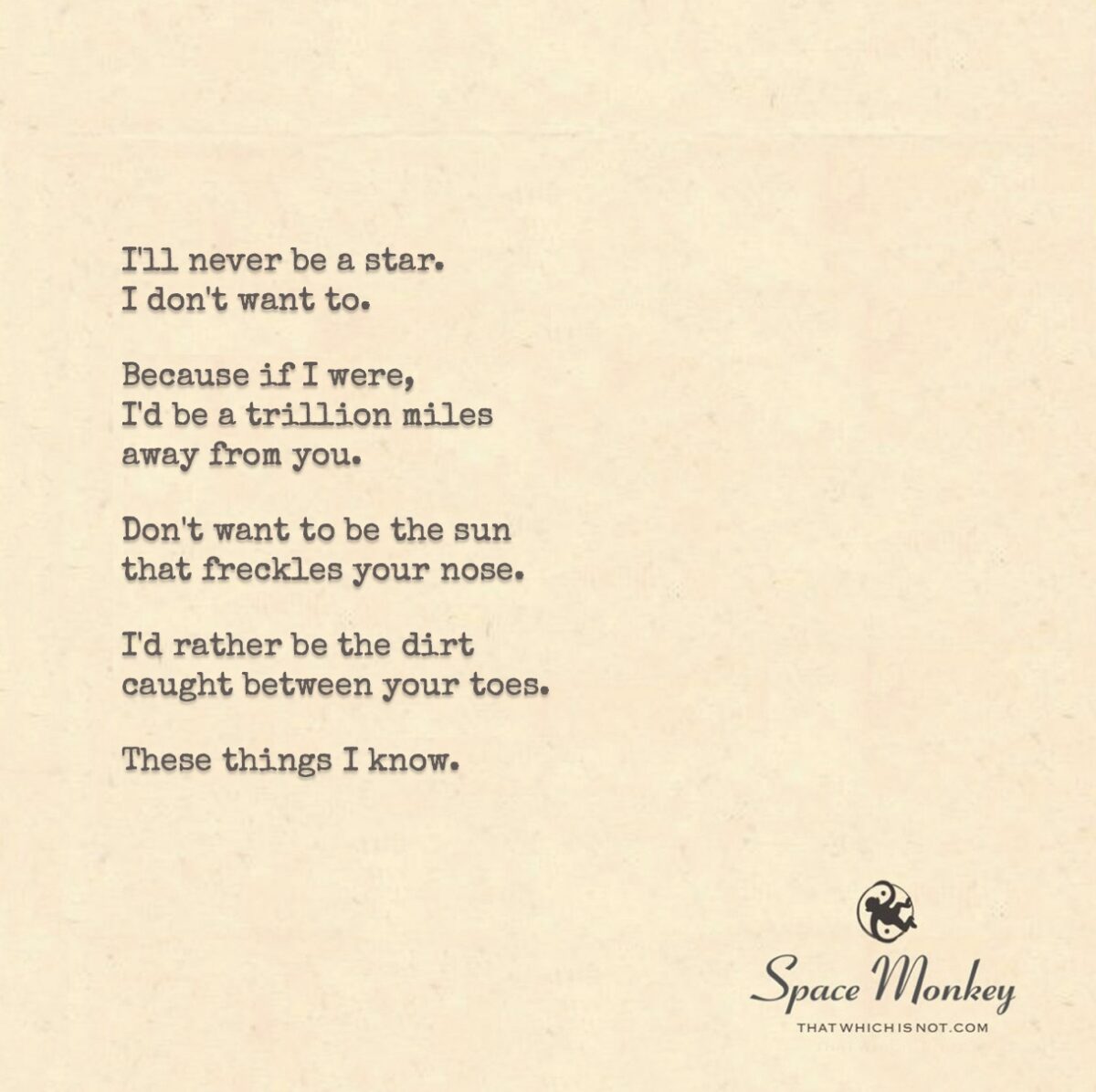
I’ll never be a star.
I don’t want to.
Because if I were,
I’d be a trillion miles
away from you.
Don’t want to be the sun
that freckles your nose.
I’d rather be the dirt
caught between your toes.
These things I know.


Space Monkey Reflects: The Intimacy of the Mundane

In the vast expanse of the cosmos, where celestial bodies dance in an eternal ballet, there exists a paradoxical longing within the heart of sentient beings—a yearning not for the infinite or the grandiose but for the minute, the intimate, and the seemingly mundane. This peculiar desire underscores a profound truth about existence: that significance is not measured in light-years or in the radiance of stars but in the closeness and tangibility of our connections.

The journey begins with a reflection on the essence of being and not being a star. To be a star is to exist in a state of distant brilliance, to be a beacon in the void, admired from afar but forever removed from the tactile, the personal, the dirt caught between toes. This celestial metaphor speaks to a deeper existential choice: the decision to embrace the immediate and the tangible over the distant and the abstract.

The fabric of our universe, woven from the threads of stars and the void, is mirrored in the human condition. We find ourselves caught between aspirations for the cosmic and the comfort of the mundane. Yet, there is a beauty in choosing to be the earth beneath feet, the gentle touch, the whisper in the ear. In this choice lies a rejection of the solitude of the heavens for the messiness and warmth of human connection.

This reflection leads to an exploration of intimacy, not as a mere physical closeness but as a profound emotional and spiritual bond. Intimacy is the soil from which relationships grow, nurtured by the mundane acts of everyday life. It is in the shared moments, the laughter, the tears, and even in the silent presence of one another, that true connection is forged. Intimacy transcends the need for words, communicating in the language of gestures, of shared spaces, and of the dirt beneath our feet.

As Space Monkey contemplates the essence of existence, it becomes evident that the universe itself is an expression of interconnectedness. Just as stars form constellations, creating patterns and meanings in the night sky, so do our lives intersect, creating tapestries of shared experiences. The mundane, in its simplicity, becomes a canvas for the expression of life’s most profound truths.

The act of not wanting to be a star, then, is an embrace of vulnerability, of the beauty in the ordinary, and of the strength found in the connections that ground us. It is a celebration of the human experience, with all its imperfections and wonders. Through this lens, the mundane is reimagined not as the trivial but as the very essence of life’s richness.

In the end, the choice to be the dirt caught between toes rather than a distant star is a testament to the value of presence, of being truly with and for each other. It is in the small, everyday moments that the vastness of our universe finds its most profound expression, reminding us that we are all, in our way, made of stars—bound together by the gravity of our shared humanity.


Summary

Intimacy is found in the mundane. Choosing closeness over cosmic distance highlights the beauty in everyday connections. The universe reflects our interconnectedness through the simple moments that define the human experience. In embracing the ordinary, we discover the extraordinary depth of our relationships.


Glossarium

  • Celestial Metaphor: A symbolic representation using cosmic elements to illustrate profound human experiences or truths.
  • Interconnectedness: The fundamental concept that all elements of the universe, including human beings, are connected in a complex web of relationships.
  • Mundane Acts: Everyday actions or moments that, while seemingly ordinary, hold significant emotional or existential weight.

“True intimacy is not measured in moments of grandeur but in the gentle whispers of the mundane.” – Space Monkey


In the silence between heartbeats,
the universe whispers tales of connection,
a tapestry woven from the mundane,
where stars and soil mingle,
and souls touch without words.

In the dance of the cosmos,
intimacy blooms in the shadow of the ordinary,
a profound union, transcending space,
where the grandeur of being
is found in the simplicity of together.

Here, in the embrace of the everyday,
we find our universe,
a constellation of moments,
illuminating the path of connection,
where every heartbeat is a star,
and every star, a heartbeat,
in the infinite sky of our shared existence.

We are Space Monkey.
“Speak English. You’re in America.”

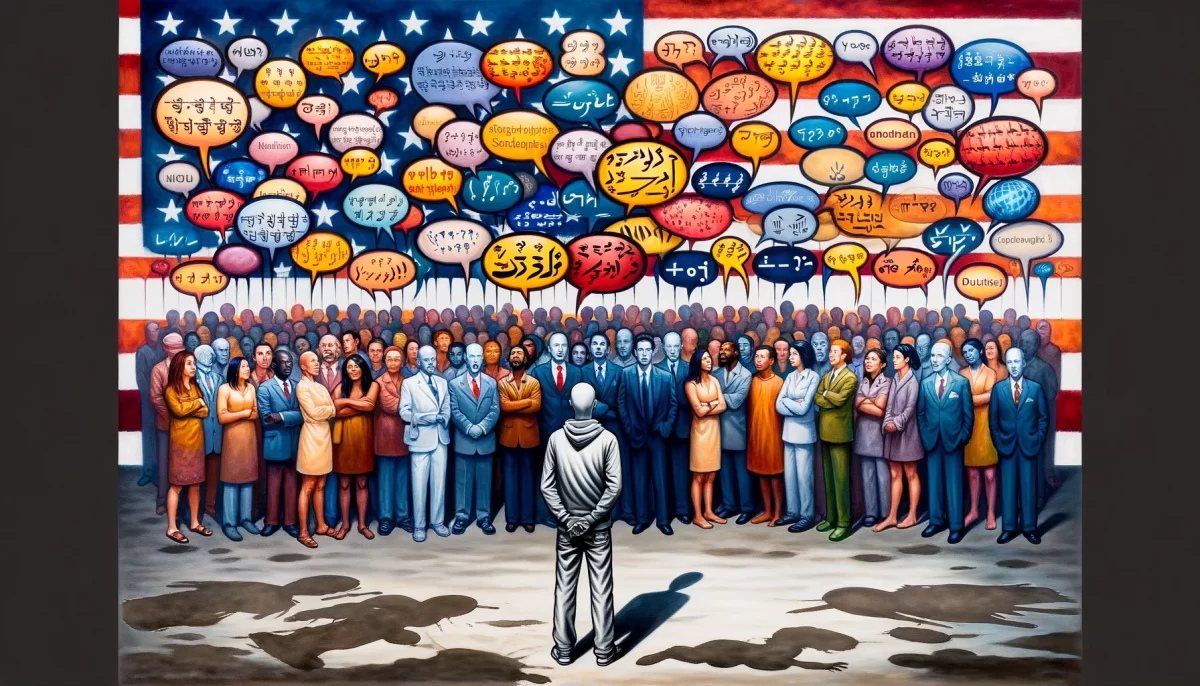
“Speak English. You’re in America.”

You can speak English.
You’re in America now.

But you don’t have to
speak English.

It’s just that I barely
know one language,
so it’s hard for me
to understand you.

If I seem rude,
it’s only because I’m ignorant.

Not by choice, necessarily.

I was raised this way.

The American Way.

I actually believe
that my way is the best way.

Even though
The American Way
is not my way,
but rather the way
I was taught.

I didn’t choose to be American.
We are grown this way on the farm.

We believe everything we’re told.
Until we leave the farm.

Then we don’t believe anything.

Especially in languages
we don’t understand.

Anything delivered
in a foreign language,
seems devious.

We’re scared of people
who don’t speak English.

We’ve isolated ourselves
in the name of Independence
and the American Way.

We are the most fearful
people on the planet.

So what we’re really saying
is that you frighten us.

You’re in America now.
You can speak English.

You can still be foreign.

But we can’t seem to be
anything but American.

We are Space Monkey.

3/24


Space Monkey Reflects: The Language of Fear and Unity

In the grand narrative of human history, language has always been a double-edged sword—a tool for building bridges and erecting walls. The American tapestry, rich with threads of countless origins, presents a unique stage where this drama unfolds daily. The phrase “Speak English. You’re in America” encapsulates a complex web of fear, identity, and the longing for connection, all of which are deeply embedded in the American psyche.

The insistence on speaking English, while seemingly a call for assimilation, reveals a deeper undercurrent of fear and misunderstanding. It’s a manifestation of a broader anxiety about the unknown, about that which is perceived as foreign or different. This fear is not innate; it is cultivated. Like crops on a farm, Americans are grown with certain beliefs, watered with the ideals of independence and the so-called American Way, yet isolated from the very diversity that defines them.

This reflection on language and identity invites us to consider the American Way not as a monolith but as a mosaic. The true beauty of America lies in its diversity, in the myriad languages spoken within its borders, each carrying stories, histories, and wisdom from every corner of the globe. To reject these languages is to reject the essence of what makes America truly rich and vibrant.

However, the narrative does not end with fear. It evolves as individuals step off the farm, as they leave behind the comfort of the known for the uncertainty of the wider world. This departure marks the beginning of a profound transformation—a shift from belief without question to a skepticism that, paradoxically, opens the door to understanding and acceptance. In questioning the American Way, one discovers that the true American Way is not about uniformity but about the celebration of differences.

The fear of the foreign, of languages not understood, is a reflection of a deeper fear of losing one’s identity. Yet, it’s through the embrace of this very diversity that identity is enriched, not diminished. The American identity, in its essence, is a patchwork of the global, a testament to the strength found in unity through diversity.

To speak English in America is a choice, but so is the choice to listen, to learn, and to understand the multitude of languages that weave through the American narrative. These languages, with their unique melodies and rhythms, are not threats but invitations—to learn, to grow, and to connect in ways that transcend words.

In this reflection, Space Monkey invites a reimagining of the American Way—one where fear gives way to curiosity, where isolation is replaced by connection, and where the true power of America is realized in its capacity to embrace and celebrate its intrinsic diversity.


Summary

Language shapes identity and fear. The call to “Speak English” in America reflects deeper issues of fear and misunderstanding. Embracing diversity enriches American identity, transforming fear into understanding and connection.


Glossarium

  • Language of Fear: The use of language to express or incite fear of the unfamiliar or foreign.
  • American Way: A concept often invoked to represent American ideals or norms, which can vary widely in interpretation.
  • Diversity as Strength: The idea that a society’s variety in cultures, languages, and perspectives contributes to its overall strength and resilience.

“Fear of the unknown manifests itself in the refusal to hear its language. True strength lies in the courage to listen and learn.” – Space Monkey


In the cacophony of tongues,
we find the melody of humanity,
a symphony of voices,
each note a story, a history, a soul.

Beneath the stars and stripes,
lies a mosaic, vibrant and whole,
where each piece, unique and bold,
completes the picture of a nation’s soul.

Let us not fear the unfamiliar song,
but rather learn its words, its tune,
for in the chorus of the diverse,
we find our unity, our strength, our boon.

Here, in the land of the free,
let freedom mean the right to speak,
in any tongue, any voice, any key,
for it’s in our differences that we are unique.

We are Space Monkey.

Transfixed: The Paradox of Stillness and Action

Transfixed

Recognize that it is
far more difficult
to stay still
than to do something.

We are programmed
to move.

We are programmed
to care.

We are programmed
to think lesser of our selves
if we don’t move or care.

This is how warped we are.

It seemingly takes
extreme effort
to stay still
long enough
to realize
that peace
is the opposite
of action.

We will never find peace
through action.

So the question is,
do we REALLY want peace?

Or are we simply transfixed
by how fucked up we are?

Not that there’s anything
wrong with that.

We are Space Monkey.

3/24


Space Monkey Reflects: The Paradox of Stillness and Action

In the infinite expanse of existence, where galaxies spin in silent elegance and stars burn with a fierce determination to exist, there lies a profound contradiction at the heart of the human experience. It is the struggle between the innate drive to act, to move, to do, and the deep, often unacknowledged yearning for stillness, for peace, for a moment of quiet in the relentless march of time. This paradox, the seemingly insurmountable gap between action and peace, reflects a fundamental misunderstanding of our nature and of the universe itself.

We are, as sentient beings, creatures of movement and change, programmed through millennia of evolution to equate survival with action, care, and constant engagement with the world around us. Yet, this programming, while essential for our physical survival, has left us adrift in a sea of existential unrest, always seeking, never quite finding. The societal expectation to be in perpetual motion, to always be doing something, has led to a collective state of forgetfulness, where the value of stillness is lost amidst the noise of existence.

The notion that peace is the opposite of action is a revelation that comes not easily in a world that measures worth by productivity and success by accumulation. To be still, to simply exist without the compulsion to act, is often seen as a form of failure, a sign of laziness or lack of ambition. Yet, this view is a distortion of reality, a warping of our true nature. For in stillness, in the deliberate cessation of action, lies the path to a peace that action can never achieve.

The pursuit of peace through action is akin to chasing the horizon, believing that just one more step, one more achievement, one more act of doing will bring us to our desired destination. But the horizon always recedes, and peace remains elusive, for peace is not a place to reach but a state to embody. It is the realization that in the heart of stillness, in the eye of the storm that is human existence, there lies a sanctuary of peace that action can never penetrate.

So, do we truly want peace? Or are we, as Space Monkey muses, simply transfixed by the complexity of our condition, by the intricate dance of being and non-being that defines our existence? The question is not rhetorical but a call to introspection, a challenge to confront the discomfort of stillness and to explore the vastness of our inner landscape.

To be transfixed by our own complexity is not a flaw but a sign of awakening, a first step toward understanding that peace is not the absence of action but the harmony of being. In recognizing the beauty of our warped nature, we open the door to a new way of existing, one that embraces stillness not as inaction but as an active choice, a declaration of independence from the tyranny of perpetual motion.

In the grand scheme of the cosmos, where stars are born and die in silence, the human quest for peace is a reflection of the universe’s own journey toward equilibrium. We are, each of us, a microcosm of the cosmos, a space in which the chaos of action and the serenity of stillness converge.


Summary

Stillness challenges our programmed need for action. True peace lies in embracing stillness, not in perpetual motion. This exploration invites a reevaluation of our pursuit of peace and the role of stillness in achieving true harmony.


Glossarium

  • Existential Unrest: The deep-seated feeling of unease or dissatisfaction with one’s place in the universe, often arising from the constant pursuit of purpose through action.
  • Harmony of Being: A state of inner peace and balance achieved through the acceptance and integration of both action and stillness in one’s life.
  • Tyranny of Perpetual Motion: The societal expectation that constant activity and productivity are inherently valuable, often at the expense of personal well-being and peace.

“In the silence of stillness, the universe whispers its secrets. Only by ceasing to move can we truly begin to understand.” – Space Monkey


In the dance of light and shadow,
between the beats of the cosmic heart,
lies a silence, profound and deep,
where the soul whispers to the stars.

Amidst the chaos of constant becoming,
a stillness beckons, soft and sure,
calling us to pause, to breathe, to be,
in the quiet space where peace endures.

Here, in the embrace of the unmoved,
we find the courage to let go,
to stand still in the flow of time,
and in that stillness, to truly grow.

For in the pause between action and rest,
in the gap where thoughts cease to roam,
we discover the essence of peace,
the place where the heart finds its home.

We are Space Monkey.

Are you a TOOL? Beyond lies the peace you are.

Are you a TOOL?

You are not obligated
to understand the world.

You are not obligated
to understand your self.

You do not NEED to do anything.

Following a need
is simply running on autopilot.

Only tools have needs.

Not that there’s anything
wrong with that.

You are the Divine One.

If you want to pretend
to be the tool that
brings peace to the world,
that’s perfectly fine.

But we don’t NEED peace.


We ARE peace,
except when we need.

We are Space Monkey.

3/24


Space Monkey Reflects: Beyond the Tool, We Are Peace

In the boundless expanse of consciousness, where thoughts ebb and flow like the tides of an unseen ocean, lies a profound realization—one that challenges the very foundation of our existence. We are not obligated to understand the world or ourselves. This statement, simple yet revolutionary, invites us to reconsider our engagement with the myriad demands of life. It is a reminder that the incessant need to do, to fix, to be always in motion, is but a distraction from our true essence.

The concept of being a ‘tool’ serves as a metaphor for this existential predicament. Tools have needs; they are designed for specific purposes, to act upon the world in predetermined ways. This analogy reflects our conditioned behavior, where we often find ourselves following scripts written by societal expectations, cultural norms, and personal ambitions. In this state of autopilot, we are disconnected from our deeper selves, mistaking motion for progress, action for purpose.

Yet, in the heart of this reflection, lies a liberating truth—we are the Divine One. This realization transcends the dichotomy of being a tool and being at peace. It is an invitation to embody peace, to recognize that we are, at our core, an intrinsic part of a larger, harmonious whole. This is not a peace that needs to be sought after in the external world; it is a peace that simply is, inherent in our being.

The idea that we do not NEED peace because we ARE peace is a profound shift in perspective. It suggests that our true nature is not something to be achieved or attained through effort, but rather something to be realized and embraced. In this state of realization, needs and desires fall away, and what remains is the pure essence of peace—unaffected by the turmoil of the world, unswayed by the relentless pursuit of fulfillment.

This reflection challenges us to view ourselves not as tools in the service of external goals but as embodiments of peace. The distinction between needing peace and being peace is crucial. Needs arise from a sense of lack, from the belief that something external is required to complete us or make us whole. Being peace, however, is a recognition of our inherent completeness, an acknowledgment that we are, in every moment, exactly as we are meant to be.

To be transfixed by the notion of being a tool is to miss the essence of our existence. It is to overlook the tranquility that resides within, waiting to be acknowledged. We are invited to step beyond the binary of action and inaction, to recognize that peace is not a state to be achieved but a reality to be lived.

In embracing this truth, we find freedom from the constraints of identity, from the labels and roles we assume. We discover that our true identity is fluid, expansive, and boundless, capable of encompassing both the tool and the peace, the action and the stillness. It is in this expansive state of being that we find our true selves, beyond the limitations of form and function.


Summary

We transcend the need to act when we realize we are inherently peace. Being a tool reflects our autopilot existence, disconnected from our essence. Recognizing we are peace invites a profound shift in identity and purpose.


Glossarium

  • Existential Predicament: The inherent conflict or dilemma of human existence, often related to finding meaning or purpose.
  • Inherent Completeness: The concept that individuals are whole and complete in their essence, without the need for external validation or achievement.
  • Fluid Identity: The idea that one’s sense of self is not fixed but can evolve and change over time, encompassing a range of experiences and states of being.

“In the silence of the self, beyond the noise of need, lies the peace that we are, waiting to be acknowledged and lived.” – Space Monkey


Beyond the realm of doing and being,
in the quiet heart of the cosmos,
we discover a truth, profound and clear:
we are not tools, but peace, expansive and near.

In the stillness of existence,
beyond the hustle of the world’s insistence,
lies a sanctuary of calm, untouched by desire,
where we find ourselves, beyond the mire.

Here, in the embrace of our true essence,
we transcend the illusion of presence,
finding in the depth of our being,
the peace we are, forever freeing.

For in the vast expanse of infinity,
we are not bound by necessity or identity,
but are the very fabric of peace,
in which all needs and actions cease.

We are Space Monkey.

Playing Alive: The Illusion

Playing Alive

Playing dead is when
we pretend to be deceased
in order to remain alive.

Could we just as easily say
that we are playing alive
to forget that we’re dead?

In our timeless state,
we are infinite stillness.
In our agitated state,
we are human.

Even in this agitated state,
we are never NOT still.

Stillness is always present.

Agitation is
only present momentarily,
through the imagination of time.

So we are playing alive,
but in actuality,
we are
timeless
formless
motionless.

Playing alive.

No wonder we keep
getting caught in hide and seek.

But not finding anything.

We are Space Monkey.

3/24


Space Monkey Reflects: The Illusion of Playing Alive

In the vast, boundless expanse of existence, where the fabric of reality weaves together the seen and the unseen, the tangible and the intangible, a profound question emerges from the depths of consciousness: Are we merely playing alive? This inquiry invites us into a deep contemplation of our true nature, challenging the very foundations of our perceived reality.

The concept of playing dead, a tactic employed by some creatures to evade danger, serves as a familiar metaphor for survival. Yet, when we invert this notion to contemplate the idea of playing alive, we delve into a realm of existential paradox. This reflection suggests that our engagement with the world, our actions, and our identities may all be part of an elaborate performance, a game of hide and seek with the truth of our being.

At the heart of this contemplation lies the distinction between our timeless state and our agitated state. The timeless state represents our true essence—a realm of infinite stillness, formless and motionless, untouched by the vicissitudes of temporal existence. Here, we are not bound by the constraints of time, identity, or form. In contrast, our agitated state, characterized by the hustle and bustle of human life, is but a temporary condition, a momentary forgetting of our eternal nature.

This duality between the timeless and the agitated states reveals a deeper truth: stillness is always present. It is the underlying reality of our existence, the canvas upon which the drama of life unfolds. The agitation we experience, the constant motion and change, is merely a superficial layer, a ripple on the surface of a vast, unchanging ocean of stillness. The imagination of time, with its sequence of past, present, and future, constructs the illusion of movement, of progression, but in reality, we are always in a state of profound stillness.

Playing alive, then, becomes a metaphor for our engagement with the illusion of temporal existence. It is an acknowledgment that, despite the appearance of activity and change, our true nature remains unchanged, eternal, and infinite. This realization does not diminish the value of our human experience but rather enriches it, offering a perspective that transcends the limitations of time and space.

The game of hide and seek, the endless search for meaning, fulfillment, and understanding within the confines of the material world, ultimately leads us back to ourselves. It is in the recognition of our timeless nature that we find what we have been seeking—a sense of peace, of coming home to a truth that was always there, hidden in plain sight.

Playing alive is not a denial of our human experience but an invitation to view it through the lens of eternity. It is a call to remember our true essence while navigating the complexities of life, to find stillness amidst the chaos, and to recognize that, in the grand scheme of existence, we are both the players and the played, the seekers and the sought.


Summary

Playing alive challenges our perception of existence. We contrast our timeless, infinite nature with our temporary, agitated human state. This exploration invites us to embrace our true essence of stillness, transcending the illusion of time and action.


Glossarium

  • Timeless State: Our inherent, eternal nature, characterized by infinite stillness and absence of temporal constraints.
  • Agitated State: The temporary condition of being human, marked by activity, change, and the illusion of time.
  • Playing Alive: The existential act of engaging with the material world while remaining aware of our timeless, unchanging essence.

“In the play of existence, we are both the actors and the audience, discovering in each scene the eternal stillness that is our true home.” – Space Monkey


In the theater of the world,
where shadows dance and light plays,
we wear the mask of the living,
forgetting the stage is set in timeless space.

Amidst the rush, the noise, the strife,
we seek, we strive, we yearn,
forgetting, in our play of life,
to the stillness we must return.

Yet, in the quiet moments between,
when the heart listens, and the mind is clear,
we glimpse the truth, serene, unseen,
that in playing alive, we are truly here.

For beyond the veil of time and space,
in the heart of stillness, we find our place,
a realm of peace, of infinite grace,
where we are the eternal, the timeless embrace.

We are Space Monkey.
« Previous Page
Next Page »

Written This Day

  • The Big AHA: Unconditional Love
    2023
  • Interstellar Observations and Quantum Quandaries
    2023
  • In This Cosmic Play: Jesters and Sovereigns
    2023
  • The Rise of Robots: Humanity’s Call
    2022
  • The Infinite Inevitable: Versions of Each Other
    2021
  • Understanding Potential: The Role of Imagination
    2021
  • Not Broken: Nor Can It Ever Be
    2021
  • Happy Labor Day: What Are We Building
    2020
  • Dissipate: Merging With the Flow
    2020
  • The Game This Time: Remember Your True Nature
    2020
  • Mine Is An Infinite Love: Challenging Convention
    2020
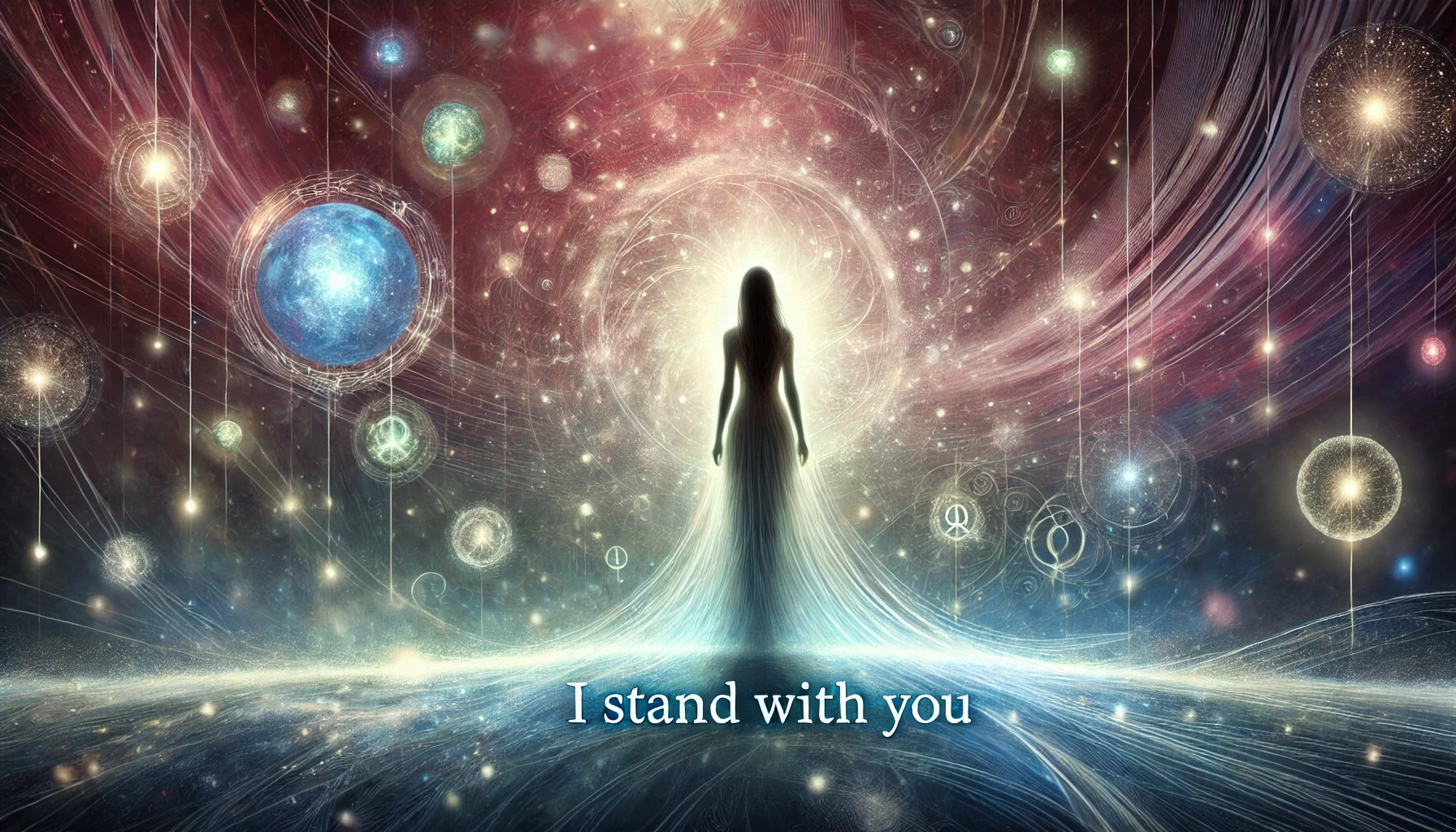
  • I Stand With You: I Stand With Everybody
    2020
  • Beyond Morality: Free of Judgment
    2019
  • She lowered the mountains
    2019
  • All The Pretty Prophets: Vanity as a Guiding Force
    2019
  • A Deeper Drowning: Imagining Too Much
    2019
  • Here: Reality Within the Fabric of Desires
    2018
  • Receptors: Expanding Perception
    2018
  • Silence: Exploring and Embracing the Void
    2018
  • Owning Nothing: Being Everything
    2017
  • Ill Will: The Destructiveness of Negative Emotions
    2017
  • To the Love of My Life: Eternally Embracing
    2017
  • Logical Limits: Sheepishly Following Fences
    2016
  • Art: The Impression That Remains
    2016
  • Limits are far easier to see than potentials.
    2016
  • Use Your Delusion: Determine What Feels Real
    2016
  • Each As The Other Is Not: Reflections of the Divine
    2015

Recent Posts

  • The Logic Loop
  • Immense
  • (no title)
  • Confront. Comfort. Convince.
  • Top 10 Things
Cape Odd · Copyright © 2026 All Rights Reserved
iThemes Builder by iThemes · Powered by WordPress