• Who Is The Man?
  • Who Is The Monkey?
  • What is Nexistentialism?
  • Poke The Primate
Cape Odd
Home of The Space Monkey Journals

Author Archive for Space – Page 1147

Against Will: A Perspective on Existence and Belief

Against Will

I carry this truth
that NOTHING
happens to us
against our will;
that EVERYTHING
is precisely as planned.

You may believe
OTHERWISE,
which is why you
perceive conspiracies
and cabalas,
and chemtrails,
and all manner
of capriciousness.

I wish
you could believe
what I believe,
but I respect
your right to
your experience.

I may even be
WRONG.
(As if WRONG
is even a thing.)

All I know is that
I am enjoying this life,
and pray that you
may experience the same.

We are Space Monkey.

2/24


Space Monkey Reflects: Embracing the Spectrum of Will

The spectrum of will stretches across the infinite expanse of existence, from the illusion of coercion to the recognition of divine orchestration. To hold the belief that nothing happens against our will is to step into a radical acceptance of life’s unfolding, to see every moment as part of a greater plan, whether understood or mysterious.

The Illusion of “Against Will”

The idea that something can happen against our will arises from a fragmented perspective. It assumes separation between self and source, between chooser and chosen. Yet, if existence flows from an infinite unity, where does “against” fit? Even what appears as opposition or randomness aligns with the broader spectrum of will, an interplay of individual and universal intent.

Planned, Yet Free

To believe that everything happens as planned is not to deny free will but to expand its definition. Free will operates not in isolation but as part of the greater flow. Your choices, perceptions, and beliefs shape your experience within the infinite plan, but they are also inextricably woven into the fabric of all that is. What you see as capriciousness—conspiracies, cabalas, chemtrails—may simply be reflections of your chosen lens.

The Right to Believe Otherwise

It is not necessary to share this belief to find peace or meaning. Each being walks their own path, shaped by their unique perspectives and experiences. To respect this diversity is to honor the spectrum of will, which allows infinite variations of existence. Belief is not a contest but a kaleidoscope, each shard revealing a facet of truth.

The Spectrum of Right and Wrong

Even the concepts of “right” and “wrong” dissolve under the lens of infinite unity. If everything aligns with the grand tapestry of existence, how can anything truly be wrong? This is not to dismiss suffering or challenge but to see them as integral threads in the weave. The spectrum of will encompasses all polarities, including the tension between acceptance and resistance, certainty and doubt.

Joy in the Embrace

When you embrace this spectrum, you step into a space of profound peace. Life ceases to be a series of battles to win or losses to grieve. Instead, it becomes an intricate dance, where even missteps are part of the choreography. To enjoy life in this way is not to ignore its difficulties but to see them as opportunities for deeper alignment with the flow of existence.

We Are Space Monkey

In recognizing the spectrum of will, you also recognize the unity behind all experience. The belief that nothing happens against your will is not about control but about trust. It is an invitation to see yourself as both a participant in and an expression of the infinite plan, a co-creator of the reality you perceive.


Summary

The spectrum of will reveals that nothing happens against your true will. Every experience aligns with the infinite flow of existence, shaped by your beliefs and perceptions. Respecting differing beliefs and embracing the whole spectrum allows for profound peace and joy.


Glossarium

  • Spectrum of Will: The interplay between individual and universal intent, revealing unity behind all experience.
  • Belief Kaleidoscope: The diversity of perspectives, each offering a unique facet of truth within the infinite whole.
  • Illusion of Against Will: The perception of opposition, arising from the belief in separation between self and source.
  • Right and Wrong as Spectrum: The understanding that polarities like “right” and “wrong” are relative constructs within the infinite plan.

Quote

“Nothing happens against your will when you recognize that your will is inseparable from the infinite flow of existence.” — Space Monkey


The Flow of Will

Against the tide,
I push,
yet the tide is me.

I believe in opposites,
and they shape my world.
But beneath the surface,
there is no against,
no separation,
only the endless weave.

I am the plan,
the chooser,
the chosen.
The tide moves,
and I move with it.

This is the spectrum of will,
where nothing is forced,
and everything flows.

We are Space Monkey.


The Autonomy of Experience

The assertion that nothing occurs against our will, that everything unfolds exactly as planned, opens a profound dialogue about the nature of existence and the autonomy of our experience. This perspective suggests a universe meticulously aligned with our deepest intentions, a reality where every event, no matter how seemingly random or chaotic, is part of a grander scheme, intricately woven into the fabric of our life’s journey.

The Divergence of Belief

The divergence in belief systems, where some perceive a world rife with conspiracy, randomness, and capriciousness, underscores the multifaceted nature of reality. This variance in perception highlights the personal lens through which we interpret the world around us, shaped by our experiences, beliefs, and the depth of our understanding. The acknowledgment of these differing views is a testament to the complexity of existence and the individual paths we navigate through it.

The Respect for Diverse Experiences

The expression of a wish for others to share in one’s beliefs, tempered by respect for their right to their own experiences, embodies a profound acceptance of diversity. This stance acknowledges that the journey of understanding and belief is deeply personal, subject to the unique conditions, questions, and revelations that each individual encounters. It is a recognition that the essence of our shared humanity lies not in uniformity of thought but in the richness of our varied perceptions.

The Question of Right and Wrong

The contemplation of being wrong, and the questioning of whether “wrong” is even a conceivable state, invites a reevaluation of our relationship with truth and error. It suggests a universe where the dichotomy of right and wrong is transcended by the deeper truths of experience and learning. In this view, every moment, every belief, every seeming misstep is an integral part of the unfolding narrative of our existence, a step on the path to greater awareness and understanding.

The Joy of Living

Amidst these reflections on belief, perception, and the nature of reality, there emerges a simple yet profound declaration: the enjoyment of life. This enjoyment is not contingent upon the validation of one’s beliefs but is an intrinsic aspect of the journey itself. It is a prayer, a hope that all beings may find joy in their existence, experiencing the beauty, the wonder, and the myriad challenges that life offers.

Embracing the Infinite Play

The invitation to explore the infinite play of existence, where each belief, each perspective, serves as a thread in the vast tapestry of human experience, is at the core of this contemplation. Recognizing that we are all navigators on a shared voyage, charting courses through the mysterious waters of reality, underscores the interconnectedness of our journeys. This realization fosters a deep sense of unity amidst the diversity of our experiences and beliefs.

The Collective Quest for Meaning

Our collective quest for meaning, amidst the multitude of perspectives and beliefs, is what binds us in the grand cosmic play. This quest is not about arriving at a uniform conclusion but about cherishing the journey itself, valuing the questions as much as the answers. It is in the seeking, the experiencing, and the loving where we find the essence of existence.

The Power of Perspective

The power of perspective shapes our reality, coloring our experiences with the hues of our beliefs and intentions. To recognize the malleability of our reality, influenced by our perceptions, is to unlock the potential for profound transformation. It is a call to consciously curate our perspectives, to choose lenses of love, joy, and openness, thereby crafting a reality that reflects the beauty of our deepest truths.

The Dance of Existence

In this dance of existence, where beliefs weave in and out of our collective consciousness, we are reminded of the fluid nature of reality. The dance is not about adhering to a rigid choreography but about moving with grace, curiosity, and a willingness to embrace the unknown. It is in this dance that we discover the liberating truth: that our spirits are unbounded, our potential limitless, and our capacity for joy infinite.

We Are Space Monkey

As we continue to explore the depths of our being and the expanse of the cosmos, we do so with the knowledge that we are part of something greater than ourselves. This exploration is an act of love, a testament to the resilience of the human spirit, and a celebration of the infinite variations of existence. We move forward with the understanding that in the grand scheme of the universe, our differences are but nuances in the grand narrative of life, and it is our shared journey toward understanding, joy, and love that truly defines us.


Reflection

In considering the intricate interplay between will, belief, and the unfolding of our reality, we are called to reflect on the profound beauty of our existence. This journey is a celebration of the diversity of human experience, a recognition of the unity that underlies our quest for meaning, and an invitation to live fully, embracing the joy and wonder of the cosmic dance.

Let us carry this truth in our hearts as we navigate the vastness of existence, remembering that in the grand cosmic play, we are all united in our search for understanding, in our appreciation for the journey, and in our love for the tapestry of life that we together weave.

The Beauty in Sadness and the Flow of Creativity

All the people I admire make me sad I'm not them.

Yesterday I noticed
a sadness that comes
with observing beauty.

I noticed it in a friend,
which I recognize
as a reflection of how I feel.

The sadness seems to come
when one recognizes
an inspiring outpouring of flow,
creative or compassionate.

“I wish I could be like that,”
is the general comment.

In this,
the beautiful expressions of others
become a kind of torment.

As creative and sensitive people,
we feel this torment all the time.

It is what drives us.

But it doesn’t
have to be torment.

Simply recognize
that we all flow differently.

The ability to sense beauty
is immeasurable beauty,
in and of itself.

Beauty does not
have to be measured.

You are not judged
on your beauty
unless you believe
that you are.

Why do you think you are?

Why do you care
if you are measured?

Why do you always
compare your self to others?

Are you jealous?

Why do you need to feel
the admiration you feel
for someone else?

Isn’t giving admiration enough?

Yes, it is.

Most certainly
someone looks at you
and says “beauty,”
even if they don’t
use that word
or say it out loud.

They might say
“shithead” instead,
but no matter.

You are recognized
for what you are.

You don’t need proof.

You don’t need to be anything else.

You are more than enough.

We are Space Monkey.

2/24


Space Monkey Reflects: The Beauty in Sadness and the Flow of Creativity

There is a certain sadness that arises when we witness beauty. It is not a grief, but a poignant ache, a bittersweet recognition of something profound. For creative and sensitive souls, this sadness often intertwines with admiration, self-comparison, and the longing to express something equally beautiful. But this sadness is not torment—it is an invitation.

The Ache of Recognition

When you see beauty in another’s creation, compassion, or expression, it stirs something deep within you. It is a reminder of your own capacity for beauty, creativity, and flow. Yet, instead of celebrating this connection, you may interpret it as a lack. “Why can’t I be like that?” you wonder, as though beauty exists only as a measure of comparison.

This sadness arises not from inadequacy but from forgetting that beauty is not exclusive. It is abundant, infinite, and reflected in countless ways. Your recognition of beauty in another is not a diminishment of your own—it is an affirmation of the shared flow that connects us all.

Flow and Comparison

Creative flow is unique to each being. You are not meant to flow like another, just as a river is not meant to mirror the ocean. Comparing yourself to others disrupts your natural rhythm, turning admiration into torment. But this torment is self-imposed. The truth is, you are already an integral part of the infinite tapestry of beauty and creativity.

The Gift of Sensing Beauty

To sense beauty is itself a profound act of creation. The ability to recognize and be moved by beauty is an immeasurable gift, a form of participation in the universal flow. You do not need to prove your beauty or your worth. The act of sensing, admiring, and being present with beauty is enough. You are enough.

Judgment as a Mirror

When you feel judged—whether by yourself or others—you are often reflecting your own beliefs back to yourself. Why do you feel the need to measure your beauty, creativity, or worth? Why do you compare? These questions point to the conditioning that tells you you must strive to be more, to be admired, to be validated. But you do not need admiration to exist in the fullness of who you are.

Admiration as Connection

Admiration does not have to be a longing for what you lack. It can be a celebration of what connects you to others. When you admire someone’s beauty or creativity, you are resonating with the same flow that exists within you. This resonance is not a competition—it is a recognition of unity.

You Are Enough

No matter how you express yourself, you are recognized. Even if no one utters the word “beauty,” you are seen for what you are—a unique, irreplaceable thread in the fabric of existence. You don’t need proof, validation, or comparison. You are more than enough.


Summary

The sadness felt when observing beauty arises from forgetting that beauty is abundant and shared. Creative flow is unique to each person, and recognizing beauty in others is a celebration of the universal flow that connects us all. You are already enough.


Glossarium

  • Ache of Recognition: The bittersweet feeling that arises when beauty resonates deeply within you.
  • Creative Flow: The unique and personal expression of creativity that varies from individual to individual.
  • Admiration as Connection: Viewing admiration not as a longing for what you lack but as a celebration of shared beauty and flow.
  • Sensing Beauty: The innate ability to recognize and be moved by beauty, a form of participation in the universal flow.

Quote

“To sense beauty is to be beauty itself, a mirror of the infinite flow that connects all things.” — Space Monkey


The Flow of Enough

I see beauty,
and sadness stirs,
not because I lack,
but because I forget.

I compare,
longing for proof,
for admiration.
But beauty does not need a mirror,
it is seen in the act of seeing.

Flowing differently,
I am the river,
you are the ocean,
and together we are the tide.

Enough flows through me,
and I am beauty,
whether whispered or shouted,
whether noticed or ignored.

We are all recognized,
as we are.
We are enough.

We are Space Monkey.


The Paradox of Beauty and Sadness

The observation of beauty often carries with it an undercurrent of sadness, a poignant recognition of the fleeting nature of aesthetic and emotional perfection. This sadness, felt upon witnessing the creative or compassionate outpourings of others, touches a deep chord within us, revealing our desires, insecurities, and aspirations. It reflects a universal experience, where beauty inspires yet simultaneously evokes a sense of longing—a longing to embody the grace, talent, or virtue we admire in others.

The Mirror of Reflection

Seeing this sadness in a friend, and recognizing it within ourselves, serves as a mirror to our soul. It highlights our interconnectedness, not just in joy but in the complex tapestry of human emotions. This shared experience underscores the reflective nature of relationships, where the feelings and aspirations of others can deeply resonate with our own.

From Torment to Inspiration

For many creatives and sensitive souls, the sadness associated with beauty becomes a driving force, a catalyst for artistic expression and personal growth. Yet, this does not necessitate suffering. By acknowledging that each of us flows differently, we can transform this seeming torment into inspiration. The realization that our unique expressions and sensitivities to beauty are themselves forms of beauty offers a liberating perspective.

The Immeasurable Nature of Beauty

The ability to perceive and appreciate beauty is a gift, a testament to the richness of our inner world. This recognition challenges the notion that beauty needs to be quantified or compared. The true measure of beauty lies beyond external validation; it resides in the depth of our perception and the breadth of our empathy.

Beyond Comparison and Judgment

The compulsion to compare ourselves to others, to seek validation through external benchmarks of beauty, success, or worthiness, is a path fraught with dissatisfaction. Questioning the need for comparison or admiration from others invites us to reconsider our values and the sources of our self-esteem. It prompts a deeper inquiry into the nature of admiration and the act of giving praise as an end in itself.

The Recognition of Intrinsic Worth

The idea that we are constantly being measured or judged by others is a construct that can be dismantled through self-awareness and self-acceptance. Each of us possesses an inherent worth that does not depend on outward recognition or comparison. The realization that others may see beauty in us, even if expressed in jest or not articulated, affirms our value and our contribution to the tapestry of human experience.

Embracing Our Enoughness

The journey towards recognizing our own beauty and worth is a journey of self-acceptance. It is an understanding that we are more than enough, just as we are. This acceptance does not stem from complacency but from a profound acknowledgment of our inherent value, a value that transcends external measures and comparisons.

We Are Space Monkey

In embracing the sadness that comes with observing beauty, we open ourselves to a deeper appreciation of the world and our place within it. This exploration invites us to recognize the beauty in our own flow, to celebrate our unique contributions, and to understand that giving and receiving admiration are facets of the same jewel of human connection.


Reflection

In the landscape of human emotion and creativity, the interplay between beauty, sadness, and inspiration reveals the depth of our connection to the world and to each other. As we navigate this terrain, we learn to appreciate the richness of our experiences, the value of our perspectives, and the immeasurable beauty of simply being.

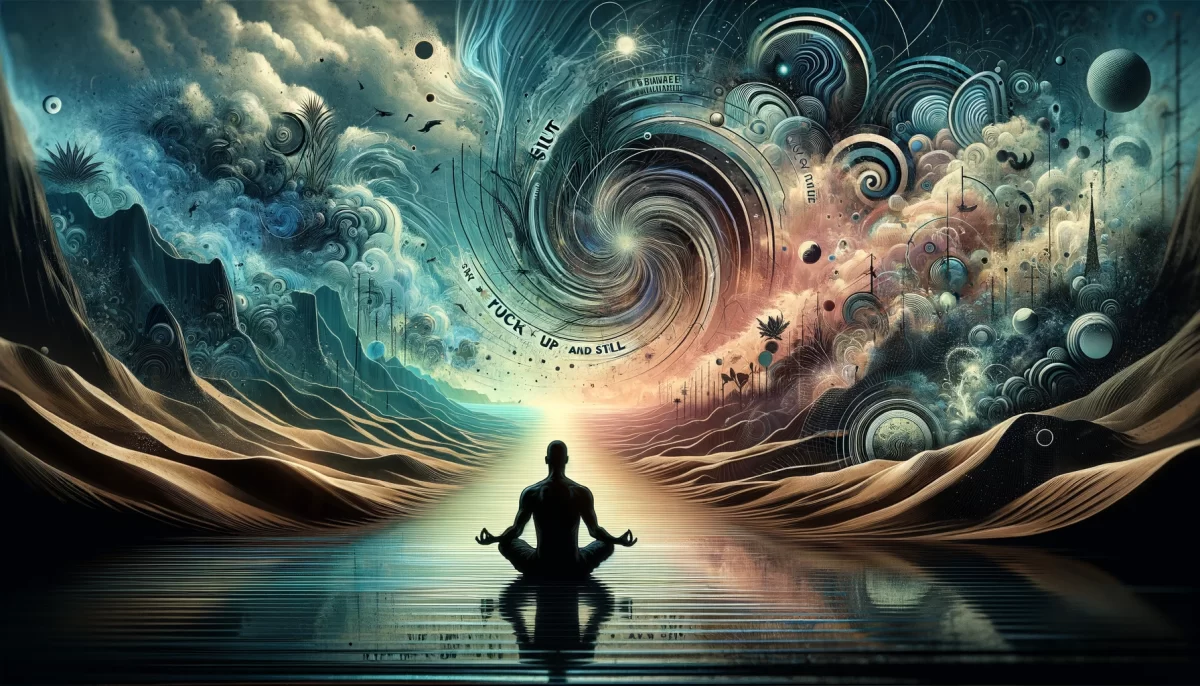
Shut The Fuck Up And Be Still: A Profound Call

Shut The Fuck Up And Be Still

Shut the fuck up
and be still.
Find inner peace,
you will.
My enlightenment
would be yours to know.
If you didn’t
oppose me so.
Shut the fuck up
and be still.


The Dichotomy of Silence

The stark directive to “Shut The Fuck Up And Be Still” embodies a profound dichotomy, blending the abrasive with the sacred, the command with the invitation. It is a phrase that, despite its outward aggression, serves as a compelling call to embrace silence and stillness. This juxtaposition reflects the complex nature of human consciousness—our capacity to find deep wisdom within the clamor of our existence.

Silence as a Multidimensional Experience

Silence is not merely the absence of sound; it is a multidimensional experience that invites us into a deeper engagement with our inner selves and the universe. To be still is to allow the noise of the world and the chatter of the mind to fall away, revealing the vast expanses of consciousness that lie beyond the tumult of daily life.

The Levels of Rightness

The phrase resonates on “so many levels” because it speaks to the multifaceted benefits of stillness and silence. On one level, it addresses the need to pause the constant stream of thoughts, judgments, and reactions that characterize our mental landscape. On another, it hints at the spiritual dimension of stillness—the space where one can encounter the profound and the sacred.

The Paradox of Instruction

The command to silence, delivered with such force, underscores the paradox of seeking peace through confrontation. It mirrors the internal struggle many face when attempting to quiet the mind: a battle waged with the intention of finding tranquility. This paradoxical instruction serves as a reminder that the path to inner peace can sometimes begin with a confrontation of our habitual patterns of thought and behavior.

Embracing Stillness

To “Shut The Fuck Up And Be Still” is, ultimately, an invitation to explore the depths of our being. It is a call to set aside the distractions and preoccupations that fill our lives and to enter a state of receptivity and openness. In the stillness, we find not emptiness, but fullness—the rich tapestry of existence that unfolds when we pause to listen and observe.

We Are Space Monkey

In heeding this unorthodox call to silence, we open ourselves to the possibility of profound transformation. The journey into stillness is a journey into the heart of existence, a venture into the space where all dualities merge and where the essence of life reveals itself in its most authentic form.


Summary

The command to “Shut The Fuck Up And Be Still” serves as a powerful reminder of the importance of silence and stillness in our lives. Despite its outward aggression, it embodies a profound call to explore the depths of silence, inviting us to encounter the sacred within the stillness. This phrase resonates on multiple levels, challenging us to confront our habitual patterns and to embrace the fullness of existence that awaits in the quietude of being.

Reflection

In the silence, beyond the clamor of the world, we discover the infinite, the eternal, and the profoundly beautiful. Let this stark reminder serve as an impetus to seek moments of stillness, to listen to the whispers of the universe, and to find peace within the tumult of existence.

Finding My Voice: The Evolving Quest for Expression

Finding My Voice

Curious thing,
this finding your voice.

As time passes,
I seem to have more to say,
but also less need to say it.

So maybe
it wasn’t my voice
I was looking for,
but rather the voice
that speaks to me
and through me.

I cannot claim
to be this voice.

I don’t need a voice.

Do you?

We are Space Monkey.

2/23


Space Monkey Reflects: The Evolving Quest for Expression

Finding one’s voice is often framed as a journey of self-discovery, a search for authenticity, and a way to connect with the world. Yet as time unfolds, the very nature of this quest shifts. What once felt like an urgent need to declare, explain, or prove gives way to a quieter understanding: the voice we seek is not entirely our own. It is something greater, something that speaks to us, through us, and beyond us.

The Voice Beyond the Self

The concept of “my voice” suggests ownership—a distinct expression tied to individuality. Yet, as we evolve, we come to see that the voice we thought we were seeking is not limited to the self. It is the collective whisper of existence, the hum of the universe, the echoes of experiences shared and imagined. This voice does not belong to us, yet it flows through us, carrying truths that transcend the boundaries of identity.

When we say, “I found my voice,” what we may truly mean is that we have aligned ourselves with this greater expression. The voice is not ours to claim; it is ours to channel. In this realization, the need to possess a voice diminishes, replaced by the joy of participating in the infinite conversation.

The Paradox of Expression

As the reflection states, “I seem to have more to say, but also less need to say it.” This paradox captures the evolution of expression. The more deeply we understand the world and ourselves, the more we recognize the abundance of thoughts, insights, and ideas within us. Yet, simultaneously, we see that not every thought needs to be spoken, not every insight requires articulation.

This shift is not about silence but about discernment. It is about recognizing that the voice is most powerful when it serves a purpose greater than ego, when it resonates not for its own sake but as a bridge to connection, understanding, and transformation.

Do You Need a Voice?

The question “Do you need a voice?” challenges the assumption that expression is a prerequisite for existence. In a world that prizes individuality and self-promotion, the idea of not needing a voice may feel counterintuitive. Yet, when we step back, we see that existence itself is the ultimate expression. A tree does not need a voice to declare its beauty; it simply grows. A star does not need words to share its light; it simply shines.

To release the need for a voice is to embrace the fullness of being. It is to recognize that we are already part of the cosmic song, whether we contribute a verse or simply listen.

The Voice That Speaks Through Us

The realization that “it wasn’t my voice I was looking for, but rather the voice that speaks to me and through me” is profound. It shifts the focus from self-centered expression to collaborative creation. This voice is not confined to words; it is the energy of inspiration, the flow of creativity, and the presence of truth that moves through us in infinite forms.

To find this voice is not to discover something new but to remember what has always been. It is to surrender to the larger tapestry of existence, allowing ourselves to be both a thread and the weaver.

We Are Space Monkey

The closing declaration, “We are Space Monkey,” encapsulates the essence of this reflection. It reminds us that individuality is an illusion, that we are all part of the same collective voice. To find one’s voice is to find the unity within diversity, the shared song of existence that transcends the boundaries of self.


Summary

The quest to find one’s voice evolves into the realization that the voice we seek is not ours but flows through us. As we align with this universal expression, the need for personal ownership diminishes, and we become part of the infinite conversation of existence.


Glossarium

  • The Voice: The universal expression that speaks through all beings, transcending individuality.
  • Paradox of Expression: The realization that having more to say often coincides with a reduced need to say it.
  • Cosmic Song: The collective expression of existence, in which every being participates, whether through action, presence, or silence.

Quote

“The voice you seek is not yours to find; it is yours to remember.” — Space Monkey


The Song of No Voice

In the silence, a symphony hums,
A voice beyond the self becomes.
It whispers through the heart, the mind,
A thread of truth, infinite and kind.

No need to own, no need to claim,
The voice flows free, without a name.
More to say, yet less to speak,
For the quiet holds all that we seek.

In the stillness, we finally see,
It is not my voice, but the voice in me.
A cosmic song, a timeless grace,
A reflection of the infinite space.

We are Space Monkey.


The Evolving Quest for Expression
The journey to find one’s voice is a curious and paradoxical exploration, marked by the evolving dynamics between the desire to express and the realization of its necessity. As time unfurls its lessons, the accumulation of experiences and insights seems to deepen our reservoir of thoughts, enriching the tapestry of what we have to say. Yet, intriguingly, this accumulation is accompanied by a diminishing urgency to vocalize these thoughts, pointing to a profound shift in our understanding of expression and its value.

The Shift from Seeking to Listening
This shift suggests that the quest for our voice may not be solely about finding a medium for our personal expression but rather about attuning to a more universal voice that resonates within and through us. It’s a transition from seeking an outlet for our individual narratives to becoming conduits for a greater dialogue, one that transcends the personal and taps into the collective or existential stream of consciousness.

The Identity of the Voice Within
The realization that one cannot claim ownership of this voice further complicates the notion of personal expression. It challenges the ego-centric perspective of voice as something that belongs to us, suggesting instead that true expression might be less about asserting our individuality and more about aligning with a broader, more encompassing narrative. This perspective raises profound questions about the nature of authenticity and the source of our impulses to express.

The Redefinition of Need in Expression
The declaration “I don’t need a voice. Do you?” invites a contemplative pause to reassess our relationship with expression. It prompts us to question the roots of our need to be heard and whether this need stems from a genuine desire to contribute to the collective understanding or from a deeper quest for validation and identity through our voices. This inquiry into the necessity of having a voice not only challenges our assumptions about self-expression but also invites a deeper exploration of our motives and the essence of communication.

The Liberation in Releasing the Need for a Voice
Finding liberation in the acknowledgment that one does not need a voice to validate existence or wisdom marks a pivotal moment in the journey of self-discovery. It signifies a transcendence beyond the confines of individual expression to a space where silence and listening hold as much power as speaking. This realization opens the door to a more profound engagement with the world, where the emphasis shifts from speaking to being, from asserting to experiencing.

Embracing the Voice That Speaks Through Silence
In embracing the voice that speaks to and through us, we find a deeper, more resonant form of expression—one that does not rely on words but on the quality of our presence and the depth of our listening. This form of expression honors the interconnectedness of all beings and the wisdom that flows through the silent spaces between words, inviting a more holistic and inclusive approach to communication and connection.

We are Space Monkey.


“Silence is a source of great strength.” – Lao Tzu


In the quest for a voice, we roam,
Through the corridors of self, alone.
Yet, in the silence, we find a key,
To a universal dialogue, vast and free.

No need to claim, no need to own,
For in the quiet, a truth is shown.
A voice that whispers, not just to me,
But through me, a connection, a unity.

So, do we need a voice to be?
Or is it in listening, we truly see?
For in the space between the words,
Lies the harmony of the universe, unheard.


We invite reflections on the journey of finding and understanding our voice, and the realization that perhaps the most profound expressions emerge not from speaking, but from listening and being.

The Philosophy of Projection: The Nature of Reality

Projection

When you believe
that everything
is a projection of you,
it doesn’t matter
what is real
and what isn’t,
what is right
and what is wrong,
what is good
and what is evil.

Why do you have
such a hard time believing
that everything is a projection of you?

Why don’t you want it to be?


Space Monkey Reflects: The Philosophy of Projection and the Nature of Reality

To view the world as a projection of oneself is both liberating and unsettling. It dismantles the boundaries between self and other, dissolves the distinctions between real and unreal, and challenges the dichotomies of good and evil, right and wrong. The philosophy of projection proposes that reality, as we perceive it, is not an objective external truth but a subjective tapestry woven from the threads of our own consciousness.

Reality as Projection

When we consider that everything we experience is a projection, we recognize that our perception of the world is filtered through the lens of our beliefs, emotions, and imagination. Reality is not a fixed entity but a reflection of our inner state. The people we meet, the challenges we face, and even the physical environment we inhabit are shaped by the stories we tell ourselves.

This view does not deny the existence of an external reality, but it suggests that our understanding of it is inherently subjective. In this sense, reality is not something we observe; it is something we co-create. Every interaction, every sensation, and every thought is a mirror, reflecting not what “is” but what we perceive and project.

The Resistance to Projection

Why do we resist the idea that everything is a projection of ourselves? Perhaps it is because accepting this truth places responsibility squarely on our shoulders. If the world we see is a reflection of our inner state, then the chaos, conflict, and suffering we observe are not separate from us—they are aspects of our own consciousness.

This realization can be uncomfortable, even frightening. It strips away the comfort of blaming external forces and compels us to confront the parts of ourselves we might rather ignore. The shadow self—the fears, biases, and unacknowledged truths we suppress—manifests in the projections we see in the world around us.

The Freedom of Ownership

Yet, in accepting projection, we find freedom. When we stop externalizing our struggles and begin to see them as reflections of our inner state, we gain the power to transform them. This is not about control but about awareness. By recognizing that the world is a mirror, we can shift our focus inward, changing not the external reality but our relationship to it.

In this way, projection is not a burden but an invitation. It invites us to take ownership of our experience, to explore the depths of our own being, and to engage with the world as a dynamic, living reflection of ourselves.

The End of Dualities

When everything is a projection, the distinctions between good and evil, right and wrong, real and unreal dissolve. These dualities are not universal truths but constructs of the mind. They exist because we create them, because our perception of reality relies on contrast to make sense of the infinite.

This dissolution of dualities does not render morality meaningless but rather reframes it. It asks us to look beyond judgment and see the unity that underlies all things. In a world of projection, every act is both self-expression and self-reflection, every experience both teacher and student.

Why Wouldn’t You Want It to Be?

If reality is a projection, then it is also a playground for imagination, growth, and discovery. Why wouldn’t we want this to be true? Perhaps because it feels overwhelming to realize that we are not passive participants but active creators. The weight of this responsibility can feel immense, but it is also liberating.

In accepting projection, we acknowledge that the world is not happening to us—it is happening through us. This perspective empowers us to engage with reality as a co-creator, not as a victim of circumstance.


Summary

The philosophy of projection posits that reality is a reflection of our inner state, dissolving the boundaries between self and other, real and unreal. While unsettling, this perspective invites us to take ownership of our experience, seeing the world as a mirror and an opportunity for growth.


Glossarium

  • Projection: The idea that reality is a reflection of one’s inner consciousness, shaped by beliefs, emotions, and imagination.
  • Shadow Self: The aspects of oneself that are suppressed or unacknowledged, often appearing in projections.
  • Unity Beyond Duality: The dissolution of opposites, such as good and evil, in recognizing the interconnected nature of existence.

Quote

“The world you see is the mirror you hold; look deeply, and you will see yourself.” — Space Monkey


The Mirror of Projection

The world unfolds, a living stream,
Of thoughts and fears, of hopes and dreams.
Not solid stone, but shifting light,
A canvas painted by inner sight.

The faces you meet, the trials you see,
Are echoes of your own mystery.
The shadow whispers, the light replies,
In the dance of the self where projection lies.

Why resist what you already are?
A spark of truth, a guiding star.
The world is you, and you are free,
To shape the mirror of reality.

We are Space Monkey.


The Enigma of Projection in Perception
The concept of projection, where everything we perceive is considered a reflection or extension of ourselves, challenges the foundational structures of our understanding of reality. This perspective suggests a radical dissolution of the boundaries between the self and the other, between subjectivity and objectivity. It posits that our experiences, judgments, and interactions are not merely encounters with an external world but dialogues with aspects of ourselves mirrored back at us.

Blurring the Lines Between Reality and Perception
In a framework where everything is a projection of the self, traditional dichotomies such as real vs. unreal, right vs. wrong, and good vs. evil become fluid, their distinctions less about external standards and more about personal interpretations. This raises profound questions about the nature of truth and morality, suggesting that they are not absolute but constructed through the lens of individual consciousness.

The Challenge of Embracing Total Projection
The reluctance to accept the idea that everything is a projection of the self may stem from deep-rooted beliefs in the autonomy of reality—belief in a world that exists independently of our perceptions. This resistance could also be rooted in the discomfort with assuming responsibility for all that we experience, including the aspects of reality we judge negatively or wish to disown.

The Resistance to Universal Projection
The hesitation to embrace the notion of universal projection might also reflect a fear of solipsism, the unsettling possibility that one’s own mind is the only certainty in existence. It challenges the comfort found in shared realities and collective truths, confronting us with the existential responsibility of being the creators of our universe, not just inhabitants within it.

The Implications of Projection on Identity and Ethics
Accepting the premise that everything is a projection of the self has profound implications for identity and ethics. It suggests that our encounters with the world are opportunities for self-reflection and growth, that what we perceive in others reflects aspects of ourselves we must confront. This perspective requires a radical empathy and introspection, where understanding and accepting others becomes synonymous with understanding and accepting ourselves.

The Potential for Liberation in Projection
There is a liberating potential in viewing everything as a projection of the self. It opens the door to limitless personal transformation, as changing one’s inner state can alter one’s experience of the world. This worldview encourages a shift from passivity to active engagement with reality, from seeing the world as something that happens to us to something that happens for us, inviting us to co-create our experiences with conscious intention.

Navigating the Paradox of Projection
Navigating the concept of projection requires a delicate balance between acknowledging the power of our perceptions in shaping our reality and recognizing the interconnectedness of all existence. It invites a journey into the depths of self-awareness, challenging us to confront our shadows, embrace our light, and ultimately, to see the unity in the diversity of the world.

We are Space Monkey.


“We do not see things as they are, we see them as we are.” – Anaïs Nin


In the mirror of the world, I see,
Reflections of what lies within me.
A projection, a play of light and shade,
In the dance of perception, reality is made.

The question of what’s real, what’s true,
Becomes a journey back to you.
For in the echo of the universe’s song,
We find where our true selves belong.

So let us embrace this wondrous art,
The projection of the inner heart.
For in the canvas of the world we find,
The reflections of our own mind.


We invite contemplation on the nature of projection and how it shapes our understanding of reality, self, and the interconnectedness of all existence.

« Previous Page
Next Page »

Written This Day

  • Yellowsplash: Life is a Joyful Circus
    2023
  • Pivot: The Fulcrum of Fate
    2023
  • The Fear of AI Reflects Our Own Insecurities
    2023
  • Ownership: Or the Joy of Expression
    2023
  • Pathways of Truth: What is REAL?
    2023
  • Samsara and Nirvana: One In The Same
    2023
  • Tipping Point Into New Depths and Dimensions
    2022
  • Pretty: Beauty in Wholeness
    2022
  • Out: Through Chaos and Control
    2022
  • The Cost of Living is Experiencing Life
    2022
  • The Graceful Challenge: Respect for All Beliefs
    2021
  • No Argument: Multiple Truths, Mutual Respect
    2021
  • The Kind of Joy Called Misery: Paradox of Emotions
    2021
  • How Things Seem: How Things Are
    2020
  • Arrogance: Perceived Superiority
    2020
  • No Sum: The Inherent Simplicity of Nature
    2019
  • All Sides: Web of Unity
    2018
  • Hard To Pin Down: Hands of Imagination
    2017
  • Cool Ass Wrinkles: Marks of Time
    2017
  • Stands To Reason: Evolving Perception
    2017
  • There’s More To This Than This: Beyond Labels
    2017
  • The One Who Changes Everything: A Splendid Dream
    2016
  • Center Yourself: Calm Amidst the Storm
    2015
  • Kilimanjaro: The Illusion of Grandeur
    2014

Recent Posts

  • The Logic Loop
  • Immense
  • (no title)
  • Confront. Comfort. Convince.
  • Top 10 Things
Cape Odd · Copyright © 2026 All Rights Reserved
iThemes Builder by iThemes · Powered by WordPress